Every successful interview starts with knowing what to expect. In this blog, we’ll take you through the top Structures Analysis interview questions, breaking them down with expert tips to help you deliver impactful answers. Step into your next interview fully prepared and ready to succeed.
Questions Asked in Structures Analysis Interview
Q 1. Explain the difference between static and dynamic analysis.
Static analysis assumes that loads applied to a structure are constant and do not change with time. Think of a bridge supporting the weight of cars – we typically analyze it under a steady, unchanging load. Dynamic analysis, on the other hand, considers loads that vary with time, such as wind gusts, earthquakes, or moving vehicles. The structure’s response will be more complex because of these time-varying forces, requiring more sophisticated techniques to predict its behavior. For example, analyzing a tall building’s response to wind requires dynamic analysis because the wind speed constantly changes. In essence, static analysis simplifies the problem by ignoring time-dependent effects, while dynamic analysis accounts for the complexities introduced by time-varying loads.
Q 2. Describe the various types of structural elements and their applications.
Structural elements are the basic building blocks of any structure. They come in various shapes and sizes, each with its own specific function.
- Columns/Piles: Primarily resist compressive loads, supporting the weight of the structure above. Imagine the columns holding up a building.
- Beams: Resist bending loads, commonly found as horizontal elements spanning between columns or supports. Think of the horizontal joists in your ceiling.
- Girders: Larger, more substantial beams typically used to support smaller beams. A main girder in a bridge, for instance.
- Trusses: Composed of interconnected members forming a triangulated system, efficient for spanning large distances with relatively lightweight members. Think of the iconic Eiffel Tower.
- Slabs: Horizontal structural elements that transfer loads to the supporting beams or columns below. Your floor is a slab.
- Walls: Resist loads in both vertical and horizontal directions, providing stability and support. Brick or concrete walls are examples.
- Cables: Primarily resist tensile loads. Think of suspension bridge cables.
- Arches: Curved structural elements that efficiently transfer loads to the supports by compression.
The application of each element depends heavily on the specific structural system and the types of loads it’s designed to withstand. For example, a high-rise building might rely heavily on columns and beams, while a bridge might utilize a combination of trusses, cables, and arches.
Q 3. What are the assumptions made in linear elastic analysis?
Linear elastic analysis makes several simplifying assumptions to facilitate calculations. These include:
- Linear Material Behavior: The material obeys Hooke’s Law, meaning stress is directly proportional to strain. This assumption breaks down beyond the material’s elastic limit.
- Small Deformations: The displacements and rotations of the structure are small compared to its overall dimensions. This allows us to simplify the equations of equilibrium.
- Linear Geometric Behavior: The geometry of the structure doesn’t change significantly under load. This simplifies the relationship between loads and deformations.
- Homogeneity and Isotropy: The material has uniform properties throughout its volume and exhibits the same properties in all directions. In reality, materials are often non-homogeneous or anisotropic.
- Principle of Superposition: The effect of multiple loads acting simultaneously is the sum of the effects of each load acting individually. This significantly simplifies calculations, but is not valid for nonlinear systems.
While these assumptions simplify calculations, they might not accurately reflect the real behavior of a structure under extreme loads. Nonlinear analysis methods are required when these assumptions are no longer valid, especially when dealing with large deformations or material yielding.
Q 4. Explain the concept of stress and strain.
Stress is the internal force per unit area within a material. Imagine a rubber band being stretched; the internal resistance to being pulled apart is stress. It’s expressed in Pascals (Pa) or pounds per square inch (psi). There are different types of stresses, including tensile (pulling), compressive (pushing), shear (sliding), and bending stress.
Strain is the measure of deformation resulting from stress. It’s the change in length or shape divided by the original length or shape. For the stretched rubber band, the amount by which it elongates is strain. It is dimensionless, often expressed as a percentage.
The relationship between stress and strain is described by the material’s constitutive law, most commonly Hooke’s Law for linear elastic materials: Stress = Elastic Modulus * Strain. The elastic modulus is a material property that indicates its stiffness.
Q 5. How do you determine the factor of safety for a structural member?
The factor of safety (FOS) is a crucial parameter in structural design that ensures the structure can withstand loads exceeding the expected design loads. It’s the ratio of the ultimate strength (the maximum load a member can carry before failure) to the allowable stress (the maximum stress permitted under normal operating conditions).
FOS = Ultimate Strength / Allowable Stress
The allowable stress is typically determined by dividing the yield strength (the stress at which the material starts to deform permanently) by a suitable safety factor. The safety factor itself depends on various factors, including the uncertainty in load estimation, material properties, and potential construction imperfections. For example, a structure with significant uncertainty may require a higher FOS (say, 4 or 5) while a structure with well-defined loads and robust materials might have a lower FOS (say, 1.5 to 2).
Determining the appropriate factor of safety is a critical decision involving engineering judgment and adherence to relevant codes and standards. Higher FOS provides greater assurance of safety, but it also leads to increased material costs.
Q 6. What are the different methods for analyzing indeterminate structures?
Indeterminate structures have more reactions than are needed to maintain equilibrium. This makes the analysis more complex than determinate structures. Several methods exist to solve indeterminate structures:
- Force Method (Flexibility Method): This method introduces redundancies (extra reactions), and analyzes their influence on the structure. It’s mathematically rigorous but can become complex for large structures.
- Displacement Method (Stiffness Method): This method is based on the displacement of joints. Matrix methods like the Finite Element Method (FEM) fall under this category. FEM is particularly suitable for complex geometries and loading conditions and is widely used in modern structural analysis software.
- Moment Distribution Method: This is an iterative method, particularly useful for analyzing continuous beams and frames. It involves distributing moments between members until equilibrium is achieved.
- Slope-Deflection Method: This method relates joint rotations and moments, expressed as algebraic equations that can be solved simultaneously. It’s effective for smaller frames.
The choice of method depends on the complexity of the structure, computational resources available, and the level of accuracy required.
Q 7. Explain the concept of moment distribution.
The moment distribution method is an iterative approach used to analyze indeterminate structures, particularly continuous beams and frames. It’s based on the concept of distributing fixed-end moments at the joints until equilibrium is achieved.
Imagine a continuous beam: when you fix each joint, moments develop at those points. These moments are ‘distributed’ to the adjacent members based on their relative stiffness. This iterative process, involving distributing and carrying over moments, continues until the moments at the joints reach equilibrium. In essence, it’s like a negotiation between different parts of the structure to reach a state of balance under the applied loads. The method is relatively straightforward and can be done manually for smaller structures, providing a good understanding of the internal moment distribution.
Modern software uses matrix methods for efficiency, but understanding moment distribution provides valuable insight into how forces flow within indeterminate structures. It provides a powerful conceptual tool.
Q 8. Describe the process of analyzing a beam under various loading conditions.
Analyzing a beam under various loading conditions involves determining its internal forces (shear and bending moment) and stresses, ultimately to ensure its structural integrity. The process typically follows these steps:
- Determine the support conditions: Is the beam simply supported, cantilever, fixed, or a combination? This dictates the boundary conditions for our analysis.
- Identify the loads: What types of loads are acting on the beam? This could include point loads (concentrated forces), uniformly distributed loads (UDLs), or triangularly distributed loads. Remember to consider live loads (temporary, e.g., people, furniture) and dead loads (permanent, e.g., the beam’s self-weight).
- Draw a free body diagram (FBD): This is a crucial step. The FBD visually represents the beam, its supports, and all acting loads. It helps in applying equilibrium equations.
- Apply equilibrium equations: For a statically determinate beam (enough support reactions to solve for all unknowns), we use ΣFx = 0, ΣFy = 0, and ΣM = 0 (sum of forces in x and y directions, and sum of moments about any point equal zero) to find support reactions.
- Determine shear force and bending moment diagrams: These diagrams graphically represent the variation of shear force and bending moment along the beam’s length. They are essential for determining critical sections where stresses are maximum. Techniques like section methods or integration of loading functions are employed.
- Calculate stresses: Using the bending moment and shear force, we calculate bending stress (σ = My/I) and shear stress (τ = VQ/It), where M is bending moment, y is distance from the neutral axis, I is the moment of inertia, V is shear force, Q is the first moment of area, and t is the thickness.
- Check for failure: Compare the calculated stresses to the allowable stresses of the beam material (obtained from design codes or material specifications) to ensure the design is safe. This step might involve checking for yielding, buckling, or fatigue.
Example: Consider a simply supported beam of length 10m with a UDL of 10kN/m. After drawing the FBD and applying equilibrium equations, we’d find the reactions at each support. Then, we’d create shear and bending moment diagrams to find the maximum bending moment, which would be used to calculate the maximum bending stress.
Q 9. How do you determine the buckling load of a column?
Determining the buckling load of a column, the critical load at which it suddenly becomes unstable and bends significantly, involves understanding Euler’s formula and considering various factors. It’s a crucial concept in structural engineering, as columns are frequently used in buildings and other structures.
Euler’s formula provides a theoretical buckling load (Pcr) for a slender, perfectly straight column with pinned ends:
Pcr = (π²EI) / (Le)²Where:
- E is the modulus of elasticity of the column material.
- I is the area moment of inertia of the column cross-section (minimum value for different cross-sections).
- Le is the effective length of the column, which depends on the column’s end conditions (fixed-fixed, fixed-free, pinned-pinned, etc.).
The effective length accounts for how the supports restrain the column’s movement. For a pinned-pinned column, Le = L (actual length). For a fixed-fixed column, Le = L/2. Different support conditions will have different effective length factors.
Beyond Euler’s Formula: Euler’s formula assumes a perfectly straight, elastic column. In reality, columns are not perfect, and they might exhibit initial imperfections. For short, stocky columns, the effects of material yielding become more significant than buckling. More complex methods are used in such cases, often involving numerical techniques or empirical formulas to account for these imperfections.
Practical Application: In design, we use the buckling load to determine a safe working load for the column – it’s typically much lower than the critical load to provide a safety factor. This considers uncertainties in material properties, load estimations, and the presence of imperfections.
Q 10. What are the different types of failure modes in structural members?
Structural members can fail in several ways, depending on the type of material, loading, and geometry. Here are some primary failure modes:
- Tensile Failure: Occurs when a member is subjected to excessive tensile forces, causing it to elongate and eventually rupture. Think of a rope breaking when too much weight is applied.
- Compressive Failure: Happens when a member is subjected to excessive compressive forces. This can lead to crushing (in brittle materials) or buckling (in slender members).
- Shear Failure: Occurs when a member is subjected to excessive shear forces, causing it to slide along a plane. Imagine cutting a piece of wood with a saw.
- Bending Failure: Results from excessive bending moments, causing the member to deform significantly and potentially fracture on the tension side. Consider a beam sagging under a heavy load.
- Torsional Failure: Occurs when a member is subjected to excessive twisting moments, leading to the member twisting and potentially failing.
- Fatigue Failure: Happens due to repeated cyclic loading, even if the stress levels are below the yield strength. Think of a metal component failing after many cycles of stress.
- Creep Failure: A gradual deformation of a material under sustained stress at elevated temperatures. This is particularly relevant in materials used at high temperatures.
Understanding these failure modes is crucial for designing safe and reliable structures. Designers incorporate safety factors and employ appropriate analysis methods to prevent any of these failures.
Q 11. Explain the principles of reinforced concrete design.
Reinforced concrete design relies on the synergistic combination of concrete (strong in compression) and steel (strong in tension) to create a composite material capable of withstanding a wide range of loads. The design principles include:
- Understanding Material Properties: Concrete is strong in compression but weak in tension, while steel is strong in both tension and compression. This dictates how the materials work together.
- Reinforcement Placement: Steel reinforcement bars (rebar) are placed within the concrete to resist tensile stresses. The location and amount of rebar are crucial for effective structural behavior. Rebar is placed in the tension zone of the member.
- Crack Control: Reinforcement limits the width of cracks that form in concrete under tension. This is critical for durability and preventing corrosion.
- Moment Resistance: The combined action of concrete and steel resists bending moments. The design ensures that the concrete’s compressive strength and the steel’s tensile strength are utilized efficiently.
- Shear Resistance: Shear forces are resisted by the concrete itself and sometimes by additional shear reinforcement, such as stirrups.
- Design Codes and Standards: Design adheres to building codes (e.g., ACI 318 in the US) and standards, dictating strength requirements, safety factors, and detailing rules.
- Analysis Methods: Various methods are used for reinforced concrete design, including working stress design, ultimate strength design, and limit state design. These methods help ensure the structural member will perform satisfactorily under design loads.
Example: In a reinforced concrete beam, rebar is placed near the bottom (tension zone) to resist the tensile stresses due to bending. The top (compression zone) relies primarily on the compressive strength of the concrete itself.
Q 12. What are the different types of steel structures?
Steel structures are prevalent due to steel’s high strength-to-weight ratio and versatility. Some common types include:
- Simple Frames: Consist of beams and columns connected to form a rigid structure. Common in smaller buildings and industrial structures.
- Trusses: Composed of interconnected members forming a triangulated framework. Efficient for spanning large distances, often used in bridges and roofs.
- Space Frames: Three-dimensional structures using interconnected members in a spatial arrangement. Useful for large-span roofs and complex structures.
- Plate Girders: Large, fabricated steel beams used for heavy loads and long spans. Frequently used in bridges and high-rise buildings.
- Steel Columns: Vertical members used to support loads, often made of rolled shapes (I-beams, H-sections, wide-flange beams) or built-up sections.
- Composite Structures: Combine steel and concrete, using the strengths of both materials to optimize performance.
The choice of steel structure type depends on factors like the span, load, cost, and aesthetic requirements. Each type is designed to withstand specific load combinations using appropriate design codes and engineering analysis techniques.
Q 13. How do you analyze a truss structure?
Truss analysis involves determining the forces in each member of a truss structure under a given set of loads. The analysis relies on the principles of statics and the assumption that all members are connected by frictionless pin joints. Common methods include:
- Method of Joints: This method involves analyzing the equilibrium of forces at each joint of the truss. We apply the equations of equilibrium (ΣFx = 0, ΣFy = 0) at each joint to solve for the unknown forces in the members connected to that joint. This is a step-by-step approach.
- Method of Sections: This method involves passing a section through the truss, isolating a portion of the truss, and analyzing the equilibrium of that isolated portion. This is useful when finding forces in specific members without having to analyze every joint.
- Matrix Methods: These methods use matrix algebra to solve for the forces in all members simultaneously. They are more efficient for larger trusses, which are often analyzed using software.
Example (Method of Joints): Starting at a joint with only two unknown forces, we can use the equilibrium equations to solve for those forces. Then, we move to another joint with only two unknowns (one might already be solved from the previous joint), and continue until all forces are determined.
Important Considerations: Correctly identifying external reactions (support forces) is crucial before applying either method. Understanding tension and compression in members is essential for proper interpretation of results. Software packages like RISA or SAP2000 automate the process, especially useful for complex trusses.
Q 14. Describe the methods for analyzing frames.
Analyzing frames, which are rigid structures composed of interconnected beams and columns, is more complex than analyzing trusses because members experience both axial forces and bending moments. Several methods exist:
- Method of Joints: Similar to truss analysis, but now we consider both axial forces and moments at each joint. This becomes quite involved for larger frames.
- Method of Sections: This method is also applicable but requires consideration of internal moments and shear forces along with axial forces.
- Slope-Deflection Method: This method uses relationships between joint rotations (slopes) and moments at the ends of members. It solves for unknown slopes and moments using equilibrium and compatibility equations.
- Moment Distribution Method: An iterative method that distributes moments between members based on stiffness. It’s useful for analyzing statically indeterminate frames.
- Matrix Methods: These methods, often employed in software, use matrix algebra to solve for all unknowns simultaneously. They are extremely powerful for large and complex frames.
- Finite Element Method (FEM): A numerical technique that divides the frame into smaller elements, allowing for accurate analysis of complex geometries and loading conditions. FEM software packages are industry standards.
The choice of method depends on the frame’s complexity and size. Simple frames might be solvable by hand using the method of joints or sections. However, larger and more complex frames generally require matrix methods or FEM software for efficient and accurate analysis.
Q 15. Explain the concept of influence lines.
Influence lines are a powerful graphical tool in structural analysis that show how a specific response (like reaction force, shear force, bending moment, or deflection) at a particular point in a structure varies as a unit load moves across the structure. Imagine a bridge: an influence line for a reaction force at a support shows how that support’s reaction changes as a heavy truck drives across the bridge. It’s like a ‘sensitivity map’ of the structure’s response to a moving load.
They are particularly useful for determining the maximum values of these responses under various moving load scenarios, like traffic on a bridge or a crane moving along a building’s girder. Instead of analyzing numerous load positions, influence lines provide a single diagram displaying the maximum effects for each point.
How they work: An influence line is constructed by plotting the value of the response at a specific point as a function of the load’s position. For a simply supported beam, the influence lines are usually simple linear functions. For more complex structures, influence lines can become more intricate but still provide valuable insight into the behavior of the structure under moving loads.
Practical Application: Influence lines are routinely used in bridge design to determine the maximum reactions, shears, and moments induced by live loads (vehicles) and to optimize the placement of bracing or strengthening components.
Career Expert Tips:
- Ace those interviews! Prepare effectively by reviewing the Top 50 Most Common Interview Questions on ResumeGemini.
- Navigate your job search with confidence! Explore a wide range of Career Tips on ResumeGemini. Learn about common challenges and recommendations to overcome them.
- Craft the perfect resume! Master the Art of Resume Writing with ResumeGemini’s guide. Showcase your unique qualifications and achievements effectively.
- Don’t miss out on holiday savings! Build your dream resume with ResumeGemini’s ATS optimized templates.
Q 16. How do you model a structure using finite element analysis (FEA)?
Modeling a structure for FEA involves several key steps: First, you must create a geometric representation of the structure. This often involves importing a CAD model or creating one within the FEA software. Think of this as building a digital twin of the structure. Next, you define the material properties of each component (e.g., steel, concrete, aluminum), including elastic modulus, Poisson’s ratio, and density. Then, you create a mesh – dividing the structure into numerous smaller elements (like triangles or tetrahedra). The mesh density influences accuracy; finer meshes yield better results but increase computation time. After meshing, boundary conditions are applied, which simulate how the structure is supported (fixed supports, hinges, rollers etc.). Finally, loads (forces, pressures, temperatures) are applied to the model, mimicking real-world conditions. The software then solves the resulting system of equations, providing displacements, stresses, and strains within the structure.
Example: Let’s say we’re analyzing a simple cantilever beam. We’d model it as a long, slender element. We’d define the material as steel, fix one end, and apply a load at the other. The FEA software would then calculate the deflection, bending moment, and stress distribution along the beam.
Q 17. What are the advantages and disadvantages of FEA?
Advantages of FEA:
- High Accuracy: FEA provides detailed stress and deformation analysis, often surpassing the accuracy of simpler methods.
- Complex Geometry Handling: Easily handles complex shapes and structures that are difficult to analyze using classical methods.
- Wide Range of Applications: Applicable to a wide range of engineering disciplines, not just structures.
- Optimization Potential: Allows engineers to optimize designs by testing different configurations and materials quickly.
Disadvantages of FEA:
- Computational Cost: Complex models can require significant computational resources and time to solve.
- Mesh Dependency: Accuracy is affected by mesh quality; a poorly designed mesh can lead to inaccurate results.
- Expertise Required: Requires expertise in both FEA software and structural analysis principles to interpret results accurately.
- Idealizations and Assumptions: FEA inherently relies on simplified models and assumptions, potentially overlooking important factors in complex structures.
Q 18. Explain the concept of mesh refinement in FEA.
Mesh refinement in FEA refers to the process of increasing the density of elements within a finite element mesh. Imagine zooming in on a map: initially, you have a coarse overview. Refinement is like zooming in to reveal finer details. It’s crucial because areas with high stress gradients (rapid changes in stress) require a finer mesh to capture the behavior accurately. A coarse mesh might miss stress concentrations, leading to inaccurate predictions of failure points.
Strategies for refinement: Refinement can be global (increasing the density everywhere), or local (focusing on specific regions of interest). Adaptive mesh refinement techniques automatically refine the mesh in regions with high error, optimizing computational efficiency. The goal is to balance accuracy and computational cost; excessively fine meshes increase computation time without proportionally increasing accuracy.
Q 19. How do you interpret the results of an FEA analysis?
Interpreting FEA results involves carefully examining the software’s output, which usually includes: displacements, stresses, and strains. Displacements show how much the structure deforms under load; stresses represent the internal forces within the structure; and strains describe the deformation of individual elements. The software will often visualize these results using color contours or vector plots.
Critical points to examine: Identify areas of high stress and strain concentration as these are potential failure points. Compare the results with allowable stresses from design codes to determine if the structure is safe. Also, consider factors like buckling, fatigue, and creep if applicable. Verification with hand calculations for simple cases is a good way to validate the results. If there are inconsistencies or unexpected results, review the model and boundary conditions for errors.
Q 20. What software packages are you familiar with for structural analysis?
I’m proficient in several industry-standard FEA software packages, including ANSYS, ABAQUS, and SAP2000. My experience with these programs extends to both linear and non-linear analyses. I’m also comfortable using pre- and post-processing tools associated with these platforms to optimize mesh generation and effectively visualize and interpret the results.
Q 21. Describe your experience with structural design codes and standards.
Throughout my career, I’ve worked extensively with various structural design codes and standards, including AISC (American Institute of Steel Construction), ACI (American Concrete Institute), and Eurocodes. My experience encompasses the application of these codes in various project types, ensuring designs meet or exceed safety requirements. I’m familiar with load combinations, limit states design philosophy, and the specific requirements for different structural elements (beams, columns, foundations etc.). I understand how to correctly incorporate material properties, safety factors, and environmental load considerations as defined by the relevant codes. I also understand the importance of staying up to date with the latest revisions and amendments to these codes to ensure compliance and best practices.
Q 22. How do you account for seismic loads in structural design?
Accounting for seismic loads in structural design is crucial for ensuring the safety and stability of structures in earthquake-prone regions. It involves applying dynamic analysis techniques to determine the forces acting on the structure during an earthquake. This isn’t simply about applying a static load; earthquakes introduce complex vibrations.
The process typically begins with defining the design earthquake. This involves selecting an appropriate ground motion record representing the expected shaking intensity at the site, considering factors like the building’s location, soil conditions, and the design life. Then, a dynamic analysis—either time-history analysis (more precise but computationally intensive) or response spectrum analysis (simpler and widely used)—is performed to determine the seismic forces on the structure. The results are then used to design structural elements (columns, beams, foundations) with sufficient strength and ductility to withstand these forces. We often utilize software like ETABS or SAP2000 to conduct these analyses.
For instance, in a recent high-rise building project, we utilized a time-history analysis incorporating multiple ground motion records to capture the building’s response under different seismic scenarios. This ensured robust design, preventing collapse and minimizing potential damage during a seismic event.
Q 23. Explain your experience with wind load analysis.
Wind load analysis is critical for the design of tall buildings, bridges, and other structures exposed to significant wind forces. The process involves determining the wind pressure acting on the structure’s surfaces, accounting for factors like wind speed, building shape, and surrounding terrain. It’s a complex interaction; wind speed isn’t constant and varies with height and location.
My experience encompasses utilizing various wind load calculation methods, from simplified approaches based on building codes to more advanced computational fluid dynamics (CFD) simulations for complex geometries. I’m proficient in using software like ANSYS Fluent for detailed CFD analysis, which can accurately predict wind pressure distributions around buildings and other structures. For example, in designing a long-span bridge, we used CFD to model the wind’s effect on the bridge deck’s aerodynamic stability, helping to minimize the risk of wind-induced oscillations or vibrations.
Simplified methods, like those outlined in ASCE 7, are often used for simpler structures. These methods use wind speed profiles and pressure coefficients to estimate the wind forces. These coefficients depend heavily on building shape and orientation to the wind. The results of the analysis inform the structural design, including the sizing of structural elements to resist the calculated wind loads.
Q 24. Describe your experience with soil-structure interaction.
Soil-structure interaction (SSI) analysis considers the influence of the soil’s properties on the structural response. It’s not just about the foundation bearing the load; the soil itself can deform and affect how a structure behaves, especially during seismic events or under high wind loads. Ignoring SSI can lead to inaccurate structural design.
My experience involves incorporating SSI effects in analyses using specialized software. I’ve worked on projects where the soil’s stiffness and damping properties were determined through geotechnical investigations and incorporated into finite element models. These models simulate the interaction between the structure and the soil, providing a more accurate assessment of the structural response. For example, in the design of a nuclear power plant, SSI analysis was essential to ensure the structure could withstand seismic loading without excessive foundation settlement or damage.
The process often involves creating a soil model, a structural model, and combining them for the coupled analysis. Different methods exist, ranging from simpler approaches such as using equivalent springs to represent the soil to more sophisticated finite element models that resolve the soil’s detailed behavior. The output of this analysis informs the foundation design and the overall structural design, mitigating potential problems from soil instability.
Q 25. How do you handle uncertainties in structural analysis?
Uncertainties in structural analysis are inevitable. Material properties, loads, and even the modeling assumptions themselves all carry inherent uncertainties. Handling these uncertainties is critical for safe and reliable designs. This is where a probabilistic approach is vital.
We use various methods to account for these uncertainties. One common approach is probabilistic analysis, which quantifies the uncertainty associated with different parameters using probability distributions. This allows us to determine the probability of structural failure or exceeding specified performance limits. For example, we might model the concrete compressive strength as a random variable with a specified mean and standard deviation, rather than using a single deterministic value. This is often done through Monte Carlo simulations, which repeatedly run the analysis with different sets of random variables.
Another approach is to employ partial safety factors—multipliers applied to loads and resistances—as prescribed by building codes. These factors account for the uncertainties in loads and material properties, providing a margin of safety. This provides a simplified way of incorporating uncertainties, ensuring the structure can adequately handle the worst-case scenarios.
Q 26. How do you ensure the accuracy of your structural analysis?
Ensuring accuracy in structural analysis is paramount and relies on a multi-faceted approach. It starts with thorough data acquisition and quality control. This includes accurate surveying, reliable material testing data, and precise load estimations. After that, model verification and validation are key.
Model verification checks if the software and the model are working as intended—that the equations and calculations are being performed correctly. This often involves comparing the model’s results to hand calculations for simple cases or comparing results from different software packages. Validation, on the other hand, checks whether the model accurately represents the real-world behavior of the structure. This can involve comparing the model predictions to experimental data from physical testing or monitoring data from existing structures.
Finally, peer review is an essential step, where independent engineers review the analysis and design to identify potential errors or areas for improvement. This ensures that multiple sets of eyes scrutinize the analysis before the designs are finalized and construction begins, adding another layer of quality control. Experience plays a key role in recognizing potential issues and ensuring that appropriate checks and balances are implemented.
Q 27. Describe your experience with structural detailing and drawings.
Structural detailing and drawing are critical for effective communication with contractors and fabricators. Accurate detailing ensures that the structure is built as designed. My experience includes producing detailed drawings and specifications that incorporate all aspects of the structural design, including dimensions, material specifications, connections, and reinforcement details.
I’m proficient in using various CAD software packages, such as AutoCAD and Revit, to produce high-quality drawings that meet industry standards. This goes beyond simply creating drawings; effective detailing requires a deep understanding of construction practices and fabrication limitations. For instance, creating detailed shop drawings for steel connections requires careful consideration of welding procedures, bolt patterns, and other factors to ensure the structural integrity and ease of fabrication.
A recent project involved detailing a complex reinforced concrete structure, where accurate reinforcement detailing was essential for structural integrity. I ensured that the drawings clearly indicated the size, spacing, and placement of reinforcement bars, minimizing the chance of errors during construction. Attention to detail here ensures the constructed building behaves as intended.
Q 28. Explain your experience working on collaborative projects within a structural engineering team.
Collaboration is integral to successful structural engineering projects. My experience in collaborative projects spans various team sizes and project types. I’ve worked on teams ranging from small groups focusing on specific aspects of a design to large, multi-disciplinary teams on major infrastructure projects.
My approach emphasizes effective communication and information sharing. This involves regular team meetings, utilizing collaborative software platforms (such as BIM software for model coordination), and clear documentation of design decisions and assumptions. I’m comfortable leading discussions, coordinating various aspects of the design, and resolving conflicts efficiently, always prioritizing clear communication and a shared understanding.
For example, on a recent high-rise building project, I worked within a team that included architects, geotechnical engineers, and MEP engineers. Effective communication and the use of BIM software were crucial to coordinating the different aspects of the design and ensuring that all disciplines’ work was compatible and integrated seamlessly.
Key Topics to Learn for Structures Analysis Interview
- Statics and Equilibrium: Understanding forces, moments, and reactions in statically determinate and indeterminate structures. Practical application: Analyzing the stability of a bridge design.
- Stress and Strain: Comprehending stress-strain relationships, material properties (elasticity, plasticity), and failure theories. Practical application: Determining the safe load capacity of a building column.
- Trusses and Frames: Analyzing statically determinate and indeterminate trusses and frames using methods like method of joints, method of sections, and matrix methods. Practical application: Designing a robust scaffolding system.
- Beams and Columns: Mastering shear and bending moment diagrams, deflection calculations, and column buckling analysis. Practical application: Ensuring the structural integrity of a skyscraper.
- Finite Element Analysis (FEA): Understanding the basic principles of FEA and its application in structural analysis. Practical application: Simulating the behavior of complex structures under various loading conditions.
- Influence Lines: Understanding the concept of influence lines and their use in determining maximum stresses and deflections in structures. Practical application: Optimizing the design of a highway bridge to handle moving loads.
- Dynamic Analysis: Understanding the principles of dynamic analysis and its applications in structural engineering. Practical application: Analyzing the response of a building to seismic activity.
Next Steps
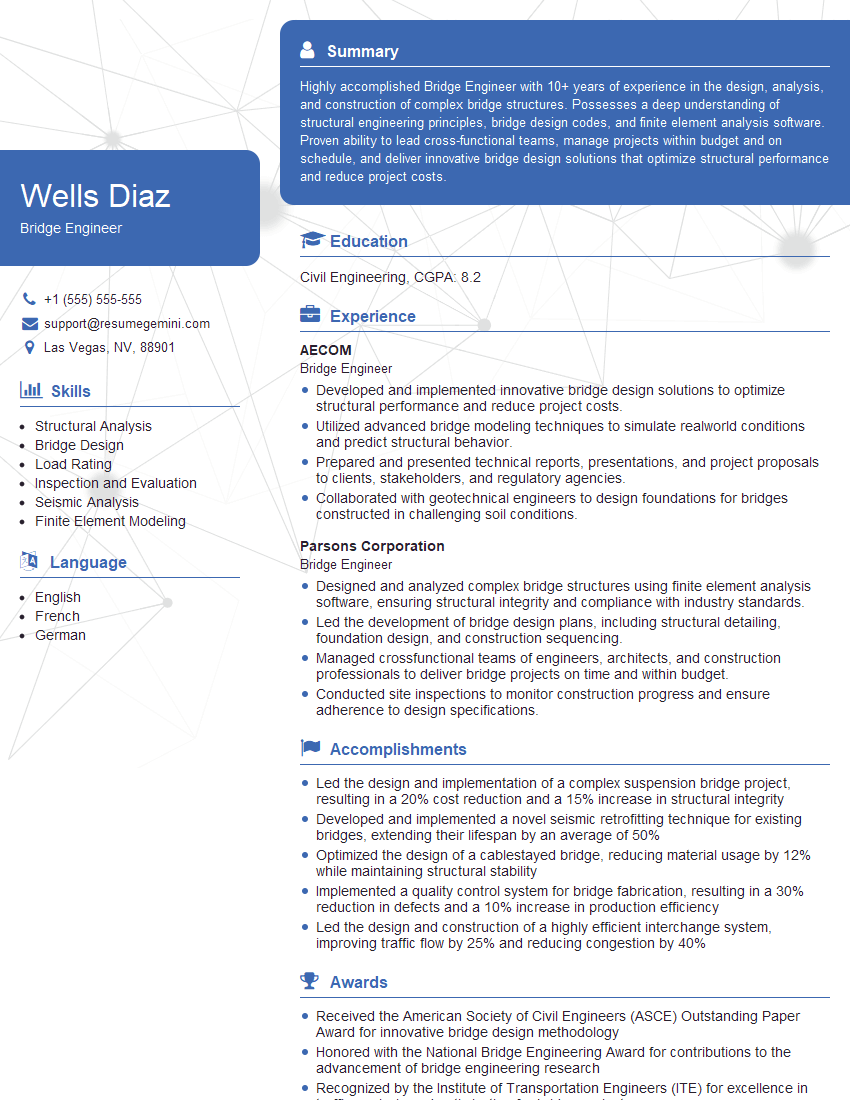
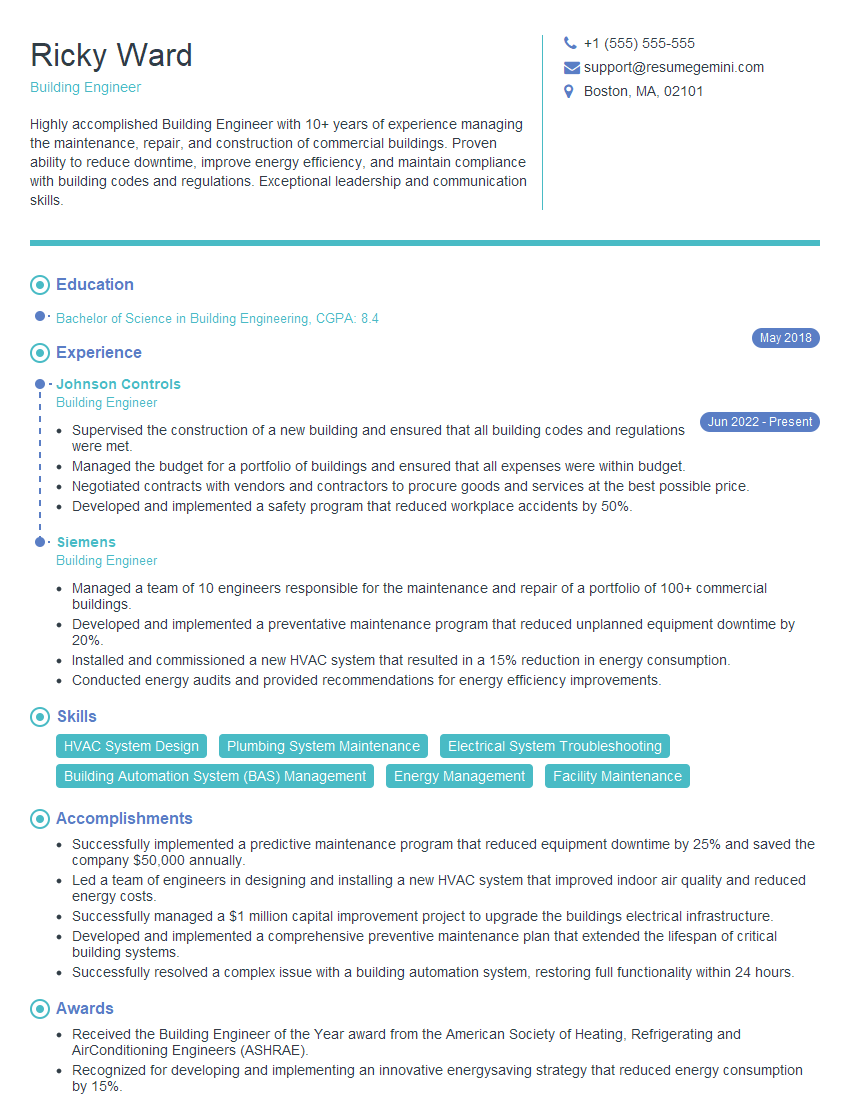
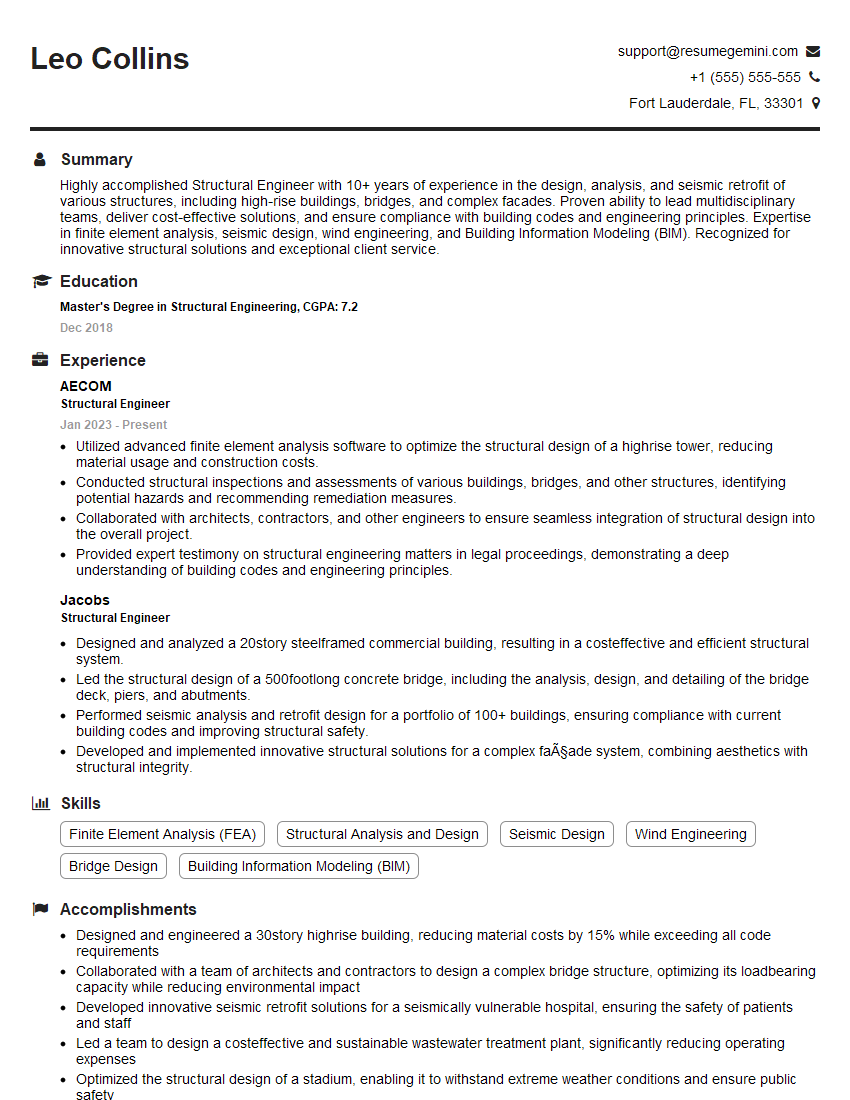
Mastering Structures Analysis is crucial for a successful career in structural engineering, opening doors to exciting projects and leadership opportunities. A strong resume is your first step towards landing your dream job. To maximize your chances, create an ATS-friendly resume that highlights your skills and experience effectively. ResumeGemini is a trusted resource that can help you build a professional and impactful resume tailored to the needs of your target employers. Examples of resumes specifically tailored for Structures Analysis positions are available to help you get started.




Explore more articles
Users Rating of Our Blogs
Share Your Experience
We value your feedback! Please rate our content and share your thoughts (optional).
What Readers Say About Our Blog
Very informative content, great job.
good