The right preparation can turn an interview into an opportunity to showcase your expertise. This guide to Foundation Analysis and Design interview questions is your ultimate resource, providing key insights and tips to help you ace your responses and stand out as a top candidate.
Questions Asked in Foundation Analysis and Design Interview
Q 1. Explain the difference between shallow and deep foundations.
The primary difference between shallow and deep foundations lies in their depth relative to the structure’s width. Shallow foundations, as the name suggests, have a depth significantly less than their width. They transfer the structural load to the upper soil strata within a relatively short depth. Think of them as the ‘feet’ of a building, sitting directly on the ground. Deep foundations, conversely, transfer loads to deeper, stronger soil strata or rock formations. They penetrate significantly deeper than their width and are typically employed when shallow foundations are unsuitable due to weak or compressible soils. Imagine them as ‘piles’ anchoring a structure deep into the earth.
A simple analogy: If you’re building a small sandbox, a shallow foundation like a concrete slab would suffice. However, for a skyscraper, you’d need deep foundations like piles to transfer the immense load to deeper, more stable soil layers.
Q 2. Describe various types of shallow foundations and their suitability.
Several types of shallow foundations exist, each suited for different soil conditions and load requirements:
- Spread Footings: These are simple, isolated concrete blocks placed under individual columns or walls. They’re suitable for low-rise structures on relatively strong, stable soil.
- Combined Footings: Used when two or more columns are close together, these distribute the load over a larger area. They are efficient in minimizing settlement and are useful when columns are close to property lines.
- Strip Footings: Continuous footings supporting walls or long rows of columns, offering uniform load distribution. These are common for supporting continuous walls.
- Mat Foundations (Raft Foundations): These are large, interconnected slabs covering the entire building footprint. They’re ideal for structures on very weak, compressible soils where individual footings would cause excessive settlement. A large area distributes the load effectively and helps to prevent differential settlement.
The selection of a particular type depends on factors like soil bearing capacity, column spacing, and the overall structural load. For instance, a spread footing is simple and cost-effective for a small house on strong soil, while a mat foundation would be necessary for a large building on soft clay.
Q 3. What are the factors influencing the selection of a foundation type?
The choice of foundation type is a crucial decision influenced by numerous factors:
- Soil Properties: Soil type, bearing capacity, shear strength, and compressibility are paramount. Weak soils necessitate deep foundations, while strong soils can support shallow foundations.
- Groundwater Conditions: High water tables might require special considerations like dewatering or waterproofed foundations.
- Structural Loads: Heavier structures require foundations with greater load-bearing capacity.
- Settlement Considerations: Differential settlement (uneven settlement) must be minimized to prevent structural damage. Mat foundations are often preferred to minimize this.
- Cost: Deep foundations are typically more expensive than shallow foundations.
- Construction Site Conditions: Accessibility, proximity to utilities, and environmental regulations can influence the feasibility of different foundation types.
For example, a building located near a river with a high water table and soft soil would likely require deep foundations, even if the structural load is relatively low. Conversely, a small house on stable bedrock might only need simple spread footings.
Q 4. Explain the concept of bearing capacity and how it’s determined.
Bearing capacity refers to the maximum pressure a soil can withstand before failure. It’s a critical parameter in foundation design, determining the allowable load a foundation can support without excessive settlement or collapse. It’s expressed in units of pressure (e.g., kPa or psf).
Determining bearing capacity involves:
- Soil Investigation: This involves obtaining soil samples and performing laboratory tests to determine soil properties like shear strength, cohesion, and friction angle.
- Engineering Analysis: Using empirical equations or advanced numerical methods (finite element analysis), the engineer calculates the ultimate bearing capacity of the soil.
- Safety Factor: A safety factor is applied to the ultimate bearing capacity to account for uncertainties and variations in soil properties. This results in the allowable bearing pressure.
For example, if the ultimate bearing capacity is calculated as 200 kPa and a safety factor of 3 is applied, the allowable bearing pressure is 200 kPa / 3 = 67 kPa. The foundation design must ensure that the pressure exerted by the structure on the soil does not exceed this allowable bearing pressure.
Q 5. Describe different methods for determining soil properties.
Several methods are employed to determine soil properties for foundation design:
- In-situ Tests: These tests are performed directly in the ground. Examples include Standard Penetration Test (SPT), Cone Penetration Test (CPT), and Vane Shear Test. The SPT, for example, involves driving a split-barrel sampler into the ground and measuring the number of blows required to drive it a certain distance, providing an indication of soil density and strength.
- Laboratory Tests: Soil samples obtained from boring logs are tested in the lab to determine properties such as grain size distribution, Atterberg limits (liquid limit, plastic limit), and shear strength parameters (cohesion and friction angle).
- Geophysical Methods: These methods use geophysical techniques like seismic refraction or electrical resistivity to obtain information about subsurface soil layers without direct drilling. This is useful for preliminary site investigations.
The choice of method depends on the project scope, soil conditions, and budget. A comprehensive soil investigation often involves a combination of in-situ and laboratory tests to obtain a complete understanding of the subsurface conditions.
Q 6. How do you account for settlement in foundation design?
Settlement is an unavoidable consequence of loading soil. However, excessive or uneven settlement can cause structural damage. Foundation design accounts for settlement in several ways:
- Estimating Settlement: Engineers use various methods, including empirical equations and numerical models, to estimate the expected settlement under the given load. Factors like soil compressibility and foundation stiffness are considered.
- Allowable Settlement Limits: Building codes and standards provide guidance on allowable settlement limits for different types of structures. These limits help to ensure that the settlement doesn’t compromise structural integrity or serviceability.
- Differential Settlement Control: Measures are taken to minimize differential settlement (uneven settlement). This might include using mat foundations, employing techniques to improve soil properties (e.g., soil improvement), or careful control of the construction process.
- Foundation Design Modifications: The foundation design itself can be adjusted to minimize settlement. For instance, increasing the size of footings reduces the contact pressure on the soil, resulting in less settlement. Deep foundations are often used to transfer loads to stronger soil layers where settlement is less.
For instance, if the estimated settlement of a building exceeds the allowable limit, the foundation design may need to be revised, perhaps by increasing the size of footings or using a different foundation type altogether. This careful consideration of settlement is critical to ensuring the long-term stability and performance of the structure.
Q 7. Explain the role of soil investigations in foundation design.
Soil investigations are the cornerstone of sound foundation design. They provide crucial information about subsurface conditions, directly influencing the choice of foundation type, its design parameters, and the overall structural safety. A thorough soil investigation typically involves:
- Site Reconnaissance: Initial assessment of the site, including topography, vegetation, and existing structures.
- Drilling and Sampling: Collecting soil samples at various depths using different drilling methods.
- Laboratory Testing: Performing various tests on the soil samples to determine their physical and mechanical properties.
- In-situ Testing: Conducting tests directly in the ground to assess soil behavior.
- Groundwater Monitoring: Measuring the water table level to determine the potential impact of groundwater on foundation performance.
Without adequate soil investigations, the risk of foundation failure increases significantly. For example, designing a shallow foundation on expansive clay without proper investigation might lead to significant heave (uplift) and cracking of the structure. Therefore, a comprehensive soil investigation, tailored to the specific site conditions, is essential for designing safe and reliable foundations.
Q 8. What are the different types of soil and their engineering properties?
Soils are classified based on their particle size distribution, plasticity, and other engineering properties. Understanding these properties is crucial for foundation design because they directly influence the bearing capacity and settlement characteristics of the soil.
- Gravelly Soils (GW, GP, GM, GC): Well-graded gravels are strong and provide excellent support for foundations. Poorly graded gravels can be less reliable. Think of them as coarse, like building with large rocks. Their drainage is usually excellent.
- Sandy Soils (SW, SP, SM, SC): Sands, like gravels, are generally well-drained, but their strength and compressibility vary significantly depending on the grain size and density. Imagine building on a beach – sometimes it’s firm, sometimes it’s loose and shifting.
- Silty Soils (ML, CL, OL): Silts are finer than sands and are more susceptible to compression. Think of wet flour – it can be compacted but will deform under load. Poor drainage is common.
- Clayey Soils (CH, CL, MH, ML, etc.): Clays exhibit high plasticity and are highly compressible. They’re like modeling clay – they can be molded and hold their shape, but they deform significantly under pressure. Drainage is extremely poor.
- Organic Soils (Pt, OH, Ot): These soils contain significant organic matter, resulting in low strength and high compressibility. They’re like peat – very weak and prone to settlement.
The Unified Soil Classification System (USCS) is widely used to categorize soils based on these characteristics. Knowing the soil type is the first step in any foundation design.
Q 9. How do you design a footing for a given load and soil conditions?
Designing a footing involves several steps. First, we determine the ultimate bearing capacity (qu) of the soil based on soil tests (like Standard Penetration Tests or Cone Penetration Tests) and geotechnical analysis. Then, we calculate the required footing area (A) using the following formula:
A = Total Load / (Allowable Bearing Pressure)The allowable bearing pressure is typically a fraction of the ultimate bearing capacity, incorporating a safety factor. For example, a safety factor of 3 is common, resulting in an allowable bearing pressure (qa) of qa = qu / 3.
Next, we consider the footing dimensions. We aim for a footing that is large enough to distribute the load while minimizing excavation and material costs. We may also check for potential overturning or sliding.
Finally, we design the footing for shear and moment capacity, using reinforced concrete design principles. Let’s say we have a column load of 500 kN and an allowable bearing pressure of 150 kPa. The required footing area would be:
A = 500 kN / 150 kPa = 3.33 m²We’d then select dimensions (e.g., 2m x 1.67m) that satisfy this area requirement while also ensuring adequate depth and reinforcement for shear and bending moment.
Q 10. Explain the design considerations for pile foundations.
Pile foundation design considers several key factors to ensure stability and prevent settlement. The primary concerns are:
- Soil conditions: The type of soil and its bearing capacity dictate the type of pile and its length. Weak, compressible soils require longer piles.
- Pile capacity: The load-carrying capacity of each pile needs to be determined through analysis and/or testing (e.g., static load testing). This capacity depends on both the pile’s material and the soil’s resistance.
- Pile spacing and arrangement: Piles need sufficient spacing to avoid interference and ensure even load distribution.
- Settlement: We must analyze the expected settlement of the pile group to ensure it remains within acceptable limits.
- Lateral stability: In areas prone to lateral loads (such as earthquake zones), the pile group’s lateral resistance must be assessed.
- Corrosion protection: In aggressive soil environments, corrosion protection is essential to ensure the pile’s longevity.
We often use computer software to model pile behavior and analyze their interaction with the soil. The design process ensures the foundation can safely support the intended load for its design life.
Q 11. What are the different types of pile foundations?
Several types of pile foundations exist, each suited for specific soil conditions and loading scenarios:
- Driven Piles: These are hammered into the ground using specialized equipment. Examples include timber, steel, and precast concrete piles.
- Bored Piles: Holes are bored into the ground, and concrete is then poured into them to form the pile. These are often used in situations where driving piles would be impractical.
- Cast-in-situ Piles: Concrete is poured directly into the ground, forming the pile in place. Variations include secant and CFA piles.
- Mini Piles: Smaller diameter piles used in situations where space is limited or when minimal ground disturbance is required.
The choice of pile type depends on factors like soil conditions, load capacity requirements, construction constraints, and cost considerations.
Q 12. How do you analyze the stability of a retaining wall?
Retaining wall stability analysis focuses on preventing failure through sliding, overturning, and bearing capacity issues. This is done through limit state analysis.
- Sliding: We calculate the resisting forces (soil friction and passive earth pressure) against the driving force (earth pressure acting horizontally on the wall). The safety factor against sliding is the ratio of resisting forces to driving forces.
- Overturning: We determine the overturning moment (caused by the earth pressure and any surcharge loads) and compare it to the resisting moment (provided by the wall’s weight and the soil’s passive resistance). A sufficient safety factor against overturning is crucial.
- Bearing Capacity: We verify that the pressure exerted by the retaining wall on the soil foundation does not exceed the soil’s allowable bearing pressure. This often requires examining the pressure distribution along the base of the wall.
Software tools and simplified methods like the Rankine or Coulomb theories are used to estimate earth pressures. The analysis must consider various load combinations, including the effects of seismic loads (discussed later).
Q 13. Explain the concept of lateral earth pressure.
Lateral earth pressure refers to the pressure exerted by soil on a retaining structure (like a wall). The magnitude of this pressure depends on several factors, including:
- Soil properties: The type of soil and its angle of internal friction significantly influence the earth pressure. Clay soils exhibit different behavior than granular soils.
- Wall movement: Whether the wall is fixed or allows movement affects the earth pressure. A moving wall generates less pressure than a fixed one.
- Surcharge loads: Loads placed on the soil behind the retaining wall (e.g., traffic, buildings) increase the earth pressure.
There are three main states of lateral earth pressure:
- At-rest pressure (Ko): Pressure in undisturbed soil before any wall movement occurs.
- Active pressure (Ka): Reduced pressure resulting from wall movement away from the soil.
- Passive pressure (Kp): Increased pressure generated when the wall moves toward the soil.
The Rankine and Coulomb theories provide methods for calculating these pressure coefficients and, ultimately, the earth pressure on the retaining wall.
Q 14. How do you account for seismic forces in foundation design?
Seismic forces significantly affect foundation design, particularly in seismically active regions. These forces cause horizontal and vertical accelerations that must be considered during the design process.
Seismic analysis involves determining the inertial forces (masses multiplied by accelerations) acting on the structure during an earthquake. These forces are then applied to the foundation elements to check for stability, overturning, and excessive settlement.
Methods like response spectrum analysis or time-history analysis are used to determine the seismic forces. The design then incorporates these forces using appropriate seismic design codes and standards (such as ASCE 7). This typically includes increasing the design loads, adding special reinforcement to the foundation elements, or using specific foundation types that are better suited to resisting seismic forces, like deep foundations. This ensures the foundation can safely withstand the earthquake-induced loads without experiencing excessive deformation or failure. The goal is to design the foundation for stability and maintain the serviceability of the structure during an earthquake.
Q 15. What is the significance of liquefaction in foundation design?
Liquefaction is a phenomenon where saturated, loose sandy or silty soils temporarily lose their strength and stiffness due to earthquake shaking. Imagine a bowl of dry sand versus a bowl of wet sand. The dry sand holds its shape; the wet sand will behave more like a liquid. This loss of strength can cause significant damage to structures founded on these soils, such as settlements, tilting, or even complete collapse. In foundation design, we must account for liquefaction potential to prevent catastrophic failures. This is crucial during seismic design in regions prone to earthquakes. We assess liquefaction potential using various methods, including soil testing, geotechnical analysis, and empirical correlations. Design strategies to mitigate liquefaction include ground improvement techniques (discussed further below) or deep foundations that extend below the liquefiable layer.
Career Expert Tips:
- Ace those interviews! Prepare effectively by reviewing the Top 50 Most Common Interview Questions on ResumeGemini.
- Navigate your job search with confidence! Explore a wide range of Career Tips on ResumeGemini. Learn about common challenges and recommendations to overcome them.
- Craft the perfect resume! Master the Art of Resume Writing with ResumeGemini’s guide. Showcase your unique qualifications and achievements effectively.
- Don’t miss out on holiday savings! Build your dream resume with ResumeGemini’s ATS optimized templates.
Q 16. Describe different methods for ground improvement.
Ground improvement techniques aim to enhance the engineering properties of soil to support structures safely and efficiently. There are many methods, broadly categorized as:
- Compaction: Improving soil strength by mechanically densifying it. This can be achieved through methods like vibratory compaction, dynamic compaction, or preloading.
- Deep Mixing: Improving soil in situ by mixing it with binding agents such as cement or lime. This strengthens the soil column and enhances its bearing capacity.
- Grouting: Injecting grout (cement, bentonite, etc.) into soil to fill voids and increase strength. It’s often used for stabilizing weak zones.
- Soil Stabilization: Mixing soil with additives like lime, cement, or fly ash to improve its strength and reduce its compressibility. This is a common technique for expansive soils.
- Stone Columns (Vibro-compaction): Creating columns of compacted gravel within a weaker soil matrix to increase its overall strength and reduce settlement. Imagine inserting strong, vertical pillars within a softer soil.
- Geosynthetics: Using synthetic materials like geotextiles, geogrids, or geomembranes to reinforce soil and improve its drainage. These are frequently used with embankments.
The choice of method depends on factors like soil type, project constraints, cost, and environmental considerations. For instance, dynamic compaction might be suitable for large areas of loose sands, while deep mixing might be preferred for confined sites with limited access.
Q 17. Explain the use of finite element analysis in foundation design.
Finite Element Analysis (FEA) is a powerful computational tool widely used in foundation design for accurately predicting soil-structure interaction. Unlike simpler methods, FEA can handle complex geometries, non-homogeneous soil conditions, and different loading scenarios. It works by dividing the soil and foundation into numerous small elements, each with defined material properties. The computer then solves a system of equations to determine stresses, strains, and displacements within each element, allowing for a comprehensive analysis of the foundation’s behavior under various loading conditions. This is particularly useful for complex geometries or unusual soil conditions where simpler methods are not sufficiently accurate. For example, FEA can accurately predict settlement patterns around a large, irregularly shaped foundation in a layered soil profile. Software packages like ABAQUS, PLAXIS, and GeoStudio are commonly used for this.
Q 18. How do you interpret soil test results?
Interpreting soil test results requires a thorough understanding of geotechnical engineering principles. The results typically include parameters like grain size distribution, Atterberg limits (liquid limit, plastic limit), shear strength, consolidation characteristics, and permeability. For example, the grain size distribution tells us about the soil type (sand, silt, clay) which influences its behavior. The shear strength parameters (cohesion and angle of internal friction) are crucial for determining the bearing capacity. Consolidation tests reveal how much the soil will settle under load over time. Permeability data helps assess drainage properties. Careful analysis of these parameters, often alongside visual inspection of soil samples, allows for accurate characterization of the soil profile and informs foundation design. We must also carefully consider the sampling methods and possible sources of error in the lab results.
Q 19. What are the common failure modes of foundations?
Foundations can fail in several ways, depending on the soil conditions, loading, and design. Some common failure modes include:
- Bearing Capacity Failure: The soil beneath the foundation yields and cannot support the applied loads, leading to excessive settlement or collapse. Think of it like placing a heavy object on a soft mattress – the mattress will deform too much.
- Settlement: The gradual compression of the soil under load, causing the foundation and structure to settle. While some settlement is expected, excessive settlement can lead to cracking and damage.
- Slope Instability: Foundation failure due to the failure of the surrounding soil slopes. This is common in hilly terrain or cut-and-fill areas.
- Liquefaction (as discussed above): Temporary loss of soil strength due to earthquake shaking, leading to settlement, tilting, or collapse.
- Lateral Movement: Horizontal movement of the foundation due to lateral earth pressure or seismic loading. This is common in retaining wall designs.
- Scour: Erosion of soil around the foundation, reducing its support and causing instability. This is often seen in river or marine environments.
Proper geotechnical investigations and design considerations are vital in mitigating these failure modes.
Q 20. How do you design foundations for expansive soils?
Expansive soils, like clays, change volume significantly with changes in moisture content. This volumetric change can cause substantial damage to foundations. Designing foundations for expansive soils requires strategies that minimize the impact of these volume changes. These strategies include:
- Shallow Foundations with Reduced Contact Area: Using shallow footings with a smaller contact area can limit the amount of heave or settlement experienced by the foundation.
- Deep Foundations: Extending foundations deep into the soil beyond the zone of significant volume change can effectively isolate the structure from expansive soil movements.
- Compaction and Stabilization: Improving the soil properties to reduce its expansiveness, as discussed earlier. Lime or cement stabilization is commonly used.
- Under-reamed Piers: Creating enlarged bases for the piers to distribute the load over a larger area and reduce the pressure on the expansive soil.
- Structural Design Considerations: Designing flexible structures that can tolerate some differential settlement due to expansive soils. Using flexible joints and careful detailing helps minimize crack formation.
- Moisture Control: Implementing techniques to control soil moisture, such as installing drainage systems or protective membranes, can mitigate volume changes.
The specific design approach depends on the characteristics of the expansive soil, the building’s sensitivity, and the project budget.
Q 21. What software are you proficient in for foundation analysis and design?
I am proficient in several software packages used for foundation analysis and design, including:
- PLAXXIS 2D/3D: A powerful finite element software for geotechnical analysis, widely used for complex soil-structure interaction problems.
- ABAQUS: A general-purpose FEA software capable of handling complex geotechnical and structural analyses.
- GeoStudio: A suite of geotechnical software that includes slope stability analysis, seepage analysis, and finite element capabilities.
- LPILE: Specialized software for analyzing the behavior of piles and other deep foundations.
- SPT software (various vendors): Software for processing standard penetration test (SPT) data, which is a standard in-situ soil testing method.
My proficiency extends to using these programs for various analyses, including bearing capacity calculations, settlement analysis, liquefaction assessment, and slope stability analyses. I’m also comfortable creating custom scripts and macros to automate tasks and improve efficiency.
Q 22. Describe your experience with foundation inspections and quality control.
Foundation inspections and quality control are crucial for ensuring the structural integrity and longevity of a building. My experience encompasses all phases, from initial site assessment to final acceptance. This involves verifying compliance with design specifications, geotechnical recommendations, and relevant building codes.
- Visual Inspections: I meticulously examine excavations, foundation placement, formwork, reinforcement, and concrete pouring, checking for proper depth, alignment, and dimensions.
- Material Testing: I oversee or conduct in-situ testing of soil, concrete compressive strength tests (cylinder and cube testing), and steel reinforcement testing to ensure quality and conformance to design parameters.
- Documentation Review: I thoroughly review contractor’s submittals, including shop drawings, material certifications, and test reports to verify adherence to the project specifications.
- Problem Identification and Resolution: I identify and document any discrepancies or defects during construction and work with the contractor to develop and implement corrective actions. This involves detailed reporting with photographic evidence.
For example, on a recent high-rise project, a minor deviation in the depth of the pile foundations was discovered during inspection. Through immediate intervention and consultation with the geotechnical engineer, a corrective action plan was implemented, preventing potential settlement issues. This proactive approach is vital to avoid costly rework later on.
Q 23. How do you manage risks and uncertainties in foundation design?
Managing risks and uncertainties in foundation design necessitates a multi-pronged approach, involving thorough investigation, robust design, and contingency planning.
- Geotechnical Investigation: A comprehensive geotechnical investigation, including soil exploration, laboratory testing, and in-situ testing, helps characterize the soil properties and identify potential hazards. This information forms the basis of a risk-informed design.
- Factor of Safety: Incorporating appropriate factors of safety in the design accounts for uncertainties in material properties, loading conditions, and construction tolerances. This provides a buffer against unexpected events.
- Probabilistic Analysis: For complex projects, probabilistic methods like Monte Carlo simulation can be used to quantify the uncertainties in input parameters and determine the probability of exceeding specified performance limits.
- Contingency Planning: Identifying and assessing potential risks allows for the development of effective contingency plans. For instance, a plan might incorporate alternative foundation types to address unexpected soil conditions, or mitigation measures for potential groundwater issues.
Imagine designing a foundation for a building near a riverbank. Uncertainty in the groundwater table needs careful consideration. We’d employ specialized analysis techniques and might consider incorporating dewatering strategies or a foundation type less susceptible to groundwater fluctuations, like a pile foundation, as part of our contingency planning.
Q 24. Explain your understanding of geotechnical report interpretation.
Geotechnical reports are the cornerstone of foundation design. My understanding encompasses a detailed analysis of the report’s various components.
- Site Investigation Methodology: I carefully evaluate the methods used for site investigation, including the number and location of borings, in-situ testing methods (e.g., Standard Penetration Test (SPT), Cone Penetration Test (CPT)), and laboratory testing procedures. The quality and extent of the investigation directly impact the reliability of the data.
- Soil Properties: I analyze the reported soil stratigraphy, grain size distribution, shear strength parameters (cohesion and angle of internal friction), consolidation characteristics, and permeability. This data is critical for selecting appropriate foundation types and assessing potential settlement and stability issues.
- Groundwater Conditions: I assess the groundwater table elevation, its fluctuations, and potential for seepage. This is essential for designing foundations that are resistant to hydrostatic pressure and minimize the risk of uplift.
- Geotechnical Recommendations: I carefully review the geotechnical engineer’s recommendations regarding foundation type, allowable bearing pressure, settlement criteria, and other design parameters. These recommendations form the basis of the foundation design.
For example, if a geotechnical report indicates the presence of expansive clays, I would consider employing a foundation design that accounts for potential heave and shrinkage, such as a deep foundation system or a raft foundation with special provisions for differential movement.
Q 25. Describe your experience with different types of foundation construction.
My experience encompasses a wide range of foundation types, each suited to different soil conditions and structural loads.
- Shallow Foundations: I have extensive experience designing and overseeing the construction of spread footings, strip footings, and combined footings for low-rise buildings. This includes understanding and detailing proper reinforcement, ensuring proper compaction of the underlying soil, and appropriate formwork design.
- Deep Foundations: My work includes piles (driven, bored, and auger cast), piers, and caissons for high-rise buildings and structures subjected to significant loads or challenging soil conditions. This often involves geotechnical analysis to ensure proper capacity and settlement considerations.
- Special Foundations: I have worked on projects involving mat foundations (raft foundations) and retaining wall designs to mitigate stability issues on slopes or where significant lateral earth pressures need to be resisted. This requires specialized software and an in-depth understanding of soil mechanics.
For instance, a recent project involved designing a pile foundation for a high-rise building in a dense urban environment. The design considered the proximity of existing structures, the limited access for construction equipment, and the required load-bearing capacity of the piles. Understanding the tradeoffs between different pile types and installation methods proved critical to this successful project.
Q 26. How do you handle unexpected site conditions during construction?
Unexpected site conditions are a common challenge in foundation construction. A robust approach involves proactive measures and decisive responses.
- Thorough Site Investigation: The first line of defense is a thorough geotechnical investigation to minimize surprises. However, even with thorough investigation, unforeseen conditions can still arise.
- Monitoring and Observation: During construction, close monitoring and observation are crucial. This includes regular inspections, monitoring of groundwater levels, and instrumenting the foundation to measure settlement and other parameters.
- Problem Identification and Assessment: If unexpected conditions are encountered, a prompt assessment is necessary to determine the extent of the issue and its potential impact on the structure. This often necessitates further geotechnical investigation and analysis.
- Corrective Actions: Based on the assessment, corrective actions are developed and implemented, which may include foundation modifications (e.g., adding more piles, increasing the footing size), or design revisions to accommodate the changes.
- Documentation: All changes, modifications, and corrective actions are meticulously documented, including photographic evidence and geotechnical assessments. This is essential for resolving any potential disputes and ensuring the long-term stability of the structure.
For example, we once discovered a large buried boulder during excavation. Immediate actions were taken – stopping the work, re-evaluating the site conditions with the geotechnical engineer, and modifying the foundation design to accommodate the unexpected obstacle. This added time and cost, but avoided potential future problems.
Q 27. Explain your understanding of code requirements for foundation design.
Code requirements for foundation design are essential to ensure public safety and structural integrity. My understanding encompasses several key areas.
- Building Codes: I’m proficient in interpreting and applying relevant building codes, such as the International Building Code (IBC) or other local or regional codes, to ensure designs meet minimum safety standards. These codes dictate allowable soil pressures, safety factors, and design criteria for various foundation types.
- Geotechnical Design Standards: I am familiar with standards established by organizations like ASTM International and the American Society of Civil Engineers (ASCE) for geotechnical engineering, which guide soil testing, analysis and interpretation of results.
- Load and Resistance Factor Design (LRFD): My design approach incorporates LRFD principles to consider uncertainties in loads, material strength, and construction variability. This provides an improved reliability compared to traditional allowable stress methods.
- Accessibility Requirements: Foundation designs must comply with accessibility requirements to ensure that the building is usable and safe for people with disabilities. This often involves careful consideration of basement height and access points.
A common example involves the requirement for adequate depth of foundations to resist uplift forces due to wind or seismic loads. Building codes specify minimum depths or provide calculation methods to ensure adequate resistance against these forces.
Q 28. Describe a challenging foundation design project you worked on and how you overcame the challenges.
One challenging project involved designing the foundation for a waterfront restaurant on a highly erodible shoreline. The site presented several significant hurdles:
- Soil Instability: The soil consisted of loose, saturated sands prone to erosion and liquefaction under seismic loading.
- Erosion Concerns: The constant wave action posed a significant risk of foundation erosion and scour.
- Environmental Regulations: Stringent environmental regulations limited the scope of potential solutions.
To overcome these challenges, we adopted a multi-faceted approach:
- Detailed Geotechnical Investigation: We conducted an extensive site investigation, including cone penetration tests (CPTs), laboratory testing, and numerical modeling to accurately characterize the soil behavior under various loading conditions.
- Innovative Foundation Design: We opted for a hybrid foundation system combining deep foundations (piles) for primary load support and shallow foundations (a reinforced concrete mat) to distribute loads across the site and resist the dynamic forces from the waves.
- Scour Protection: We designed and implemented comprehensive scour protection measures, including rock riprap and a geotextile layer to prevent erosion and protect the foundation from wave action.
- Collaboration: Close collaboration with geotechnical engineers, environmental consultants, and contractors was essential to successfully navigate the complex regulatory and environmental constraints.
The project’s success demonstrates the importance of a thorough understanding of geotechnical principles, creative problem-solving, and teamwork in overcoming challenging foundation design scenarios.
Key Topics to Learn for Foundation Analysis and Design Interview
- Soil Mechanics Fundamentals: Understanding soil properties (e.g., shear strength, compressibility), classification systems, and their influence on foundation design.
- Shallow Foundations: Design principles for footings (isolated, combined, strap), including bearing capacity calculations, settlement analysis, and detailing considerations. Practical application: Calculating the required size of a footing for a given load.
- Deep Foundations: Analysis and design of piles (driven, bored), caissons, and piers; understanding pile capacity, settlement, and group effects. Practical application: Selecting appropriate pile type and arrangement for a high-rise building.
- Foundation Stability: Evaluating foundation stability against sliding, overturning, and bearing capacity failure. Problem-solving approach: Utilizing limit equilibrium methods and factor of safety calculations.
- Settlement Analysis: Methods for predicting foundation settlement (e.g., elastic settlement, consolidation settlement) and managing differential settlement. Practical application: Designing a foundation to minimize settlement and prevent structural damage.
- Lateral Earth Pressure: Understanding active and passive earth pressures and their implications for retaining wall design and foundation stability. Practical application: Designing a retaining wall to support a slope.
- Computer-Aided Design (CAD) in Foundation Engineering: Familiarity with relevant software for foundation design and analysis. Problem-solving approach: Utilizing software to model complex geotechnical problems.
- Geotechnical Site Investigation: Understanding the importance of site investigation methods (e.g., boring, sampling, in-situ testing) and interpreting geotechnical reports. Practical application: Interpreting soil boring logs to determine soil strata and properties.
Next Steps
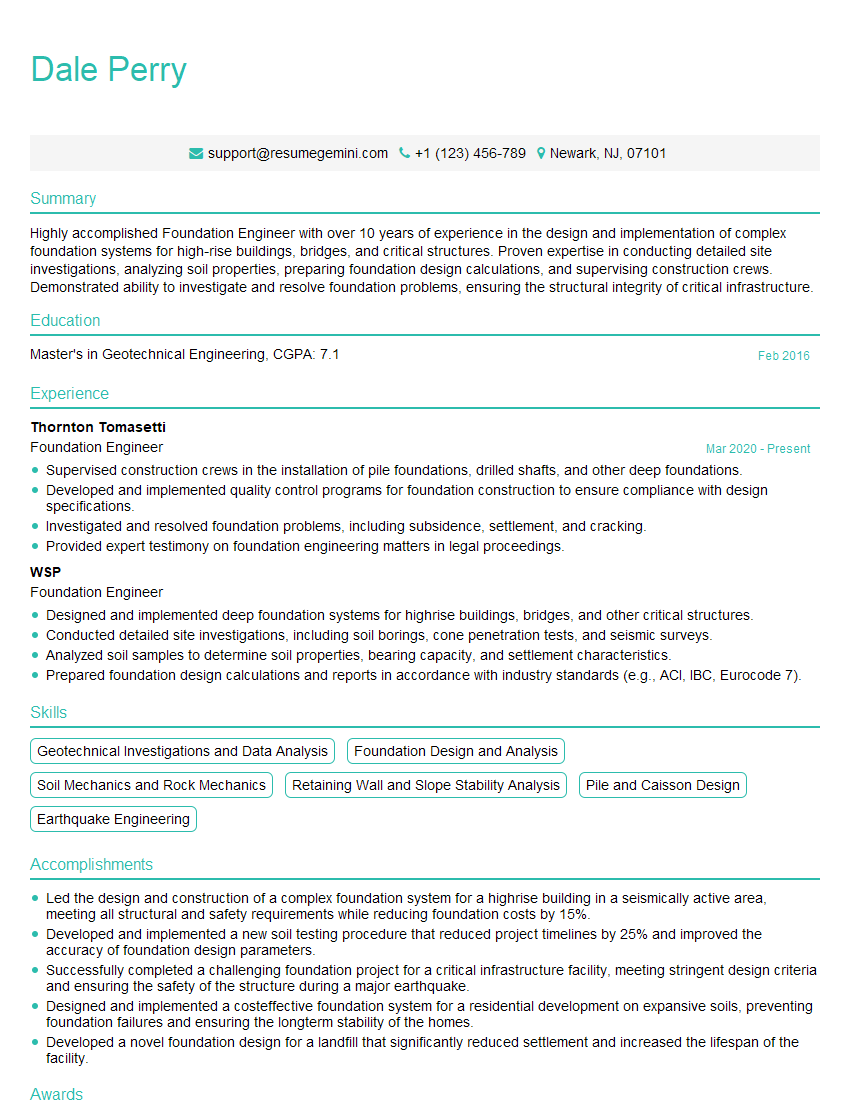
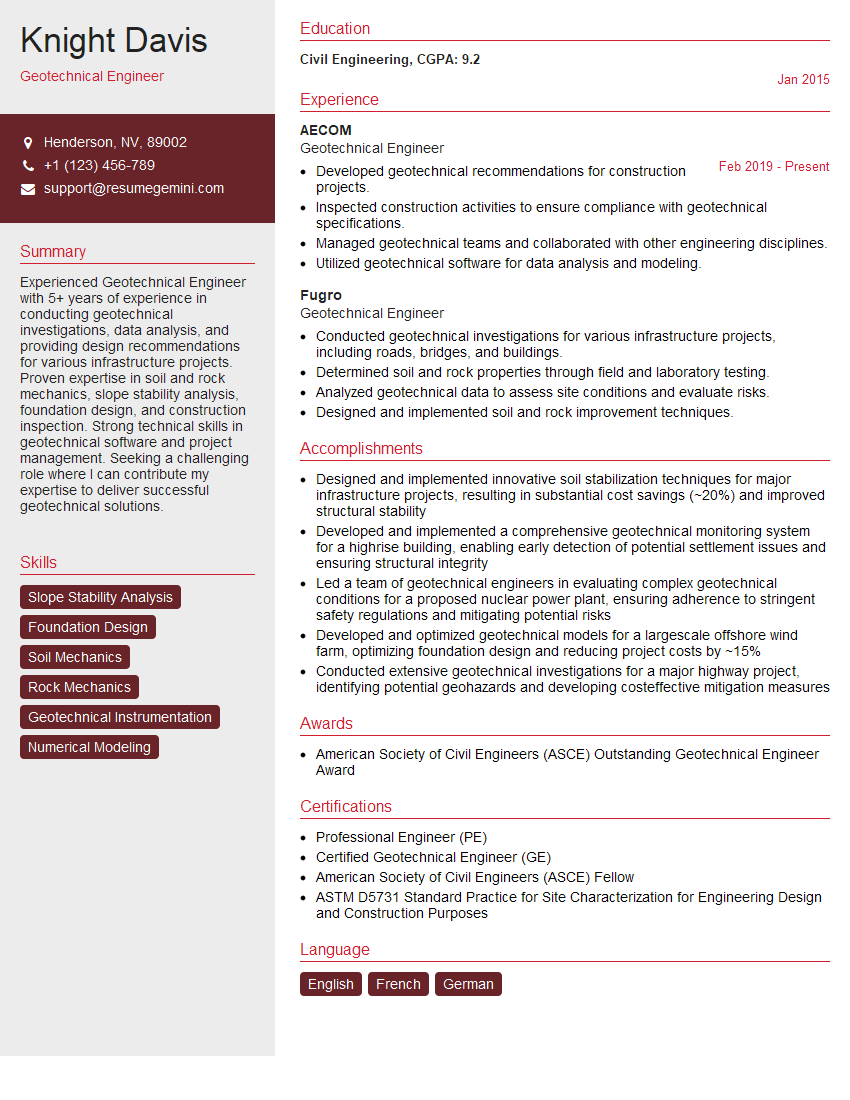
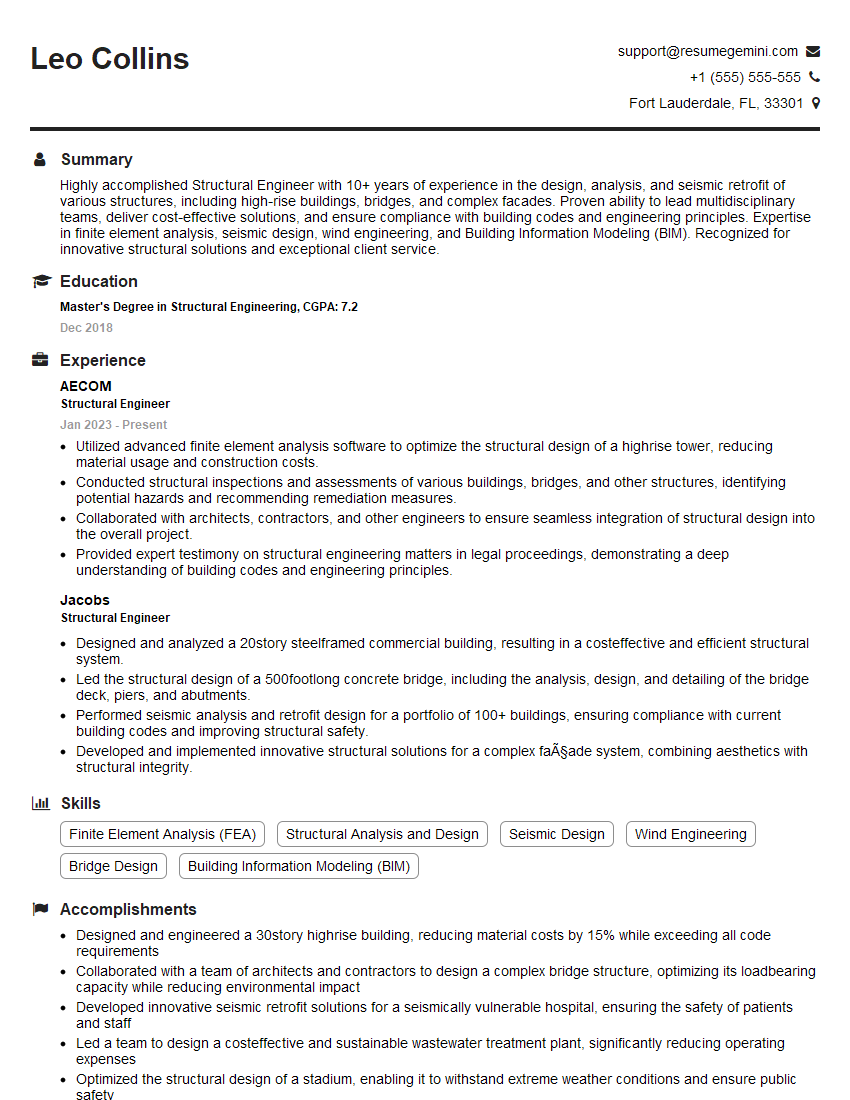
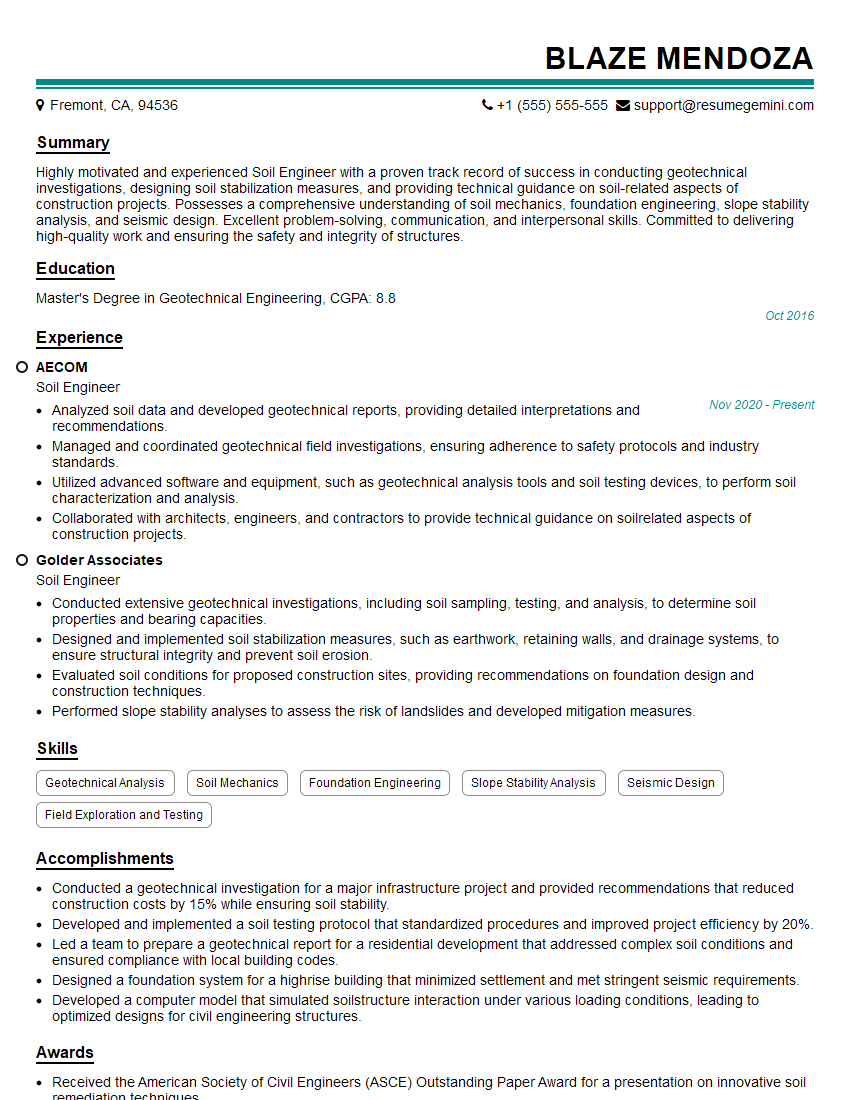
Mastering Foundation Analysis and Design is crucial for career advancement in civil engineering, opening doors to specialized roles and leadership opportunities. A well-crafted resume is your key to unlocking these prospects. Ensure your resume is ATS-friendly to maximize its visibility to potential employers. ResumeGemini is a trusted resource to help you build a professional and impactful resume. Examples of resumes tailored to Foundation Analysis and Design are available to provide you with inspiration and guidance. Invest time in crafting a strong resume; it’s your first impression to a future employer.
Explore more articles
Users Rating of Our Blogs
Share Your Experience
We value your feedback! Please rate our content and share your thoughts (optional).
What Readers Say About Our Blog
Very informative content, great job.
good