Unlock your full potential by mastering the most common Ability to Read and Interpret Glass Blueprints interview questions. This blog offers a deep dive into the critical topics, ensuring you’re not only prepared to answer but to excel. With these insights, you’ll approach your interview with clarity and confidence.
Questions Asked in Ability to Read and Interpret Glass Blueprints Interview
Q 1. Explain the different types of glass typically depicted on blueprints.
Glass blueprints specify various glass types, each with unique properties affecting performance and aesthetics. Commonly depicted types include:
- Annealed Glass: Standard, economical glass, relatively easy to break. Often used for less demanding applications.
- Heat-Strengthened Glass: Stronger than annealed glass, about twice the strength, suitable for applications requiring slightly more durability.
- Tempered (or Toughened) Glass: Significantly stronger than annealed and heat-strengthened, breaking into small, relatively harmless pieces. Ideal for safety-critical applications like shower enclosures or storefront windows.
- Laminated Glass: Composed of two or more layers of glass bonded together by a layer of polyvinyl butyral (PVB) interlayer. Provides improved strength, security, and sound insulation. Can also be used in security applications to deter break-ins.
- Insulated Glass Units (IGUs): Two or more panes of glass separated by an air or gas-filled space, significantly improving thermal insulation and noise reduction. Commonly used in windows and curtain walls.
- Specialty Glass: This broad category encompasses various types with specialized properties, such as low-E glass (reduces heat transfer), tinted glass (controls light transmission), patterned glass (for privacy), and fire-resistant glass.
The blueprint will typically specify the type of glass using abbreviations or notes, for example, ‘ANN’ for annealed, ‘TMP’ for tempered, or ‘LAM’ for laminated. Understanding these abbreviations is crucial for accurate interpretation and ordering.
Q 2. Describe your experience interpreting glass dimensions and tolerances on blueprints.
Interpreting glass dimensions and tolerances is paramount to successful glass installation. Blueprints usually specify dimensions in millimeters or inches, indicating the precise size of each glass pane. Tolerances, which represent acceptable deviations from the specified dimensions, are crucial. A typical tolerance might be ±1mm or ±1/8 inch.
My experience involves meticulously reviewing these dimensions and tolerances to ensure compatibility with the framing system. I’ve encountered instances where slight discrepancies in dimensions, if overlooked, could lead to installation issues, such as gaps or binding. For instance, a project with intricate beveling on glass required exceptionally tight tolerances, and failing to account for those tolerances would have resulted in significant rework and delays. I consistently use digital measuring tools and cross-check dimensions to minimize errors. I also ensure that the tolerances specified in the blueprint are reasonable and achievable considering the fabrication methods.
Q 3. How do you identify different types of glass fittings and hardware on a glass blueprint?
Glass blueprints often use symbols and annotations to represent fittings and hardware. These might include:
- Spigots/Standoffs: Used to secure glass panels to a frame, often indicated with small circles or symbols.
- Clamps: Various types of clamps are used to secure glass panels, usually shown with detailed drawings and specifications.
- Hinges: For doors, these are clearly shown in section and detail drawings, often with specifications on pivot points and sizes.
- Handles and Pulls: Illustrated and located on elevation drawings, with notes regarding material and style.
- Sealants and Gaskets: Indicated with cross-sections and material specifications to ensure proper weather sealing and water resistance.
Identifying these components requires a good understanding of common glass hardware. For example, a ‘U-channel’ clamp is very different from a ‘side-mounted’ clamp, and understanding the difference is key for accurate ordering and installation. I often verify these details by referencing manufacturer catalogs to ensure compatibility and proper selection.
Q 4. How do you interpret sections and details related to glass installations on blueprints?
Sections and details on glass blueprints provide crucial information about glass installation methods. Sections show the cross-section of the glass assembly, illustrating how different components interact, such as the relationship between the glass, framing, and sealant. Details provide enlarged views of specific components or assemblies, revealing precise dimensions, tolerances, and connection methods.
For example, a section might show the layering of a laminated glass assembly, clearly indicating the glass layers and the interlayer. A detail might show how a specific type of clamp secures the glass to a metal frame. Thoroughly reviewing sections and details is essential to understand how the glass installation should be executed correctly and to anticipate potential challenges. I often use these drawings to create 3D models to further visualize the assembly and identify potential issues before construction begins.
Q 5. Explain how you would identify potential conflicts or errors on a glass blueprint.
Identifying conflicts or errors in glass blueprints requires careful review and cross-checking. Common errors include:
- Dimension Discrepancies: Inconsistent dimensions between different drawings or between drawings and specifications.
- Missing Information: Missing details about glass types, hardware, or installation methods.
- Tolerance Conflicts: Tolerances that are too tight or too loose, leading to installation problems.
- Hardware Incompatibility: Hardware that is incompatible with the specified glass type or framing system.
- Code Violations: Designs that do not meet building codes or safety regulations.
My approach involves a systematic review, comparing all aspects of the blueprint, including general arrangement drawings, details, and specifications. I then cross-check the design against relevant building codes and standards to ensure compliance. I also use software tools to verify dimensional accuracy and detect potential conflicts. A project involving a curved glass wall required careful checking for consistent radii and tolerances to ensure that the glass would fit within the framework without stress fractures. By using advanced drafting software and regularly cross-referencing drawings, I caught a minor dimension discrepancy that would have caused a significant problem during installation.
Q 6. How familiar are you with different glass fabrication techniques as shown on blueprints?
I am very familiar with common glass fabrication techniques depicted on blueprints. These often include:
- Cutting and Grinding: The blueprint will specify the precise dimensions and shape of glass panels, requiring understanding of how these are achieved through cutting and grinding processes.
- Edge Finishing: Different edge finishes (polished, ground, etc.) are essential for safety and aesthetics. These are usually specified on the drawings.
- Drilling and Routing: Holes or channels for hardware or other features are often shown on the blueprint, needing understanding of the fabrication process to ensure proper placement.
- Heat-Strengthening and Tempering: These processes are indicated when using heat-treated glass, requiring awareness of their effect on the glass properties.
- Laminating: Blueprints will specify the number of glass plies and the interlayer material used in laminated glass.
Understanding these processes is vital to ensure the feasibility and practicality of the design. For instance, a complex curved glass panel requires expertise in heat bending techniques, and the blueprint must clearly specify the appropriate method. A failure to understand these techniques can lead to production delays, costly rework, or even structural failure.
Q 7. Describe your experience with reviewing shop drawings for glass components.
Shop drawings for glass components are crucial for verifying that the fabrication matches the design intent. My experience in reviewing these drawings involves a meticulous comparison with the original blueprints, checking for:
- Dimensional Accuracy: Ensuring the fabricated dimensions are within the specified tolerances.
- Material Compliance: Verifying that the correct type of glass and hardware are being used.
- Fabrication Methods: Confirming that the fabrication methods are appropriate for the glass type and design.
- Installation Details: Checking for any discrepancies in the installation details provided in the shop drawings compared to the original plans.
Discrepancies identified during this review process can prevent costly mistakes on site. I’ve had numerous instances where shop drawings contained minor errors that, if undetected, could have resulted in significant delays or even safety hazards. On one project, a minor error in a shop drawing for a laminated glass panel’s thickness was caught before fabrication, preventing the use of an incorrect panel and saving significant time and money.
Q 8. How do you ensure the accuracy of a glass blueprint’s specifications?
Ensuring the accuracy of glass blueprint specifications requires a multi-faceted approach. It starts with verifying the source – is it a reputable firm? Then, I meticulously check for dimensional accuracy: Are all measurements clearly indicated and consistent throughout the document? Are tolerances specified for glass dimensions, allowing for manufacturing variances? I also verify the types of glass specified (e.g., laminated, tempered, insulated) and their thicknesses, ensuring they match the intended use and building codes. Finally, I cross-reference details against other project documents like architectural plans and structural engineering drawings to check for conflicts or omissions. Think of it like building with LEGOs: each piece needs to fit perfectly, and the blueprints are the instructions ensuring the correct pieces are used in the correct places.
For example, a discrepancy in the specified glass thickness could compromise the structural integrity or energy efficiency of the building. A simple verification step like comparing the specified glass to the load requirements outlined in the structural engineer’s document can prevent catastrophic failures.
Q 9. What software are you proficient in for reviewing and interpreting glass blueprints?
My proficiency lies in several software packages commonly used in architectural and construction projects. I’m highly skilled in Autodesk AutoCAD, which allows me to review and interpret 2D blueprints with ease, examining every line, dimension, and annotation. I’m also proficient in Revit, a Building Information Modeling (BIM) software, which allows me to work with 3D models and check for interferences and clashes with other building systems. Finally, I’m familiar with various glass-specific software programs that allow for detailed calculations of glass properties and stress analysis, important for complex designs.
Q 10. Describe your process for identifying and resolving discrepancies between blueprints and actual glass installations.
Identifying and resolving discrepancies between blueprints and actual glass installations involves a systematic approach. Firstly, I conduct a thorough on-site inspection, comparing the installed glass against the blueprint specifications. I use precise measuring tools to verify dimensions, glass type, and other details. Any discrepancies are meticulously documented with photos and detailed notes. Next, I analyze the discrepancies to understand their root cause – were there errors in the blueprints, manufacturing issues, or problems during installation? I then coordinate with the relevant parties (architects, fabricators, installers) to determine the best course of action, whether it’s minor adjustments or complete replacements. This requires excellent communication and problem-solving skills. Think of it like a detective investigation; you need to gather evidence and trace the discrepancy to its source.
For instance, if the installed glass is of the wrong thickness, it could be a simple mistake during fabrication that needs correction by the manufacturer. However, a more complex issue might require design changes.
Q 11. How do you communicate complex glass design details from blueprints to other team members?
Communicating complex glass design details involves a combination of visual and verbal communication. I use annotated drawings, highlighting critical aspects and clarifying ambiguities. For example, I may use different colors or callouts to identify specific glass types, finishes, or hardware requirements. This visual representation complements verbal explanations, ensuring everyone understands the design intent. I also utilize clear and concise language, avoiding technical jargon unless absolutely necessary, and I provide detailed specifications, including material lists and installation instructions. I firmly believe that clear communication is the cornerstone of a successful project.
For instance, when describing a custom-designed glass panel with integrated shading devices, I would provide annotated drawings showing the shading device placement, the glass type, and its overall dimensions. I would also detail the specifications in a separate document, outlining the materials, tolerances, and installation procedures.
Q 12. Explain your approach to checking for compliance with building codes in glass blueprints.
Checking for building code compliance in glass blueprints requires thorough knowledge of relevant codes and standards (like IBC, ANSI, etc.). I review the blueprints to ensure that all aspects meet requirements for strength, safety (impact resistance, human-impact safety), fire-resistance ratings, energy efficiency (insulation, U-values, SHGC), and accessibility. I refer to specific code sections and cross-reference them with the detailed glass specifications. I also verify the use of approved materials and construction methods. This process requires attention to detail and a comprehensive understanding of local building codes – a critical aspect of ensuring a safe and compliant building. Failing to do so could result in expensive rework or even project delays.
For example, the required safety glazing around a door needs to adhere to specific impact resistance standards, and the blueprint should clearly specify the type of glass that meets these standards.
Q 13. How do you interpret symbols and annotations related to glass on architectural plans?
Interpreting symbols and annotations related to glass on architectural plans requires familiarity with industry standards and conventions. Common symbols indicate glass type (e.g., tempered, laminated, insulated), thickness, and other properties. Annotations typically provide more detailed information such as manufacturer specifications, finish type, and installation details. I leverage my experience to correctly interpret these symbols and annotations to determine the exact glass specifications for fabrication and installation. It’s similar to learning a specialized language, but once mastered, you can translate the blueprint into practical instructions.
For instance, a filled-in rectangle might represent a glass panel, while a symbol within that rectangle could represent the type of glass (e.g., a circle inside the rectangle can represent laminated glass). Additional annotations next to the panel will provide more details such as thickness and any special treatments.
Q 14. Describe a situation where you had to interpret a complex glass detail on a blueprint.
I once encountered a complex glass detail involving a curved, laminated glass wall with integrated LED lighting. The blueprint showed the curve’s radius and the overall dimensions, but lacked precise specifications for the glass layers (number of plies, interlayer material) and the LED integration. I contacted the architectural firm and the glass fabricator, and through collaborative discussions and additional detailed drawings provided by the architect, I obtained the missing information to ensure the accurate fabrication and installation. This required not only an understanding of the drawing itself, but also the ability to successfully navigate communication channels to resolve ambiguities. The project was successfully completed on time and to the client’s satisfaction.
Q 15. How do you manage changes to glass blueprints during the course of a project?
Managing changes to glass blueprints requires a systematic approach. First, any change request must be formally documented, ideally with a change order number and clear justification. This ensures traceability and accountability. Next, the impact of the change is assessed – does it affect the structural integrity, the cost, the timeline, or the aesthetics? We then update the blueprint using revision control software, clearly marking the changes with revision numbers and dates. This revised blueprint is then distributed to all relevant stakeholders – fabricators, installers, architects, and clients – to ensure everyone is working from the same updated document. For instance, if a design change requires switching from a standard glass panel to a custom-sized one, the blueprint would be revised to reflect the new dimensions and specifications, and a corresponding cost adjustment would be calculated and agreed upon. Finally, we maintain a comprehensive history of all changes, ensuring transparency and accountability throughout the project.
Career Expert Tips:
- Ace those interviews! Prepare effectively by reviewing the Top 50 Most Common Interview Questions on ResumeGemini.
- Navigate your job search with confidence! Explore a wide range of Career Tips on ResumeGemini. Learn about common challenges and recommendations to overcome them.
- Craft the perfect resume! Master the Art of Resume Writing with ResumeGemini’s guide. Showcase your unique qualifications and achievements effectively.
- Don’t miss out on holiday savings! Build your dream resume with ResumeGemini’s ATS optimized templates.
Q 16. What safety considerations do you take into account when interpreting glass blueprints?
Safety is paramount when interpreting glass blueprints. We must carefully review the specifications for glass type (tempered, laminated, insulated), thickness, and any safety features like impact-resistant films or coatings. Understanding the structural support system is critical – incorrect interpretation could lead to structural failure. We need to identify potential hazards like sharp edges, which need to be mitigated through appropriate detailing (e.g., specifying polished edges). The handling and installation methods outlined or implied in the blueprint need careful consideration, aligning with relevant safety regulations and standards (OSHA, local building codes). For example, if the blueprint specifies handling of large glass panels without mentioning the use of vacuum lifters, I would flag this as a potential safety issue, recommending the inclusion of specific handling instructions. This proactive approach prevents accidents during fabrication and installation.
Q 17. How familiar are you with different types of glass sealants and their representation on blueprints?
I’m very familiar with various glass sealants and their representation on blueprints. Common sealants include silicones, polyurethane, and butyl. Blueprints typically denote the type of sealant through either abbreviations (e.g., ‘SIL’ for silicone) or notes specifying the manufacturer and product code. The location and application method of the sealant are usually indicated through symbols or detailed annotations. For example, a continuous line along the edge of two glass panels might represent a silicone sealant bead. The required sealant properties – such as its adhesive strength, UV resistance, and temperature range – are often found in separate specifications linked to the blueprint. Understanding these aspects is vital because the sealant’s failure can compromise the structural integrity and water tightness of a glass assembly. For instance, using a low-quality sealant in a high-wind area could lead to glass failure, so accurate blueprint interpretation is essential.
Q 18. Explain your understanding of glass structural support systems as shown in blueprints.
Glass structural support systems are crucial for ensuring the stability and safety of glass elements. Blueprints illustrate these systems through detailed drawings showing the location and type of supporting elements, such as mullions, spigots, and structural glazing systems. They show how the glass is connected to the frame and the building structure, specifying the type of fasteners, anchor points, and connections. For example, a point support system might be detailed using symbols for the individual clamps or points, along with cross-sections illustrating their connection to the structural framing. Understanding these systems is fundamental to ensuring the glass can withstand the design loads (wind, snow, seismic). Misinterpretation can result in catastrophic failures. Analyzing the blueprints requires a good understanding of engineering principles, especially structural mechanics.
Q 19. How do you interpret details regarding glass surface finishes and treatments on blueprints?
Glass surface finishes and treatments are frequently detailed on blueprints using notes, symbols, or references to material specifications. These may include information on coatings (low-e, anti-reflective), etching, printing, or laminations. For example, a low-e coating might be specified using an abbreviation like ‘low-e’ accompanied by a performance rating. The blueprint could also reference a separate material specification sheet providing detailed information on the properties of the coating. Incorrect interpretation of these specifications could lead to the use of an unsuitable finish which might affect the performance or aesthetics of the finished product. For instance, a high-reflective coating might not be suitable for a building facade intended to minimize glare.
Q 20. Describe your experience with using blueprints to estimate the quantity of glass needed for a project.
Estimating glass quantity involves a meticulous process. I start by carefully reviewing the blueprint’s dimensions for each glass panel. This includes accounting for any cuts, bevels, or other adjustments. Then, I use the dimensions to calculate the area of each panel and multiply by the thickness. If there are multiple panels with the same dimensions, I group them to simplify the calculation. The total calculated volume or area is then adjusted to account for waste and potential breakage during handling, fabrication, and installation, which typically ranges from 5-10%, depending on the complexity and the type of glass. Finally, this adjusted quantity is added to the preliminary estimate to arrive at the final glass quantity required. Accurate quantity estimation is vital for cost control and project planning.
Q 21. How do you interpret the specifications for laminated, tempered, or insulated glass on a blueprint?
Blueprints specify the type of glass (laminated, tempered, insulated) using abbreviations or symbols. For example, ‘LAMI’ might denote laminated glass, while ‘TEMP’ indicates tempered glass. The thickness of each glass layer in an insulated glass unit (IGU) and the spacing between layers are also usually indicated. Understanding these details is crucial since the type and thickness influence structural integrity, safety, and thermal performance. Tempered glass, for instance, provides significantly improved strength and safety compared to annealed glass. Misinterpretation could lead to safety hazards or thermal discomfort. I ensure I always cross-reference the specifications with the appropriate industry standards to ensure the glass meets the required performance criteria.
Q 22. Explain your process for understanding and communicating glass specifications to fabricators.
Understanding and communicating glass specifications to fabricators requires a systematic approach. First, I meticulously review the blueprint, noting all relevant details: glass type, thickness, dimensions, edgework, coatings, and any special treatments. I then cross-reference these details with the project specifications and any supplementary documentation to ensure consistency. Any ambiguities are clarified with the architect or design team before proceeding.
Next, I create a clear and concise fabrication drawing or specification sheet. This document uses precise terminology and industry-standard notations to leave no room for misinterpretation. I include detailed dimensions, tolerances, edgework specifications (e.g., polished, bevelled, etc.), and a detailed list of any required coatings or treatments. I always include diagrams, especially for complex configurations, and clearly indicate the quantity of each glass type. Finally, I communicate this information to the fabricator, answering any questions they may have and ensuring they fully understand the requirements before fabrication begins.
For example, if a blueprint specifies ’12mm tempered laminated glass with a 10mm air space’, the fabrication drawing would explicitly state the glass type, thickness, lamination details, and the exact air space dimension, along with any relevant safety standards compliance.
Q 23. How familiar are you with different types of glass edges and their representation on blueprints?
I’m very familiar with various glass edges and their blueprint representations. Common edge types include polished, bevelled, eased, and ground edges. Blueprints often use standardized symbols or annotations to represent these. For example, a simple line might indicate a ground edge, while a more detailed drawing with angled lines might depict a bevel. Sometimes, the edge type is specified in a notes section or a separate glass schedule.
Understanding these representations is crucial to ensure the final product meets design intent. Misinterpreting an edge type could lead to aesthetic or structural issues. A polished edge, for instance, gives a clean, sophisticated look, while a ground edge provides a more subtle, less reflective finish. The wrong choice could significantly alter the final appearance of the glass element.
I’ve worked with blueprints that specify complex edge details, such as radius bevels or special shapes, using detailed drawings or separate specifications. My experience allows me to interpret these accurately and translate them into clear instructions for fabrication.
Q 24. Describe your experience with interpreting details related to glass connections to framing systems.
Interpreting glass connections to framing systems is a critical aspect of my work. Blueprints often show how glass panels connect to metal frames, wood frames, or other structural elements using diagrams, detail drawings, and annotations. These details specify the type of glazing system (e.g., silicone sealant, structural silicone, etc.), the type of fasteners (if any), and the tolerance requirements for the connection.
I pay close attention to any notes or specifications related to water tightness and structural integrity. For example, I might look for indications of the required sealant depth, the type of backer rod used, and the placement of any mechanical fasteners. A misunderstanding in this area can lead to water leakage or structural failure.
In one project, I encountered a complex connection detail that required the use of specialized structural silicone and hidden fasteners. The blueprint lacked specific instructions on sealant placement and cure time. I collaborated with the structural engineer and the fabricator to develop a detailed procedure to ensure watertightness and structural stability.
Q 25. How do you identify and interpret information regarding glass performance characteristics (e.g., U-value, SHGC) on blueprints?
Glass performance characteristics, such as U-value (thermal transmittance) and SHGC (solar heat gain coefficient), are crucial for energy efficiency and occupant comfort. Blueprints often specify these values in a notes section, a separate glass schedule, or directly on the glass panel details.
U-value indicates how well a glass unit insulates, with lower values representing better insulation. SHGC represents the fraction of solar radiation admitted through the glass. Understanding these values helps to select the appropriate glass type for a specific climate and building design. For example, a building in a hot, sunny climate would likely require glass with a low SHGC to minimize solar heat gain.
I’ve encountered instances where the desired performance characteristics were implied rather than explicitly stated on the blueprint. In such cases, I’d consult relevant building codes, energy efficiency standards, and the project specifications to determine the appropriate glass type and confirm the U-value and SHGC meet the requirements.
Q 26. Describe a time you successfully identified and corrected an error on a glass blueprint.
In a recent project, a blueprint specified 19mm thick laminated glass for a large storefront window. However, a detail drawing showed a different glass thickness of 12 mm. This discrepancy could lead to structural issues or failure to meet the design load requirements.
I immediately noticed this discrepancy and verified the dimensions with the architect. After several discussions, it was discovered that the 12 mm detail was an oversight, and the architect confirmed that 19mm laminated glass was the correct specification. This correction prevented the use of inadequate glass and ensured the structural integrity of the entire window system. This early identification of the error saved time and potential costs associated with material replacement and rework.
Q 27. How would you handle a situation where the glass blueprint contains conflicting information?
Conflicting information on a glass blueprint is a serious issue that requires careful handling. My approach involves a multi-step process:
- Identify and document the discrepancies: I’d meticulously note all conflicting information, clearly marking the location and nature of each conflict on the blueprint.
- Verify the information: I’d try to trace the source of the conflicting information, checking for revisions, updates, or errors. If possible, I’d contact the original designers to clarify any ambiguities.
- Consult project documents: I’d refer to specifications, shop drawings, and other related documents to try and resolve the conflict based on overall design intent.
- Establish a resolution: Based on the above steps, I would propose a resolution. This might involve selecting the most accurate and appropriate information, adjusting the drawings to ensure consistency, or contacting the architectural team to clarify and correct the blueprint.
- Document the resolution: I’d always document the conflicting information, the process of resolution, and the final decision, ensuring the changes are approved by relevant stakeholders.
By documenting every step in the process, I can ensure that there are clear records of the original discrepancy and the resolution, protecting the project from potential issues down the line.
Q 28. Explain your understanding of the different types of glass cutting and fabrication processes represented on blueprints.
Blueprints often indicate various glass cutting and fabrication processes. Understanding these is crucial for accurate fabrication and cost estimation. Common processes include:
- Cutting: Blueprints specify the dimensions of the glass panels to be cut. The accuracy of the cuts is crucial for the final assembly.
- Edgework: The type of edgework (polished, bevelled, etc.) is always specified, along with any radius or other shaping requirements.
- Tempering/Annealing: The blueprint will indicate whether the glass needs to be tempered (heat-strengthened) or annealed (slowly cooled). Tempering increases strength and safety, particularly for large panels or those in high-traffic areas.
- Laminating: Laminated glass comprises two or more layers bonded together by an interlayer (often PVB). The blueprint indicates the number of layers, their thickness, and the interlayer type.
- Coating: Various coatings (low-E, solar control, etc.) are applied to enhance performance characteristics. Blueprints specify the type and properties of these coatings.
- Drilling/Notching: Blueprints may show the locations of any holes or notches needed for hardware or other connections.
Understanding these processes allows me to anticipate potential challenges during fabrication, discuss cost implications, and recommend suitable alternatives to optimize the design and the manufacturing process.
Key Topics to Learn for Ability to Read and Interpret Glass Blueprints Interview
- Blueprint Terminology and Symbols: Understanding standard symbols, abbreviations, and notations used in glass blueprints, including those representing different glass types, thicknesses, finishes, and hardware.
- Dimensions and Measurements: Accurately interpreting scale, dimensions, and tolerances specified on blueprints to ensure precise glass fabrication and installation.
- Glass Types and Properties: Familiarity with various glass types (e.g., annealed, tempered, laminated, insulated) and their respective properties, and how these are represented on blueprints.
- Fabrication Details: Identifying details related to cutting, edging, drilling, tempering, and other fabrication processes indicated on blueprints.
- Hardware and Installation: Interpreting specifications for hardware (e.g., clips, channels, spacers) and understanding their placement and installation as shown on the blueprints.
- Detailed Drawings and Sections: Interpreting complex drawings, including cross-sections and detailed views, to understand the complete assembly and relationships between components.
- Identifying Errors and Inconsistencies: Recognizing potential discrepancies or errors in blueprints and employing problem-solving skills to resolve ambiguity.
- Practical Application: Visualizing the final product based on blueprint information and relating blueprint details to the actual construction process.
- Blueprint Revision Control: Understanding how revisions and updates are indicated and managed within a set of blueprints.
Next Steps
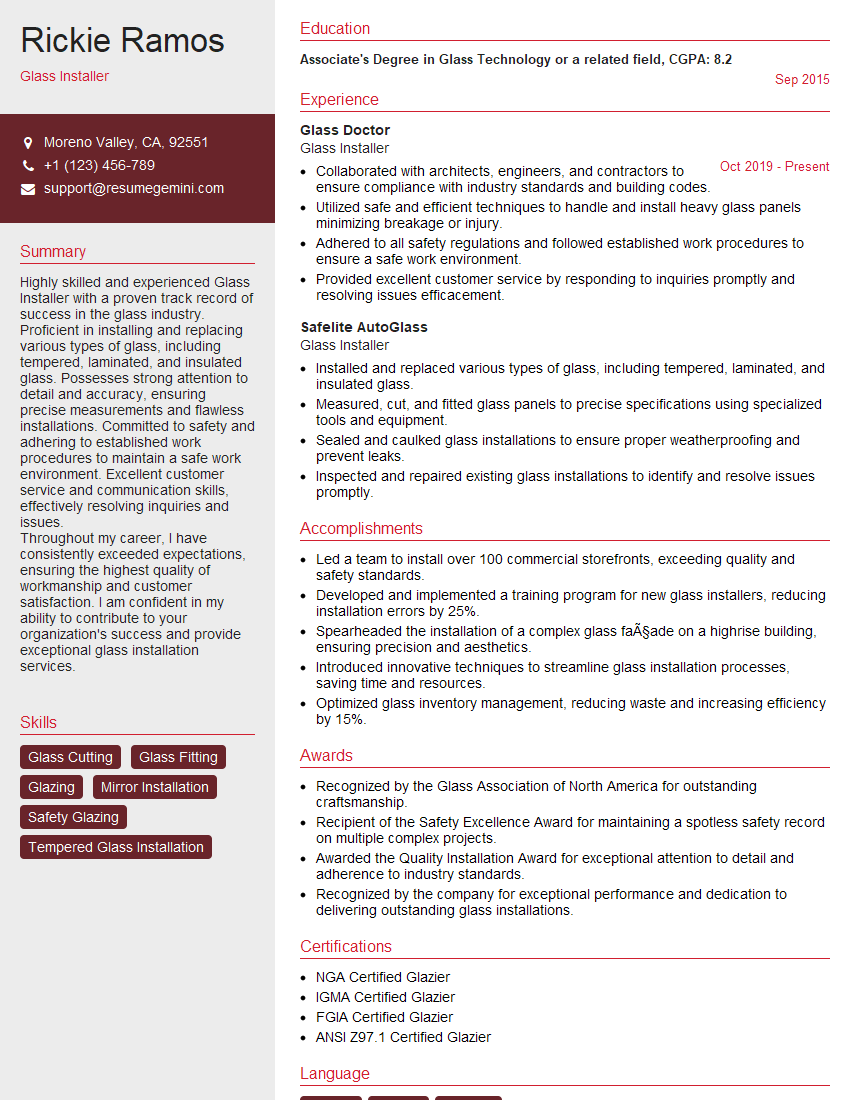
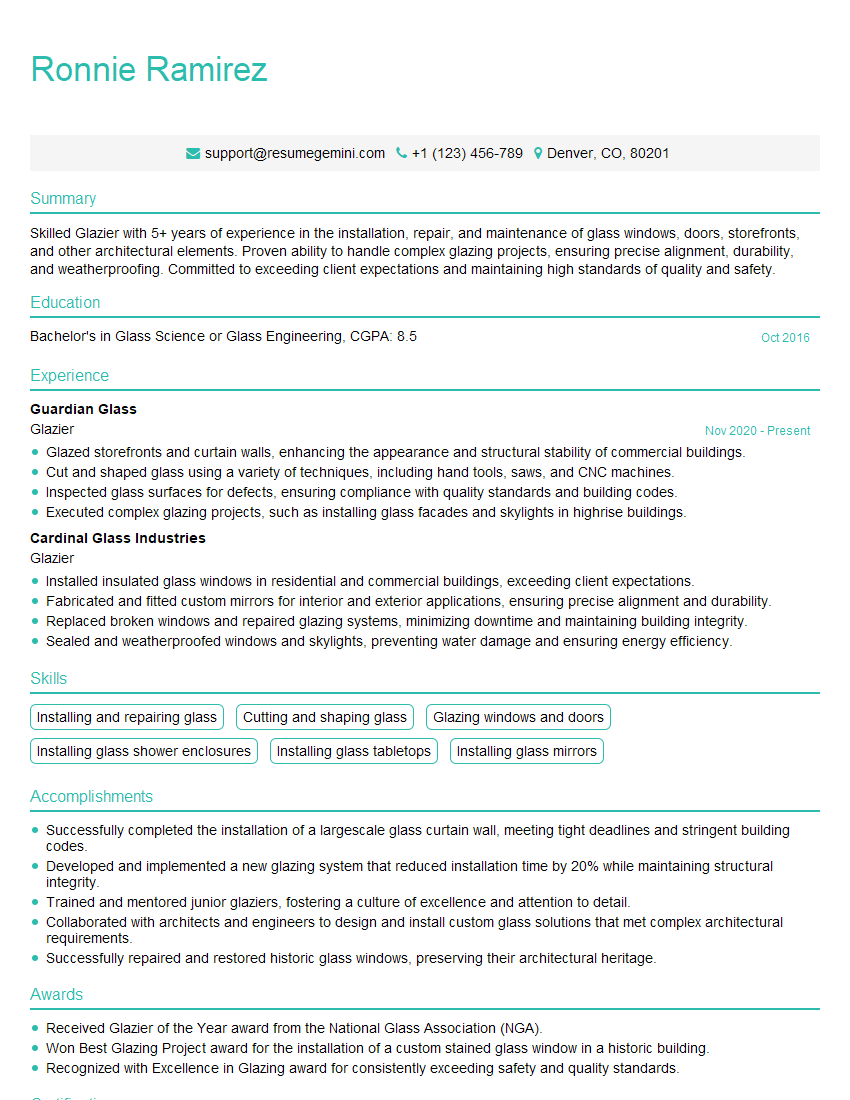
Mastering the ability to read and interpret glass blueprints is crucial for career advancement in the glass and glazing industry, opening doors to more specialized roles and higher earning potential. A well-crafted resume is your key to unlocking these opportunities. Make sure your resume is ATS-friendly to ensure it gets noticed by recruiters. ResumeGemini is a trusted resource to help you create a professional and impactful resume that highlights your skills and experience. We provide examples of resumes tailored to showcasing expertise in reading and interpreting glass blueprints to help you get started. Invest in your future; invest in your resume.
Explore more articles
Users Rating of Our Blogs
Share Your Experience
We value your feedback! Please rate our content and share your thoughts (optional).
What Readers Say About Our Blog
Very informative content, great job.
good