Interviews are opportunities to demonstrate your expertise, and this guide is here to help you shine. Explore the essential Glass Handling Techniques interview questions that employers frequently ask, paired with strategies for crafting responses that set you apart from the competition.
Questions Asked in Glass Handling Techniques Interview
Q 1. Describe your experience with different types of glass (e.g., annealed, tempered, laminated).
My experience encompasses a wide range of glass types, each with unique properties influencing handling techniques. Annealed glass, the most common type, is relatively inexpensive and easy to cut but shatters unpredictably when broken. Tempered glass, on the other hand, undergoes a heat treatment making it significantly stronger and safer; however, it requires specialized tools and careful handling to avoid breakage as it shatters into small, relatively harmless pieces. Laminated glass, composed of multiple layers of glass bonded with a polymer interlayer, is highly resistant to impact and penetration, offering superior safety. Its strength and weight necessitate careful handling during transport and installation, particularly larger sheets. I’ve worked extensively with all three, adapting my techniques based on the specific characteristics of each glass type. For instance, scoring annealed glass before snapping it is straightforward, while tempered glass requires diamond-tipped cutting wheels due to its hardness. Laminated glass needs precise measurements and gentle handling to avoid damaging the interlayer.
Q 2. Explain the safety precautions you take when handling glass.
Safety is paramount in glass handling. My standard procedure always begins with assessing the environment, ensuring adequate lighting and a clear workspace free from obstructions. I always wear appropriate personal protective equipment (PPE), including cut-resistant gloves, safety glasses, and closed-toe shoes. When working with larger sheets, I utilize suction cups, safety straps, and potentially a glass lifter to minimize the risk of cuts or drops. Before handling any glass, I visually inspect it for cracks or damage to prevent unexpected breakage. Furthermore, I maintain a safe distance from sharp edges and broken pieces, and I carefully manage any sharp fragments according to safety protocols for disposal. Communication with colleagues is key, particularly when lifting or moving heavy glass panels, to ensure coordinated and safe handling. Think of it like a well-rehearsed dance – each individual knows their part and works together for a flawless and safe outcome.
Q 3. What are the common tools and equipment used in glass handling?
The tools and equipment used in glass handling vary depending on the task, but common essentials include:
- Glass cutter: Used for scoring glass before snapping or breaking.
- Snap cutter: Used for clean breaks.
- Safety glasses: Essential eye protection.
- Cut-resistant gloves: Protect hands from cuts.
- Suction cups: Used for lifting and moving glass sheets.
- Glass lifter: A mechanical device for lifting and maneuvering larger, heavier panels.
- Measuring tape: For precise measurements.
- Pencil or marker: For marking cutting lines.
- Straight edge: For guiding the glass cutter.
- Safety harness and rigging equipment: For handling extremely large and heavy sheets.
Q 4. How do you measure and cut glass accurately?
Accurate measurement and cutting are crucial. I begin by carefully measuring the desired dimensions using a reliable measuring tape, double-checking to ensure precision. The glass is then marked using a pencil or marker, following the measurement. A straight edge is used to guide the glass cutter, ensuring a clean, straight score. The scored line is then carefully snapped, using a snap cutter or by applying controlled pressure. For complex cuts, a wet saw or specialized glass cutting equipment is used. Regular calibration of measuring tools and proper technique are essential to minimize errors. Imagine a surgeon performing delicate surgery – precision and accuracy are paramount.
Q 5. Describe your experience with glass installation techniques.
My experience in glass installation ranges from simple window panes to complex curtain walls. The techniques vary depending on the type of glass and the application. For instance, installing annealed glass in a window frame involves careful measurement, application of appropriate sealant, and gentle insertion to prevent breakage. Laminated glass installation requires even more care due to its weight and layered structure. Curtain wall installations often involve a team, utilizing specialized tools and rigging to lift and precisely position large glass panels. Proper sealing and bracing are crucial to ensure the structural integrity and weather resistance of the final installation. The process needs thorough planning to guarantee that the entire structure remains secure and weatherproof.
Q 6. How do you handle damaged or broken glass safely?
Handling damaged or broken glass requires extreme caution. I always wear cut-resistant gloves and safety glasses. Small pieces are carefully swept into a dustpan, and the container is clearly labeled for safe disposal. Larger pieces require more attention – I would use heavy-duty gloves and potentially specialized equipment for the removal of any large, potentially hazardous shards. The area around the broken glass is cordoned off to prevent accidental injuries to others. Broken glass is always disposed of properly, following all relevant safety and environmental regulations. Remember, safety is more than a procedure; it is a mindset that should always prevail.
Q 7. What are the different methods for transporting glass sheets?
Glass sheets are transported using methods that prioritize safety and prevent damage. Smaller sheets can be transported carefully by hand, with adequate protection using cardboard or foam padding. Larger sheets require specialized handling. These include:
- Glass racks: These provide secure support for transporting multiple sheets simultaneously.
- Pallet wrapping and strapping: Protects glass from shifting or breaking during transit.
- Specialized trucks: Equipped with secure mounting systems and padding to prevent damage.
- Cranes and forklifts: For loading and unloading heavy sheets.
Q 8. Explain your understanding of glass tempering processes.
Glass tempering is a heat treatment process that significantly increases the strength and durability of glass. It involves heating the glass to a high temperature (around 650°C) and then rapidly cooling it, typically with forced air. This rapid cooling induces compressive stresses on the surface of the glass and tensile stresses in the core. This stress profile makes the tempered glass much more resistant to impact and thermal shock compared to annealed (standard) glass.
Imagine a tightly wound spring: the compressive surface stresses act like that spring, resisting external forces. When an impact occurs, the glass absorbs more energy before fracturing. This is why tempered glass is commonly used in car windows, shower doors, and other applications where safety and durability are paramount.
The process itself typically involves a continuous furnace where the glass is heated evenly, followed by a cooling chamber with high-velocity air jets. Precise temperature control and cooling rates are critical to achieving the desired compressive stress profile and avoiding defects.
Q 9. Describe your experience with glass laminating techniques.
Glass laminating involves bonding two or more sheets of glass together with a layer of polyvinyl butyral (PVB) interlayer. This interlayer acts as a tough, transparent adhesive, providing significant safety and sound insulation properties. The process usually involves placing the glass sheets and the PVB interlayer in an autoclave, a heated and pressurized chamber. The heat and pressure cause the PVB to cure and bond strongly to the glass, creating a monolithic unit.
My experience includes working with both standard and specialized PVB interlayers, offering different levels of safety, security, and acoustic performance. For example, I’ve worked with laminated glass incorporating sound-dampening PVB for use in noise-sensitive environments like offices or recording studios. I also have experience with laminated glass containing security films, enhancing resistance to penetration and preventing shattering in case of impact. The quality control process is stringent, ensuring complete bonding and absence of bubbles or delamination.
Q 10. How do you inspect glass for defects?
Inspecting glass for defects is a crucial step in ensuring quality and safety. I utilize a multi-faceted approach, combining visual inspection with specialized tools. Visual inspection involves carefully examining the glass for any visible imperfections, including scratches, chips, bubbles, stones (small solid inclusions), and surface irregularities. This is often done under controlled lighting conditions to maximize visibility.
Beyond visual inspection, I utilize tools like polariscopes to detect internal stresses and strain in the glass. These stresses can be indicative of potential weaknesses and are particularly important for tempered glass. Furthermore, specialized software and measurement tools can be used to quantitatively assess surface flatness and imperfections.
The inspection process also includes checking for proper dimensions and ensuring the glass meets the specified tolerances. Detailed documentation of any defects identified, along with their location and severity, is essential for quality control and traceability.
Q 11. What are the common types of glass defects and their causes?
Common glass defects arise from various stages of manufacturing or handling. Some examples include:
- Bubbles: Trapped air pockets during the melting and forming processes.
- Stones: Small solid impurities embedded in the glass.
- Scratches: Surface imperfections caused by contact with abrasive materials during handling or processing.
- Nipples: Small protrusions on the glass surface.
- Roller waves: Undulations on the surface caused by imperfections in the forming process.
- Stress cracks (in tempered glass): Cracks caused by improper tempering or handling.
- De-lamination (in laminated glass): Separation of the glass layers from the interlayer.
Understanding the cause of a defect helps to prevent its recurrence. For instance, bubbles might indicate a problem with the melting process, while scratches point towards issues with handling or storage. Proper training and adherence to safety protocols during each stage are vital in minimizing defects.
Q 12. How do you ensure the quality of your work in glass handling?
Ensuring quality in glass handling requires a meticulous approach starting from the moment the glass is received. This includes careful handling to prevent scratches or chipping. Proper storage conditions, avoiding extreme temperatures and humidity, are also vital. Cleanliness is paramount; dust and debris can cause scratches during processing or installation. I use appropriate handling tools, like suction cups and gloves, depending on the glass type and its size. For large sheets, specialized equipment like vacuum lifters are employed.
Throughout the entire process, adherence to safety protocols is non-negotiable. This includes wearing appropriate personal protective equipment (PPE) such as safety glasses and gloves. Regular training and review of safety procedures are critical for preventing accidents. Detailed documentation of each step, from receiving the glass to its final installation, ensures traceability and helps identify potential areas for improvement in the quality management system.
Q 13. Describe your experience with different types of glass sealants and adhesives.
My experience encompasses a variety of glass sealants and adhesives, each with its own properties and applications. Silicone sealants are commonly used for their flexibility, weather resistance, and ease of application. They are frequently used in exterior applications such as window installations. However, their curing time can be a consideration.
Polyurethane sealants offer excellent adhesion and strength, often preferred for structural applications where high bonding strength is critical. In contrast, epoxy adhesives provide very strong bonds but require precise mixing and handling. I’ve also used specialized adhesives for bonding specific glass types, for example, those designed for use with tempered glass to avoid stress-related issues. The choice of sealant or adhesive depends entirely on the application, the type of glass, and the environmental conditions.
Q 14. Explain your understanding of glass safety regulations.
Glass safety regulations vary depending on the location and application. However, common elements include standards related to the type of glass used (e.g., tempered glass for safety glazing in certain applications), its thickness, and the method of installation. Regulations often address impact resistance requirements, ensuring the glass can withstand expected loads and forces without shattering in a hazardous way.
Specific standards for safety glazing in buildings, vehicles, and other applications are crucial. Compliance involves meticulous documentation of the glass’s specifications, testing reports, and installation methods. Moreover, ongoing training and adherence to safe handling practices are essential for minimizing the risk of accidents and ensuring the safety of workers and the public. Failure to comply with regulations can lead to serious consequences, including legal liabilities and safety hazards.
Q 15. How do you maintain a safe working environment when handling glass?
Maintaining a safe working environment when handling glass is paramount. It begins with a strong safety culture, reinforced through training and consistent adherence to safety protocols. This includes proper Personal Protective Equipment (PPE), such as safety glasses, gloves, and steel-toed boots, which are essential to prevent cuts and injuries.
The workspace itself needs to be organized and free of clutter to prevent trips and falls. Glass should be stored properly, ideally on edge to minimize the risk of breakage and using appropriate racking systems for larger sheets. We must also be mindful of the fragility of glass during transportation, using protective materials like cardboard and corner protectors. Furthermore, lifting techniques should be employed to prevent strains and injuries. Always lift with your legs, using proper posture, and using appropriate lifting aids for heavy pieces. Finally, regular safety inspections and reporting of any unsafe conditions are crucial to maintaining a safe and productive work environment.
Career Expert Tips:
- Ace those interviews! Prepare effectively by reviewing the Top 50 Most Common Interview Questions on ResumeGemini.
- Navigate your job search with confidence! Explore a wide range of Career Tips on ResumeGemini. Learn about common challenges and recommendations to overcome them.
- Craft the perfect resume! Master the Art of Resume Writing with ResumeGemini’s guide. Showcase your unique qualifications and achievements effectively.
- Don’t miss out on holiday savings! Build your dream resume with ResumeGemini’s ATS optimized templates.
Q 16. Describe your experience with troubleshooting glass installation problems.
Troubleshooting glass installation problems often involves a systematic approach. I start by carefully examining the issue, identifying the root cause, whether it’s a measurement error, a faulty installation technique, or a problem with the glass itself. For example, I’ve encountered instances where seemingly minor discrepancies in measurements led to significant installation difficulties. A thorough review of the blueprints and accurate re-measurements are usually necessary in these cases.
Other times, the problem stems from improper sealant application, leading to leaks or compromised structural integrity. In such instances, removing the faulty sealant and applying a fresh coat, ensuring proper curing time, is crucial. I’ve also had to address situations where the glass itself was damaged during transport or handling. In such cases, replacement is necessary, accompanied by a review of handling procedures to prevent recurrence.
Q 17. How do you calculate the amount of glass needed for a project?
Calculating the amount of glass needed for a project requires precise measurements and careful consideration of waste. The first step is accurately measuring the dimensions of each glass component, taking into account any cuts, shapes, and allowances for fabrication. For example, a simple rectangular window requires measuring its height and width. More complex shapes might require breaking them down into smaller, manageable geometric figures.
Once these measurements are complete, we calculate the total area for each component and add them together to find the total glass area. However, it’s critical to account for waste during cutting. This percentage varies based on the complexity of the project and the type of cutting equipment used. We usually add a 10-15% buffer to account for potential errors or additional cuts during fabrication. Finally, the total glass area, including the waste factor, gives us the required amount of glass for the entire project. This methodology is crucial to minimize material costs and reduce waste.
Q 18. What are the different types of glass edges and their applications?
Glass edges come in various types, each with specific applications. Common types include:
- Penetrated edges: These edges are ground and polished, providing a smooth, finished look. They are commonly used in furniture, architectural applications, and decorative pieces where aesthetics are important.
- Seamed edges: This is a simple type of edge where two pieces of glass are joined together creating a seam. It is mainly used for applications requiring structural integrity where the seam is hidden.
- Arris edges: These edges are simply cut without any grinding or polishing, leaving a sharp, rough edge. This type is generally less expensive but is not ideal for applications where the edge is visible or where safety is paramount.
- Beveled edges: These edges are angled, creating a sleek, sophisticated look. They are frequently used in decorative glass applications and high-end furniture.
The choice of edge type depends heavily on the intended application, aesthetic considerations, and safety requirements. For example, furniture often uses polished edges for safety and appearance, while structural glass may use simpler edges where they are not visible.
Q 19. Describe your experience with automated glass handling equipment.
My experience with automated glass handling equipment includes working with robotic arms for precise glass placement, automated cutting and polishing machines, and automated storage and retrieval systems (AS/RS) for efficient inventory management. These systems drastically improve efficiency and safety, reducing human error and the risk of injuries associated with manual handling of glass.
For instance, robotic arms can handle delicate, large format glass panels with incredible precision, placing them into frames or other fixtures without risk of breakage or damage. Automated cutting machines provide consistent and accurate cuts, reducing material waste. AS/RS systems allow for quick retrieval of specific glass sizes, streamlining the production process. This experience has broadened my understanding of optimizing workflows and maintaining precision in high-volume glass handling operations.
Q 20. How do you handle different glass thicknesses and sizes?
Handling different glass thicknesses and sizes requires adapting techniques and equipment to ensure safety and prevent damage. Thicker glass, naturally, requires more robust handling techniques and potentially specialized lifting equipment. This might involve using suction cups or other vacuum-based lifting devices for larger or thicker sheets.
For smaller, thinner glass, careful manual handling with appropriate gloves is sufficient, but always ensuring a secure grip and stable support to avoid breakage. The size also dictates the storage and transportation methods; larger sheets require more careful planning for transportation and specialized racking systems for storage, minimizing the risk of warping or breakage. The selection of the right tools and equipment is crucial for handling each dimension safely and efficiently.
Q 21. Explain your understanding of the properties of different types of glass.
Understanding the properties of different types of glass is fundamental to successful glass handling. For example, annealed glass, or standard float glass, is relatively inexpensive but more susceptible to breakage than tempered glass. Tempered glass, on the other hand, undergoes a heat treatment that makes it significantly stronger and safer, although it shatters into small, relatively harmless pieces upon breakage, unlike annealed glass, which can fracture into sharp shards.
Laminated glass is composed of two or more layers of glass bonded together with a layer of interlayer material (typically PVB), making it impact resistant and holding the glass together even if broken, minimizing potential injuries. Other types like coated glass, with various coatings for insulation or UV protection, have different handling considerations, as the coatings can be delicate. Understanding these properties allows for selecting the correct type of glass for specific applications and employing suitable handling techniques to minimize the risk of damage or injury.
Q 22. Describe your experience working with different types of glass cutting tools.
My experience encompasses a wide range of glass cutting tools, from the simplest hand-held glass cutters using a tungsten carbide wheel to sophisticated automated systems. Hand-held cutters, while requiring precision and skill, are ideal for smaller projects and intricate cuts. I’ve honed my technique over years, understanding the importance of consistent pressure and the right scoring angle for clean breaks. For larger projects, I’ve utilized automated glass cutting machines that offer high precision and speed. These machines often use water jets or laser cutting for delicate or complex designs. I’m also proficient with specialized tools like oil-fed cutters for thicker glass and diamond-tipped wheels for particularly hard glass types. Understanding the strengths and limitations of each tool is critical to producing a high-quality, safe cut.
For instance, when working with tempered glass (which is extremely strong but shatters into small pieces upon breakage), I always use a specialized, high-quality tool and exercise extreme caution. A slight mistake with a dull or improperly used tool can easily result in damage to the glass or even injury. This is where experience in handling different tool types is truly indispensable.
Q 23. How do you ensure the proper alignment of glass during installation?
Ensuring proper alignment during glass installation is paramount for both aesthetics and structural integrity. My approach begins with meticulous planning, utilizing laser levels and precise measurements to determine the exact placement of each glass panel. For large installations, I often use suction cups and specialized glass handling equipment to move and position the glass with minimal risk of breakage. Temporary supports and shims are strategically placed to maintain alignment until the final installation. Regular checks throughout the process, using both visual inspection and measuring tools, are crucial. For instance, when installing a large glass storefront, slight misalignments can lead to stress points and potential cracking. My process includes multiple alignment checks: before installation, during the initial placement, and again after the sealant has cured, to ensure everything stays perfect.
Furthermore, I’m very conscious of expansion and contraction. Glass, being a material sensitive to temperature changes, necessitates consideration for thermal movement. Therefore, appropriate gaps and expansion joints are incorporated into the installation design to mitigate the potential for stress-induced cracking.
Q 24. Explain your understanding of the thermal properties of glass.
Understanding the thermal properties of glass is fundamental to safe and effective handling and installation. Glass has a relatively low thermal conductivity compared to metals, meaning it heats up and cools down more slowly. This property can be both advantageous and problematic. For example, in situations with significant temperature gradients (like a window exposed to direct sunlight), uneven heating can lead to thermal stress and subsequent cracking. This is why using appropriate sealant types and ensuring proper expansion joints are critical.
Conversely, the low thermal conductivity of glass can be beneficial in certain applications such as energy-efficient windows. Low-E coatings, for example, are designed to modify the thermal properties of glass, reflecting infrared radiation and reducing heat transfer. This understanding translates directly into selecting appropriate glass types for specific applications and ensuring the long-term durability of installations.
Q 25. Describe your experience with cleaning and maintaining glass surfaces.
Cleaning and maintaining glass surfaces is crucial to preserving their aesthetic appeal and structural integrity. The method depends heavily on the type of glass and its location. For example, cleaning exterior glass on a high-rise building will involve different techniques and safety precautions compared to cleaning interior glass in a domestic setting. I always start with assessing the type of glass and the kind of soiling involved. I’ve used a range of cleaning solutions, from simple soap and water to specialized glass cleaners designed to remove stubborn stains, fingerprints, and grime. In particular, I’m careful to avoid harsh chemicals that could damage the glass surface or its coatings (like Low-E coatings).
Tools range from squeegees and microfiber cloths for routine cleaning to specialized brushes and scrubbers for tougher jobs. Regular maintenance, whether it’s daily wiping or periodic deep cleaning, is essential. For large installations, professional window cleaning equipment and techniques are often necessary to ensure efficient and safe cleaning.
Q 26. How do you ensure the structural integrity of glass installations?
Ensuring structural integrity in glass installations involves a multi-faceted approach. It starts with proper design and material selection, taking into account factors like glass thickness, type, and the loads it will bear (wind, snow, etc.). The correct use of high-quality fasteners and sealants is also paramount. I carefully inspect all materials before installation and ensure they meet the required specifications. Incorrect sealant application or use of inappropriate fasteners can drastically compromise the overall structural integrity. Furthermore, understanding stress points within the glass and framework design is essential. We always implement appropriate support structures, such as mullions or structural supports, to distribute loads effectively.
Throughout the installation, I perform regular quality checks using appropriate measuring tools and visual inspections to ensure everything is aligned correctly and securely fastened. This includes verifying the sealant integrity and checking for any cracks or signs of stress. Post-installation inspections are critical to detect any potential issues early on, preventing costly repairs or safety hazards.
Q 27. What are the potential risks associated with handling different types of glass?
Different types of glass present unique handling risks. Tempered glass, while strong, shatters into small, sharp fragments upon breakage, posing a significant laceration hazard. Laminated glass is safer in this regard, as the interlayer holds the fragments together, but it can still be heavy and difficult to maneuver. Other glass types, such as etched or textured glass, can have irregular surfaces, increasing the risk of cuts or scrapes during handling. Working at heights adds another layer of risk, making proper safety precautions like harnesses and fall protection absolutely necessary.
I always prioritize safety by using appropriate personal protective equipment (PPE), including safety glasses, gloves, and closed-toe shoes. Proper lifting techniques are crucial to avoid injury, especially when handling large or heavy glass panels. I’m trained to handle glass safely and efficiently and ensure all team members are also aware of these critical safety measures.
Q 28. How do you address client concerns regarding glass installations?
Addressing client concerns is a critical part of my job. I believe in open and honest communication throughout the entire process. I start by actively listening to the client’s concerns, making sure I fully understand their issues. I then provide clear and concise explanations, using plain language and avoiding technical jargon. If the concern is valid, I present potential solutions and explain the rationale behind my recommendations. This might involve showing samples, providing detailed drawings, or discussing alternative options.
For example, if a client is concerned about the visibility through a certain type of glass, I might offer samples of different glass types for comparison. If there’s a concern about the durability of the installation, I can demonstrate the use of high-quality materials and the structural integrity of my design. I strive to maintain a professional and empathetic approach, assuring the client that their concerns are taken seriously and resolving any issues promptly and effectively.
Key Topics to Learn for Glass Handling Techniques Interview
- Safety Procedures: Understanding and adhering to all safety protocols, including PPE usage, hazard identification, and emergency response procedures for glass handling.
- Glass Types and Properties: Knowledge of different glass types (e.g., annealed, tempered, laminated), their physical properties (strength, fragility, thermal expansion), and how these properties influence handling techniques.
- Lifting and Moving Techniques: Proper techniques for lifting, carrying, and transporting glass sheets and other glass components of varying sizes and weights to prevent damage and injury.
- Cutting and Shaping Techniques (if applicable): Understanding of safe and efficient methods for cutting, scoring, and shaping glass, including appropriate tools and safety measures.
- Installation and Mounting Techniques: Knowledge of various glass installation methods, including appropriate adhesives, sealants, and fasteners, depending on the application.
- Cleaning and Maintenance: Proper techniques for cleaning and maintaining different types of glass surfaces, avoiding damage and ensuring clarity.
- Troubleshooting and Problem Solving: Identifying and resolving common issues encountered during glass handling, installation, or maintenance, such as cracks, chips, or scratches.
- Quality Control and Inspection: Understanding quality control measures and inspection techniques to ensure the integrity and safety of handled glass.
- Regulations and Compliance: Familiarity with relevant industry regulations and safety standards related to glass handling and installation.
Next Steps
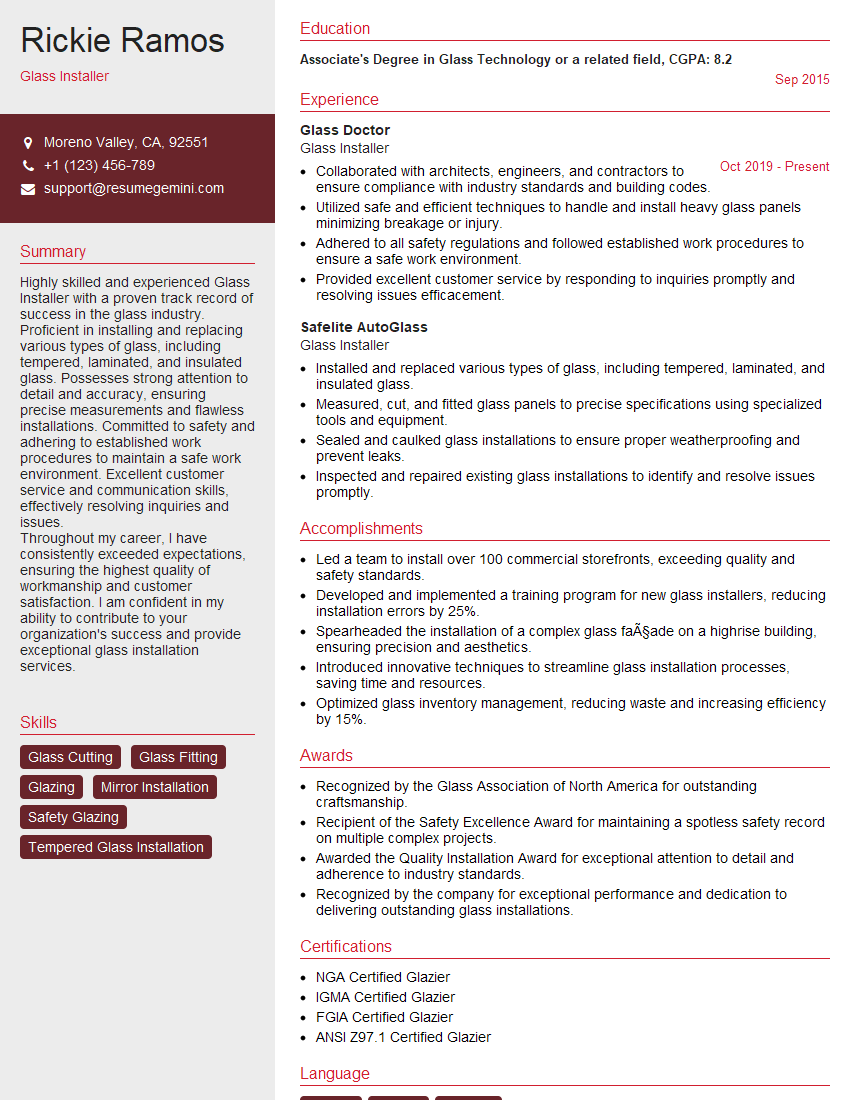
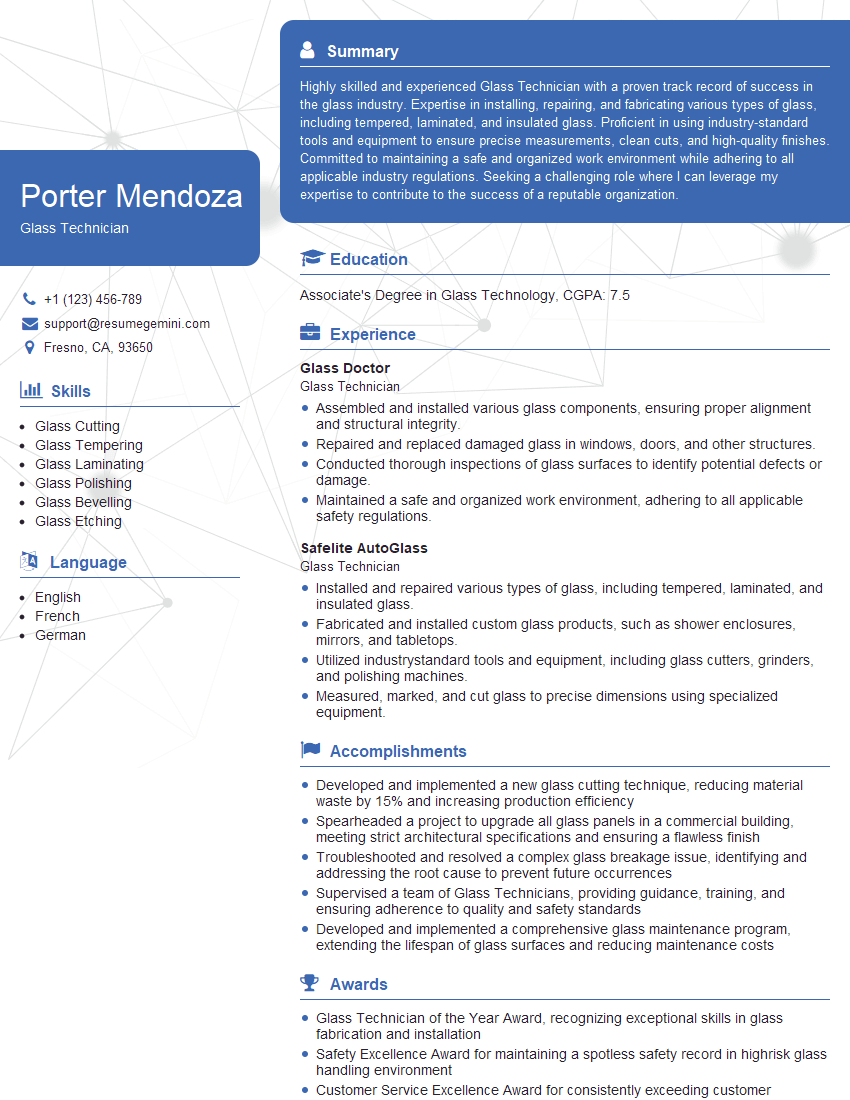
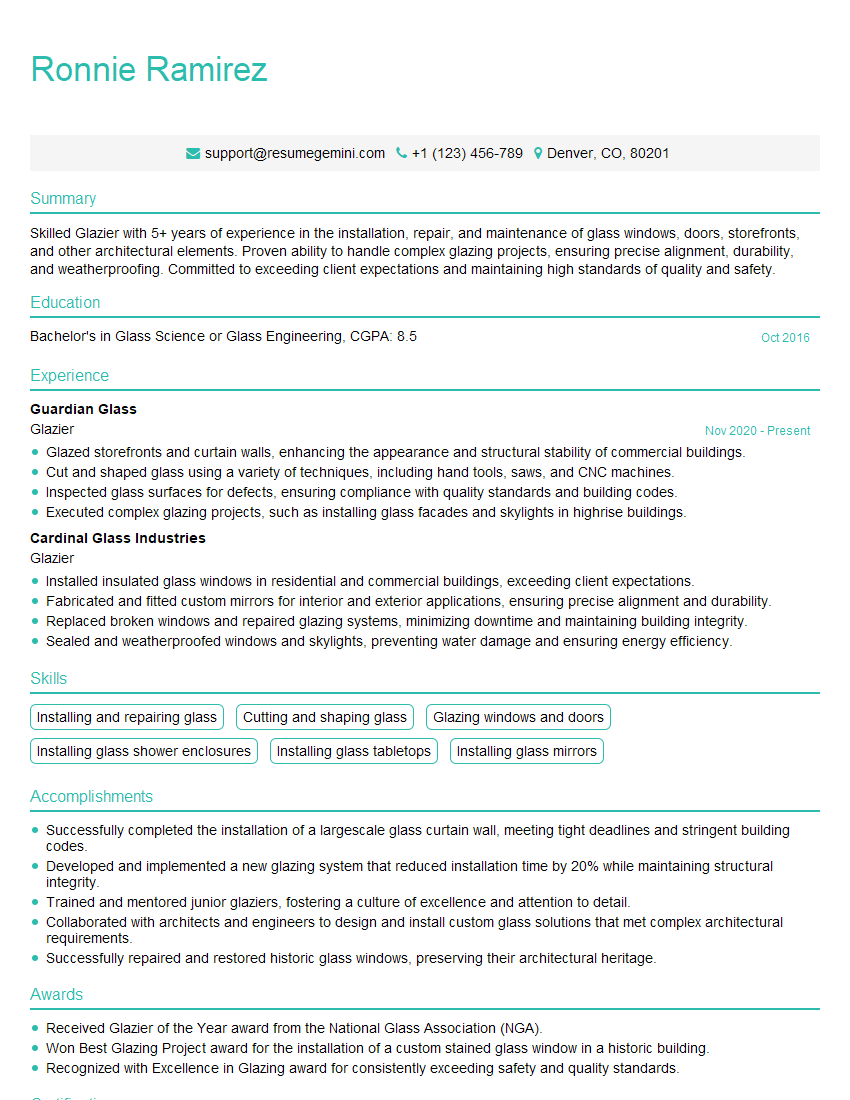
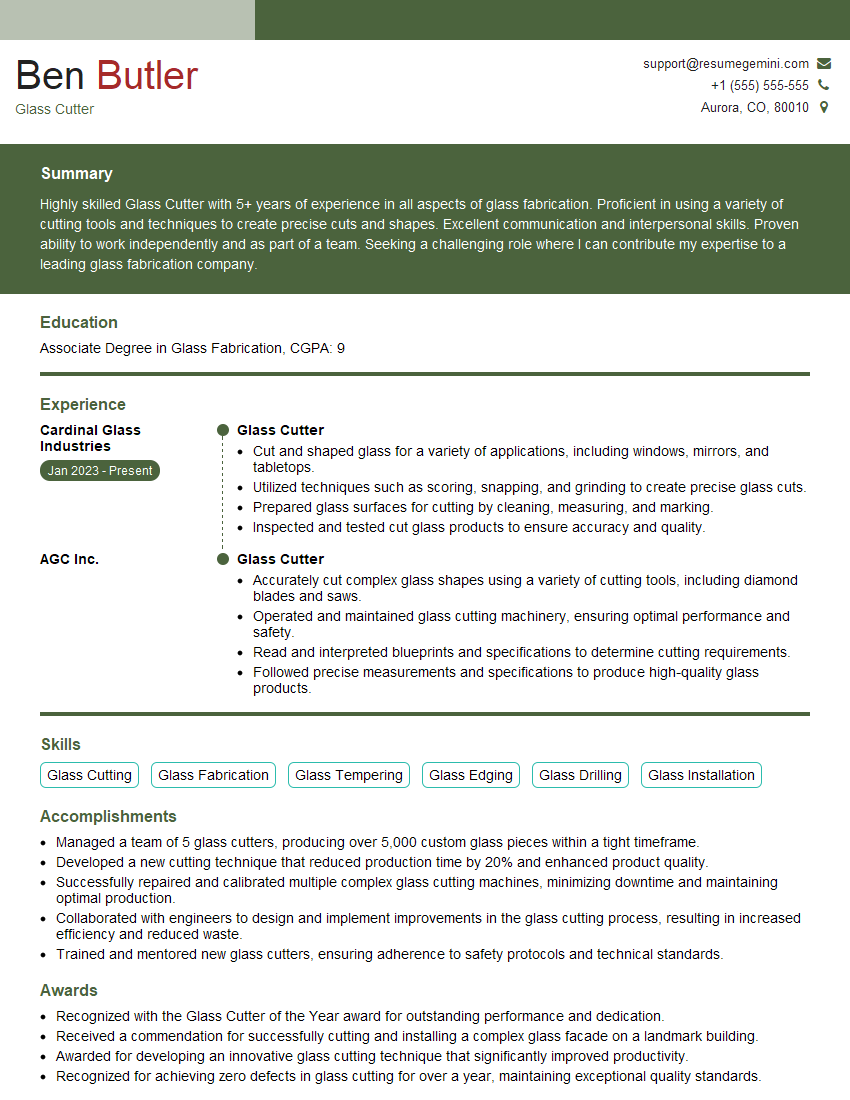
Mastering Glass Handling Techniques is crucial for career advancement in numerous industries, opening doors to specialized roles and higher earning potential. A strong resume is essential for showcasing your skills and experience to potential employers. Creating an ATS-friendly resume significantly increases your chances of getting your application noticed. We highly recommend using ResumeGemini to build a professional and impactful resume that highlights your expertise in Glass Handling Techniques. ResumeGemini provides examples of resumes tailored to this specific field, guiding you in crafting a compelling document that captures the attention of recruiters. Invest time in building a strong resume – it’s your first impression!




Explore more articles
Users Rating of Our Blogs
Share Your Experience
We value your feedback! Please rate our content and share your thoughts (optional).
What Readers Say About Our Blog
Very informative content, great job.
good