Are you ready to stand out in your next interview? Understanding and preparing for Color Mixing and Pigmentation interview questions is a game-changer. In this blog, we’ve compiled key questions and expert advice to help you showcase your skills with confidence and precision. Let’s get started on your journey to acing the interview.
Questions Asked in Color Mixing and Pigmentation Interview
Q 1. Explain the difference between additive and subtractive color mixing.
Additive and subtractive color mixing are two fundamentally different approaches to creating colors. Think of it like this: additive mixing is like shining lights together, while subtractive mixing is like layering paints.
Additive Color Mixing: This is the method used in screens, like your computer or television. It starts with black (absence of light) and adds primary colors – red, green, and blue (RGB) – to create other colors. When you combine all three at full intensity, you get white light. Mixing red and green produces yellow; red and blue make magenta; and green and blue create cyan.
Subtractive Color Mixing: This applies to pigments, paints, inks, and dyes. It begins with white (reflection of all light) and subtracts colors by layering pigments. The primary colors in subtractive mixing are cyan, magenta, and yellow (CMYK – the K stands for Key, which is black). These pigments absorb certain wavelengths of light, and the remaining wavelengths determine the perceived color. Mixing cyan and magenta absorbs red light, resulting in blue. Similarly, cyan and yellow create green, and magenta and yellow create red.
In short: Additive mixing adds light to create color, while subtractive mixing subtracts light by absorbing certain wavelengths.
Q 2. Describe the Munsell color system.
The Munsell color system is a color space that organizes colors based on three color dimensions: hue, value, and chroma.
- Hue: This refers to the pure color, like red, green, blue, yellow, etc. It’s represented by the position around the color wheel.
- Value: This describes the lightness or darkness of a color, ranging from black (value 0) to white (value 10). It’s essentially the color’s brightness.
- Chroma: This indicates the color’s saturation or intensity. A high chroma color is vivid and intense, while a low chroma color is duller and grayer. It represents the distance from a neutral gray of the same value.
The Munsell system visually represents these dimensions as a three-dimensional solid, making it a very intuitive and practical system for organizing and describing colors. Each color is identified by a unique notation, such as 5YR 7/4, where 5YR is the hue, 7 is the value, and 4 is the chroma. This system is widely used in various fields, from art to soil science, due to its organized and easily understandable color representation.
Q 3. How do you achieve a specific color using different pigment combinations?
Achieving a specific color using different pigment combinations is a complex process requiring an understanding of color theory and pigment properties. It’s a bit like a recipe – you need the right ingredients (pigments) in the correct proportions.
Here’s a step-by-step approach:
- Identify the target color: Define the exact hue, value, and chroma of your desired color. Tools like colorimeters or color software can help.
- Choose your base pigment: Select a pigment that provides a foundation close to your target color. This simplifies the mixing process.
- Select modifying pigments: Based on the difference between the base color and the target color, choose pigments to adjust hue, value, and chroma. For example, if the base is too dark, add a white pigment (tinting) to increase value. If it’s too saturated, add a gray pigment (toning) to decrease chroma. If the hue is off, carefully add a pigment to shift it closer to your target.
- Mix incrementally and assess: Add the modifying pigments gradually, mixing thoroughly after each addition. Continuously compare the mixture to your target color using a color chart or a spectrophotometer for precision. Small incremental adjustments are key to achieving a precise match.
- Consider color interactions: Pigments can interact with each other in unexpected ways. Some pigments may be transparent, allowing underlying colors to affect the final result. Others may exhibit ‘masking’ properties, obscuring underlying colors.
For example, let’s say you want a specific shade of reddish-brown. You might start with a burnt umber (base) and adjust the hue with a touch of red oxide, the value with a small amount of titanium white, and the chroma with a tiny bit of black.
Q 4. Explain the concept of color space (e.g., RGB, CMYK).
A color space is a specific organization of colors, represented numerically. It defines a range of colors that can be displayed or printed. Different color spaces use different models, each with advantages and disadvantages.
- RGB (Red, Green, Blue): This is an additive color model used in screens. Each color is defined by the intensity of red, green, and blue light components, ranging from 0 to 255 (or 0 to 1). For example,
(255, 0, 0)represents pure red,(0, 255, 0)pure green, and(0, 0, 255)pure blue.(255, 255, 255)represents white, and(0, 0, 0)represents black. - CMYK (Cyan, Magenta, Yellow, Key/Black): This is a subtractive color model used in printing. It defines colors by the amount of cyan, magenta, yellow, and black ink used. Values typically range from 0% to 100%. CMYK is more restricted than RGB, as it’s difficult to achieve the same vibrancy.
Other notable color spaces include LAB (more perceptually uniform than RGB), HSV (hue, saturation, value), and HSL (hue, saturation, lightness).
The choice of color space depends on the application. RGB is ideal for screen displays, while CMYK is necessary for printing. Understanding the differences is crucial for accurate color reproduction across different mediums.
Q 5. What are metamerism and how does it affect color matching?
Metamerism is a phenomenon where two colors appear identical under one light source but different under another. This happens because our eyes perceive color based on the spectral distribution of light reflected from the object, not the absolute wavelengths. Two objects can have different spectral reflectances but appear the same color under a specific lighting condition.
Impact on Color Matching: Metamerism significantly complicates color matching. A color match achieved under one lighting condition, such as daylight, may not hold true under another, like incandescent light. This makes accurate color reproduction across different environments and devices challenging. To mitigate this, color matching often involves specifying the lighting conditions (e.g., D65 daylight) under which the match is valid. Standards like those defined by CIE (International Commission on Illumination) guide accurate color measurement and communication to reduce metameric effects.
A classic example is a paint that matches a fabric perfectly indoors, but under sunlight, the color difference becomes noticeable. This is metamerism at play.
Q 6. How do you measure color accurately?
Accurate color measurement involves using specialized instruments that quantify the color’s properties. The most common method is using a spectrophotometer.
Spectrophotometers: These devices measure the spectral reflectance or transmittance of a material across the visible spectrum. They provide data on how much light is reflected or transmitted at each wavelength, offering a comprehensive color profile. This spectral data can then be used to calculate color coordinates in various color spaces, ensuring consistent and accurate color reproduction.
Other methods include:
- Colorimeters: These instruments measure the tristimulus values (X, Y, Z) directly, representing the perceived color coordinates. They are simpler and less expensive than spectrophotometers, but they don’t provide spectral data.
- Visual Color Matching: While subjective, visual assessment is still an important part of color quality control. It assesses the overall appearance under various lighting conditions, considering factors beyond simple numerical values.
Accurate color measurement is crucial in various industries, such as paint manufacturing, textile production, and printing, to ensure consistency and maintain high quality standards.
Q 7. Describe different types of pigments (organic, inorganic).
Pigments are finely divided solid particles that impart color when dispersed in a binder (like oil or water). They are broadly classified as organic or inorganic.
Organic Pigments: These pigments are derived from carbon-based compounds. They often offer vibrant and intense colors but can be less durable and more prone to fading due to light exposure or chemical reactions. Examples include azo pigments (known for their brilliant reds and yellows), phthalocyanine pigments (intense blues and greens), and quinacridones (a range of hues with excellent lightfastness).
Inorganic Pigments: These are derived from minerals or metal oxides. Generally, they tend to be more lightfast and durable than organic pigments, but their color range is usually narrower. Examples include titanium dioxide (a white pigment known for its high opacity), iron oxides (reds, yellows, browns, and blacks), and ultramarine blue (a rich blue obtained from lapis lazuli or synthetically).
The choice between organic and inorganic pigments depends on the application’s requirements. For applications where lightfastness and durability are paramount, inorganic pigments are preferred. Where intense and vibrant colors are needed, organic pigments are often selected, though their long-term stability needs to be carefully considered. Many paints and inks use a mixture of both types of pigments to achieve the desired color and properties.
Q 8. What are the challenges in matching colors across different substrates?
Matching colors across different substrates is notoriously tricky because each substrate interacts with the colorants differently. Think of it like painting on different types of paper; watercolor paper will absorb the pigment differently than glossy cardstock. This difference stems from the substrate’s inherent properties: its surface texture, porosity, chemical composition, and even its opacity.
- Surface Texture: A smooth surface will reflect light differently than a rough one, impacting the perceived color. A matte surface will absorb more light, appearing less vibrant than a glossy one.
- Porosity: Porous substrates, like wood or uncoated paper, absorb more pigment, leading to deeper, potentially duller, colors compared to non-porous ones like plastic or metal.
- Chemical Composition: The chemical makeup of the substrate can chemically interact with the pigments. For example, alkaline substrates can alter the color of certain pigments.
- Opacity: Opaque substrates completely block light transmission, whereas translucent substrates allow light to pass through, affecting color perception.
To overcome this, color matching needs to take into account these substrate characteristics. Careful selection of pigments, binders, and application techniques is crucial. Often, we need to adjust the color formulation to compensate for the substrate’s impact, perhaps adding more pigment to achieve the desired color on a more porous material.
Q 9. How do you handle color inconsistencies in production?
Color inconsistencies in production are a major concern. They can arise from various sources, including variations in raw materials, inconsistencies in mixing processes, and even fluctuations in environmental conditions like temperature and humidity. Imagine baking a cake – if your oven temperature varies, your cake won’t be consistent. Similarly, slight differences in pigment concentration or the viscosity of the ink can lead to noticeable color shifts.
To handle these inconsistencies, a multi-pronged approach is necessary:
- Strict Quality Control (QC): This involves regularly testing raw materials and intermediate products to ensure consistency. Spectrophotometers are essential tools for objective color measurement.
- Standardized Procedures: Implementing clear, well-defined procedures for mixing, applying, and curing the colorant ensures uniformity across batches. This includes precise weighing of pigments and careful monitoring of the mixing process.
- Automated Processes: Automation helps to minimize human error in measuring, mixing and application of colorants.
- Feedback Loops: Regularly monitoring the output and adjusting the process in response to variations in the final product helps maintain consistency.
- Color Management Systems (CMS): These systems use sophisticated software and hardware to manage color throughout the production process, from design to finished product, aiming for consistent colour across multiple locations or devices.
By combining these strategies, we aim to create a stable and repeatable color production process, minimizing variations and ensuring customer satisfaction.
Q 10. Explain the importance of pigment dispersion in color formulation.
Pigment dispersion is the process of evenly distributing pigment particles within a binder (e.g., resin, varnish, or paint). Think of it like making a perfectly smooth chocolate milkshake: you need to thoroughly mix the chocolate powder (pigment) into the milk and ice cream (binder) to avoid clumps. Poor dispersion leads to uneven color, reduced gloss, and compromised durability.
The importance of proper dispersion cannot be overstated:
- Color Uniformity: Evenly dispersed pigments ensure a consistent color throughout the finished product. Uneven dispersion creates patchy or mottled appearance.
- Gloss and Sheen: Undispersed pigment particles can scatter light, reducing the gloss and sheen of the final product.
- Durability and Weathering: Proper dispersion increases the film’s durability and resistance to weathering, because the pigments are properly protected within the binder matrix.
- Strength and Hiding Power: Proper dispersion ensures that more pigment surface area is available for light interaction increasing the color strength and hiding power.
Various techniques are used to achieve optimal dispersion, including high-speed mixing, ball milling, and the use of dispersing agents to reduce agglomeration (clumping).
Q 11. What are rheological properties and how do they impact color application?
Rheological properties describe a material’s flow and deformation behavior. This is especially important in color application, because it affects how easily the color can be applied and how it flows and levels during application. Imagine trying to paint with a very thick, viscous paint; it would be hard to apply smoothly. Conversely, a very thin, low-viscosity paint might run or drip excessively.
Key rheological properties influencing color application include:
- Viscosity: This refers to the thickness or resistance to flow. Higher viscosity means the color is thicker and flows less readily. Viscosity is crucial for spray application, screen printing, and brush application.
- Yield Stress: This is the minimum amount of stress required to initiate flow. High yield stress materials require more force to start flowing but hold their shape well when at rest.
- Thixotropy: This refers to the property of a material’s viscosity decreasing with agitation and increasing when left at rest. This is desired in some applications, like paints, to allow for easier application but prevent dripping.
- Elasticity: The ability of the material to return to its original shape after deformation.
Controlling rheological properties often involves using rheological modifiers (thixotropic agents, thickeners) to tailor the flow characteristics to specific applications. The proper rheological profile ensures a smooth, even application of color with appropriate leveling, preventing problems like sagging, orange peel, or other surface defects.
Q 12. How do you determine the appropriate pigment loading for a specific application?
Determining the appropriate pigment loading (the amount of pigment in a given volume or weight of the colorant) is critical for achieving the desired color strength, opacity, and other properties. It’s a delicate balance; too little pigment results in weak or transparent color, while too much can lead to poor flow, increased cost, and other issues.
The optimal pigment loading is determined by several factors:
- Desired Color Strength: Deeper, more intense colors usually require higher pigment loadings.
- Opacity: Achieving high opacity (hiding power) often necessitates a higher pigment loading.
- Application Method: Different application methods (e.g., spray coating, screen printing) have different requirements for viscosity and pigment loading.
- Pigment Properties: Each pigment has unique properties, such as oil absorption, tinting strength, and particle size, that influence the required loading.
- Binder Properties: The type and quantity of binder also affects the optimal pigment loading.
Determining the right pigment loading usually involves experimentation. We often create samples with varying pigment loadings and evaluate them for color, opacity, and other properties. This is often done through creating a color formulation chart, often paired with the use of spectrophotometers and color matching software to determine the appropriate loading for a specific application.
Q 13. What are the factors affecting the lightfastness of a color?
Lightfastness refers to a color’s resistance to fading when exposed to light. This is crucial for applications where color permanence is critical, such as outdoor paints, textiles, and automotive coatings. Imagine a vibrant mural slowly fading in the sunlight; that’s a lack of lightfastness.
Several factors influence a color’s lightfastness:
- Pigment Type: Some pigments are inherently more lightfast than others. Organic pigments are generally less lightfast than inorganic pigments.
- Binder Type: The binder can protect pigments from UV degradation. UV absorbers in the binder can significantly improve lightfastness.
- Light Intensity and Wavelength: High intensity UV radiation accelerates fading. Certain wavelengths are more damaging to specific pigments.
- Temperature and Humidity: Exposure to high temperatures and humidity can accelerate fading.
- Exposure to Pollutants: Pollutants in the environment, particularly acidic pollutants, can hasten degradation of the colorants.
Improving lightfastness involves selecting lightfast pigments, using appropriate binders with UV absorbers, and potentially incorporating other light stabilizers into the formulation.
Q 14. Describe different methods for measuring color strength (e.g., tinting strength).
Measuring color strength, particularly tinting strength, is essential for evaluating the efficiency and performance of pigments. Tinting strength refers to the ability of a pigment to tint a standard base to a specified color. Imagine having two different reds, one requiring much more to achieve the same shade as another – the one requiring less has higher tinting strength.
Several methods are used to measure color strength:
- Visual Assessment: This is a subjective method where trained personnel compare the color of a tinted sample to a standard. It is less precise than instrumental methods but is still widely used for quality control.
- Spectrophotometry: This is an objective instrumental method that uses a spectrophotometer to measure the reflectance or transmittance of light at various wavelengths. The data provides quantitative information about the color, including its strength. Specific strength indexes such as the K/S value are calculated.
- Colorimetric Calculations: These calculations use spectrophotometric data and specific color formulas to quantitatively assess color strength and other parameters.
- Instrumental Tinting Strength Evaluation: This involves creating a series of tinted samples with varying pigment concentrations and using a spectrophotometer to measure their color strength. The results are often expressed as a strength index.
The choice of method depends on the specific application and the level of precision required. Spectrophotometry and colorimetric calculations are the preferred methods for accurate and objective evaluation.
Q 15. How do you troubleshoot color matching issues?
Troubleshooting color matching issues is a systematic process. It begins with identifying the discrepancy between the target color and the achieved color. This involves understanding the color space (e.g., RGB, CMYK) and the specific application (e.g., paint, ink, textiles). A key initial step is to quantify the difference using a colorimeter or spectrophotometer. This provides numerical data, like ΔE (delta E), which represents the difference in color. A low ΔE indicates a close match, while a high ΔE signifies a significant difference.
Once the discrepancy is quantified, I systematically investigate potential causes. This can include:
- Incorrect pigment ratios: A slight variation in the proportion of pigments can lead to noticeable color shifts. I use precise weighing and mixing techniques to eliminate this. For instance, a recipe calling for 10 parts blue and 5 parts yellow might produce a different green if the ratios are off by even a small amount. Recalibration of weighing scales is vital.
- Pigment quality: Batch variations in pigment can lead to color inconsistencies. I work with reliable suppliers and maintain meticulous records of pigment batches used.
- Substrate interaction: The base material (substrate) can affect the final color appearance. Some substrates might absorb certain pigments more than others, leading to a shift in hue or saturation. Careful selection and pre-testing of the substrate is crucial.
- Environmental factors: Temperature, humidity, and light exposure can affect the final color outcome. Maintaining consistent environmental conditions during mixing and application is essential. I often use controlled environment rooms to avoid these variable.
- Instrument calibration: Color measurement instruments must be regularly calibrated to ensure accuracy. This guarantees that the color measurements are reliable and consistent. Incorrectly calibrated instruments can introduce significant errors in color assessment.
The troubleshooting process involves iteratively adjusting pigment ratios, checking the quality of materials, and refining the process until the target ΔE value is achieved. Thorough documentation of each step is crucial for repeatability and future reference.
Career Expert Tips:
- Ace those interviews! Prepare effectively by reviewing the Top 50 Most Common Interview Questions on ResumeGemini.
- Navigate your job search with confidence! Explore a wide range of Career Tips on ResumeGemini. Learn about common challenges and recommendations to overcome them.
- Craft the perfect resume! Master the Art of Resume Writing with ResumeGemini’s guide. Showcase your unique qualifications and achievements effectively.
- Don’t miss out on holiday savings! Build your dream resume with ResumeGemini’s ATS optimized templates.
Q 16. What is the role of binders and solvents in color formulations?
Binders and solvents play critical roles in color formulations, impacting both the application and the final appearance of the colored product. The binder acts as the adhesive, holding the pigment particles together and to the substrate. Solvents, on the other hand, control the viscosity and flow of the formulation.
- Binders: These are polymers or resins that provide cohesion and adhesion. Different binders have different properties, impacting the final film’s flexibility, durability, and gloss. For example, acrylic binders are common in paints due to their flexibility and durability, while alkyd resins are known for their gloss and hardness. The choice of binder depends on the application and desired properties of the final product. A water-based binder may be preferred for eco-friendly applications.
- Solvents: These are liquids that dissolve or disperse the binder and pigments, allowing for easy application. They evaporate after application, leaving behind the pigment and binder film. The choice of solvent influences the drying time, viscosity, and even the color intensity. For instance, using a more volatile solvent will lead to faster drying, while using a less volatile solvent might give more time for application. Safety and environmental regulations strongly guide solvent selection. Water-based systems are increasingly favored for their environmental benefits.
The interaction between binder and solvent is crucial. The wrong combination can lead to poor adhesion, cracking, or unwanted changes in viscosity. Therefore, careful selection and testing are vital steps in color formulation.
Q 17. Explain the concept of color harmony and contrast.
Color harmony and contrast are fundamental principles in color theory that describe how colors interact to create visually pleasing or striking effects. They guide the selection and arrangement of colors for various applications, from art to design and even product packaging.
- Color Harmony: This refers to the pleasing combination of colors that create a sense of balance and visual unity. Harmonious color schemes often use colors that are close to each other on the color wheel (analogous harmony), colors opposite each other (complementary harmony), or a combination of both. For example, using shades of blue, green, and teal creates an analogous harmony, while using blue and orange creates a complementary harmony. These combinations create a sense of visual equilibrium and relaxation.
- Color Contrast: This refers to the juxtaposition of colors that differ significantly in hue, saturation, or value (lightness/darkness). High contrast schemes, using colors that are far apart on the color wheel (e.g., red and green, yellow and purple), create visual excitement and draw attention. High contrast schemes make text easy to read on signage or screens. Contrast is crucial for accessibility and visual impact.
Both harmony and contrast are tools that designers and artists employ to evoke certain moods or convey specific messages. A harmonious palette might be suitable for a calming environment, whereas a high-contrast palette is better suited for attracting attention or creating visual dynamism. The effective use of color harmony and contrast is a sign of skilled color design.
Q 18. How do you identify and address color defects?
Identifying and addressing color defects requires a systematic approach, combining visual inspection with instrumental measurements. Defects can manifest in various ways, including metamerism, bronzing, flocculation, and more.
- Visual Inspection: This is the first step, providing an overview of the color’s overall appearance. I look for inconsistencies, such as mottling, streaking, or variations in shade and gloss. This qualitative assessment provides crucial insights that guide further investigation.
- Instrumental Measurement: A spectrophotometer or colorimeter provides precise, quantitative data on the color. This enables objective comparison to the target color and identifies specific deviations. For instance, the ΔE value helps quantify the magnitude of color differences.
- Microscopic Analysis: This can reveal issues at the microscopic level, such as flocculation (pigment clumping), which can affect color uniformity and appearance. This analysis provides insights into pigment dispersion and binder interaction.
- Addressing Defects: Once a defect is identified, corrective actions are implemented. This could involve adjusting pigment ratios, improving pigment dispersion, changing the binder, optimizing the application method, or addressing environmental conditions. This iterative approach involves testing and refinement until the defect is resolved.
For example, if bronzing (a metallic sheen) is observed, I may investigate the pigment particle size distribution and adjust the binder to improve pigment wetting and dispersion.
Q 19. What are the environmental considerations in choosing pigments?
Environmental considerations are paramount when choosing pigments. The environmental impact spans the entire life cycle, from pigment production and transportation to application and disposal.
- Toxicity: Some pigments contain heavy metals or other hazardous substances. I prioritize pigments with low toxicity and minimal environmental risk. This is critical for worker safety and to prevent soil and water contamination. The use of heavy metal-free pigments is crucial for environmentally responsible practices.
- Biodegradability: The ideal pigment is biodegradable or at least has minimal impact on the environment when disposed of. This involves considering the fate of the pigment in landfills or water systems.
- Sustainability: I favor pigments derived from sustainable sources and produced through environmentally friendly manufacturing processes. This includes evaluating the energy consumption, waste generation, and emissions associated with pigment production. Sustainable sourcing practices are growing in importance and align with the shift towards circular economy practices.
- Regulatory Compliance: Compliance with local, national, and international environmental regulations is crucial. This includes adhering to limits on hazardous substance emissions and waste disposal regulations. Compliance avoids legal repercussions and demonstrates responsible manufacturing.
The selection of environmentally friendly pigments might involve a trade-off with some performance characteristics, but the long-term environmental benefits usually outweigh these considerations.
Q 20. Describe the different types of color measurement instruments.
Various color measurement instruments exist, each with strengths and weaknesses depending on the application. The choice depends on factors such as accuracy requirements, speed, portability, and cost.
- Spectrophotometers: These are precision instruments that measure the spectral reflectance or transmittance of a sample. This data provides a complete spectral profile, enabling precise color characterization and comparison. They are essential for precise color matching and quality control, offering superior accuracy than other methods. Spectrophotometers are used in demanding applications where absolute color accuracy is critical.
- Colorimeters: These instruments measure the tristimulus values (X, Y, Z) of a sample, representing the perception of color by the human eye. They are generally more portable and less expensive than spectrophotometers, but offer lower precision and may be limited in the range of colors they can measure. Colorimeters are suitable for applications where less stringent accuracy requirements are acceptable.
- Densitometers: These instruments are primarily used in the printing industry to measure the density of inks. They are useful for evaluating ink coverage and ensuring consistent color reproduction across multiple prints. They provide a measure of relative ink density, not a full spectral profile.
Each instrument has its place in color measurement. The selection depends on the accuracy, cost, and portability requirements of the application. For extremely precise measurements, a spectrophotometer is required; while for quick, relatively accurate checks, a colorimeter might suffice.
Q 21. Explain your experience with color management software.
I have extensive experience using various color management software packages, including industry-standard programs like X-Rite i1Profiler, Datacolor SpyderX, and Adobe Color Engine. My expertise extends to both the basic and advanced features of these softwares.
My experience encompasses:
- Profile creation: Creating accurate color profiles for monitors, printers, and scanners to ensure consistent color reproduction across different devices.
- Color transformation: Converting colors between different color spaces (e.g., RGB to CMYK) while minimizing color shifts. This is critical in situations where color needs to be displayed on screens, printed on paper, or transferred to different mediums.
- Color correction: Identifying and correcting color inconsistencies and improving overall color accuracy. This is crucial in ensuring color consistency throughout the manufacturing process.
- Quality Control: Using color management software for quality control and maintaining consistency of color across different batches of products.
I’m proficient in using these tools to streamline the color management process, improving efficiency and accuracy while minimizing errors. For example, I use these tools to develop and maintain color libraries, ensuring consistent color across different products and projects. I consider software a vital part of the modern color professional’s arsenal, offering efficiency and minimizing subjective color judgement.
Q 22. How do you maintain color consistency throughout the production process?
Maintaining color consistency across a production run is paramount. It’s achieved through a multi-faceted approach involving precise formulation, meticulous quality control, and standardized processes.
- Precise Formulation: We begin with highly accurate digital recipes, using spectrophotometers to measure and record the exact pigment ratios. This eliminates guesswork and ensures repeatability. For example, a specific shade of blue might require a precise ratio of 20% Phthalo Blue, 15% Ultramarine Blue, and 5% Titanium Dioxide. These percentages are meticulously documented and followed.
- Color Standards and Communication: Utilizing a universal color language, like Pantone or RAL, ensures that everyone—from designers to printers—is on the same page. Digital color standards are also used.
- Batch-to-Batch Consistency: We employ rigorous quality checks at each stage. Spectrophotometers measure the color of each batch against the master standard, identifying any deviations. This allows for timely adjustments before the entire run is affected. Think of it like baking a cake – you wouldn’t just assume the ingredients are the same each time; you’d measure them out carefully each time!
- Environmental Control: Factors like temperature and humidity can subtly affect color. We maintain a consistent environment in our mixing and production areas to minimize these variations.
- Calibration and Maintenance: Our equipment, including spectrophotometers and colorimeters, undergo regular calibration and maintenance to guarantee accuracy.
This systematic approach ensures that the final product consistently meets the specified color requirements.
Q 23. What are the key performance indicators (KPIs) for a color specialist?
Key Performance Indicators (KPIs) for a color specialist revolve around accuracy, efficiency, and cost-effectiveness. These include:
- Color Accuracy: Measured by the Delta E (ΔE) value, a quantitative measure of the difference between a target color and the produced color. A lower ΔE value indicates better accuracy. We strive for ΔE values below 1, meaning the color difference is imperceptible to the human eye.
- First-Pass Yield: This reflects the percentage of batches that meet color specifications on the initial attempt. A high first-pass yield shows efficient color matching and minimizes rework.
- Production Time: Efficient color formulation and matching processes minimize production delays and maximize throughput.
- Waste Reduction: Careful pigment usage and minimal color adjustments contribute to less waste and a lower environmental impact.
- Customer Satisfaction: Ultimately, consistent color delivery directly translates to customer satisfaction and positive feedback.
- Cost per batch: Tracking the cost of materials and labor per batch helps to identify opportunities for process optimization.
By tracking these KPIs, we can identify areas for improvement and maintain high standards of color quality and efficiency.
Q 24. Describe your experience working with different color standards (e.g., Pantone).
I have extensive experience working with various color standards, most notably Pantone and RAL. Understanding these systems is fundamental to effective color communication and reproduction.
- Pantone Matching System (PMS): Pantone provides a standardized system of spot colors, each identified by a unique number. Working with PMS colors requires selecting the appropriate inks and ensuring accurate matching during printing. For instance, a client might specify ‘Pantone 186 C’ for a specific shade of blue; I’d then formulate the ink to precisely match that reference.
- RAL System: The RAL system is widely used for coatings and paints. It’s also commonly used in industrial color specifications. The system uses a numbering system to identify a specific color, for instance, RAL 7016 (Anthracite grey). Working with RAL requires accurate color matching for paints and coatings.
- Digital Color Standards: Modern workflow often includes digital color standards such as those established through spectrophotometer readings and digital color management systems. This approach ensures color consistency across different digital and physical mediums. These digital profiles help to maintain consistency throughout various stages of a project such as design, proofing, and printing.
My experience extends to translating between these different systems and ensuring that the final product achieves the desired color regardless of the specified standard.
Q 25. How do you handle customer complaints related to color?
Handling color-related customer complaints requires a systematic and professional approach.
- Gather Information: First, I thoroughly understand the nature of the complaint. This involves obtaining detailed information including images, production batch numbers, and the client’s description of the problem. We should always ask how the problem affects the customer’s usage of the product.
- Analyze the Issue: Based on the information gathered, we assess the root cause. This may involve examining the original color specifications, production records, and conducting further color analysis using spectrophotometers. For instance, the problem could stem from incorrect color formulation, inconsistent production conditions, or even issues during printing or application.
- Develop a Solution: We work to develop a solution that rectifies the issue and prevents it from recurring. This might involve adjustments to the formulation, improvements to quality control processes, or retraining of production staff.
- Communicate with the Customer: Open and transparent communication with the client is crucial. We keep them informed about the investigation’s progress, the proposed solutions, and the actions being taken. This shows the client that we take their concerns seriously.
- Follow-Up: After implementing the solution, we follow up to ensure that the issue has been resolved and to avoid future occurrences. We might request feedback from the client and record the entire process to prevent this happening again.
A proactive and customer-centric approach helps maintain positive relationships and builds trust.
Q 26. What is your understanding of color psychology and its impact on product design?
Color psychology is a significant aspect of product design. Understanding how colors evoke emotions and associations enables us to create products that resonate with the target audience.
- Emotional Impact: Colors carry powerful emotional connotations. For example, blue often conveys calmness and trust, while red suggests energy and excitement. Knowing this allows us to choose colors strategically to create the desired emotional response in consumers. For instance, a calming blue might be ideal for a relaxation product, whereas a vibrant red might be better suited for an energy drink.
- Cultural Associations: Color meanings vary across cultures. What represents happiness in one culture might represent mourning in another. We need to account for these cultural nuances when designing products for global markets.
- Brand Identity: Colors play a critical role in building brand identity. Consistent color usage across a brand’s products and marketing materials reinforces recognition and builds brand equity. For example, think of the iconic red of Coca-Cola or the bright yellow of McDonald’s.
- Accessibility: Color choices must also consider accessibility for individuals with color vision deficiencies. Ensuring sufficient contrast and color differentiation prevents exclusion.
By combining our color expertise with an understanding of color psychology, we can help create products that are not only visually appealing but also emotionally resonant and effective.
Q 27. Explain your experience with different printing techniques and their color implications.
Different printing techniques have distinct color implications that require specialized knowledge.
- Offset Printing: This method uses plates to transfer ink onto a substrate, resulting in sharp and vibrant colors. However, achieving consistent color requires careful ink selection and calibration of the printing press. Offset printing often requires significant lead time for production.
- Digital Printing: Digital printing offers greater flexibility and speed but can sometimes result in less vibrant colors compared to offset. Color management techniques are crucial to ensure accurate representation in digital printing. Digital printing is often favored for short runs and personalized products.
- Screen Printing: This technique uses stencils to apply ink, offering bold and opaque colors. However, achieving fine details can be challenging. Screen printing is often used for apparel or other high impact products.
- Flexographic Printing: This method uses flexible printing plates, often for packaging materials. It’s known for its speed and cost-effectiveness, but color matching requires specialized inks and press adjustments. Flexographic printing is often used for large scale printing.
My experience encompasses various printing techniques, enabling me to make informed decisions about color formulation and production methods based on the project’s specific requirements and limitations. Each method has its own quirks and limitations when it comes to color replication.
Q 28. Describe your approach to continuous improvement in color formulation and matching.
Continuous improvement in color formulation and matching is an ongoing process. We utilize several strategies to enhance accuracy and efficiency:
- Data Analysis: We meticulously track production data, including color measurements, batch performance, and customer feedback. This data helps identify trends and areas for improvement.
- Process Optimization: Based on data analysis, we refine processes to streamline workflows, reduce waste, and enhance accuracy. This may involve automating steps, improving training, or investing in new technologies.
- Technology Adoption: We stay abreast of the latest advancements in color measurement technologies, software, and equipment. Adopting these new tools helps to ensure that we’re leveraging the latest technology for better efficiency and accuracy.
- Training and Development: We provide continuous training for our team to expand their color knowledge and enhance their skills in color management, formula development, and problem-solving.
- Industry Collaboration: We actively participate in industry events and collaborate with pigment manufacturers and other experts to share best practices and learn about new innovations.
This iterative approach ensures that our color formulation and matching processes remain at the forefront of the industry.
Key Topics to Learn for Your Color Mixing and Pigmentation Interview
- Color Theory Fundamentals: Understand the color wheel, additive vs. subtractive color mixing, primary, secondary, and tertiary colors, and color harmonies.
- Pigment Properties: Learn about pigment characteristics such as hue, saturation, value, transparency, opacity, tinting strength, and lightfastness. Understand how these properties influence color mixing results.
- Practical Color Mixing Techniques: Master various mixing methods, including achieving specific color matches, understanding undertones, and adjusting for different substrates (e.g., paint, ink, dyes).
- Color Measurement and Standardization: Familiarize yourself with colorimetric systems (e.g., CIELAB, CIE XYZ) and their application in achieving consistent color reproduction.
- Material Science and Pigment Chemistry: Gain a basic understanding of the chemical composition of pigments and their interaction with binders and other materials. This is especially valuable for advanced roles.
- Troubleshooting and Problem-Solving: Develop your ability to diagnose color inconsistencies, identify the root causes of mixing issues, and propose effective solutions. This often involves analyzing the characteristics of the pigments and the mixing process.
- Industry-Specific Applications: Research the specific applications of color mixing and pigmentation relevant to your target role (e.g., coatings, textiles, printing, cosmetics). Highlight your understanding of industry-standard practices.
Next Steps
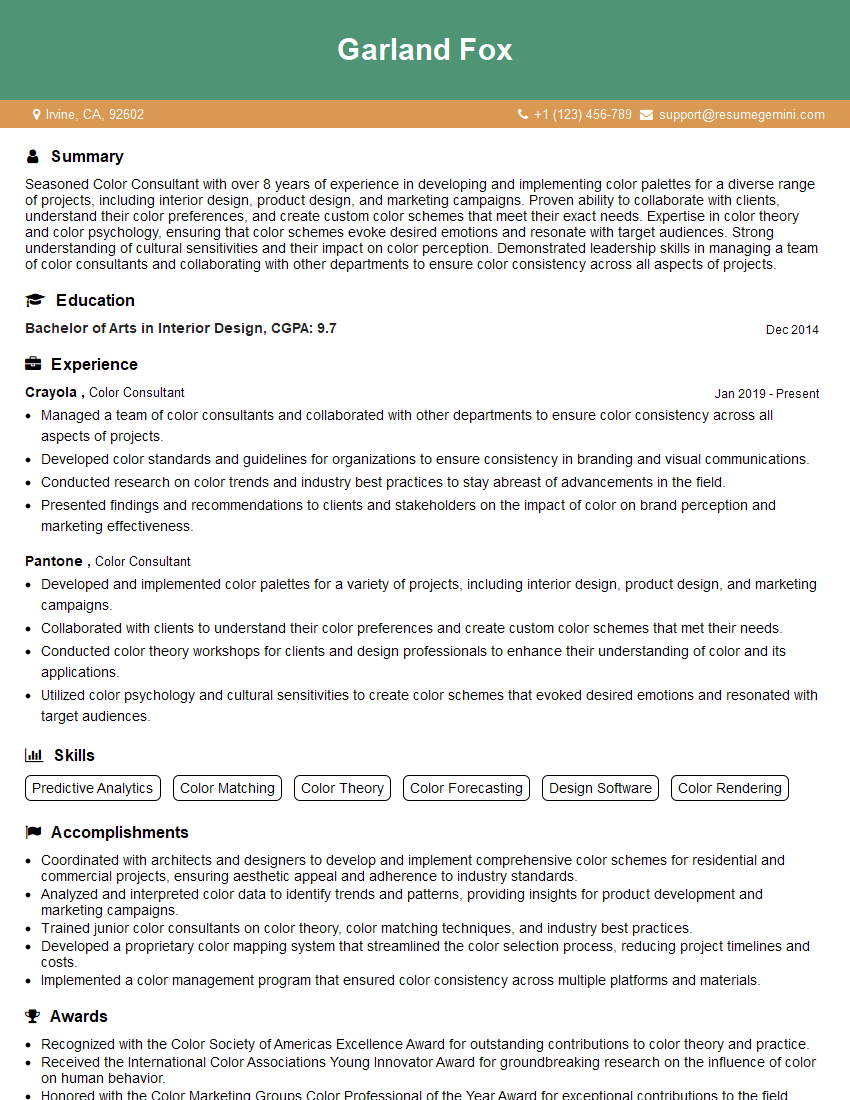
Mastering color mixing and pigmentation opens doors to exciting career opportunities in diverse and creative fields. A strong understanding of these principles is highly valued by employers, demonstrating both technical skill and creative problem-solving abilities. To maximize your job prospects, create an ATS-friendly resume that effectively highlights your expertise. ResumeGemini is a trusted resource to help you build a professional and impactful resume. They provide examples of resumes tailored to the Color Mixing and Pigmentation field, ensuring your qualifications shine. Take the next step in your career journey – craft a compelling resume that captures your skills and experience.

Explore more articles
Users Rating of Our Blogs
Share Your Experience
We value your feedback! Please rate our content and share your thoughts (optional).
What Readers Say About Our Blog
Very informative content, great job.
good