Cracking a skill-specific interview, like one for Glass coloring (powdered frits, glass paint, enamels), requires understanding the nuances of the role. In this blog, we present the questions you’re most likely to encounter, along with insights into how to answer them effectively. Let’s ensure you’re ready to make a strong impression.
Questions Asked in Glass coloring (powdered frits, glass paint, enamels) Interview
Q 1. Describe the difference between powdered frits, glass paints, and enamels.
While all three – powdered frits, glass paints, and enamels – are used to color glass, they differ significantly in composition, application, and firing process. Think of it like this: frits are the raw ingredient, glass paints are a pre-mixed blend, and enamels are a specialized type of frit often designed for specific applications.
- Powdered Frits: These are finely ground, partially fused glass particles. They require a high-temperature firing to fully melt and fuse to the glass surface, creating a durable, permanent bond. They are highly versatile, allowing for custom color mixing and effects.
- Glass Paints: These are ready-to-use mixtures containing frit, along with binders and other additives for improved application and handling. They are generally fired at lower temperatures than frits and offer greater convenience. Think of them as the ‘pre-mixed’ version, offering less control over color but easier application.
- Enamels: These are usually specialized frits with specific properties, such as high opacity, specific chemical resistance, or a particular finish (glossy, matte). They often require very precise firing temperatures and conditions to achieve the desired results. They can be thought of as ‘high-performance frits’ optimized for particular aesthetics or functional properties.
Q 2. Explain the process of applying powdered frits to glass.
Applying powdered frits involves several steps: First, prepare the glass surface by thoroughly cleaning it to remove any dust, grease, or other contaminants that might prevent proper adhesion. Next, sieve the frits to remove any large particles that could create an uneven surface. Then, apply the frit to the glass using a variety of techniques, including sifting, brushing, or spraying. The choice of method depends on the desired effect and the scale of the project. A thin, even coat is generally ideal. Finally, the glass is fired in a kiln at a temperature high enough to melt the frit and fuse it to the glass. This temperature will vary depending on the type of frit and the glass being used. Improper firing can lead to bubbling, cracking, or incomplete fusion.
Q 3. What are the key factors affecting the firing temperature of glass enamels?
Several factors influence the firing temperature of glass enamels: The most crucial is the composition of the enamel itself. Different frit formulations have different melting points. The type of glass being enameled also matters; different glass types have different coefficients of thermal expansion (CTE), and a mismatch can lead to cracking or delamination. The firing schedule (the rate of heating and cooling) is also critical. Rapid temperature changes can cause stress fractures in the enamel. Finally, the thickness of the enamel layer affects the firing temperature. A thicker layer will require a higher temperature and longer firing time to achieve full fusion.
Q 4. How do you achieve consistent color application with glass paints?
Consistent color application with glass paints requires careful attention to detail. First, ensure the paint is well mixed to avoid variations in pigment concentration. Then, use a consistent application technique – whether it’s brushing, sponging, or airbrushing – and maintain even pressure throughout the application process. Multiple thin coats are often preferable to one thick coat, as this reduces the risk of runs or uneven coverage. Finally, allow each coat to dry completely before applying the next, to prevent the colors from blending unexpectedly. A practiced, steady hand and attention to detail are key to achieving professional results.
Q 5. What are the common challenges encountered when using powdered frits?
Working with powdered frits presents unique challenges: Dust inhalation is a significant health concern; always use appropriate respiratory protection. Uneven application can result from clumping or inconsistencies in the frit itself. Color variations can occur due to variations in firing temperature or atmosphere within the kiln. Pinholing (tiny holes in the finished piece) can happen if the frit doesn’t fully fuse. Finally, the cleanup can be tedious, as frit dust is fine and persistent.
Q 6. How do you troubleshoot uneven color distribution in a fired piece?
Uneven color distribution after firing usually points to issues during the application or firing process. Here’s how to troubleshoot:
- Examine the application: Were there any clumps or thick areas of frit? Were different areas fired at different temperatures? Consider using a consistent application technique.
- Check the firing: Was the kiln temperature accurate and consistent throughout the firing process? Was the firing schedule followed correctly? Incorrect temperature or uneven heating can cause major discrepancies in color.
- Analyze the frit: Was the frit itself consistent in color and particle size? Some batches of frit can have variations. If using multiple batches or colors, ensure they’re fully blended.
- Re-fire (carefully): If the problem seems to be incomplete fusion, consider a second firing, but carefully monitor the temperature to prevent damage. If the problem is a thick area, consider carefully sanding or gently removing the excess material before refiring.
Careful documentation of the entire process, including firing logs, can be invaluable in identifying the source of the problem.
Q 7. Describe different methods for applying glass paints.
Several methods exist for applying glass paints:
- Brushing: This is the most common method for precise work and detailed designs. Different brush types (round, flat, liner) create different effects.
- Sponging: Creates a textured, somewhat less precise application, ideal for creating mottled or organic patterns.
- Airbrushing: Allows for even coverage over large areas and smooth gradients. Requires specialized equipment and skill.
- Sgraffito: This technique involves applying a layer of paint, then scratching or scraping away portions to reveal underlying layers or the glass surface. Creates dramatic effects.
- Stenciling: Using stencils provides precise patterns and shapes, perfect for repetitive designs or logos.
The best method depends on the desired effect, the artist’s skill level, and the project’s scale.
Q 8. Explain the importance of proper cleaning and preparation before applying glass color.
Proper cleaning and preparation are paramount to achieving vibrant, long-lasting results when applying glass color. Think of it like preparing a canvas before painting – a clean surface ensures the color adheres properly and prevents imperfections.
- Cleaning: Begin by thoroughly cleaning the glass surface with a degreaser to remove any oils, fingerprints, or dust. Warm soapy water often works well, followed by rinsing with distilled water to avoid mineral deposits. Then, meticulously dry the surface with a lint-free cloth. Even microscopic particles can interfere with adhesion.
- Surface Preparation (for certain techniques): Depending on the technique, you may need further surface preparation. For example, etching or sandblasting can create a textured surface that improves frit adhesion. For delicate glass, a gentle polishing step might be necessary.
- Example: I once had a student whose artwork was marred by streaks. It turned out a simple lint-free cloth wasn’t enough; microscopic fibers from a regular cloth had interfered with the even application of the frit. Switching to a dedicated cleaning cloth solved the problem immediately.
Paying attention to this crucial first step saves time and frustration in the long run and ultimately leads to a higher quality final product.
Q 9. What safety precautions are necessary when working with powdered frits and enamels?
Safety is paramount when handling powdered frits and enamels. These materials, while beautiful, can pose certain health risks if not handled properly.
- Respiratory Protection: Always wear a well-fitted respirator or dust mask specifically designed to filter fine particles. Inhaling frit dust can irritate the lungs.
- Eye Protection: Safety glasses or goggles are essential to protect your eyes from dust and potential splashes.
- Skin Protection: Gloves are recommended to prevent skin irritation from prolonged contact. Some frits can be mildly abrasive.
- Ventilation: Work in a well-ventilated area or use a ventilation system to minimize dust accumulation. A dedicated workspace is ideal.
- Disposal: Dispose of any leftover materials and cleaning supplies responsibly according to local regulations.
Remember, neglecting these precautions can lead to serious health problems. Treat these materials with the respect they deserve to ensure a safe and productive working environment.
Q 10. How do you determine the correct firing schedule for different glass colors?
Determining the correct firing schedule is critical for achieving the desired color intensity and preventing damage to the glass. The schedule varies significantly depending on the type of glass, the color itself (low-fire vs. high-fire), and the kiln’s characteristics.
- Manufacturer’s Recommendations: Always start with the manufacturer’s recommended firing schedule for your specific frit or enamel. This is the safest starting point.
- Testing: Conduct test firings on scrap glass to experiment with slight variations in temperature and time. This allows you to fine-tune the schedule for your specific kiln and desired effects. Document your findings meticulously.
- Kiln Type: Different kiln types (electric, gas, etc.) have varying heating rates, impacting the firing schedule. A slower heating rate is generally preferred to prevent thermal shock.
- Example: For a low-fire enamel, a slow ramp up to a peak temperature, a soak time at that temperature, and a gradual cool-down are crucial to prevent cracking or crazing. High-fire frits, however, may require a much higher peak temperature and longer firing times.
Accurate temperature control and a well-defined firing schedule are essential for consistent results. Never rush the process. Precision is key.
Q 11. Describe the various types of kilns used for firing glass.
Several kiln types are suitable for firing glass, each with its advantages and disadvantages. The choice often depends on budget, space, and the scale of your projects.
- Electric Kilns: These are popular for their precision temperature control, ease of use, and relative cleanliness. They are a great option for hobbyists and small studios.
- Gas Kilns: Gas kilns offer faster firing cycles and higher peak temperatures, making them suitable for large-scale projects and specific high-fire applications. They require more maintenance and proper ventilation.
- Resistance Kilns: Similar to electric kilns but often designed for high temperatures. They are robust and efficient.
- Small Portable Kilns: Excellent for low-fire applications and smaller projects where space is limited.
Consider factors like your budget, available space, the types of glass and colors you’ll be using, and the frequency of use when selecting a kiln. Research reviews before investing in a kiln to ensure it is suitable for your needs.
Q 12. How do you adjust the firing temperature to achieve specific color effects?
Adjusting firing temperature directly impacts the final color of your glass. Think of it as cooking – different temperatures lead to different results.
- Higher Temperatures: Generally, higher firing temperatures can deepen or intensify certain colors, making them more vibrant. However, excessive heat can also cause colors to become muddy or even burn out.
- Lower Temperatures: Lower temperatures can result in softer, more muted colors or preserve delicate nuances within the color itself.
- Oxidation/Reduction: The atmosphere within the kiln (oxidizing or reducing) also affects color. This is especially important for certain metallic oxides in your frit. Oxidizing atmospheres usually promote brighter colours, while reducing atmospheres often produce darker, more muted tones.
- Experimentation: The best approach involves careful experimentation using small test pieces and keeping detailed records of your results, including precise temperature settings, firing times, and atmospheric conditions.
Remember, precise temperature control is crucial for consistent, predictable results. This requires careful calibration of your kiln and detailed recording of your firing parameters. Always test on scrap pieces before working on your final artwork.
Q 13. Explain the concept of fusing glass with powdered frits.
Fusing glass with powdered frits involves melting the frit into the surface of a base glass piece to create a decorative effect. This process typically creates a permanently bonded, cohesive surface. The key is achieving a proper melt and fusion without causing the base glass to deform.
- Application: Apply the frit to the clean glass surface using a variety of techniques, such as sifting, brushing, or even stencils.
- Firing: The firing schedule needs to reach a temperature where the frit melts and flows but does not exceed the softening point of the base glass. This temperature will vary depending on the glass types.
- Adhesion: A proper firing schedule ensures the frit chemically bonds with the base glass, creating a strong, permanent fusion.
- Example: Fusing colorful frits onto clear glass can create stunning stained glass effects without the traditional lead came. Or, you can use frit to create textured surfaces and artistic patterns on functional glassware.
The beauty of frit fusing lies in its versatility. The range of colors and techniques available allows for unique artistic expression.
Q 14. What are the differences between low-fire and high-fire enamels?
Low-fire and high-fire enamels differ primarily in their melting point and the temperatures required for firing. This difference impacts their application and the types of glass they can be used on.
- Low-Fire Enamels: These are designed to melt and fuse at relatively low temperatures (typically around 1450-1550°F or 787-843°C). They are often easier to use and require less expensive kilns, making them ideal for beginners. However, they may not be as durable as high-fire enamels.
- High-Fire Enamels: These require significantly higher firing temperatures (typically 2000-2300°F or 1093-1260°C or higher) and are usually more durable. This requires more advanced equipment and expertise. They produce a more robust, scratch-resistant finish, suitable for functional ware.
- Compatibility: Always check the manufacturer’s recommendations for compatibility with the type of glass you intend to use. Using the wrong enamel type for your glass can lead to cracking or other defects.
Choosing between low-fire and high-fire enamels depends largely on your project’s requirements, your experience level, and the equipment available. The decision balances ease of use, cost, and the desired level of durability.
Q 15. Describe different techniques for creating textured surfaces with glass paint.
Creating textured surfaces with glass paint opens up a world of artistic possibilities. Think of it like adding dimension to a painting, but with glass! We can achieve this through several techniques. One common method is using stencils. By placing a stencil on the glass and applying paint, you can create crisp, defined patterns. Think geometric designs, floral motifs, or even lettering. Experimenting with different stencil materials, like vinyl or laser-cut metal, yields varied results.
Another approach involves applying the paint with different tools. A simple sponge can create a stippled effect, while a palette knife allows for expressive, impasto-like textures. You can even use textured rollers or stamps to imprint unique patterns onto the glass surface. The key is to experiment and let your creativity flow. For a truly organic texture, consider layering different paints, allowing some to dry slightly before applying another layer, or even adding elements like small glass beads or frit to the wet paint for a three-dimensional effect.
- Stencils: Precise, repeatable patterns.
- Sponges/Palette Knives: Organic and expressive textures.
- Textured Rollers/Stamps: Unique patterns and designs.
- Layering & Additives: Depth and dimension.
Career Expert Tips:
- Ace those interviews! Prepare effectively by reviewing the Top 50 Most Common Interview Questions on ResumeGemini.
- Navigate your job search with confidence! Explore a wide range of Career Tips on ResumeGemini. Learn about common challenges and recommendations to overcome them.
- Craft the perfect resume! Master the Art of Resume Writing with ResumeGemini’s guide. Showcase your unique qualifications and achievements effectively.
- Don’t miss out on holiday savings! Build your dream resume with ResumeGemini’s ATS optimized templates.
Q 16. How do you achieve a specific color by mixing different powdered frits?
Achieving a specific color with powdered frits is a bit like mixing paints, but with a little more nuance. It’s a process that requires understanding color theory and the properties of the individual frits. Each frit has a unique color and opacity, and the final shade is determined by the ratios in which they are mixed. Think of it like a recipe: you need the right proportions to achieve the desired result. For example, to create a vibrant green, you might combine a yellow frit with a blue frit. The exact amounts will depend on the specific frits you’re using and the intensity of green you’re aiming for.
I often start with a small test batch to see how the colors interact. I’ll mix small amounts of each frit, apply them to a test tile, and fire it to see the final result. This allows me to adjust the proportions until I achieve the desired shade. It’s an iterative process, and sometimes it takes a few tries to get it just right. Factors like the firing temperature and atmosphere also affect the final color, so consistency in these variables is crucial for reproducibility.
Q 17. What are the effects of different firing atmospheres on glass color?
Firing atmospheres significantly impact the final color of your glass. Think of it as the environment in which the glass undergoes a chemical transformation during firing. Different atmospheres affect oxidation and reduction processes within the glass, altering the way metal oxides within the frits and paints interact. A reducing atmosphere (one with limited oxygen) can lead to more vibrant, intense colors, often with warmer tones, while an oxidizing atmosphere (ample oxygen) may result in paler, more muted colors. For example, copper in a reducing atmosphere can create beautiful, ruby reds, while in an oxidizing atmosphere, it might result in a more brownish-yellow.
This is particularly relevant when working with certain metal oxides. Some colors are highly sensitive to the firing atmosphere, while others are relatively unaffected. Understanding these nuances is crucial to achieving the intended color. I meticulously control the atmosphere in my kiln to ensure consistency and achieve my desired aesthetic effect. It is a delicate balancing act, requiring precise control over the kiln’s environment to achieve predictability in color.
Q 18. How do you prevent crazing or cracking in your fired glass pieces?
Crazing and cracking in fired glass are frustrating issues that stem from thermal expansion mismatch between the different layers of glass or between the glass and the base material. It’s like having two pieces of wood with different expansion rates glued together; when heated or cooled, one expands or contracts differently causing stress leading to cracks. The key to preventing this lies in ensuring compatibility between the glass and the substrate and managing the firing process. Careful selection of compatible frits and paints is crucial. Always check the manufacturer’s specifications for compatibility with your chosen substrate.
Gradual heating and cooling cycles during firing are vital to minimize thermal stress. Slowing down the heating and cooling rates allows for even expansion and contraction, reducing the likelihood of cracking. Also, ensuring a clean and well-prepared surface before applying the glass colors minimizes imperfections that could act as stress points. Finally, applying thin, even coats of paint minimizes the risk of cracking compared to thick, uneven layers. The art is in the balance – precise technique coupled with careful material selection.
Q 19. How do you maintain the quality and consistency of your work?
Maintaining quality and consistency is paramount. It’s about establishing a reliable process and paying close attention to detail. For me, this starts with meticulously documenting every step of my process, from the frits and paints used to the firing schedule. I use precise measuring tools for my frit mixtures, ensuring consistent ratios each time. This consistency in material preparation is key.
Regular calibration and maintenance of my kiln are also essential. I meticulously track its performance and ensure it’s firing at the correct temperatures and atmospheric conditions. This minimizes unexpected variations in the outcome. Consistent cleaning of my tools and workspace prevents contamination and ensures that the quality of my materials isn’t compromised. Finally, continuous learning and experimentation are crucial for improvement and refinement, always pushing me to enhance my techniques and expand my creative horizons.
Q 20. Describe your experience with different brands of glass paints and enamels.
Over the years, I’ve worked with a wide range of glass paint and enamel brands. Each brand has its own strengths and weaknesses, often relating to color vibrancy, opacity, and ease of application. For example, some brands offer excellent color saturation but can be challenging to apply evenly, while others may have a more forgiving application but less intense colors. I have my go-to brands for specific applications, such as one brand for its exceptional reds and another for its wide range of translucent colors.
Experimentation is key to discovering which brands best suit your needs and style. Consider factors like the cost-effectiveness, firing temperature ranges, the level of detail you can achieve, and the overall aesthetic feel of the finished product. It’s about finding the perfect tool for the job and understanding how to optimize their use for desired outcomes. I often compare notes with fellow artists and seek advice on specific brands or techniques.
Q 21. What are the common causes of color variations in fired glass?
Color variations in fired glass can stem from various sources. Inconsistent frit mixing is a common culprit; slight variations in the proportions of each frit can lead to noticeable color shifts. Changes in the firing temperature or atmosphere also greatly impact the final color. Even seemingly small fluctuations can lead to noticeable differences. For example, a slight increase in temperature can alter the oxidation state of the metal oxides in the glass, leading to color shifts.
The kiln’s consistency is also paramount. Uneven heating within the kiln can result in variations in color across a single piece. Finally, the base material itself can affect the outcome. Different types of glass or substrates can interact differently with the applied frits or paints, influencing the final color. Careful consideration and control over all of these factors are essential for achieving consistent and predictable results.
Q 22. How do you handle a situation where a fired piece has unwanted color results?
Unwanted color results after firing are unfortunately common in glass coloring. The first step is to carefully analyze the problem. Was the color too light, too dark, or completely different from the intended shade? Was there uneven application, blistering, or other defects? The root cause could be several factors.
- Incorrect Frit/Paint Ratio: Using too little pigment will result in a pale color, while too much can lead to uneven coverage or cracking. Precise measurement is crucial, often involving weighing rather than just eyeballing quantities.
- Firing Temperature Issues: Each frit and glass paint has a specific firing temperature range. Firing outside this range can alter the final color significantly. A kiln’s temperature accuracy should be verified regularly with a calibrated pyrometer.
- Improper Application: Uneven application can result in streaking or blotches. A consistent and controlled application method, whether by brushing, spraying, or sifting, is vital.
- Contamination: Any impurities, even trace amounts of oil or dust, can affect color. Maintaining a clean workspace is paramount.
- Glass Type Incompatibility: Certain frits are better suited to specific glass types. Using the wrong frit for the glass base can lead to unexpected reactions and color changes.
Troubleshooting involves systematically eliminating these possibilities. I typically start by recreating the process with precise measurements and controlled firing conditions. If the problem persists, I carefully examine the materials, looking for signs of contamination or expiry dates. Sometimes, a small test piece fired at slightly different temperatures helps pinpoint the issue.
Q 23. Explain your experience with different glass types and their suitability for various color application techniques.
My experience spans a broad range of glass types, including soda-lime, borosilicate, and lead crystal, each requiring a different approach to color application. Soda-lime glass, common in everyday glassware, generally works well with most powdered frits and glass paints. Borosilicate glass, known for its heat resistance, may require specific high-temperature frits to avoid issues during firing. Lead crystal glass presents a unique challenge, often demanding carefully selected low-temperature enamels to prevent damage to the delicate glass structure.
For example, applying powdered frits to soda-lime glass often involves sifting and then fusing at a high temperature. With borosilicate, I’d use a higher-temperature enamel, and potentially a different application technique like silk screening to control the precise placement and thickness of the frit. For lead crystal, I may opt for hand-painting with carefully formulated enamels, focusing on gentle firing cycles to avoid cracking.
The application technique itself also varies depending on the desired effect. For example, a fine spray application might produce a translucent effect, while a thicker, brushed application creates more opacity. I have expertise in numerous techniques including brushwork, airbrushing, silk-screening, and decal application, each adapted to the specific glass type and intended aesthetic outcome.
Q 24. How do you manage your inventory of glass colors and materials?
Inventory management is crucial for maintaining color consistency and avoiding waste. My system is organized by pigment type (frits, paints, enamels) and then further categorized by color and manufacturer. Each container is clearly labeled with the product name, manufacturer, batch number, and date of acquisition. This meticulous labeling ensures traceability and aids in quality control.
I use a digital inventory management system (I use a spreadsheet, but specialized software is also an option) to track stock levels, ensuring that I reorder materials before running out. This system allows for easy identification of slow-moving items, enabling better purchasing strategies and reducing storage space for less frequently used pigments. Proper storage is also vital. I store frits in airtight containers in a cool, dry place to prevent moisture absorption, which can affect color and consistency.
Regular inventory checks are performed to ensure accuracy and identify any damaged or expired materials. These are promptly disposed of according to safety regulations.
Q 25. What are your preferred methods for cleaning and maintaining your tools?
Maintaining clean tools is essential for consistent color application and preventing cross-contamination. My cleaning routine varies depending on the tool and the material used. After each use, brushes are thoroughly rinsed with warm soapy water, then rinsed again with clean water to remove all traces of pigment. I then reshape the bristles and let them air dry completely to prevent warping.
For airbrushes, I use a dedicated airbrush cleaner and follow the manufacturer’s instructions meticulously. This typically involves rinsing with cleaner, followed by water, and then a final air purge to ensure the lines are completely clear. Palette knives, stencils, and other tools are carefully cleaned with mild detergent and water, and meticulously dried. If stubborn residues persist, I may use a specialized glass cleaner, but always ensuring that the cleaner is compatible with the tools’ material.
Regular maintenance also includes checking for wear and tear. Worn brushes need replacing to maintain a consistent application. Similarly, damaged stencils are replaced to avoid inaccuracies in the design.
Q 26. How do you stay up-to-date with the latest developments in glass coloring techniques?
Staying current in this field requires continuous learning. I regularly attend workshops and conferences related to glass art and ceramics, keeping abreast of the latest techniques, equipment, and materials. Many suppliers offer training sessions or workshops on their newest products and best practices.
Professional journals and online publications dedicated to glass art and technology are invaluable resources. I also actively follow leading artists and glass studios on social media to observe and learn from their innovative techniques. There are many excellent online communities dedicated to glass art where artists share their work and experiences, fostering knowledge sharing and collaboration.
Experimentation is another crucial aspect. I regularly conduct tests with different frits, paints, and firing techniques to explore new color combinations and effects. This experimental approach is crucial in staying at the forefront of glass coloring advancements.
Q 27. Describe a time you had to solve a problem related to glass color application.
Once, I was commissioned to create a series of glass vases with a specific, deep teal color. After the initial firing, the color turned out to be much lighter than anticipated, despite using a reputable frit and following established procedures. Initially, I suspected a problem with the frit batch, but testing a new batch yielded similar results.
My systematic troubleshooting began with reviewing the firing process. I meticulously checked the kiln’s temperature profile using a calibrated pyrometer, discovering slight fluctuations during the crucial part of the firing cycle. Although within the stated firing range, these minor inconsistencies were enough to subtly impact color development. I adjusted the firing schedule to maintain a more consistent temperature profile, ensuring a more controlled firing process.
After implementing these changes and repeating the process, the desired teal color was achieved. This experience underscored the importance of meticulous record-keeping and the use of calibrated equipment for consistent and reliable results.
Q 28. Explain your experience with quality control procedures related to glass coloring.
Quality control is paramount in my workflow. It begins with carefully selecting high-quality materials from reputable suppliers. I always check for expiry dates, ensuring the materials are in optimal condition. Before starting a project, I perform test firings with small samples to verify color consistency and to check for any potential issues with the chosen frit and glass combination.
During the application process, I maintain consistency in the application method (whether brushing, spraying, or sifting), ensuring even coverage and preventing streaking or blotching. After firing, each piece is inspected for defects such as blistering, cracking, or uneven color. Any pieces that do not meet my quality standards are rejected and reworked or discarded.
Detailed records are kept for each project, including the materials used, quantities, firing schedule, and any modifications made. This comprehensive documentation allows for reproducibility and facilitates future troubleshooting, should any issues arise. This commitment to rigorous quality control ensures the consistent production of high-quality, visually appealing glass pieces.
Key Topics to Learn for Glass Coloring (Powdered Frits, Glass Paint, Enamels) Interview
- Powdered Frits: Understanding frit composition, particle size distribution, and its impact on color development and application techniques.
- Glass Paint: Exploring different types of glass paints (e.g., oil-based, water-based, acrylic), their application methods, firing temperatures, and achieving desired opacity and vibrancy.
- Enamels: Differentiating between low-fire and high-fire enamels, understanding their chemical properties, and mastering application techniques for achieving smooth, consistent finishes.
- Color Theory and Mixing: Applying color theory principles to predict and achieve desired colors by mixing powdered frits, glass paints, or enamels. Understanding color stability and potential changes during firing.
- Firing Techniques and Kiln Operation: Understanding the role of temperature, time, and atmosphere in achieving optimal results during the firing process. Troubleshooting common firing issues.
- Surface Preparation: Preparing different substrates (glass, ceramics, metal) for optimal adhesion of glass coloring materials. Understanding cleaning, priming, and other pre-application steps.
- Health and Safety Regulations: Familiarity with handling procedures, safety equipment, and waste disposal practices for powdered frits, glass paints, and enamels.
- Troubleshooting and Quality Control: Identifying and resolving common issues such as pinholes, crazing, color inconsistencies, and other defects.
- Practical Applications: Understanding the application of glass coloring techniques in various industries (e.g., stained glass, jewelry making, ceramics, decorative arts).
Next Steps
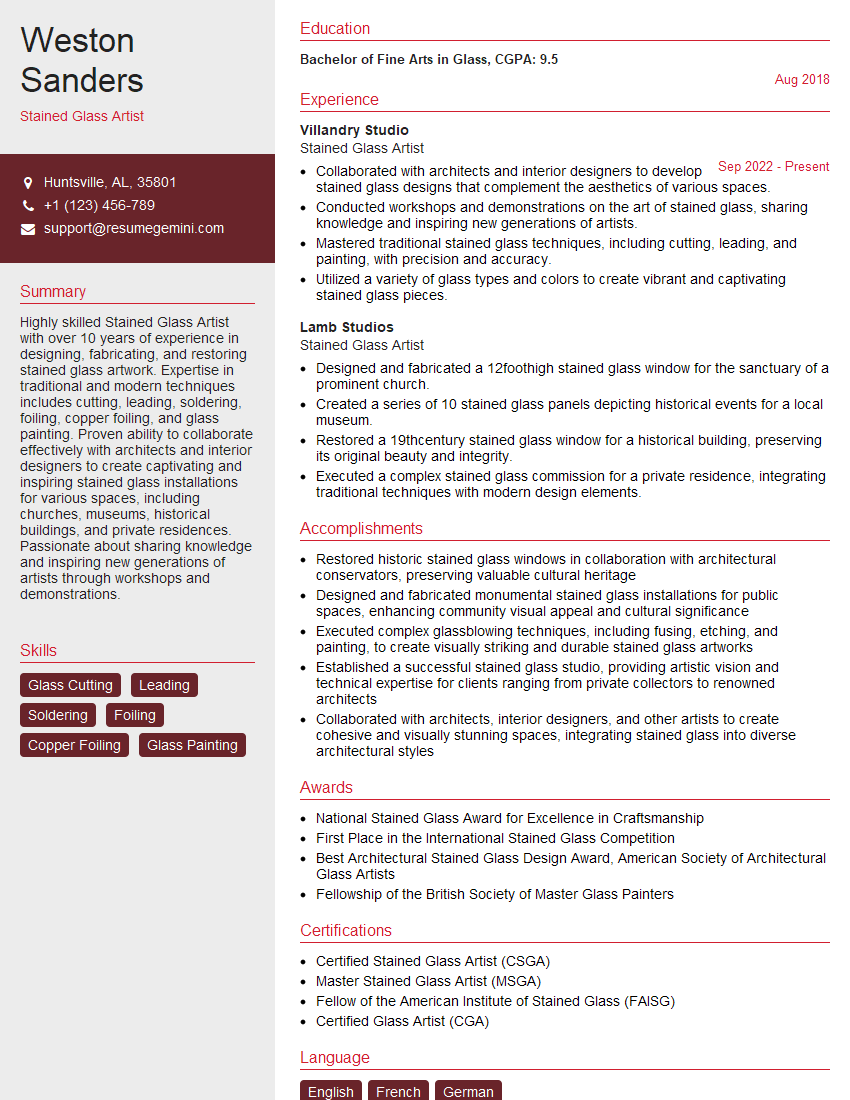
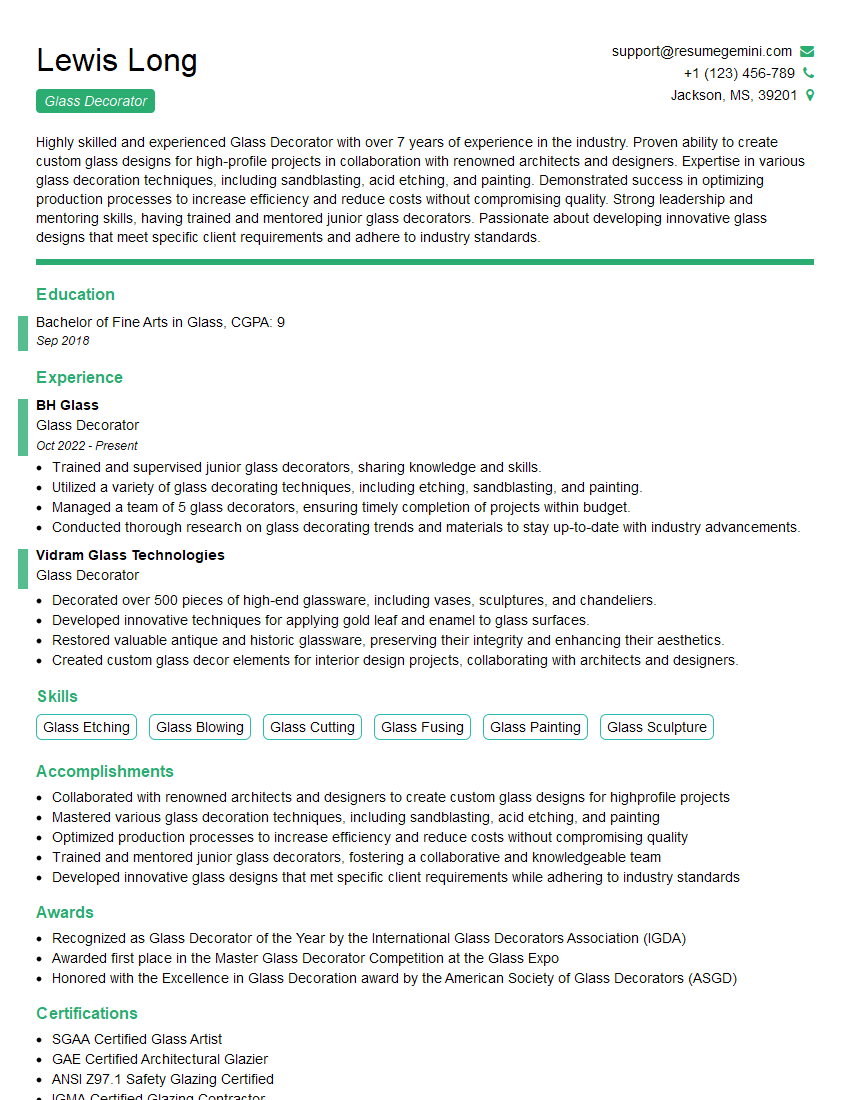
Mastering the art of glass coloring with powdered frits, glass paints, and enamels opens doors to exciting career opportunities in creative and technical fields. To maximize your chances of securing your dream role, focus on crafting a strong, ATS-friendly resume that highlights your skills and experience effectively. ResumeGemini is a trusted resource that can help you build a professional and impactful resume tailored to your specific experience. Examples of resumes tailored to glass coloring are available to help guide you. Invest time in building a compelling resume – it’s your first impression with potential employers.

Explore more articles
Users Rating of Our Blogs
Share Your Experience
We value your feedback! Please rate our content and share your thoughts (optional).
What Readers Say About Our Blog
Very informative content, great job.
good