Interviews are opportunities to demonstrate your expertise, and this guide is here to help you shine. Explore the essential Testing and validation of weight engineering solutions interview questions that employers frequently ask, paired with strategies for crafting responses that set you apart from the competition.
Questions Asked in Testing and validation of weight engineering solutions Interview
Q 1. Explain the process of weight engineering validation.
Weight engineering validation ensures that the designed weight of a component or system meets its specified requirements and performs as intended. It’s a multi-step process involving analysis, testing, and verification.
- Analysis: This phase uses computational tools like Finite Element Analysis (FEA) and weight estimation software to predict the weight and structural integrity of the design. We’ll check for stress concentrations, fatigue life, and other critical factors.
- Testing: This involves physical testing of prototypes or components to validate the analytical predictions. This can include static load tests, dynamic tests (vibration, shock), and fatigue tests to verify that the design can withstand expected operational loads.
- Verification: This compares the results from analysis and testing with the original design specifications. This often involves creating a detailed report documenting any discrepancies and suggesting corrective actions if the design doesn’t meet the requirements. Tolerance analysis is crucial here.
- Iteration: If discrepancies exist, the design is iterated upon, using the test data and analysis to refine the design for optimal weight and performance. This iterative approach is key to achieving a successful weight-optimized design.
For example, in aerospace, validating the weight of a landing gear requires detailed stress analysis to ensure it can withstand landing impacts, combined with fatigue testing to guarantee its lifespan. Any deviations from the predicted weight would need to be investigated.
Q 2. Describe different weight reduction techniques for aerospace applications.
Weight reduction in aerospace is critical due to fuel efficiency and payload capacity. Several techniques are employed:
- Material Substitution: Replacing heavier materials like steel with lighter alternatives like aluminum alloys, titanium, or carbon fiber composites. For example, using carbon fiber reinforced polymers (CFRP) instead of aluminum in aircraft fuselages significantly reduces weight.
- Design Optimization: Using topology optimization software to remove excess material from components without compromising strength. This involves complex algorithms to create designs that are both lightweight and structurally sound.
- Component Integration: Combining multiple components into a single, more efficient unit. This minimizes fasteners and reduces overall weight. Think of integrating hydraulic lines within a wing structure.
- Miniaturization: Reducing the size of components through advancements in technology, allowing for the use of less material. This is frequently employed in avionics and other systems.
- Hollow Structures: Utilizing hollow or honeycomb structures to maximize strength-to-weight ratio. This is common in aircraft panels and structural elements.
- Additive Manufacturing: Utilizing 3D printing techniques to create lightweight, complex geometries that would be impossible to manufacture using traditional methods. Lattice structures are a great example.
The selection of the best technique depends on factors such as component function, load requirements, and manufacturing capabilities.
Q 3. How do you determine the acceptable weight tolerance for a given component?
Acceptable weight tolerance depends on several factors and is determined through a combination of engineering judgment and rigorous analysis. It’s not a fixed value.
- Functional Requirements: How critical is the component’s weight to the overall system performance? A minor component with less impact might allow for a larger tolerance than a critical load-bearing structure.
- Manufacturing Process Capabilities: What are the inherent variations in the manufacturing process? A precisely manufactured component can have a tighter tolerance than one produced through a less precise process.
- Safety Factors: The tolerance should incorporate safety factors to account for uncertainties and unexpected loads. For aerospace applications, this is crucial.
- Cost Considerations: Tight tolerances often increase manufacturing costs, so the economic impact must be considered.
Tolerance is usually expressed as a percentage of the nominal weight or as an absolute weight difference. For instance, a tolerance of ±2% for a 10kg component implies that the actual weight can vary between 9.8 kg and 10.2 kg. Detailed tolerance analysis uses statistical methods to account for variability in manufacturing and material properties.
Q 4. What are the common software tools used in weight engineering analysis?
Several software tools facilitate weight engineering analysis:
- CATIA: A widely used CAD software package with robust capabilities for design, analysis, and weight estimation.
- NX: Another powerful CAD software offering similar functionalities to CATIA.
- ANSYS: A leading FEA software widely used for structural analysis and optimization, including weight optimization.
- Abaqus: A comprehensive FEA software used for complex simulations and analysis.
- Nastran: A finite element solver frequently used in aerospace applications.
- Weight Estimation Software: Specialized software packages exist specifically for weight prediction and estimation, simplifying the process.
The choice of software depends on the complexity of the analysis and the specific needs of the project. Often, multiple software packages are used in a complementary fashion.
Q 5. How do you balance performance requirements with weight constraints?
Balancing performance and weight constraints often involves trade-off decisions. It’s an iterative process.
- Define Clear Requirements: Begin with a clear understanding of the performance goals and weight limitations. These should be documented rigorously.
- Multidisciplinary Optimization (MDO): Employ MDO techniques to consider the interactions between different disciplines. This involves coordinated design changes across multiple engineering teams.
- Pareto Optimization: Use optimization methods to identify the best balance between competing objectives. A Pareto front represents optimal solutions; we select one based on engineering judgment and considerations.
- Sensitivity Analysis: Understand how changes in one parameter affect others. This helps in identifying design variables that significantly impact both weight and performance.
- Iterative Design Process: Employ an iterative design process, continuously evaluating the trade-offs and making adjustments until a satisfactory balance is achieved.
For example, designing a lighter aircraft wing might necessitate using more expensive materials or employing more complex manufacturing techniques, impacting cost. The decision on how much weight to save versus the extra expense requires careful consideration and justification.
Q 6. Explain the concept of ‘Design for Weight’.
‘Design for Weight’ is a holistic approach to engineering design that prioritizes minimizing weight from the initial conceptual stages. It’s not merely about reducing weight at the end of the design process; it’s a fundamental philosophy that permeates the entire design cycle.
- Early Weight Estimation: Incorporate weight estimations from the very beginning, guiding design choices and identifying potential weight-saving opportunities.
- Material Selection: Thoroughly evaluate material properties to select the lightest suitable materials for each component.
- Simplified Design: Avoid unnecessary complexity; strive for simple, efficient designs that minimize material usage.
- Modular Design: Design components in modules, allowing for easier replacement and optimization.
- Collaboration: Foster strong collaboration between different engineering teams (structural, aerodynamic, etc.) to ensure a coordinated approach to weight reduction.
Think of it like building with LEGOs: ‘Design for Weight’ means selecting the fewest, yet strongest, LEGO bricks needed to build the structure, avoiding unnecessary additions.
Q 7. Describe your experience with Finite Element Analysis (FEA) in weight optimization.
I have extensive experience using Finite Element Analysis (FEA) in weight optimization. FEA is a powerful tool for predicting the structural behavior of components under various loads, enabling us to identify areas where material can be removed without compromising strength or safety.
- Topology Optimization: I have used FEA software like ANSYS and Abaqus to perform topology optimization studies. This allows us to identify the optimal material distribution within a component, effectively removing unnecessary material while ensuring structural integrity. The software generates designs that are often counter-intuitive and much lighter than conventional designs.
- Stress Analysis: FEA is crucial for stress analysis, helping us identify stress concentrations that can lead to premature failures. Understanding the stress distribution helps refine the design and potentially remove material in low-stress regions.
- Modal Analysis: I’ve used FEA to perform modal analysis, determining the natural frequencies and mode shapes of components. This is especially important for aerospace applications, where vibration can be a significant concern. We can then adjust the design to avoid resonance.
- Nonlinear Analysis: For complex situations involving large deformations or nonlinear material behavior, I’ve conducted nonlinear FEA simulations to accurately predict the component’s behavior under load.
In one project, I used topology optimization to reduce the weight of an aircraft wing rib by 20% without compromising its strength. This resulted in significant fuel savings and improved aircraft performance. FEA is indispensable in validating these design changes.
Q 8. What are the key considerations when selecting materials for weight reduction?
Selecting materials for weight reduction is a crucial step in weight engineering, demanding a careful balance between strength, stiffness, and density. We must consider several key factors:
- Specific Strength and Stiffness: We prioritize materials with high strength-to-weight and stiffness-to-weight ratios. For example, carbon fiber reinforced polymers (CFRP) offer superior strength and stiffness compared to steel, allowing for significant weight savings while maintaining structural integrity.
- Density: Lower density materials directly translate to lower weight. Aluminum alloys are frequently used due to their relatively low density compared to steel. Titanium, while more expensive, provides an even higher strength-to-weight ratio for applications demanding extreme lightness.
- Manufacturing Processability: The chosen material must be easily and cost-effectively formed into the desired shape. Some advanced materials, while possessing excellent properties, might be challenging and expensive to manufacture.
- Cost: Material cost is a significant constraint. While lightweight materials like titanium are advantageous, their high cost necessitates careful evaluation and potentially alternative solutions for less critical components.
- Environmental Impact: The environmental impact of material extraction, processing, and disposal should be factored into material selection. Recyclable and sustainable materials are gaining traction.
- Durability and Fatigue Resistance: The material must withstand expected operating conditions, including fatigue loading, corrosion, and temperature extremes.
In practice, we often use material selection charts and software tools that combine material properties with design constraints to identify optimal choices. For instance, in designing a lightweight aircraft component, we might compare aluminum alloys, CFRP, and titanium based on their strength, stiffness, cost, and manufacturing feasibility before making a final decision.
Q 9. How do you handle discrepancies between predicted and actual weights?
Discrepancies between predicted and actual weights are common in weight engineering projects. These discrepancies can stem from various sources, including inaccuracies in material properties, manufacturing tolerances, and modeling simplifications. Addressing these discrepancies involves a systematic approach:
- Root Cause Analysis: We meticulously investigate the sources of the discrepancy. This might involve reviewing the finite element analysis (FEA) model for potential errors, checking material certifications for accuracy, and inspecting manufactured parts for dimensional variations.
- Model Refinement: If the discrepancy is significant and attributable to modeling inaccuracies, we refine the FEA model. This could involve improving mesh density, incorporating more accurate material properties, or adding details like fasteners and joints.
- Manufacturing Process Review: We might need to review the manufacturing process to identify and address potential sources of weight variation. Improved quality control and tighter tolerances can minimize these variations.
- Compensation Strategies: Depending on the magnitude and nature of the discrepancy, compensation strategies might be employed. This could involve minor design adjustments or using lighter materials in non-critical areas.
- Documentation and Reporting: All findings, corrections, and deviations from the predicted weight are meticulously documented. This documentation is crucial for future projects and helps to improve prediction accuracy.
For example, if a component is consistently heavier than predicted due to variations in casting, we’d collaborate with the manufacturing team to refine the casting process, reducing variations and improving predictability.
Q 10. Describe your experience with weight budget management.
Weight budget management is akin to financial budgeting, but instead of money, we’re managing weight. It’s a crucial aspect of weight engineering, particularly in projects with stringent weight limitations, like aircraft or spacecraft design. My experience involves:
- Establishing Weight Targets: This starts with defining the overall weight goal for the entire system and then allocating weights to individual subsystems and components. This allocation takes into account functional requirements and performance targets.
- Tracking Weight Changes: Throughout the design process, we diligently track all changes in weight. This involves regularly updating a weight budget spreadsheet or database that reflects modifications to components or materials.
- Weight Optimization Strategies: If the weight exceeds the budget, we implement weight reduction strategies, such as material substitution, design optimization, and process improvements.
- Communication and Collaboration: Effective weight budget management requires close collaboration with all engineering disciplines. Regular updates and communication prevent conflicts and ensure that weight targets are met.
- Contingency Planning: It’s crucial to account for unforeseen weight increases. We often build in a weight contingency to accommodate unexpected issues or design changes.
In a recent project involving the design of a drone, I was responsible for managing a weight budget of 5kg. Through careful selection of materials and iterative design optimization, we successfully reduced the weight by 1.2kg, achieving a significant performance improvement while staying within the budget.
Q 11. How do you ensure the structural integrity of a lightweight design?
Ensuring structural integrity in lightweight designs requires a multi-faceted approach that goes beyond simply using lighter materials. It’s a delicate balance between minimizing weight and maintaining structural strength and safety. Key strategies include:
- Finite Element Analysis (FEA): FEA is extensively used to simulate the structural behavior of the design under various loading conditions. This helps to identify potential stress concentrations and weak points.
- Optimization Techniques: Topology optimization and other optimization techniques can be employed to find designs that minimize weight while satisfying structural constraints.
- Material Selection: As mentioned earlier, choosing materials with high strength-to-weight ratios is paramount. This often involves advanced materials like CFRP or titanium alloys.
- Design for Manufacturing (DFM): DFM principles are crucial. The design must be manufacturable without compromising its structural integrity.
- Testing and Validation: Rigorous testing, including static, dynamic, and fatigue tests, is necessary to verify the structural integrity of the lightweight design.
- Redundancy and Fail-Safe Mechanisms: In critical applications, incorporating redundancy and fail-safe mechanisms can enhance the safety and reliability of the structure.
For example, in designing a lightweight bicycle frame, we use FEA to analyze stress distribution under various riding conditions. We might then optimize the frame’s geometry to minimize weight while ensuring sufficient stiffness to prevent fatigue failure.
Q 12. What are the common challenges in weight engineering projects?
Weight engineering projects often encounter numerous challenges. Some of the most common include:
- Conflicting Requirements: Weight reduction often conflicts with other design requirements, such as strength, stiffness, cost, and manufacturability. Balancing these competing demands requires careful trade-off analyses.
- Material Limitations: The availability and cost of lightweight materials can pose significant challenges. Finding suitable materials that meet performance, cost, and manufacturability requirements is often a complex task.
- Uncertainties in Loading Conditions: Accurate prediction of loading conditions is crucial for structural design. Uncertainties in loading can lead to over-design and unnecessary weight.
- Manufacturing Constraints: Manufacturing processes can limit the ability to achieve highly optimized lightweight designs. Design choices must be compatible with available manufacturing capabilities.
- Testing and Validation Challenges: Testing lightweight structures can be challenging due to their sensitivity to damage and the need for sophisticated testing equipment.
For example, in aerospace applications, the need for extreme lightness often clashes with safety regulations and the need for robust and reliable performance in harsh environments. Managing these conflicting requirements is a central challenge in weight engineering.
Q 13. Explain your experience with different testing methodologies (e.g., static, dynamic).
My experience encompasses a wide range of testing methodologies crucial for validating weight engineering solutions. I’ve extensively used:
- Static Testing: This involves applying static loads to a structure to determine its strength and stiffness. It helps verify the design’s ability to withstand expected service loads without failure. We use load cells, strain gauges, and displacement sensors to measure forces and deformations.
- Dynamic Testing: Dynamic testing assesses the structure’s response to time-varying loads. Modal testing, for instance, helps identify the natural frequencies and mode shapes of the structure. This is crucial for preventing resonance and fatigue failures. We often employ accelerometers and impact hammers for dynamic testing.
- Fatigue Testing: Fatigue testing evaluates the structure’s resistance to repeated cyclic loading. This involves subjecting the component to millions of load cycles to determine its fatigue life. This testing is critical for ensuring the longevity and reliability of lightweight structures prone to fatigue failure.
- Non-Destructive Testing (NDT): NDT techniques, like ultrasonic inspection and X-ray radiography, are used to inspect components for internal flaws or defects without causing damage. This is crucial for quality control and ensuring the integrity of lightweight structures.
In a recent project involving a lightweight automotive component, we employed static testing to verify strength under maximum load conditions, dynamic testing to assess its response to road vibrations, and fatigue testing to determine its lifespan under typical driving conditions.
Q 14. How do you interpret and report weight analysis results?
Interpreting and reporting weight analysis results requires clarity and precision. The results are presented in a structured format, incorporating both quantitative and qualitative information. Key elements include:
- Weight Summary Table: A table summarizing the weight of individual components and the overall system weight. This table often includes initial estimates, final weights, and the percentage of weight reduction achieved.
- Stress and Strain Plots: Visualizations of stress and strain distributions obtained from FEA are crucial for identifying potential problem areas. These plots are carefully analyzed to ensure that stresses remain within acceptable limits.
- Modal Analysis Results: Results from modal analysis, such as natural frequencies and mode shapes, are presented graphically and discussed in the context of avoiding resonance issues.
- Testing Data: Data from static, dynamic, and fatigue testing are meticulously documented and presented graphically. This provides evidence of the structure’s performance and its ability to withstand expected loading conditions.
- Deviation Analysis: If discrepancies exist between predicted and actual weights, a detailed analysis of the root causes and corrective actions is included.
- Recommendations: Based on the analysis and testing results, recommendations for design improvements and future work are provided.
The report’s clarity and accuracy are crucial. Using clear visuals and concise explanations helps ensure that stakeholders, who may not have a deep understanding of weight engineering, can easily grasp the key findings and conclusions.
Q 15. Describe your experience with data analysis and reporting in weight engineering.
Data analysis and reporting are crucial in weight engineering. It’s not just about getting a final weight; it’s about understanding why a component weighs what it does and identifying areas for improvement. My process typically involves collecting data from various sources – CAD models, material specifications, manufacturing processes, and test results. I then use statistical software like Minitab or JMP to analyze this data, looking for trends, outliers, and correlations. For example, I might analyze the relationship between material thickness and component weight to identify opportunities for material substitution without compromising strength. My reports are detailed, visually appealing, and easily understandable by both technical and non-technical audiences. They include clear visualizations like charts and graphs showing weight breakdowns by component, material, and manufacturing process, along with recommendations for weight reduction strategies and their potential impact on cost and performance.
For example, in a recent project analyzing the weight of an automotive chassis, I discovered a significant weight disparity between the left and right sides. Through data analysis, I identified a machining process variation as the root cause, leading to the implementation of stricter quality control measures and a 5% reduction in overall chassis weight.
Career Expert Tips:
- Ace those interviews! Prepare effectively by reviewing the Top 50 Most Common Interview Questions on ResumeGemini.
- Navigate your job search with confidence! Explore a wide range of Career Tips on ResumeGemini. Learn about common challenges and recommendations to overcome them.
- Craft the perfect resume! Master the Art of Resume Writing with ResumeGemini’s guide. Showcase your unique qualifications and achievements effectively.
- Don’t miss out on holiday savings! Build your dream resume with ResumeGemini’s ATS optimized templates.
Q 16. How do you collaborate with other engineering disciplines during weight optimization?
Weight optimization is a collaborative effort. I frequently work closely with design engineers, materials engineers, and manufacturing engineers. Effective communication is key. Early involvement in the design process allows for proactive weight reduction strategies rather than reactive fixes later on. I use collaborative tools like shared spreadsheets and project management software to keep everyone informed and aligned on goals. For example, I might work with design engineers to explore alternative designs that reduce material usage while maintaining structural integrity. With materials engineers, I’ll explore lighter, stronger materials or innovative composite materials. And with manufacturing engineers, I’ll ensure that any weight reduction strategies are manufacturable without compromising quality or increasing production costs.
Think of it like building a house – the architect (design engineer) creates the blueprint, the materials supplier (materials engineer) provides the bricks, and the construction crew (manufacturing engineer) builds the house. The weight engineer ensures the house is built efficiently and within the weight limits.
Q 17. Explain your experience with weight engineering in a specific industry (e.g., automotive, aerospace).
My extensive experience is in the aerospace industry, focusing on aircraft weight reduction. In this field, even small weight savings translate into significant fuel efficiency gains, reduced operating costs, and increased payload capacity. I’ve worked on numerous projects, from optimizing the weight of individual components like landing gear and seats to the overall airframe weight. This often involves using Finite Element Analysis (FEA) to assess the structural integrity of components after weight reduction modifications. A key aspect of my work has been adhering to stringent aerospace standards and regulations regarding safety and structural integrity. For example, in one project, we reduced the weight of an aircraft’s wing structure by 8% through the use of advanced composite materials and optimized design, while simultaneously ensuring the structure met all FAA certification requirements. This led to a substantial improvement in fuel economy and operational efficiency for the airline.
Q 18. How do you manage changes in weight requirements during the project lifecycle?
Changes in weight requirements are common, especially in dynamic projects. To manage these changes effectively, I utilize a structured approach that involves: 1) Impact Assessment: Quantify the impact of weight changes on other systems and overall performance. 2) Feasibility Analysis: Determine if meeting the revised requirements is technically and economically feasible. 3) Mitigation Planning: Develop a plan to address the changes, identifying trade-offs and potential risks. 4) Communication: Keep all stakeholders updated on the impact of the changes and the mitigation plan. 5) Documentation: Meticulously document all changes and their justifications. A robust change management system, integrated with project management tools, helps me track these changes and ensure smooth implementation. Changes are never implemented unilaterally; they require collaborative discussions and decision making.
Q 19. What is your experience with weight engineering standards and regulations?
My understanding of weight engineering standards and regulations is comprehensive. I’m familiar with industry-specific standards such as those set by the FAA (Federal Aviation Administration) for aerospace, SAE (Society of Automotive Engineers) for automotive, and ISO (International Organization for Standardization) for general engineering. Knowledge of these regulations is critical to ensuring the safety, reliability, and compliance of any weight engineering solution. This includes understanding material certifications, design standards, testing procedures, and regulatory documentation requirements. For example, in aerospace, adhering to fatigue and damage tolerance requirements is paramount, which significantly influences material selection and design optimization strategies.
Q 20. Describe a situation where you had to troubleshoot a weight-related problem.
In one project, we encountered unexpected weight increases during the manufacturing phase of a satellite component. The initial design and analysis indicated the component should weigh significantly less. Through systematic troubleshooting, we identified the problem to be inconsistent material density in the manufacturing process. We utilized statistical process control methods to analyze the manufacturing data and pinpoint the source of the variation. We then collaborated with the manufacturing team to implement process improvements to control material density more effectively. This involved adjusting equipment settings, improving material handling procedures and implementing stricter quality control measures. The result was a significant reduction in weight variation and brought the component weight closer to the design target, preventing costly delays and potential mission failure.
Q 21. How familiar are you with different types of weight analysis methods (e.g., statistical, deterministic)?
I’m proficient in various weight analysis methods. Deterministic methods, such as FEA (Finite Element Analysis), provide precise weight predictions based on detailed models and material properties. They are useful for high-precision components where accuracy is paramount. Statistical methods, on the other hand, leverage statistical data and probability distributions to estimate weight variations and uncertainties. They’re particularly useful in early design stages when detailed models might not be available. I also utilize probabilistic methods, which combine aspects of both deterministic and statistical approaches to account for uncertainties in various parameters. Selecting the appropriate method depends heavily on the project stage, available data, and the required accuracy level. The choice is always guided by risk assessment, cost, and project timelines.
Q 22. Explain your understanding of the trade-offs between weight, cost, and performance.
The relationship between weight, cost, and performance is a classic engineering trade-off. Often, reducing weight improves performance (e.g., faster acceleration in a vehicle, increased fuel efficiency in an aircraft). However, this usually comes at a higher cost. Lighter materials are often more expensive, and more complex manufacturing processes may be required to achieve the same strength with less mass.
For example, consider replacing steel components with lightweight carbon fiber. Carbon fiber offers significant weight reduction and improved performance, leading to better fuel economy. However, the cost of carbon fiber is considerably higher than steel, requiring a careful cost-benefit analysis. The decision hinges on balancing the improved performance gains against the increased material and manufacturing costs. Sometimes, a small weight reduction might not justify the significant cost increase, while in other cases, the performance gains outweigh the added expense, particularly in high-performance applications. This requires a thorough understanding of the design requirements and a robust cost model to make informed decisions.
Q 23. Describe your approach to identifying potential weight savings in existing designs.
Identifying weight savings in existing designs is a systematic process. It starts with a thorough review of the current design, utilizing tools like Finite Element Analysis (FEA) to understand stress distributions and material usage. My approach involves these steps:
- Material Substitution: Exploring alternative materials with similar mechanical properties but lower density. This could involve switching from steel to aluminum alloys, or from aluminum to composites in certain areas. For instance, in automotive applications, replacing steel panels with aluminum can drastically reduce weight.
- Design Optimization: Using simulation tools like FEA and Computational Fluid Dynamics (CFD) to identify areas where material can be removed without compromising structural integrity or functionality. This involves iterative design refinement, simulating various design iterations to find the optimal weight-strength balance. For example, FEA can reveal areas where a component is over-engineered, allowing us to reduce the thickness or volume of material.
- Component Consolidation: Combining multiple components into a single, more efficient unit. This approach simplifies assembly and reduces the overall weight. Imagine consolidating multiple smaller brackets into a single, optimized part through additive manufacturing.
- Topology Optimization: Advanced simulation techniques that determine the optimal material distribution within a component to maximize strength while minimizing weight. This results in designs with intricate internal structures that are lightweight yet incredibly strong.
After implementing these changes, rigorous testing is essential to validate the new design’s performance and ensure it meets all safety and functionality requirements. This iterative process is key to achieving significant weight reduction without compromising functionality.
Q 24. How do you incorporate sustainability considerations into weight engineering decisions?
Sustainability is paramount in modern weight engineering. We incorporate sustainability considerations by focusing on the entire life cycle of the product, from material sourcing to end-of-life disposal. This involves:
- Material Selection: Prioritizing the use of recycled materials, bio-based materials, or materials with a lower carbon footprint during manufacturing. This reduces the environmental impact of the product throughout its life cycle. For instance, using recycled aluminum in a car chassis significantly reduces the need for virgin material extraction.
- Energy Efficiency: Weight reduction directly contributes to energy efficiency. Lighter vehicles consume less fuel, resulting in lower greenhouse gas emissions. Similarly, lighter aircraft burn less fuel, reducing their overall carbon footprint.
- Design for Disassembly and Recycling: Designing components for easy disassembly and material separation at the end of the product’s life cycle. This allows for easier recycling and reduces waste going to landfills. For example, using easily separable fasteners makes recycling much more efficient.
- Lifecycle Assessment (LCA): Conducting a comprehensive LCA to evaluate the environmental impact of different design options. This allows for a quantitative assessment of the environmental benefits of different weight-saving strategies.
By considering these factors, we aim to create lightweight solutions that are not only efficient but also environmentally responsible.
Q 25. How do you use simulation and modeling to optimize weight?
Simulation and modeling are indispensable tools for weight optimization. I extensively utilize FEA, CFD, and other multiphysics simulations to predict the behavior of components under various loads and conditions. This allows for virtual prototyping and testing, saving time and resources compared to physical prototyping.
For example, using FEA, I can analyze the stress distribution in a complex component, identify areas of high stress, and then modify the design to reduce material in those areas without compromising strength. CFD simulations are crucial in aerodynamic design, helping to minimize drag and optimize the shape for reduced weight while maintaining performance. These simulations often involve iterative design refinement, with each iteration informed by the simulation results, leading to an optimized design that meets all requirements. The use of optimization algorithms, integrated into these simulation tools, helps to automate the search for the lightest possible design meeting performance constraints.
The results from these simulations are then used to guide physical testing and validation, ensuring the simulated behavior aligns with the real-world performance.
Q 26. Explain your experience with different types of testing equipment.
My experience encompasses a broad range of testing equipment, including:
- Universal Testing Machines: For determining material properties like tensile strength, yield strength, and elongation. This data is crucial for material selection and validating the performance of lighter materials.
- Fatigue Testing Machines: To assess the endurance of components under cyclical loading. This is vital for ensuring the durability of lightweight designs under real-world operating conditions.
- Strain Gauges and Sensors: To measure strain and stress distributions in components during testing. This provides detailed data for validating FEA results and identifying potential weaknesses in the design.
- Dimensional Measurement Equipment: Such as CMM (Coordinate Measuring Machines) and laser scanners, for precise dimensional inspection of components to verify the accuracy of manufacturing and ensure compliance with design specifications.
- Environmental Chambers: To test the performance of components under varying temperature and humidity conditions, simulating real-world environmental exposures.
I’m proficient in using this equipment to conduct a range of tests, from simple material characterization to complex structural and fatigue testing, ensuring the validity and reliability of weight-optimized designs.
Q 27. What is your experience with creating weight engineering reports and documentation?
Creating clear and comprehensive weight engineering reports is essential for effective communication and decision-making. My reports typically include:
- Design Overview: A description of the original design and the proposed modifications.
- Weight Savings Analysis: Detailed calculations demonstrating the achieved weight reduction, including material volume and mass comparisons.
- Simulation Results: Visualizations and data from FEA, CFD, or other simulations, demonstrating the structural integrity and performance of the modified design.
- Testing Results: Data from physical testing, validating the performance of the lightweight design and confirming that it meets all functional and safety requirements.
- Cost Analysis: A comparison of the costs of the original and modified designs, including material costs, manufacturing costs, and potential life-cycle costs.
- Recommendations: Based on the analysis, recommendations for implementation, including potential risks and mitigation strategies.
I use a variety of software tools to create visually appealing and easy-to-understand reports that clearly communicate the findings and recommendations. These reports are vital for presenting the work to stakeholders, gaining buy-in, and enabling informed decision-making throughout the development process.
Q 28. Describe your experience with weight monitoring and control during manufacturing.
Weight monitoring and control during manufacturing are crucial to ensure the final product meets the weight targets achieved during design and testing. My experience includes implementing various strategies for weight control:
- Real-time Monitoring: Using automated weighing systems integrated into the manufacturing process to track the weight of components and assemblies at various stages. This allows for immediate detection of any deviations from the target weight.
- Statistical Process Control (SPC): Using statistical methods to monitor the manufacturing process and identify potential sources of variation that could lead to weight discrepancies. This helps to optimize the manufacturing process and maintain consistent weight across all units.
- Material Traceability: Implementing systems to track the material used in each component, ensuring that the specified materials with the desired properties are used consistently.
- Quality Control Inspections: Regular inspections to verify that components and assemblies meet the specified weight requirements. This involves using precise weighing equipment and comparing the actual weights to the target weights.
- Feedback Loops: Establishing feedback loops between manufacturing and design to address any inconsistencies or issues that may arise during production, ensuring the design is manufacturable within the required weight tolerances.
Effective weight monitoring and control during manufacturing are vital to ensure that the weight advantages achieved through design are translated into the final product, delivering on the performance and efficiency goals.
Key Topics to Learn for Testing and Validation of Weight Engineering Solutions Interview
- Weight Estimation Techniques: Understanding various methods for predicting the weight of engineering solutions, including empirical formulas, statistical models, and component-based estimations. Consider the accuracy and limitations of each approach.
- Validation Methods: Explore different validation techniques such as Finite Element Analysis (FEA), experimental testing (e.g., static load tests, fatigue tests), and comparison with similar existing designs. Understand the strengths and weaknesses of each method in the context of weight engineering.
- Uncertainty Quantification: Learn how to quantify and manage uncertainties in weight predictions. This involves understanding sources of error, propagating uncertainties through calculations, and assessing the overall confidence in weight estimates.
- Material Selection and Optimization: Master the principles of material selection for weight optimization. Understand the trade-offs between strength, stiffness, density, and cost. Explore optimization techniques to minimize weight while meeting performance requirements.
- Design for Manufacturing (DFM) Considerations: Explore how manufacturing processes influence weight and cost. Understand the impact of design choices on manufacturability and weight control during production.
- Testing and Validation Documentation: Familiarize yourself with the importance of thorough and accurate documentation of testing procedures, results, and analysis. Understand the regulatory requirements and industry best practices for documentation.
- Problem-Solving and Troubleshooting: Develop your ability to identify and troubleshoot discrepancies between predicted and measured weights. Practice formulating and testing hypotheses to explain deviations from expected results.
- Software and Tools: Gain proficiency in relevant software and tools used for weight estimation, FEA, and data analysis. This might include CAD software, FEA packages, and data visualization tools.
Next Steps
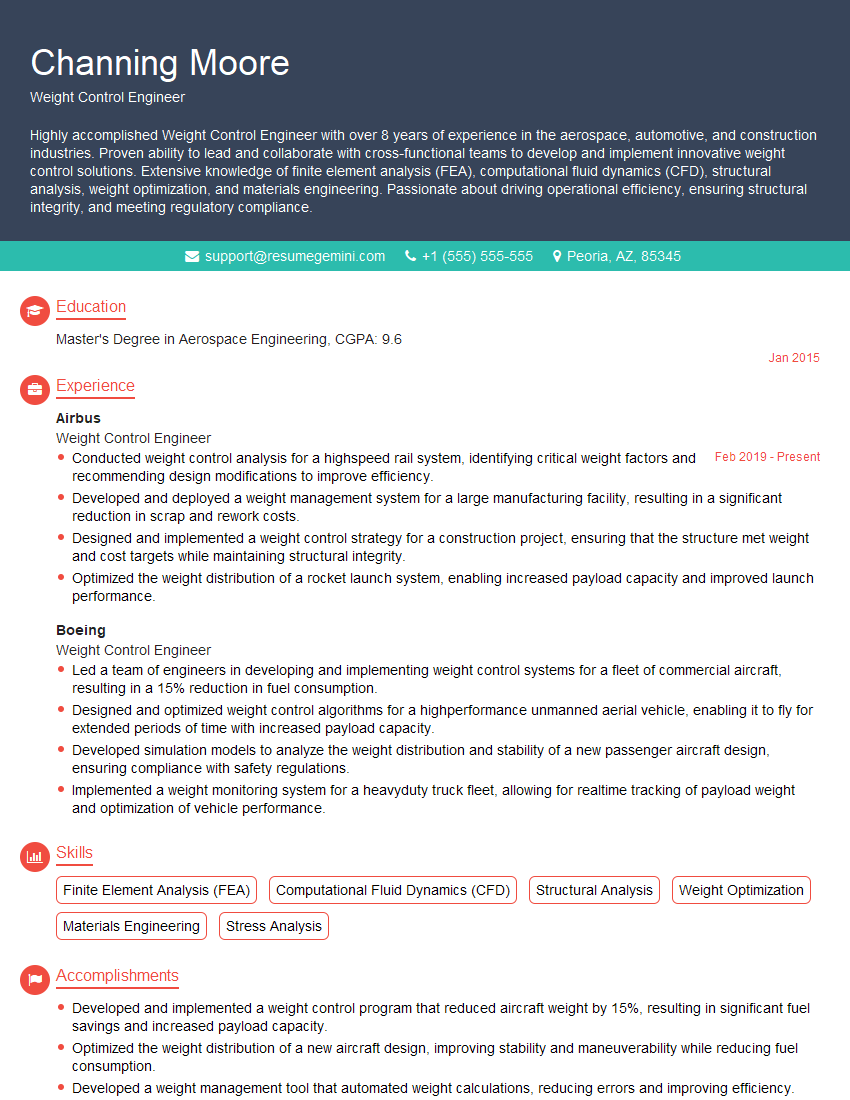
Mastering the testing and validation of weight engineering solutions is crucial for career advancement in this specialized field. It demonstrates a strong understanding of engineering principles and a commitment to rigorous quality control. To significantly enhance your job prospects, creating an ATS-friendly resume is essential. This ensures your application is effectively screened by Applicant Tracking Systems used by many companies. We strongly recommend using ResumeGemini, a trusted resource, to build a professional and impactful resume. Examples of resumes tailored to Testing and Validation of Weight Engineering Solutions are available to help you get started.
Explore more articles
Users Rating of Our Blogs
Share Your Experience
We value your feedback! Please rate our content and share your thoughts (optional).
What Readers Say About Our Blog
Very informative content, great job.
good