The right preparation can turn an interview into an opportunity to showcase your expertise. This guide to Grain Leadership interview questions is your ultimate resource, providing key insights and tips to help you ace your responses and stand out as a top candidate.
Questions Asked in Grain Leadership Interview
Q 1. Describe your experience managing grain inventory across multiple locations.
Managing grain inventory across multiple locations requires a robust system that integrates data from various sites into a centralized platform. Think of it like orchestrating a complex symphony – each location is an instrument, and the central system is the conductor ensuring harmony. My experience involves utilizing sophisticated software to track grain type, quantity, quality parameters (moisture, protein, etc.), and location. This allows for real-time visibility of inventory levels, enabling informed decision-making regarding storage, transportation, and sales. For example, I’ve successfully managed inventory across five different silos, using a cloud-based system to monitor stock levels and predict future needs, optimizing storage costs and minimizing spoilage.
This system also helps optimize transportation logistics. By knowing the precise location and quantity of grain, we can efficiently route shipments, minimizing transport costs and delivery times. In one instance, our system identified surplus grain in one location and a shortage in another, allowing for a strategic internal transfer that saved us significant transportation expenses compared to sourcing from the open market.
Q 2. Explain your approach to mitigating risk in grain trading.
Mitigating risk in grain trading involves a multi-pronged approach encompassing hedging, contract management, and market analysis. It’s like navigating a ship through a storm – you need a clear understanding of the weather (market conditions), a robust vessel (financial strength), and a skilled crew (expert team).
- Hedging: Using financial instruments like futures contracts to offset potential price fluctuations is crucial. This allows us to lock in prices and protect against adverse market movements. For instance, we might sell futures contracts to hedge against a potential price drop in corn.
- Contract Management: Careful review and negotiation of contracts with buyers and sellers are essential to minimize legal and financial risks. We focus on clearly defined quality specifications, delivery terms, and payment conditions to protect our interests.
- Market Analysis: Continuous monitoring of market trends, weather patterns, and geopolitical events enables proactive risk management. For example, an impending drought could influence our purchasing and hedging strategies.
Furthermore, maintaining strong relationships with reliable buyers and suppliers is crucial in mitigating risk, ensuring consistent sourcing and reducing uncertainty in supply and demand.
Q 3. How do you ensure grain quality throughout the supply chain?
Maintaining grain quality throughout the supply chain is paramount. It’s like preserving a fine wine – careful handling at every stage is key. This involves rigorous quality control measures at each step, from the field to the final consumer. We utilize:
- Proper Storage: Maintaining optimal temperature and humidity levels within storage facilities prevents spoilage, insect infestation, and quality degradation. Regular inspections ensure conditions remain within acceptable parameters.
- Transportation Controls: Ensuring appropriate transportation methods and minimizing transit time prevents damage and contamination. This includes using well-maintained trucks and adhering to strict loading and unloading procedures.
- Regular Testing: We conduct regular testing of grain samples throughout the supply chain to monitor key quality indicators such as moisture content, protein levels, and foreign matter content. This allows us to identify and address potential problems proactively.
- Effective Cleaning & Drying: Implementing efficient cleaning and drying processes at various stages removes impurities and reduces moisture levels, minimizing the risk of mold and spoilage.
Implementing a robust traceability system allows us to pinpoint the source of any quality issues, enabling prompt corrective action and preventing widespread contamination.
Q 4. What strategies do you employ for efficient grain storage and handling?
Efficient grain storage and handling involves optimizing both physical infrastructure and operational processes. Imagine a well-oiled machine – every component needs to function seamlessly. Key strategies include:
- Optimized Silo Design: Selecting storage facilities with appropriate capacity, aeration systems, and pest control measures is critical. We prioritize facilities with efficient loading and unloading capabilities.
- Inventory Management System: Utilizing sophisticated software to track grain inventory, monitor quality parameters, and manage storage space optimizes storage utilization and minimizes waste.
- Automated Handling Systems: Implementing automated systems for grain handling, such as conveyor belts and automated loaders, enhances efficiency and minimizes labor costs. These systems also reduce the risk of human error and potential damage.
- Preventive Maintenance: Regular maintenance of storage facilities and equipment prevents breakdowns and ensures smooth operation, minimizing downtime and maximizing efficiency.
For example, using a first-in, first-out (FIFO) system ensures that older grain is sold or utilized before newer grain, preventing spoilage and minimizing losses.
Q 5. Detail your experience with grain logistics and transportation.
Grain logistics and transportation represent a critical link in the supply chain. It’s akin to managing a complex network of highways and railways, ensuring timely and efficient delivery. My experience includes:
- Carrier Selection: Choosing reliable and cost-effective carriers that meet our specific needs in terms of capacity, delivery schedules, and handling capabilities. We consider factors like their insurance coverage and track record.
- Route Optimization: Utilizing route optimization software to identify the most efficient transportation routes, minimizing travel time and transportation costs. This involves considering factors like distance, road conditions, and traffic patterns.
- Documentation Management: Maintaining accurate and up-to-date documentation, including bills of lading, certificates of origin, and other relevant paperwork, ensures compliance with regulations and facilitates seamless transactions.
- Risk Management: Implementing strategies to mitigate risks associated with transportation, including damage, loss, and delays. This could involve using insurance, employing tracking systems, and selecting carriers with a strong safety record.
In one case, we successfully negotiated favorable freight rates by consolidating shipments with other producers, leveraging economies of scale to reduce transportation costs.
Q 6. How do you manage grain procurement to optimize cost and quality?
Optimizing grain procurement involves balancing cost and quality considerations. Think of it as a careful dance – you need to secure the best possible price without compromising quality. This entails:
- Market Research: Conducting thorough market research to understand current price trends, identify reliable suppliers, and compare offerings from different sources.
- Supplier Relationship Management: Building strong relationships with reliable suppliers ensures consistent supply of high-quality grain at competitive prices. This also helps in negotiating favorable terms and securing priority access to grain during periods of high demand.
- Quality Control: Implementing stringent quality control measures to ensure that the procured grain meets our specifications in terms of moisture content, protein levels, and other relevant parameters.
- Contract Negotiation: Negotiating favorable contract terms with suppliers, including pricing, delivery schedules, and payment conditions, protects our interests and ensures cost-effectiveness.
For example, I’ve successfully negotiated contracts that included price adjustments based on market fluctuations, protecting us from unforeseen price hikes while ensuring a stable supply of high-quality grain.
Q 7. Describe your experience in grain sales and marketing.
Grain sales and marketing require a deep understanding of market dynamics and customer needs. It’s about connecting the right grain to the right buyer at the right price. My experience involves:
- Market Analysis: Continuously monitoring market trends, identifying potential buyers, and understanding their specific requirements.
- Pricing Strategy: Developing effective pricing strategies that maximize profitability while remaining competitive in the market. This involves considering factors such as market demand, supply levels, and transportation costs.
- Sales Channel Management: Utilizing various sales channels, such as direct sales, brokers, and online platforms, to reach a wider range of buyers and optimize sales volume.
- Customer Relationship Management: Building strong relationships with customers through regular communication, consistent quality, and reliable service fosters loyalty and repeat business.
For instance, by proactively identifying a buyer needing a specific type of grain, we successfully secured a premium price by directly negotiating a contract, avoiding the need for intermediary brokers and improving margins.
Q 8. Explain your understanding of futures contracts and hedging strategies in grain trading.
Futures contracts are agreements to buy or sell a specific quantity of grain at a predetermined price on a future date. They’re crucial for hedging in grain trading, which involves minimizing risk associated with price fluctuations. Imagine you’re a farmer expecting a large corn harvest in the fall. You’re worried that prices might drop by then. A hedge would involve selling futures contracts now, locking in a price for your future harvest. If prices fall, you’ll still receive the agreed-upon price from the futures contract, mitigating losses. Conversely, if prices rise, you’ll potentially miss out on higher profits, but you’ll be protected from significant losses.
Several hedging strategies exist, including:
- Short Hedge: Selling futures contracts to protect against price declines (like the farmer example above).
- Long Hedge: Buying futures contracts to protect against price increases – for example, a miller might buy futures contracts to ensure they have enough wheat at a predictable cost for their baking operations.
- Basis Hedging: This strategy acknowledges that the futures price isn’t always perfectly correlated with the local cash price. It involves a more nuanced approach to manage the difference (the ‘basis’) between the two.
Successful hedging requires careful analysis of market conditions, understanding the basis, and selecting appropriate contract specifications (quantity, delivery date, etc.). It’s not a perfect system; it manages risk, not eliminates it.
Q 9. How do you analyze market trends and make informed grain purchasing decisions?
Analyzing market trends for grain purchasing involves a multi-faceted approach combining fundamental and technical analysis. Fundamental analysis focuses on factors impacting supply and demand, such as weather patterns (droughts, floods), global production estimates, government policies (subsidies, tariffs), and overall economic conditions. For example, a poor harvest in a major exporting country would signal a potential price increase.
Technical analysis uses charts and indicators to identify trends and potential price movements. This includes studying historical price data, volume, and trading activity to identify patterns and predict future price movements. Moving averages, relative strength index (RSI), and other technical indicators are employed.
Informed grain purchasing also involves:
- Understanding Storage Capacity and Logistics: Knowing your storage limitations and transportation costs is crucial. You wouldn’t buy more grain than you can store efficiently.
- Quality Assessment: Thoroughly inspecting the grain for quality (moisture content, impurities, etc.) before purchase. Lab testing often plays a crucial role.
- Market Timing: Identifying optimal buying opportunities based on the combination of fundamental and technical analysis. This requires a keen eye and the ability to anticipate market shifts.
Ultimately, successful grain purchasing requires a balanced view, integrating quantitative data with market understanding and experience. It’s like being a detective, piecing together clues to predict future price movements.
Q 10. Describe your approach to managing a team in a fast-paced grain operations environment.
Managing a team in a fast-paced grain operations environment demands strong leadership, clear communication, and efficient delegation. My approach centers around:
- Clear Roles and Responsibilities: Ensuring everyone understands their tasks and how their work contributes to the overall goals. This is especially crucial during harvest seasons where time is of the essence.
- Open Communication: Maintaining a transparent environment where team members feel comfortable communicating challenges and ideas. Regular team meetings and updates are critical.
- Empowerment and Delegation: Trusting team members with responsibility and providing the necessary training and support to succeed. Micromanaging is counterproductive in a high-pressure environment.
- Conflict Resolution: Addressing conflicts promptly and fairly. A well-defined dispute resolution process can prevent minor issues from escalating.
- Performance Feedback and Recognition: Providing regular feedback and acknowledging the hard work of the team. Celebrating successes boosts morale.
I strive to foster a team culture of collaboration, accountability, and mutual respect, knowing that a motivated team is a productive team. During peak seasons, flexibility and adaptability are vital. We might need to adjust schedules on short notice, and open communication is key to navigate these challenges.
Q 11. Explain your experience with grain drying and preservation techniques.
Grain drying and preservation are essential for maintaining quality and preventing spoilage. My experience encompasses various methods, including:
- Low-temperature drying: This is a gentle drying technique that minimizes damage to the grain kernels. It’s particularly suited for sensitive crops like malting barley.
- High-temperature drying: This method is faster, often used for high-volume operations. However, it’s crucial to carefully monitor temperatures to avoid scorching the kernels.
- Aerated storage: This involves using fans to circulate air through the grain mass, controlling moisture and temperature. It’s an effective preservation technique for larger storage facilities.
- Chemical treatments (fumigation): These are used to control insect infestations. It’s important to strictly adhere to safety regulations and label instructions when using chemical treatments.
I understand the importance of monitoring moisture content using moisture meters. Accurate measurement is key to determining appropriate drying and storage methods. Maintaining proper ventilation is crucial in all storage methods to prevent mold growth. Experience has shown that a proactive approach to grain preservation is far more cost-effective than dealing with spoilage later.
Q 12. How do you handle disputes with grain buyers or suppliers?
Disputes with buyers or suppliers are unfortunately inevitable in grain trading. My approach is to address them fairly and professionally, prioritizing a collaborative solution. First, I focus on clear communication to understand the nature of the dispute. This often involves reviewing contracts and documentation to identify the source of disagreement. If a simple misunderstanding is the cause, clarifying the terms and expectations can resolve the issue quickly.
For more complex disputes, a structured approach is necessary:
- Mediation: Seeking a neutral third party to facilitate a discussion and help reach a mutually acceptable agreement.
- Arbitration: If mediation fails, arbitration provides a formal process for resolving the dispute, with a binding decision from an arbitrator.
- Legal action: This is a last resort and typically involves significant cost and time. It’s important to document everything meticulously from the outset.
Maintaining strong relationships with buyers and suppliers is key to minimizing disputes. Clear communication, fair pricing, and adherence to agreed-upon terms are crucial.
Q 13. Describe your experience with regulatory compliance in the grain industry.
Regulatory compliance is paramount in the grain industry. My experience covers a range of regulations, including:
- Food safety regulations (e.g., FDA, USDA): This includes adhering to standards for grain handling, storage, and transportation to prevent contamination and ensure the safety of the food supply. Regular inspections and testing are crucial.
- Weight and measure regulations: Accurate weighing and measurement of grain are essential to ensure fair transactions. Regular calibration of equipment is necessary.
- Environmental regulations: This covers aspects such as grain dust management to minimize air pollution and responsible disposal of waste materials.
- Transportation regulations: Adhering to regulations governing the transport of grain, including safety standards for trucks and rail cars.
Maintaining compliance involves implementing effective internal procedures, keeping detailed records, and staying updated on changing regulations. Proactive compliance is far more efficient than responding to violations. It’s crucial to have a designated person or team responsible for monitoring compliance.
Q 14. How do you ensure food safety and quality standards are met in grain handling?
Ensuring food safety and quality standards in grain handling is critical. My approach involves a comprehensive system encompassing:
- Proper Cleaning and Sanitation: Maintaining clean storage facilities and equipment is essential to prevent contamination. Regular cleaning schedules and appropriate sanitation methods should be strictly followed.
- Pest Control: Implementing measures to prevent and control insect infestations and rodent activity. Regular inspections and appropriate treatments are required, always adhering to safety and environmental regulations.
- Moisture Control: Maintaining optimal moisture levels throughout the handling process is crucial to prevent mold growth and spoilage. Regular moisture testing and appropriate drying techniques are essential.
- Temperature Monitoring: Monitoring temperatures throughout storage to ensure conditions are optimal for grain preservation. This is particularly crucial during warmer months.
- Traceability: Implementing a robust traceability system to track grain from origin to final destination. This allows for swift identification of sources in case of contamination.
Regular audits and adherence to established protocols, including those from organizations like the GFSI (Global Food Safety Initiative), ensure that all aspects of food safety and quality are managed effectively. Employee training is a critical component of this system; they’re the frontline defenders of food safety standards.
Q 15. Explain your knowledge of different grain types and their characteristics.
Understanding grain types is fundamental to successful grain leadership. Different grains possess unique characteristics impacting their cultivation, processing, and market value. Key differences lie in their protein content, starch composition, moisture levels, and susceptibility to pests and diseases.
- Wheat: A staple crop, wheat varieties differ significantly in protein content (affecting bread-making quality), growing season, and disease resistance. Hard red winter wheat, for example, is ideal for bread, while soft white wheat is better suited for cakes and pastries.
- Corn (Maize): Used for feed, ethanol, and food, corn varieties are categorized by their maturity, kernel type (dent, flint, sweet), and growing conditions. Dent corn, with its indented kernels, is the most common type used for feed and ethanol production.
- Soybeans: A primary source of protein and oil, soybeans are classified by maturity group and oil content. High-oil soybeans are favored for oil extraction, while others are better suited for animal feed.
- Rice: Different rice varieties vary in grain length, texture, and cooking characteristics. Long-grain rice, known for its fluffy texture, is a popular choice, whereas short-grain rice is stickier.
Understanding these variations is crucial for making informed decisions about planting, storage, and marketing strategies.
Career Expert Tips:
- Ace those interviews! Prepare effectively by reviewing the Top 50 Most Common Interview Questions on ResumeGemini.
- Navigate your job search with confidence! Explore a wide range of Career Tips on ResumeGemini. Learn about common challenges and recommendations to overcome them.
- Craft the perfect resume! Master the Art of Resume Writing with ResumeGemini’s guide. Showcase your unique qualifications and achievements effectively.
- Don’t miss out on holiday savings! Build your dream resume with ResumeGemini’s ATS optimized templates.
Q 16. Describe your experience with grain processing technologies.
My experience encompasses the entire grain processing chain, from cleaning and drying to milling and storage. I’m proficient in various technologies used to enhance grain quality and efficiency.
- Cleaning and Drying: I’ve worked with advanced cleaning systems that utilize sieves, aspirators, and gravity separators to remove foreign materials and reduce moisture content. Efficient drying is crucial to prevent spoilage and maintain grain quality. I’ve implemented systems using various drying methods including air drying and high-temperature drying depending on grain type and environmental conditions.
- Milling: My experience includes overseeing milling operations for wheat, corn, and soybeans, using hammer mills, roller mills, and other equipment to produce flour, grits, and other products. I’m familiar with optimizing milling processes to maximize yield and product quality, while minimizing waste.
- Storage: Effective storage is vital to prevent spoilage and maintain grain value. I have extensive experience in managing grain storage facilities, including aeration systems, temperature monitoring, and pest control strategies to ensure quality preservation.
Furthermore, I’ve implemented quality control measures throughout the entire process using near-infrared (NIR) spectroscopy for rapid analysis of grain composition and quality parameters.
Q 17. How do you optimize grain yield and quality through agronomic practices?
Optimizing grain yield and quality requires a holistic approach incorporating several agronomic practices. It’s not just about maximizing yield, but also about ensuring the quality characteristics desired by the market.
- Soil Health: Improving soil health through practices like no-till farming, cover cropping, and crop rotation enhances nutrient availability and water retention, leading to better yields and healthier crops. I’ve successfully implemented these techniques, resulting in significant improvements in soil fertility and yield.
- Precision Agriculture: Utilizing GPS-guided machinery, variable rate fertilization, and remote sensing technologies allows for precise application of inputs, optimizing resource use and minimizing environmental impact. This results in increased yields and improved grain quality while reducing costs.
- Pest and Disease Management: Implementing integrated pest management (IPM) strategies, including biological controls, minimizes the use of pesticides and reduces the risk of developing pesticide resistance in pests. This is crucial for ensuring high-quality yields and sustainability.
- Variety Selection: Choosing appropriate grain varieties adapted to local climatic conditions and disease resistance is vital. This increases yield potential and reduces the risk of crop failure.
For example, in one project, by implementing precision agriculture techniques, we were able to increase corn yields by 15% while simultaneously reducing fertilizer usage by 10%.
Q 18. What are the key performance indicators you monitor in grain operations?
In grain operations, several key performance indicators (KPIs) are monitored to assess efficiency, profitability, and sustainability.
- Yield per acre: This measures the amount of grain produced per unit of land, indicating the efficiency of production.
- Grain quality: Parameters like protein content, moisture level, and test weight are monitored to ensure the grain meets market standards.
- Storage losses: Tracking losses due to spoilage, insects, or other factors is crucial for minimizing waste and maintaining profitability.
- Operating costs: Monitoring costs related to planting, harvesting, processing, and storage helps optimize resource allocation and enhance profitability.
- Energy efficiency: Tracking energy consumption during various operations is crucial for evaluating sustainability efforts.
- Market price fluctuations: Close monitoring of market prices allows for strategic selling decisions and risk management.
Regular monitoring and analysis of these KPIs provide valuable insights into operational performance, allowing for timely adjustments and improvements.
Q 19. Explain your experience with implementing new technologies in grain handling.
Implementing new technologies is crucial for enhancing efficiency and sustainability in grain handling. My experience includes the successful integration of various technologies.
- Automated Grain Handling Systems: I’ve overseen the installation and operation of automated systems for grain unloading, conveying, and storage, reducing labor costs and improving efficiency. This included advanced sensors and control systems for optimal grain flow.
- Remote Monitoring and Control: I’ve implemented remote monitoring systems for grain storage facilities, allowing for real-time monitoring of temperature, humidity, and other parameters, enabling proactive responses to potential problems. This significantly reduced losses due to spoilage.
- Data Analytics and Predictive Modeling: Utilizing data analytics tools to analyze grain quality data and predict future market trends. This allows for more informed decision-making regarding planting, storage, and sales strategies.
For example, the implementation of a remote monitoring system in a grain storage facility reduced spoilage losses by 12% within the first year.
Q 20. Describe your approach to managing grain waste and sustainability.
Managing grain waste and promoting sustainability is a high priority in modern grain operations. My approach involves a multi-pronged strategy focusing on prevention, reduction, and utilization of by-products.
- Minimizing Spoilage: Employing proper drying, storage, and handling techniques to minimize grain losses due to spoilage, insects, or rodents. This includes regular inspections, pest control measures, and optimized storage conditions.
- Efficient Processing: Optimizing milling and processing operations to minimize waste generation. This might involve implementing advanced milling technologies or improving cleaning and separation techniques.
- By-Product Utilization: Exploring options for utilizing by-products, such as grain screenings or milling residues, for animal feed, biofuel production, or other applications. This minimizes waste and generates additional revenue streams.
- Sustainable Practices: Adopting environmentally friendly agricultural practices, such as reduced tillage, cover cropping, and precision nutrient management to minimize the environmental footprint of grain production.
For example, we implemented a program to utilize grain screenings as animal feed, reducing waste disposal costs and providing a valuable protein source for livestock.
Q 21. How do you assess and manage the financial risks associated with grain trading?
Managing financial risks in grain trading requires a strategic approach combining risk assessment, hedging, and diversification.
- Market Risk Assessment: This involves analyzing historical price data, market trends, and factors influencing supply and demand to anticipate price fluctuations. Tools such as futures and options contracts are instrumental in assessing this risk.
- Hedging Strategies: Utilizing hedging techniques, like futures and options contracts, to mitigate price risk. This involves locking in prices for future sales or purchases to protect against adverse market movements.
- Diversification: Diversifying grain types and sales channels reduces the reliance on a single market and minimizes the impact of price fluctuations or market disruptions in a single sector.
- Financial Modeling: Employing financial models to simulate different market scenarios and assess potential profits and losses under various conditions. This allows for informed decision-making and risk management.
- Contract Management: Careful management of contracts with buyers and sellers to ensure favorable terms and minimize potential liabilities.
For instance, during periods of high price volatility, we’ve successfully utilized futures contracts to lock in selling prices for our grain, protecting against potential price declines and ensuring stable revenue.
Q 22. Explain your experience with data analysis and its application in grain management.
Data analysis is crucial for efficient grain management. I leverage various analytical techniques to optimize operations, from predicting yields to managing inventory. My experience involves using tools like Excel, specialized agricultural software, and statistical packages like R or Python.
For instance, I’ve used regression analysis to model the relationship between weather patterns and grain yields, allowing for more accurate yield forecasts and better resource allocation. I also utilize descriptive statistics to analyze grain quality data from various storage facilities, identifying trends and potential quality issues early on. This helps in implementing proactive measures to prevent losses and maintain consistent quality standards.
Furthermore, I’ve developed dashboards that visualize key performance indicators (KPIs) such as storage capacity utilization, grain quality metrics, and transportation costs. These dashboards provide a real-time overview of operations, facilitating informed decision-making and enabling quicker responses to changing market conditions.
Q 23. How do you build and maintain strong relationships with stakeholders in the grain industry?
Building and maintaining strong relationships with stakeholders – farmers, buyers, transporters, and regulatory bodies – is paramount in the grain industry. I approach this through open communication, active listening, and a focus on mutual benefit. I believe in transparency and proactive engagement.
For example, I regularly communicate with farmers about market prices, providing insights and guidance on optimal selling strategies. With buyers, I maintain clear communication regarding grain quality, delivery schedules, and contract terms. Building trust and demonstrating reliability are key components of these relationships. I also ensure regular communication with regulatory bodies to ensure compliance with all relevant rules and regulations.
Regular meetings, both formal and informal, are key. These allow for collaborative problem-solving and help build a strong sense of community and shared goals within the grain network. Building personal rapport through informal communication also makes a difference. A strong network is more resilient to shocks.
Q 24. Describe your experience with forecasting grain production and demand.
Forecasting grain production and demand requires a multi-faceted approach combining quantitative and qualitative data. I utilize various forecasting models, including time series analysis, regression models, and econometric techniques.
Historically, I’ve used time series analysis to forecast grain prices based on past price trends and seasonal variations. Incorporating weather data and agricultural reports allows for a more precise prediction. Furthermore, I conduct market research to understand consumer demand and market trends, which helps refine my forecasts. I’ve incorporated GIS data to analyze regional production patterns and transportation logistics, further enhancing forecasting accuracy.
One specific example involved predicting soybean production in a particular region by combining weather forecasts with historical yield data and soil analysis. This prediction allowed the company to secure necessary storage capacity and transportation arrangements well in advance.
Q 25. How do you effectively communicate complex information about grain operations to different audiences?
Communicating complex grain operations information requires tailoring the message to the specific audience. I adapt my communication style and the level of technical detail based on the recipient’s knowledge and interests.
For instance, when communicating with farmers, I focus on practical implications and the bottom line. With financial stakeholders, I emphasize financial performance and risk management. With technical staff, I utilize technical jargon and detailed data analysis. Visual aids like charts, graphs, and maps are always effective in clarifying complex information for all audiences.
I also prioritize clear and concise language, avoiding technical jargon when possible. For more technical audiences, I use well-defined terminology, but ensure to explain it simply when necessary. Regular updates and feedback sessions ensure everyone stays informed and engaged. Creating a culture of open communication is also key.
Q 26. Explain your experience in developing and implementing grain management strategies.
Developing and implementing grain management strategies requires a holistic approach, considering various factors including production, storage, transportation, and marketing. My approach is based on a thorough understanding of market dynamics, supply chain logistics, and risk management principles.
For example, I’ve developed strategies to optimize grain storage utilization by forecasting demand and implementing efficient inventory management systems. This involved developing a system that tracks grain quality throughout the entire supply chain, ensuring minimal losses from spoilage or damage. Another example involved optimizing the transportation network by analyzing transportation costs and route efficiency.
These strategies invariably involve using data analytics to pinpoint inefficiencies, modeling different scenarios, and then presenting the results in an easily understandable format to stakeholders. This is followed by an implementation plan with clear metrics for success and regular monitoring of the effectiveness of the implemented strategies.
Q 27. How do you prioritize tasks and manage competing demands in a grain operations setting?
Prioritizing tasks and managing competing demands in grain operations requires a structured approach. I utilize project management techniques like prioritization matrices, time management tools, and delegation strategies.
I typically employ a prioritization matrix based on urgency and importance to allocate resources and focus on the most critical tasks first. Effective time management techniques, such as time blocking and the Pomodoro technique, ensure efficiency and prevent burnout. Delegation of tasks to capable team members allows for focus on higher-level strategic decision-making.
For example, I prioritize tasks based on deadlines, potential impact on revenue, and risk mitigation. Critical tasks that can jeopardize the entire operation always take precedence. Regular review of priorities is also crucial in the face of changing market demands.
Q 28. Describe a time you had to make a difficult decision regarding grain quality or safety.
I once faced a situation where a shipment of grain showed signs of insect infestation. The decision was whether to treat the grain, incurring additional costs, or to reject the shipment, potentially leading to financial losses and reputational damage.
After a thorough assessment, considering factors such as the extent of the infestation, the potential for remediation, and the market value of the affected grain, I chose to implement a strict fumigation procedure. This resulted in additional costs, but it minimized potential losses and ensured compliance with safety regulations. Detailed documentation of the entire process, including laboratory testing results and communication with regulatory bodies, was critical to mitigate potential risks.
This decision highlighted the importance of risk assessment and proactive decision-making in maintaining the quality and safety of grain. It demonstrated the importance of a strict adherence to established protocols and maintaining transparent communication with all stakeholders involved.
Key Topics to Learn for Grain Leadership Interview
- Strategic Grain Management: Understanding market trends, supply chain dynamics, and risk mitigation strategies in grain handling and trading.
- Operational Efficiency: Optimizing processes within grain storage, transportation, and processing facilities; improving efficiency through technology and data analysis.
- Quality Control and Assurance: Implementing and maintaining rigorous quality standards throughout the grain handling process, ensuring compliance with regulations and customer requirements.
- Team Leadership and Management: Demonstrating effective communication, delegation, and conflict resolution skills within a team environment; fostering collaboration and achieving shared goals.
- Financial Acumen: Understanding key financial metrics related to grain trading, budgeting, and profitability; making informed decisions based on financial data.
- Risk Assessment and Mitigation: Identifying and evaluating potential risks (market fluctuations, weather events, logistical challenges) and developing effective mitigation strategies.
- Sustainability and Environmental Responsibility: Understanding and implementing sustainable practices in grain handling, minimizing environmental impact, and adhering to relevant environmental regulations.
- Problem-solving and Decision-making: Utilizing analytical skills to identify problems, evaluate options, and make timely, effective decisions under pressure.
- Regulatory Compliance: Demonstrating a thorough understanding of relevant industry regulations and ensuring compliance across all operations.
- Technological Proficiency: Familiarity with relevant software and technologies used in grain handling and management (e.g., inventory management systems, data analytics platforms).
Next Steps
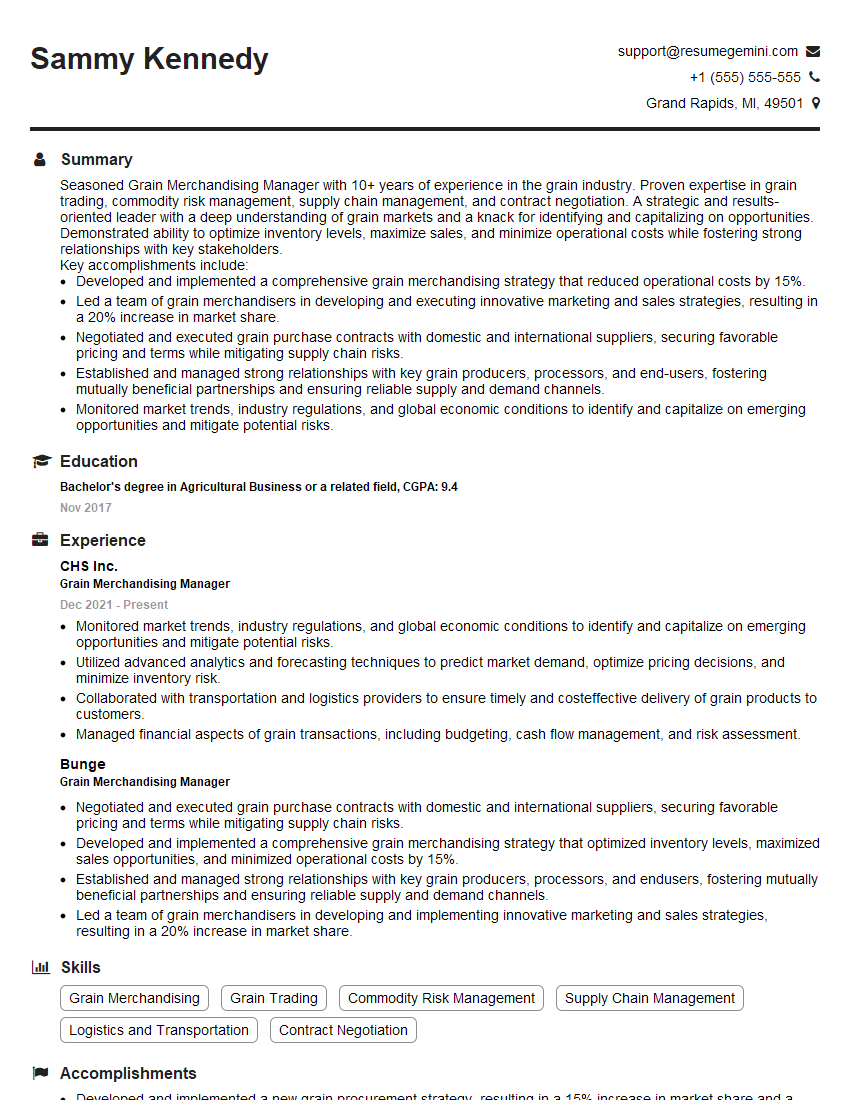
Mastering Grain Leadership principles is crucial for advancing your career in the agricultural sector. It opens doors to leadership roles requiring strategic thinking, operational expertise, and strong team management skills. To significantly enhance your job prospects, focus on creating an ATS-friendly resume that highlights your relevant experience and skills. We strongly encourage you to leverage ResumeGemini, a trusted resource for building professional resumes that stand out. Examples of resumes tailored specifically for Grain Leadership positions are provided below to help you craft your own compelling application materials.
Explore more articles
Users Rating of Our Blogs
Share Your Experience
We value your feedback! Please rate our content and share your thoughts (optional).
What Readers Say About Our Blog
Very informative content, great job.
good