Preparation is the key to success in any interview. In this post, we’ll explore crucial Medical Modeling interview questions and equip you with strategies to craft impactful answers. Whether you’re a beginner or a pro, these tips will elevate your preparation.
Questions Asked in Medical Modeling Interview
Q 1. Explain the difference between deterministic and stochastic models in medical modeling.
In medical modeling, we use both deterministic and stochastic models to represent biological systems. The key difference lies in how they handle uncertainty.
Deterministic models predict a single, definite outcome based on a given set of inputs. Think of it like a precise recipe: if you follow the steps exactly, you get the same result every time. In medical modeling, this could involve predicting drug concentration in the body based on a known dose and absorption rate, assuming no variability in individual patient responses. These models are simpler to build and analyze, but they often lack realism as biological systems are inherently variable.
Stochastic models, on the other hand, incorporate randomness and uncertainty. Imagine baking a cake – even with the same recipe, there’s some variation in how it turns out due to slight differences in ingredients, oven temperature, etc. In medical modeling, this could involve simulating the spread of an infection through a population, acknowledging individual variations in susceptibility and transmission rates. Stochastic models are more complex but offer a more realistic representation of the biological reality by explicitly incorporating this inherent variability. They are often represented using probability distributions and can provide insights into the range of possible outcomes, not just a single prediction.
In short: Deterministic models are predictable and precise, while stochastic models are probabilistic and account for uncertainty, making them usually more applicable in medical modeling where patient variability is significant.
Q 2. Describe your experience with different types of model validation techniques.
Model validation is crucial to ensure our models accurately reflect reality. My experience encompasses various techniques, including:
- Visual Predictive Checks (VPCs): I frequently use VPCs to visually assess the model’s ability to predict the observed data. By plotting simulated data against observed data, we can identify systematic biases or discrepancies. For example, in PK/PD modeling, a VPC would compare the simulated drug concentration profiles to the actual measured concentrations in patients.
- Goodness-of-fit metrics: These are quantitative measures like the Akaike Information Criterion (AIC) and Bayesian Information Criterion (BIC) (which I’ll discuss in more detail later). Lower values suggest a better fit to the data, though one must always consider the balance between model complexity and goodness-of-fit. I also use visual diagnostic plots provided by software packages to supplement these metrics.
- External validation: This involves testing the model’s performance on a separate dataset that wasn’t used for model building. This is critical for assessing generalizability and preventing overfitting to a specific dataset. For example, building a model with data from one clinical trial and validating its predictive performance on an independent clinical trial.
- Bootstrapping and Cross-validation: These resampling techniques are employed to assess the robustness and stability of model parameters. Bootstrapping involves repeatedly sampling with replacement from the original data, creating many slightly different datasets to assess variability. Cross-validation involves splitting the dataset into multiple subsets to train and validate the model repeatedly, preventing overfitting. I use these methods, especially for smaller datasets to get reliable estimates of model performance and parameter uncertainty.
The choice of validation techniques depends on the specific modeling context, available data, and research question. A combination of visual and quantitative methods is often necessary for a comprehensive validation.
Q 3. What are the limitations of using in vitro data for model calibration?
While in vitro data (data obtained from experiments outside a living organism, like cell cultures) is invaluable in medical modeling, it has significant limitations when used for model calibration (adjusting model parameters to fit data):
- Lack of physiological context: In vitro systems simplify complex biological processes. Cell cultures don’t perfectly replicate the environment within a living organism; factors like blood flow, immune response, and interactions with other organs are absent. This can lead to inaccurate parameter estimates and unreliable predictions when applying the model to a whole-body scenario.
- Simplified interactions: In vitro studies often focus on specific cells or pathways, ignoring the complex interactions within a whole organism. The calibrated parameters may therefore not be reflective of the behavior of the system in vivo.
- Scale-up issues: Extrapolating findings from in vitro experiments to the whole-body scale is challenging and often results in significant uncertainty. A model calibrated only on in vitro data might drastically underestimate or overestimate effects seen in a human patient.
- Potential for artifacts: In vitro experiments can introduce artifacts due to the artificial environment and experimental techniques. For example, specific culture conditions might alter cell behavior compared to their behavior in the body, leading to biased parameter estimates.
Therefore, while in vitro data can provide valuable mechanistic insights and inform model structure, relying solely on it for calibration can lead to inaccurate and unreliable models. In vivo data (from living organisms) are essential for robust model calibration and validation.
Q 4. How do you handle missing data in your medical models?
Missing data is a common challenge in medical modeling. The optimal strategy depends on the nature and extent of the missingness. My approach generally involves:
- Assessment of Missing Data Mechanisms: First, I determine the mechanism of missingness. Is it Missing Completely at Random (MCAR), Missing at Random (MAR), or Missing Not at Random (MNAR)? This guides the imputation method. MCAR is easiest to handle, while MNAR presents the greatest challenges.
- Imputation Methods: For MCAR or MAR data, I often use multiple imputation techniques, which create multiple plausible datasets with imputed values. This accounts for uncertainty introduced by imputation. For numerical data, I might use methods like k-nearest neighbors or expectation-maximization (EM) algorithms. For categorical data, I would use techniques like multiple imputation by chained equations (MICE).
- Deletion Methods: In some cases, if the missing data are few and MCAR, I might use a complete-case analysis (deleting observations with missing values). However, this is generally avoided if there is significant missing data as it can lead to bias and loss of statistical power.
- Model-Based Approaches: When the missing data are MNAR, model-based approaches can be more appropriate. These approaches incorporate the missing data mechanism directly into the model framework, which is more complex but yields less biased estimations.
Throughout the process, I carefully evaluate the impact of the chosen imputation or deletion technique on model parameters and predictions, using sensitivity analyses to assess the robustness of my results to the handling of missing data.
Q 5. Explain the concept of parameter identifiability in pharmacokinetic/pharmacodynamic (PK/PD) modeling.
Parameter identifiability in PK/PD modeling refers to the ability to uniquely estimate the model parameters from the available data. If a parameter is not identifiable, it means that multiple parameter combinations could produce equally good fits to the data, making it impossible to draw reliable conclusions about the true value of the parameter.
This can arise from several reasons:
- Lack of informative data: The experimental design might not provide enough information to distinguish between different parameter values. For example, if drug concentrations are only measured at a few time points, it may be difficult to estimate the rate constants accurately.
- Model over-parameterization: Including too many parameters in the model can lead to identifiability issues. The model becomes too flexible and can fit the data in multiple ways, making it difficult to pinpoint the best parameter values.
- High correlation between parameters: If two or more parameters are highly correlated in their effects on the observed data, they can become difficult to distinguish and estimate uniquely.
Assessing identifiability is crucial. Methods like profile likelihood analysis can be used to explore the parameter space and assess the uniqueness of the estimates. If a parameter is unidentifiable, the model may need to be simplified by removing parameters, or the experimental design may need to be improved to collect more informative data. Failing to address identifiability problems results in unreliable model parameters and predictions.
Q 6. What software packages are you proficient in for medical modeling (e.g., NONMEM, Phoenix, R)?
My experience includes proficiency in several software packages commonly used in medical modeling:
- NONMEM: I’m highly experienced in NONMEM, a powerful tool for nonlinear mixed-effects modeling. I use it extensively for PK/PD modeling, particularly for analyzing data from clinical trials and optimizing drug dosing regimens. I’m comfortable with its advanced features for model building, parameter estimation, and diagnostic testing.
- Phoenix NLME: Phoenix NLME is another robust platform that I use for nonlinear mixed-effects modeling. Its user-friendly graphical interface aids in model development and visualization compared to NONMEM’s command-line interface.
- R: I utilize R’s extensive libraries (like `nlme`, `lme4`, and `ggplot2`) for data analysis, statistical modeling, and data visualization. This is particularly useful for exploratory data analysis and for performing more complex statistical analyses beyond those readily available in dedicated PK/PD software.
I’m comfortable adapting to other modeling software packages as needed, and I value the strengths each of these packages offers for different aspects of the modeling process.
Q 7. Describe your experience with model selection criteria (e.g., AIC, BIC).
Model selection criteria, like the Akaike Information Criterion (AIC) and Bayesian Information Criterion (BIC), are essential for comparing models with different complexities. They help prevent overfitting, which occurs when a model fits the training data too well but performs poorly on new data.
AIC penalizes model complexity based on the number of parameters. A lower AIC suggests a better model. It’s based on information theory, aiming to minimize the difference between the model and the real data generating process.
BIC is similar but applies a stronger penalty for additional parameters. It’s particularly useful when the dataset is large. A lower BIC value also suggests a better model.
Example: Suppose I’m building PK models for a new drug. I test a one-compartment model and a two-compartment model. If the two-compartment model has a significantly lower AIC and BIC than the one-compartment model, and visual diagnostics confirm a better fit, this might suggest the two-compartment model better represents the drug’s disposition in the body, even though it’s more complex.
Important Note: AIC and BIC are relative measures; they only allow for comparison between models fitted to the same data. The absolute values are not directly interpretable, making visual inspection and other diagnostic tools crucial for comprehensive model evaluation. The focus should not be solely on minimizing these criteria, but also on creating a model that is both accurate and interpretable.
Q 8. How do you assess the sensitivity and uncertainty of your model predictions?
Assessing the sensitivity and uncertainty of model predictions is crucial for ensuring their reliability and clinical utility. We employ several methods. Sensitivity analysis helps determine how changes in input parameters affect model outputs. This is often done through techniques like local sensitivity analysis (e.g., varying parameters one at a time) and global sensitivity analysis (e.g., using variance-based methods like Sobol indices) to explore the entire parameter space. Uncertainty quantification, on the other hand, aims to characterize the range of plausible model outputs given the uncertainty in the input parameters. We commonly utilize techniques like Bayesian methods to incorporate prior knowledge and update beliefs about parameters, as well as Monte Carlo simulations to propagate uncertainty through the model. For instance, in a cancer drug model, sensitivity analysis might reveal that the tumor growth rate parameter has a significant impact on predicted response, while uncertainty quantification would give a confidence interval around the predicted survival time, reflecting the inherent variability of both the model and the underlying biological processes. Visualizing these uncertainties using techniques like probabilistic sensitivity analysis plots can aid in informed decision-making.
Q 9. Explain your understanding of different physiological-based pharmacokinetic (PBPK) models.
Physiological-based pharmacokinetic (PBPK) models simulate drug disposition in the body by explicitly representing different organs and tissues and the processes of absorption, distribution, metabolism, and excretion (ADME). These models differ in complexity. Simple PBPK models may use a few compartments representing major organs (e.g., a two-compartment model with central and peripheral compartments). More complex models might incorporate many tissues and organs, include detailed descriptions of metabolic pathways, and even incorporate factors like age, gender, or disease states. For example, a simple PBPK model might only consider hepatic clearance, while a complex one would account for metabolism in the liver, gut, and kidneys, possibly employing specific enzyme kinetics. The choice of model complexity depends on the research question and the availability of data. A key advantage of PBPK models is their ability to extrapolate data from one species (e.g., animal studies) to another (e.g., humans), allowing for more efficient and ethical drug development. They are particularly useful in assessing the impact of alterations in physiological parameters on drug exposure.
Q 10. Describe your experience with model building for specific disease areas (e.g., oncology, cardiology).
My experience encompasses model building in both oncology and cardiology. In oncology, I’ve developed models to predict tumor growth and response to various therapies, incorporating factors like tumor heterogeneity, drug resistance, and immune response. For example, one project involved building an agent-based model to simulate the interaction between cancer cells and immune cells under different treatment regimens, ultimately helping to predict treatment efficacy. In cardiology, I’ve worked on models that simulate cardiac electrophysiology and hemodynamics, aiding in the understanding of arrhythmias and the impact of drug interventions. Specifically, I’ve developed models to investigate the efficacy and safety of novel anti-arrhythmic drugs by simulating their effects on cardiac action potential duration and conduction velocity. These projects required leveraging different modeling techniques, including ordinary differential equations (ODEs), partial differential equations (PDEs), and agent-based modeling, chosen according to the specific biological questions and available data.
Q 11. How do you incorporate prior knowledge into your model development process?
Incorporating prior knowledge is essential for building robust and reliable models. This knowledge can come from various sources, including literature reviews, expert opinion, and previous experimental data. Bayesian methods are particularly well-suited for incorporating this prior information. In a Bayesian framework, prior knowledge is expressed as a prior probability distribution over the model parameters. As new data become available, this prior distribution is updated using Bayes’ theorem to obtain a posterior distribution, which reflects both the prior knowledge and the new data. For example, in a model of drug metabolism, prior knowledge about enzyme kinetics obtained from literature could inform the prior distribution of relevant parameters. Furthermore, structural knowledge, such as the known pathways of drug metabolism, can be explicitly incorporated into the model structure itself. This helps to constrain the model and prevents it from fitting noise in the data, leading to more generalizable and reliable predictions.
Q 12. What is your experience with model diagnostics and troubleshooting?
Model diagnostics and troubleshooting are critical steps in the model development process. This involves assessing the model’s goodness-of-fit to the data, identifying potential biases or errors, and refining the model to improve its accuracy and reliability. Techniques include assessing residual plots to check for patterns or heteroscedasticity, using diagnostic tests to examine the assumptions underlying the model (e.g., normality of residuals, independence of errors), and performing sensitivity analysis to assess the impact of model parameters on the predictions. Troubleshooting involves systematically investigating potential sources of error, such as inaccurate data, inappropriate model structure, or unrealistic parameter values. For instance, if a model shows poor predictive accuracy, I might examine the data for outliers, reassess the model assumptions, or explore alternative model structures. Iterative model refinement based on diagnostic analysis is crucial for achieving a well-performing and reliable model.
Q 13. How do you communicate complex modeling results to both technical and non-technical audiences?
Communicating complex modeling results effectively requires tailoring the message to the audience. For technical audiences (e.g., scientists, modelers), I use precise language, detailed visualizations (e.g., plots of model parameters, predictions, and uncertainties), and may present mathematical derivations. For non-technical audiences (e.g., clinicians, regulatory agencies), I focus on clear, concise summaries, using visual aids such as charts and graphs to highlight key findings, and avoiding technical jargon. I employ analogies and real-world examples to make abstract concepts more relatable. For example, instead of saying “the model predicts a 20% increase in efficacy with a 95% confidence interval,” I might say “our simulations suggest this treatment could be 20% more effective, and we’re confident this estimate is accurate to within a reasonable margin of error.” Interactive dashboards and presentations, incorporating clear visualisations and engaging narratives are important for effective communication across different audiences.
Q 14. Describe your experience with regulatory requirements for medical modeling.
Regulatory requirements for medical modeling vary depending on the intended use of the model (e.g., drug development, diagnostics). For drug development, models used to support regulatory submissions need to be well-documented, thoroughly validated, and meet the guidelines set by agencies like the FDA (Food and Drug Administration) and EMA (European Medicines Agency). This includes documentation of model assumptions, parameter estimation methods, model validation strategies, and uncertainty analysis. The level of validation required depends on the criticality of the model’s intended use. Models used for decision-making in clinical trials generally require a higher level of validation than those used for exploratory research. Compliance with good modeling practices (GMP) and adherence to relevant regulatory guidelines are critical. Understanding and meeting these requirements is essential to ensure the model’s acceptance by regulatory agencies and the ultimate safety and efficacy of medical products.
Q 15. How do you manage and organize large datasets for medical modeling projects?
Managing large medical datasets effectively is crucial for successful model building. It involves a multi-step process focusing on data cleaning, organization, and efficient storage. First, I employ robust data quality checks to identify and handle missing values, outliers, and inconsistencies. This often involves using techniques like imputation for missing data (e.g., using k-Nearest Neighbors or mean imputation, depending on the data distribution) and outlier detection methods (e.g., box plots, Z-scores). Next, I organize the data using a structured format, often a relational database (like PostgreSQL or MySQL) or a data lake (using tools like Hadoop or cloud-based solutions like AWS S3), allowing for efficient querying and retrieval. For very large datasets, I leverage distributed computing frameworks such as Apache Spark to parallelize processing and analysis. Finally, data versioning and provenance tracking are essential for reproducibility and auditing. Tools like DVC (Data Version Control) are invaluable in managing changes and ensuring data integrity throughout the project lifecycle. For instance, in a recent project involving genomic data, I used a combination of cloud storage (AWS S3) and Spark to process and analyze terabytes of data, ensuring scalability and efficient handling of complex queries.
Career Expert Tips:
- Ace those interviews! Prepare effectively by reviewing the Top 50 Most Common Interview Questions on ResumeGemini.
- Navigate your job search with confidence! Explore a wide range of Career Tips on ResumeGemini. Learn about common challenges and recommendations to overcome them.
- Craft the perfect resume! Master the Art of Resume Writing with ResumeGemini’s guide. Showcase your unique qualifications and achievements effectively.
- Don’t miss out on holiday savings! Build your dream resume with ResumeGemini’s ATS optimized templates.
Q 16. What is your experience with model simplification and reduction techniques?
Model simplification and reduction are critical for improving model interpretability, reducing computational complexity, and preventing overfitting. My experience encompasses several techniques. Feature selection methods, like recursive feature elimination or LASSO regularization, help identify the most relevant features and discard irrelevant ones. Dimensionality reduction techniques, such as Principal Component Analysis (PCA) or t-distributed Stochastic Neighbor Embedding (t-SNE), transform high-dimensional data into lower-dimensional representations while preserving essential information. For complex models like neural networks, techniques such as pruning (removing less important connections) or knowledge distillation (training a smaller, simpler model to mimic a larger one) are frequently employed. For example, in a project involving predicting patient readmission rates, we used LASSO regression to select the most influential predictors, resulting in a more interpretable and accurate model than the initial, more complex one. The simpler model also significantly reduced the computational burden, allowing for faster predictions in a clinical setting.
Q 17. Explain your understanding of different model evaluation metrics.
Model evaluation metrics are essential for assessing the performance of a medical model. The choice of metrics depends heavily on the specific problem and the type of model. For classification tasks, common metrics include accuracy, precision, recall, F1-score, and the area under the ROC curve (AUC). Accuracy measures the overall correctness of predictions, while precision focuses on the proportion of true positives among all positive predictions. Recall measures the proportion of true positives identified out of all actual positives, highlighting the model’s ability to avoid false negatives. The F1-score balances precision and recall. AUC summarizes the model’s ability to distinguish between classes across different thresholds. For regression tasks, metrics like mean squared error (MSE), root mean squared error (RMSE), mean absolute error (MAE), and R-squared are used. MSE quantifies the average squared difference between predicted and actual values, RMSE is the square root of MSE, and MAE is the average absolute difference. R-squared indicates the proportion of variance in the dependent variable explained by the model. Additionally, it’s crucial to consider clinical relevance. A high AUC might not be impactful if the model’s predictions lack clinical utility. I always prioritize a holistic evaluation encompassing multiple metrics and their clinical interpretations.
Q 18. Describe your experience with using Bayesian methods in medical modeling.
Bayesian methods offer a powerful framework for incorporating prior knowledge and quantifying uncertainty in medical modeling. My experience includes using Bayesian networks for modeling complex relationships between variables, such as in disease progression modeling. Bayesian inference allows us to update our beliefs about model parameters based on observed data, providing probability distributions rather than point estimates. This is particularly valuable in medical contexts where uncertainty is inherent. For example, in a study on predicting the risk of cardiovascular disease, we employed a Bayesian hierarchical model to incorporate prior information about risk factors from the literature while accounting for variability between individuals. The results provided not only point estimates of risk but also credible intervals, allowing clinicians to understand the uncertainty associated with their predictions. Markov Chain Monte Carlo (MCMC) methods, such as Gibbs sampling or Hamiltonian Monte Carlo, were used for posterior inference. The Bayesian approach proved superior in capturing the inherent uncertainty compared to frequentist methods.
Q 19. How do you handle model discrepancies between different data sources?
Handling discrepancies between data sources is a common challenge in medical modeling. These discrepancies can stem from differences in data collection methods, patient populations, or measurement units. My approach involves a thorough investigation of the underlying reasons for the discrepancies. This often includes examining data quality, exploring potential biases, and checking for inconsistencies in data definitions. Data harmonization techniques, such as standardization, normalization, or transformation, can be applied to align the data from different sources. When substantial differences remain, I may consider domain expertise to make informed decisions on how to handle conflicting information. Model-based approaches, like ensemble methods, can also be used to integrate data from multiple sources, allowing the model to learn from the strengths of each while mitigating the impact of discrepancies. In a project comparing the efficacy of different treatments across different hospitals, we used a mixed-effects model to account for hospital-specific variations while pooling information across sites. Careful data cleaning and analysis significantly improved the comparability and reliability of the results.
Q 20. What is your experience with model calibration and optimization techniques?
Model calibration and optimization are vital steps in ensuring a model’s accuracy and reliability. Calibration involves adjusting a model’s predictions to match the observed data distribution, often addressing issues of overconfidence or underconfidence. Techniques include Platt scaling for probabilistic outputs and isotonic regression for non-linear calibration curves. Optimization involves finding the best model parameters that minimize a chosen loss function. Common optimization algorithms include gradient descent, stochastic gradient descent, and Adam. Cross-validation techniques, such as k-fold cross-validation, are essential for evaluating the model’s generalization performance and preventing overfitting. Hyperparameter tuning, often using grid search or Bayesian optimization, is crucial for finding the optimal settings for the model’s hyperparameters. In a recent project on predicting patient survival, we employed gradient boosting machines and calibrated the predictions using Platt scaling. Rigorous cross-validation and hyperparameter optimization ensured a robust and accurate model with reliable uncertainty estimates.
Q 21. Describe your experience with different types of model visualization and reporting techniques.
Effective visualization and reporting are crucial for communicating model results and insights to both technical and non-technical audiences. My experience encompasses a range of techniques. For example, I use ROC curves and precision-recall curves to illustrate the diagnostic performance of classification models. For regression models, I utilize scatter plots, residual plots, and prediction intervals to visualize the model’s fit and identify potential outliers. For high-dimensional data, techniques like heatmaps and parallel coordinate plots help explore complex relationships between variables. I often create interactive dashboards using tools like Tableau or Shiny to facilitate exploration of the model’s predictions and their associated uncertainty. The format of the report is tailored to the audience; technical reports might include detailed statistical analyses and model code, while presentations for clinicians focus on clear visualizations of key findings and their clinical implications. In a project focused on predicting the risk of a specific disease based on imaging data, we created an interactive dashboard showcasing patient-specific risk scores, including uncertainty estimates and visualizations of image-based features contributing to the prediction. This allowed clinicians to easily interpret the results and integrate them into their workflow.
Q 22. Explain your experience in developing and implementing mechanistic models.
Mechanistic models, unlike purely statistical models, explicitly represent the underlying biological processes. My experience encompasses developing these models across various applications, from simulating drug delivery in the body to modeling the progression of chronic diseases. For instance, I worked on a project modeling the pharmacokinetics and pharmacodynamics of a novel cancer drug. This involved creating a system of differential equations describing drug absorption, distribution, metabolism, and excretion, alongside the drug’s effect on tumor growth. The model incorporated parameters like clearance rate, volume of distribution, and tumor growth rate, all estimated from preclinical data. We then used this model to predict optimal dosing regimens and explore potential drug-drug interactions. Another project involved building a mechanistic model of type 2 diabetes progression, incorporating factors such as insulin resistance, beta-cell dysfunction, and glucose homeostasis. These models were validated against clinical data and used for scenario planning and hypothesis testing.
Implementation often involves utilizing computational tools such as MATLAB, R, or specialized software packages like Berkeley Madonna. The process requires iterative refinement, with model parameters constantly being adjusted and validated against experimental observations. This iterative process ensures the model accurately reflects the biological reality.
Q 23. How do you ensure the reproducibility of your medical models?
Reproducibility is paramount in medical modeling. To ensure this, I meticulously document every step of the modeling process, from data acquisition and preprocessing to model development, parameter estimation, and validation. This documentation includes detailed descriptions of the algorithms used, the software versions employed, and the data sources. Furthermore, I utilize version control systems like Git to track changes to the model code and associated data. Open-source software and standardized file formats are preferred whenever possible to maximize reproducibility. I also advocate for transparently reporting all model assumptions and limitations, along with the uncertainty associated with model predictions. A key aspect is to make the code and data publicly available, whenever ethical considerations and data privacy allow. For example, in one project, we developed a detailed protocol outlining the exact steps involved in model calibration and validation, and we made the code available through a public repository. This allowed other researchers to replicate our findings and potentially build upon our work.
Q 24. What are the ethical considerations when developing and applying medical models?
Ethical considerations are central to medical modeling. Firstly, data privacy is paramount. We must adhere to all relevant regulations (e.g., HIPAA) to protect patient confidentiality. Anonymization and de-identification techniques are crucial for any data used in model development. Secondly, model transparency is essential. The model’s assumptions, limitations, and potential biases should be clearly articulated to avoid misinterpretations and inappropriate applications. Bias in the data used to train the model can lead to unfair or discriminatory outcomes. It is crucial to address this through careful data selection and the use of techniques to mitigate bias. Thirdly, the intended use of the model must be carefully considered. The model should only be used for its intended purpose and not extrapolated beyond its validated domain of applicability. For example, using a model developed for one population to make predictions for another population with significant differences in demographics or clinical characteristics would be unethical. Finally, model outcomes should be interpreted cautiously and should not replace clinical judgment.
Q 25. Describe your experience with integrating medical models with clinical decision support systems.
I have experience integrating medical models into clinical decision support systems (CDSS). This typically involves developing a user-friendly interface that allows clinicians to input patient data and receive model-generated predictions or recommendations. The integration requires careful consideration of the system’s architecture, ensuring seamless data exchange between the model and the CDSS. This might involve using Application Programming Interfaces (APIs) to connect the model to the clinical database. For example, in one project, we integrated a model predicting the risk of heart failure into an electronic health record (EHR) system. The model’s output, a probability score, was displayed alongside other patient data, providing clinicians with additional information to aid their decision-making process. The interface was designed to be intuitive and easy to use, minimizing the disruption to the existing workflow. Ensuring the CDSS provides clear explanations of the model’s predictions and their limitations is crucial for trust and adoption by clinicians.
Q 26. How do you stay up-to-date with the latest advancements in medical modeling?
Staying current in medical modeling requires a multifaceted approach. I regularly attend conferences like the Society for Modeling and Simulation International (SCS) and relevant biomedical engineering conferences. I actively participate in professional organizations such as the American Institute of Medical and Biological Engineering (AIMBE), which provides access to cutting-edge research and networking opportunities. I subscribe to relevant journals, such as the Bulletin of Mathematical Biology and PLOS Computational Biology, and regularly review the literature. Online resources, including pre-print servers such as arXiv and bioRxiv, allow me to access the most recent developments. Furthermore, engaging in collaborative projects with researchers from diverse backgrounds exposes me to new techniques and applications. Finally, participation in online communities and forums dedicated to medical modeling enables continuous learning and knowledge sharing.
Q 27. What are some potential pitfalls to avoid when building and interpreting medical models?
Several pitfalls can hinder the effectiveness of medical models. Overfitting, where a model performs well on training data but poorly on unseen data, is a common issue. This can be mitigated through techniques like cross-validation and regularization. Another challenge is data limitations. Medical data can be scarce, noisy, or incomplete, potentially leading to inaccurate or biased models. Careful data preprocessing and imputation techniques are crucial to address this. Misinterpreting model results is also a significant concern. Models provide predictions, not certainties, and it’s vital to understand the uncertainty associated with those predictions. The assumption that a correlation implies causation is a frequent error; rigorous validation is necessary to establish causality. Finally, neglecting the ethical implications and neglecting the limitations of the model can lead to misuse and harmful consequences. A robust validation process is crucial, involving both internal and external validation steps, using diverse datasets and clinical scenarios, to ensure the model’s generalizability and reliability.
Key Topics to Learn for Medical Modeling Interview
- Physiological Modeling: Understanding the fundamental principles of building mathematical representations of biological systems, including compartmental modeling and system dynamics. Practical application: Simulating drug distribution and metabolism within the body.
- Biomechanical Modeling: Developing models to simulate the mechanical behavior of tissues, organs, and the musculoskeletal system. Practical application: Analyzing the biomechanics of joint replacement surgery or designing improved prosthetics.
- Image-Based Modeling: Utilizing medical imaging data (CT, MRI, etc.) to create 3D models for diagnosis, treatment planning, and surgical simulation. Practical application: Pre-surgical planning for complex procedures, improving surgical precision.
- Disease Modeling: Creating computational models to simulate the progression of diseases, evaluating the effectiveness of treatments, and predicting disease outbreaks. Practical application: Studying the spread of infectious diseases or optimizing cancer treatment strategies.
- Statistical Modeling & Data Analysis: Applying statistical methods to analyze medical data, validate model predictions, and draw meaningful conclusions. Practical application: Assessing the efficacy of a new drug based on clinical trial data.
- Software & Programming Skills: Demonstrating proficiency in relevant programming languages (e.g., Python, MATLAB, R) and modeling software packages. Practical application: Building, calibrating, and validating your medical models.
- Model Validation & Verification: Understanding the importance of rigorous model validation and verification techniques to ensure accuracy and reliability. Practical application: Comparing model predictions to experimental data and identifying potential sources of error.
Next Steps
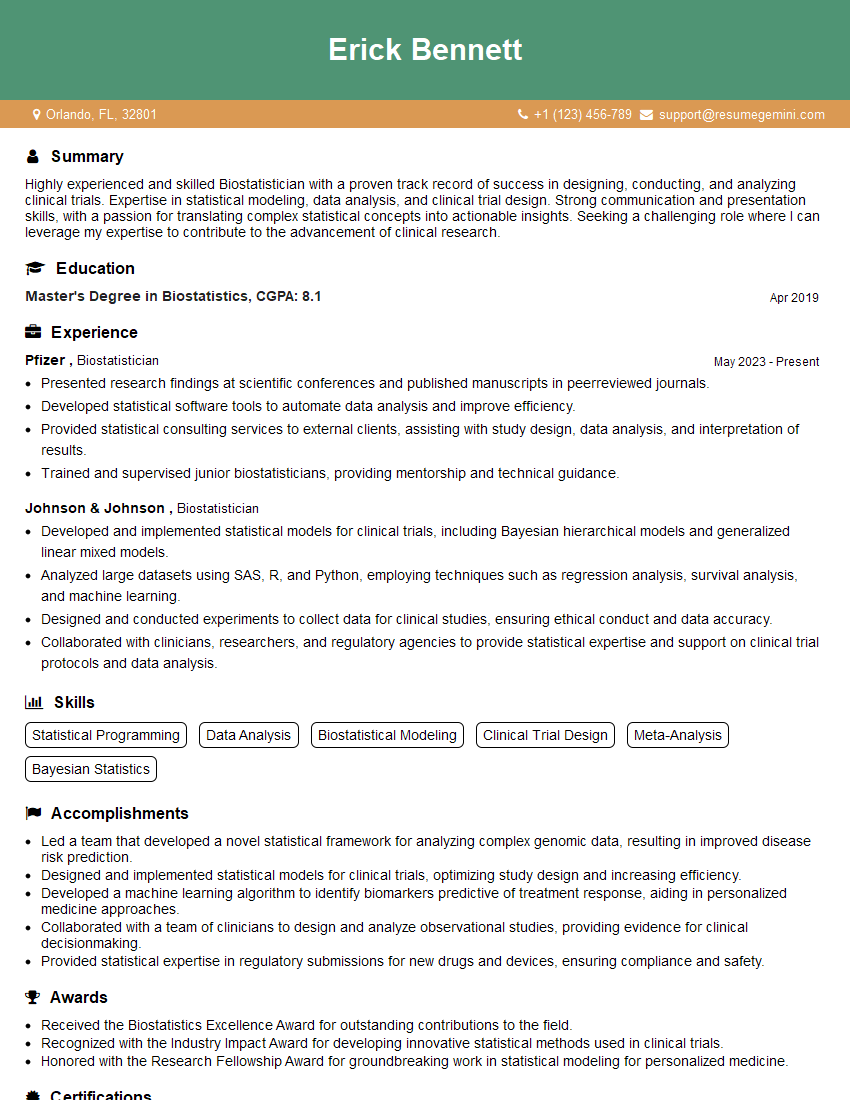
Mastering medical modeling opens doors to exciting and impactful careers in healthcare, research, and technology. To maximize your job prospects, crafting a strong, ATS-friendly resume is crucial. ResumeGemini can help you build a professional and compelling resume that highlights your skills and experience effectively. They provide examples of resumes tailored to Medical Modeling to help guide your process. Take advantage of this valuable resource to present your qualifications in the best possible light and land your dream job!


Explore more articles
Users Rating of Our Blogs
Share Your Experience
We value your feedback! Please rate our content and share your thoughts (optional).
What Readers Say About Our Blog
Very informative content, great job.
good