Feeling uncertain about what to expect in your upcoming interview? We’ve got you covered! This blog highlights the most important Perspective Grids interview questions and provides actionable advice to help you stand out as the ideal candidate. Let’s pave the way for your success.
Questions Asked in Perspective Grids Interview
Q 1. Explain the principles of one-point, two-point, and three-point perspective.
Perspective grids are fundamental tools for creating realistic depth in drawings. They rely on the concept of vanishing points, which represent where parallel lines appear to converge as they recede into the distance. The number of vanishing points used determines the type of perspective:
- One-Point Perspective: This is the simplest form, used for scenes where the viewer is looking directly at a single face of an object or building. All parallel lines recede towards a single vanishing point on the horizon line. Imagine looking down a long, straight road – the edges of the road converge at a single point in the distance.
- Two-Point Perspective: This is more complex, used when viewing an object from a corner or angle. Parallel lines from two sets of receding edges converge towards two distinct vanishing points on the horizon line. Think about sketching a building from across a street; the sides of the building will have their own vanishing points.
- Three-Point Perspective: This creates a more dramatic and dynamic perspective, often used for high-angle shots (looking down) or low-angle shots (looking up). In addition to two vanishing points on the horizon, a third vanishing point sits either above (for a high angle) or below (for a low angle) the horizon line, representing the convergence of vertical lines. Imagine a cityscape viewed from a skyscraper above.
Q 2. Describe how vanishing points are used in creating perspective.
Vanishing points are crucial for establishing the illusion of depth. They’re the points on the horizon line where parallel lines appear to converge. In a drawing, the placement of these points directly impacts the perspective’s strength and the overall impression of distance and space. By carefully choosing the positions of vanishing points, an artist can control how the objects appear to recede into the background, creating a sense of depth and realism. For example, moving vanishing points closer together creates a more compressed or claustrophobic feeling, while wider spacing produces a sense of vastness.
Q 3. How do you determine the appropriate placement of vanishing points in a composition?
The placement of vanishing points is a crucial artistic decision that influences the composition’s impact. It depends entirely on the desired perspective and the subject matter. There isn’t a single ‘correct’ answer, but here’s a guide:
- Consider the viewpoint: Where is the viewer situated relative to the subject? A high vantage point might call for a three-point perspective, while a frontal view might only require one.
- Think about the mood: Closely spaced vanishing points create a sense of confinement, while wider spacing leads to openness and spaciousness.
- Maintain balance: While creativity is key, ensure that the vanishing points aren’t placed too close to the edges of the canvas, as this can make the drawing feel unbalanced or cramped.
- Experiment: Sketch multiple layouts with different vanishing point placements to explore various perspectives and compositions before finalizing your design.
For example, in a landscape painting, placing vanishing points far apart could emphasize the vast expanse of the scenery, while in a portrait, the placement might be more subtle and focused on the subject.
Q 4. What is the horizon line, and what is its role in perspective drawing?
The horizon line is a horizontal line representing the apparent meeting point of the earth and the sky. In perspective drawing, it’s the line where all vanishing points reside. Its role is fundamental: It establishes the eye level of the viewer and dictates the location of all vanishing points, directly influencing the perspective’s orientation and depth. Think of it as the ‘eye-level’ line in your drawing – everything below it is below your eye level, and everything above it is above your eye level.
Q 5. Explain the concept of orthogonals and their importance in constructing accurate perspective.
Orthogonals are lines that run directly from an object to a vanishing point. They are lines that, in reality, are parallel to each other. In a perspective drawing, they are crucial for establishing accuracy and consistency. They help to create a structured grid on which to build the drawing, ensuring that all elements are placed correctly and maintain the desired perspective. By accurately drawing orthogonals, you can correctly scale objects as they recede in the distance, maintaining consistent proportions throughout the entire piece. Imagine drawing a tiled floor – the lines formed by the tiles are orthogonals, converging towards vanishing points.
Q 6. How do you create a convincing sense of depth using perspective grids?
Creating a convincing sense of depth with perspective grids involves several key techniques:
- Accurate vanishing points: The correct placement and use of vanishing points is paramount.
- Precise orthogonals: Precisely drawn orthogonals provide the framework for accurate placement and scaling of objects.
- Atmospheric perspective: Adding atmospheric perspective (softer colours, reduced contrast, and less detail in the distance) enhances the sense of depth. The further away something is, the hazier and lighter in value it becomes.
- Overlapping objects: Placing objects in front of one another creates a sense of layering and depth.
- Size variation: Objects further away should be smaller, while those closer should be larger. This is a fundamental aspect of perspective.
- Detail variation: Add more detail to closer objects and less detail to distant ones.
Combining these techniques helps establish a natural and believable sense of space and distance in your drawing.
Q 7. What are some common mistakes to avoid when using perspective grids?
Common mistakes when using perspective grids include:
- Inconsistent vanishing points: Using multiple vanishing points inconsistently can create a distorted and unrealistic perspective.
- Incorrect orthogonal placement: Errors in drawing orthogonals will lead to inaccuracies in the sizing and placement of objects, ruining the perspective.
- Ignoring the horizon line: Neglecting the horizon line can result in a drawing that lacks coherence and a consistent perspective.
- Forgetting atmospheric perspective: Failing to account for atmospheric perspective can make a drawing feel flat and two-dimensional.
- Uneven scaling of objects: Objects should get smaller consistently as they recede into the distance. Inconsistent scaling breaks the illusion of depth.
- Ignoring the viewer’s eye level: Failing to consider the viewer’s eye level can result in an inaccurate and unrealistic representation of the scene.
Careful planning, precise execution, and a strong understanding of perspective principles are essential to avoid these common pitfalls.
Q 8. How does perspective affect the size and shape of objects in a drawing?
Perspective dictates how objects appear to shrink in size as they recede into the distance. This is a fundamental aspect of how we perceive the three-dimensional world on a two-dimensional surface. The further an object is from the viewer, the smaller it appears. Shape is also affected; parallel lines appear to converge towards a vanishing point, creating the illusion of depth. For example, imagine a long, straight road: the edges of the road appear parallel up close, but as they extend towards the horizon, they seem to get closer together and eventually meet at a single point.
Think of it like looking down a railway track – the tracks appear to converge in the distance, even though we know they remain parallel in reality. This convergence is a key element in creating a convincing perspective drawing. The size change helps illustrate distance and the shape changes, showing depth.
Q 9. Describe different methods for constructing perspective grids, including manual and digital techniques.
Constructing perspective grids involves creating a framework of lines to guide the accurate placement of objects in a drawing, simulating the way our eyes perceive depth. There are various methods:
- One-Point Perspective: Uses one vanishing point on the horizon line, suitable for scenes viewed straight on. Manually, this involves drawing a horizon line and a vanishing point, then lightly sketching receding lines converging to that point. Digitally, software like Photoshop or Blender provides tools to quickly create a one-point perspective grid using perspective guides or rulers.
- Two-Point Perspective: Employs two vanishing points on the horizon line, offering a more dynamic view, often used for scenes viewed from an angle. Manually, you’d draw two vanishing points and receding lines converging to each. Digital tools offer similar functionality for creating the grid and placing objects.
- Three-Point Perspective: Adds a third vanishing point above or below the horizon line, suitable for looking up at tall buildings or down from a height. Manual construction is more complex, requiring careful planning and precise measurement. Most digital software facilitates quick creation of three-point perspective grids.
Manual methods rely on careful measurement and consistent line work, potentially using rulers, squares, and compasses. Digital techniques leverage software features like perspective guides, rulers, and 3D modeling environments for greater efficiency and precision. For example, in Photoshop, you can create a perspective grid via the ‘View’ menu and then use the rulers and guides.
Q 10. Explain how to use perspective grids to create accurate proportions in a scene.
Perspective grids are crucial for maintaining accurate proportions in a scene. By aligning objects to the grid lines, you ensure that the size and position of elements are consistent with the established perspective. For example, if you’re drawing a building, each floor should follow the receding lines of the perspective grid, ensuring that the upper floors appear smaller than the lower ones, accurately reflecting depth.
To use a perspective grid effectively, first, establish your vanishing point(s) and horizon line. Then, lightly sketch the grid lines, extending them across your drawing space. Finally, place objects and elements, ensuring their key points (corners, edges) align with the grid lines. This keeps everything proportional and visually cohesive within the perspective.
Q 11. How do you adjust perspective grids for different camera angles or viewpoints?
Adjusting perspective grids for different camera angles involves shifting the position of the vanishing points and horizon line. For instance, if you’re changing from a straight-on view (one-point perspective) to a more angled view (two-point perspective), you’ll need to establish two vanishing points on the horizon line instead of one. The higher your viewpoint, the lower your horizon line will be and vice versa.
Consider this: If you’re drawing a street scene from a high vantage point, your horizon line will be significantly higher on your canvas compared to a lower vantage point. The vanishing points will also adjust, affecting the angles of your perspective lines. In digital software, this usually involves simply moving the vanishing points within the perspective guide tools or re-establishing the grid altogether.
Q 12. Discuss the role of foreshortening in creating a realistic perspective.
Foreshortening is the technique of representing depth by shortening the length of an object which extends towards or away from the viewer. It’s an essential component of creating a realistic perspective. For example, if you’re drawing a person lying down, their legs will appear significantly shorter than if they were standing. This is because the legs are extending away from the viewer’s perspective.
Foreshortening ensures that the proportions of objects remain accurate within the perspective. Without foreshortening, objects might look distorted or unnatural, losing the illusion of depth. Mastering foreshortening requires a strong understanding of how perspective affects the apparent size and shape of objects.
Q 13. How do you use perspective grids in various digital art software (e.g., Photoshop, Maya, Blender)?
Most digital art software offers various tools for working with perspective grids. In Photoshop, you can utilize the ‘Perspective Grid’ tool under the ‘View’ menu, creating a customizable grid to aid in drawing and positioning elements. Maya and Blender, 3D modeling programs, have robust perspective and grid functionalities built into their viewport settings. You can manipulate camera angles and the perspective view directly within these 3D environments.
In these software packages, perspective grids are often dynamic, adapting to changes in camera angles and viewpoint. They serve as interactive guides, allowing for precise placement of objects within the 3D space and ensuring proportional accuracy in the final rendered image. The method differs slightly between software but the core functionality remains similar – to accurately represent 3D space in a 2D view.
Q 14. Explain how to accurately represent parallel lines using perspective grids.
Parallel lines in reality appear to converge in perspective drawings. They meet at the vanishing point(s). This convergence is what gives the illusion of depth. To accurately represent parallel lines using perspective grids, you need to extend those lines towards the appropriate vanishing point(s). The lines themselves remain parallel in the 3D world but their 2D projection converges.
Imagine railroad tracks – the tracks are parallel, yet in a perspective drawing, the tracks converge towards a vanishing point on the horizon. To draw this accurately, you would use the grid lines in your chosen perspective system (one-point, two-point, etc.) to guide the placement of the tracks, ensuring they consistently converge toward the designated vanishing point, maintaining the illusion of depth and correct perspective.
Q 15. How do you handle converging lines in a complex scene using perspective grids?
Handling converging lines in complex scenes using perspective grids relies on understanding the vanishing points. Imagine you’re looking down a long road – the sides of the road appear to meet at a point on the horizon. That’s a vanishing point. In complex scenes, you might have multiple vanishing points, depending on the angles of the objects and the viewer’s perspective. For example, a building with walls at different angles might have two or even three vanishing points. To manage this complexity, you establish your main vanishing points on the grid first. Then, you carefully measure and project the lines from the object’s edges towards these points. The accuracy of your grid will determine the accuracy of the convergence. It’s like a roadmap for your drawing, ensuring consistent perspective. If lines seem off, double-check your vanishing points and measurements. Subdividing your grid into smaller sections can greatly assist with precision, especially for intricate details within the overall scene.
Think of it like building a house of cards: each card needs to precisely connect to the others to maintain structural integrity. Similarly, accurately converging lines create the believable illusion of three-dimensional space on a two-dimensional surface. Any inaccuracies will break the illusion and the image will appear distorted or unconvincing.
Career Expert Tips:
- Ace those interviews! Prepare effectively by reviewing the Top 50 Most Common Interview Questions on ResumeGemini.
- Navigate your job search with confidence! Explore a wide range of Career Tips on ResumeGemini. Learn about common challenges and recommendations to overcome them.
- Craft the perfect resume! Master the Art of Resume Writing with ResumeGemini’s guide. Showcase your unique qualifications and achievements effectively.
- Don’t miss out on holiday savings! Build your dream resume with ResumeGemini’s ATS optimized templates.
Q 16. Explain the concept of atmospheric perspective and how it interacts with linear perspective.
Atmospheric perspective is a technique that simulates the way air affects the appearance of objects at a distance. The further away an object is, the hazier and less saturated it appears. This is due to the scattering of light particles in the atmosphere. Linear perspective, on the other hand, deals with the geometrical convergence of parallel lines towards vanishing points, creating the illusion of depth and distance. These two perspectives work together to create realistic and immersive scenes.
For example, imagine a landscape painting. Using linear perspective, the artist creates depth by having roads and fences converge towards vanishing points on the horizon. But, using atmospheric perspective, the mountains in the distance are painted with lighter values and less color saturation than those closer to the viewer. This combination perfectly conveys the depth of the scene and makes it feel much more natural. The interplay between these creates a powerful sense of realism, enriching the scene’s depth and three-dimensionality.
Q 17. How do you create a believable sense of scale using perspective?
Creating a believable sense of scale with perspective relies primarily on correctly utilizing linear perspective and including comparative elements within the scene. The size of objects diminishes as they recede towards vanishing points, giving the impression of distance. You need to establish a clear focal point, which helps the viewer understand the scale of the rest of the scene.
A simple yet effective example is including a human figure within a scene. By knowing the average human height, the viewer can easily gauge the size of the buildings or trees surrounding the figure. Similarly, adding familiar objects of known size, such as cars or streetlamps, provides clear points of reference for judging distance and scale. The interaction between objects of known and unknown size within a properly rendered perspective view allows for an effective perception of scale. Careful attention to the relative size of objects will create a three-dimensional world that is immediately believable and understandable to the viewer.
Q 18. What are the limitations of using perspective grids, and how can these be overcome?
While perspective grids are invaluable tools, they have limitations. Firstly, they are most effective for representing relatively simple scenes; complex scenes with many objects and irregular shapes may become difficult to manage using a grid system alone. Secondly, the grids themselves can sometimes become cumbersome and visually distracting, especially in the final artwork. They are merely a construction aid, and the artist must be able to transition away from the grid to achieve a more fluid artistic outcome.
These limitations can be overcome by employing a combination of techniques: First, start with a simple grid, carefully planned to cover the main features of the scene. You can then use looser techniques for smaller details. Second, use the grid as a guideline, not a rigid structure. Allow for artistic license and adjustments as needed. Third, utilize digital tools; software allows for easy adjustments and refinements to perspective during the design process, making corrections easier than working exclusively by hand. The grid is an instrument; mastery of perspective requires going beyond relying solely on it.
Q 19. How do you utilize perspective grids in the creation of architectural drawings?
Perspective grids are fundamental in architectural drawing for accurately representing the size, shape, and spatial relationships of buildings. Architects use them to create realistic and believable representations of their designs. One common application is creating detailed perspective views of building exteriors from various viewpoints, helping clients visualize the project. Grids provide a framework for accurately placing windows, doors, and other architectural features; they allow an architect to maintain a consistent perspective throughout the drawing, ensuring the building appears realistically scaled and proportioned.
Consider a house design: using a two-point perspective grid, the architect can quickly establish the building’s overall dimensions and then accurately place windows and doors, ensuring that their sizes and positions are consistent with the overall perspective. The grid ensures that the drawing is both accurate and aesthetically pleasing, allowing the architect to effectively communicate the design to the client.
Q 20. Describe how to create a perspective grid for a curved surface.
Creating a perspective grid for a curved surface is more complex than for a flat surface. It typically involves a combination of techniques, such as using curvilinear grids or employing a series of vanishing points. A curvilinear grid is a grid where the lines are curved rather than straight, reflecting the curvature of the surface. This approach is especially suitable for representing cylindrical or spherical objects. For complex curves, you might need to use several smaller grids with different vanishing points to represent sections of the surface accurately.
Imagine trying to draw a dome. Instead of straight lines converging to a single vanishing point, you’d need to imagine lines curving around the dome, converging towards multiple vanishing points or creating a curvilinear grid. This would provide a more accurate and believable representation of the dome’s curvature. It is a more advanced technique requiring a greater understanding of perspective principles and more practice.
Q 21. Explain the differences between perspective projection and orthographic projection.
Perspective projection and orthographic projection are two fundamentally different methods of representing three-dimensional objects on a two-dimensional surface. Perspective projection simulates how we see the world, with objects appearing smaller as they recede into the distance, converging towards vanishing points. This creates a sense of depth and realism, making it ideal for artistic representations and architectural visualizations.
Orthographic projection, on the other hand, uses parallel lines to project views of an object onto orthogonal planes (top, front, and side views). It does not distort the size or shape of the object, providing accurate measurements and dimensions. This makes it the preferred method for technical drawings, engineering blueprints, and detailed illustrations where accurate measurements are crucial. The choice between these methods depends entirely on the intended purpose of the representation; perspective for realistic views, orthographic for precise measurements. Think of perspective like a photograph, and orthographic like a technical drawing.
Q 22. How do you use perspective grids to accurately represent reflections?
Representing reflections accurately using perspective grids involves understanding that reflections follow the same perspective rules as the original objects. The reflection appears to recede into the reflective surface, just as objects in the scene do. Think of the reflective surface (like water or a mirror) as a plane that bisects the scene.
To draw a reflection:
- Establish your vanishing points: Determine the vanishing points for your main scene. These same vanishing points will govern the reflection.
- Identify the reflection plane: Draw the horizon line representing the reflective surface. This line will act as a mirror for your reflected objects.
- Construct the reflection: For each point of the object you are reflecting, measure its perpendicular distance to the reflection plane. Then, extend that same distance below the plane to create the corresponding point in the reflection. Connect these reflected points to create the mirrored shape. Keep in mind that objects closer to the reflecting surface will appear larger in the reflection than those further away.
- Consider distortions: If the reflective surface is not perfectly flat (like rippling water), the reflection will be distorted. You would need to account for this distortion by adjusting the placement of reflected points.
For instance, imagine reflecting a building in a still pond. The base of the building will be closer to the reflection plane, and thus its reflection will appear larger than the reflection of the building’s top, creating a convincing perspective.
Q 23. How can you integrate perspective grids with other drawing techniques?
Perspective grids are incredibly versatile and integrate seamlessly with other drawing techniques. They act as a foundational structure, allowing you to build upon them with various artistic styles and approaches.
- Combining with sketching techniques: You can use a lightly drawn perspective grid as a guide for a looser, more impressionistic sketch. The grid provides the underlying structure, while your artistic skill creates the details and texture.
- Incorporating with painting techniques: For painting, a subtle, faintly drawn grid can help place objects accurately within the perspective space, maintaining realism without overwhelming the artwork’s visual elements.
- Utilizing with digital painting software: Many digital art programs offer perspective grid tools, which you can adjust and customize for any scene. The grid’s overlay function permits precise placement of elements and allows for easier editing.
- Blending with atmospheric perspective: Combine a perspective grid with atmospheric perspective (creating depth by adjusting color and detail based on distance) for breathtakingly realistic scenes. The grid assures accuracy, while atmospheric perspective adds to realism.
Essentially, the grid is a tool – the artistic style and technique are your choice. It provides the foundational accuracy that many techniques would otherwise need to rely on instinct or guesswork alone to achieve.
Q 24. What are some tools and techniques for creating accurate vanishing points?
Accurate vanishing points are crucial for a convincing perspective. Here are some tools and techniques:
- Using rulers and squares: The most traditional way. Extending lines from the edges of the drawing towards your intended vanishing points (typically placed on the horizon line) allows for accurate convergence of parallel lines.
- Perspective drawing software/applications: Many digital tools provide pre-set or customizable perspective grids, allowing you to quickly generate a grid with variable vanishing points and angles.
- Finding vanishing points from real-life observation: Photograph the scene you intend to draw; analyze the converging lines and use your photo to guide your choice of vanishing point placement in your drawing.
- Using a vanishing point finder tool: These physical tools simplify finding vanishing points in real life using a small device to align lines and estimate locations.
- Mathematical calculation (for very precise needs): Through trigonometry and geometry, you can precisely calculate the location of vanishing points based on the angles and dimensions of the scene. This is usually only necessary for highly technical illustrations and architectural renderings.
The key is consistency: Once you’ve established your vanishing points, all lines should converge correctly towards them. Inconsistency introduces distortion and undermines the illusion of depth.
Q 25. How would you approach creating a perspective grid for a complex interior scene?
Creating a perspective grid for a complex interior scene requires a methodical approach:
- Identify the main vanishing points: Usually, there will be at least two, often more. These often relate to the walls and major structural elements of the room.
- Determine the horizon line: This is the eye-level of the viewer, fundamental for accurate placement of vanishing points.
- Create a basic grid: Begin by lightly sketching a simple grid based on the chosen vanishing points. This forms your foundational structure.
- Add secondary vanishing points: As you incorporate more details, additional vanishing points might be needed for furniture or smaller features.
- Break down the complexity: Tackle the scene in layers. First, create the basic framework using the grid (walls, floor, ceiling), then add furniture and other details using the grid as a guide. Think of it as constructing a three-dimensional model on a two-dimensional surface.
- Utilize orthogonal lines: These lines are perpendicular to the picture plane. Using orthogonal lines helps to determine the location of objects accurately within the 3D space suggested by the perspective grid.
- Refine and adjust: The initial grid might need adjustment as you add more details to ensure the overall consistency of the perspective.
This approach ensures even complex interiors are accurately represented in perspective, preventing visual inconsistencies and ensuring realism.
Q 26. How does understanding perspective grids improve your overall artistic ability?
Understanding perspective grids significantly enhances artistic ability in several ways:
- Improved accuracy and realism: Grids provide a foundation for drawing realistic scenes with proper depth, avoiding common errors like distorted shapes or inconsistent sizing.
- Enhanced spatial reasoning: Mastering perspective grids improves your ability to visualize and represent three-dimensional space on a two-dimensional surface.
- Increased confidence: With the grid as a guide, you can tackle more complex scenes with confidence. The grid acts as a safety net to ensure accuracy.
- Greater compositional control: Understanding perspective helps you strategically place elements within your artwork, leading to more engaging and balanced compositions. You can consciously manipulate the viewers’ perspective and focus.
- Development of a stronger understanding of form and volume: Working with a perspective grid forces you to think about how objects occupy three-dimensional space, which increases your understanding of form and volume.
It’s not about slavishly following the grid, but about using it as a tool to enhance your natural artistic talent. It liberates you to focus on other aspects like color, texture and emotion, knowing that the underlying structure is sound.
Q 27. Describe a situation where you had to use perspective grids to solve a visual problem. What challenges did you encounter, and how did you overcome them?
I once worked on a project illustrating a grand Victorian-era building from a slightly elevated viewpoint for a historical fiction novel. The challenge was to accurately depict the many intricate details of the building’s facade—windows, balconies, and rooflines— while maintaining a consistent perspective from a non-standard viewpoint.
The initial challenge was determining the appropriate number and placement of vanishing points. The building’s angles and the elevated viewpoint required more than the typical one or two-point perspective. I initially struggled to maintain consistency, resulting in distorted elements.
To overcome this, I created a very detailed initial grid, using multiple vanishing points to accommodate the building’s complexities and the camera angle. I constructed the grid digitally, allowing for adjustments and refinements. I used orthogonal lines liberally to measure and ensure the accurate placement of the building’s architectural elements. I broke down the facade into simpler sections, working on one segment at a time. Repeatedly checking my work against the reference images and grid ensured the final image maintained a consistent and accurate perspective. This iterative approach, combining careful planning with the flexibility of digital tools, solved the visual problem and produced a highly accurate and detailed illustration.
Q 28. Explain the relationship between perspective grids and the illusion of three-dimensional space.
Perspective grids are fundamentally about creating the illusion of three-dimensional space on a flat two-dimensional surface. They do this by simulating how our eyes perceive depth and distance.
Parallel lines in the real world appear to converge as they recede into the distance. This convergence is what creates the sense of depth. A perspective grid mimics this convergence by using vanishing points—points where parallel lines appear to meet on the horizon—to create the illusion of depth and distance. The grid systematically organizes this convergence, ensuring consistent depth cues and accuracy.
The distance between lines on the grid also contributes to the illusion. The closer lines are together, the greater the perceived distance, mimicking how our eyes perceive objects far away as smaller and more compressed. It’s the systematized representation of this natural visual phenomenon that makes perspective grids so effective in portraying three-dimensional space.
Key Topics to Learn for Perspective Grids Interview
- Fundamentals of Perspective Grids: Understand the core concepts, including vanishing points, horizon lines, and orthogonal lines. Practice identifying these elements in various images and sketches.
- Applying Perspective Grids in Design: Explore how perspective grids are used to create depth and realism in 2D and 3D design, such as architectural drawings, illustrations, and game design. Consider the practical application in your chosen field.
- Types of Perspective: Become familiar with one-point, two-point, and three-point perspective and their appropriate uses. Be able to explain the differences and when to choose each type.
- Constructing Accurate Perspective: Master the techniques for accurately constructing perspective grids using rulers, compasses, or digital tools. Practice creating your own grids from scratch.
- Troubleshooting Perspective Issues: Understand common mistakes in perspective drawing and how to identify and correct them. Develop a problem-solving approach for resolving inaccuracies.
- Perspective and Composition: Learn how to effectively use perspective grids to enhance the composition and visual storytelling in your designs. Explore the relationship between perspective and focal points.
- Advanced Perspective Techniques: Research more advanced techniques like curvilinear perspective and atmospheric perspective to demonstrate a deeper understanding of the subject.
Next Steps
Mastering Perspective Grids is crucial for success in many design-related fields, showcasing your ability to create realistic and engaging visuals. A strong understanding of these principles will significantly enhance your portfolio and impress potential employers. To maximize your job prospects, create an ATS-friendly resume that highlights your skills and experience effectively. ResumeGemini is a trusted resource to help you build a professional and impactful resume. Examples of resumes tailored to showcase expertise in Perspective Grids are available to help guide you.

Game Designer Resume Sample
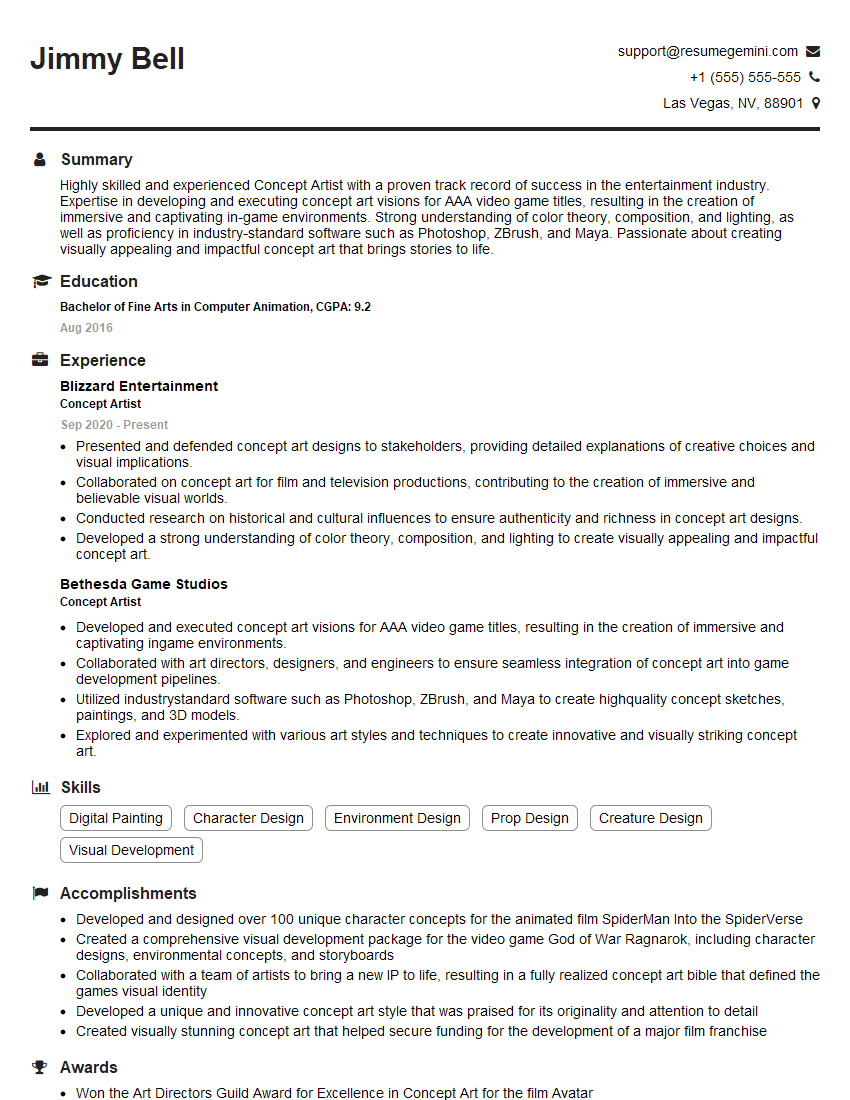
Concept Artist Resume Sample
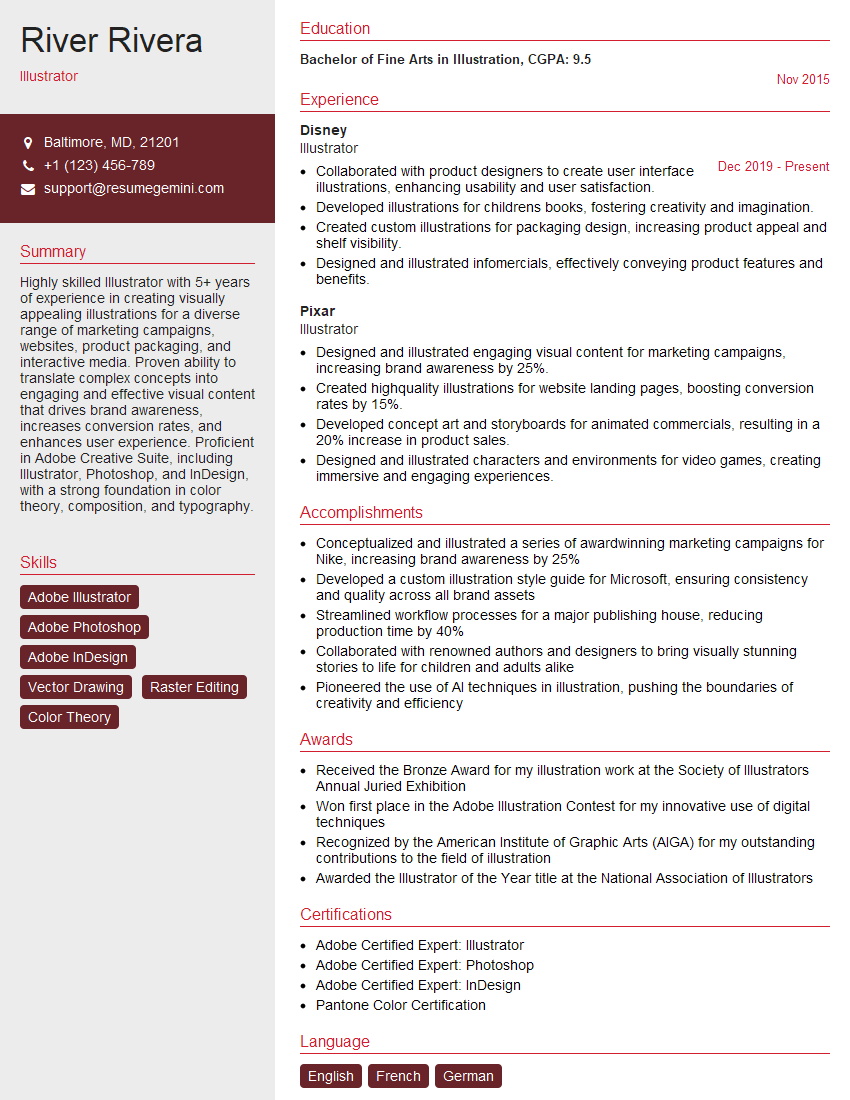
Illustrator Resume Sample

Technical Artist Resume Sample
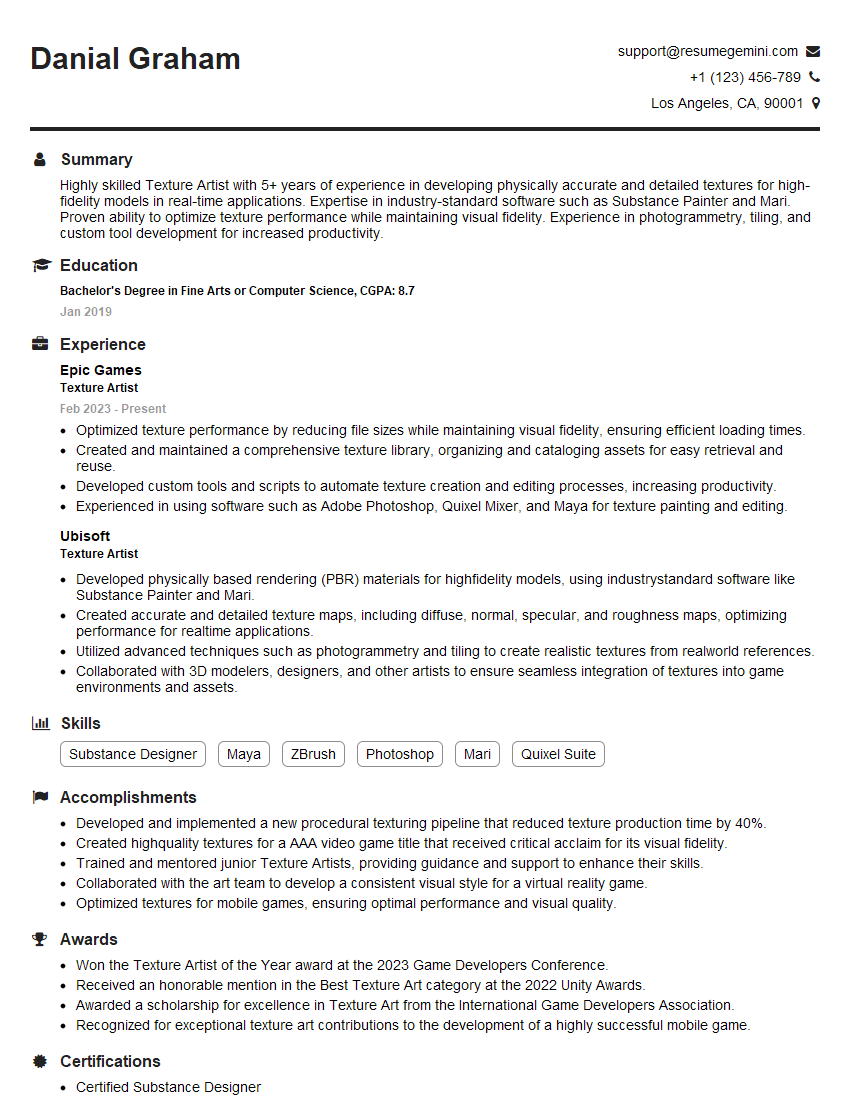
Texture Artist Resume Sample
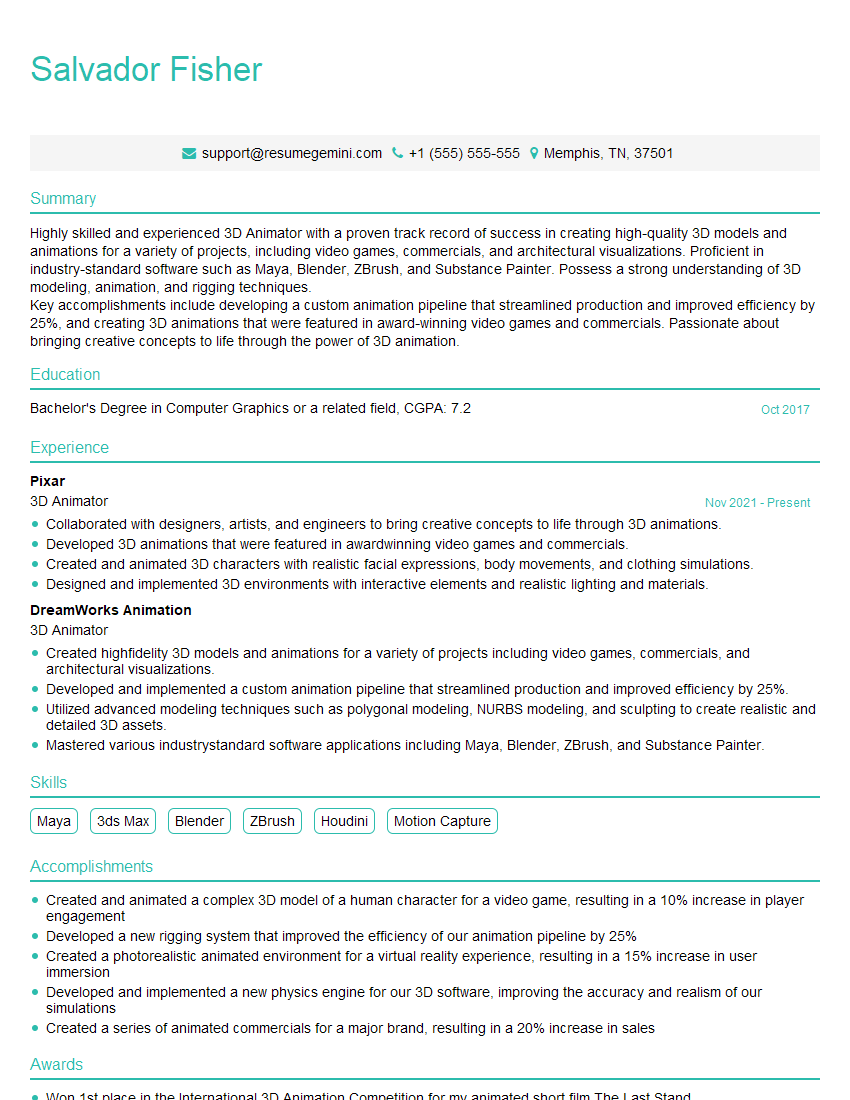
3D Animator Resume Sample
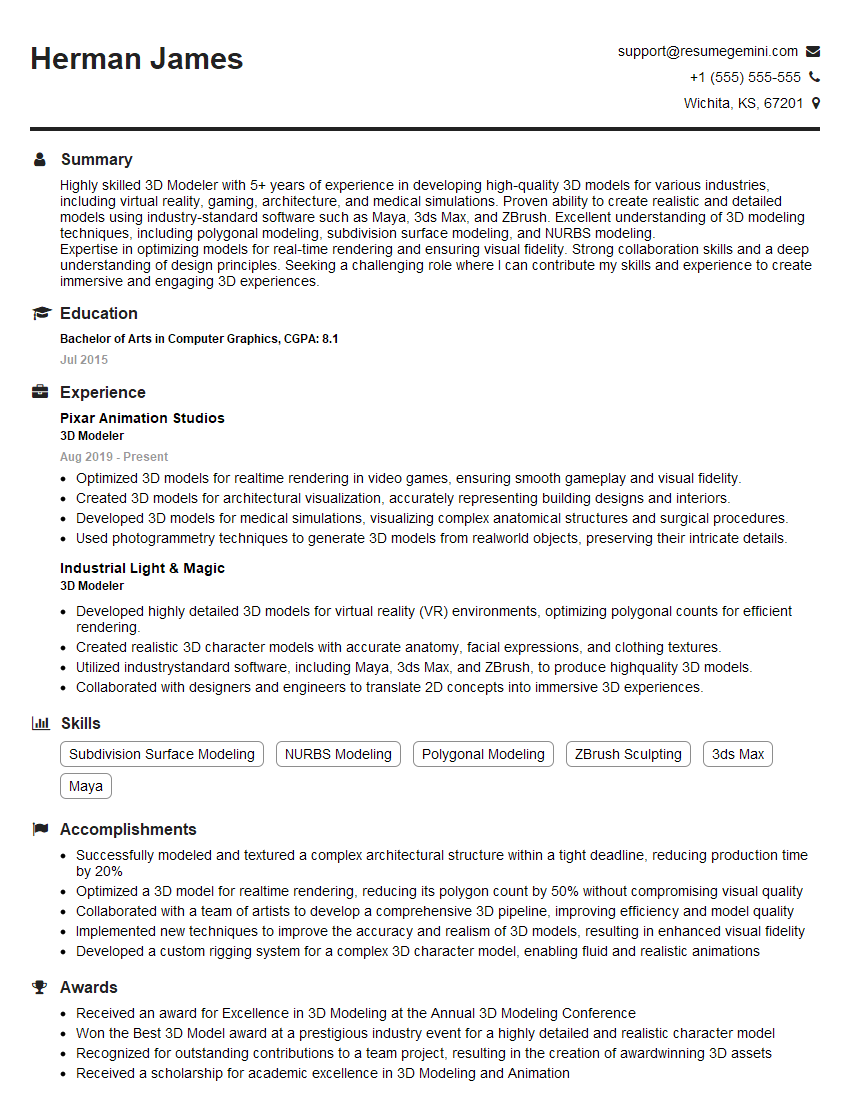
3D Modeler Resume Sample
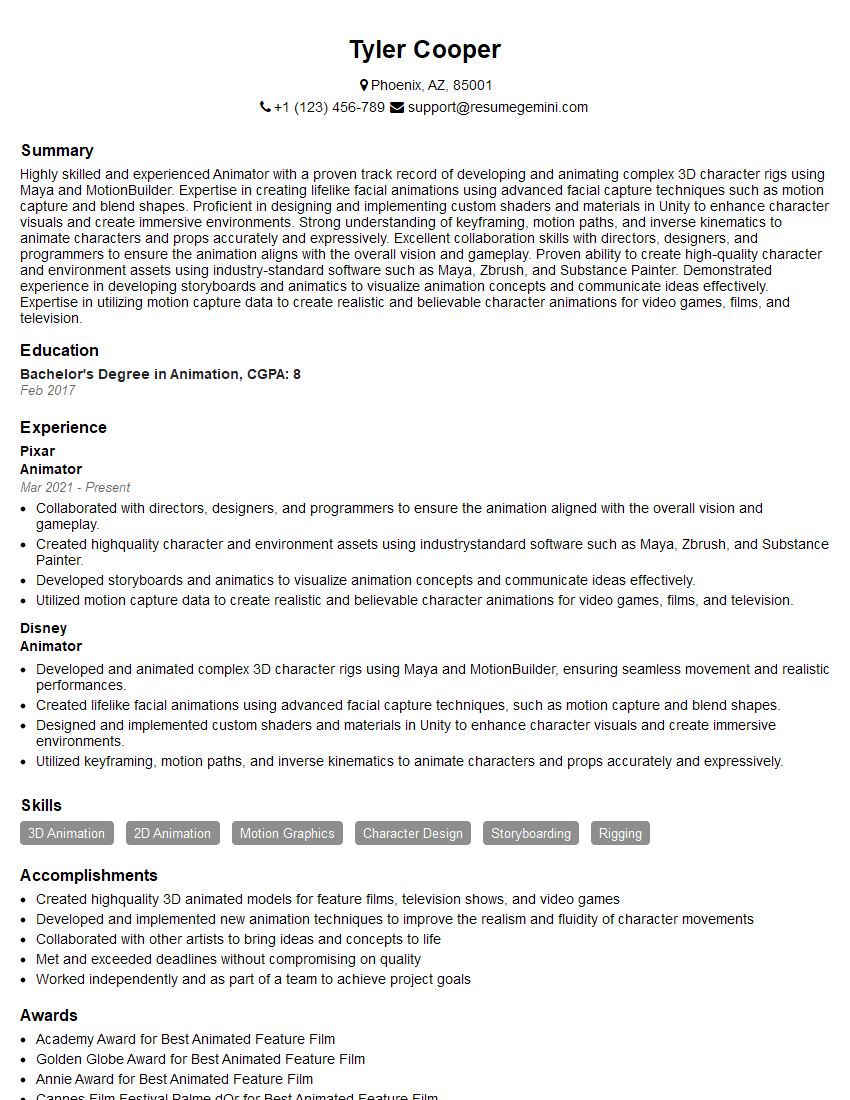
Animator Resume Sample

Compositor Resume Sample
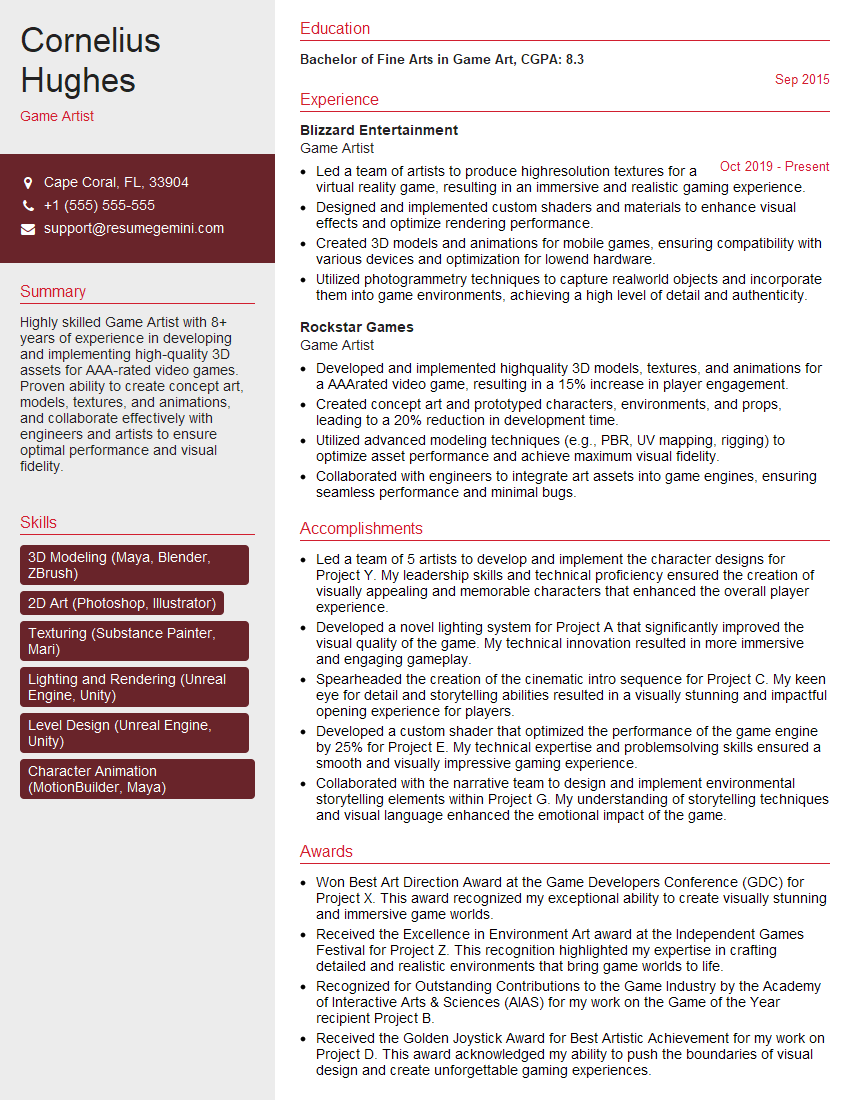
Game Artist Resume Sample

Graphic Designer Resume Sample
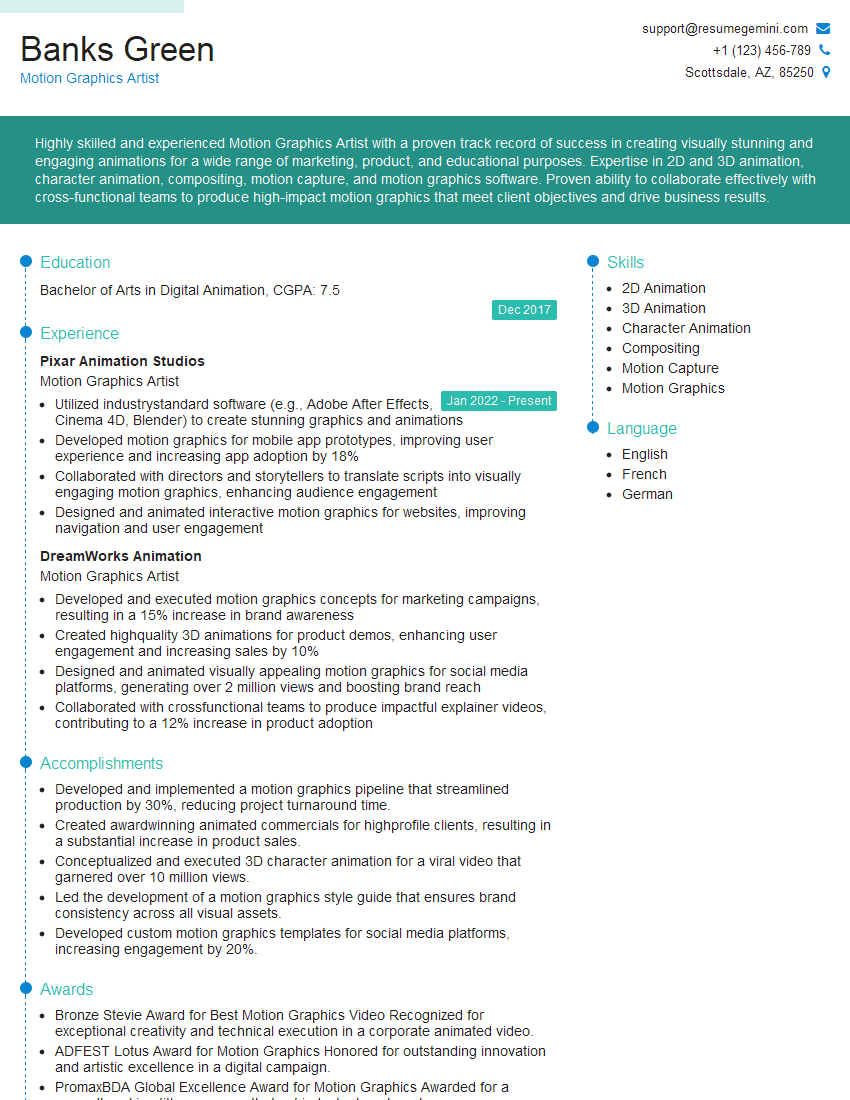
Motion Graphics Artist Resume Sample
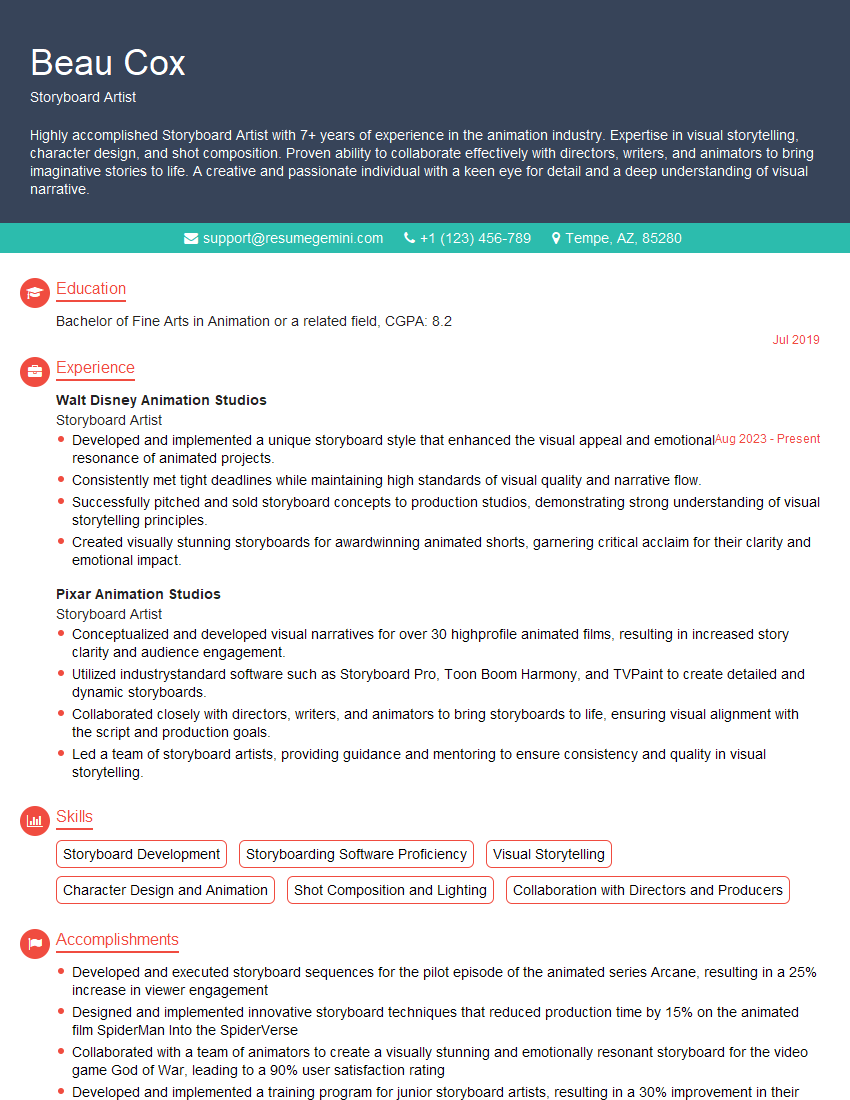
Storyboard Artist Resume Sample
Explore more articles
Users Rating of Our Blogs
Share Your Experience
We value your feedback! Please rate our content and share your thoughts (optional).
What Readers Say About Our Blog
Very informative content, great job.
good