Unlock your full potential by mastering the most common Calligraphy interview questions. This blog offers a deep dive into the critical topics, ensuring you’re not only prepared to answer but to excel. With these insights, you’ll approach your interview with clarity and confidence.
Questions Asked in Calligraphy Interview
Q 1. What calligraphy styles are you proficient in?
My calligraphy proficiency spans a range of styles, each demanding a unique approach and skillset. I’m highly skilled in traditional styles like Copperplate, known for its elegant flourishes and precise strokes, and Spencerian, appreciated for its flowing rhythm and readability. I also excel in more modern styles such as Gothic, with its strong vertical strokes and geometric precision, and Uncial, characterized by its rounded forms and decorative elements. Beyond these, I have experience with various italic scripts, including foundational italic and variations like Chancery Italic. This diverse skillset allows me to cater to a broad spectrum of client needs and project aesthetics.
Q 2. Describe your experience with different calligraphy tools and materials.
My experience with calligraphy tools and materials is extensive. I’m comfortable using a variety of nibs, from the delicate flexibility of Gillott 303 nibs ideal for Copperplate, to the broader strokes achievable with Brause Rose nibs for a more expressive style. I’ve worked with different types of inks, including India ink for its archival quality, and pigment inks for their vibrant colors. My paper selection is equally varied; I frequently use high-quality cotton paper or vellum for its texture and absorbency. I’m also familiar with using different types of holders, from traditional oblique holders to more modern straight holders, and I often experiment with different techniques to achieve specific effects, such as using a brush pen for more calligraphic brush lettering styles.
Q 3. Explain your process for creating a custom calligraphy piece.
Creating a custom calligraphy piece is a meticulous process. It begins with a thorough understanding of the client’s vision. This involves a detailed discussion to ascertain the desired style, tone, and purpose of the piece. Next, I’ll sketch preliminary designs, experimenting with different letterforms and layouts. Once the design is approved, I carefully select the appropriate materials, considering the chosen style and the overall effect I want to achieve. The actual lettering process involves precise execution, focusing on consistency in stroke weight, letter spacing, and overall flow. Finally, I review the finished piece for any imperfections and ensure it meets the client’s expectations before delivery. For example, a wedding invitation requires a more elegant and refined approach compared to a casual hand-lettered poster.
Q 4. How do you handle client requests that are outside your comfort zone?
When faced with a client request outside my immediate comfort zone, I embrace it as an opportunity for growth. My first step is thorough research. I’ll study examples of the requested style, identify key characteristics, and practice until I feel confident in replicating them. I’ll also be transparent with the client, clearly communicating any challenges or potential limitations and offering alternative solutions if necessary. For instance, if a client requests a very specific historical script I haven’t mastered, I might suggest a closely related style or offer to collaborate with a specialist. Open communication and a willingness to learn are crucial in these scenarios.
Q 5. How do you manage your time when working on multiple calligraphy projects?
Managing multiple calligraphy projects demands effective time management skills. I utilize project management tools and techniques, including creating detailed project timelines, assigning priorities based on deadlines and complexity, and breaking down large projects into smaller, manageable tasks. I also allocate specific time blocks for each project, maintaining focus and avoiding multitasking. Consistent scheduling and setting realistic deadlines are paramount to prevent burnout and ensure the timely completion of each project. For example, I might dedicate mornings to intricate pieces and afternoons to projects involving quicker turnaround times.
Q 6. What software are you familiar with for digital calligraphy or design?
While I primarily work with traditional methods, I’m familiar with several digital calligraphy and design software programs. My experience includes Adobe Illustrator and Photoshop, which I use for vector illustration, digital lettering, and incorporating calligraphy into larger design projects. I also have experience with Procreate on iPad for digital brush lettering and experimentation with different textures and styles. These digital tools enhance my workflow, allowing for easier revisions, corrections, and the creation of digital versions of my work.
Q 7. How do you maintain the accuracy and consistency of your lettering?
Maintaining accuracy and consistency in lettering is fundamental to quality calligraphy. This involves regular practice to refine my technique, focusing on consistent stroke weight, consistent letterforms, and proper spacing. I use guidelines and practice sheets extensively, particularly when working on larger projects. I also regularly review my work, paying attention to details and making corrections as needed. Using a consistent set of tools and materials contributes to uniformity. For instance, I might stick to one specific nib and ink type throughout a project to maintain a cohesive style. Developing a keen eye for detail and a commitment to continuous improvement are essential for achieving high standards of accuracy and consistency.
Q 8. What techniques do you use to create different letter weights and textures?
Creating varied letter weights and textures in calligraphy is all about controlling the pressure and angle of your pen or nib against the paper. Think of it like sculpting with ink!
Pressure Control: Applying more pressure creates thicker strokes, while lighter pressure results in thinner ones. This is fundamental to achieving contrast and visual interest. For instance, a heavier downstroke followed by a light upstroke is a classic technique.
Angle Variation: Changing the angle of your pen nib relative to the paper significantly alters the stroke width. A more vertical angle produces broader strokes, whereas a flatter angle results in thinner, finer lines. Experimenting with angles is key to achieving expressive letterforms.
Nib Selection: Different nibs naturally produce different textures. A broad-edged nib will create very distinct thick and thin strokes, while a fine nib will yield delicate, consistent lines. I often use a variety of nibs—from flexible nibs for dramatic variation to stiffer nibs for more controlled consistency—depending on the project’s aesthetic.
Ink Properties: The ink itself plays a role. A thicker ink will inherently create a bolder texture than a thinner, more fluid ink.
For example, when creating a formal invitation, I might use a consistent pressure and angle with a fine nib for elegance. In contrast, a more expressive piece of art calligraphy might benefit from dramatic pressure changes and varied angles using a flexible nib to convey emotion.
Q 9. Describe your experience with various ink types and their properties.
My experience with ink types is extensive, as the choice of ink dramatically affects the final look and feel of the calligraphy. I’ve worked with a wide range, each possessing unique properties:
India Ink: A classic, archival-quality ink known for its intense black color and permanence. It’s excellent for formal pieces but can be unforgiving—mistakes are difficult to correct.
Sumi Ink: A traditional Japanese ink with a subtly varied black color and a beautiful, slightly textured finish. It allows for beautiful shading and blends well but can be less waterproof than India ink.
Acrylic Inks: These are water-based but, once dry, are waterproof and incredibly vibrant. They work well on a variety of surfaces but can sometimes be a bit more challenging to control due to their opacity.
Fountain Pen Inks: These inks, designed for fountain pens, are generally more fluid and less opaque, resulting in delicate lines. They offer a wide range of colors, but archival properties vary widely depending on the brand.
Selecting the right ink is vital; for a wedding invitation requiring permanence, I might opt for India ink. For a more artistic piece where blending is key, Sumi ink might be my preference. The choice depends entirely on the project’s demands and aesthetic.
Q 10. How do you troubleshoot common calligraphy challenges?
Troubleshooting in calligraphy often involves addressing issues with ink flow, nib control, or paper choice. Here’s how I approach common challenges:
Inconsistent Ink Flow: If the ink isn’t flowing smoothly, I’ll check the nib for clogs. I might gently clean it with a soft cloth or use a specialized nib cleaner. Sometimes, the ink itself is too thick, so diluting it slightly can resolve the issue.
Poor Nib Control: Lack of control usually stems from improper posture or grip. I emphasize proper hand positioning and relaxed wrist movements. Practice is key—drills focusing on consistent pressure and angle greatly improve control.
Feathering or Bleed-Through: Feathering (ink spreading) or bleed-through (ink showing on the back of the paper) often indicates using the wrong paper. Switching to a higher-quality paper designed for calligraphy is usually the solution. I often recommend high-quality cotton papers.
Uneven Strokes: This often indicates inconsistent pressure or angle. I’ll guide the client (or myself) to practice maintaining a consistent technique. Practicing basic strokes is incredibly helpful in developing control.
I encourage a methodical approach; identify the problem, consider potential causes, and test solutions until the issue is resolved.
Q 11. How do you ensure the longevity and preservation of your calligraphy work?
Ensuring the longevity of calligraphy involves thoughtful material choices and proper storage. Archival quality is paramount:
Archival Inks: Using inks like India ink or pigmented inks ensures the calligraphy will resist fading and degradation over time.
Acid-Free Paper: Acid-free paper prevents the ink from degrading or the paper from yellowing. Cotton-based papers are ideal for longevity.
Proper Storage: Keeping the artwork away from direct sunlight, moisture, and extreme temperatures is crucial. Acid-free storage boxes or sleeves offer optimal protection.
Mounting and Framing: If framing, use acid-free mats and backing boards to prevent damage. UV-protective glass helps protect from light damage.
I often advise clients on these preservation methods, particularly for important documents or artwork intended as heirlooms. The extra effort is well worth it to guarantee the work’s longevity.
Q 12. Explain your understanding of different paper types and their suitability for calligraphy.
Paper selection is critical in calligraphy; the wrong paper can lead to frustrating bleed-through, feathering, or poor ink absorption. Here’s what I consider:
Weight: Heavier weight paper (around 100gsm or higher) prevents bleed-through and offers better support for the pen.
Texture: Smooth papers produce clean, crisp lines, while textured papers add visual interest but can challenge nib control.
Material: Cotton-based papers are the most durable and archival, resisting acid and deterioration. Wood-free papers are a good, more affordable alternative.
Color: While white is classic, tinted papers can add visual interest. Darker papers require using lighter colored inks.
For delicate script, I prefer a smooth, heavier weight cotton paper. For a more rustic or textured look, I might select a slightly textured paper. The paper choice often complements the overall aesthetic of the calligraphy project.
Q 13. How do you approach designing calligraphy for different applications (e.g., wedding invitations, logos)?
Designing calligraphy for different applications demands a versatile approach, understanding the context and desired aesthetic. I tailor my design to the project’s specific requirements:
Wedding Invitations: Here, elegance and formality are key. I often use classic scripts, paying close attention to balance and legibility. The choice of ink color and paper are vital for enhancing the overall look and feel.
Logos: Logo design prioritizes simplicity, memorability, and scalability. The calligraphy should be clean, bold, and easily recognizable, even at small sizes. I might use a stylized script or a bolder font.
Other Applications: Book illustrations might demand a more whimsical or decorative style; hand-lettered quotes might prioritize individual expression. The design choices always stem from the specific application’s needs.
Each project is approached uniquely, with sketches and explorations done before committing to a final design. Client input is crucial in shaping the final product, ensuring it meets their expectations.
Q 14. What is your process for pricing your calligraphy services?
Pricing my calligraphy services involves a multifaceted approach, considering several factors:
Project Scope: The number of pieces, complexity of the design, and required materials heavily influence the price. Intricate designs naturally take more time and effort.
Materials: The cost of high-quality paper, ink, and other materials is factored into the overall price. Using archival materials increases the cost.
Time Investment: Calligraphy is time-intensive; I calculate the price based on the time spent on design, practice, and execution. This is often calculated per piece or per hour depending on the project.
Client’s Budget: I offer various packages or options to accommodate different budgets while maintaining quality.
Transparency is key; I provide detailed quotes explaining the cost breakdown. My pricing reflects the value of my skills, experience, and the use of premium materials to ensure client satisfaction.
Q 15. Describe a challenging calligraphy project and how you overcame the obstacles.
One particularly challenging project involved creating a large-scale calligraphy piece for a museum exhibit. The piece required a specific historical script, Uncial, which demanded extreme precision and a deep understanding of the letterforms’ subtle nuances. The main obstacle was the scale; the letters needed to be several feet tall, requiring a completely different approach than my usual work.
To overcome this, I first created a meticulously detailed miniature version to perfect the lettering and spacing. I then used a projector to enlarge the design onto the final surface, a specially treated canvas. This ensured accuracy but also allowed for adjustments during the larger-scale execution. Instead of traditional quill pens, I used custom-made brushes and carefully thinned inks to achieve the desired line weight and consistency across the vast surface. The project demanded patience and meticulous planning, but the result was a visually stunning piece that truly embodied the historical script’s elegance and power.
Career Expert Tips:
- Ace those interviews! Prepare effectively by reviewing the Top 50 Most Common Interview Questions on ResumeGemini.
- Navigate your job search with confidence! Explore a wide range of Career Tips on ResumeGemini. Learn about common challenges and recommendations to overcome them.
- Craft the perfect resume! Master the Art of Resume Writing with ResumeGemini’s guide. Showcase your unique qualifications and achievements effectively.
- Don’t miss out on holiday savings! Build your dream resume with ResumeGemini’s ATS optimized templates.
Q 16. How do you stay current with calligraphy trends and techniques?
Staying current in calligraphy requires a multi-faceted approach. I regularly attend workshops and conferences, both online and in-person, to learn new techniques and styles from master calligraphers. Many talented artists share their knowledge through online tutorials and courses, which I actively follow.
Exploring various social media platforms dedicated to calligraphy is also crucial. Instagram, in particular, provides a vast visual library showcasing diverse styles and approaches. I actively engage with the community, seeking feedback and inspiration. Finally, studying historical manuscripts and examples of different calligraphy traditions – from medieval illuminated manuscripts to modern design applications – constantly enriches my understanding and keeps me informed about evolving trends.
Q 17. What are your strengths and weaknesses as a calligrapher?
My greatest strength is my meticulous attention to detail. I possess a keen eye for precision and consistency, which is crucial for creating visually appealing and technically sound calligraphy. I also have a broad understanding of various scripts and styles, allowing me to adapt my approach depending on the project’s needs. My weakness, if I were to identify one, is occasionally getting overly invested in perfecting minute details, potentially slowing down the overall workflow. To mitigate this, I employ time management techniques and regularly check my progress to maintain a balance between quality and efficiency.
Q 18. What is your experience with calligraphy restoration or preservation?
I have experience with the careful restoration and preservation of antique calligraphy. This often involves delicate cleaning techniques using specialized materials to remove dirt and grime without damaging the original artwork. I am familiar with the proper handling and storage of fragile documents, utilizing archival-quality materials to prevent further deterioration.
One particular project involved restoring a faded 18th-century letter. This required using specialized light sources to assess the ink’s condition and applying a gentle cleaning solution to remove surface dirt. Careful filling in of minor ink losses was executed with archival-quality inks that matched the original. Each stage demanded meticulous attention and a deep understanding of material science to avoid further damage. Proper documentation of the restoration process was crucial, including photographic records and detailed notes.
Q 19. How do you collaborate with other designers or artists?
Collaboration is a vital part of my work. I frequently collaborate with graphic designers on projects where calligraphy complements other design elements. Communication is key; I ensure clear discussions regarding the project’s vision, styles, and deadlines. I’m proficient in sharing digital files and providing high-resolution scans of my work for seamless integration into their design process.
For example, in a recent project with a graphic designer, we worked together to create wedding invitations. They provided the overall design layout, and I supplied the custom-designed calligraphy for the names and key text elements. We exchanged several proofs, ensuring both the calligraphy’s artistic integrity and the cohesive integration within the overall design.
Q 20. Describe your understanding of color theory as it applies to calligraphy.
Color theory is fundamental in calligraphy, influencing both the aesthetic impact and the legibility of the text. Understanding color harmony – complementary, analogous, triadic – helps choose color combinations that enhance the overall design. The value (lightness or darkness) of the ink significantly impacts readability; lighter inks on dark backgrounds or vice versa can be challenging to read, requiring careful consideration.
For instance, a formal invitation might use muted analogous colors for an elegant look, while a more playful design might employ contrasting complementary colors for a striking effect. The ink’s saturation (intensity) also impacts its visual presence. A highly saturated ink draws attention, while a desaturated one might be more subtle.
Q 21. What are the ethical considerations in calligraphy, particularly regarding copyright and intellectual property?
Ethical considerations in calligraphy, particularly regarding copyright and intellectual property, are vital. It’s crucial to respect the intellectual property rights of fonts, designs, and existing artworks. Creating original works and not directly copying others’ designs is fundamental. When using existing scripts or styles as inspiration, it’s important to acknowledge and attribute those sources appropriately.
For instance, creating a piece inspired by a specific historical script requires clearly stating the inspiration’s source, while avoiding direct replication that might infringe on copyright if the original work is still under protection. When commissioned to work, it is essential to agree on usage rights and licensing to avoid any future disputes regarding the final artwork.
Q 22. Explain your familiarity with different historical calligraphy styles.
My familiarity with historical calligraphy styles spans centuries and diverse cultures. I’ve extensively studied and practiced scripts like Uncial, a rounded majuscule script from the Roman era known for its elegance; Carolingian Minuscule, a crucial development in the standardization of lowercase letters in Europe; Gothic, with its characteristic angularity and intricacy; and various Italic scripts, famous for their flowing, cursive nature. Beyond European styles, I’m also well-versed in the beautiful forms of East Asian calligraphy, including Japanese shodo and Chinese shufa, appreciating their distinct brushwork techniques and philosophies. This broad knowledge allows me to appreciate the evolution of letterforms and apply historical principles to contemporary design.
- Uncial: Think of the majestic lettering in early illuminated manuscripts.
- Gothic: Imagine the sharp, pointed letters in medieval documents.
- Italic: Visualize the fluid, expressive handwriting in Renaissance letters.
Q 23. How do you adapt your calligraphy style to suit different audiences?
Adapting my calligraphy style depends heavily on the audience and the intended message. For a formal wedding invitation, I might choose a classic, elegant script like Copperplate, emphasizing precision and legibility. For a children’s book, a playful, more informal script would be appropriate, perhaps incorporating illustrative elements. A corporate logo might require a clean, modern sans-serif style, prioritizing clarity and memorability. The key is understanding the context – the tone, formality, and the overall aesthetic – and selecting a style that complements it. I always prioritize readability while maintaining the artistic integrity of the chosen style. For instance, while a highly stylized script might be visually striking, ensuring the text is easily deciphered is paramount.
Q 24. Describe your understanding of typography and its relationship to calligraphy.
Typography and calligraphy share a deep historical and artistic connection. Calligraphy, the art of beautiful handwriting, is the ancestor of typography, the art and technique of arranging type to make written language legible, readable, and appealing. Many typefaces are directly inspired by historical calligraphic styles. For example, many serif typefaces echo the characteristics of humanist and old-style scripts, while modern sans-serif typefaces often borrow from simpler, geometric calligraphy styles. Understanding typography’s principles – such as kerning, leading, and tracking – helps me translate calligraphic forms into digital designs while maintaining the aesthetic integrity of the original script. I see my role as bridging the gap between the traditional art of calligraphy and the modern applications of typography.
Q 25. What is your approach to creating consistent and legible calligraphy?
Achieving consistent and legible calligraphy requires meticulous practice and attention to detail. My approach involves:
- Mastering basic strokes: Developing a solid foundation in fundamental strokes, practicing them repeatedly to achieve consistency in thickness, angle, and pressure.
- Careful planning: Sketching out the piece beforehand, ensuring proper letter spacing and overall composition. This helps avoid errors and ensures visual harmony.
- Consistent posture and grip: Maintaining a relaxed yet controlled posture and grip while writing prevents hand fatigue and promotes fluidity.
- Regular practice: Consistent practice hones technique and improves control, resulting in more consistent letterforms.
- Self-critique and refinement: Regularly reviewing my work, identifying areas needing improvement, and refining my techniques.
Q 26. What safety precautions do you follow when working with calligraphy tools and materials?
Safety is paramount when working with calligraphy tools. I always handle sharp nibs and blades with extreme care, using appropriate cutting mats and protective gloves when necessary. I clean my tools after each use to prevent ink buildup and maintain their sharpness. I ensure proper ventilation when using solvents or inks with strong fumes. Furthermore, I always store my tools and materials securely and out of reach of children. Eye protection is crucial when using tools that could potentially cause debris to fly. For example, when working with pointed nibs, a misjudgment could lead to tiny particles flying and injuring the eye.
Q 27. How do you handle pressure and deadlines while working on calligraphy projects?
Handling pressure and deadlines requires a structured approach. I start by carefully estimating the time required for each project, factoring in potential challenges. I break down large projects into smaller, manageable tasks, setting realistic deadlines for each. This allows me to track progress and adjust my schedule if needed. I prioritize tasks based on urgency and complexity, focusing on crucial aspects first. When feeling overwhelmed, I take short breaks to clear my mind and regain focus. Effective time management and prioritizing tasks are essential for maintaining quality under pressure. For example, if I have a large wedding invitation order, I’ll work on the most complex elements early, allowing ample time for adjustments and corrections.
Q 28. How would you approach teaching calligraphy to beginners?
Teaching beginners starts with building a solid foundation. I begin by introducing basic strokes, explaining their nuances and demonstrating proper posture and grip. I emphasize the importance of consistent practice and provide ample opportunities for hands-on learning. I introduce different lettering styles gradually, starting with simpler scripts before progressing to more complex ones. I encourage experimentation and self-expression, guiding students to develop their unique calligraphic voice. Positive reinforcement and constructive feedback are vital. Making learning fun is key, perhaps by starting with projects they can relate to, like personalized cards or artistic quotes. I might even introduce digital calligraphy tools as a supplemental learning aid. The goal is to foster a love for the art form while developing technical skills.
Key Topics to Learn for Your Calligraphy Interview
- Handwriting Styles: Understanding the history and characteristics of various calligraphy styles (e.g., Gothic, Copperplate, Spencerian) and their appropriate applications.
- Tool & Material Knowledge: Demonstrate familiarity with different nibs, inks, papers, and other materials used in calligraphy, and their impact on the final product. Be prepared to discuss the advantages and disadvantages of various options.
- Letter Formation & Technique: Mastering the precise strokes and movements required for creating consistent and aesthetically pleasing lettering. Be ready to discuss your approach to achieving uniformity and elegance.
- Layout & Design Principles: Show your understanding of composition, spacing, and balance in calligraphy projects. Discuss how you approach the design process for different formats (e.g., invitations, signage, manuscripts).
- Practical Applications: Be prepared to discuss your experience in applying calligraphy skills to various contexts, such as custom lettering, graphic design, or illustration. Showcase your versatility.
- Troubleshooting & Problem Solving: Discuss how you approach challenges such as ink flow issues, uneven strokes, or correcting mistakes. Highlight your problem-solving skills and resourcefulness.
- Digital Calligraphy & Technology: If applicable, showcase your understanding of digital calligraphy tools and software, and their integration with traditional techniques.
Next Steps
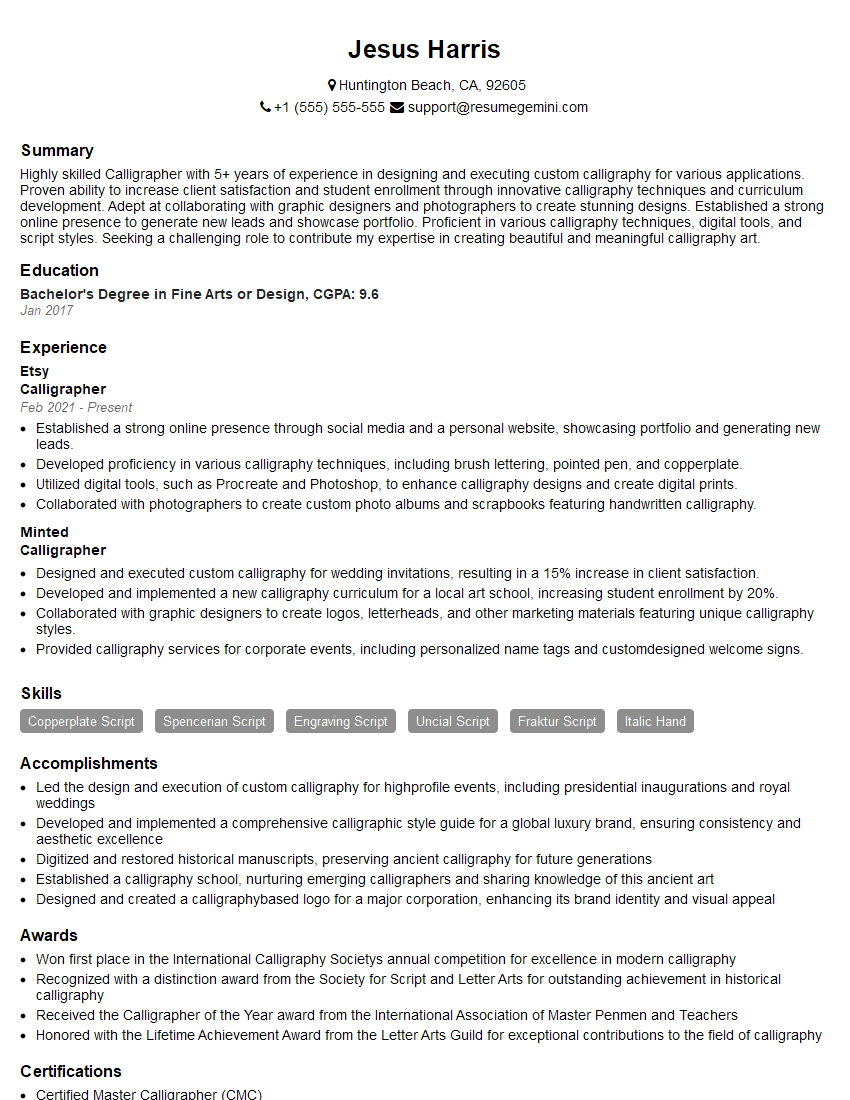
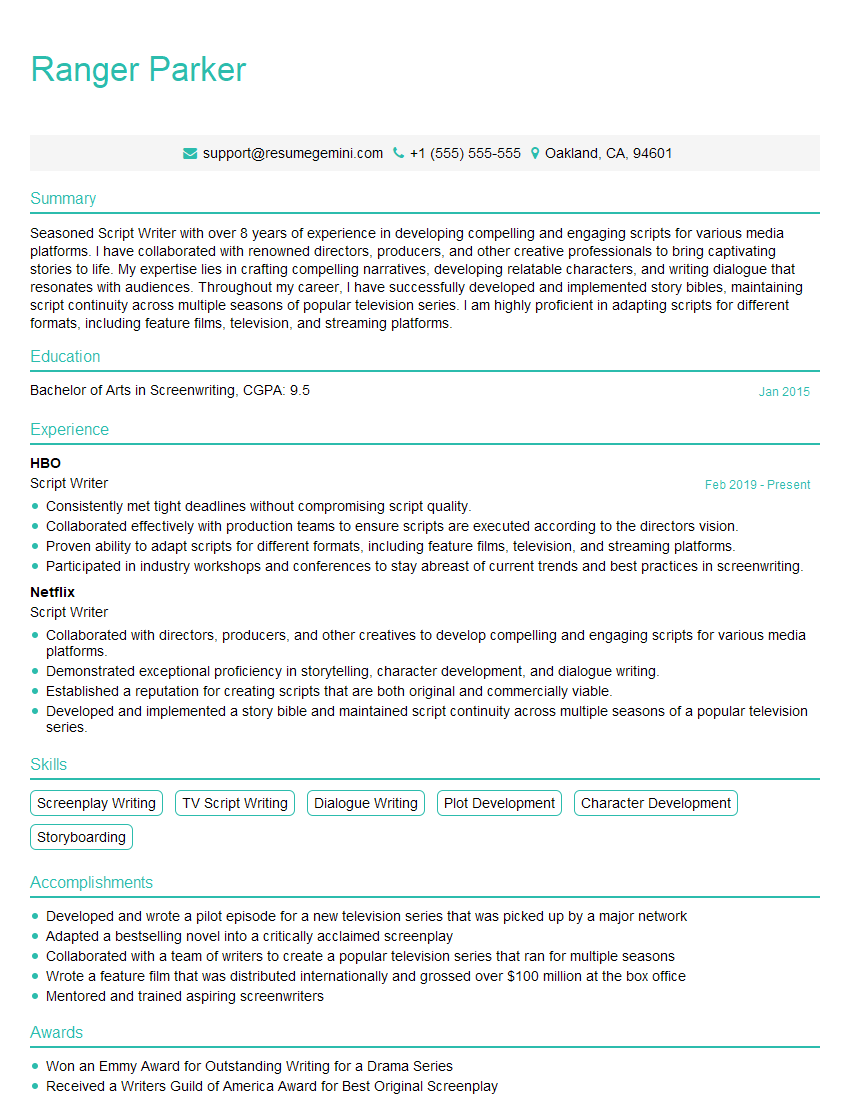
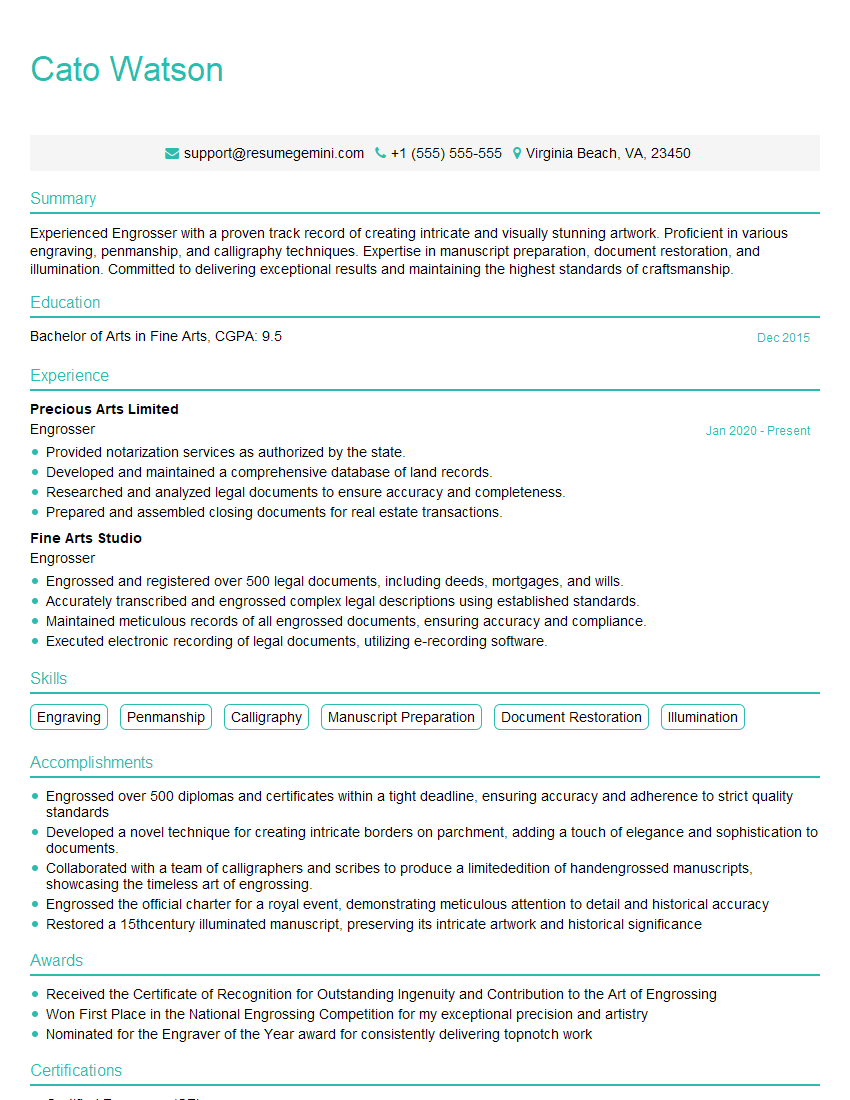
Mastering calligraphy opens doors to diverse and rewarding career paths, from freelance artist to in-house designer. To maximize your job prospects, crafting a strong, ATS-friendly resume is crucial. ResumeGemini can help you build a professional resume that highlights your skills and experience effectively. We offer examples of resumes tailored specifically to the calligraphy field to give you a head start. Take the next step in your career journey – create a resume that truly showcases your talent and passion.
Explore more articles
Users Rating of Our Blogs
Share Your Experience
We value your feedback! Please rate our content and share your thoughts (optional).
What Readers Say About Our Blog
Very informative content, great job.
good