The right preparation can turn an interview into an opportunity to showcase your expertise. This guide to Proficient in Scientific Illustration Techniques interview questions is your ultimate resource, providing key insights and tips to help you ace your responses and stand out as a top candidate.
Questions Asked in Proficient in Scientific Illustration Techniques Interview
Q 1. What software packages are you proficient in for scientific illustration (e.g., Adobe Illustrator, Photoshop, Blender, Maya)?
My core software proficiency lies in the Adobe Creative Suite, specifically Adobe Illustrator and Photoshop. Illustrator is my go-to for vector-based illustrations, offering unparalleled precision and scalability crucial for scientific work. I leverage its robust tools for creating clean lines, precise shapes, and intricate details necessary in diagrams and schematics. Photoshop, on the other hand, excels in raster-based illustrations, allowing me to manipulate photographs, create realistic textures, and work with high-resolution images for detailed anatomical renderings or microscopic views. I also have experience with Blender for 3D modeling and rendering, particularly useful for creating complex structures or animations for scientific visualization. While I haven’t used Maya extensively for scientific illustration, I’m familiar with its capabilities and could adapt quickly if a project required its use.
Q 2. Explain your experience with different illustration styles (e.g., realistic, schematic, cross-sectional).
I’m comfortable working across a wide spectrum of illustration styles. Realistic illustrations, often requiring meticulous detail and photo-realistic rendering, are frequently used to depict anatomical structures or microscopic organisms. For example, I’ve created highly realistic depictions of the human heart, showing its intricate chambers and valves. Schematic illustrations prioritize clarity and simplicity, emphasizing key features and relationships. These are ideal for flowcharts, diagrams explaining processes (like metabolic pathways), or simplified representations of complex systems. Cross-sectional illustrations provide a view of an internal structure as if it had been sliced open. This style is particularly useful for showing the layered structure of organs, tissues, or geological formations; I recently completed a series of cross-sections showing the different strata of a particular rock formation.
Q 3. Describe your process for creating a scientific illustration, from initial concept to final product.
My process is iterative and highly collaborative. It begins with a thorough understanding of the scientific concept. I engage in detailed discussions with the client or supervisor to clarify the objectives, target audience, and desired style. Then, I create several initial sketches or thumbnails to explore various compositional approaches and stylistic choices. Once a concept is approved, I create a detailed digital draft, incorporating feedback at each stage. This draft undergoes rigorous refinement, including adjustments to accuracy, aesthetics, and overall clarity. The final step involves thorough quality control checks, ensuring the illustration is scientifically accurate, visually appealing, and meets all specifications. This might involve consultation with subject matter experts to ensure factual accuracy.
Q 4. How do you ensure accuracy in your scientific illustrations?
Accuracy is paramount. I meticulously research the subject matter using peer-reviewed scientific literature, textbooks, and databases. I consult with subject matter experts as needed to ensure that all details, proportions, and relationships are scientifically sound. For anatomical illustrations, I cross-reference multiple anatomical atlases and compare them to ensure consistency. I use precise measurements and scale when appropriate and maintain careful labelling and annotations. Every illustration undergoes a rigorous quality check, and I often request a second review from a colleague to catch any potential errors.
Q 5. How do you handle revisions and feedback from clients or supervisors?
I embrace revisions as an opportunity for improvement. I maintain open communication with clients and supervisors throughout the process, providing regular updates and soliciting feedback. I use version control (saving different versions of the file) to track changes effectively and readily incorporate suggestions, clarifying any misunderstandings or ambiguities. My aim is to ensure that the final illustration precisely meets the client’s needs and reflects their vision while maintaining scientific accuracy.
Q 6. How do you balance artistic creativity with scientific accuracy in your illustrations?
Balancing artistic creativity with scientific accuracy is a delicate act, but crucial to successful scientific illustration. Scientific accuracy forms the foundation—it’s non-negotiable. Artistic creativity comes into play in choosing the most effective way to present the scientific information. For example, I might use color palettes to highlight key features or employ different visual techniques to improve understanding. The goal is to create an illustration that is both scientifically accurate and engaging; it shouldn’t be merely a diagram, but a visual story effectively communicating complex information. For instance, I might use subtle shading and lighting techniques to enhance the three-dimensionality of an anatomical structure while ensuring all anatomical details are accurately represented.
Q 7. Describe your experience with creating anatomical illustrations.
I have extensive experience creating anatomical illustrations. This includes illustrations of various organ systems (e.g., cardiovascular, nervous, musculoskeletal), microscopic structures (e.g., cells, tissues), and whole-body anatomical representations. I understand the importance of anatomical terminology and precise representation of structures’ relationships and proportions. I frequently consult Gray’s Anatomy and other reliable sources to ensure accuracy. I’ve worked on projects ranging from simple diagrams for educational purposes to highly detailed, photorealistic renderings for medical publications. I’m adept at incorporating labels, annotations, and legends to improve clarity and understanding. The challenge is always to find the perfect balance between artistic appeal and scientific precision.
Q 8. What are your preferred methods for incorporating data visualization into your illustrations?
Data visualization is crucial for making scientific illustrations impactful. My preferred methods involve choosing the right chart type to represent the data accurately and engagingly. For instance, I’d use bar charts for comparing discrete categories, line graphs for showing trends over time, and scatter plots for revealing correlations between variables. Beyond basic charts, I frequently incorporate:
Interactive elements: If the illustration is for a digital platform, I might integrate interactive components like tooltips, allowing viewers to hover over data points for more detailed information. This significantly enhances understanding and engagement.
Color-coding: Strategically using color to highlight key data points or categories improves visual clarity and draws attention to important findings. A legend clearly explaining the color scheme is essential.
Data mapping: For geographical data, I’d employ cartographic techniques to visualize spatial patterns and distributions.
For example, when illustrating the effect of a new drug on blood pressure, I’d use a line graph showing blood pressure changes over time for the treatment and control groups, clearly distinguishing them with color and adding a concise legend.
Q 9. How do you research and understand complex scientific concepts for illustration?
Understanding complex scientific concepts requires a multi-faceted approach. It begins with thorough literature review—I delve into research papers, review articles, and relevant textbooks to grasp the fundamental principles and the specific details relevant to the illustration. I often look at existing illustrations in similar areas to understand common visualization strategies and identify best practices. I also:
Consult with experts: Direct communication with the scientists involved in the research is invaluable. I ask clarifying questions to ensure my understanding is accurate and complete, and to discuss visualization preferences.
Simplify complex ideas: I break down complex processes into manageable steps or stages. Think of explaining photosynthesis—I’d illustrate it as a series of smaller, more comprehensible events.
Use analogies and metaphors: These help translate abstract concepts into easily digestible visuals. For instance, explaining electron orbitals can be done by comparing them to planetary orbits, making it relatable.
This combination of research and expert interaction ensures accuracy and clarity in the final illustration, guaranteeing the scientific integrity of the work.
Q 10. What techniques do you use to create 3D models for scientific visualization?
My 3D modeling workflow typically involves these steps:
Software Selection: I choose the appropriate software based on the project’s complexity and desired outcome. Popular choices include Blender (open-source and versatile), Maya (industry standard, powerful), and 3ds Max (widely used in architecture and visualization).
Model Creation: Starting from basic primitives (spheres, cubes, etc.), I sculpt and refine the 3D model using a combination of polygon modeling, NURBS surfaces, or sculpting tools, depending on the subject’s nature and level of detail required. For microscopic structures, for instance, I might rely heavily on the data provided from microscopy techniques.
Texturing and Lighting: I apply realistic textures and lighting to enhance the model’s visual appeal and accuracy. Accurate representation is crucial for scientific visualization.
Rendering: Finally, I render the 3D model into a high-resolution image or animation using appropriate rendering techniques to achieve a photorealistic or stylized look as needed.
For example, visualizing a protein structure might involve using data from X-ray crystallography to create a 3D model, then carefully rendering it to highlight specific amino acid interactions or binding sites.
Q 11. How do you create effective legends and captions for your illustrations?
Effective legends and captions are essential for conveying the context and interpretation of an illustration. They should be:
Concise: Avoid unnecessary jargon and lengthy descriptions. Get to the point quickly.
Accurate: Information presented must precisely reflect the data and the illustration itself.
Clear: Use simple language and avoid ambiguity.
Consistent: Use a standardized format for all elements, ensuring visual uniformity across all illustrations.
For legends, I use clear labels and color-coding corresponding to the elements in the illustration. Captions provide a brief explanation of the figure’s purpose and key takeaways. A caption might say something like: “Figure 1. Effect of Drug X on Blood Pressure. Blood pressure (mmHg) measured in control (blue) and treatment (red) groups over 7 days. Data represents mean ± SEM (n=10).”
Q 12. Explain your knowledge of color theory and its application in scientific illustration.
Color theory is fundamental in scientific illustration. My understanding encompasses color harmony, color temperature, color psychology, and accessibility considerations. I use:
Color harmony: Choosing colors that work well together improves visual appeal and avoids jarring contrasts. Analogous colors (adjacent on the color wheel) often create a harmonious feel.
Color temperature: Warmer colors (reds, oranges) can convey energy or heat, while cooler colors (blues, greens) might suggest calmness or cold processes.
Color psychology: Certain colors evoke specific emotions or associations (e.g., red for danger, green for growth). This needs careful consideration to avoid misinterpretations.
Color blindness accessibility: I ensure my color palettes are perceptually distinct, avoiding combinations that are difficult for individuals with color blindness to differentiate. I test my illustrations using color blindness simulation tools.
For instance, if illustrating a temperature gradient, I might choose a color scheme that progressively changes from cool blues to warm reds, with a clearly labeled color bar to indicate the temperature values.
Q 13. How do you approach illustrating microscopic structures?
Illustrating microscopic structures necessitates a blend of artistic skill and scientific accuracy. The process usually begins with obtaining high-resolution microscopic images (e.g., from electron microscopy, confocal microscopy). I then:
Enhance and process images: Adjust contrast, brightness, and potentially add pseudo-coloring to highlight specific structures or features while maintaining fidelity to the original data.
Create stylized interpretations: Sometimes a simplified, stylized representation is more effective than a complex, highly detailed image. This helps focus attention on key features.
Combine multiple images: If multiple images are needed to fully represent a complex 3D structure, I might combine them strategically to create a composite illustration.
Add labels and annotations: Clearly labeled structures improve understanding and interpretation.
For example, illustrating a cell’s internal structures might involve combining images from different microscopy techniques, enhancing contrast to highlight specific organelles, and adding clear labels to identify each component.
Q 14. Describe your experience with working with scientific publications or journals.
I have extensive experience working with scientific publications and journals. My contributions include:
Figure preparation: I create and prepare high-resolution illustrations according to the specific formatting requirements of individual journals.
Collaboration with authors: I closely collaborate with scientists to ensure the illustrations accurately represent their data and meet their communication goals.
File format management: I provide illustrations in the formats required by publishers (e.g., TIFF, EPS, AI).
Copyright and licensing: I’m aware of copyright issues and can navigate the relevant licensing agreements.
I’ve worked on numerous projects resulting in publications in peer-reviewed journals across various scientific disciplines, including biomedical research, environmental science, and materials science. Understanding the needs of scientific journals ensures that my work meets the highest standards for quality and accuracy in publication.
Q 15. How do you ensure your illustrations are accessible to a diverse audience?
Accessibility in scientific illustration is paramount. It’s not just about creating a visually appealing image; it’s about ensuring everyone can understand it, regardless of their visual abilities or cultural background. I achieve this through several strategies.
- Colorblind-friendly palettes: I avoid using color combinations that are difficult for individuals with color vision deficiencies to distinguish. Tools like Coblis are invaluable for testing. For example, I’d use different shapes or patterns alongside colors to encode information, rather than relying solely on color to convey meaning.
- Sufficient contrast: I ensure there’s ample contrast between text and background, and between different elements within the illustration, to improve readability for people with low vision. WebAIM’s contrast checker is a helpful tool here.
- Clear and concise labeling: All elements are clearly labeled with easy-to-read fonts, avoiding unnecessary jargon. I use alt text for all images, crucial for screen readers used by visually impaired individuals.
- Multilingual options: When appropriate, I provide illustrations with labels and captions in multiple languages to cater to a global audience. This is especially important for international scientific publications.
- Simple and consistent visual language: I use clear and consistent visual cues throughout the illustration, minimizing ambiguity and maximizing comprehension. For example, maintaining a consistent style for representing different cell types or organelles.
By prioritizing these techniques, I aim to make my scientific illustrations inclusive and understandable to the widest possible audience.
Career Expert Tips:
- Ace those interviews! Prepare effectively by reviewing the Top 50 Most Common Interview Questions on ResumeGemini.
- Navigate your job search with confidence! Explore a wide range of Career Tips on ResumeGemini. Learn about common challenges and recommendations to overcome them.
- Craft the perfect resume! Master the Art of Resume Writing with ResumeGemini’s guide. Showcase your unique qualifications and achievements effectively.
- Don’t miss out on holiday savings! Build your dream resume with ResumeGemini’s ATS optimized templates.
Q 16. How do you manage your time and prioritize tasks when working on multiple projects?
Managing multiple projects efficiently requires a structured approach. I utilize a project management system, typically a combination of a digital task manager (like Asana or Trello) and a physical planner. Each project gets its own board or section, breaking down larger tasks into smaller, manageable steps. This allows for better tracking of progress and identification of potential bottlenecks.
- Prioritization: I use the Eisenhower Matrix (urgent/important) to prioritize tasks. Deadlines and client importance heavily influence prioritization. Some projects, especially urgent ones, may require focused, uninterrupted ‘deep work’ sessions.
- Time Blocking: I allocate specific time blocks for each project, ensuring focused work without constant switching. This minimizes context switching overhead and improves efficiency.
- Regular review: I regularly review my schedule and tasks, adjusting plans as needed. This flexibility allows me to accommodate unforeseen challenges or changes in priorities.
- Communication: Clear and proactive communication with clients is crucial to manage expectations and avoid delays. Regular updates prevent misunderstandings and allow for timely adjustments.
For instance, if I have a detailed anatomical illustration due next week and a series of smaller infographics for a journal article due in a month, I might dedicate mornings to the anatomical illustration and afternoons to the infographics, switching as needed based on progress and deadlines.
Q 17. What is your experience with different printing techniques and their impact on illustration quality?
My experience encompasses a range of printing techniques, each with its unique impact on illustration quality. The choice of technique is dictated by factors such as budget, desired final appearance, and the number of copies needed.
- Offset printing: Excellent for large-scale printing, offering high-quality results with vibrant colors and sharp detail. However, it can be more expensive for smaller print runs.
- Digital printing: Ideal for smaller print runs or quick turnaround times. The quality is generally high, though perhaps not as vibrant as offset printing for some media. It’s particularly useful for proofs and initial test prints.
- Large format inkjet printing: Well-suited for posters or large scientific displays, offering flexibility in size and media. The print quality is good, but the cost per print may be comparatively high.
Understanding the resolution requirements of each technique is crucial. For offset printing, high-resolution files (at least 300 DPI) are essential to maintain sharpness and detail. Digital printing may allow for slightly lower resolutions, but compromising quality is usually not advisable. I always ensure to prepare my files to the appropriate specifications for the selected printing method to optimize print quality.
Q 18. Explain your understanding of copyright and intellectual property rights regarding scientific illustrations.
Copyright and intellectual property rights are fundamental aspects of scientific illustration. Understanding these principles is crucial for both the illustrator and the client. Essentially, copyright protects the original creative work of the illustrator, while intellectual property rights relate to the underlying scientific data or concepts depicted.
- Copyright Ownership: Unless otherwise specified in a contract, the illustrator retains copyright of their artwork. This means they have the exclusive rights to reproduce, distribute, and display the illustrations. The client generally obtains a license to use the artwork for specific purposes.
- Licensing Agreements: Clear licensing agreements should specify the permitted uses of the illustration, geographical limitations, duration of usage, and any restrictions on modifications. This avoids future disputes.
- Attribution: It’s standard practice to credit the illustrator appropriately, usually with their name or a copyright notice. This is a matter of professional ethics and respect for the creator’s work.
- Data Ownership: The client usually owns the underlying scientific data or information used to create the illustrations. However, the illustrations themselves are subject to the illustrator’s copyright.
I always engage in thorough discussions with clients to establish clear terms of use and ownership before starting any project. I use well-defined contracts to safeguard both my rights and those of the client. This approach prevents misunderstandings and ensures compliance with copyright laws.
Q 19. How do you maintain up-to-date knowledge of advancements in scientific illustration techniques and software?
Staying current in the rapidly evolving field of scientific illustration requires continuous learning. I employ various methods to remain up-to-date with advancements in techniques and software.
- Professional Organizations: Membership in organizations like the Association of Medical Illustrators (AMI) or similar groups provides access to publications, conferences, and networking opportunities. Conferences often feature workshops on cutting-edge techniques and software.
- Online Resources: I regularly consult online tutorials, blogs, and forums dedicated to scientific illustration and related fields. Websites and YouTube channels focusing on digital art and design are also invaluable.
- Software Updates: I regularly update my software (Adobe Creative Suite, specialized scientific illustration programs, etc.) to leverage new features and functionality. This often includes following software-specific tutorials and exploring new tools.
- Peer Learning: Engaging with other scientific illustrators through online communities and collaborations allows for the exchange of knowledge and experience. This informal learning can be surprisingly effective.
- Scientific Literature: Staying abreast of advancements in scientific methodology and visualization techniques directly influences my illustrative approach.
For example, I recently attended a workshop on using AI tools for creating highly detailed anatomical models, a technique that significantly streamlines my workflow and improves the level of detail I can incorporate into my illustrations.
Q 20. How would you approach illustrating a complex biological process?
Illustrating a complex biological process requires a strategic approach to simplify and clarify the information without sacrificing accuracy. I employ a multi-step process.
- Understanding the Process: I begin by thoroughly researching the scientific literature to ensure a complete grasp of the process. This may involve consulting with scientists or experts to clarify ambiguities or complex aspects.
- Simplification: I break down the complex process into smaller, more manageable components. This might involve creating a series of panels or diagrams showing individual steps, or using a flowchart to illustrate the sequence of events.
- Visual Hierarchy: I use visual cues such as color, size, and arrangement to highlight key elements and processes. Important elements are made more prominent, while less crucial details are subtly incorporated.
- Analogy and Metaphor: Where appropriate, I utilize analogies or metaphors to make complex concepts more relatable and easier to understand. For example, I might compare a cellular process to a familiar mechanical system.
- Interactive Elements (if applicable): For digital illustrations, I explore opportunities to create interactive elements (animations, zoom features) to enhance engagement and understanding.
For example, when illustrating the Krebs cycle, I would likely create a flowchart or a circular diagram showing the various steps involved, using color-coding to identify different molecules and enzymes. I would carefully label each component and ensure the visual representation aligns with the scientific accuracy of the process.
Q 21. How do you deal with challenging or ambiguous scientific information provided by clients?
Dealing with ambiguous or challenging scientific information requires careful communication and critical thinking. My approach focuses on clarification and collaboration.
- Clarification with the Client: I proactively engage with the client to clarify any unclear or conflicting information. This may involve asking detailed questions, seeking further information, or requesting clarification from the scientists involved.
- Research and Verification: I independently research the scientific literature to corroborate the information provided. This helps to identify potential inconsistencies or gaps in the provided data.
- Alternative Representations: If the information remains ambiguous, I may propose alternative visual representations to illustrate the different interpretations or possibilities. I’d clearly highlight the uncertainty in the visual representation.
- Transparency and Communication: I maintain open communication with the client throughout the process, clearly explaining any challenges encountered and proposing potential solutions. Honesty about any uncertainties is crucial.
- Iteration and Feedback: I provide the client with drafts or preliminary versions for feedback, allowing for adjustments and refinement based on their input and the evolving understanding of the scientific information.
For instance, if a client provides conflicting data on a specific cellular mechanism, I would communicate the discrepancy and propose either a visual representation that reflects the uncertainty or to collaborate with the relevant scientists to resolve the conflicting information before proceeding.
Q 22. What methods do you use to ensure consistency in style and format across a series of illustrations?
Maintaining consistent style and format across a series of illustrations is crucial for clarity and professional presentation. I achieve this through a multi-faceted approach. Firstly, I develop a detailed style guide at the project’s outset. This guide includes specifications for color palettes (e.g., specifying hex codes for brand consistency), font choices (including sizes and weights), line weights, labeling conventions, and even the style of arrows and other graphical elements. This guide serves as a ‘bible’ for the entire project.
Secondly, I utilize template files in my chosen software (Adobe Illustrator, primarily). This means I create a master template with all the consistent elements pre-set, such as margins, grids, and common graphic elements. Each subsequent illustration is then created within this template, ensuring inherent consistency. Think of it like using a pre-formatted document template for writing a series of reports – it ensures uniformity.
Finally, I meticulously review each completed illustration against the style guide, using checklists to ensure adherence to all specifications. This final check helps catch any inconsistencies that may have crept in during the creative process, ensuring a polished and professional final product. For example, I might check for variations in line weight or inconsistent use of fonts.
Q 23. Describe your experience with collaborative projects, involving scientists and other professionals.
Collaboration is fundamental to scientific illustration. I have extensive experience working with diverse teams, including scientists, researchers, editors, and marketing professionals. My approach centers on clear communication and active listening. Before commencing any project, I have thorough discussions with the scientists to understand their specific needs, target audience, and the key message they wish to convey. This ensures the illustrations accurately reflect their research and resonate with their intended audience.
During the process, I use project management software (such as Asana or Trello) to manage deadlines, feedback, and revisions. I provide regular updates and actively solicit feedback at key stages. For example, I might present sketches for initial approval before moving on to final artwork. I see myself as a translator, converting complex scientific data into visually engaging and accessible narratives. One recent project involved working with a team of microbiologists to illustrate the life cycle of a newly discovered bacteria. Through collaborative discussions, we ensured the illustrations were both scientifically accurate and visually compelling for both an academic and a public audience.
Q 24. How do you adapt your illustration style to different target audiences (e.g., academic, public, medical)?
Adapting my illustration style to different target audiences is paramount. For an academic audience (e.g., a scientific journal), accuracy and precision take precedence. The illustrations should be detailed, clearly labeled, and adhere to strict scientific conventions. I might use a more formal, realistic style, focusing on anatomical accuracy or precise data representation. Think detailed electron micrographs or precisely rendered diagrams of molecular structures.
In contrast, illustrating for a public audience requires a simpler, more engaging style. The priority is clarity and memorability. I would use a less technical approach, emphasizing visual appeal and easy comprehension. For example, I might use metaphors or analogies, and opt for brighter colors and simpler layouts. Think stylized infographics or easily understood anatomical charts. For a medical audience, I would balance scientific accuracy with clarity and focus on conveying essential information efficiently. This could involve using medically recognized conventions and terminology.
Q 25. What are some common challenges in scientific illustration and how have you overcome them?
Scientific illustration presents unique challenges. One common issue is accurately representing complex three-dimensional structures in two dimensions. I overcome this by utilizing techniques like cross-sections, exploded views, and perspective drawings, combining them strategically to give a clear understanding of the 3D form. Another challenge is balancing scientific accuracy with visual appeal. Sometimes, making a diagram scientifically perfect can make it look cluttered or visually unappealing. I navigate this by carefully prioritizing information, using color coding, and selecting appropriate visual techniques.
Balancing artistic expression with scientific rigor can also be tricky. For example, it is important to ensure that the artistic choices do not misrepresent or oversimplify the scientific content. I overcome this by constantly validating my work against the latest scientific literature and consulting with experts whenever necessary. Time constraints and budget limitations can also pose significant challenges. To address these, I prioritize efficiently planning projects, utilizing time-management tools, and clearly defining the scope of work upfront.
Q 26. Describe your process for creating animations or interactive visualizations.
Creating animations and interactive visualizations significantly enhances communication of complex scientific concepts. My process starts with storyboarding – outlining the sequence of events or the flow of information. I then utilize software like Adobe After Effects or similar animation packages to build the animation, incorporating various techniques like motion graphics, transitions, and visual effects. For interactive visualizations, I often use tools such as Adobe Animate or specialized software designed for data visualization.
For example, I recently created an animation illustrating the process of protein synthesis. The animation started with a simplified 3D model of DNA, showing the transcription process before moving to the ribosome to depict translation. The use of color-coding, clear labels, and a well-paced narrative helped convey a complex biological process in an easily digestible format. For interactive elements, I might incorporate clickable elements, pop-up definitions, or 360-degree views to enhance user engagement and understanding.
Q 27. How familiar are you with different file formats (e.g., AI, EPS, TIFF, PNG, PDF)?
I am proficient in a wide range of file formats commonly used in scientific illustration. I understand the strengths and limitations of each and choose accordingly based on the project requirements and the intended use. AI (Adobe Illustrator) files are my primary format for vector-based illustrations, preserving scalability and quality without loss of resolution. EPS (Encapsulated PostScript) is another vector format suitable for high-resolution printing and compatibility with various applications. TIFF (Tagged Image File Format) is excellent for high-quality raster images, often used for photographs or complex scans.
PNG (Portable Network Graphics) is a lossless raster format suitable for web use and digital presentations, offering transparency support. PDF (Portable Document Format) is crucial for distributing finalized illustrations in a format that maintains layout and formatting consistency across different platforms and viewers. My choice of file format is always guided by the needs of the client and the intended method of publication or distribution. For example, I would supply high-resolution TIFF files for print publications and optimized PNG files for online use.
Q 28. How do you address feedback and incorporate changes effectively into your illustrations?
Addressing feedback is integral to my workflow. I encourage open and constructive criticism throughout the project. I typically solicit feedback at multiple stages: after initial sketches, after rough drafts, and after the final artwork is completed. I find that incorporating feedback early saves time and ensures the final product meets the client’s expectations.
I actively listen to feedback, clarifying any points of confusion and asking follow-up questions to understand the rationale behind the suggestions. I then systematically incorporate the changes, using version control to track revisions and ensure easy access to previous versions. I always aim to create a collaborative and transparent process, enabling the client to feel involved and confident in the final output. If there are conflicting requests or suggestions, I would engage in constructive discussion with the client to clarify expectations and reach a mutually satisfactory solution.
Key Topics to Learn for Proficient in Scientific Illustration Techniques Interview
- Software Proficiency: Demonstrate mastery of relevant software like Adobe Illustrator, Photoshop, or specialized scientific illustration programs. Be prepared to discuss your experience with vector graphics, image editing, and workflow optimization.
- Anatomical & Biological Accuracy: Showcase your understanding of accurate representation of biological structures, processes, and data. Practice creating illustrations that are both visually appealing and scientifically sound.
- Data Visualization Techniques: Explain your expertise in translating complex data sets (e.g., graphs, charts, microscopy images) into clear and informative visual representations. Be ready to discuss different chart types and their appropriate uses.
- Scientific Communication Principles: Understand the importance of clear labeling, concise captions, and effective visual storytelling in communicating scientific findings. Discuss how your illustrations support scientific narratives.
- Style & Aesthetics: Highlight your ability to adapt your illustration style to meet the specific requirements of different scientific publications or presentations. Discuss your understanding of visual hierarchy and design principles.
- Workflow & Collaboration: Discuss your experience managing projects, collaborating with scientists, and meeting deadlines. This includes understanding client briefs and providing effective feedback.
- Troubleshooting & Problem Solving: Be prepared to discuss how you overcome challenges in illustration creation, such as complex data visualization or resolving inconsistencies in scientific representation.
Next Steps
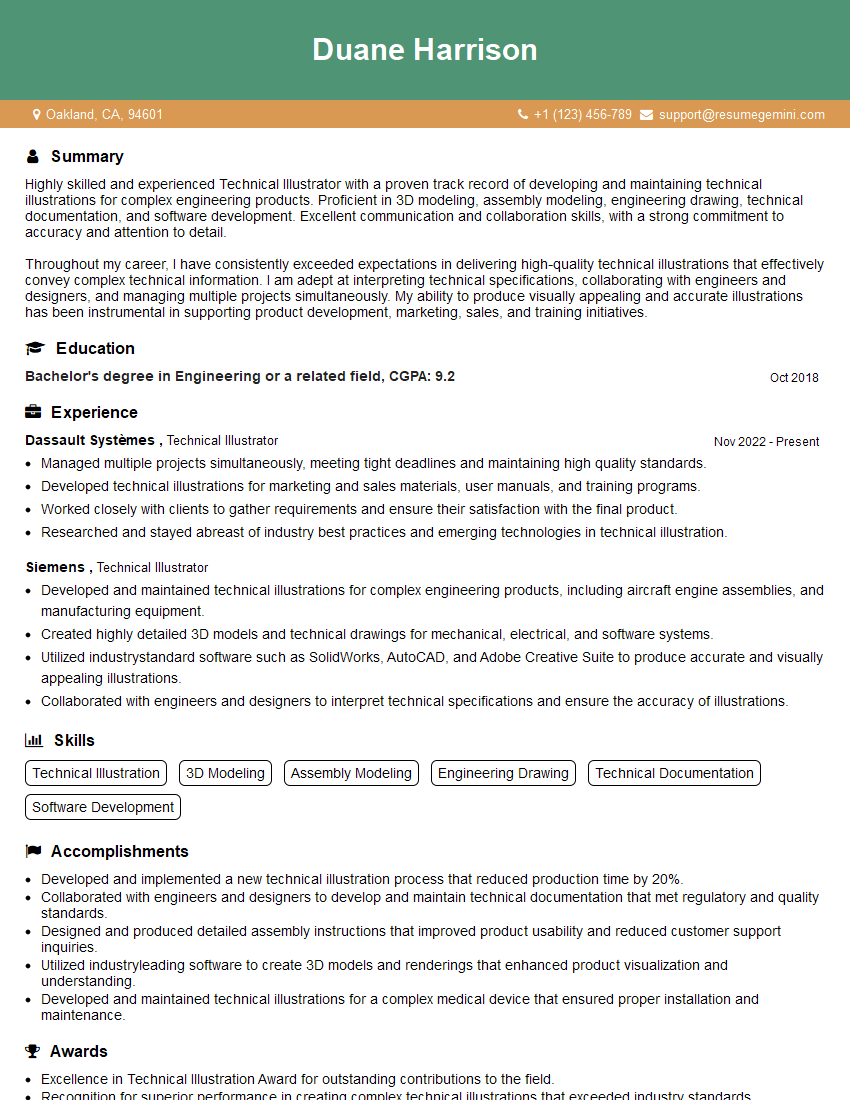
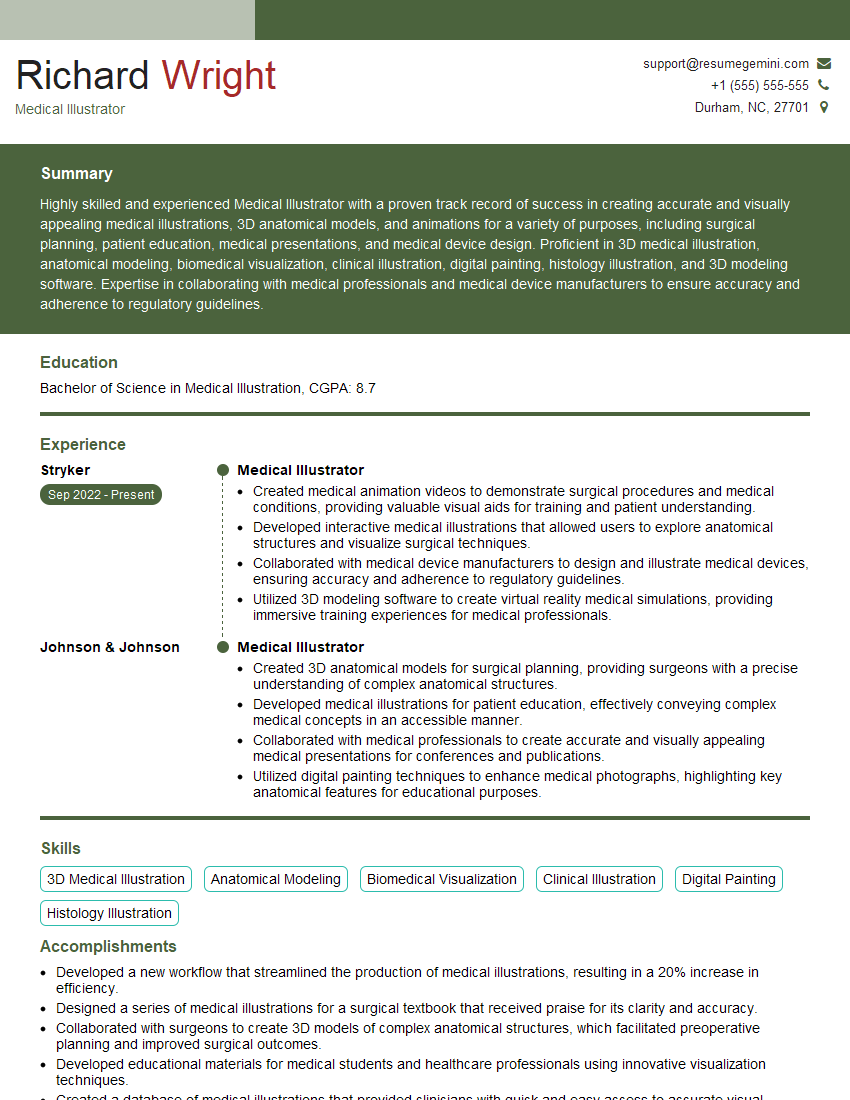
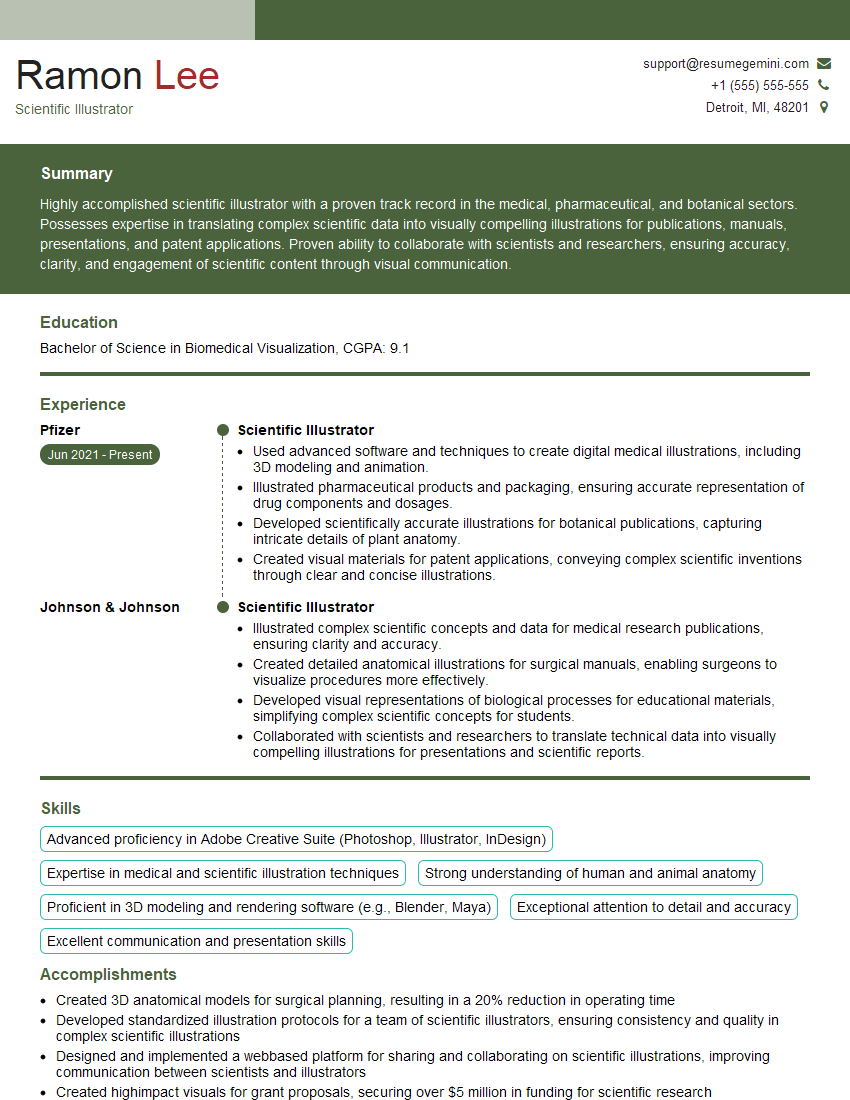
Mastering proficient scientific illustration techniques is crucial for career advancement in scientific research, publishing, education, and communication. A strong command of these skills opens doors to exciting opportunities and positions you as a valuable asset in any science-related field. To significantly improve your job prospects, crafting an ATS-friendly resume is essential. ResumeGemini is a trusted resource that can help you build a professional and impactful resume tailored to highlight your abilities. Examples of resumes specifically designed for candidates proficient in scientific illustration techniques are available through ResumeGemini. Take the next step and build a resume that showcases your unique skills and experience.
Explore more articles
Users Rating of Our Blogs
Share Your Experience
We value your feedback! Please rate our content and share your thoughts (optional).
What Readers Say About Our Blog
Very informative content, great job.
good