Every successful interview starts with knowing what to expect. In this blog, we’ll take you through the top Experience in creating illustrations for textbooks and educational materials interview questions, breaking them down with expert tips to help you deliver impactful answers. Step into your next interview fully prepared and ready to succeed.
Questions Asked in Experience in creating illustrations for textbooks and educational materials Interview
Q 1. What software are you proficient in for creating educational illustrations (e.g., Adobe Illustrator, Photoshop, etc.)?
My core proficiency lies in Adobe Illustrator and Photoshop. Illustrator is my go-to for vector-based illustrations, perfect for creating crisp, scalable images that look great at any size – essential for textbooks which may be printed at various scales or viewed digitally. Photoshop is invaluable for raster-based illustrations, particularly when working with photo manipulation, textures, or intricate details that require a pixel-based approach. I also have experience with other programs like Affinity Designer and Procreate, allowing for flexibility based on project needs and client preferences. For example, I recently used Illustrator to create a series of highly detailed anatomical diagrams for a high school biology textbook, ensuring perfect linework and scalability, while Photoshop was instrumental in adding realistic textures and shading to a series of illustrations of geological formations for a college-level geology text.
Q 2. Describe your experience illustrating for different age groups (e.g., K-12, higher education).
My experience spans a wide range of age groups. I’ve illustrated for elementary school textbooks, focusing on bright, simple visuals that capture children’s attention and effectively communicate basic concepts. For instance, I designed vibrant, cartoonish characters to explain simple addition and subtraction. For middle and high school, the illustrations become more detailed and realistic, using diagrams and charts to explain more complex ideas. For example, I created labeled diagrams of the human circulatory system for a high school biology text. Finally, my work for higher education involves more sophisticated and nuanced illustrations, often incorporating scientific accuracy and detail. I recently completed a series of highly detailed anatomical illustrations for a medical textbook, requiring precise anatomical accuracy and a clear representation of complex structures.
Q 3. How do you ensure your illustrations are accurate and aligned with the educational content?
Accuracy is paramount. Before starting any illustration, I meticulously review the accompanying text and consult relevant resources, like scientific papers or reference books, to ensure complete accuracy. For example, when illustrating a historical event, I carefully examine primary source material and historical accounts. I often collaborate with subject matter experts to verify the accuracy of my work, especially when dealing with complex scientific or technical concepts. This collaborative approach guarantees that the illustrations not only visually represent the information but also align precisely with the educational objectives. I also maintain detailed reference images and notes throughout the creation process to guarantee accuracy and consistency.
Q 4. Explain your process for creating illustrations from a written brief or concept.
My process begins with a thorough review of the provided brief or concept. I identify the key message, target audience, and desired style. Next, I create rough sketches, exploring various visual approaches to best communicate the information. This is crucial for finding the most effective visual representation. I then refine the best sketch, adding details and ensuring accurate representation of the subject matter. After creating a digital version of the refined sketch, I add color, texture, and other visual elements, always keeping in mind the target audience and the overall style guide. Throughout, I regularly check for accuracy and clarity, seeking feedback at different stages to ensure alignment with the project goals. Finally, the illustration is finalized and prepared for delivery in the required format.
Q 5. How do you handle feedback and revisions during the illustration process?
Feedback is crucial to the success of any illustration project. I actively solicit feedback at various stages of the process – initial concepts, rough sketches, and final artwork. I view feedback not as criticism but as an opportunity to refine my work and ensure it meets the client’s expectations and the project’s objectives. I use a collaborative approach to incorporate feedback; I will explain my design choices, answer any questions, and work with the client to find creative solutions that address their concerns without compromising the overall quality or accuracy of the illustration. I usually keep detailed records of all changes made to the illustration, making it easy to track the evolution and revisions.
Q 6. Describe your experience working with different illustration styles (e.g., realistic, cartoonish, abstract).
My experience encompasses a wide range of illustration styles. I’m comfortable working with realistic styles, often used for scientific illustrations requiring accuracy and detail. I can also create cartoonish, playful illustrations ideal for younger audiences or to make complex concepts more accessible. For example, I once created a series of simplified diagrams of the solar system for children’s textbooks, using a cartoonish, colorful style that engaged young readers. Abstract styles can be very effective for conveying complex ideas or representing abstract concepts. I will choose the style based on the project’s goals, target audience, and educational content.
Q 7. How do you incorporate accessibility considerations (e.g., colorblindness) into your illustrations?
Accessibility is a priority. I use color palettes that are colorblind-friendly, ensuring that illustrations are understandable by everyone. I avoid relying solely on color to convey information; instead, I utilize patterns, textures, and clear labeling to support color-coding. For example, when illustrating different cell types, I might use different textures and shapes to differentiate them, in addition to using different colors. I also ensure sufficient contrast between elements to ensure readability for those with visual impairments. Furthermore, I’m mindful of using clear, simple fonts in any accompanying text within the illustration itself. I regularly test my illustrations using color blindness simulation tools to verify their accessibility before finalizing them.
Q 8. How do you maintain consistency of style and quality across a large project?
Maintaining consistent style and quality across a large project is crucial for a cohesive final product. It’s like baking a large batch of cookies – you need to ensure each one is perfectly baked and looks identical to the others. I achieve this through several key strategies:
- Style Guide: I create a detailed style guide at the project’s outset. This document includes examples of character design, color palettes, line weights, and texture styles. This serves as a reference point for all illustrations throughout the project.
- Template Files: I often develop template files in my illustration software (e.g., Adobe Illustrator or Photoshop) with pre-set dimensions, layers, and style elements. This ensures consistency in file setup and reduces the chance of errors.
- Regular Check-Ins: Throughout the project, I conduct regular self-reviews and have periodic check-ins with the project lead or editor. This helps identify any deviations from the style guide early on, allowing for timely corrections.
- Digital Asset Management: I utilize a robust digital asset management system to store and organize all illustrations, ensuring easy access and version control. This prevents inconsistencies caused by using different versions of the same asset.
For example, in a recent textbook project on the human anatomy, I created a style guide that meticulously defined the level of detail for muscle structures, the color palette for different organ systems, and the consistent use of labels and annotations. This ensured that the illustrations, even across multiple chapters and illustrators (if applicable), maintained a unified and professional look.
Q 9. How do you manage your time and prioritize tasks when working on multiple illustration projects?
Juggling multiple illustration projects demands effective time management and prioritization. Think of it like a conductor leading an orchestra – each instrument (project) needs attention, but the conductor must ensure a harmonious performance. My approach relies on:
- Project Planning: I begin with a thorough breakdown of each project, estimating timelines and potential roadblocks. I use project management tools (e.g., Trello, Asana) to visualize deadlines and dependencies.
- Prioritization Matrix: I employ a prioritization matrix (like Eisenhower Matrix) to categorize tasks by urgency and importance. Urgent and important tasks receive immediate attention, while less urgent tasks are scheduled accordingly.
- Time Blocking: I dedicate specific blocks of time for focused work on each project, minimizing distractions. This approach enhances concentration and productivity.
- Regular Breaks: It’s vital to incorporate regular breaks to maintain focus and prevent burnout. Short, frequent breaks are more effective than long, infrequent ones.
For instance, if I’m working on a children’s book illustration and a complex scientific diagram simultaneously, I might allocate mornings to the detailed scientific work, requiring deep concentration, and afternoons to the more creative and playful children’s book illustrations.
Q 10. How familiar are you with copyright and usage rights related to educational illustrations?
Copyright and usage rights are paramount in educational illustration. It’s like building a house; you wouldn’t use materials you don’t own. My understanding encompasses:
- Copyright Law: I’m familiar with copyright laws pertaining to images, text, and other elements used in educational materials. This includes understanding fair use, Creative Commons licenses, and the need for obtaining permissions for copyrighted works.
- Image Licensing: I’m proficient in navigating various stock photo and illustration websites, selecting appropriate licenses, and correctly attributing sources.
- Model Releases: I’m aware of the necessity for model releases when using photographs of identifiable individuals.
- Contractual Agreements: I carefully review contracts to ensure I have the necessary rights to use specific imagery and to understand my obligations.
A recent project involved incorporating historical images. I ensured that each image was either in the public domain or that I had obtained the necessary permissions from the copyright holders, including proper attribution within the textbook.
Q 11. Can you describe a time you had to adapt your illustration style to meet a specific project requirement?
Adapting my illustration style is a regular part of my work. It’s similar to an actor preparing for a new role; you need to understand the character and adapt your performance accordingly. Once, I was commissioned to create illustrations for a middle school biology textbook. The initial style guide called for realistic, detailed depictions of biological structures. However, after initial reviews, the feedback indicated the style was too complex for the target audience. I adapted my style to a simpler, more cartoonish aesthetic, while retaining the accuracy of the scientific representations. I used bolder colors, simpler lines, and minimized detail while still conveying the essential biological information. The result was a set of illustrations that were both engaging and easily understandable for the intended age group.
Q 12. How do you ensure your illustrations are culturally sensitive and inclusive?
Cultural sensitivity and inclusivity are fundamental principles in my work. It’s like building a bridge – it needs to connect different communities, not divide them. My approach involves:
- Diverse Representation: I actively seek to portray diverse characters and settings in my illustrations, reflecting the rich tapestry of human experiences. This includes considering skin tones, body types, abilities, and cultural backgrounds.
- Avoiding Stereotypes: I carefully avoid perpetuating harmful stereotypes and biases in my imagery. This involves thorough research and self-reflection to ensure responsible and respectful representation.
- Consultation: When illustrating topics related to specific cultures or communities, I consult with experts or individuals from those groups to ensure accuracy and avoid unintentional misrepresentation.
- Sensitivity Review: I frequently seek feedback from diverse colleagues and peers to review my work for potential biases or areas for improvement.
For a children’s book about different cultures, I collaborated with cultural consultants to ensure authentic portrayal of clothing, traditions, and architectural styles, avoiding stereotypical depictions often found in children’s books.
Q 13. What is your experience with creating illustrations for different media (e.g., print, digital, video)?
My experience spans various media, from print to digital to video. Each medium has its unique demands, like different instruments in an orchestra.
- Print: I’m highly proficient in creating illustrations for print media, understanding the intricacies of resolution, color profiles (CMYK), and print limitations. I ensure illustrations are optimized for different print processes.
- Digital: I have extensive experience creating illustrations for digital platforms, including websites, e-books, and interactive learning modules. This includes familiarity with various file formats (e.g., PNG, SVG, JPG) and optimization for different screen resolutions and devices.
- Video: I have experience creating illustrations for video productions, understanding the need for animation-ready files, frame rates, and resolution suitable for video editing software. This also encompasses working with animators and motion graphics designers.
For example, a recent project involved creating illustrations for a digital textbook. I created vector-based illustrations in Adobe Illustrator, ensuring scalability and high resolution for both online viewing and potential printing. I also provided the assets in formats suitable for various e-reader platforms.
Q 14. How do you collaborate effectively with writers, editors, and other team members?
Collaboration is the cornerstone of successful textbook illustration. It’s like a team sport; everyone plays their part to achieve a common goal. My approach to collaboration involves:
- Clear Communication: I maintain open and transparent communication with writers, editors, and other team members. This involves active listening, providing regular updates, and soliciting feedback.
- Shared Understanding: Before commencing work, I thoroughly discuss the project goals, target audience, and style guidelines with the team to ensure everyone is on the same page.
- Iterative Process: I embrace an iterative process, incorporating feedback and revisions to refine the illustrations. This is crucial for achieving a final product that aligns with the project’s vision.
- Constructive Feedback: I provide constructive criticism when necessary and welcome feedback from others. This mutual exchange of ideas fosters creativity and quality.
On a previous project, the writer was unsure about the best way to visually represent a complex scientific concept. We worked together through several iterations, brainstorming different approaches, before settling on a solution that accurately and engagingly conveyed the information.
Q 15. Explain your experience with creating illustrations for specific subject areas (e.g., science, history, math).
My experience spans a wide range of subject areas, including science, history, and mathematics. In science, I’ve illustrated complex biological processes like cellular respiration and photosynthesis, breaking them down into easily digestible steps using diagrams and colorful analogies. For example, I illustrated the Krebs cycle as a circular track, with each stage represented by a different color-coded station. In history, I’ve created maps and timelines to depict historical events and migrations, adding visual interest with historically accurate details of clothing, architecture, and landscapes. One project involved illustrating the Silk Road, highlighting key cities and trading goods along the route. Finally, in mathematics, I’ve focused on creating visually clear representations of abstract concepts like fractions and geometric proofs. A recent project involved creating engaging illustrations of different geometrical shapes and their properties, using dynamic visual aids that help students visualize the concepts more effectively.
Career Expert Tips:
- Ace those interviews! Prepare effectively by reviewing the Top 50 Most Common Interview Questions on ResumeGemini.
- Navigate your job search with confidence! Explore a wide range of Career Tips on ResumeGemini. Learn about common challenges and recommendations to overcome them.
- Craft the perfect resume! Master the Art of Resume Writing with ResumeGemini’s guide. Showcase your unique qualifications and achievements effectively.
- Don’t miss out on holiday savings! Build your dream resume with ResumeGemini’s ATS optimized templates.
Q 16. What is your approach to research when creating illustrations for educational materials?
My research process is thorough and multi-faceted. It begins with a deep dive into the subject matter, often involving consulting textbooks, scientific papers, historical records, and other authoritative sources. I then verify the accuracy of the information with subject-matter experts to ensure that the illustrations are factually correct and free of misconceptions. For example, when illustrating a historical event, I’d consult primary sources like letters and diaries in addition to secondary scholarly works. This ensures accuracy and avoids perpetuating inaccuracies. Furthermore, I pay close attention to the target audience’s age and understanding to tailor the complexity of the illustrations accordingly. I utilize visual references, such as photographs, sketches and even 3D models, to ensure realism and accuracy in my final artwork.
Q 17. How do you ensure your illustrations are engaging and effective in conveying complex information?
Engaging and effective illustrations are crucial for conveying complex information. I achieve this through a combination of strategies: simplifying complex information into easily understood visuals, using clear and concise labeling, incorporating color strategically to highlight key elements and create visual hierarchies, and using a variety of visual techniques such as diagrams, charts, and maps to present data effectively. For example, a complex scientific process might be broken down into a series of sequential illustrations, each depicting a single step. I also prioritize clear and consistent visual styles throughout the project to maintain a cohesive and professional look. Furthermore, I aim for a style that is visually appealing, engaging and appropriate for the target audience. For younger audiences, I might incorporate more vibrant colors and playful elements, while for older audiences, I might favor a more sophisticated and realistic style.
Q 18. What are your strengths and weaknesses as an educational illustrator?
My strengths lie in my ability to translate complex information into clear and engaging visuals, my strong attention to detail, and my ability to adapt my style to meet the specific needs of different projects and audiences. I’m also proficient in various illustration techniques and software. However, I recognize that time management can sometimes be a challenge when working on multiple projects simultaneously. To mitigate this, I utilize project management tools and meticulous planning to ensure timely completion of projects. Another area I continuously work on is expanding my knowledge of emerging technologies and software relevant to illustration.
Q 19. Describe your process for creating a storyboard for an educational video.
My storyboard process begins with a detailed review of the video script and learning objectives. I then break down the script into individual scenes, each representing a key concept or narrative point. For each scene, I create a rough sketch illustrating the key visual elements, including characters, setting, and any necessary visual aids. This is accompanied by a brief description of the action and dialogue. The sketches are then organized sequentially to visually represent the flow of the video. I revise the storyboard iteratively based on feedback and refine the visuals to ensure clarity and visual consistency. The final storyboard serves as a roadmap for the animation team, ensuring everyone is on the same page throughout the production process.
Q 20. How familiar are you with the principles of visual communication and design?
I have a strong understanding of the principles of visual communication and design, including Gestalt principles (proximity, similarity, closure, continuity), color theory, typography, and visual hierarchy. I apply these principles to ensure that my illustrations are not only aesthetically pleasing but also effectively communicate the intended message. For example, using proximity to group related elements together or color to highlight key information. Understanding visual hierarchy is crucial for guiding the viewer’s eye through the illustration and ensuring that the most important information is easily discernible. I also constantly seek to improve my skills in these areas through ongoing research and practice.
Q 21. How would you approach illustrating a complex scientific concept for a young audience?
Illustrating a complex scientific concept for a young audience requires a simplified and engaging approach. I would begin by breaking down the concept into its core components, using analogies and metaphors to make it relatable to their everyday experiences. For example, explaining cellular respiration as a miniature power plant within a cell. I would use bright colors, simple shapes, and cartoonish characters to make the illustrations visually appealing. Labeling would be clear and concise, using age-appropriate language. Interactive elements, such as animations or pop-ups, could be incorporated to enhance engagement. The goal is to make learning fun and accessible, fostering curiosity and understanding rather than intimidation.
Q 22. What are some common challenges you face when creating illustrations for textbooks?
Creating illustrations for textbooks presents unique challenges. Accuracy is paramount; a single misplaced detail can mislead a student. Balancing scientific accuracy with visual appeal is a constant tightrope walk. Another key challenge is simplifying complex concepts into easily digestible visuals. For example, illustrating the Krebs cycle, a crucial part of cellular respiration, requires distilling a complex biochemical pathway into a clear and concise diagram. Finally, there’s the challenge of catering to diverse learning styles and age groups. What works for a high school biology textbook won’t necessarily work for an elementary school science book.
- Accuracy: Ensuring factual correctness across all aspects of the illustration.
- Visual Appeal & Simplicity: Making complex ideas easily understood and engaging.
- Accessibility: Catering to different learning styles and age groups.
Q 23. How do you overcome those challenges?
Overcoming these challenges requires a multifaceted approach. Thorough research is essential – I meticulously verify all information with reliable sources, consulting with subject matter experts when necessary. For visual clarity, I use a variety of techniques: color coding, labeling, visual metaphors, and strategic use of whitespace. For example, when illustrating the layers of the Earth, using distinct color palettes for the crust, mantle, and core, coupled with clear labels, significantly enhances comprehension. To address diverse learning styles, I incorporate different visual elements, such as diagrams, charts, and even small, illustrative anecdotes. Iterative feedback with editors and educators is crucial in ensuring the illustrations meet pedagogical goals.
Q 24. What strategies do you use to make your illustrations memorable and impactful?
Memorable and impactful illustrations go beyond mere accuracy; they tell a story. I achieve this through several strategies. Firstly, I focus on creating visually engaging compositions. Using vibrant, but appropriate, colors, dynamic layouts, and compelling visual narratives can significantly improve engagement. Secondly, I incorporate storytelling elements. A simple illustration of a cell might be significantly more engaging if it shows the cell actively performing its function, rather than just a static representation. Finally, the use of realistic and relatable imagery, or even employing a touch of humor where appropriate (while maintaining academic rigor), can resonate strongly with students. For example, in a math textbook, using familiar objects in problem-solving illustrations can aid in understanding abstract concepts.
Q 25. How do you stay up-to-date with current trends in educational illustration?
Staying current in educational illustration involves continuous professional development. I regularly attend conferences and workshops, network with other illustrators and educators, and actively follow relevant journals, blogs, and online communities. Exploring new software and techniques is also crucial. For example, the emergence of interactive elements in textbooks means I’m now incorporating skills in animation and interactive design into my repertoire. Keeping abreast of research on learning styles and cognitive science informs my approach to visualization, enabling me to tailor my illustrations to optimize learning outcomes.
Q 26. What are your salary expectations?
My salary expectations are commensurate with my experience and expertise in the field of educational illustration, and are in line with industry standards for similar roles with comparable responsibility. I am open to discussing this further based on the specifics of the position and benefits package.
Q 27. What are your long-term career goals?
My long-term career goals involve becoming a leading figure in educational illustration, creating impactful and innovative visuals that enhance learning for students worldwide. I aspire to collaborate on large-scale educational projects, perhaps even developing my own educational resources or contributing to research on the effectiveness of different illustrative techniques in pedagogy. I envision myself mentoring and training the next generation of educational illustrators.
Q 28. Why are you interested in this specific position?
I’m particularly interested in this position because of [Company Name]’s reputation for creating high-quality, engaging educational materials. I’m excited by the opportunity to contribute my skills to a team that shares my passion for improving learning experiences. The description of the role aligns perfectly with my strengths and interests, particularly [mention a specific aspect of the job description that resonates with you], and I am confident that I can make a significant contribution to your team’s success.
Key Topics to Learn for Experience in creating illustrations for textbooks and educational materials Interview
- Understanding Educational Design Principles: Explore the core principles of visual communication in education, including clarity, accuracy, age-appropriateness, and engagement.
- Software Proficiency: Demonstrate your expertise in relevant illustration software (e.g., Adobe Illustrator, Photoshop, Procreate) and your ability to adapt to different software requirements.
- Style and Technique: Discuss your experience with various illustration styles (e.g., realistic, cartoonish, diagrammatic) and your ability to adapt your style to meet the needs of different projects and audiences.
- Workflow and Collaboration: Explain your process for creating illustrations, from initial concept to final product, including your experience working with editors, designers, and authors.
- Project Management and Deadlines: Highlight your ability to manage multiple projects simultaneously, meet deadlines, and adapt to changing requirements.
- Client Communication and Feedback: Discuss your experience working with clients to understand their needs, presenting your work effectively, and incorporating feedback constructively.
- Copyright and Intellectual Property: Demonstrate an understanding of copyright laws and ethical considerations related to using and creating illustrations.
- Accessibility Considerations: Show awareness of creating inclusive illustrations that consider diverse learners and accessibility guidelines (e.g., colorblindness, visual impairments).
- Technical Aspects: Discuss your understanding of file formats, resolution, printing considerations, and digital asset management.
- Research and Fact-Checking: Explain your approach to ensuring the accuracy of illustrations and their alignment with the text content.
Next Steps
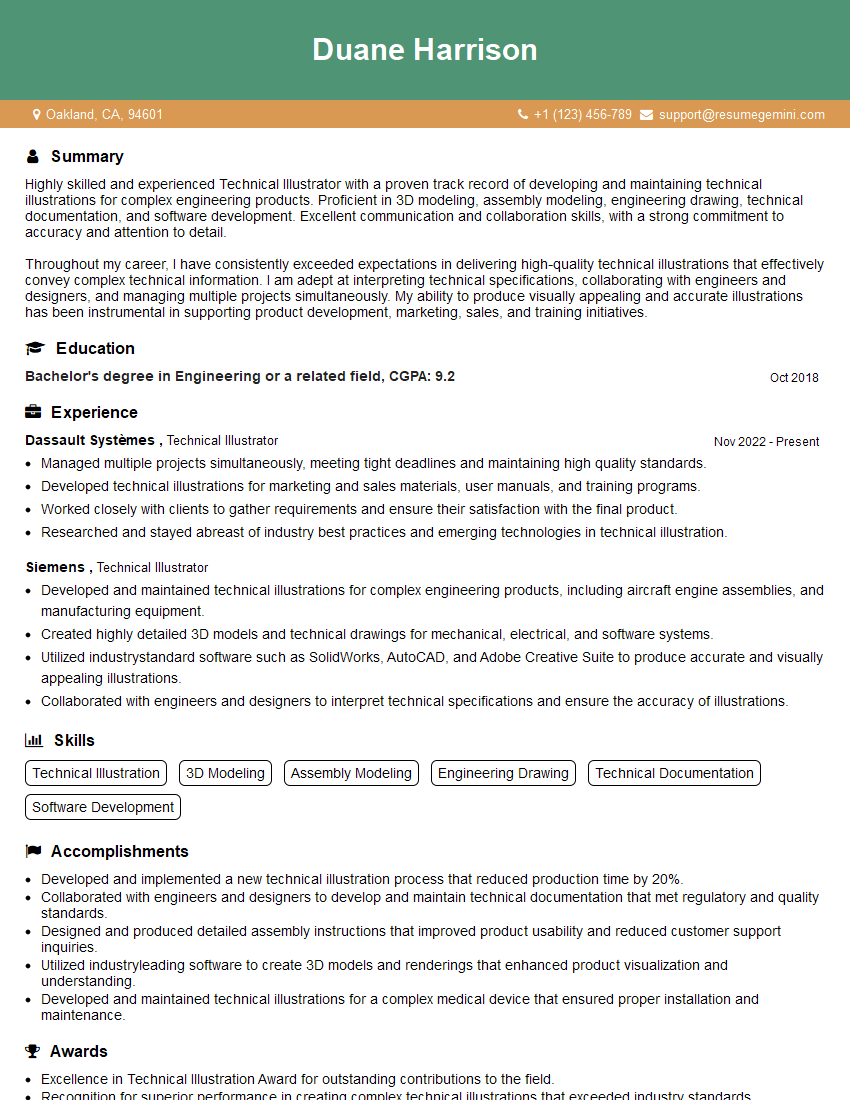
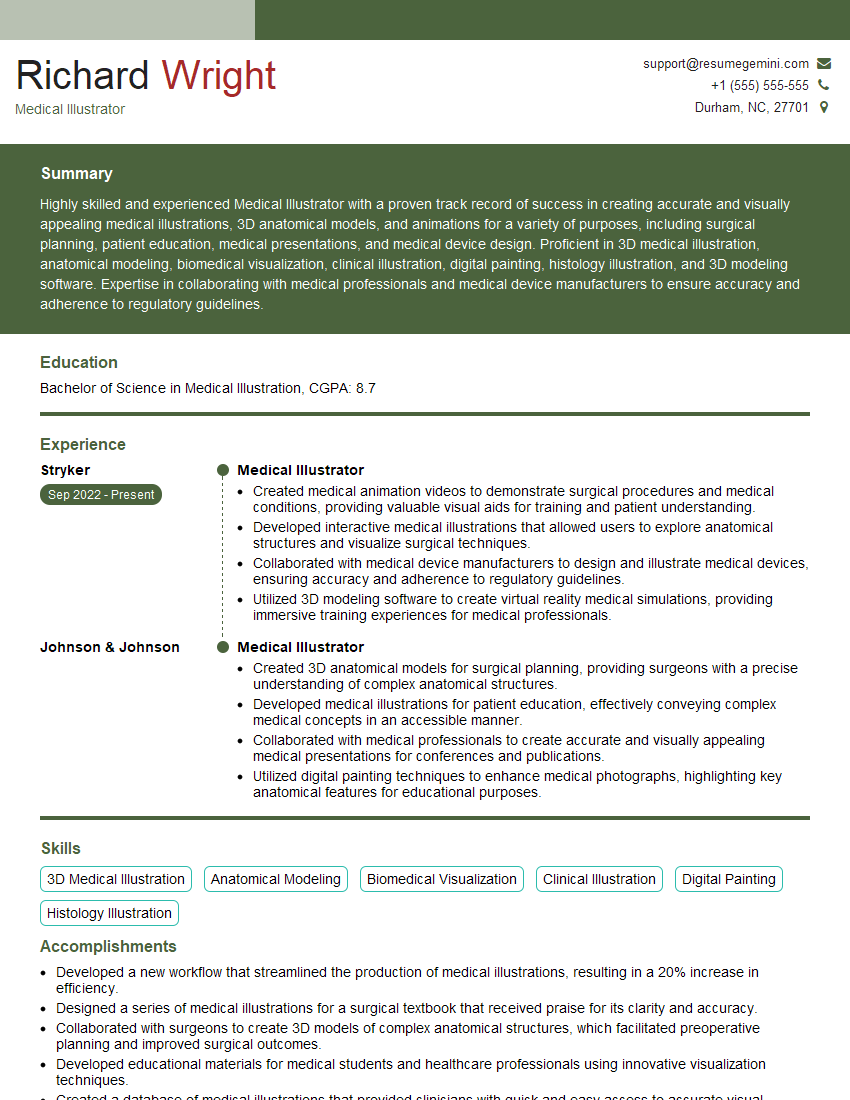
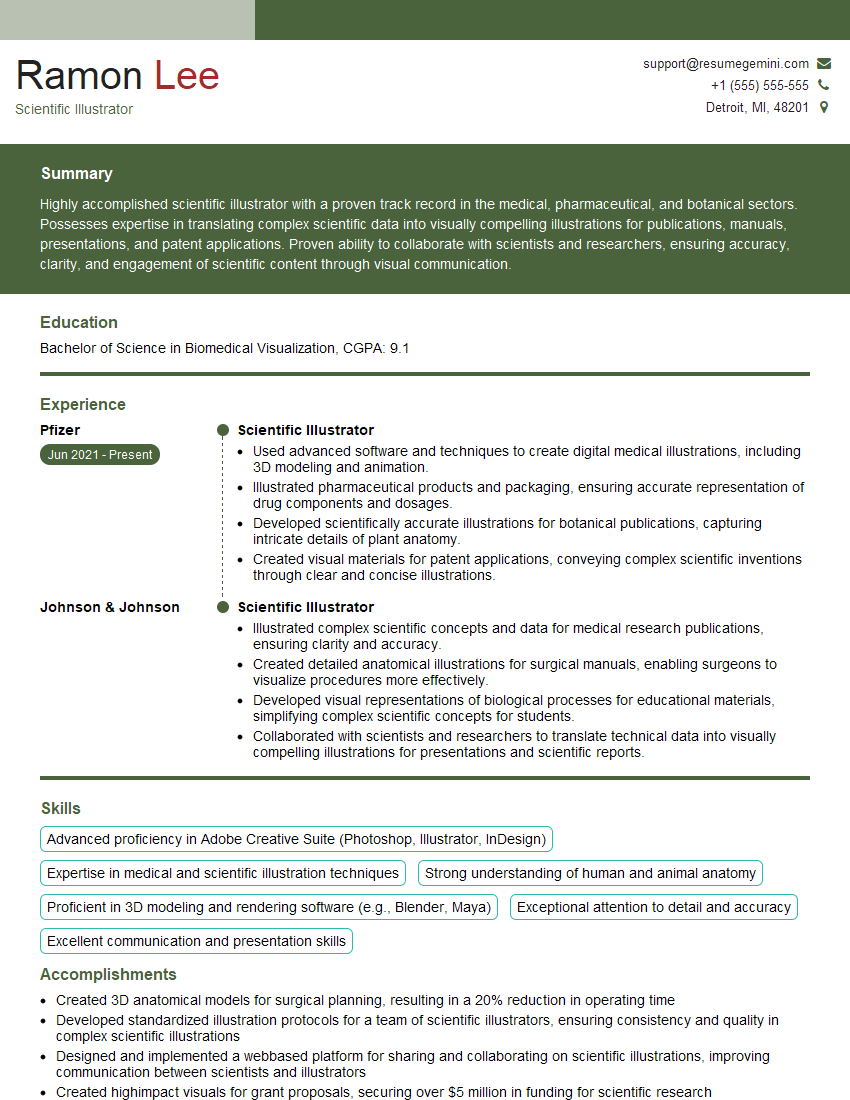
Mastering the art of creating illustrations for textbooks and educational materials significantly enhances your career prospects in publishing, education, and related fields. A strong portfolio showcasing your skills is crucial, but a well-crafted resume is your first step to landing an interview. Building an ATS-friendly resume is essential for maximizing your chances of getting noticed by recruiters. ResumeGemini is a trusted resource to help you create a professional and effective resume that highlights your unique qualifications. Examples of resumes tailored to experience in creating illustrations for textbooks and educational materials are available to guide you through the process.
Explore more articles
Users Rating of Our Blogs
Share Your Experience
We value your feedback! Please rate our content and share your thoughts (optional).
What Readers Say About Our Blog
Very informative content, great job.
good