Unlock your full potential by mastering the most common Hydraulic Structures interview questions. This blog offers a deep dive into the critical topics, ensuring you’re not only prepared to answer but to excel. With these insights, you’ll approach your interview with clarity and confidence.
Questions Asked in Hydraulic Structures Interview
Q 1. Explain the principles of fluid mechanics relevant to hydraulic structures.
Hydraulic structures, like dams and spillways, are governed by fundamental principles of fluid mechanics. Understanding concepts like fluid pressure, flow rate, and energy dissipation is crucial for their design and operation. Let’s break it down:
Fluid Pressure: Pascal’s Law dictates that pressure applied to a fluid is transmitted equally in all directions. This is critical in designing dam walls to withstand the immense water pressure acting against them. The pressure increases linearly with depth, hence the thicker base of most dams.
Fluid Flow: The principles of continuity (conservation of mass) and Bernoulli’s equation (conservation of energy) are vital in determining flow rates through spillways, tunnels, and other components. Bernoulli’s equation explains how velocity and pressure are inversely related in a flowing fluid; a faster flow implies lower pressure.
Energy Dissipation: When high-velocity water suddenly changes direction or encounters an obstruction, it can cause erosion or structural damage. Therefore, hydraulic structures employ energy dissipation structures like stilling basins to safely reduce the energy of flowing water after it exits a spillway.
Open Channel Flow: Many hydraulic structures involve open channel flow, which is flow with a free surface exposed to atmospheric pressure. Understanding the Manning’s equation or other methods to calculate flow in open channels is essential for design.
Consider the design of a spillway: We use Bernoulli’s equation to calculate the flow velocity and then use principles of open channel flow to design the channel geometry to safely convey that flow without causing erosion downstream. Ignoring these fluid mechanics principles would lead to catastrophic failures.
Q 2. Describe different types of dams and their suitability for various applications.
Dams are classified based on their material and design. Here are some common types:
Earth Dams: Constructed primarily of compacted earth, rock, or a combination. They are cost-effective and adaptable to various site conditions but require careful seepage control. Examples include the Hoover Dam (partially earthfill).
Rockfill Dams: Utilize large rock fills, often with an impervious core made of clay or concrete to prevent seepage. They are highly stable and suitable for seismic zones. The Oroville Dam is a notable example.
Concrete Gravity Dams: Massive structures relying on their own weight for stability. They’re suitable for deep valleys with strong foundations and offer excellent control over seepage but are expensive to construct. The Grand Coulee Dam is a prime example.
Concrete Arch Dams: Curved structures that transfer water pressure to the abutments (valley walls) through arch action. They are efficient in high-head applications (large height difference between reservoir and downstream) but require strong, stable abutments. The Hoover Dam incorporates arch elements.
Buttress Dams: A combination of gravity and arch principles where the weight of the water is transferred to supporting buttresses. They use less concrete than gravity dams but require careful design of the buttresses.
Suitability depends on factors such as site geology, available materials, seismic activity, and budget. For example, an earth dam might be preferable in a location with readily available soil and less stringent seismic requirements, while a concrete gravity dam might be necessary in a high-seismic zone with a deep valley.
Q 3. How do you design for seepage control in earth dams?
Seepage control in earth dams is critical to prevent erosion, instability, and potential failure. Design strategies include:
Impervious Core: An inner core of low-permeability material, such as compacted clay or a concrete core wall, is placed within the dam to block the flow of water.
Filters and Drainage Systems: Layers of graded materials are used to prevent the finer soil particles from being washed out by seepage. Drainage systems collect seepage water and safely discharge it away from the dam.
Cut-off Walls: These are impermeable barriers, often made of concrete or compacted clay, that are installed into the foundation of the dam to prevent seepage along the foundation.
Upstream and Downstream Blankets: These are layers of permeable material placed on the upstream and downstream faces of the dam to help disperse seepage pressures and prevent erosion.
Seepage Monitoring: Piezometers (pressure measurement devices) are installed within the dam to monitor seepage pressures and detect any potential problems.
The design of these elements involves careful consideration of soil properties, hydraulic gradients, and the overall stability of the dam. For example, the design of a filter would consider the size gradation of the soil to prevent both piping (erosion of fine particles) and clogging.
Q 4. What are the common failure modes of hydraulic structures?
Hydraulic structures can fail due to various factors. Common failure modes include:
Overtopping: The water level exceeds the dam’s crest, leading to catastrophic failure. This can be caused by inadequate spillway capacity, extreme rainfall events, or dam breaches.
Seepage and Piping: Water seeping through the dam’s body can erode soil particles, creating channels (pipes) that weaken the structure and eventually lead to failure.
Foundation Failure: Inadequate foundation strength or improper design can lead to the dam settling or sliding, resulting in failure.
Slope Instability: Erosion, over-steep slopes, or seismic activity can cause the dam’s slopes to fail.
Structural Failure: Design flaws, material defects, or inadequate construction can lead to cracks or collapse of the dam’s structural elements.
Seismic Effects: Earthquakes can damage dams through ground shaking, liquefaction, or slope instability.
Regular inspection and maintenance are essential to prevent these failures. Understanding the potential failure modes allows engineers to design safer and more resilient structures.
Q 5. Explain the concept of spillway design and its importance.
Spillway design is crucial for controlling water levels in reservoirs and preventing dam overtopping. It involves designing a controlled outlet structure that safely releases excess water. Key considerations include:
Capacity: The spillway must have sufficient capacity to handle the maximum expected inflow, including flood events.
Type: Different spillway types (ogee, side channel, chute, etc.) are chosen based on site conditions and flow characteristics.
Energy Dissipation: High-velocity water exiting the spillway must be safely dissipated to prevent erosion downstream. This often involves stilling basins or other energy dissipation structures.
Gate Control: Gates (radial, roller, etc.) are often incorporated for precise control of the water discharge.
Hydraulic Design: Detailed hydraulic analysis is performed to ensure appropriate flow velocities, water depths, and energy dissipation.
The importance of spillway design cannot be overstated; a poorly designed spillway can lead to dam overtopping and catastrophic failure, as demonstrated in several historical dam failures.
Q 6. How do you analyze the stability of a retaining wall?
Retaining wall stability analysis involves evaluating its resistance to overturning, sliding, and bearing capacity failure. It’s a complex process combining soil mechanics and structural analysis.
Overturning: Calculated by comparing the resisting moment (due to the wall’s weight and soil pressure) to the overturning moment (due to the lateral earth pressure).
Sliding: Evaluated by comparing the resisting forces (due to friction and passive earth pressure) to the driving forces (due to lateral earth pressure).
Bearing Capacity: Assessed to ensure the soil beneath the wall can support the wall’s weight and the superimposed loads. Factors like soil strength, depth of embedment, and surcharge loads are considered.
Seismic Analysis: In seismically active areas, a seismic analysis is necessary to evaluate the wall’s stability under earthquake loading. This often involves dynamic analysis using software.
The analysis typically involves using limit equilibrium methods or finite element analysis (FEA) software. The factors of safety against overturning, sliding, and bearing capacity failure must exceed acceptable values according to design codes.
Q 7. Describe different types of hydraulic gates and their operation.
Hydraulic gates are critical components of hydraulic structures, controlling the flow of water. Common types include:
Radial Gates: Mounted on a pivot and rotate to regulate flow. They are common in spillways and are efficient for large openings.
Roller Gates: Similar to radial gates, but with rollers to reduce friction during operation, facilitating smoother and quicker opening and closing.
Vertical Lift Gates: Move vertically to control flow. Simple and reliable, but less efficient for large openings.
Slide Gates: Slide horizontally to open and close. Suitable for large openings, but require significant space for operation.
Sector Gates: Curved gates that rotate around a pivot. They efficiently control the flow in a curved channel.
Tainter Gates: A variation of radial gates that offer robust performance in many scenarios.
The choice of gate depends on various factors such as flow conditions, required opening size, head of water, maintenance requirements, and cost. For instance, a roller gate might be preferred in a high-flow spillway due to its ease of operation and minimal friction, while a slide gate might be suitable for a large sluice gate in a dam.
Q 8. What are the factors influencing the design of a canal system?
Designing a canal system is a complex undertaking, influenced by a multitude of factors. Think of it like planning a vast, intricate network of roads – each section needs careful consideration.
- Water Availability and Demand: The primary driver! The design must ensure sufficient water supply to meet irrigation, industrial, or domestic needs, while accounting for seasonal variations and potential droughts. For example, a canal system in a desert region will require careful water management techniques.
- Topography and Geology: The land’s slope, soil type, and rock formations dictate the canal’s alignment, cross-section, and the need for structures like bridges and tunnels. A steep slope might necessitate a lined canal to prevent erosion, while a rocky terrain would require blasting and specialized excavation.
- Environmental Considerations: Protecting the environment is crucial. This involves minimizing impacts on ecosystems, mitigating water pollution, and ensuring safe passage for aquatic life. Fish ladders, for instance, are vital in some designs.
- Economic Factors: Construction and maintenance costs are significant. Designs need to balance functionality with economic feasibility. This might involve choosing cost-effective materials while ensuring long-term durability.
- Social Impacts: Land acquisition, resettlement, and community engagement are critical. The canal system’s route must carefully consider its impact on local populations.
- Hydraulic Design Parameters: This includes flow rate, velocity, water depth, and channel roughness, which influence the canal’s dimensions and stability. We use Manning’s equation, for instance,
Q = (A*R^(2/3) * S^(1/2))/n, where Q is the discharge, A is the cross-sectional area, R is the hydraulic radius, S is the slope, and n is Manning’s roughness coefficient, to determine optimal channel dimensions.
Q 9. Explain the principles of open channel flow.
Open channel flow, like a river or canal, is governed by several key principles. Imagine water flowing downhill – it’s all about gravity, friction, and the shape of the channel.
- Energy Conservation: The total energy of the flow (kinetic, potential, and pressure) remains constant along a streamline, neglecting losses. This is described by the Bernoulli equation.
- Continuity Equation: The flow rate (discharge) remains constant along the channel, unless there’s inflow or outflow. This means the product of the cross-sectional area and velocity stays constant.
- Manning’s Equation: This empirical formula relates flow velocity to channel geometry and roughness. It’s crucial for designing channels of appropriate size and slope. We already saw it in the previous answer.
- Critical Flow: A specific flow condition where the specific energy is minimum for a given discharge. This is significant for hydraulic jump calculations and spillway design.
- Specific Energy: The sum of the flow depth and the velocity head. Understanding specific energy helps in analyzing flow transitions and determining the depth of flow for a given discharge.
- Gradually Varied Flow and Rapidly Varied Flow: Gradually varied flow changes slowly over long distances, while rapidly varied flow changes abruptly over short distances (e.g., hydraulic jumps).
Q 10. How do you design for erosion and scour protection in hydraulic structures?
Erosion and scour are significant threats to hydraulic structures. Imagine a river relentlessly carving away at its banks – that’s scour. We need robust protection!
- Proper Design of Channel Cross-Section: Designing stable channel geometries that minimize high velocities and turbulence. This may involve using riprap, which are large stones, or gabions, which are wire cages filled with rocks.
- Use of Protective Linings: Applying linings like concrete, asphalt, or specialized geotextiles to prevent erosion. The choice of lining depends on the severity of the erosion and the cost constraints.
- Construction of Guide Banks and Spur Dikes: These structures help guide the flow, reduce velocity, and protect the banks from erosion. They’re like natural barriers guiding the river’s path.
- Scour Protection at Bridge Piers and Abutments: These critical points require special attention. Measures include using rockfill aprons, sheet piling, or other scour countermeasures.
- Regular Monitoring and Maintenance: Regular inspection and timely repair of any signs of erosion or scour. This prevents small problems from escalating into major issues.
- Hydraulic Modeling: Using computational fluid dynamics (CFD) to simulate flow conditions and predict potential scour locations. This helps in optimizing the design for scour protection.
Q 11. What are the key considerations for the design of a culvert?
Culvert design is critical for safe and efficient water passage under roads or other structures. Think of them as underground tunnels for streams.
- Hydraulic Design: Determining the appropriate size and shape to handle the design discharge, considering factors like headwater and tailwater elevations, using Manning’s equation or other appropriate methods. This ensures proper flow capacity and prevents flooding.
- Structural Design: Ensuring the culvert’s structural integrity to withstand loads from the overlying structure and the soil. Factors like material strength, soil conditions, and traffic loads need to be carefully considered.
- Material Selection: Choosing the appropriate material, such as concrete, corrugated metal, or plastic, based on cost, durability, and environmental factors. Concrete is durable but expensive, while corrugated metal is more economical.
- Inlet and Outlet Design: Optimizing the inlet and outlet structures to minimize energy losses and prevent erosion or scour. Sharp transitions can cause excessive turbulence.
- Scour Protection: Implementing measures to prevent scour around the inlet and outlet. This often involves using riprap or other protective materials.
- Environmental Considerations: Minimizing impacts on aquatic life, ensuring adequate fish passage if necessary. Fish passage structures may be needed in some designs.
Q 12. Describe the methods used for hydraulic modeling.
Hydraulic modeling is crucial for analyzing and designing hydraulic structures. It’s like creating a digital twin of the system to test different scenarios.
- Physical Models: Building scaled-down physical models in laboratories to simulate flow conditions. This is useful for complex geometries or when detailed flow visualization is needed, but can be expensive and time-consuming.
- Computational Fluid Dynamics (CFD): Using computer software to solve the governing equations of fluid flow. This allows for detailed analysis of complex flow patterns and interactions with structures. Examples include OpenFOAM or ANSYS Fluent.
- 1D, 2D, and 3D Modeling: Simulations can be performed in one, two, or three dimensions, depending on the complexity of the flow and the level of detail required. 1D models are simpler but less accurate, while 3D models are more complex but provide more detailed information.
- HEC-RAS: A widely used software for hydraulic modeling of rivers and other open channels. It’s excellent for flood modeling and designing flood control structures.
The choice of method depends on factors like project complexity, budget, and the required level of accuracy.
Q 13. What are the environmental impacts of hydraulic structures?
Hydraulic structures, while beneficial, can have significant environmental impacts. It’s important to minimize negative effects and maximize positive ones.
- Habitat Alteration: Dams and other structures alter river flow patterns, affecting aquatic ecosystems. Fish migration can be disrupted, and water quality can change.
- Sedimentation: Dams trap sediment, leading to downstream erosion and affecting habitats. This sediment is crucial for maintaining healthy river ecosystems.
- Water Quality Changes: Changes in flow regime and temperature can affect water quality. For example, reduced flow can lead to increased water temperatures, harming aquatic organisms.
- Greenhouse Gas Emissions: Reservoirs can release methane, a potent greenhouse gas. This is particularly concerning for large-scale hydroelectric projects.
- Displacement of Communities and Loss of Land: Large projects may require the relocation of communities and the loss of valuable land. Proper mitigation strategies are vital.
Mitigation measures include implementing environmental flow requirements, designing fish ladders, and using strategies for greenhouse gas reduction.
Q 14. How do you account for seismic forces in the design of a dam?
Seismic forces are a major concern in dam design, especially in seismically active regions. Imagine the powerful shaking during an earthquake – the dam must withstand this.
- Seismic Hazard Analysis: Conducting thorough seismic hazard assessments to determine the potential ground motion at the dam site. This involves considering fault lines, historical earthquake data, and soil conditions.
- Dynamic Analysis: Performing dynamic analyses using sophisticated software to simulate the dam’s response to earthquake ground motions. This determines stresses and deformations within the dam.
- Seismic Design Criteria: Designing the dam to meet specific seismic design criteria, ensuring sufficient safety factors and stability against failure. This includes appropriate material selection and structural design features.
- Appropriate Dam Type Selection: Certain dam types are better suited for seismic zones than others. For example, rockfill dams are generally more resilient to seismic forces compared to embankment dams.
- Strengthening Measures: Incorporating strengthening measures such as seismic joints, shear keys, and other design features that enhance the dam’s ability to withstand seismic forces.
- Regular Monitoring and Inspection: Post-construction monitoring is crucial to detect any signs of damage or distress caused by seismic activity.
Q 15. Explain the concept of hydraulic jump and its significance.
A hydraulic jump is a rapid, turbulent transition of flow from supercritical to subcritical conditions in an open channel. Imagine a fast-flowing river suddenly slowing down and becoming much deeper; that’s essentially a hydraulic jump. It’s characterized by a sudden increase in water depth and a significant energy loss due to turbulence. The significance lies in its ability to dissipate energy, making it crucial in several hydraulic structures.
Significance:
- Energy Dissipation: Hydraulic jumps are intentionally created downstream of spillways, sluice gates, and other energy-dissipating structures to prevent erosion and damage to the channel bed.
- Flow Control: By carefully designing the jump, engineers can control the flow depth and velocity, improving downstream conditions.
- Mixing: The turbulent nature of the jump promotes mixing of water, which can be beneficial in certain applications, such as aeration or mixing of pollutants.
Example: In a dam’s spillway, a hydraulic jump is often designed at the downstream end to protect the channel bed from the high-velocity outflow.
Career Expert Tips:
- Ace those interviews! Prepare effectively by reviewing the Top 50 Most Common Interview Questions on ResumeGemini.
- Navigate your job search with confidence! Explore a wide range of Career Tips on ResumeGemini. Learn about common challenges and recommendations to overcome them.
- Craft the perfect resume! Master the Art of Resume Writing with ResumeGemini’s guide. Showcase your unique qualifications and achievements effectively.
- Don’t miss out on holiday savings! Build your dream resume with ResumeGemini’s ATS optimized templates.
Q 16. How do you determine the appropriate size of a pipe for a given flow rate?
Determining the appropriate pipe size involves considering the flow rate (Q), the desired velocity (V), and the roughness of the pipe material. We use the Hazen-Williams equation or the Manning’s equation for this. The Hazen-Williams equation is widely used in practice because of its simplicity. It is less accurate than the Manning equation for non circular pipes but is readily usable for many common designs.
Step-by-step process:
- Determine the flow rate (Q): This is usually given in the design parameters, often in cubic meters per second (m³/s) or gallons per minute (gpm).
- Choose a material: Select a pipe material (e.g., PVC, ductile iron, concrete) based on cost, durability, and chemical compatibility with the fluid.
- Estimate the velocity: This depends on the fluid and material, and limits such as preventing erosion. A commonly accepted range for velocity is between 1 and 3 m/s.
- Apply Hazen-Williams equation:
Q = 0.849 * C * A * R^0.63 * S^0.54where: - Q = flow rate
- C = Hazen-Williams roughness coefficient (material dependent)
- A = cross-sectional area of the pipe
- R = hydraulic radius (A/P where P is the wetted perimeter)
- S = pipe slope
- Solve for the pipe diameter (D): Rearrange the equation to solve for the diameter, given the desired flow rate and velocity. This often involves an iterative process, as A and R depend on D.
- Check for acceptable velocity and head loss: After determining the diameter, check if the calculated velocity falls within the acceptable range and that head losses are within allowable limits for your application.
Example: If a flow rate of 1 m³/s is required, you would use the above procedure (iterative calculations) to find a pipe diameter that satisfies flow requirements and the acceptable velocity. Iteration would be required to find the diameter D.
Q 17. Describe the use of Manning’s equation and Darcy-Weisbach equation.
Both Manning’s and Darcy-Weisbach equations are used to determine the flow characteristics in open channels and pipes. However, they differ in their approach and application.
Manning’s Equation: Primarily used for open channels, it’s an empirical equation relating flow velocity to the channel geometry and roughness. It’s relatively simple to use but less accurate for very smooth or very rough channels. The equation is: V = (1/n) * R^(2/3) * S^(1/2) where:
- V = flow velocity
- n = Manning’s roughness coefficient
- R = hydraulic radius
- S = channel slope
Darcy-Weisbach Equation: Used for both open channels and pipes, this equation is based on more fundamental principles of fluid mechanics. It’s more accurate than Manning’s equation, especially for pipes, and accounts for the energy losses due to friction. The equation is: hf = f * (L/D) * (V²/2g) where:
- hf = head loss due to friction
- f = Darcy-Weisbach friction factor (dependent on Reynolds number and pipe roughness)
- L = pipe length
- D = pipe diameter
- V = flow velocity
- g = acceleration due to gravity
In essence: Manning’s equation offers simplicity and is suitable for preliminary designs, while the Darcy-Weisbach equation provides greater accuracy but requires more complex calculations, often involving iterative solutions to determine the friction factor.
Q 18. What are the different types of sediment transport in open channels?
Sediment transport in open channels is a complex phenomenon influenced by flow velocity, sediment size, and channel geometry. It can be categorized into three main types:
- Bed Load: This refers to sediment particles rolling, sliding, or saltating (hopping) along the channel bed. Larger, heavier particles are typically transported as bed load. The transport rate is highly sensitive to near bed velocity.
- Suspended Load: Smaller sediment particles are suspended within the flow, carried along by turbulence. The concentration of suspended load varies with depth and distance from the bed. Suspended load makes the water appear muddy or cloudy.
- Wash Load: This is the finest sediment, often composed of clay and silt particles, that’s transported in suspension throughout the water column. The transport of wash load is less affected by flow velocity, and it’s largely determined by the sediment supply.
Understanding sediment transport is critical in designing stable channels and preventing erosion or deposition, particularly in river management and dam construction.
Q 19. Explain the design considerations for a pump station.
Designing a pump station requires careful consideration of several factors to ensure efficient and reliable operation.
- Capacity: Determine the required pumping capacity based on the projected flow demand. This includes peak flows and future growth.
- Pump Selection: Choose appropriate pumps considering head (elevation difference), flow rate, efficiency, and type (e.g., centrifugal, axial). Consider pump life-cycle costs, including maintenance.
- Piping System Design: Design the suction and discharge piping systems to minimize head losses and ensure sufficient capacity. Consider pipe diameter, material, and fittings.
- Energy Efficiency: Optimize the pump system for energy efficiency through appropriate pump selection, variable speed drives, and efficient piping design. This directly impacts operating costs.
- Automation and Control: Implement automated control systems for efficient operation and monitoring. This can include level sensors, flow meters, and remote monitoring capabilities.
- Environmental Considerations: Assess potential environmental impacts, such as noise pollution or discharge of heated water, and implement mitigation measures if necessary.
- Maintenance Accessibility: Design the pump station with easy access for maintenance and repairs, reducing downtime and maintenance costs.
- Safety Considerations: Incorporate safety features such as emergency shut-off switches, safety railings, and proper ventilation.
A well-designed pump station balances efficiency, reliability, and safety, leading to cost-effective and environmentally sound operation.
Q 20. How do you perform a hydraulic analysis of a complex network?
Hydraulic analysis of a complex network, like a water distribution system, requires the use of specialized software employing numerical methods. A common approach is the Hardy-Cross method or more advanced techniques used in software packages. These methods solve for the flow and head in each pipe segment iteratively.
General Steps:
- Define the network: Create a schematic diagram representing the network including pipes, pumps, reservoirs, and junctions. Each pipe is characterized by length, diameter, and roughness.
- Establish boundary conditions: Specify the pressures or flows at the boundaries of the network (reservoirs, junctions).
- Initial flow estimates: Start with initial estimates of the flow rate in each pipe. These estimates can be based on simple assumptions or previous data.
- Iterative solution: The software utilizes a numerical method (Hardy-Cross or similar) to adjust the flow in each pipe iteratively until the continuity and energy equations are satisfied at each junction and loop. This involves solving simultaneous equations.
- Check convergence: Monitor the changes in flow rates between iterations. The iteration process continues until the flow rates converge to a satisfactory level of accuracy.
- Post-processing: Once the solution converges, the software provides results such as flow rates, head losses, and pressures at all points in the network. This allows for analysis of pressure drops, and identifying potential problems.
Software packages such as EPANET are commonly used for these types of analyses. The complexity of the software allows for consideration of multiple factors affecting flow and pressure. The use of such software requires advanced training and experience.
Q 21. Describe different methods for measuring flow in open channels.
Several methods exist for measuring flow in open channels, each with its own advantages and limitations. The choice of method depends on factors such as the channel size, flow rate, accuracy requirements, and cost.
- Flow Metering: Various types of flow meters, such as electromagnetic flow meters, ultrasonic flow meters, and vortex flow meters, can be installed in channels to directly measure flow rate. These meters provide accurate and continuous flow data, but they can be expensive and require calibration.
- Weirs and Flumes: These structures create a controlled constriction in the channel, causing a predictable relationship between water depth and flow rate. The flow is then determined by measuring the water depth upstream of the weir or flume. Weirs are simple, reliable, and relatively inexpensive, but their accuracy can be affected by sediment or debris.
- Current Meters: A current meter is a device that measures the velocity of water at a specific point in the channel. By measuring the velocity at multiple points across the channel cross-section, and integrating those measurements, one can estimate the total flow rate. This method is suitable for a wide range of flow rates but requires skilled operators and can be time-consuming.
- Dilution Methods: These methods involve injecting a known concentration of a tracer (such as salt or dye) into the flow and then measuring the concentration downstream. The flow rate can be determined from the dilution of the tracer. This is useful in large, inaccessible channels, but it’s less accurate than other methods.
- Acoustic Doppler Current Profilers (ADCPs): ADCPs use sound waves to measure water velocity at multiple depths and locations across the channel cross-section. This is a non-intrusive method that can provide detailed flow data, but it can be expensive.
The selection of the most appropriate method requires careful consideration of the specific circumstances.
Q 22. What software packages are you familiar with for hydraulic design and analysis?
I’m proficient in several software packages crucial for hydraulic design and analysis. These include HEC-RAS (Hydrologic Engineering Center’s River Analysis System) for modeling river flows and flood inundation, which is incredibly useful for designing flood control structures like dams and levees. I also have extensive experience with MIKE FLOOD and MIKE 11, which offer powerful capabilities for simulating complex hydrodynamic processes in various water bodies. For detailed 2D flow modeling, I use software like Delft3D. Finally, I’m comfortable working with AutoCAD for the design and drafting aspects of projects. Each software package offers unique advantages, and the selection depends on the specific project’s complexity and requirements.
Q 23. Explain the importance of risk assessment in hydraulic structures.
Risk assessment is paramount in hydraulic structure design. It’s not just about ensuring the structure works; it’s about anticipating potential failures and mitigating their consequences. A comprehensive risk assessment identifies hazards like flooding, erosion, seismic activity, and material degradation. We then evaluate the likelihood and potential impact of these hazards. This helps us determine the appropriate safety factors and design standards to minimize the risk of failure. For example, a dam located in a seismically active zone would require significantly higher safety standards compared to one in a stable region. Ignoring risk assessment can lead to catastrophic failures with devastating consequences, both economically and in terms of human life.
Q 24. How do you ensure the safety and reliability of hydraulic structures?
Ensuring safety and reliability involves a multi-faceted approach. It starts with robust design based on sound engineering principles, incorporating appropriate safety factors to account for uncertainties in data and modeling. Then, rigorous quality control throughout the construction process is vital, ensuring materials meet specifications and construction practices adhere to strict standards. Regular inspection and maintenance are crucial for identifying and addressing potential problems early on, preventing minor issues from escalating into major failures. This includes visual inspections, non-destructive testing, and monitoring of structural performance using sensors and instrumentation. Finally, emergency response plans should be in place to deal with unforeseen events and minimize the impact of potential failures.
Q 25. Describe your experience with hydraulic structure inspections and maintenance.
I have extensive experience in hydraulic structure inspections and maintenance. This includes both visual inspections to assess the overall condition and identify visible damage, and more detailed inspections involving non-destructive testing methods such as ground-penetrating radar to detect internal flaws. I’ve also been involved in developing and implementing maintenance schedules based on the specific needs of the structures and the environmental conditions they face. A crucial aspect is the use of monitoring equipment and data analysis to track the structure’s performance over time. For example, we’d regularly monitor the water levels and pressure on a dam to identify any unusual patterns. This proactive approach ensures early detection of problems, allowing for timely intervention and preventing costly repairs or major failures.
Q 26. Explain the principles of hydro-power generation.
Hydropower generation relies on the potential energy of water stored at a height. Water released from a reservoir flows through turbines, converting potential energy into kinetic energy. The spinning turbines drive generators, producing electricity. The basic principle is the conversion of gravitational potential energy to mechanical energy and then to electrical energy. The efficiency of the process depends on several factors, including the head (height difference between water levels), flow rate, and the design of the turbine and generator. Different types of turbines (e.g., Kaplan, Francis, Pelton) are suited for different head and flow conditions, maximizing energy generation for specific sites.
Q 27. How do you handle uncertainties in hydraulic design?
Uncertainties are inherent in hydraulic design. These stem from incomplete or imprecise data (like rainfall patterns or soil properties), uncertainties in modeling (simplifying complex processes), and potential changes in future conditions (climate change). We address these using probabilistic methods. This might involve Monte Carlo simulations to generate a range of possible outcomes based on different input parameters. We also use safety factors in our designs, which are multipliers applied to design loads to account for uncertainties. For example, a safety factor of 1.5 on a design load indicates the structure must withstand a load 50% greater than the calculated design load. Sensitivity analysis helps pinpoint the parameters that have the greatest influence on the overall outcome, guiding design choices towards robustness.
Q 28. Describe a challenging hydraulic design problem you solved and how you approached it.
I once worked on a project to design a new spillway for an existing dam. The challenge was integrating the new spillway design with the existing dam structure without compromising its structural integrity. The existing spillway was inadequate for handling extreme flood events. We used 3D hydrodynamic modeling to simulate different flood scenarios and evaluate the performance of various spillway designs. We also conducted detailed structural analyses to ensure the new spillway wouldn’t overload the dam foundation. The solution involved a phased approach, constructing the new spillway in stages to minimize disruption and risks. Careful coordination with construction crews and regular monitoring of the project were also key to the project’s successful completion. The final design successfully addressed the capacity limitations while safeguarding the dam’s structural integrity.
Key Topics to Learn for Hydraulic Structures Interview
- Open Channel Flow: Understand concepts like Manning’s equation, specific energy, critical depth, and gradually varied flow. Consider practical applications in canal design and river management.
- Hydraulic Design of Dams and Spillways: Explore different dam types (gravity, arch, buttress), spillway design principles (energy dissipation, flow control), and relevant safety considerations. Analyze case studies of successful and failed dam projects.
- Culverts and Waterways: Master the hydraulic design of culverts, including inlet and outlet control, and their application in highway and railway projects. Understand the design of various waterway structures like bridges and weirs.
- Sediment Transport and Control: Learn about sediment transport processes (e.g., bed load, suspended load) and strategies for managing sediment in reservoirs and channels. Consider the impact of sediment on hydraulic structures.
- Hydraulic Modeling and Simulation: Familiarize yourself with numerical modeling techniques (e.g., HEC-RAS, MIKE 11) and their application in analyzing complex hydraulic systems. Be prepared to discuss the strengths and limitations of different models.
- Hydropower and Water Management: Understand the principles of hydropower generation and water resource management. Discuss the role of hydraulic structures in optimizing water use and energy production.
- Hydraulic Structures Materials and Construction: Develop a basic understanding of the materials used in hydraulic structure construction (concrete, steel, etc.) and common construction methods. Consider the impact of material selection on long-term performance.
Next Steps
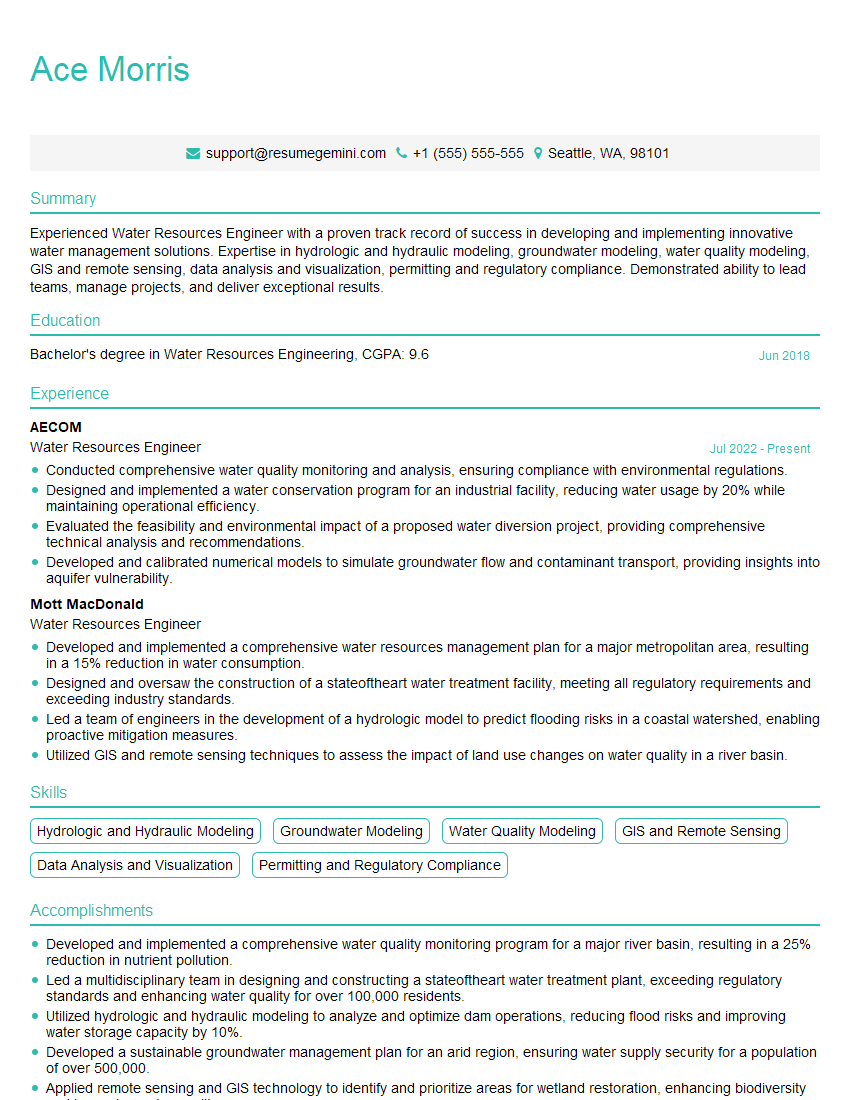
Mastering Hydraulic Structures is crucial for a successful and rewarding career in civil engineering, opening doors to exciting projects and leadership opportunities. A well-crafted resume is your key to unlocking these possibilities. An ATS-friendly resume ensures your qualifications are effectively communicated to potential employers. ResumeGemini is a trusted resource to help you build a professional and impactful resume tailored to the specific requirements of the Hydraulic Structures field. Examples of resumes optimized for this sector are available to guide you.






Explore more articles
Users Rating of Our Blogs
Share Your Experience
We value your feedback! Please rate our content and share your thoughts (optional).
What Readers Say About Our Blog
Very informative content, great job.
good