Every successful interview starts with knowing what to expect. In this blog, we’ll take you through the top Community Arts interview questions, breaking them down with expert tips to help you deliver impactful answers. Step into your next interview fully prepared and ready to succeed.
Questions Asked in Community Arts Interview
Q 1. Describe your experience developing and implementing community arts programs.
My experience in developing and implementing community arts programs spans over 15 years, encompassing a wide range of projects from large-scale public art installations to intimate, participatory workshops. I’ve worked with diverse communities, guiding projects from initial concept to final evaluation. For instance, in one project, we transformed a neglected park into a vibrant community space through collaborative mural painting and landscaping workshops, engaging over 200 residents. Another successful initiative involved creating a youth theatre program that culminated in a community-wide performance, fostering creative expression and building self-confidence among participants.
- Project Lifecycle Management: I am adept at managing every phase of a project, from needs assessment to fundraising, implementation, and evaluation.
- Curriculum Development: I have extensive experience in creating engaging and accessible arts curricula that cater to diverse skill levels and interests.
- Community Engagement: I excel at building rapport with community members and fostering a sense of ownership and participation.
Q 2. How do you assess the needs and interests of a community when planning arts initiatives?
Assessing community needs and interests is crucial for creating relevant and impactful arts initiatives. My approach involves a multi-faceted strategy that combines quantitative and qualitative data collection. This starts with community dialogues – open forums, surveys, and informal conversations – to understand the aspirations, challenges, and existing resources within the community. For instance, I recently conducted a series of focus groups to gauge interest in a photography project, uncovering a strong desire to document local history and celebrate community identity.
- Surveys & Questionnaires: These provide a broader reach and capture quantitative data on preferences and demographics.
- Focus Groups & Interviews: These offer rich qualitative insights into community perspectives and experiences.
- Community Mapping: Identifying existing resources, strengths, and challenges within the geographical area.
- Collaboration with Local Leaders: Engaging with community leaders, such as teachers, social workers, and religious leaders, to gain a more comprehensive understanding.
By integrating these methods, I create a comprehensive profile of the community’s needs and preferences, informing program design and ensuring its resonance with its intended audience.
Q 3. Explain your approach to building partnerships with community organizations and stakeholders.
Building strong partnerships is essential for successful community arts projects. My approach is based on mutual respect, transparency, and shared goals. I begin by identifying key stakeholders – community organizations, schools, businesses, local government – and engaging them in open discussions about project objectives and potential contributions. I actively listen to their concerns and find ways to incorporate their expertise into the program design.
- Relationship Building: I foster strong relationships based on trust and mutual understanding, ensuring a collaborative spirit.
- Shared Vision: I work collaboratively to establish a shared vision for the project that aligns with the interests of all stakeholders.
- Clear Communication: I maintain open communication channels throughout the project lifecycle, addressing concerns promptly and effectively.
- Memoranda of Understanding (MOUs): Formal agreements define roles, responsibilities, and expectations for all partners.
For example, in a recent project, we partnered with a local library, a community center, and a youth organization to deliver a series of interactive art workshops. Each partner played a unique role, contributing their resources and expertise to ensure the success of the program.
Q 4. What strategies do you use to secure funding for community arts projects?
Securing funding for community arts projects requires a strategic approach that blends diverse funding streams. My experience encompasses grant writing, corporate sponsorship, individual donations, and fundraising events. I develop compelling proposals that highlight the project’s impact, its alignment with funding priorities, and the sustainability of the program.
- Grant Writing: Crafting compelling grant proposals that showcase the project’s value proposition and its potential impact.
- Corporate Sponsorships: Seeking partnerships with businesses that align with the project’s mission and values.
- Crowdfunding: Leveraging online platforms to engage a wider audience and generate public support.
- Fundraising Events: Organizing events to raise funds and build community engagement.
For instance, in securing funding for a public art project, we successfully secured a grant from a local arts council, sponsorship from a local bank, and donations from community members.
Q 5. How do you measure the success of a community arts program?
Measuring the success of a community arts program goes beyond simple participation numbers. I employ a multi-faceted evaluation approach that considers both quantitative and qualitative data. This includes pre- and post-program surveys to measure changes in participants’ knowledge, skills, and attitudes. I also conduct focus groups and interviews to gather feedback on the program’s impact and effectiveness.
- Quantitative Data: Participation rates, attendance figures, program completion rates.
- Qualitative Data: Participant feedback (through surveys, interviews, and focus groups), community observations, media coverage.
- Community Impact Assessment: Assessing the program’s broader impact on the community, such as increased social cohesion, improved community pride, or economic benefits.
For example, we used pre- and post-program surveys to assess the impact of a youth theatre program on participants’ self-esteem and communication skills. We also analyzed community feedback to identify areas for improvement in future programs.
Q 6. Describe your experience working with diverse populations in a community arts setting.
Working with diverse populations is central to my philosophy of community arts. I believe that art should be accessible to everyone, regardless of their background or circumstances. My approach emphasizes inclusivity and cultural sensitivity, ensuring that all voices are heard and respected. I actively seek out diverse artists and collaborators, and tailor program content to reflect the rich tapestry of cultural experiences within the community.
- Culturally Responsive Programming: Designing programs that are sensitive to the cultural backgrounds and values of diverse community members.
- Language Access: Providing translation and interpretation services to ensure that programs are accessible to non-English speakers.
- Accessibility for People with Disabilities: Adapting programs to meet the needs of people with disabilities, including providing assistive technologies and accessible venues.
In a recent project, we collaborated with artists from various ethnic and cultural backgrounds to create a series of murals that celebrated the diversity of our community. We ensured that the project was inclusive by providing language support and working with artists who had experience in working with diverse communities.
Q 7. How do you address challenges related to accessibility and inclusion in community arts programming?
Addressing accessibility and inclusion is paramount in community arts. This involves proactively identifying and removing barriers to participation. This may include adapting program content and delivery methods to meet the needs of participants with disabilities, offering multilingual support, or providing childcare to enable participation for parents. Furthermore, I collaborate with disability organizations and community leaders to identify and address accessibility barriers.
- Accessible Venues: Ensuring that programs are held in venues that are accessible to people with disabilities.
- Adaptive Arts Practices: Employing adaptive arts techniques to engage individuals with diverse abilities.
- Flexible Scheduling: Offering programs at various times and locations to cater to different schedules and needs.
- Financial Aid: Providing financial assistance to participants who may not be able to afford program fees.
For instance, in our photography project, we provided assistive technology for participants with visual impairments and offered workshops in accessible locations. We also partnered with a local disability organization to ensure that our materials and program design met accessibility standards.
Q 8. Explain your understanding of creative placemaking and its application in community development.
Creative placemaking is a multifaceted approach to community development that leverages arts and culture to revitalize public spaces, strengthen community bonds, and improve quality of life. It’s not just about putting art in a place; it’s about using art as a catalyst for broader social and economic transformation.
In community development, creative placemaking acts as a powerful tool. For instance, transforming a neglected park into a vibrant community hub through public art installations, workshops, and performances can attract residents, boost local businesses, and foster a sense of collective ownership. This creates a positive feedback loop, where improved aesthetics and community engagement lead to increased property values and economic growth. A successful example is the High Line in New York City, a repurposed elevated railway line transformed into a linear park and public space, attracting tourism and boosting surrounding neighborhoods.
- Economic Development: Increased tourism and local business revenue.
- Social Cohesion: Building stronger community bonds through shared experiences.
- Environmental Improvement: Transforming neglected spaces into vibrant public realms.
- Cultural Identity: Celebrating local heritage and artistic expression.
Q 9. What are some innovative approaches to engaging diverse communities in the arts?
Engaging diverse communities requires thoughtful strategies that acknowledge and celebrate cultural differences. A ‘one-size-fits-all’ approach will rarely succeed. Innovative approaches include:
- Participatory Arts Projects: Involving community members in all stages of the artistic process, from concept development to implementation, ensures ownership and relevance. This might involve community murals where everyone contributes, or collaborative theatre productions where stories are drawn from the community’s experiences.
- Culturally Specific Programming: Offering arts programs that reflect the diverse cultural traditions within a community. This could involve hosting traditional dance workshops, musical performances, or storytelling events that reflect the richness of the community’s heritage.
- Language Accessibility: Ensuring all materials and communications are available in multiple languages. This includes program descriptions, websites, and signage.
- Community Partnerships: Collaborating with community leaders, organizations, and faith-based institutions to reach diverse populations and build trust. For example, partnering with a local mosque to host an arts event during Ramadan.
- Removing Barriers to Access: Addressing financial, transportation, and accessibility challenges that might prevent participation. This could involve offering free or low-cost classes, providing transportation assistance, or ensuring venues are accessible to individuals with disabilities.
Q 10. How do you handle conflicts or disagreements among community members involved in an arts project?
Conflicts are inevitable in collaborative projects. A proactive and inclusive approach is key.
- Establish Clear Communication Channels: Regular meetings, open forums, and accessible communication tools help prevent misunderstandings.
- Facilitate Dialogue and Mediation: Create a safe space for expressing concerns and finding common ground. Neutral mediators can be valuable in resolving disputes.
- Establish Ground Rules and Decision-Making Processes: Agreeing upfront on how decisions will be made and conflicts addressed prevents power imbalances and ensures fairness.
- Focus on Shared Goals: Remind participants of the common purpose and positive impact of the project.
- Document Agreements and Decisions: Keeping clear records of decisions and agreements provides transparency and prevents future disputes.
For instance, if a disagreement arises about the design of a community mural, a facilitated discussion could involve community members expressing their preferences, compromising on elements, and reaching a consensus that reflects the community’s diverse perspectives.
Q 11. Describe your experience in grant writing and reporting for community arts projects.
Grant writing and reporting are essential skills in community arts. I have extensive experience in writing compelling grant proposals that clearly articulate project goals, methodology, budget, and expected impact. My proposals highlight the community benefit, showcasing the project’s alignment with funder priorities.
I meticulously track project progress and produce detailed reports that demonstrate the achievement of project goals and the impact on the community. This includes quantitative data (participation numbers, attendance figures) and qualitative data (testimonials, photographs) illustrating the project’s success. I always ensure the reports are clear, concise, and accurately reflect the project’s activities and outcomes. My reporting templates are tailored to the specific requirements of each funder.
Q 12. How do you promote and market community arts events and programs?
Promoting community arts events requires a multi-pronged approach:
- Social Media Marketing: Utilizing platforms like Facebook, Instagram, and Twitter to reach a wide audience. Engaging content, visually appealing posts, and targeted advertising are crucial.
- Community Outreach: Collaborating with local businesses, schools, community centers, and other organizations to spread awareness.
- Public Relations: Working with local media outlets (newspapers, radio, television) to generate publicity.
- Website and Email Marketing: Creating a user-friendly website with event information, and using email marketing to reach potential attendees directly.
- Flyers and Posters: Using traditional marketing methods to reach a broader audience, particularly those who may not be online.
- Event Partnerships: Collaborating with other community events to cross-promote and reach a wider audience.
For instance, to promote a community theatre production, we might partner with local restaurants to offer discounts to attendees, and use social media to run a contest for free tickets, generating excitement and engagement.
Q 13. What are some key performance indicators (KPIs) you would use to track the impact of a community arts program?
Key Performance Indicators (KPIs) for a community arts program should measure both artistic success and community impact.
- Participation Rates: Number of participants in workshops, classes, and events.
- Attendance Figures: Number of attendees at performances, exhibitions, and festivals.
- Community Engagement: Number of volunteers, feedback collected from participants, and community partnerships formed.
- Economic Impact: Revenue generated by events, jobs created, and increased tourism.
- Social Impact: Changes in community perceptions, improved social cohesion, and increased civic pride. This could be measured through surveys and interviews.
- Artistic Output: Number of artworks created, performances given, and skills learned.
By tracking these KPIs, we can assess the program’s effectiveness, identify areas for improvement, and demonstrate its value to stakeholders.
Q 14. Explain your familiarity with relevant legislation and regulations related to community arts.
My familiarity with relevant legislation and regulations related to community arts includes:
- Copyright Law: Understanding copyright and intellectual property rights to ensure legal compliance in using music, images, and other copyrighted materials.
- Accessibility Laws: Adhering to accessibility standards to ensure inclusivity for individuals with disabilities (e.g., Americans with Disabilities Act in the US).
- Health and Safety Regulations: Meeting all relevant health and safety standards to create safe environments for participants and audiences (e.g., fire safety codes, licensing requirements).
- Funding Regulations: Understanding the rules and regulations governing grants and funding from various sources. This includes reporting requirements and compliance obligations.
- Labor Laws: Understanding employment laws if the project involves hiring staff or volunteers.
Staying updated on relevant legislation ensures legal compliance, protects the organization, and safeguards the interests of participants and the community.
Q 15. How do you manage budgets and resources effectively in a community arts setting?
Effective budget management in community arts is crucial for sustainability. It requires a multi-faceted approach combining meticulous planning, diverse funding streams, and transparent accountability. I begin by creating a detailed budget that outlines all anticipated expenses, from artist fees and materials to marketing and venue rentals. This budget is then presented to stakeholders for review and approval.
To secure funding, I actively pursue grants from various sources, including local arts councils, foundations, and corporate sponsors. I also explore opportunities for in-kind donations, such as venue space or equipment. Furthermore, I might implement a tiered pricing structure for workshops or events to ensure accessibility while generating revenue. For instance, we offered a sliding scale fee for our summer art camp, ensuring affordability for families of varying income levels. Regular monitoring of expenses against the budget is essential, along with timely adjustments to maintain financial stability. This includes using budgeting software to track income and expenditure and producing regular financial reports for review.
Career Expert Tips:
- Ace those interviews! Prepare effectively by reviewing the Top 50 Most Common Interview Questions on ResumeGemini.
- Navigate your job search with confidence! Explore a wide range of Career Tips on ResumeGemini. Learn about common challenges and recommendations to overcome them.
- Craft the perfect resume! Master the Art of Resume Writing with ResumeGemini’s guide. Showcase your unique qualifications and achievements effectively.
- Don’t miss out on holiday savings! Build your dream resume with ResumeGemini’s ATS optimized templates.
Q 16. Describe your experience in evaluating the effectiveness of different arts education programs.
Evaluating arts education programs requires a comprehensive strategy that goes beyond simple attendance figures. My approach involves a mix of quantitative and qualitative methods to assess both the program’s impact and the participants’ experience.
- Quantitative Data: I collect data on attendance rates, pre- and post-program assessments to measure skill development, and surveys to gauge participant satisfaction. Statistical analysis helps identify trends and areas for improvement.
- Qualitative Data: I conduct focus groups with participants and teachers to gather in-depth feedback on the program’s strengths and weaknesses. Observations during program sessions provide further insights into the learning environment and teaching methods. Case studies of individual participant progress help to illustrate the impact of the program.
For example, in a recent youth theatre program, we used pre- and post-program questionnaires to assess the participants’ confidence and skills in acting, while conducting focus groups with the young people and their parents to uncover their overall experience. This helped us to refine the program content and delivery method to maximize its effectiveness. The integration of both quantitative and qualitative data paints a complete picture of the program’s success and provides valuable insights for future iterations.
Q 17. How do you build and maintain relationships with artists and arts organizations?
Building and maintaining strong relationships with artists and arts organizations is fundamental to the success of any community arts initiative. I prioritize open communication, mutual respect, and a collaborative spirit.
- Networking: I actively attend arts events, workshops, and conferences to meet artists and connect with organizations. This provides opportunities to collaborate on projects and build professional relationships.
- Collaboration: I actively seek opportunities for joint projects, shared resources, and cross-promotional activities. For example, we partnered with a local gallery to showcase student artwork at their space, providing a wider audience and a valuable learning opportunity for the young artists.
- Clear Communication: I maintain transparent and timely communication with artists and organizations regarding project timelines, budgets, and expectations.
Building trust and demonstrating genuine appreciation for artists’ contributions is crucial for long-term collaboration. By providing regular feedback and celebrating achievements, I strive to cultivate lasting partnerships based on mutual respect and shared vision.
Q 18. What strategies do you use to engage volunteers in community arts projects?
Engaging volunteers effectively requires careful planning and a genuine appreciation for their time and skills. I begin by clearly defining the roles and responsibilities of each volunteer position, ensuring that tasks are manageable and aligned with their interests and abilities.
- Recruitment: I leverage various channels to attract volunteers, including online platforms, community bulletin boards, and partnerships with local organizations.
- Training: Providing comprehensive training sessions equipped with clear instructions and expectations helps equip volunteers to perform their tasks effectively.
- Recognition & Appreciation: Regularly acknowledging and celebrating volunteers’ contributions is crucial for maintaining their motivation and commitment. This could involve organizing volunteer appreciation events, providing certificates of recognition, or highlighting their contributions in project reports and newsletters.
For instance, during our annual community mural project, we had volunteers who were skilled artists, those who preferred administrative tasks, and others who helped with community outreach. Tailoring roles to individual capabilities ensured a high level of engagement and successful completion of the project.
Q 19. How do you ensure the sustainability of community arts programs over the long term?
Ensuring the long-term sustainability of community arts programs involves a multifaceted approach. It’s about building a strong foundation that can weather challenges and continue to thrive.
- Diversified Funding: Relying solely on one funding source is risky. A diversified funding strategy is crucial, including grants, sponsorships, earned income (through workshops, events, etc.), and individual donations.
- Community Engagement: Building a strong network of supporters within the community is essential for long-term viability. It builds local ownership and helps secure both financial and volunteer support.
- Adaptability: Community needs evolve. A sustainable program needs to be flexible and responsive to those changes, adapting its offerings to meet the community’s changing needs and interests.
- Strong Leadership & Governance: Effective governance structure, including a board of directors or advisory committee, can help guide strategy and ensure accountability, helping to build trust and sustain the project over the long term.
For example, one program I helped develop implemented a robust membership program, offering tiered benefits to attract recurring donations, which created financial stability.
Q 20. Explain your approach to risk management in community arts projects.
Risk management in community arts projects is vital to ensure safety, legal compliance, and the successful completion of initiatives. My approach involves proactive identification, assessment, and mitigation of potential risks.
- Risk Identification: I regularly review project plans, identifying potential risks, such as financial shortfalls, health and safety hazards, or negative publicity.
- Risk Assessment: Each identified risk is evaluated based on its likelihood and potential impact.
- Risk Mitigation: Strategies are developed to address each risk. For example, a risk assessment of a workshop involving hazardous materials would involve detailed safety protocols, appropriate training, and readily available safety equipment.
- Contingency Planning: Alternative plans are established to manage unforeseen circumstances. This includes having backup plans for weather-related events or artist cancellations.
Thorough documentation of all risk management procedures is essential for accountability and transparency. Regular reviews and updates ensure that the risk management plan remains relevant and effective.
Q 21. How familiar are you with different community arts models and approaches?
I’m very familiar with a wide range of community arts models and approaches. My understanding encompasses various models including:
- Place-based initiatives: These focus on using art to revitalize specific areas, such as creating murals or public art installations.
- Participatory arts projects: These models emphasize community engagement and collaboration, where community members actively participate in the creative process.
- Arts-based community development: This approach uses art as a tool for social change, addressing community needs such as poverty, violence, or lack of educational opportunities.
- Mobile arts programs: These programs bring arts activities to underserved communities, often through outreach initiatives.
- Arts integration: This approach involves incorporating arts into other subjects or programs, such as integrating visual arts into science education.
My experience has allowed me to adapt and implement various models depending on the specific needs and context of a given community. I believe in a flexible approach, drawing from different models to design projects that are meaningful and impactful.
Q 22. Describe a time you had to adapt a community arts program due to unforeseen circumstances.
Adaptability is crucial in community arts. One instance involved a mural project in a low-income neighborhood. We’d secured funding and artist participation, but a week before the start, a severe storm damaged the designated wall. Instead of canceling, we quickly pivoted.
- Problem-Solving: We assessed alternative locations, considering factors like sunlight, accessibility, and community input. A local church offered a suitable interior wall.
- Adaptation: The artist adjusted their design to suit the indoor space, incorporating elements reflecting the church’s community involvement. We also adapted our promotional materials to reflect the change in location.
- Outcome: The project was successfully completed, albeit in a different location, and the flexibility showed the community our commitment and problem-solving abilities. The final artwork beautifully integrated with the church’s existing atmosphere, resulting in a stronger sense of community ownership.
Q 23. How do you use technology to support community arts initiatives?
Technology is transformative for community arts. We leverage it across various aspects.
- Project Management: Tools like Trello and Asana help manage artist collaborations, deadlines, and resource allocation. For example, we use Kanban boards to track progress on multiple projects simultaneously.
- Community Engagement: Social media platforms like Facebook and Instagram facilitate communication and outreach. We create engaging content showcasing project updates, artist spotlights, and participation opportunities. We also use platforms like Eventbrite for registrations and ticketing.
- Digital Storytelling: We utilize video and audio editing software to document projects and amplify community voices. This allows us to share the impact of our work more effectively.
- Accessibility: We use tools like closed captioning software and image descriptions to make our content accessible to a wider audience, ensuring inclusivity.
Q 24. What are your thoughts on the role of arts in social justice and community building?
Arts play a vital role in both social justice and community building. They act as a powerful catalyst for social change and foster a sense of belonging.
- Social Justice: Arts provide a platform for marginalized voices to share their experiences, challenge societal norms, and advocate for change. For instance, theater productions can explore issues of inequality and discrimination, sparking dialogue and awareness. Public art installations can challenge existing power structures and prompt reflection on social issues.
- Community Building: Collaborative art projects encourage participation, fostering a sense of shared identity and purpose. They bring people together across diverse backgrounds, breaking down barriers and strengthening community ties. Think of neighborhood-wide mural projects or community theatre productions.
Arts provide a safe space for dialogue, expression, and healing, creating stronger, more equitable communities.
Q 25. Describe your experience with data analysis and its application in community arts programming.
Data analysis provides valuable insights into program effectiveness and community needs. We use data to inform decision-making and improve outcomes.
- Program Evaluation: We track participation rates, audience demographics, and feedback to assess program success. For example, analyzing survey data helps us understand what resonates with participants and identify areas for improvement.
- Needs Assessment: Data on community demographics and access to arts programs informs future initiatives. We can identify gaps in service and target underserved populations.
- Resource Allocation: Analyzing data on program costs and impact helps us optimize resource allocation, ensuring we maximize funding and achieve greater impact.
We utilize spreadsheet software and data visualization tools to analyze data and communicate our findings effectively.
Q 26. How do you communicate effectively with diverse audiences about community arts programs?
Effective communication is key to building community engagement. We tailor our messages to different audiences using a variety of methods.
- Multilingual Materials: We translate program information into relevant languages spoken by our community members.
- Accessible Formats: We provide information in various formats (e.g., large print, audio, simplified language) to meet diverse needs.
- Community Partnerships: We collaborate with community leaders and organizations to disseminate information effectively through established channels. This includes working with local libraries, community centers, and faith-based organizations.
- Visual Communication: We use images and videos to communicate complex ideas simply and effectively, particularly for audiences with limited literacy skills.
By actively seeking feedback and adapting our communication strategies, we ensure the information is understandable and engaging to our diverse audience.
Q 27. Describe your understanding of the ethical considerations in community arts practice.
Ethical considerations are paramount in community arts. Our practice prioritizes respect, inclusivity, and community benefit.
- Consent and Participation: We ensure community members are fully informed and give their consent before participating in projects. We avoid exploiting vulnerable populations.
- Cultural Sensitivity: We are mindful of cultural differences and work to avoid appropriation or misrepresentation of cultural practices. We actively involve community members in shaping projects that reflect their identities and values.
- Transparency and Accountability: We maintain transparency in our financial practices and decision-making processes. We are accountable to the community we serve.
- Fair Compensation: We ensure that artists and community members are fairly compensated for their time and contributions.
Our ethical framework guides us to create projects that uplift and empower communities, upholding the highest standards of professionalism and integrity.
Q 28. How do you foster a sense of ownership and participation among community members in arts projects?
Fostering ownership and participation is crucial. We employ strategies that empower community members.
- Participatory Decision-Making: We involve community members in all phases of a project, from conceptualization and design to implementation and evaluation. For example, we hold community forums to gather input and feedback.
- Leadership Development: We provide training and mentorship opportunities for community members to develop their skills and take on leadership roles within projects. This could involve training in arts techniques or project management skills.
- Mentorship Programs: We pair experienced artists with community members to build skills and knowledge. This ensures knowledge transfer and sustainable participation within the community.
- Recognition and Celebration: We celebrate community contributions publicly, showcasing their work and acknowledging their contributions.
By empowering community members, we cultivate a sense of ownership and pride, fostering long-term engagement and sustainability.
Key Topics to Learn for Your Community Arts Interview
- Community Engagement Strategies: Understanding diverse community needs and developing inclusive participation models. Practical application: Designing and implementing a community arts project that addresses specific social issues.
- Arts Administration and Funding: Grant writing, budgeting, fundraising, and financial management within a non-profit or community arts organization. Practical application: Creating a realistic budget proposal for a community arts initiative.
- Project Management in the Arts: Planning, organizing, executing, and evaluating arts projects, considering logistical challenges and stakeholder management. Practical application: Developing a detailed project timeline and risk mitigation plan.
- Accessibility and Inclusion: Creating equitable access to the arts for all community members, regardless of background or ability. Practical application: Adapting arts programs to meet the diverse needs of participants.
- Cultural Sensitivity and Ethical Considerations: Understanding and respecting cultural differences in artistic expression and community engagement. Practical application: Navigating potential conflicts arising from diverse perspectives in a community arts setting.
- Arts Education and Outreach: Developing and delivering effective arts education programs for diverse age groups and skill levels. Practical application: Designing an engaging workshop for a specific community group.
- Evaluation and Impact Measurement: Assessing the effectiveness of community arts programs and demonstrating their social impact. Practical application: Developing key performance indicators (KPIs) to measure the success of a community arts project.
Next Steps
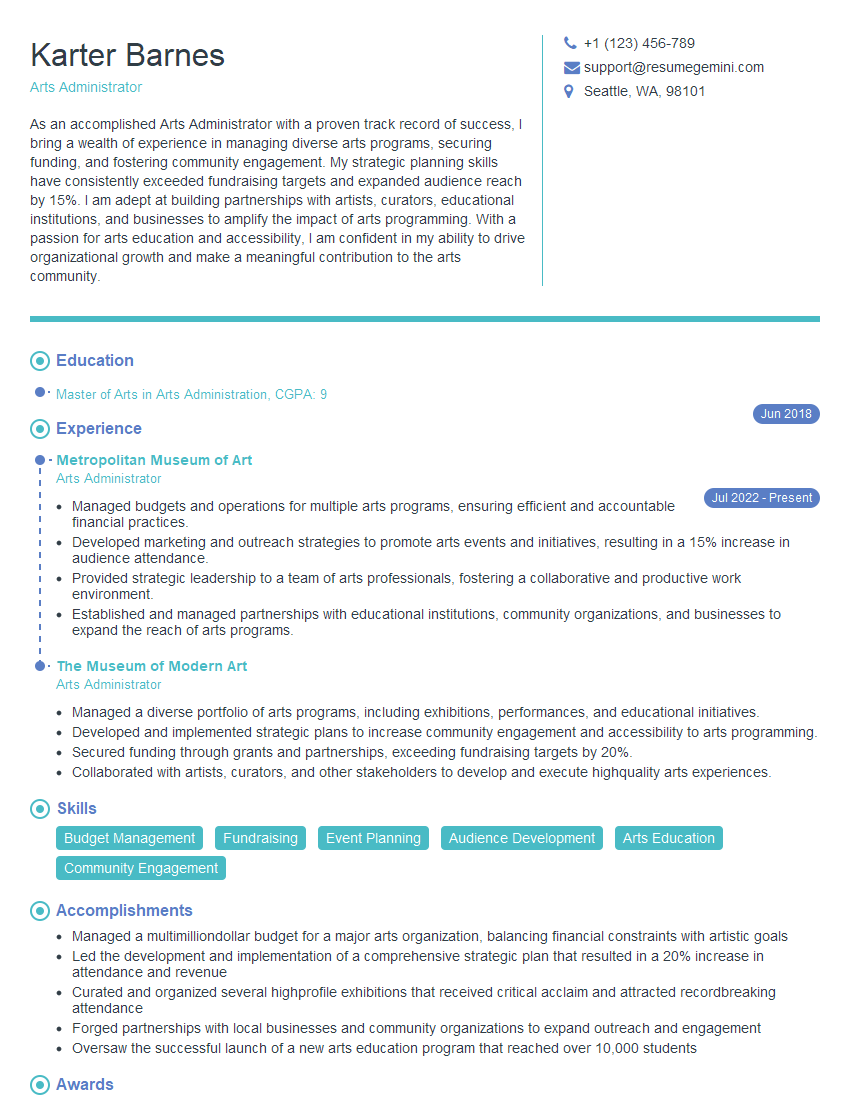
Mastering Community Arts opens doors to fulfilling and impactful careers, enabling you to contribute meaningfully to your community while pursuing your passion. A strong resume is crucial for showcasing your skills and experience to potential employers. To maximize your job prospects, create an ATS-friendly resume that highlights your accomplishments and effectively communicates your value. ResumeGemini is a trusted resource to help you build a professional and compelling resume. Examples of resumes tailored to the Community Arts field are available to guide you through the process.
Explore more articles
Users Rating of Our Blogs
Share Your Experience
We value your feedback! Please rate our content and share your thoughts (optional).
What Readers Say About Our Blog
Very informative content, great job.
good