The thought of an interview can be nerve-wracking, but the right preparation can make all the difference. Explore this comprehensive guide to Experience with video editing interview questions and gain the confidence you need to showcase your abilities and secure the role.
Questions Asked in Experience with video editing Interview
Q 1. What video editing software are you proficient in?
I’m proficient in several industry-standard video editing software packages. My core expertise lies in Adobe Premiere Pro, which I’ve used extensively for over seven years on a wide range of projects. I’m also comfortable with DaVinci Resolve, particularly for its color grading capabilities, and have experience with Final Cut Pro X, primarily for smaller projects or quick turnaround jobs. The choice of software often depends on the specific project requirements and collaborative workflow needs.
Q 2. Describe your experience with nonlinear editing.
Nonlinear editing (NLE) is the cornerstone of modern video editing. Unlike linear editing, where you assemble footage sequentially on a tape, NLE allows for non-destructive editing. This means I can rearrange clips, add effects, and make changes without affecting the original source files. My experience with NLE involves everything from assembling basic cuts to intricate multi-camera edits. For example, in a recent documentary project, we had multiple camera angles of an interview. Using Premiere Pro’s NLE capabilities, I was able to seamlessly switch between these angles, focusing on the most engaging shots to maintain viewer interest and enhance the storytelling. This flexibility is crucial for achieving creative vision and refining a project iteratively.
Q 3. Explain your workflow for a typical video editing project.
My workflow for a typical video editing project follows a structured process. It usually starts with ingestion and organization, where I meticulously label and sort all the raw footage. Then comes the rough cut, a first assembly of the clips in chronological order, focusing on the overall narrative flow. This is followed by the fine cut, where I meticulously refine the edit, paying attention to pacing, transitions, and overall visual storytelling. Next is audio editing and mixing, followed by color correction and grading to enhance the visual quality. I then incorporate any motion graphics or animation, followed by a final review and export. Throughout this process, client feedback is crucial and integrated at each major stage. Think of it like building a house: you start with the foundation (ingestion), then the structure (rough cut), the finer details (fine cut), the utilities (audio), the aesthetics (color), and finally, the finishing touches (motion graphics).
Q 4. How do you manage large video files efficiently?
Managing large video files efficiently is paramount. I utilize a combination of strategies. First, I use high-performance storage solutions like external SSDs with fast read/write speeds. Secondly, I leverage proxy editing; creating smaller, lower-resolution versions of the footage for smoother editing in Premiere Pro. Once the edit is finalized, I switch back to the original high-resolution files for final rendering. Thirdly, I always organize my project files in a clear, hierarchical structure within dedicated folders to avoid confusion. Think of it as organizing a library – you wouldn’t just throw all your books into one pile. Finally, I use media management software to keep track of file locations and metadata.
Q 5. What are your preferred methods for color correction and grading?
My preferred methods for color correction and grading involve a combination of techniques. I primarily use DaVinci Resolve for its powerful color tools, but I also leverage Premiere Pro’s color correction capabilities. Color correction aims to fix inaccuracies, ensuring consistent color temperature and exposure. Grading is more artistic, using color to create a specific mood or style. For example, I might use a warmer color palette for a romantic scene, or cooler tones for a dramatic one. I always start with a balanced correction before moving to creative grading, often using scopes (waveform, vectorscope) to guide my adjustments and ensure accuracy.
Q 6. How do you handle audio editing and mixing in your projects?
Audio is crucial. I use a multi-track approach, carefully cleaning up individual audio tracks – removing noise, hiss, and pops – before mixing them together. I’m proficient in using EQ (equalization) to adjust frequency balance and compression to control dynamic range. I often use plugins to add effects, like reverb or delay, to enhance the atmosphere. My aim is to create a clean, clear, and engaging soundscape that complements the visuals. In a recent corporate video, I had to remove background noise from an interview recorded in a busy office. Using Adobe Audition’s noise reduction tools, I was able to create a crisp, professional-sounding audio track.
Q 7. Describe your experience with motion graphics and animation.
I have considerable experience with motion graphics and animation, primarily using Adobe After Effects. This extends to creating lower-thirds, animated logos, and simple kinetic typography. I’ve also worked with more complex animations, integrating them seamlessly into video projects. For example, I once animated a data visualization for a client presentation, creating a compelling visual representation of complex information. I understand the principles of animation, including timing, spacing, and easing, to create engaging and visually appealing motion graphics.
Q 8. How do you ensure consistency in style and branding across multiple videos?
Maintaining consistent style and branding across multiple videos is crucial for building a recognizable brand identity. I achieve this through meticulous planning and execution. Before any editing begins, I work closely with the client or creative director to define a style guide. This guide includes:
- Color palettes: Specific hex codes for primary, secondary, and accent colors are defined to ensure visual uniformity.
- Font choices: Designated fonts for titles, subtitles, and on-screen text are selected for legibility and brand consistency.
- Graphics and animations: A consistent style is established for lower thirds, logo animations, and any other graphical elements. This often includes creating templates within my editing software to ensure ease of application and consistency.
- Music and sound design: A set of pre-approved music tracks and sound effects is chosen to maintain a cohesive audio experience. This includes defining the overall mood and tone of the audio landscape.
During the editing process, I use these guidelines religiously. I create templates for common elements like lower thirds and intros, and I regularly review my work against the style guide to catch any inconsistencies. For example, I recently worked on a series of promotional videos for a tech company. We established a sleek, modern style guide, and throughout the entire series, I used the same color scheme, fonts, and animation styles to maintain a professional and cohesive brand experience across all the videos.
Q 9. How do you incorporate feedback from clients or directors?
Incorporating client or director feedback is a vital part of the video editing process. I believe in open communication and iterative refinement. My approach involves:
- Regular check-ins: I schedule regular review sessions with the client or director to showcase progress and solicit feedback at key milestones, not just at the very end.
- Detailed feedback forms: I provide clients with a structured feedback form to ensure clarity and consistency in their comments. This form prompts specific feedback on different aspects like pacing, music, visuals, and storytelling.
- Version control: I maintain multiple versions of the edit so that feedback can be incorporated without losing previous iterations. This allows me to revert to earlier versions if needed.
- Clear communication: I make sure to actively listen and ask clarifying questions. Often, a client may have a vision that’s difficult to articulate. Through collaborative discussion, we can arrive at a shared understanding and find creative solutions.
For example, I once had a client who initially requested a more dramatic tone for their corporate video. After reviewing the first cut, they realized that a more upbeat, optimistic tone would better represent their brand. By actively listening and working with them, we were able to make the necessary adjustments and deliver a final product they were very pleased with.
Q 10. What is your experience with different video formats and codecs?
My experience encompasses a wide range of video formats and codecs. I’m proficient in working with various resolutions (from 480p to 4K and beyond), frame rates (24fps, 25fps, 30fps, 60fps), and aspect ratios (16:9, 4:3, 1:1, etc.). My familiarity with codecs includes:
- H.264 (AVC): A widely used codec for its balance of compression efficiency and quality, commonly used for web video.
- H.265 (HEVC): A more efficient codec offering better compression at higher resolutions, ideal for 4K and above.
- ProRes: An Apple codec ideal for editing in post-production because of its high quality and lossless compression, albeit larger file sizes.
- DNxHD/DNxHR: A range of codecs from Avid, offering different levels of quality and compression, suitable for high-quality editing workflows.
Understanding the nuances of these codecs is essential for optimizing video quality and file size. Choosing the right codec depends on factors like the intended platform (web, broadcast, mobile), desired quality, and storage capacity. For example, I would use ProRes for offline editing on a powerful workstation to ensure smooth performance and then transcode to H.264 for web delivery to reduce file size.
Q 11. Describe your approach to storytelling in video editing.
My approach to storytelling in video editing centers on crafting a compelling narrative that engages the audience from beginning to end. This involves a deep understanding of the narrative arc, including:
- Establishing the premise: The opening scenes must clearly introduce the subject and set the tone for the video.
- Building tension and anticipation: Through pacing, music, and visuals, I create moments of suspense and intrigue to keep the audience engaged.
- Developing the characters or subject: Whether it’s a documentary, commercial, or short film, I ensure the subject’s personality and story arc are clearly conveyed.
- Creating emotional resonance: I aim to evoke emotions in the viewer through strategic use of music, visuals, and storytelling techniques.
- Providing a satisfying resolution: The ending should feel complete and leave the audience with a lasting impression.
I frequently use storyboarding and shot lists to plan the flow of the video before I even begin editing. This ensures a cohesive narrative from the beginning. For example, when editing a documentary about a local artist, I carefully sequenced shots to show the artist’s creative process, struggles, and eventual triumphs, ultimately creating a deeply engaging story that connects with the audience on an emotional level.
Q 12. How do you use transitions and effects to enhance video narratives?
Transitions and effects are powerful tools for enhancing video narratives, but they should always serve the story, not distract from it. My use of transitions and effects is guided by these principles:
- Purposeful transitions: I avoid jarring or overly flashy transitions. Instead, I opt for smooth transitions like cross dissolves or cuts that maintain the flow of the story. A jump cut might be used for a specific stylistic effect to highlight a change in time or location.
- Subtlety and restraint: Overuse of effects can be distracting. I use visual effects sparingly and only when they enhance the narrative, such as slow motion to emphasize a specific moment or color grading to establish a mood.
- Consistent style: The style of transitions and effects should align with the overall tone and style of the video. A whimsical animation style might suit a children’s show, while a more austere approach may be appropriate for a corporate video.
For instance, I recently used a series of subtle cross-dissolves to transition between different time periods in a historical documentary, seamlessly guiding the viewer through the narrative. The transitions themselves were almost invisible; they only served to smoothly move the story forward.
Q 13. How do you deal with challenging deadlines and time constraints?
Meeting tight deadlines is a common challenge in video editing. My approach to managing time constraints involves a combination of effective planning, efficient workflow, and proactive communication:
- Detailed scheduling: I break down large projects into smaller, manageable tasks with assigned deadlines. This helps me track progress and identify potential bottlenecks early on.
- Prioritization: I focus on the most critical tasks first, ensuring that the essential elements of the video are completed on time. This requires careful assessment of what is truly important and what can be trimmed if absolutely necessary.
- Efficient workflow: I use keyboard shortcuts, custom presets, and other tools to streamline my editing process and maximize productivity.
- Proactive communication: If I anticipate delays, I communicate with the client immediately to discuss options and adjust the timeline if necessary.
For example, once I was faced with a significantly compressed deadline for a client’s promotional video. By meticulously planning each step, prioritizing key scenes, and leveraging my knowledge of efficient workflow techniques, I successfully delivered a high-quality video on time and to the client’s satisfaction.
Q 14. What’s your process for organizing and archiving video projects?
Organizing and archiving video projects is critical for efficiency and long-term accessibility. My process involves:
- Clear file naming conventions: I use a consistent naming system for all project files (e.g., Project Name_Date_Version.mov). This avoids confusion and ensures easy retrieval.
- Organized folder structure: I create a hierarchical folder structure for each project, separating raw footage, edited footage, audio files, graphics, and final deliverables.
- Regular backups: I implement a robust backup strategy using multiple storage solutions, including local hard drives, external drives, and cloud storage. This safeguards against data loss.
- Metadata tagging: I add metadata tags to my video files including keywords, descriptions, and client information, which simplifies searching and retrieval.
- Project archiving: After project completion, I create a compressed archive of the entire project, including all source files, deliverables, and relevant documentation.
This systematic approach ensures that my projects are easily accessible and manageable, even years after completion. It simplifies finding specific clips, revisiting old projects, or delivering archival material to clients.
Q 15. Describe a time you had to troubleshoot a technical issue during video editing.
One time, I was working on a corporate video with a tight deadline. We’d shot the footage in multiple locations with varying lighting conditions, resulting in inconsistent color grading across the scenes. The initial edit looked jarring because of these inconsistencies. Troubleshooting involved a multi-step process. First, I carefully analyzed the footage in each scene, noting the specific lighting issues. Then, I used color correction tools in Adobe Premiere Pro to carefully match the color temperature and white balance across all scenes. This included using the Lumetri Color panel to adjust curves, highlights, shadows, and whites. I also used the Color Match panel to match specific shots to a reference scene. Finally, I carefully reviewed the entire video again to ensure a smooth and consistent color grade throughout. This meticulous process, which took longer than anticipated, highlighted the importance of consistent lighting setup during filming, and the power of color correction tools in post-production.
Career Expert Tips:
- Ace those interviews! Prepare effectively by reviewing the Top 50 Most Common Interview Questions on ResumeGemini.
- Navigate your job search with confidence! Explore a wide range of Career Tips on ResumeGemini. Learn about common challenges and recommendations to overcome them.
- Craft the perfect resume! Master the Art of Resume Writing with ResumeGemini’s guide. Showcase your unique qualifications and achievements effectively.
- Don’t miss out on holiday savings! Build your dream resume with ResumeGemini’s ATS optimized templates.
Q 16. What is your experience with video compression techniques?
Video compression is crucial for efficient storage and distribution. My experience encompasses a range of techniques, from lossy to lossless compression. Lossy compression, such as H.264 and H.265 (HEVC), discards some data to reduce file size, offering a balance between quality and storage. I frequently use H.264 for web distribution due to its broad compatibility, and H.265 for higher quality at smaller file sizes when bandwidth is less of a concern. Lossless codecs like ProRes and DNxHD maintain all the original data, resulting in superior quality but significantly larger file sizes, ideal for archiving or intermediate editing. The choice of codec depends heavily on the final delivery platform and the desired quality. For instance, a high-resolution video for a cinema screen would benefit from a lossless codec during the editing process and a high-quality lossy codec for distribution. A video for social media platforms might prioritize smaller file size with H.264 or H.265 from the start.
Q 17. How do you ensure the quality of your video output?
Ensuring high-quality video output is a multi-faceted process starting from pre-production. This includes checking the camera settings, proper lighting, and sound recording. In post-production, my quality control measures include regular checks throughout the editing process. I pay close attention to details like color grading, audio mixing, and sharpness. I routinely review the video on different devices and screen sizes to ensure consistency and identify potential issues early on. Furthermore, I always perform a final render using high-quality settings before delivering the final product. This involves a close examination for artifacts, glitches, or other imperfections. Finally, client feedback is invaluable; I use their input to make final refinements and ensure the output aligns perfectly with their expectations.
Q 18. Describe your experience with subtitles and closed captions.
I have extensive experience with subtitles and closed captions, understanding the importance of accessibility and inclusivity. I’m proficient in creating both using software like Adobe Premiere Pro and dedicated captioning tools. I understand the difference between subtitles (translation for different languages) and closed captions (transcript for the hearing impaired, often including sound descriptions). My process involves ensuring accuracy, timing precision, and readability. I always adhere to best practices regarding font size, style, and placement to guarantee optimal viewing experience. For example, I ensure captions don’t overlap with video content and are easily legible against the background. I also understand the technical requirements for various platforms, like YouTube, which has specific guidelines for closed captions.
Q 19. What is your experience with different aspect ratios?
Aspect ratios are critical for visual presentation. I’m familiar with various aspect ratios, including the standard 16:9 (widescreen), the older 4:3 (standard definition), and cinematic ratios like 2.39:1. I understand how to adapt footage to different ratios, whether it’s letterboxing (adding black bars to maintain the original aspect ratio) or pillarboxing (adding vertical bars). Cropping and scaling techniques are often necessary to match the desired aspect ratio without compromising crucial elements of the video. My familiarity extends to understanding how aspect ratio affects composition and storytelling; adjusting framing and content placement to suit the chosen format is crucial for an engaging viewing experience. For example, a landscape-oriented shot might be better suited for a widescreen ratio (16:9), while a portrait-oriented shot might require creative adjustments for a widescreen presentation.
Q 20. How do you collaborate with other members of a video production team?
Collaboration is key in video production. I thrive in team environments, actively communicating with directors, producers, camera operators, and sound engineers throughout the project lifecycle. I use project management tools to track progress, share feedback, and ensure everyone is on the same page. Regular meetings and open communication are essential for seamless integration of various creative inputs. For instance, I might work with the director to review rough cuts, incorporating their creative vision and feedback on the story’s pacing and emotional impact. I’ll also work closely with the sound engineer to ensure consistent audio levels and quality, sometimes making adjustments to the visuals to sync with their work. Clear and concise communication is paramount, and I utilize version control systems to track different versions of the edit and facilitate feedback cycles.
Q 21. What are some common video editing mistakes to avoid?
Many common video editing mistakes can significantly impact the final product. One major mistake is poor audio quality. Ignoring sound and relying solely on visuals produces an unbalanced and less engaging video. Another common error is inconsistent color grading, as discussed earlier, leading to a jarring viewing experience. Overuse of transitions and effects can feel distracting and unprofessional. Jumps in continuity, where actions or elements don’t match between shots, also need to be avoided. Lastly, neglecting to properly export the video in the correct format and resolution for the intended platform results in poor viewing quality or incompatibility issues. Careful planning, attention to detail, and consistent reviews throughout the editing process can effectively prevent these mistakes.
Q 22. Explain your understanding of video resolutions and scaling.
Video resolution refers to the number of pixels displayed horizontally and vertically on a screen. It determines the image’s clarity and detail. Common resolutions include 720p (1280 x 720 pixels), 1080p (1920 x 1080 pixels), and 4K (3840 x 2160 pixels). Higher resolutions mean more pixels, resulting in sharper images. Scaling involves changing the resolution of a video, either increasing (upscaling) or decreasing (downscaling) the number of pixels.
Upscaling can improve the perceived quality of lower-resolution videos by adding detail, but it can’t magically create information that wasn’t there originally. Downscaling reduces file size, but can lead to a loss of detail and sharpness if not done carefully. I often use scaling when preparing videos for different platforms, for example, downscaling a 4K video to 1080p for online streaming to maintain compatibility while preserving some quality. Understanding the limitations of scaling is crucial; upscaling a heavily compressed 720p video to 4K won’t result in a visually impressive 4K video. Careful consideration needs to be given to the source material and the final intended use.
Q 23. How do you use keyframing in your video editing workflow?
Keyframing is a fundamental aspect of animation and effects in video editing. It’s the process of setting specific values for a parameter at different points in time, allowing the software to automatically interpolate (smoothly transition) between those values. This is especially useful for creating smooth animation of elements like text, logos, or even camera movements.
In my workflow, I use keyframing extensively. For instance, if I want a logo to fade in over three seconds, I’ll set its opacity to 0% at the beginning (the first keyframe), and 100% at the three-second mark (the second keyframe). The software will then automatically transition the opacity between these two values smoothly. Similarly, I use keyframes for creating smooth camera movements, like pans or zooms, or adjusting audio levels dynamically throughout a video. I often find myself using easing functions within keyframes to refine the animation curves, avoiding abrupt movements that look unprofessional. This allows for more dynamic and visually appealing effects.
Q 24. What is your experience with VFX compositing?
I have significant experience with VFX compositing, primarily using Adobe After Effects and occasionally Fusion. Compositing involves combining multiple video or image layers to create a single, seamless image. My experience includes rotoscoping (cutting out elements from video footage), keying (removing backgrounds), tracking (following objects in motion), and color correction to seamlessly integrate VFX elements with live-action footage. I’ve worked on projects ranging from simple logo animations to more complex scenarios involving digital environments and character integration. For example, I once worked on a project where I had to composite a character digitally walking on a street scene. This involved carefully rotoscoping the character, tracking the camera movement to match the perspective and creating realistic shadows and lighting to seamlessly integrate him into the scene. The process required precise attention to detail to make the composite appear believable. A solid understanding of color correction is essential, because it’s often needed to match the lighting and overall color balance of various elements being composed together.
Q 25. How do you stay up-to-date with the latest video editing trends?
Staying current in the fast-paced world of video editing is paramount. I actively follow industry blogs and websites such as No Film School and PremiumBeat. I regularly attend online and in-person workshops and webinars focused on emerging software features and post-production techniques. I also engage with online video editing communities on platforms like Reddit and YouTube to learn from other professionals and share knowledge. Exploring new software and plugins, experimenting with different editing styles, and observing current trends in film and television are also key to continuous improvement.
Keeping a close eye on the evolution of formats and codecs is crucial for maintaining efficiency and optimal quality. Understanding the differences between H.264, H.265, and newer codecs impacts file sizes and compatibility with different platforms.
Q 26. What are your strengths and weaknesses as a video editor?
My strengths lie in my meticulous attention to detail, my proficiency in a range of editing software (Adobe Premiere Pro, After Effects, DaVinci Resolve), and my ability to efficiently manage complex projects under tight deadlines. I’m also a strong visual storyteller; I understand how to use pacing and visual effects to convey a message effectively. I’m a collaborative team player and enjoy working with others to bring creative projects to life.
A weakness I’m actively working to improve is my time management in highly collaborative projects. While I can handle complex tasks independently, coordinating schedules and communication in larger teams sometimes presents a challenge. I’m addressing this by developing stronger project management skills and actively utilizing collaborative tools.
Q 27. What are your salary expectations?
My salary expectations are commensurate with my experience and the specific demands of the role. Based on my research and understanding of current market rates for video editors with my skill set and experience, I am targeting a salary range between [Insert Salary Range]. I’m open to discussing this further based on a more detailed understanding of the role’s responsibilities and benefits package.
Q 28. Do you have any questions for me?
Yes, I have a few questions. First, could you describe the team I would be working with and their respective roles? Second, what are the company’s current video editing workflows and standards? Lastly, are there opportunities for professional development and growth within the company?
Key Topics to Learn for Your Video Editing Interview
- Video Editing Software Proficiency: Demonstrate expertise in popular software like Adobe Premiere Pro, Final Cut Pro, DaVinci Resolve, or Avid Media Composer. Be prepared to discuss your experience with specific features and workflows within your chosen software(s).
- Nonlinear Editing Principles: Understand the fundamental concepts of nonlinear editing, including the timeline, layers, transitions, keyframes, and effects. Be ready to explain how you utilize these elements to achieve specific creative goals.
- Post-Production Workflow: Describe your experience with the complete video editing process, from importing footage and organizing assets to color correction, audio mixing, and exporting the final product. Highlight your efficiency and organizational skills.
- Visual Storytelling & Composition: Showcase your understanding of visual storytelling techniques, including shot composition, pacing, and the use of visual elements to enhance narrative. Be able to articulate how you use these techniques to create engaging videos.
- Audio Editing & Mixing: Discuss your skills in audio editing and mixing, including dialogue cleaning, sound effects integration, and music selection. Explain how you ensure audio quality and clarity in your projects.
- Color Correction & Grading: Demonstrate your knowledge of color correction and grading techniques, and how you use them to achieve a consistent look and feel throughout a project. Be prepared to discuss different color spaces and workflows.
- Problem-Solving & Collaboration: Share examples of how you’ve overcome technical challenges during the editing process and collaborated effectively with clients or team members. Highlight your adaptability and resourcefulness.
- File Formats & Compression: Explain your understanding of different video file formats and compression techniques, and how you choose the appropriate settings for different platforms and distribution methods.
Next Steps
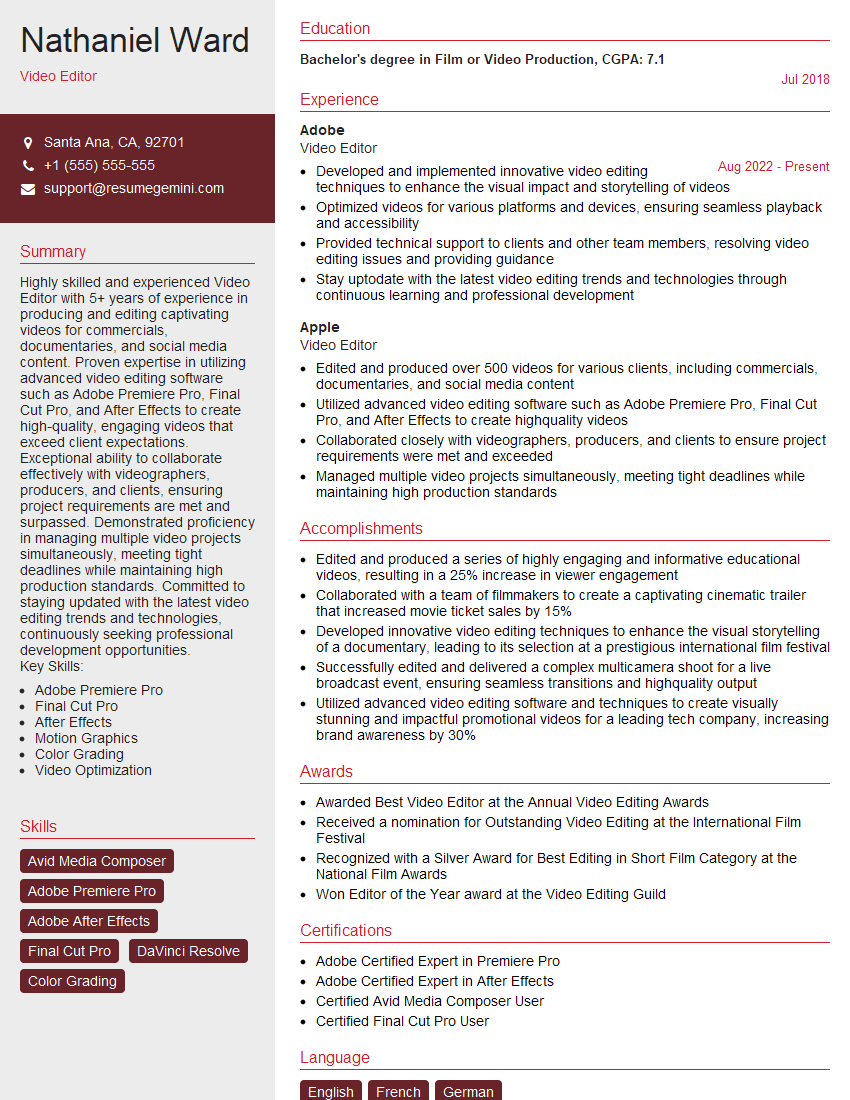
Mastering video editing skills significantly enhances your career prospects in film, television, advertising, and digital media. A strong portfolio is essential, but an ATS-friendly resume is your first impression. To maximize your job search success, create a resume that effectively highlights your skills and experience. ResumeGemini is a trusted resource to help you build a professional and impactful resume. We provide examples of resumes tailored to video editing professionals, giving you a head start in crafting your perfect application.
Explore more articles
Users Rating of Our Blogs
Share Your Experience
We value your feedback! Please rate our content and share your thoughts (optional).
What Readers Say About Our Blog
Very informative content, great job.
good