Feeling uncertain about what to expect in your upcoming interview? We’ve got you covered! This blog highlights the most important Experience with art direction interview questions and provides actionable advice to help you stand out as the ideal candidate. Let’s pave the way for your success.
Questions Asked in Experience with art direction Interview
Q 1. Describe your process for developing a visual brand identity.
Developing a visual brand identity is a meticulous process that goes beyond simply creating a logo. It’s about crafting a holistic visual language that encapsulates a brand’s personality, values, and aspirations. My process typically involves these key steps:
- Discovery and Research: I begin by deeply understanding the client’s business, target audience, competitors, and market positioning. This involves thorough market research, competitor analysis, and client interviews to gather crucial insights. For example, I’d ask questions like: What is your unique selling proposition? Who is your ideal customer? What feeling do you want your brand to evoke?
- Mood Board Creation: Based on the research, I create a mood board, a visual collage of images, colors, textures, and typography that encapsulates the desired brand aesthetic. This serves as a visual guide throughout the design process. This might include images representing a feeling of luxury, or a youthful energy, depending on the brand.
- Logo Design and Branding Elements: I then design the logo, keeping in mind its versatility across different platforms and sizes. I also develop other key branding elements like color palettes, typography choices, and iconography, ensuring consistency and cohesiveness.
- Style Guide Creation: Finally, I compile a comprehensive brand style guide that serves as a definitive reference for maintaining brand consistency across all touchpoints, including website, social media, print materials, and merchandise. This document details everything from logo usage to color codes and typography specifications.
For instance, in a recent project for a sustainable coffee company, the research phase revealed a focus on ethically sourced beans and environmental consciousness. This directly influenced the mood board, which incorporated natural earthy tones, recycled textures, and imagery representing nature. The final brand identity reflected these values, creating a strong visual connection with the target audience.
Q 2. How do you manage multiple projects with competing deadlines?
Managing multiple projects with competing deadlines requires a structured and organized approach. My strategy combines effective time management techniques with efficient project prioritization. It’s like conducting an orchestra – each instrument (project) needs to be played at the right time and volume.
- Prioritization and Planning: I start by prioritizing projects based on urgency and importance, using tools like a Kanban board or a project management software. This allows me to focus my energy on the most critical tasks first.
- Time Blocking: I allocate specific time blocks for each project, ensuring sufficient time for each task. I use time-tracking tools to monitor my progress and make adjustments as needed.
- Delegation and Collaboration: When possible, I delegate tasks to team members, ensuring clear communication and collaboration. This lightens my workload and accelerates the overall project timeline.
- Regular Check-ins and Communication: Consistent communication with clients and team members is crucial. Regular check-ins help identify potential roadblocks and prevent delays.
For example, I might use a project management software like Asana to track progress on several projects simultaneously, creating separate sections for each client and assigning deadlines to individual tasks. This keeps everything organized and allows me to easily monitor progress.
Q 3. Explain your experience with client presentations and feedback incorporation.
Client presentations and feedback incorporation are vital aspects of the design process. I approach presentations as a collaborative dialogue, not a monologue. It’s about building a shared vision.
- Preparation and Structure: I prepare detailed presentations that clearly articulate the design rationale, showcasing the creative process and justifying design choices. I use visuals and data to support my points.
- Active Listening and Engagement: During the presentation, I actively listen to client feedback, asking clarifying questions to fully understand their concerns and suggestions. The client’s perspective is paramount.
- Iterative Design Process: I view feedback as an opportunity for improvement. I incorporate constructive criticism into the design process, creating revised versions based on client input. This is an iterative process, where we collaborate to refine the final product.
- Documentation and Follow-up: After each presentation, I document all agreed-upon changes and follow up promptly to address any remaining questions or concerns. Clear communication is key throughout this process.
In one project, a client initially expressed concerns about the color palette. Through active listening, I understood their concerns stemmed from a misunderstanding of the intended brand perception. By carefully explaining my rationale and presenting alternative options, we arrived at a color scheme that satisfied both their needs and the overall design strategy.
Q 4. How do you stay current with design trends and technologies?
Staying current in the ever-evolving world of design requires consistent effort and a proactive approach. It’s a lifelong learning process.
- Following Design Publications and Blogs: I regularly follow influential design publications, blogs, and online communities to stay informed about emerging trends and best practices. This keeps me updated on what’s happening in the industry.
- Attending Industry Events and Workshops: Participating in conferences, workshops, and seminars provides valuable opportunities to learn from industry leaders, network with peers, and discover new technologies.
- Experimentation and Exploration: I constantly experiment with new software, tools, and design techniques. This hands-on approach helps me build familiarity and mastery of the latest technologies.
- Following Key Influencers and Designers: Observing the work of leading designers and following them on social media provides inspiration and exposes me to diverse perspectives and creative approaches.
For instance, I might explore a new animation software to enhance my motion graphics skills or delve into the latest trends in web design by reviewing popular websites and case studies.
Q 5. What software and tools are you proficient in?
I am proficient in a wide range of software and tools, including:
- Adobe Creative Suite: Photoshop, Illustrator, InDesign, After Effects, Premiere Pro
- Figma and Sketch: For UI/UX design and prototyping
- 3D modeling software (Blender, Cinema 4D): For creating 3D assets and animations
- Project Management Software: Asana, Trello
- Prototyping tools: InVision, Adobe XD
My proficiency extends beyond the software itself; I understand how to leverage these tools effectively to solve design challenges and achieve optimal results. It’s about mastering the tools, not just knowing how to use them.
Q 6. Describe your experience with typography and layout.
Typography and layout are fundamental to effective visual communication. They are the building blocks of readability and visual hierarchy. A well-chosen typeface and a thoughtfully planned layout can significantly enhance the overall impact of a design.
- Type Selection and Pairing: I possess a keen understanding of typography, including font families, weights, and styles. I know how to select and pair typefaces effectively to create visual harmony and convey the desired message. The choice of font heavily impacts the brand’s personality; a serif font might suggest tradition, while a sans-serif font might convey modernity.
- Layout Principles: I apply established layout principles such as the rule of thirds, visual weight distribution, and white space utilization to create balanced and visually appealing designs. White space, often underestimated, is crucial for readability and visual breathing room.
- Hierarchy and Readability: I carefully consider the visual hierarchy of information, using typography and layout to guide the viewer’s eye and ensure clear communication. This ensures important information is easily accessible.
For example, in designing a brochure, I might use a bold headline in a prominent typeface to grab attention, followed by body text in a more readable and legible font. The layout itself would guide the reader through the information in a logical and visually pleasing manner.
Q 7. How do you ensure brand consistency across different mediums?
Maintaining brand consistency across various mediums is crucial for building a strong brand identity. Inconsistent branding leads to confusion and dilutes the brand message.
- Comprehensive Style Guide: A detailed brand style guide is the cornerstone of brand consistency. This document serves as a central reference for all design elements, ensuring uniformity across all platforms.
- Asset Management System: I use cloud-based asset management systems to centralize and organize brand assets, making it easy for all team members and stakeholders to access the correct and updated versions of logos, color palettes, and other branding elements.
- Template Creation: I create design templates for various mediums, such as social media posts, email newsletters, and marketing materials. These templates ensure consistency in design elements and branding across different applications.
- Regular Audits: Periodic audits of brand applications help identify inconsistencies and ensure the brand guidelines are followed consistently across different mediums and over time.
For instance, if a brand uses a specific shade of blue in its logo, that same shade should be consistently used across its website, marketing materials, and social media profiles. A consistent brand identity strengthens the recognition and association with the brand.
Q 8. Describe your approach to art direction in digital vs. print media.
My approach to art direction differs significantly between digital and print media, primarily due to the inherent characteristics of each platform. In print, I focus on the tactile experience, the quality of the paper stock, and the permanence of the design. The process often involves careful consideration of color profiles, bleed areas, and the limitations of the printing press. I’ll meticulously plan for CMYK color spaces and ensure the design translates effectively from screen to physical form. Think of creating a luxury magazine – the weight of the paper, the subtle embossing, and the overall feel are crucial elements of the art direction.
Digital art direction, however, is more dynamic and interactive. I concentrate on user experience (UX) and the responsiveness of the design across multiple devices and screen sizes. Considerations include optimizing images for web performance, ensuring accessibility for users with disabilities, and creating designs that seamlessly adapt to different resolutions. A website, for instance, demands a flexible approach; it might need to look equally appealing on a desktop, tablet, and smartphone. I utilize responsive design principles and leverage the fluidity of digital media to create engaging and immersive experiences.
Q 9. How do you handle creative disagreements with team members?
Creative disagreements are inevitable, but they can also lead to innovative solutions. My approach centers around respectful communication and collaborative problem-solving. I always begin by actively listening to everyone’s perspectives, ensuring each team member feels heard and valued. I encourage open dialogue, focusing on the why behind design choices rather than simply stating preferences. We use visual aids – mood boards, sketches, and prototypes – to clarify our vision and identify areas of agreement and disagreement.
If a compromise is needed, I employ a structured approach. We might use a weighted prioritization system, where we score design elements based on importance and feasibility. This ensures that the final design incorporates the most crucial aspects of everyone’s input. The goal is never to win an argument but to arrive at a design that reflects the best possible outcome for the project.
Q 10. Give an example of a time you had to compromise on a creative vision.
During a recent branding project for a sustainable coffee company, my initial vision involved a highly stylized, minimalist logo incorporating intricate line work. However, the client, concerned about potential printing costs and readability across different applications (packaging, website, social media), expressed reservations. This wasn’t a matter of simply adjusting the font size; it impacted the overall aesthetic.
Rather than rigidly sticking to my initial concept, I collaborated with the client and the design team, exploring alternative approaches. We retained some of the key elements of my original idea – clean lines and earthy tones – but simplified the logo to ensure better legibility and cost-effectiveness in printing. The outcome was a logo that effectively conveyed the brand’s message while remaining financially viable for the client. It was a valuable lesson in balancing artistic vision with practical considerations.
Q 11. Explain your experience with budget management and resource allocation.
I have extensive experience managing budgets and allocating resources across various projects. My approach is proactive and data-driven. I start by carefully reviewing the project brief, identifying all potential costs (design software subscriptions, stock photography, printing costs, talent fees, etc.). This involves creating detailed budget spreadsheets and tracking expenses throughout the project lifecycle.
Resource allocation is also meticulously planned. I prioritize tasks based on their urgency and impact, ensuring that the most critical elements receive adequate time and attention. I involve the team in the budgeting process, fostering transparency and shared accountability. We regularly review the budget and make adjustments as needed, always striving for optimal efficiency without compromising on the quality of the final product.
Q 12. How do you measure the success of a design project?
Measuring the success of a design project extends beyond just aesthetic appeal. I employ a multi-faceted approach, incorporating quantitative and qualitative data. Key performance indicators (KPIs) vary depending on the project type. For a website, this might involve tracking website traffic, bounce rate, conversion rates, and user engagement metrics. For a print campaign, it could be measuring brand awareness, sales figures, or customer feedback.
Qualitative data is equally important. I conduct user surveys, focus groups, and A/B testing to gather feedback on user experience and satisfaction. This holistic approach allows for a comprehensive understanding of the project’s impact, identifying areas of strength and areas that need improvement for future projects. This feedback loop is vital for continuous improvement.
Q 13. Describe your experience with user experience (UX) principles and their impact on design.
User experience (UX) principles are foundational to my design process. I firmly believe that a well-designed product should be both aesthetically pleasing and user-friendly. I integrate UX considerations at every stage of the project, from initial concept development to final execution. This includes understanding user personas, conducting user research, and creating user flows to ensure a seamless and intuitive user journey.
For example, when designing a mobile application, I’ll meticulously plan the information architecture, ensuring that navigation is clear and easy to follow. I’ll also pay close attention to micro-interactions, making sure that elements such as buttons and animations provide clear visual feedback to users. Ignoring UX principles can lead to frustration and a negative user experience, directly impacting the project’s overall success. A visually stunning app that’s difficult to navigate is ultimately a failure.
Q 14. How do you integrate user feedback into the design process?
User feedback is invaluable for refining the design process. I integrate it in several ways. Firstly, I conduct user testing throughout the project lifecycle – from early prototypes to the final product. This feedback can be gathered through various methods, including usability testing sessions, surveys, and online feedback forms. Secondly, I actively monitor user engagement with the final product using analytics tools. This data informs ongoing improvements and iterations.
When integrating user feedback, I focus on identifying patterns and trends rather than getting bogged down in individual opinions. I prioritize feedback that addresses usability issues, accessibility concerns, or areas where the design falls short of expectations. This data-driven approach allows for objective assessment and informed decision-making, ensuring the design continues to evolve and meet user needs.
Q 15. What is your preferred design workflow?
My preferred design workflow is iterative and collaborative, emphasizing clear communication and frequent feedback loops. It typically follows these stages:
- Briefing & Research: Thoroughly understanding the project goals, target audience, and brand guidelines is paramount. This involves client meetings, competitor analysis, and market research.
- Mood Boarding & Concepting: I create mood boards to visually define the project’s direction, exploring different styles and aesthetics. This often involves sketching and brainstorming sessions.
- Wireframing & Prototyping: I create low-fidelity wireframes to map out the user flow and functionality before diving into visual design. This allows for early testing and feedback.
- Visual Design & Mockups: This stage involves creating high-fidelity mockups, incorporating typography, color palettes, and imagery, based on the approved wireframes.
- Testing & Iteration: I conduct user testing, A/B testing (as needed), and incorporate feedback to refine the design. This is an ongoing process throughout the project.
- Handoff & Implementation: Once the design is finalized, I prepare all assets for developers, providing detailed specifications and guidelines.
This workflow is flexible and adapts to the specific needs of each project, but the core principles of collaboration, iteration, and user-centricity remain consistent.
Career Expert Tips:
- Ace those interviews! Prepare effectively by reviewing the Top 50 Most Common Interview Questions on ResumeGemini.
- Navigate your job search with confidence! Explore a wide range of Career Tips on ResumeGemini. Learn about common challenges and recommendations to overcome them.
- Craft the perfect resume! Master the Art of Resume Writing with ResumeGemini’s guide. Showcase your unique qualifications and achievements effectively.
- Don’t miss out on holiday savings! Build your dream resume with ResumeGemini’s ATS optimized templates.
Q 16. How do you maintain a consistent brand voice across all design elements?
Maintaining a consistent brand voice across all design elements is crucial for building a strong brand identity. I achieve this through meticulous attention to detail and the use of style guides.
- Comprehensive Style Guides: I develop or work with existing style guides that clearly define the brand’s personality, typography, color palettes, imagery style, and tone of voice. This serves as the single source of truth for all design decisions.
- Consistent Typography: Using a consistent font family and hierarchy across all platforms ensures visual unity and readability.
- Color Palette Adherence: Strict adherence to the defined color palette prevents visual inconsistencies and maintains brand recognition.
- Imagery Guidelines: Establishing guidelines for image style, ensuring consistency in tone, quality, and subject matter, is vital.
- Regular Review & Updates: The style guide should be regularly reviewed and updated to reflect changes in branding or design trends. This ensures ongoing consistency.
Think of it like a well-rehearsed orchestra – each instrument (design element) plays its part perfectly, creating a harmonious whole (consistent brand identity). Without a conductor (style guide), the performance (brand experience) becomes chaotic.
Q 17. Explain your understanding of color theory and its application in design.
Color theory is the foundation of effective visual communication. Understanding how colors interact—in terms of hue, saturation, value, and temperature—is crucial for creating visually appealing and impactful designs.
- Hue: This refers to the pure color itself (e.g., red, blue, green).
- Saturation: This refers to the intensity or purity of the color. A highly saturated color is vibrant, while a desaturated color is muted.
- Value: This refers to the lightness or darkness of a color.
- Temperature: Colors can be categorized as warm (reds, oranges, yellows) or cool (blues, greens, purples). These temperature differences can create a variety of moods and effects.
In design, I apply color theory to create visual hierarchies, evoke specific emotions, and ensure brand consistency. For example, using a warm color palette might create a welcoming feeling for a food brand, while a cool palette could project professionalism for a financial institution. Understanding color harmony (analogous, complementary, triadic) helps create visually pleasing combinations, while contrast is used to draw attention to key elements.
I frequently utilize color tools like Adobe Color to explore and generate harmonious palettes, ensuring my design choices are informed and effective.
Q 18. Describe your experience with A/B testing and design iteration.
A/B testing and design iteration are integral parts of my process. A/B testing allows us to compare different design versions to determine which performs better based on measurable metrics, such as click-through rates or conversion rates.
My experience with A/B testing involves:
- Defining Key Metrics: Clearly identifying the metrics that will determine success (e.g., click-through rate on a call-to-action button).
- Creating Variations: Developing different versions of a design element (e.g., different button colors or copy).
- Implementing the Test: Using A/B testing tools to distribute the variations to users and collect data.
- Analyzing Results: Carefully analyzing the data to determine which version performed better and why.
- Iterating Based on Data: Using the insights gained to improve the design. This is an iterative process, often requiring multiple rounds of testing and refinement.
For example, I recently A/B tested two different versions of a landing page. One version featured a prominent call-to-action button in red, while the other used a blue button. The A/B test showed a significantly higher click-through rate for the red button, leading us to finalize the design with the red button.
Q 19. How do you delegate tasks effectively within a design team?
Effective delegation within a design team requires clear communication, trust, and a well-defined project structure. I approach delegation by:
- Assessing Team Member Skills: Understanding each designer’s strengths and weaknesses to assign tasks accordingly.
- Providing Clear Instructions: Giving specific instructions, outlining deadlines, and setting clear expectations for each task.
- Establishing Communication Channels: Creating clear communication channels (e.g., project management software) to facilitate collaboration and feedback.
- Empowering Team Members: Allowing team members to take ownership of their work and make decisions within their assigned areas.
- Regular Check-ins: Conducting regular check-ins to monitor progress, provide support, and address any roadblocks.
Delegation is not about simply assigning tasks; it’s about fostering growth and leveraging the team’s collective expertise to achieve a shared goal. I aim to create an environment where each designer feels valued and empowered to contribute their unique skills.
Q 20. How do you provide constructive feedback to designers?
Providing constructive feedback is crucial for fostering growth and improvement within a design team. My approach centers on being specific, positive, and solution-oriented.
- Focus on Specifics: Instead of general statements like “this isn’t working,” I focus on providing concrete examples and suggesting specific improvements. For instance, “The spacing between these elements feels cramped. Consider increasing the padding to improve readability.”
- Sandwich Feedback: I often use the “sandwich” technique: start with positive feedback, then offer constructive criticism, and finish with another positive note. This softens the criticism and makes it easier to receive.
- Focus on the Work, Not the Person: Feedback should always be about the design itself, not the designer’s abilities or personality.
- Ask Questions: Instead of dictating solutions, I often ask questions to encourage critical thinking and problem-solving. For example, “What were you thinking when you made this design choice? How might we explore alternative approaches?”
- Offer Support: I ensure the feedback is delivered in a supportive and encouraging manner, providing resources or assistance where needed.
Constructive feedback is about helping designers learn and improve. It’s a collaborative process focused on achieving the best possible outcome.
Q 21. Describe your experience with managing external vendors or freelancers.
Managing external vendors and freelancers requires careful planning and strong communication. My approach involves:
- Clear Contracts: Establishing clear contracts that outline the scope of work, deliverables, timelines, payment terms, and intellectual property rights.
- Detailed Briefings: Providing comprehensive project briefs to ensure vendors fully understand the project’s goals, requirements, and brand guidelines.
- Regular Communication: Maintaining consistent communication throughout the project using tools such as email, project management software, and video conferencing.
- Quality Control: Implementing rigorous quality control processes to ensure the work meets the required standards. This might involve regular reviews and feedback sessions.
- Payment Processing: Establishing a clear and transparent payment process to ensure timely and accurate payments.
Effective management of external vendors requires building strong working relationships based on trust and mutual respect. Clear communication and proactive problem-solving are key to successful collaborations.
Q 22. How do you approach designing for accessibility and inclusivity?
Accessibility and inclusivity are paramount in my design process. It’s not just about adhering to guidelines; it’s about creating genuinely empathetic experiences for everyone. My approach involves a multi-faceted strategy:
- Understanding User Needs: I begin by researching and understanding the diverse needs of my target audience, considering visual, auditory, motor, and cognitive impairments. This often involves consulting accessibility guidelines like WCAG (Web Content Accessibility Guidelines) and conducting user research with individuals from diverse backgrounds.
- Color Contrast and Typography: I meticulously check color contrast ratios using tools like WebAIM’s Contrast Checker to ensure sufficient readability for users with low vision. I also choose fonts that are highly legible and provide sufficient spacing between lines and characters.
- Alternative Text and Captions: For images and videos, I always provide detailed alternative text descriptions for screen readers, and ensure videos have accurate captions and transcripts for the deaf and hard of hearing.
- Keyboard Navigation: I design interfaces that are fully navigable using only a keyboard, ensuring that all interactive elements are accessible without a mouse.
- Cognitive Accessibility: I simplify complex information, use clear and concise language, and structure content logically to improve comprehension for users with cognitive impairments. This includes using consistent labeling, clear visual hierarchy, and avoiding unnecessary animations or flashing elements.
For example, in a recent project designing a website for a museum, I worked closely with accessibility experts to ensure the website was usable by people with various disabilities. This included creating audio descriptions for exhibits, ensuring proper color contrast for all text and images, and implementing keyboard navigation for all interactive elements.
Q 23. Explain your experience with motion graphics and animation in design.
Motion graphics and animation are powerful tools for enhancing user engagement and communicating complex information effectively. My experience spans various software like After Effects, Cinema 4D, and even simpler tools like Lottie for web animation. I leverage animation to:
- Guide User Attention: Subtle micro-interactions can subtly guide users through a website or app, ensuring they don’t miss important information or calls to action. For example, a slight bounce animation on a button can make it more noticeable.
- Explain Complex Processes: Animated explainer videos are excellent for visually representing complex concepts or processes. For instance, I’ve created animations explaining intricate financial products, making them easier for the average user to understand.
- Enhance Brand Identity: Motion graphics are a powerful way to reinforce a brand’s personality and visual identity. I can use animation to create memorable and engaging brand experiences, such as animated logos or short promotional videos.
- Create Immersive Experiences: In projects involving VR or AR, animation plays a crucial role in creating seamless and believable virtual environments.
In one project, I used After Effects to create a series of short animated explainer videos for a SaaS company. The videos effectively conveyed the value proposition of the software and significantly improved user engagement.
Q 24. Describe your approach to visual storytelling.
Visual storytelling is the art of using images and design to communicate a narrative. My approach centers around understanding the core message and crafting a visual journey that resonates with the audience. It involves:
- Defining the Narrative Arc: Before I start designing, I meticulously map out the story’s beginning, middle, and end. What is the central theme? What are the key moments? What feeling should the audience walk away with?
- Choosing the Right Visual Language: This includes selecting appropriate colors, typography, imagery, and composition to effectively convey the tone and mood of the story. For example, a vibrant color palette might evoke joy, while muted tones could express seriousness or nostalgia.
- Crafting a Compelling Visual Hierarchy: I carefully arrange visual elements to guide the viewer’s eye and control the flow of the narrative. The most important elements should be most prominent, drawing attention where needed.
- Utilizing Various Visual Techniques: This might involve using metaphors, symbolism, or other techniques to enhance the storytelling and evoke deeper emotional responses.
For example, when designing a brochure for a non-profit organization, I carefully selected imagery and typography to reflect the organization’s mission and values, creating a visually compelling narrative that moved the audience to action.
Q 25. How familiar are you with different printing techniques and their limitations?
I have extensive familiarity with various printing techniques and their limitations. My experience covers offset printing, digital printing, screen printing, and large-format printing. Understanding these techniques is crucial for ensuring the final product meets the client’s expectations and is within budget:
- Offset Printing: Ideal for large print runs, offering high quality and consistency but with higher upfront costs. I’m aware of its limitations regarding short runs and quick turnaround times.
- Digital Printing: Suitable for shorter runs and faster turnaround, offering flexibility in design but often with lower quality and less vibrant colors compared to offset printing. I consider its limitations with very large-scale projects.
- Screen Printing: A versatile method for textiles and promotional materials, known for its durability and vibrant colors. I understand its limitations with detailed imagery and complex designs.
- Large-Format Printing: Used for banners, posters, and billboards, it requires careful consideration of resolution and material choice. I am familiar with its limitations concerning fine details and close-up viewing.
In a recent project involving the design and printing of a high-end product catalog, I opted for offset printing to ensure high-quality image reproduction and a professional finish. However, for a smaller promotional campaign, digital printing was a more cost-effective and timely solution.
Q 26. How do you manage expectations with clients who have unrealistic deadlines or budgets?
Managing client expectations, especially concerning unrealistic deadlines or budgets, requires proactive communication and skillful negotiation. My approach involves:
- Setting Clear Expectations Early On: I begin by providing a realistic project timeline and budget estimate based on the project’s scope and complexity. I clearly explain the factors influencing these estimations.
- Prioritizing and Scoping: If the deadline or budget is unrealistic, I work with the client to prioritize features and scope down the project to achieve a deliverable within the constraints. We discuss potential trade-offs and prioritize essential elements.
- Transparent Communication: Throughout the project, I maintain open and transparent communication, updating the client regularly on progress and any potential challenges. This helps prevent misunderstandings and allows for timely adjustments.
- Offering Alternatives: I might suggest alternative solutions, such as using different printing methods or simplifying the design to meet the budget. I present various options with their respective pros and cons.
- Documentation and Agreements: A well-defined project brief and contract that clearly outlines the scope, timeline, and budget helps manage expectations and minimizes disputes.
In one instance, a client had an extremely tight deadline. By working collaboratively, we prioritized core features, and through focused execution, we successfully delivered a high-quality minimum viable product (MVP) meeting the client’s core needs.
Q 27. Describe your experience with design systems and their implementation.
Design systems are crucial for creating consistent and scalable design across multiple platforms and products. My experience includes designing, implementing, and maintaining design systems using tools like Figma, Sketch, and Abstract.
- Component-Based Design: I build design systems around reusable components, such as buttons, icons, and text styles, ensuring consistency and reducing design redundancy. This makes future design updates much smoother and more efficient.
- Style Guides and Documentation: I create comprehensive style guides that document design specifications, including color palettes, typography, spacing, and component usage guidelines. This aids collaboration and maintains consistency across the design team.
- Version Control: I use version control systems like Abstract to manage design assets and track changes effectively. This makes collaborating on large design systems much easier and prevents conflicts.
- Collaboration and Training: Successful design system implementation requires collaboration across teams. I conduct training sessions to ensure that developers and designers understand how to utilize the system effectively.
In a previous role, I was instrumental in building a design system for a large e-commerce platform. The system streamlined the design process, reduced development time, and ensured a consistent brand experience across all platforms.
Q 28. What are your salary expectations?
My salary expectations are commensurate with my experience and skills, and are also dependent on the specifics of the role, including responsibilities, company size, benefits, and location. I am open to discussing a competitive compensation package that fairly reflects my contributions to the team.
Key Topics to Learn for Experience with Art Direction Interview
- Visual Communication & Storytelling: Understanding how to translate concepts into compelling visuals and communicate a clear narrative through design.
- Branding & Identity Systems: Developing and maintaining consistent brand identities across various platforms and mediums; demonstrating knowledge of logo design, typography, and color palettes.
- Design Principles & Theories: Applying principles like Gestalt, visual hierarchy, and balance to create effective and aesthetically pleasing designs. Understanding the impact of different design styles.
- Collaboration & Client Communication: Discussing experiences working with designers, developers, and clients; highlighting effective communication strategies and negotiation skills.
- Project Management & Workflow: Demonstrating experience in managing projects, meeting deadlines, and working efficiently within design software and project management tools.
- Art Direction in Different Media: Showcasing experience across various platforms, such as print, digital, video, or animation, and adapting design approaches accordingly.
- Art Direction Software Proficiency: Highlighting familiarity with industry-standard software (e.g., Adobe Creative Suite) and your technical skills.
- Problem-Solving & Creative Thinking: Providing examples of overcoming design challenges, thinking outside the box, and presenting innovative solutions.
- Trend Awareness & Industry Knowledge: Demonstrating knowledge of current design trends and the overall landscape of the art direction field.
- Portfolio & Presentation Skills: Articulating your design choices and the thought process behind your work effectively during the interview.
Next Steps
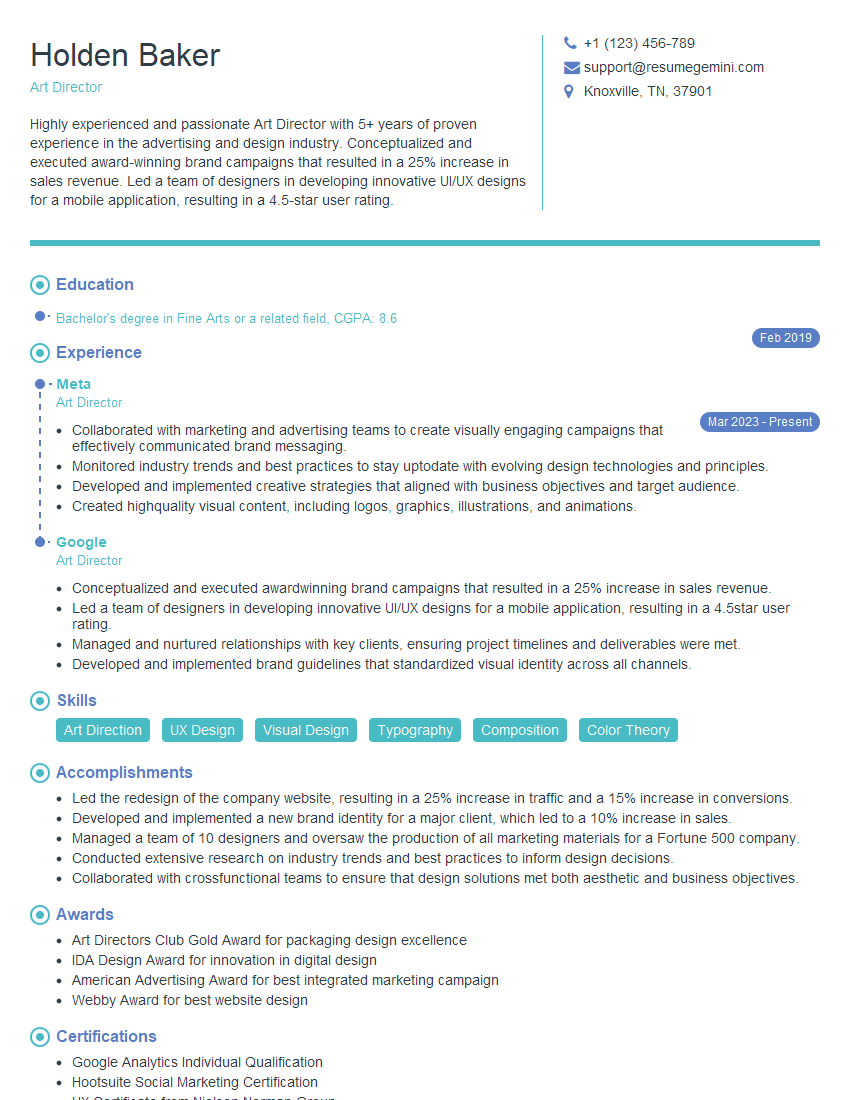
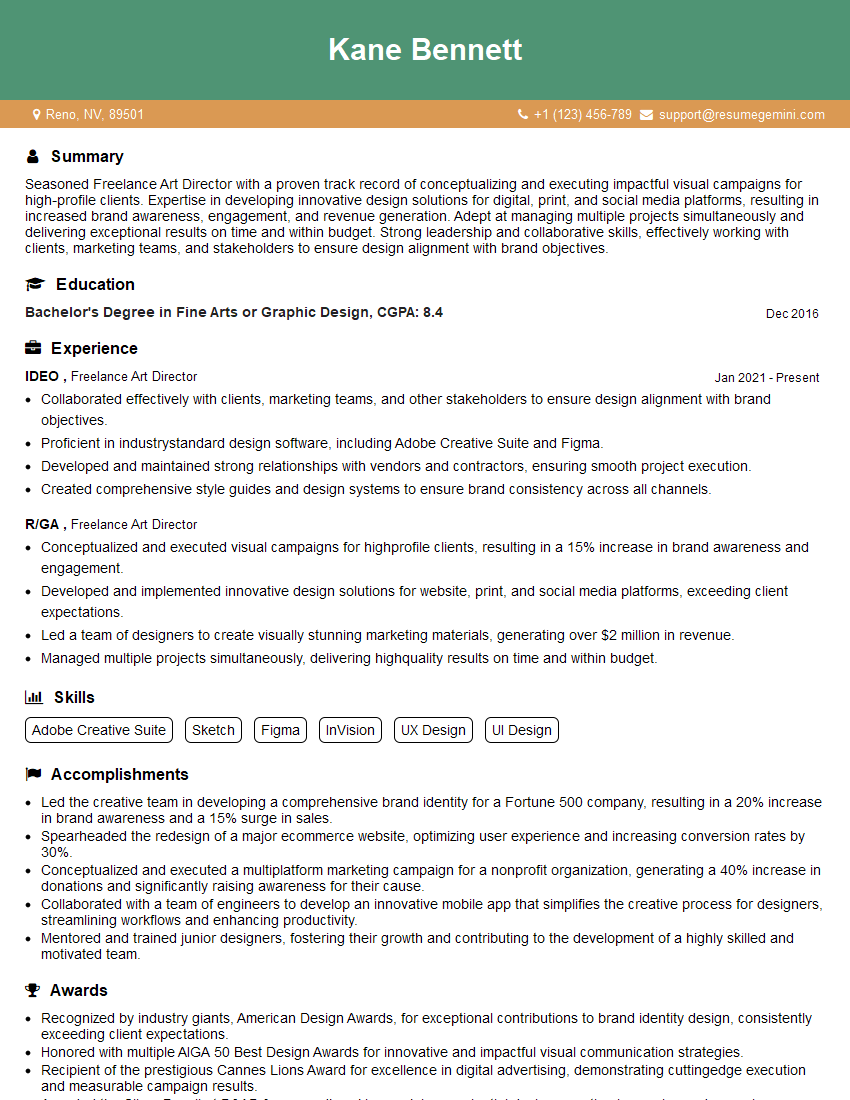
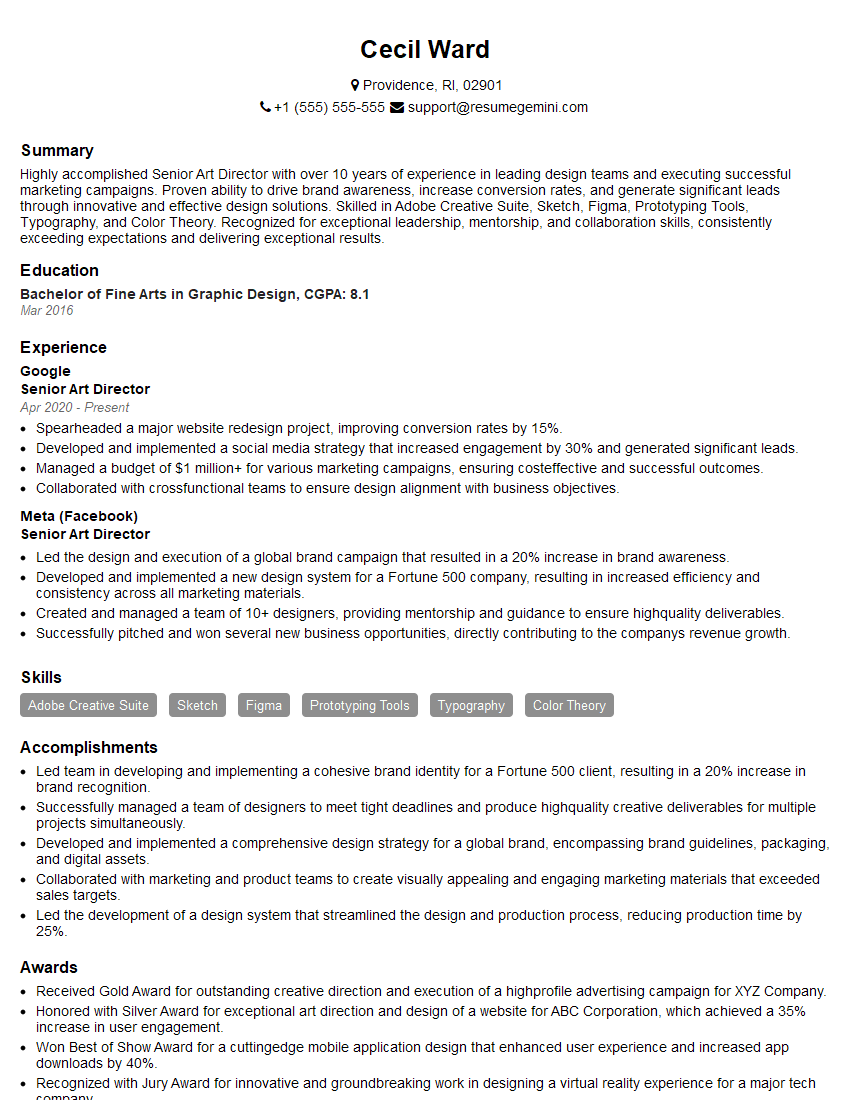
Mastering art direction opens doors to exciting and rewarding career opportunities, allowing you to shape brand identities and influence visual communication on a larger scale. To maximize your job prospects, focus on creating a strong, ATS-friendly resume that showcases your skills and experience effectively. ResumeGemini is a trusted resource to help you build a professional and impactful resume. We offer examples of resumes tailored to art direction roles to guide you through the process. Invest time in crafting a compelling resume – it’s your first impression on potential employers.

Explore more articles
Users Rating of Our Blogs
Share Your Experience
We value your feedback! Please rate our content and share your thoughts (optional).
What Readers Say About Our Blog
Very informative content, great job.
good