Cracking a skill-specific interview, like one for Galvanostatic Pulse Technique, requires understanding the nuances of the role. In this blog, we present the questions you’re most likely to encounter, along with insights into how to answer them effectively. Let’s ensure you’re ready to make a strong impression.
Questions Asked in Galvanostatic Pulse Technique Interview
Q 1. Explain the principle behind the Galvanostatic Pulse Technique (GPT).
The Galvanostatic Pulse Technique (GPT) is an electrochemical method used to study the kinetics of electrode reactions. It works by applying a short, constant current pulse (galvanostatic) to an electrode and monitoring the resulting potential change as a function of time. The principle relies on the fact that the applied current drives a Faradaic process (electron transfer) at the electrode surface, causing a change in the electrode potential. The rate of this change is directly related to the kinetics of the electrochemical reaction and the properties of the electrode-electrolyte interface.
Imagine it like this: You’re filling a bucket (the electrode) with water (electrons) at a constant rate (the current). How quickly the water level (potential) rises depends on how quickly the water can drain out through holes at the bottom (the electrochemical reaction rate). By measuring the rise in water level, you can infer how big these holes are – effectively characterizing the reaction kinetics.
Q 2. What are the advantages of GPT compared to other electrochemical techniques?
GPT offers several advantages over other electrochemical techniques. Compared to potentiostatic techniques (like chronoamperometry), GPT is less susceptible to problems associated with double-layer charging because the current is controlled, and the double layer is quickly charged. This allows for a more accurate determination of the faradaic current and reaction kinetics. Furthermore, GPT is particularly well-suited for studying fast electrode processes due to the short duration of the current pulses. It can provide information about the various rate-determining steps in complex reactions, revealing insights unavailable with steady-state methods. Finally, it is experimentally simpler to implement than some other techniques like EIS (Electrochemical Impedance Spectroscopy).
Q 3. What are the limitations of GPT?
While GPT is a powerful technique, it does have limitations. The short pulse duration requires high-speed data acquisition systems and precise timing control. It might be less sensitive for slower electrode reactions where the potential changes are minimal within the short pulse time. Analysis of the data can also be complex, particularly for systems with multiple electrochemical processes occurring simultaneously. Furthermore, the accuracy of the measurement is strongly dependent on the precision of the current source and the quality of the reference electrode. Finally, if the current pulses are too large, it can lead to non-linear behavior, making data interpretation more challenging.
Q 4. Describe the instrumentation required for GPT measurements.
A typical GPT setup requires several key components:
- Potentiostat/Galvanostat: This is the heart of the system, delivering the precisely controlled current pulses and measuring the resulting potential changes.
- Electrochemical Cell: Contains the working electrode, counter electrode, and reference electrode, immersed in the electrolyte solution.
- Working Electrode: The electrode of interest where the electrochemical reaction takes place.
- Counter Electrode: Completes the electrical circuit and provides the electrons.
- Reference Electrode: Provides a stable potential reference against which the potential of the working electrode is measured.
- Data Acquisition System: A high-speed data acquisition system is needed to capture the rapid potential changes during the short pulses. This often includes a digital oscilloscope and associated software.
High-speed data acquisition is crucial, as the potential changes are often very rapid, and proper software is needed for data analysis.
Q 5. How do you prepare an electrode for GPT measurements?
Electrode preparation is critical for obtaining reliable GPT data. The procedure depends on the electrode material and the specific application. Generally, it involves the following steps:
- Cleaning: This is crucial to remove any contaminants or oxides from the electrode surface. Methods include polishing with progressively finer abrasives, ultrasonic cleaning, and chemical etching.
- Surface Finishing: This step may involve mechanical polishing to achieve a specific surface roughness or electrochemical treatments to create a well-defined surface.
- Pretreatment: Sometimes, a pre-treatment step is necessary to activate the electrode surface, such as cycling the potential in the electrolyte or applying a specific surface treatment.
- Electrolyte Preparation: The electrolyte should be carefully prepared and degassed to remove dissolved oxygen, which can interfere with the electrochemical measurements.
The specific cleaning and pretreatment protocols are carefully chosen based on the nature of the electrode material and the experiment design.
Q 6. Explain the concept of overpotential in GPT.
Overpotential in GPT refers to the difference between the actual electrode potential and the equilibrium potential under the given conditions. In simpler terms, it’s the extra potential needed to drive the electrochemical reaction at the applied current. This extra potential is needed to overcome various resistances, including the charge transfer resistance (related to the rate of electron transfer at the electrode/electrolyte interface), the ohmic resistance (due to the electrolyte solution), and the concentration overpotential (due to changes in the concentration of reactants and products at the electrode surface).
Think of it as the extra force you need to push water through a pipe (the electrode). The smaller the pipe (lower reaction rate), the more force (overpotential) is needed.
Q 7. How do you determine the charge transfer resistance from GPT data?
The charge transfer resistance (Rct) is a crucial parameter reflecting the kinetics of the electrochemical reaction. In GPT, it can be determined by analyzing the initial part of the potential-time transient after the current pulse is applied. One common method is to use a simple equivalent circuit model, which often includes a resistor (Rct) in series with a capacitor representing the double-layer capacitance (Cdl).
Several methods exist for extracting Rct from the data. One frequently used approach involves fitting the initial part of the potential-time transient using an appropriate mathematical model, such as the Cottrell equation or a more complex model accounting for other factors. Another approach involves using the initial slope of the potential-time curve which, in simplified cases, is inversely proportional to RctCdl. Software packages dedicated to electrochemical data analysis are often employed for this purpose, using techniques such as non-linear curve fitting.
Determining the Rct precisely necessitates careful experimental setup and accurate data analysis to account for other factors such as ohmic drop. Sometimes, techniques like potential-step measurements followed by impedance spectroscopy can be used in conjunction with GPT to improve the accuracy of Rct determination.
Q 8. How do you determine the double-layer capacitance from GPT data?
Determining double-layer capacitance (Cdl) from Galvanostatic Pulse Technique (GPT) data involves analyzing the potential response of the electrode to a constant current pulse. The double layer acts like a capacitor, charging up when a current is applied. We exploit this capacitive charging behavior to extract Cdl.
The key is to observe the potential (voltage) change (ΔE) during the pulse. A simple way to calculate Cdl is by using the following equation:
Cdl = I*t / ΔEwhere:
Iis the applied current (Amps)tis the pulse duration (seconds)ΔEis the potential change (Volts)
However, this equation assumes an ideal capacitor and ignores other factors like Faradaic reactions and solution resistance. More sophisticated methods like analyzing the potential-time curve with equivalent circuit models (using software like ZView or EIS Spectrum Analyzer) are necessary for better accuracy, especially at longer pulse durations where these other effects become more prominent. These models incorporate elements like solution resistance, and charge transfer resistance alongside the double-layer capacitance to get a much more realistic estimation of Cdl.
Q 9. Explain the significance of the time constant in GPT.
The time constant (τ) in GPT is crucial because it represents the characteristic time it takes for the double-layer to charge. It’s essentially a measure of how quickly the electrode responds to the applied current pulse. A smaller time constant indicates a faster response, typically associated with a smaller double-layer capacitance and lower solution resistance.
The time constant is determined from the potential-time curve. In a simple RC circuit analogy (where the double layer is the capacitor and the solution resistance is the resistor), the time constant is given by:
τ = Rs * Cdlwhere:
Rsis the solution resistance (Ohms)Cdlis the double-layer capacitance (Farads)
Understanding τ is vital in choosing appropriate pulse durations. Pulses significantly shorter than τ mainly focus on the capacitive charging, while pulses significantly longer than τ allow both capacitive and Faradaic processes to contribute, affecting the accuracy of Cdl determination. A good practice is to maintain pulses in the range comparable to τ, with variations in the pulse width to better understand the system response. The time constant’s value greatly influences the analysis and interpretation of the obtained data, so carefully controlling it is vital for reliable results.
Q 10. How does temperature affect GPT measurements?
Temperature significantly affects GPT measurements, primarily by influencing both the double-layer capacitance and the solution resistance. An increase in temperature generally leads to a decrease in solution resistance. Imagine the ions in the electrolyte solution: higher temperature means they move around more quickly, reducing the resistance to their movement. This decrease in solution resistance directly influences the time constant (τ = Rs * Cdl), making it smaller. This will also change the charging time of the capacitor.
The double-layer capacitance itself shows a more complex temperature dependence. While a simple linear relationship isn’t always observed, there are cases where higher temperatures can result in a slight decrease in capacitance. The exact behavior depends on the electrode material, electrolyte, and temperature range.
Therefore, it’s essential to maintain a constant temperature during GPT measurements. A temperature-controlled environment (e.g., using a thermostatted cell) is highly recommended to minimize errors related to temperature fluctuations and to ensure reproducibility of results. Any temperature changes will affect the accuracy of the measurements and might lead to misleading conclusions. Thus, a controlled environment is essential for conducting accurate experiments.
Q 11. Describe different types of pulse waveforms used in GPT.
GPT utilizes various pulse waveforms, each offering advantages depending on the experimental goals. The most common are:
- Rectangular Pulses: These are the simplest, involving a sudden switch from zero current to a constant current for a defined duration, followed by a return to zero. They are extensively used for their simplicity in data interpretation, especially when dealing with systems close to an ideal RC response.
- Staircase Pulses: A series of rectangular pulses of increasing or decreasing amplitude are applied sequentially. This waveform is beneficial for studying systems with non-linear electrochemical responses and allows for the gradual charging and discharging of the double layer, providing insights beyond the basic double layer capacitance.
- Double Pulses: These involve two pulses of opposite polarity. This helps to compensate for certain error sources and enhance the accuracy of determining the capacitance. For instance, the capacitive current can be extracted by separating the charge and discharge components.
The choice of waveform depends on the experimental needs. For basic double-layer capacitance measurements, rectangular pulses often suffice. However, more complex systems may necessitate staircase or double pulses for a comprehensive understanding of the electrode’s behavior.
Q 12. How do you analyze the data obtained from a GPT experiment?
Analyzing GPT data involves several steps. It begins with the potential-time response (often a voltammogram) obtained during the experiment. The most basic approach is to use the equation I*t/ΔE as described above, but this is only valid for systems that follow an ideal RC behavior (often untrue in electrochemical experiments).
More accurate analysis uses equivalent circuit models. These models represent the electrochemical system using electrical components like resistors (representing solution resistance and charge-transfer resistance), capacitors (representing the double-layer capacitance), and other elements to describe the Warburg Impedance (associated with diffusion processes), and Inductances (associated with the cell construction). Fitting the experimental data to these models using dedicated software (e.g., ZView, EIS Spectrum Analyzer) allows for extracting not only the double-layer capacitance but also other crucial parameters characterizing the system. The accuracy of the chosen model depends on the complexity of the studied system and the need for accurate representation of all electrochemical processes that occur at the interface.
Data analysis should also consider potential artifacts such as noise and IR drops (voltage drops due to the solution resistance). Software packages will often offer different analysis techniques that account for such artifacts, which might affect the overall accuracy of the measurement. Understanding these potential issues is very crucial for data interpretation.
Q 13. What are the common sources of error in GPT measurements?
Several sources of error can affect GPT measurements:
- IR drop: The voltage drop across the solution resistance can significantly distort the potential-time curve, leading to underestimation of Cdl. Careful consideration of the solution resistance and potentially using compensation techniques are crucial. The use of a high-impedance voltmeter is also important.
- Faradaic processes: If Faradaic reactions (redox processes) occur concurrently with capacitive charging, they can distort the measured current and potential response, making it difficult to isolate the capacitive component. This can often be minimized by choosing appropriate potential ranges and electrolyte compositions.
- Electrode surface roughness and impurities: Non-ideal electrode surfaces can influence the double-layer structure and capacitance. Careful electrode preparation and surface characterization techniques are vital. The presence of impurities or adsorbates can also significantly affect the measured values.
- Instrumentation noise: Electronic noise in the potentiostat and other instruments can affect the accuracy of the potential and current measurements. High-quality instrumentation and proper grounding techniques are important.
- Temperature fluctuations: Variations in temperature can impact both the solution resistance and double-layer capacitance, as previously discussed. A stable temperature environment is therefore crucial.
Careful experimental design, proper calibration, and rigorous data analysis are needed to minimize these errors and ensure the reliability of the obtained results.
Q 14. How do you calibrate the instrumentation used for GPT?
Calibrating the instrumentation used for GPT involves several steps, focusing on the potentiostat (the main instrument used in this technique) and associated equipment:
- Open-circuit voltage (OCV) check: Verify the potentiostat’s ability to accurately measure the potential at open circuit. This is typically done by measuring the potential between two reference electrodes in a stable electrolyte solution.
- Current calibration: Check the accuracy of the current output using a precise current source and a calibrated ammeter. This ensures that the applied current is what the instrument indicates.
- Cell resistance compensation: Many potentiostats offer built-in options for cell resistance compensation (iR compensation). This feature compensates for the IR drop by applying an additional voltage to counteract it and improve accuracy. It’s vital to properly calibrate and optimize this feature. The effectiveness of this feature should be checked regularly to ensure high accuracy measurements.
- Signal filtering: Assess the level of electronic noise in the potentiostat’s signal output and select appropriate filtering parameters to minimize this noise without distorting the important features of the potential-time response.
- Regular maintenance: This includes proper grounding of the system and checking connections to avoid any interference and maintain long-term stability and accuracy of the instrument.
Calibration procedures and frequency of calibration depend on the specific instrument used, and it’s crucial to follow the manufacturer’s recommendations closely. Regular calibration is vital for high-quality GPT data. Calibration ensures the accuracy of the obtained data and leads to reliable and valid conclusions.
Q 15. How does the electrode surface area affect GPT results?
The electrode surface area plays a crucial role in Galvanostatic Pulse Technique (GPT) experiments. A larger surface area means the current density (current per unit area) will be lower for the same applied current. This directly impacts the observed potential response. Think of it like this: if you’re pouring the same amount of water onto a large surface versus a small one, the water level (potential) will rise much less on the larger surface. In GPT, a smaller surface area will lead to faster potential changes and potentially higher overpotentials, while a larger area will result in slower changes and lower overpotentials. Accurate surface area determination is therefore essential for reproducible and meaningful results. Precise measurements, often using microscopy or electrochemical techniques, are vital for proper data interpretation and comparison across different experiments.
For example, if you’re studying the kinetics of a battery electrode, a smaller electrode might show significantly higher polarization during a pulse due to the increased current density, masking the intrinsic electrochemical behavior. This highlights the necessity of carefully controlling and reporting the electrode’s surface area in any GPT study.
Career Expert Tips:
- Ace those interviews! Prepare effectively by reviewing the Top 50 Most Common Interview Questions on ResumeGemini.
- Navigate your job search with confidence! Explore a wide range of Career Tips on ResumeGemini. Learn about common challenges and recommendations to overcome them.
- Craft the perfect resume! Master the Art of Resume Writing with ResumeGemini’s guide. Showcase your unique qualifications and achievements effectively.
- Don’t miss out on holiday savings! Build your dream resume with ResumeGemini’s ATS optimized templates.
Q 16. Explain the difference between galvanostatic and potentiostatic techniques.
Both galvanostatic and potentiostatic techniques are electrochemical methods used to study electrode processes, but they differ fundamentally in how they control the experiment. In galvanostatic techniques, like GPT, the current is controlled. We apply a specific current to the electrode, and the system’s response is observed as a change in potential. It’s like setting the water flow rate in a pipe and measuring the resulting pressure.
In contrast, potentiostatic techniques maintain a constant potential. A specific potential is applied to the electrode, and the resulting current is measured. This is analogous to setting the pressure in a pipe and measuring the resulting flow rate. GPT excels in studying transient phenomena and kinetics, especially when fast processes are involved, while potentiostatic techniques are more suited for steady-state measurements and determining equilibrium potentials.
Q 17. How is GPT used in the characterization of batteries?
GPT is a powerful tool for characterizing batteries because it provides insights into several key aspects of battery performance. By applying current pulses, we can probe the kinetics of charge transfer and mass transport within the battery. The potential response reveals information about the internal resistance, the diffusion coefficient of ions in the electrolyte, and the rate capabilities of the electrode materials. For example, analyzing the potential relaxation after a pulse can help determine the diffusion coefficient of lithium ions in a lithium-ion battery. The shape of the potential-time curve reveals crucial information about the battery’s capacity, its rate capability, and its susceptibility to polarization effects.
Specifically, GPT can be used to determine parameters like the charge transfer resistance (Rct), the diffusion coefficient (D), and the double-layer capacitance (Cdl). This detailed characterization allows researchers to design better battery materials and optimize battery performance.
Q 18. How is GPT used in corrosion studies?
GPT’s ability to rapidly change the electrode potential makes it valuable in corrosion studies. By applying a series of pulses, we can investigate the kinetics of corrosion processes, such as the formation and breakdown of passive films on metal surfaces. For instance, a pulse to a more anodic potential might cause passivation (the formation of a protective oxide layer), while a subsequent cathodic pulse can probe the reductive dissolution of that film. Analyzing the current responses during and after these pulses reveals important information about the stability and integrity of the protective layer.
Furthermore, GPT can help to determine the corrosion rate by measuring the faradaic current associated with the corrosion reactions. By carefully analyzing the GPT curves under various conditions, one can obtain critical data related to corrosion mechanisms, inhibition, and the effectiveness of corrosion-resistant coatings.
Q 19. How is GPT used in the study of electrodeposition?
GPT is very useful in electrodeposition studies because it allows for the precise control of the deposition process. By applying short, controlled current pulses, it is possible to achieve more uniform and controlled deposition compared to using constant current. This is because the potential is allowed to relax between pulses, preventing excessive nucleation and achieving a finer-grained deposit. The pulse parameters (pulse duration, pulse amplitude, and pause duration) are critical. Varying these parameters can affect the nucleation rate, crystal growth, and the overall morphology of the deposited film.
Analyzing the potential response during and after the pulses allows the study of the kinetics of metal ion reduction and the factors that affect the deposition process. This is crucial in tailoring the properties of the electrodeposited material, such as its crystallinity, porosity, and stress levels, for specific applications.
Q 20. Explain the concept of Faradaic and non-Faradaic currents in GPT.
In GPT, the total current measured is the sum of two components: Faradaic and non-Faradaic currents. Faradaic current is directly associated with the electrochemical reactions occurring at the electrode surface. These reactions involve electron transfer, such as metal deposition, oxidation, or reduction reactions. It’s the current that leads to actual chemical changes at the electrode.
Non-Faradaic current, on the other hand, is related to changes in the electrical double layer at the electrode-electrolyte interface. It involves charging and discharging of this double layer capacitance without any net electrochemical reaction. This is analogous to charging a capacitor; no chemical transformation occurs, but current flows briefly during the charging process. In GPT, carefully separating these currents is important because Faradaic currents reveal information about the electrode reactions while non-Faradaic currents can provide information about the double layer capacitance and its properties.
Q 21. How do you interpret a GPT curve for a simple electrochemical reaction?
Interpreting a GPT curve for a simple electrochemical reaction starts by analyzing the potential-time response during and after a current pulse. A typical curve shows a sharp potential change during the pulse (overpotential), primarily due to the combined effects of Faradaic and non-Faradaic currents. The magnitude of the overpotential is related to the kinetic parameters of the reaction, like the exchange current density.
After the pulse, the potential gradually relaxes back toward the equilibrium potential, a process driven by diffusion and charge transfer. The rate of this relaxation reveals information about the diffusion coefficient of the electroactive species. For a simple reaction, a semi-infinite diffusion model can be applied to fit the relaxation curve and extract kinetic parameters. Deviations from the expected shape can indicate complications such as coupled chemical reactions or inhomogeneous electrode surfaces. Careful analysis of the shape, time constants, and magnitude of the potential changes provide valuable insights into the reaction mechanism and rate.
Q 22. What is the significance of the potential plateau in a GPT experiment?
The potential plateau in a Galvanostatic Pulse Technique (GPT) experiment is a crucial observation representing the equilibrium potential of the electrochemical reaction under investigation. Imagine it like this: you’re pushing a rock uphill (applying a current pulse). Once the rock reaches a relatively flat area (plateau), it’s temporarily balanced – the driving force (applied current) is exactly counteracted by the opposing electrochemical forces. This plateau potential is directly related to the thermodynamic properties of the electrochemical reaction, such as the standard potential and the activities of the involved species.
Specifically, the plateau signifies that the surface electrochemical reaction is operating at its limiting current. Any further increase in applied current is compensated for by an increase in overpotential rather than an increase in the reaction rate. The length of the plateau can also provide insights into the kinetics and the surface characteristics of the electrode material. A longer plateau suggests a faster reaction rate and a more uniform surface.
Q 23. How can you use GPT to determine the exchange current density?
Determining the exchange current density (i0), a measure of the intrinsic reaction rate at equilibrium, using GPT involves analyzing the potential-time response during a pulse. The exchange current density is intimately linked to the Tafel slope (b) and the overpotential (η) through the Butler-Volmer equation:
i = i0[exp(αnFη/RT) - exp(-(1-α)nFη/RT)]where: i is the current density, α is the charge transfer coefficient, n is the number of electrons transferred, F is Faraday’s constant, R is the gas constant, and T is the temperature.
In a GPT experiment, a small overpotential is applied using a brief current pulse. The resulting potential-time transient is analyzed. By plotting the overpotential (η) versus the current density (i), we can determine the Tafel slope from the linear region of the plot. Knowing the Tafel slope, and extrapolating the line back to η = 0, allows us to determine i0 at the intercept.
Q 24. Describe the application of GPT in fuel cell research.
GPT plays a vital role in fuel cell research by enabling the characterization of electrode kinetics and performance. For example, GPT can be used to assess the activity of electrocatalysts used in fuel cells (like platinum for oxygen reduction). By applying current pulses to the fuel cell electrode, we can investigate the rate of the electrochemical reactions that occur at the electrode/electrolyte interface. The resulting potential-time curves provide critical information on electrocatalytic activity, which is essential for optimizing fuel cell designs and improving their overall performance. Furthermore, GPT helps determine the effect of various parameters, such as electrode material, electrolyte composition, and temperature, on fuel cell performance and durability. This helps in understanding the degradation mechanism and improving fuel cell longevity.
Q 25. Explain the role of reference electrodes in GPT measurements.
Reference electrodes are absolutely crucial in GPT measurements because they provide a stable and known potential against which the potential of the working electrode (where the reaction of interest is occurring) is measured. Think of it as a stable benchmark. Without a reference electrode, we’d only have a relative potential change, making it impossible to accurately determine the kinetic parameters or analyze the electrochemical processes occurring at the working electrode. Common examples include saturated calomel electrodes (SCE) and silver/silver chloride (Ag/AgCl) electrodes. The reference electrode needs to be stable and non-reactive under the experimental conditions. It ensures the measured potential changes are directly attributable to the electrochemical processes on the working electrode, and not due to variations in the reference.
Q 26. How does the electrolyte concentration affect GPT measurements?
Electrolyte concentration significantly impacts GPT measurements. Changes in concentration directly influence the ionic conductivity and the activity of the electroactive species involved in the reaction. Higher electrolyte concentrations typically result in higher ionic conductivity, leading to smaller ohmic drops (IR drop) – the voltage lost due to resistance in the electrolyte. A smaller IR drop enhances the accuracy of the kinetic data extracted from GPT measurements. However, excessively high concentrations might introduce other effects, like changes in the double layer structure or ion-pairing, influencing the observed kinetics. The activity of the electroactive species also depends on the concentration, directly affecting the reaction rate and consequently the shape and characteristics of the potential-time transients observed in GPT. For example, in a given reaction, increasing the concentration of a reactant will likely increase the current observed at a fixed overpotential during the pulse.
Q 27. What are some advanced applications of GPT?
Advanced applications of GPT extend beyond basic electrochemical characterization. For example:
- Battery Research: GPT helps study the kinetics of intercalation reactions in battery electrodes, providing crucial insights into battery performance and lifespan.
- Electrodeposition Studies: It can be used to control and monitor the electrodeposition process, providing precise control over the deposited layer thickness and structure.
- Corrosion Studies: GPT is applied to investigate the corrosion behavior of metals under different conditions, helping to develop corrosion-resistant materials.
- Electrocatalytic Studies: Besides fuel cell applications, GPT helps in investigating the kinetics of electrocatalytic reactions in various systems like water splitting and CO2 reduction.
- Biosensors Development: GPT can be applied to characterize the electron transfer kinetics of biological molecules, crucial for developing high-performance biosensors.
The versatility of GPT makes it a powerful tool across diverse electrochemical fields, constantly evolving with advanced analytical techniques and computational modelling.
Q 28. How can you troubleshoot common issues encountered during GPT experiments?
Troubleshooting GPT experiments involves a systematic approach. Common issues include:
- Unstable baseline potential: This might indicate problems with the reference electrode, electrolyte contamination, or insufficient electrode cleaning. Verify reference electrode stability, ensure electrolyte purity, and clean the electrode rigorously.
- High noise levels: Poor grounding, faulty instrumentation, or external electromagnetic interference can cause significant noise. Check grounding, use shielded cables, and possibly employ signal filtering techniques.
- Distorted potential-time transients: This might suggest electrode surface inhomogeneities, slow mass transport, or complex reaction mechanisms. Optimize experimental conditions, improve electrode preparation to ensure a uniform surface, and consider using microelectrodes or flow cells to enhance mass transport.
- Non-reproducible results: Inconsistencies in electrode preparation, electrolyte composition, or temperature control can lead to irreproducibility. Precisely control all experimental parameters and meticulously document each step of the experimental procedure.
Always perform control experiments and analyze the data carefully. Employing electrochemical impedance spectroscopy (EIS) in conjunction with GPT can provide valuable complementary information and aid in troubleshooting.
Key Topics to Learn for Galvanostatic Pulse Technique Interview
- Fundamentals of Electrochemical Impedance Spectroscopy (EIS): Understand the underlying principles of EIS and its relationship to Galvanostatic Pulse Technique (GPT).
- GPT Instrumentation and Setup: Familiarize yourself with the components of a typical GPT system, including potentiostats, current sources, and data acquisition systems. Be prepared to discuss their function and limitations.
- Data Acquisition and Analysis: Master the techniques for acquiring high-quality data and analyzing the resulting current-time transients. Understand the significance of various parameters, such as overpotential and time constants.
- Kinetic Parameters Extraction: Learn how to extract key kinetic parameters, such as exchange current density and charge transfer resistance, from GPT data. Discuss various fitting methods and their advantages/disadvantages.
- Applications in Battery Research: Explore the use of GPT in characterizing battery performance, including studying lithium-ion battery kinetics, and assessing capacity fade mechanisms.
- Applications in Corrosion Science: Understand how GPT can be used to investigate corrosion processes, specifically focusing on the determination of corrosion rates and passivation behavior.
- Troubleshooting and Error Analysis: Be prepared to discuss potential sources of error in GPT measurements and strategies for minimizing their impact on data accuracy.
- Comparison with other Electrochemical Techniques: Understand the strengths and weaknesses of GPT compared to other electrochemical techniques, such as cyclic voltammetry and chronoamperometry. Be ready to justify the choice of GPT for specific applications.
- Advanced GPT Techniques: Explore more advanced variations of GPT, such as double-pulse techniques or potential step methods, and their applications.
Next Steps
Mastering Galvanostatic Pulse Technique opens doors to exciting career opportunities in materials science, electrochemistry, and energy storage. A strong understanding of GPT is highly valued by employers in research and development roles. To maximize your job prospects, focus on creating a compelling and ATS-friendly resume that highlights your skills and experience effectively. ResumeGemini is a trusted resource that can help you craft a professional resume tailored to your specific career goals. Examples of resumes tailored to showcasing Galvanostatic Pulse Technique expertise are available to guide you through the process.

Project Engineer Resume Sample

Research Associate Resume Sample

Senior Research Scientist Resume Sample

Process Engineer Resume Sample

Test Engineer Resume Sample

Technical Specialist Resume Sample

Engineering Technician Resume Sample

Field Service Engineer Resume Sample

Product Development Engineer Resume Sample
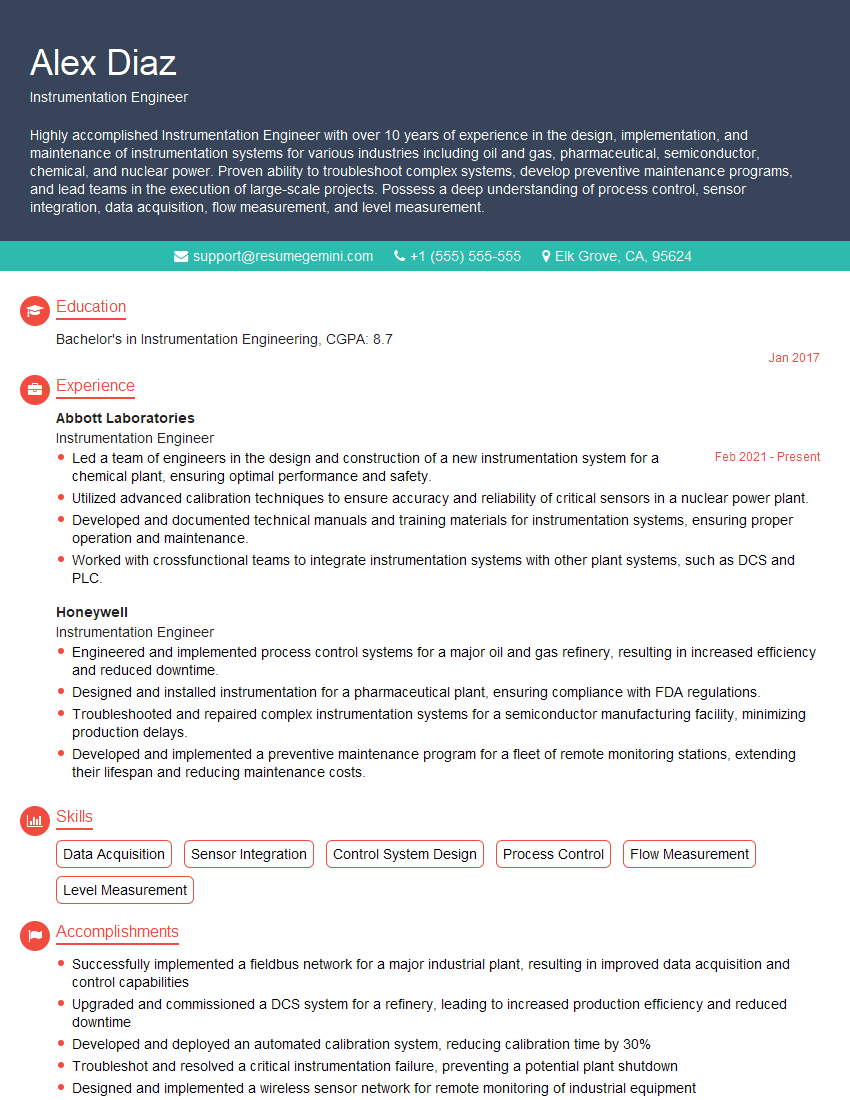
Instrumentation Engineer Resume Sample

Manufacturing Engineer Resume Sample

Quality Control Engineer Resume Sample
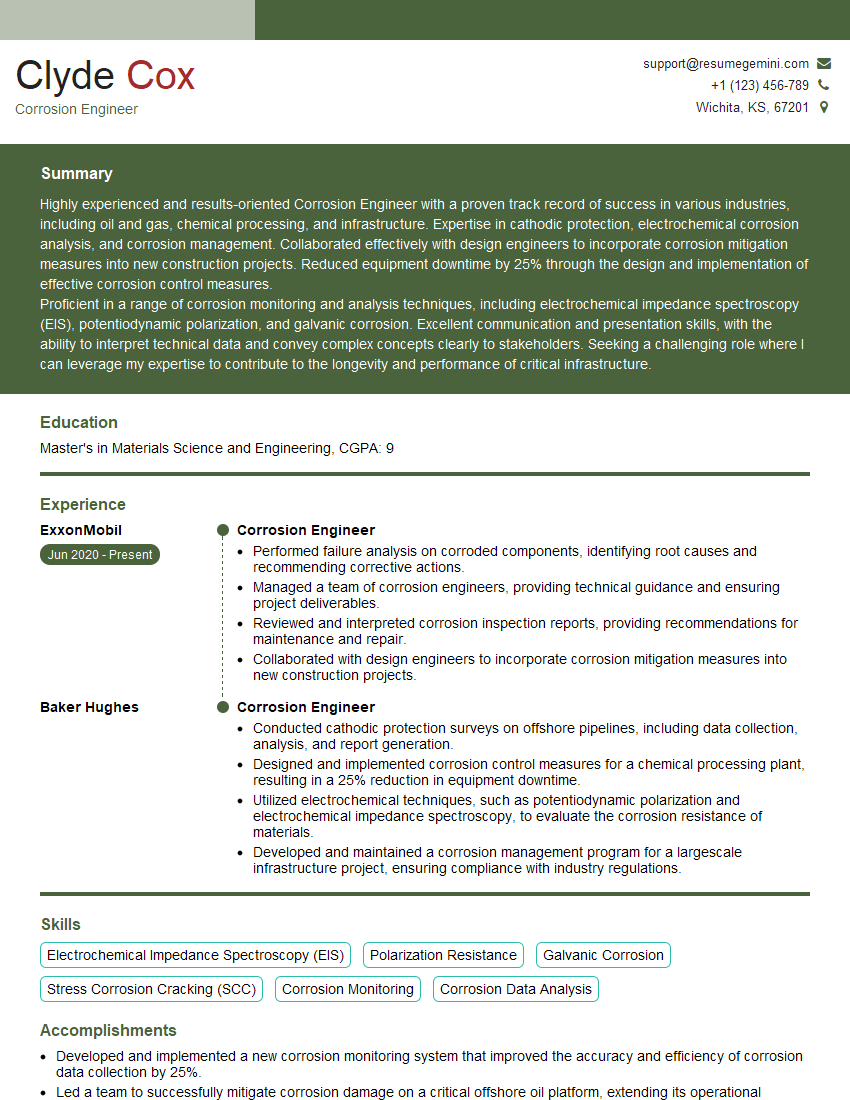
Corrosion Engineer Resume Sample

Laboratory Technician Resume Sample

Analytical Chemist Resume Sample
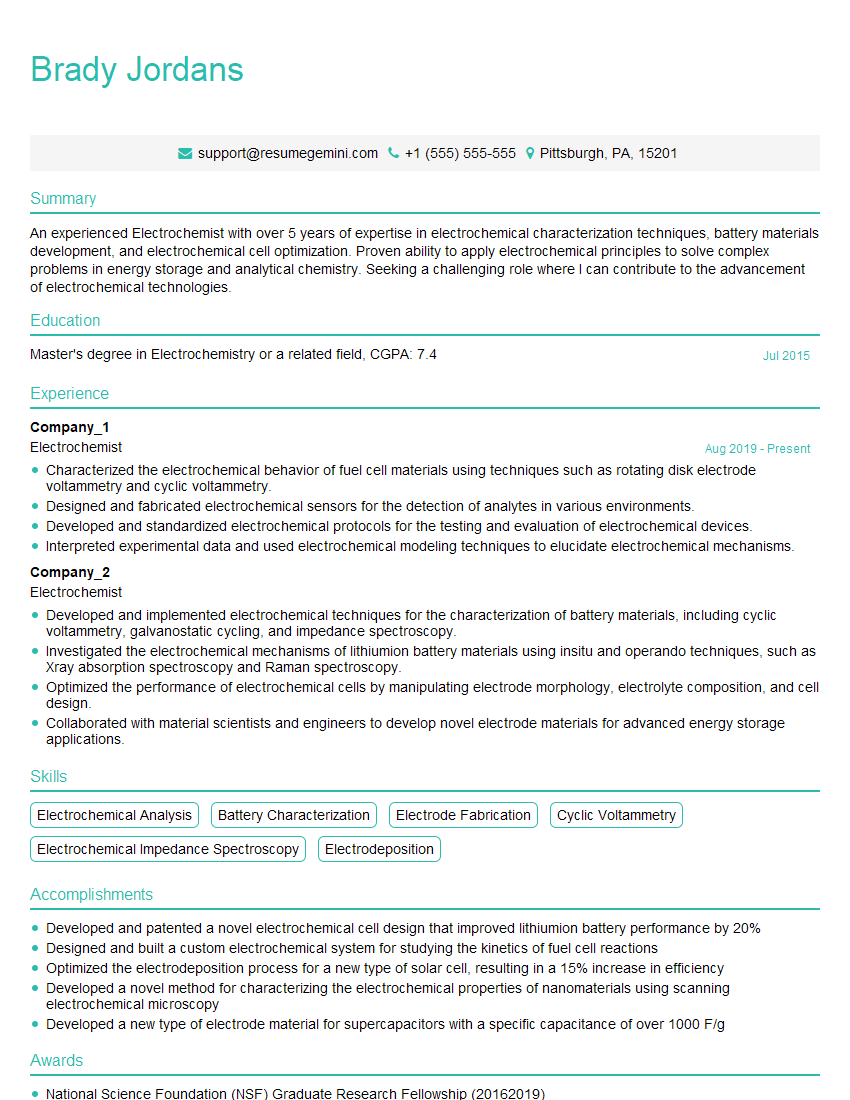
Electrochemist Resume Sample

Materials Scientist Resume Sample

Graduate Research Assistant Resume Sample
- Project Engineer
- Research Associate
- Senior Research Scientist
- Process Engineer
- Test Engineer
- Technical Specialist
- Engineering Technician
- Field Service Engineer
- Product Development Engineer
- Instrumentation Engineer
- Manufacturing Engineer
- Quality Control Engineer
- Corrosion Engineer
- Laboratory Technician
- Analytical Chemist
- Electrochemist
- Materials Scientist
- Graduate Research Assistant
Explore more articles
Users Rating of Our Blogs
Share Your Experience
We value your feedback! Please rate our content and share your thoughts (optional).
What Readers Say About Our Blog
Very informative content, great job.
good