Preparation is the key to success in any interview. In this post, we’ll explore crucial Lighting Calculations interview questions and equip you with strategies to craft impactful answers. Whether you’re a beginner or a pro, these tips will elevate your preparation.
Questions Asked in Lighting Calculations Interview
Q 1. Explain the inverse square law and its relevance to lighting calculations.
The inverse square law is a fundamental principle in lighting calculations. It states that the intensity of light from a point source decreases proportionally to the square of the distance from the source. Imagine a light bulb: the closer you are, the brighter it seems; the farther you move, the dimmer it gets, and not just a little dimmer, but much more so.
Mathematically, it’s represented as:
E = I / d²where:
Eis illuminance (light level on a surface).Iis luminous intensity (light output from the source).dis the distance from the source.
This law is crucial because it helps us predict the light level at various points in a space, assisting in determining the number and placement of luminaires for adequate illumination. For instance, doubling the distance from a light source reduces the illuminance to one-quarter of its original value.
Q 2. What are the different types of light sources and their characteristics?
Light sources are broadly categorized into several types, each with unique characteristics affecting their application in lighting design:
- Incandescent: These produce light by heating a filament until it glows. They offer warm light but are inefficient and generate significant heat.
- Fluorescent: These use electricity to excite mercury vapor, producing UV radiation that then excites a phosphor coating to emit visible light. They’re more energy-efficient than incandescent but can have a cooler light color.
- High-Intensity Discharge (HID): These include metal halide and high-pressure sodium lamps, producing light by passing an electric arc through a gas or vapor. They offer high luminous efficacy (light output per unit of power) but have longer startup times and require ballasts.
- Light Emitting Diode (LED): LEDs are semiconductor devices that emit light when an electric current flows through them. They are highly energy-efficient, long-lasting, and offer a wide range of color temperatures and control options.
The choice of light source depends on factors like energy efficiency, color rendering, lifespan, cost, and the desired aesthetic.
Q 3. Describe the concept of illuminance, luminance, and luminous intensity.
These three terms are fundamental photometric quantities:
- Illuminance (E): This measures the amount of light falling on a surface. It’s expressed in lux (lx), which is lumens per square meter (lm/m²). Think of it as how much light hits a desk.
- Luminance (L): This measures the amount of light emitted, reflected, or transmitted from a surface in a particular direction. It’s expressed in candelas per square meter (cd/m²), also known as nits. This describes how bright a surface appears to the eye, like the brightness of a computer screen.
- Luminous Intensity (I): This measures the light output from a light source in a specific direction. It’s expressed in candelas (cd). This indicates the strength of a light source, like the output of a spotlight.
Understanding these quantities is crucial for achieving the desired lighting levels and visual comfort in a space. For example, a high luminance on a computer screen might cause glare, while insufficient illuminance on a task surface hinders visibility.
Q 4. How do you calculate the required number of luminaires for a given space?
Calculating the required number of luminaires involves several steps:
- Determine the required illuminance: This depends on the space’s function (e.g., office, retail), using relevant lighting codes and recommendations.
- Calculate the total luminous flux needed: Multiply the required illuminance (in lux) by the area of the space (in square meters). This gives the total lumens needed.
- Select the luminaires: Choose luminaires with appropriate luminous flux (lumens) and light distribution.
- Account for losses: Consider factors like light absorption by walls, ceilings, and furniture (typically 10-20% loss). Adjust the total lumens needed accordingly.
- Calculate the number of luminaires: Divide the total lumens needed by the luminous flux of each selected luminaire. Round up to the nearest whole number.
Example: A 20m² office requires 500 lux. A chosen luminaire emits 3000 lumens. Accounting for a 15% loss, the total lumens needed are 500 lx * 20 m² * 1.15 = 11500 lumens. The number of luminaires required is 11500 lumens / 3000 lumens/luminaire ≈ 4 luminaires.
Q 5. What are the key factors to consider when designing lighting for different spaces (e.g., office, retail, museum)?
Lighting design varies significantly depending on the space:
- Office: Requires sufficient illuminance for tasks, good color rendering for visual comfort, and minimized glare to prevent eye strain. Task lighting combined with ambient lighting is common.
- Retail: Focuses on showcasing products effectively. Highlighting displays with accent lighting and creating a welcoming atmosphere through ambient lighting are essential. Color temperature plays a significant role in mood creation.
- Museum: Prioritizes protecting artifacts from light damage while ensuring adequate viewing conditions. Low illuminance levels, UV filtration, and controlled lighting schedules are crucial.
Other factors to consider include energy efficiency, aesthetics, and compliance with relevant building codes and regulations.
Q 6. Explain the importance of light levels and uniformity in lighting design.
Light levels and uniformity are critical for visual comfort and task performance. Insufficient light levels lead to eye strain, headaches, and reduced productivity. Uneven illumination creates visual discomfort and shadows that can hinder tasks.
Uniformity is expressed as a ratio of minimum to average illuminance. A higher uniformity ratio indicates more even lighting. For instance, a uniformity ratio of 0.7 indicates that the minimum illuminance is 70% of the average illuminance. The desired uniformity ratio depends on the space’s function and the type of task performed.
Properly designed lighting ensures consistent light distribution, minimizing discomfort and maximizing efficiency.
Q 7. What are the different types of lighting control systems?
Lighting control systems offer various ways to manage and optimize lighting:
- Manual switches: The simplest form, offering on/off control.
- Dimmers: Allow adjusting light levels, improving energy efficiency and creating ambiance.
- Timers: Automate lighting schedules based on time of day.
- Occupancy sensors: Turn lights on/off based on the presence of people, saving energy.
- Daylight harvesting: Adjust artificial lighting based on available daylight, maximizing natural light and minimizing energy consumption.
- Networked lighting control systems: These allow centralized control and monitoring of lighting across a building, providing advanced features such as scene setting and remote management.
The choice of lighting control system depends on the budget, building complexity, and desired level of control and energy savings.
Q 8. How do you use photometric data in lighting design?
Photometric data is the cornerstone of lighting design. It provides crucial information about a luminaire’s light output, including its intensity, distribution, and color characteristics. This data, typically presented in IES files (Illuminating Engineering Society), allows us to accurately predict the illuminance levels at various points within a space. We use this data in lighting design software to simulate the lighting effect of different luminaire types, positions, and quantities. For example, we might use photometric data to determine the optimal number and placement of downlights in an office to achieve a uniform 500 lux on the work surfaces while minimizing glare.
The process involves importing the IES files into software like DIALux or AGI32. The software then uses this data to calculate illuminance levels across the space based on factors like room dimensions, surface reflectances, and luminaire characteristics. This allows us to optimize the lighting design for energy efficiency, visual comfort, and adherence to lighting standards.
Q 9. What are the common lighting design software packages you are familiar with (e.g., DIALux, Relux, AGI32)?
I’m proficient in several lighting design software packages, each with its own strengths. DIALux is a popular choice, particularly for its user-friendly interface and comprehensive library of luminaire data. Relux offers advanced features for complex projects and detailed simulations. AGI32 is a powerful tool often used for larger-scale projects and offers advanced capabilities for integrating lighting design with other building systems (like HVAC and fire safety). My familiarity extends to using these programs for tasks ranging from simple room lighting design to complex museum or stadium illuminations. The choice of software often depends on the project’s complexity and specific requirements.
Q 10. How do you account for daylighting in your lighting calculations?
Daylighting is a crucial aspect of sustainable and energy-efficient lighting design. We account for it by using specialized software tools and techniques. First, we assess the building’s orientation, window sizes, and shading devices (trees, blinds, etc.). Then we use software to simulate the daylight contribution throughout the day and year, considering the sun’s path and the building’s geometry. This helps determine the extent of daylight penetration in the space. We use this daylighting simulation data to adjust the artificial lighting system, ensuring that we only provide supplemental artificial light where and when needed. This minimizes energy consumption while maintaining adequate illuminance levels.
For instance, we might strategically place light sensors that automatically dim or switch off artificial lights when sufficient daylight is available. We could also design the layout to maximize natural light penetration, reducing the reliance on electric lights. This integrated approach of daylighting and electric lighting is essential for achieving optimal energy efficiency and visual comfort.
Q 11. Explain the concept of color rendering index (CRI) and its significance.
The Color Rendering Index (CRI) is a crucial metric that quantifies how well a light source renders the colors of objects compared to a reference light source (usually daylight). It’s expressed on a scale of 0 to 100, with higher values indicating better color rendering. A CRI of 100 means the light source renders colors perfectly accurately, while a lower CRI means that colors appear distorted or muted.
The significance of CRI lies in its impact on visual perception and task performance. In applications where accurate color rendition is vital, such as museums, art galleries, and food preparation areas, a high CRI (typically above 80) is essential. Conversely, a lower CRI light source might be acceptable in areas where color accuracy is less critical. For example, a warehouse might use a light with a lower CRI that is more energy efficient, since color accuracy isn’t as important as sufficient illuminance levels.
Q 12. What are the different types of light fittings and their applications?
There’s a wide array of light fittings, each suited to specific applications. Common types include:
- Downlights: Recessed fixtures providing general illumination in ceilings.
- Track lighting: Flexible system with adjustable spotlights, ideal for accent lighting or display areas.
- Pendant lights: Suspended fixtures offering ambient or task lighting.
- Surface-mounted lights: Attached directly to ceilings or walls, simple and cost-effective.
- High-bay lights: High-intensity fixtures for industrial or warehouse spaces.
- Linear lights: Long, continuous light sources, suitable for offices or retail spaces.
- Streetlights: Designed for outdoor illumination, typically with robust construction and energy efficiency.
The choice depends on factors like the space’s function, aesthetic requirements, and budget constraints. For example, a retail store might use a combination of track lighting for product accentuation, downlights for general illumination, and linear lights for ambient lighting.
Q 13. How do you calculate the energy consumption of a lighting system?
Calculating the energy consumption of a lighting system involves several steps. First, we determine the power consumption of each luminaire (in Watts). This information is usually found on the luminaire’s datasheet. Then, we multiply the power consumption by the number of luminaires and the number of hours of operation per day. This gives us the daily energy consumption in Watt-hours (Wh). Finally, we convert this to kilowatt-hours (kWh) by dividing by 1000. This is typically done annually to determine the yearly energy usage which can be used to calculate the overall cost of running the system. This calculation takes into account factors like the number of operating hours, the power consumption of each fixture, and any control systems that might reduce energy use (e.g., occupancy sensors or daylight harvesting).
Example: 10 x 50W downlights operating 8 hours/day = 4000 Wh/day = 4 kWh/day. Annual consumption (assuming 365 days) = 1460 kWh.
Q 14. What are the common energy-efficient lighting technologies?
Several energy-efficient lighting technologies are commonly employed to reduce energy consumption and operational costs:
- LED (Light Emitting Diode): LEDs are highly efficient, long-lasting, and available in various color temperatures and CRI values. They are rapidly becoming the dominant lighting technology due to their superior energy efficiency compared to traditional lighting.
- Compact Fluorescent Lamps (CFLs): CFLs are more energy-efficient than incandescent bulbs but less efficient than LEDs. They are less commonly used now due to the dominance of LEDs.
- High-Intensity Discharge (HID) lamps (e.g., Metal Halide, High-Pressure Sodium): These were widely used for high-intensity lighting but are less popular now due to longer start-up times, poorer color rendering, and lower efficiency compared to LEDs.
Beyond the lamp type, smart controls like occupancy sensors, daylight harvesting systems, and dimming controls further enhance energy efficiency by ensuring lights are only on when needed and at the appropriate intensity.
Q 15. Describe the process of conducting a lighting audit.
A lighting audit is a systematic evaluation of a space’s lighting system to identify inefficiencies, safety hazards, and opportunities for improvement. It’s like giving your lighting system a thorough health check-up!
The process typically involves:
- Initial Assessment: This involves a site visit to document the existing lighting system, including fixture types, quantities, wattages, and control systems. We also assess the space’s function and occupant needs.
- Measurements: Illuminance levels (lux or foot-candles) are measured at various points within the space using a calibrated light meter. This data provides a baseline for comparison.
- Calculations: We then calculate key metrics such as energy consumption, lighting power density (LPD), and illuminance uniformity. This involves using established lighting design principles and software.
- Analysis: The collected data is analyzed to identify areas where lighting is excessive, inadequate, or inefficient. We look for potential code violations and safety hazards, like insufficient illumination in stairwells.
- Recommendations: Finally, we provide a report with detailed recommendations for improvements. This might include replacing inefficient fixtures with energy-efficient LEDs, upgrading controls, or adjusting fixture placement to optimize light distribution. We also factor in cost-benefit analysis for each recommended change.
For example, in a recent audit of an office building, we discovered that outdated fluorescent fixtures were consuming significantly more energy than necessary. Our recommendations included replacing them with LED fixtures, resulting in substantial energy savings and improved lighting quality.
Career Expert Tips:
- Ace those interviews! Prepare effectively by reviewing the Top 50 Most Common Interview Questions on ResumeGemini.
- Navigate your job search with confidence! Explore a wide range of Career Tips on ResumeGemini. Learn about common challenges and recommendations to overcome them.
- Craft the perfect resume! Master the Art of Resume Writing with ResumeGemini’s guide. Showcase your unique qualifications and achievements effectively.
- Don’t miss out on holiday savings! Build your dream resume with ResumeGemini’s ATS optimized templates.
Q 16. How do you calculate the light loss factor (LLF)?
The Light Loss Factor (LLF) accounts for the reduction in light output from a luminaire (lighting fixture) over time and under real-world conditions. Think of it as a multiplier that adjusts the theoretical light output to reflect the actual light reaching the work plane.
Calculating LLF involves considering several factors:
- Luminaire Dirt Depreciation (LDD): Dust and dirt accumulate on luminaires, reducing light output. This factor depends on the environment (clean room vs. factory).
- Lamp Lumen Depreciation (LLD): The light output of lamps decreases over their lifespan. Manufacturers provide data on lumen maintenance curves.
- Room Surface Depreciation (RSD): The reflectivity of room surfaces (walls, ceilings, floors) affects the amount of light reflected back into the space. Darker surfaces reduce reflectivity.
- Lamp Burnouts (if applicable): In systems with multiple lamps per fixture, the failure of one or more lamps reduces overall output.
The LLF is typically expressed as a decimal between 0 and 1. A higher LLF indicates less light loss. The calculation is multiplicative:
LLF = LDD × LLD × RSD × (Burnout factor if applicable)For instance, if LDD = 0.85, LLD = 0.90, and RSD = 0.75, then LLF = 0.85 × 0.90 × 0.75 = 0.57. This means that only 57% of the initial light output reaches the work plane.
Q 17. What are the different methods for calculating illuminance levels?
Several methods exist for calculating illuminance levels, each with its strengths and weaknesses:
- Point-by-Point Method: This is the most accurate but also the most time-consuming method. It involves calculating the illuminance at numerous points within the space using the inverse square law and considering the contribution of each luminaire. This is ideal for complex spaces or when high accuracy is crucial.
- Zonal Cavity Method: This method is more simplified and faster, using predetermined coefficients and calculations for different room cavity ratios. It’s suitable for rectangular spaces with uniform lighting layouts and is widely used in practice.
- Lumen Method: This is a simplified approach useful for initial estimations. It calculates total lumens emitted by the luminaires and divides them by the area of the space to get an average illuminance. It doesn’t account for variations in illuminance across the space.
- Computer-aided design (CAD) software: Lighting design software, such as DIALux evo or AGi32, simulates lighting scenarios using advanced algorithms and offers detailed analysis and visualization. This method allows for efficient exploration of various design options before implementation.
The choice of method depends on project complexity, required accuracy, and available resources. For a small office, the zonal cavity method might suffice. However, for a large, irregularly shaped space, point-by-point calculations or a CAD software might be necessary.
Q 18. Explain the principles of glare control in lighting design.
Glare control is crucial in lighting design to ensure visual comfort and prevent eye strain. Glare occurs when there’s excessive brightness or luminance contrast within the field of vision, causing discomfort or reduced visibility.
Principles of glare control include:
- Limiting luminance: Using luminaires with lower luminance values reduces direct glare. This often involves using diffusers or baffles within the fixture.
- Shielding: Luminaire design plays a key role. Shields and louvers prevent direct light from reaching the eye at high angles.
- Limiting contrast: Minimizing the difference in brightness between the task area and the surrounding environment reduces discomfort glare.
- Positioning luminaires carefully: Avoid placing luminaires directly in the line of sight. Indirect or semi-indirect lighting solutions distribute light more evenly, reducing glare.
- Using appropriate light levels: Over-illumination can contribute to glare, especially if combined with high luminance sources. Properly chosen illuminance levels are critical.
Imagine working at a computer screen with a bright light directly above it. This would create direct glare and make it difficult to see the screen comfortably. Proper glare control would involve using a luminaire with a low luminance and a shield to prevent direct light from striking the eyes.
Q 19. How do you determine the appropriate lighting color temperature for a given application?
Choosing the right color temperature (measured in Kelvin, K) for a lighting application is vital to achieve the desired mood and visual effect. Color temperature affects the appearance of colors and influences our perception of a space.
Lower color temperatures (2700K-3000K) produce a warm, yellowish light, often associated with relaxation and comfort. These are commonly used in residential settings, restaurants, or hotel lobbies.
Higher color temperatures (5000K-6500K) produce a cooler, bluish light that can enhance alertness and productivity. This is often preferred in offices, hospitals, or industrial settings.
The appropriate color temperature depends on the application:
- Retail spaces: Warmer color temperatures can enhance the appearance of merchandise and create a welcoming atmosphere.
- Office environments: Cooler color temperatures can increase alertness and improve task performance but should be balanced to prevent discomfort.
- Healthcare settings: Neutral to slightly cooler color temperatures are often preferred to promote a clean and sterile environment.
It’s crucial to consider the impact on color rendering (CRI). A high CRI (above 80) is usually preferred to ensure accurate color reproduction.
Q 20. What are the relevant lighting standards and codes you are familiar with (e.g., IES, ASHRAE)?
I’m familiar with several relevant lighting standards and codes, including:
- IES (Illuminating Engineering Society): The IES publishes numerous recommended practices and standards for lighting design, including those related to illuminance levels, glare control, and energy efficiency. Their publications are widely recognized as authoritative resources.
- ASHRAE (American Society of Heating, Refrigerating and Air-Conditioning Engineers): While primarily focused on HVAC, ASHRAE also addresses lighting energy efficiency and integration within building systems. Their standards cover aspects like building energy modeling and lighting controls.
- IEC (International Electrotechnical Commission): The IEC develops international standards for electrical equipment, including lighting products. Their standards ensure compatibility and safety of lighting equipment worldwide.
- Local building codes: Many jurisdictions have their own building codes that specify minimum illuminance requirements for various spaces (e.g., exits, workplaces). These codes must be strictly adhered to during lighting design.
Staying updated with these standards is essential for ensuring safe, efficient, and compliant lighting designs.
Q 21. Explain the difference between point-by-point and zonal cavity calculations.
Both point-by-point and zonal cavity methods are used to calculate illuminance, but they differ significantly in their approach and complexity:
- Point-by-Point Method: This method directly calculates the illuminance at specific points within the space by considering the contribution of each luminaire using the inverse square law and the cosine law. It accounts for the geometry of the space and the luminaire’s light distribution. This approach is highly accurate but very time-consuming, especially for large spaces with numerous luminaires. Think of it as meticulously measuring the light at each point individually.
- Zonal Cavity Method: This is a more simplified, yet still robust, method that divides the room into several zones (ceiling cavity, room cavity, floor cavity). It uses pre-calculated coefficients to determine the light distribution within each zone. This method is faster and less computationally intensive than point-by-point but assumes a certain degree of uniformity in the room geometry and luminaire placement. It’s like dividing the room into sections and averaging the light levels in each section.
The point-by-point method offers greater accuracy but requires significant computational power and time. The zonal cavity method is a practical compromise between accuracy and efficiency, making it suitable for many common lighting design tasks. The selection depends on the project requirements and the level of detail required.
Q 22. How do you handle reflections in lighting calculations?
Handling reflections in lighting calculations is crucial for accurate results, as reflections significantly impact the overall illuminance and luminance within a space. We use several methods, depending on the complexity of the scene and the desired accuracy.
One common approach is the use of ray tracing or radiosity algorithms. Ray tracing simulates the path of light rays as they bounce off surfaces, accounting for specular (mirror-like) and diffuse (scattered) reflections. Radiosity, on the other hand, considers the overall energy distribution within a space, calculating the radiant exchange between surfaces. These methods are incorporated into lighting simulation software like DIALux, Relux, or AGi32.
For simpler scenarios, we might use a more simplified approach based on reflection factors (reflectance values) assigned to surfaces. These values represent the percentage of light reflected by a surface and are readily available for common materials. For example, a highly polished white surface might have a reflectance of 0.8 (80%), while a dark matte surface might have a reflectance of 0.1 (10%). These values are then used to estimate the contribution of reflected light to the overall illuminance.
The choice of method depends on factors such as the level of detail required, computational resources available, and the complexity of the geometry involved. For instance, for a simple office space, using reflection factors might be sufficient, whereas simulating a complex museum with many reflective surfaces would require ray tracing or radiosity for higher accuracy.
Q 23. Describe your experience with lighting simulations and modeling.
I have extensive experience with lighting simulations and modeling using various software packages, including DIALux, AGi32, and Relux. My experience spans diverse projects from small residential spaces to large commercial buildings and outdoor lighting schemes. I’m proficient in creating accurate 3D models of spaces, importing detailed geometry data, assigning material properties (including reflectance, transmittance, and absorption), and defining light sources with their specific characteristics (lumens, color temperature, distribution).
I’ve used simulations to optimize lighting placement, predict illuminance levels, analyze glare, and evaluate energy consumption. For example, in a recent project designing the lighting for a retail store, I used AGi32 to model the space and simulate different lighting scenarios. This allowed us to compare various fixture types and placements, optimizing for both visual comfort and energy efficiency. The simulation identified areas of over-illumination and under-illumination, guiding the placement of additional fixtures or adjustments to existing ones.
Beyond the software, I understand the underlying principles of illuminance calculations, including the inverse square law, and the use of luminance and illuminance calculations to ensure appropriate lighting levels are maintained while minimizing energy consumption.
Q 24. How do you balance aesthetic considerations with energy efficiency in lighting design?
Balancing aesthetic considerations with energy efficiency in lighting design is a crucial aspect of creating sustainable and visually appealing environments. It often requires a creative approach that integrates various strategies.
- Efficient Fixture Selection: Choosing high-efficiency luminaires (lighting fixtures) with high lumen output per watt is paramount. LEDs are the current standard, offering significant energy savings compared to traditional technologies.
- Light Control Strategies: Implementing dimming systems, occupancy sensors, and daylight harvesting strategies dramatically reduces energy consumption. Dimming allows adjusting light levels based on need, while sensors turn off lights in unoccupied areas. Daylight harvesting maximizes the use of natural light, minimizing the need for artificial lighting.
- Strategic Fixture Placement: Careful placement of fixtures optimizes light distribution, reducing energy waste from over-illumination. Proper aiming, shielding, and utilization of reflectors direct light precisely where needed, minimizing spill light.
- Material Selection: Using light-colored walls and ceilings increases the reflection of light, reducing the number of fixtures required and enhancing the overall brightness. Conversely, dark colors absorb light, which may require higher light levels for sufficient illumination.
- Light Quality: While energy efficiency is vital, neglecting light quality compromises the aesthetic and functional aspects of design. Color rendering index (CRI) and correlated color temperature (CCT) should be selected appropriately to create a suitable ambiance while maintaining energy efficiency. A high CRI ensures accurate color rendition, while CCT determines the warmth or coolness of the light.
Ultimately, this balance involves thoughtful design decisions considering the client’s aesthetic preferences, building codes, and energy budgets. It’s an iterative process, frequently requiring multiple design iterations and simulations to achieve the desired outcome.
Q 25. How would you approach troubleshooting a poorly lit space?
Troubleshooting a poorly lit space begins with a systematic approach. My strategy typically involves these steps:
- Visual Assessment: A thorough visual inspection helps identify areas of inadequate illumination, glare, or uneven light distribution. I would note the existing fixtures, their types, and their placement.
- Measurement of Illuminance Levels: Using a light meter, I would measure the illuminance levels (lux) at various points within the space. This provides quantitative data to compare against recommended illuminance levels based on the space’s function (e.g., IES standards).
- Analysis of Light Sources: I would assess the quality of the light sources (CRI and CCT), their lumen output, and their light distribution patterns. This helps determine if the light sources themselves are inadequate.
- Evaluation of Environmental Factors: Factors such as the room’s dimensions, ceiling height, surface reflectivity, and the presence of obstacles that block light would be considered.
- Review of Design Documents: If available, the original lighting design would be reviewed to understand the intended illuminance levels and fixture placement.
- Proposed Solutions: Based on my assessment, I would propose specific solutions, such as replacing outdated fixtures with more energy-efficient ones, adjusting fixture positions, adding supplemental lighting, or altering surface finishes to increase reflectivity.
- Re-measurement and Validation: After implementing solutions, I would re-measure illuminance levels to confirm that the problem has been resolved.
For instance, if a space suffers from excessive glare, I would investigate the fixture’s shielding, the surface reflectivity, or the position of the light sources. If the illuminance levels are insufficient, I would consider increasing the number of fixtures or their lumen output. The solution always involves a blend of both objective data and subjective observations to understand the specific nature of the lighting deficiency.
Q 26. Describe your experience with lighting control systems programming.
My experience with lighting control systems programming encompasses several platforms and protocols, including BACnet, DALI, and DMX. I’m proficient in configuring and programming lighting control systems to manage lighting levels, schedules, and scenes for optimal energy efficiency and user experience. My experience is practical, moving beyond simple configuration to incorporating sophisticated control logic.
For example, I’ve programmed DALI systems to integrate with building management systems (BMS), allowing for centralized control and monitoring of lighting across a large building. This includes creating customized lighting scenes for various times of day or occupancy conditions and setting schedules to automatically adjust lighting levels based on occupancy or natural light availability. I’ve also worked with DMX systems for theatrical lighting and other dynamic lighting applications, using scripting to create complex lighting sequences and shows.
I understand the importance of robust programming practices, including error handling and system redundancy, to ensure the reliability and maintainability of lighting control systems. This involves understanding data communication protocols, network topologies, and hardware integration for seamless system operation. In my experience, ensuring the system is user-friendly and easily maintainable is essential for long-term success.
Q 27. Explain your understanding of the relationship between lighting and human behavior.
The relationship between lighting and human behavior is multifaceted and well-documented. Proper lighting significantly impacts mood, productivity, safety, and even circadian rhythms.
- Circadian Rhythm: Exposure to light, particularly blue light, regulates our natural sleep-wake cycle. The right lighting helps maintain a healthy circadian rhythm, impacting alertness, mood, and sleep quality. This is particularly important in office spaces and healthcare settings.
- Mood and Productivity: Studies demonstrate a link between lighting levels and mood. Adequate illumination enhances alertness, focus, and productivity, while poorly lit spaces can lead to fatigue and decreased performance. The color temperature of the light also plays a role. Cooler light is often more stimulating, while warmer light is generally more relaxing.
- Safety and Security: Proper lighting enhances visibility, reducing the risk of accidents and enhancing security. Adequate illumination in walkways, stairwells, and parking lots significantly improves safety and creates a sense of security.
- Visual Comfort: Glare, excessive contrast, and flickering lights negatively affect visual comfort and can cause eye strain, headaches, and decreased productivity. Proper lighting design aims to minimize these issues.
Understanding these connections allows lighting designers to create environments that support human well-being. For example, using human-centric lighting in office spaces helps improve productivity by optimizing lighting levels and color temperature throughout the workday. In healthcare settings, ensuring proper lighting can contribute to faster patient recovery and staff well-being.
Q 28. What are your strengths and weaknesses when it comes to lighting calculations?
Strengths: My strength lies in my ability to integrate complex lighting calculations with practical design considerations. I’m adept at using simulation software to predict lighting performance and optimize designs for energy efficiency and visual comfort. My experience in various lighting control systems programming allows me to create effective and efficient lighting solutions. I excel at translating complex technical information into easily understandable terms for clients and colleagues.
Weaknesses: While proficient in several software packages, keeping up with the rapid advancements in lighting technology and software updates requires continuous learning. I’m always striving to expand my knowledge of the latest advancements in lighting technologies and software, attending workshops and pursuing relevant certifications to stay ahead of the curve. I also actively seek feedback to refine my design approach, understanding that continuous improvement is key in this constantly evolving field.
Key Topics to Learn for Lighting Calculations Interview
- Illuminance and Luminance: Understanding the difference and their practical applications in various lighting design scenarios. This includes mastering the units of measurement and conversion factors.
- Light Sources: Characteristics of different light sources (LED, fluorescent, incandescent) and their impact on calculations. This includes understanding color temperature, color rendering index (CRI), and luminous efficacy.
- Photometry: Working with intensity, flux, and illuminance calculations using various methods and tools. Practice applying these concepts to real-world lighting design problems.
- Lighting Design Software: Familiarity with industry-standard software used for lighting calculations and simulations. Be prepared to discuss your experience and proficiency in these tools.
- Energy Efficiency and Sustainability: Understanding energy codes, regulations, and best practices related to energy-efficient lighting design. This includes calculating energy consumption and cost savings.
- Lighting Design Principles: Application of lighting design principles like ambient, task, and accent lighting in different spaces. Understanding the impact of light on mood, functionality and aesthetics.
- Problem-Solving & Calculations: Demonstrate your ability to solve complex lighting problems involving multiple light sources, different room geometries, and varying surface reflectances. Be prepared to explain your approach and methodology.
Next Steps
Mastering lighting calculations is crucial for career advancement in the lighting design field, opening doors to more challenging and rewarding roles. A strong understanding of these principles demonstrates technical proficiency and problem-solving skills highly valued by employers.
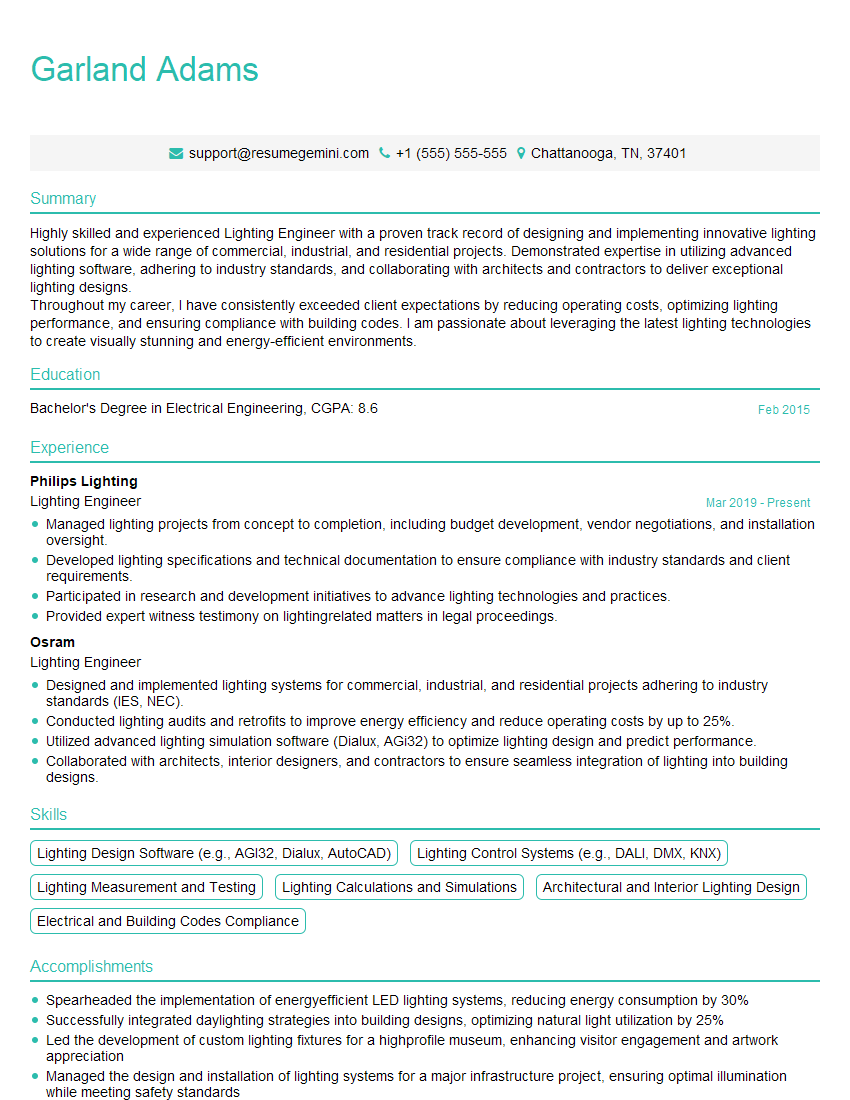
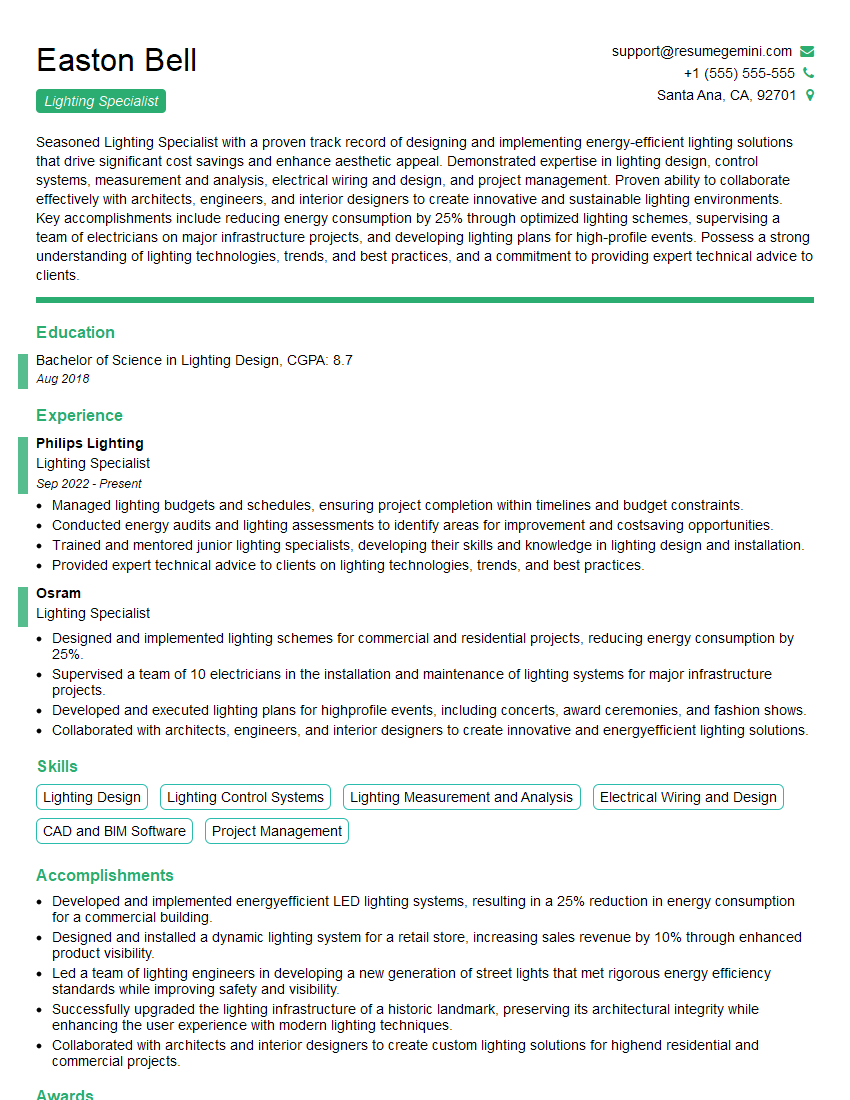
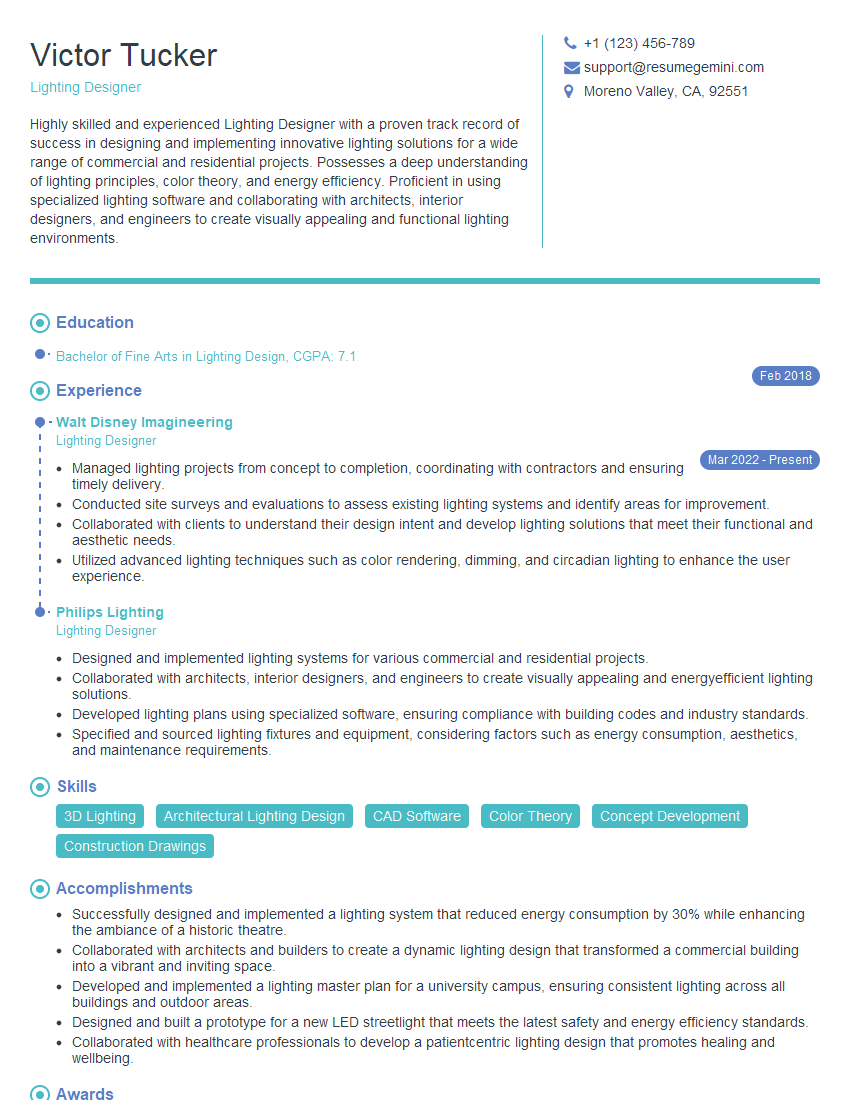
To significantly boost your job prospects, it’s vital to create a resume that’s both ATS-friendly and showcases your skills effectively. ResumeGemini is a trusted resource that can help you craft a professional and impactful resume tailored to the lighting calculations field. Examples of resumes specifically designed for lighting calculations professionals are available to guide you.
Explore more articles
Users Rating of Our Blogs
Share Your Experience
We value your feedback! Please rate our content and share your thoughts (optional).
What Readers Say About Our Blog
Very informative content, great job.
good