Every successful interview starts with knowing what to expect. In this blog, we’ll take you through the top Developing interview questions, breaking them down with expert tips to help you deliver impactful answers. Step into your next interview fully prepared and ready to succeed.
Questions Asked in Developing Interview
Q 1. Explain the difference between == and === in JavaScript.
In JavaScript, both == and === are used for comparison, but they differ significantly in how they perform the check. == is the loose equality operator, while === is the strict equality operator. The key difference lies in type coercion.
The loose equality operator (==) checks for equality after performing type coercion. This means it will try to convert the operands to the same type before comparing their values. For example, 1 == '1' evaluates to true because the string ‘1’ is coerced to the number 1 before comparison.
The strict equality operator (===), on the other hand, checks for both value and type equality without performing any type coercion. Therefore, 1 === '1' evaluates to false because, although the values are the same, their types are different (number and string, respectively).
Example:
1 == true // true (true is coerced to 1)1 === true // false (different types)0 == false // true (false is coerced to 0)0 === false // false (different types)
In most cases, it’s best practice to use the strict equality operator (===) to avoid unexpected behavior due to type coercion. It leads to more predictable and maintainable code.
Q 2. What is the purpose of a REST API?
A REST API (Representational State Transfer Application Programming Interface) is a set of architectural constraints that define how to design networked applications. Its purpose is to allow different software systems to communicate with each other over the internet using standard HTTP methods (GET, POST, PUT, DELETE) and formats like JSON or XML.
Think of it as a waiter taking your order (request) in a restaurant and bringing you your food (response). The waiter (API) doesn’t need to know how the food was prepared; it just needs to know what to order and where to get it from (the resources). Similarly, a REST API provides a structured way for applications to interact without needing to know the internal workings of each other.
Key features of a REST API include:
- Statelessness: Each request contains all the information needed to process it; the server doesn’t store any context between requests.
- Client-Server Architecture: The client (the application making the request) and the server (the application providing the response) are independent.
- Cacheability: Responses can be cached to improve performance.
- Uniform Interface: A consistent way of interacting with resources using standard HTTP methods.
- Layered System: Clients may not know whether they are interacting directly with the final server or an intermediary.
REST APIs are ubiquitous in modern software development, powering everything from mobile apps to large-scale web services.
Q 3. Describe your experience with Agile development methodologies.
I have extensive experience working with Agile development methodologies, primarily Scrum and Kanban. In my previous role at [Previous Company Name], we utilized Scrum for a large-scale e-commerce project. We worked in two-week sprints, holding daily stand-up meetings, sprint reviews, and sprint retrospectives. This allowed us to iteratively develop and deliver features, get early feedback, and adapt to changing requirements.
My contributions included:
- Participating in sprint planning and backlog refinement.
- Estimating story points and tracking progress using Jira.
- Collaborating effectively with cross-functional teams (designers, QA, product owners).
- Identifying and mitigating risks proactively.
- Contributing to sprint retrospectives to improve team processes.
In another project, we used Kanban to manage a smaller team focused on maintenance and bug fixes. The Kanban board helped us visualize the workflow and prioritize tasks based on urgency and impact. Both methodologies emphasized collaboration, transparency, and continuous improvement, which significantly benefited our projects.
Q 4. How do you handle conflicting priorities in a project?
Handling conflicting priorities is a common challenge in project management. My approach involves a combination of prioritization techniques and clear communication. First, I gather all stakeholders and clearly define each competing priority with its associated business value and potential risks.
Then, I apply prioritization frameworks such as:
- MoSCoW method: Categorizing requirements as Must have, Should have, Could have, and Won’t have.
- Value vs. Effort matrix: Plotting priorities based on their relative value and the effort required to implement them.
- Prioritization matrix (urgent/important): Identifying tasks based on their urgency and importance.
Once prioritized, I present a revised project plan to the stakeholders, explaining the rationale behind the decisions. Transparency is key; everyone needs to understand the trade-offs involved. Throughout the project, I maintain open communication channels and actively monitor progress, ensuring the plan adapts to unforeseen changes.
Finally, I emphasize proactive risk management to prevent conflicts from escalating. This involves regular monitoring and reporting to stakeholders about progress and any potential roadblocks.
Q 5. Explain the concept of polymorphism.
Polymorphism, meaning “many forms,” is a powerful concept in object-oriented programming. It allows objects of different classes to be treated as objects of a common type. This is achieved through inheritance and interfaces (or abstract classes in some languages).
Imagine a farm with different animals (chickens, cows, ducks). They all have a common characteristic – they make sounds. In a polymorphic system, you could have a function makeSound(). Each animal class (Chicken, Cow, Duck) would implement its own version of makeSound(), producing different sounds. When you call makeSound() on an animal object, the appropriate implementation for that animal’s class is executed.
Example (Conceptual):
class Animal { makeSound() { console.log('Generic animal sound'); } } class Chicken extends Animal { makeSound() { console.log('Cluck!'); } } class Cow extends Animal { makeSound() { console.log('Moo!'); } }This allows for flexibility and extensibility. You can add new animal types without modifying existing code, as long as they implement the makeSound() method.
Q 6. What are the advantages and disadvantages of using microservices?
Microservices architecture involves breaking down a large application into smaller, independently deployable services. This offers several advantages, but also introduces some challenges.
Advantages:
- Improved scalability and resilience: Individual services can be scaled independently, and the failure of one service doesn’t necessarily bring down the entire application.
- Faster development and deployment cycles: Smaller teams can work on individual services concurrently, leading to faster development and quicker deployments.
- Technology diversity: Different services can be built using different technologies best suited for their specific tasks.
- Easier maintenance and updates: Changes to one service have a minimal impact on others.
Disadvantages:
- Increased complexity: Managing a large number of services can be complex, requiring robust monitoring, logging, and orchestration tools.
- Inter-service communication overhead: Communication between services can introduce latency and require careful design.
- Data consistency challenges: Maintaining data consistency across multiple services can be difficult.
- Deployment and monitoring overhead: Deploying and monitoring many services requires more infrastructure and tools.
The decision of whether to use microservices should be based on a careful assessment of the project’s specific needs and complexity. It’s not always the best solution; a simpler monolithic architecture might be more suitable for smaller projects.
Q 7. Describe your experience with version control systems like Git.
I’m proficient in using Git for version control. I have extensive experience with branching strategies (like Gitflow), merging, rebasing, resolving conflicts, and using various Git commands for managing code changes.
In my past projects, I’ve utilized Git for:
- Collaborative development: Working with multiple developers on the same project, merging changes seamlessly.
- Feature branching: Creating separate branches for developing new features, ensuring the main branch remains stable.
- Bug fixing: Creating branches for bug fixes and merging them back to the main branch after testing.
- Code reviews: Using pull requests (or merge requests) to facilitate code reviews and ensure code quality.
- Rollback capabilities: Using Git to easily revert to previous versions of the code in case of issues.
- Using Git platforms like GitHub and GitLab: Effectively managing repositories, contributing to open-source projects, and collaborating with remote teams.
I’m familiar with various Git workflows and can adapt my approach to the specific needs of a project. My skills in Git ensure efficient collaboration and maintainable codebases.
Q 8. How would you debug a production issue?
Debugging a production issue requires a systematic approach. It’s like being a detective, piecing together clues to solve a mystery. My process typically involves these steps:
- Reproduce the issue: First, I try to reproduce the bug consistently. This often involves examining logs, error messages, and user reports to understand the context. If I can’t reproduce it, gathering more data is crucial.
- Isolate the problem: Once reproduced, I narrow down the source. This might involve using logging statements at various points in the code, or stepping through the code with a debugger. Tools like remote debugging are incredibly useful for production environments.
- Analyze the logs and metrics: System logs, application logs, and performance metrics are invaluable. They provide a timeline of events leading up to the error. I look for anomalies in resource usage (CPU, memory, network) which can often pinpoint the problem area.
- Implement a fix and test thoroughly: After identifying the root cause, I develop a fix, ensuring it addresses the problem without introducing new bugs. Rigorous testing, including unit, integration, and potentially system tests, is crucial before deploying the fix.
- Monitor the fix: After deploying the fix, continuous monitoring is essential to confirm it resolves the issue and doesn’t cause any unintended consequences. I often implement more comprehensive logging to track the behavior of the fix in the production environment.
- Implement preventative measures: Finally, I examine the root cause to determine whether there were any systemic issues that led to the problem. This might involve improving code quality, enhancing monitoring, or implementing better error handling to prevent similar issues in the future.
For example, I once debugged a performance bottleneck in a high-traffic e-commerce application. By analyzing the application logs and database queries, I discovered a poorly optimized SQL query responsible for significant delays. Rewriting the query drastically improved response times.
Q 9. Explain the difference between SQL and NoSQL databases.
SQL and NoSQL databases differ fundamentally in their data model and how they manage data. Think of it like this: SQL databases are like neatly organized libraries with well-defined shelves and catalogs (relational model), while NoSQL databases are more like flexible warehouses with different storage options for various types of goods (non-relational model).
- SQL (Relational Databases): These databases use a structured, relational model where data is organized into tables with rows and columns. Relationships between tables are defined using keys. They emphasize data integrity and ACID properties (Atomicity, Consistency, Isolation, Durability). Examples include MySQL, PostgreSQL, and SQL Server. They are ideal for applications requiring strong data consistency and complex queries.
- NoSQL (Non-Relational Databases): These databases have flexible schemas and can handle various data types, including key-value pairs, documents, graphs, and wide-column stores. They often prioritize scalability and availability over strict data consistency. Examples include MongoDB, Cassandra, and Redis. They excel in handling large volumes of unstructured or semi-structured data and are suitable for applications requiring high scalability and write performance.
Choosing between SQL and NoSQL depends entirely on the application’s requirements. If your application needs strong data consistency and complex relationships, a SQL database is preferable. If you need high scalability and flexibility to handle unstructured data, NoSQL is a better choice. In some cases, a hybrid approach utilizing both types of databases might be the best solution.
Q 10. What are some common design patterns you’ve used?
I’ve extensively used several design patterns throughout my career, tailoring my choice to the specific problem at hand. Some of the most common ones include:
- Singleton: Ensures only one instance of a class exists. Useful for managing resources like database connections or logging services. For example, a singleton can ensure there’s only one instance of a logging object, centralizing log management.
- Factory: Creates objects without specifying their concrete classes. This promotes loose coupling and makes it easy to switch implementations. For instance, a factory pattern can create different types of database connections (MySQL, PostgreSQL) based on configuration.
- Observer (or Publish-Subscribe): Defines a one-to-many dependency between objects. When one object changes state, all its dependents are notified. This is particularly useful for building event-driven systems, such as user interface updates or real-time data synchronization.
- MVC (Model-View-Controller): Separates the application into three interconnected parts: Model (data), View (user interface), and Controller (application logic). This promotes maintainability and testability. Most web applications use this pattern to structure their code.
- Repository: Provides an abstraction layer for accessing data. It decouples the application logic from the underlying data source. This makes it easier to switch databases or to mock data during testing.
The selection of a design pattern is context-dependent. I always consider factors like scalability, maintainability, and testability before making a decision.
Q 11. Describe your experience with testing frameworks.
My experience with testing frameworks is extensive. I’m proficient in using both unit testing and integration testing frameworks.
- Unit Testing: I use frameworks like JUnit (Java), pytest (Python), and NUnit (.NET) to write unit tests. These tests verify individual components or modules of the codebase in isolation. I strive for high test coverage, aiming to test all critical code paths.
- Integration Testing: For integration testing, I’ve used frameworks like Selenium (web applications), RestAssured (REST APIs), and Spring Test (Spring framework). These frameworks enable testing interactions between different components and ensure that they work together seamlessly.
- Test-Driven Development (TDD): I frequently employ TDD, writing tests *before* writing the actual code. This approach helps ensure code meets requirements and improves code quality.
Example using pytest (Python):
import unittest

def add(x, y):
    return x + y

class TestAdd(unittest.TestCase):
    def test_add_positive(self):
        self.assertEqual(add(2, 3), 5)
    def test_add_negative(self):
        self.assertEqual(add(-2, 3), 1)
Effective testing is crucial for delivering high-quality software. It reduces bugs, improves maintainability, and increases developer confidence.
Q 12. How do you optimize database queries for performance?
Optimizing database queries for performance is critical for any application that relies on a database. Slow queries can severely impact application responsiveness and scalability. My strategies involve:
- Indexing: Creating indexes on frequently queried columns drastically speeds up search operations. It’s like having a detailed table of contents for a book – finding specific information becomes much faster.
- Query Optimization: Analyzing query execution plans using tools provided by database systems (e.g.,
EXPLAIN PLANin Oracle,EXPLAINin MySQL) helps identify bottlenecks. Rewriting inefficient queries using JOINs effectively, avoidingSELECT *, and using appropriate data types can significantly improve performance. - Caching: Caching frequently accessed data in memory (e.g., using Redis or Memcached) reduces database load. This is particularly useful for read-heavy applications.
- Database Tuning: Properly configuring the database server, such as adjusting buffer pool size, connection limits, and other parameters, can optimize performance. This requires understanding the database system and its characteristics.
- Database Normalization: Ensuring database tables are normalized reduces data redundancy and improves data integrity, leading to more efficient queries.
- Connection Pooling: Reusing database connections instead of creating new ones for each request reduces overhead.
For instance, I once optimized a slow query by adding an index to a critical column, reducing query execution time from several seconds to milliseconds. Proper profiling and analysis are key to identifying areas for improvement.
Q 13. Explain the concept of SOLID principles.
SOLID principles are five design principles intended to make software designs more understandable, flexible, and maintainable. They are acronyms for:
- Single Responsibility Principle (SRP): A class should have only one reason to change. This promotes modularity and reduces complexity. For example, a class responsible for both user authentication and email sending should be split into two separate classes.
- Open/Closed Principle (OCP): Software entities (classes, modules, functions, etc.) should be open for extension, but closed for modification. This allows adding new functionality without altering existing code. Using interfaces and abstract classes helps achieve this.
- Liskov Substitution Principle (LSP): Subtypes should be substitutable for their base types without altering the correctness of the program. This ensures that subclasses maintain the behavior of their parent classes.
- Interface Segregation Principle (ISP): Clients should not be forced to depend upon interfaces they don’t use. Large interfaces should be broken down into smaller, more specific ones. This improves code flexibility and reduces dependencies.
- Dependency Inversion Principle (DIP): High-level modules should not depend on low-level modules. Both should depend on abstractions. Abstractions should not depend on details. Details should depend on abstractions. This promotes loose coupling and makes code more testable.
Adhering to SOLID principles leads to more robust, maintainable, and scalable software designs. They are fundamental to object-oriented programming and are crucial for building large and complex applications.
Q 14. How do you handle asynchronous operations?
Handling asynchronous operations is essential in modern software development, particularly in applications involving I/O-bound tasks like network requests or database interactions. Blocking on these operations can lead to poor performance and unresponsive applications.
Several techniques are used:
- Callbacks: A callback function is executed when an asynchronous operation completes. This is a simple approach, but can lead to callback hell with deeply nested callbacks for multiple asynchronous operations.
- Promises/Futures: These represent the eventual result of an asynchronous operation. They provide a cleaner way to handle asynchronous operations than callbacks, allowing chaining of operations and error handling. Many modern programming languages (JavaScript, Python) include built-in support for promises.
- Asynchronous/Await: This syntactic sugar makes asynchronous code look and behave more like synchronous code. It makes asynchronous code easier to read and reason about. Languages like JavaScript, Python, and C# support this pattern.
- Event Loops: An event loop manages multiple asynchronous operations concurrently. It checks for completion of operations and executes associated callbacks when they finish. Node.js uses an event loop for its non-blocking I/O model.
- Thread Pools/Asynchronous Tasks: For CPU-bound asynchronous tasks, thread pools or dedicated asynchronous task queues can be used to utilize multi-core processors and improve performance. These are especially useful for tasks that are computationally expensive.
The choice of technique often depends on the programming language and framework being used. Understanding the implications of each approach regarding concurrency and error handling is crucial for writing efficient and robust asynchronous code.
Q 15. What is your experience with cloud platforms like AWS, Azure, or GCP?
I have extensive experience with major cloud platforms, including AWS, Azure, and GCP. My work has involved designing, deploying, and managing applications across these platforms. With AWS, I’ve worked extensively with EC2 for instance management, S3 for object storage, and Lambda for serverless computing. I’ve utilized various AWS services like RDS (Relational Database Service), DynamoDB (NoSQL database), and API Gateway for creating robust and scalable applications. On Azure, I’ve leveraged Azure Virtual Machines, Azure Blob Storage, and Azure Functions, mirroring the functionality I’ve used on AWS. Finally, with GCP, I have experience with Compute Engine, Cloud Storage, and Cloud Functions, demonstrating my adaptability across different cloud environments. I understand the nuances of each platform’s strengths and weaknesses and choose the best option based on project requirements. For example, I’d choose AWS Lambda for event-driven microservices due to its cost-effectiveness and ease of deployment, while I might prefer Azure’s robust virtual machine offerings for applications requiring more granular control and customization.
Career Expert Tips:
- Ace those interviews! Prepare effectively by reviewing the Top 50 Most Common Interview Questions on ResumeGemini.
- Navigate your job search with confidence! Explore a wide range of Career Tips on ResumeGemini. Learn about common challenges and recommendations to overcome them.
- Craft the perfect resume! Master the Art of Resume Writing with ResumeGemini’s guide. Showcase your unique qualifications and achievements effectively.
- Don’t miss out on holiday savings! Build your dream resume with ResumeGemini’s ATS optimized templates.
Q 16. Explain your understanding of data structures and algorithms.
Data structures and algorithms are fundamental to efficient software development. Data structures are ways of organizing and storing data, while algorithms are sets of instructions for solving a problem. Understanding them is crucial for writing optimized and scalable code. I’m proficient in various data structures, including arrays, linked lists, stacks, queues, trees (binary trees, binary search trees, AVL trees), graphs, and hash tables. I know how to choose the appropriate structure depending on the problem; for example, a hash table for fast lookups, or a binary search tree for efficient searching and sorting. My algorithm knowledge encompasses sorting algorithms (merge sort, quick sort, bubble sort), searching algorithms (binary search, linear search), graph traversal algorithms (depth-first search, breadth-first search), and dynamic programming techniques. I can analyze the time and space complexity of algorithms using Big O notation, allowing me to make informed decisions about algorithm selection to ensure optimal performance, especially for large datasets. For instance, I’d choose merge sort over bubble sort for large datasets due to its better time complexity (O(n log n) vs O(n^2)).
Q 17. Describe a time you had to learn a new technology quickly.
During a recent project, we needed to integrate a new payment gateway within a tight deadline. I had no prior experience with this specific gateway, but I quickly immersed myself in its documentation, API specifications, and sample code. I utilized online resources, tutorials, and community forums to grasp the key concepts and functionalities. I broke down the integration process into smaller, manageable tasks. I started with testing basic functionalities, gradually building more complex features. Through focused learning and iterative development, I successfully integrated the payment gateway within the stipulated timeframe, ensuring a smooth user experience and minimal disruption to the existing system. This experience highlighted the importance of efficient learning strategies, resourcefulness, and a systematic approach to mastering new technologies.
Q 18. How do you ensure the security of your applications?
Application security is paramount. My approach to ensuring security involves a multi-layered strategy. I start by following secure coding practices, including input validation, output encoding, and preventing SQL injection and cross-site scripting (XSS) vulnerabilities. I use appropriate authentication and authorization mechanisms, often leveraging OAuth 2.0 or OpenID Connect for robust user authentication. I incorporate encryption techniques to protect sensitive data both in transit and at rest. For cloud deployments, I leverage the security features provided by the cloud platform, such as IAM roles and access control lists (ACLs). Regular security audits and penetration testing are crucial; I actively participate in these processes to identify and address any vulnerabilities before they can be exploited. Furthermore, I keep abreast of the latest security threats and vulnerabilities, and regularly update my applications and their dependencies to patch known security flaws. This proactive approach, combining secure coding with robust infrastructure and regular security checks, ensures a comprehensive security posture for my applications.
Q 19. What is your preferred development environment?
My preferred development environment is highly adaptable to the project’s requirements, but I generally favor a combination of tools that boost my productivity and efficiency. This typically includes a powerful code editor like VS Code, with extensions for syntax highlighting, debugging, and Git integration. I use a version control system like Git for collaborative development and code management. For building and testing, I utilize a command-line interface (CLI) for automation and seamless integration with CI/CD pipelines. I often use Docker containers for consistent development and deployment environments. The specific tools might vary slightly depending on the project—for instance, for front-end development, I might integrate tools like Webpack and Babel. My focus is on using the best tools for the job, maximizing efficiency and maintaining consistency across projects.
Q 20. Explain your experience with different programming languages.
I’m proficient in several programming languages, each suited for different tasks. My core expertise lies in Java and Python. Java’s robustness and scalability make it ideal for large-scale enterprise applications, while Python’s ease of use and extensive libraries are perfect for data science and scripting tasks. I’ve also worked with JavaScript for front-end web development, and have experience with C# for Windows applications. My language choices are driven by the project’s needs; I select the most appropriate language for the specific task and existing infrastructure, considering factors like performance requirements, developer familiarity, and available libraries. For instance, I might use Python for a machine learning project because of its rich ecosystem of machine learning libraries, while I might prefer Java for developing a high-performance, multi-threaded server application.
Q 21. How do you approach problem-solving in a development context?
My problem-solving approach in a development context is methodical and iterative. I begin by clearly defining the problem and understanding its constraints. I then break down the problem into smaller, more manageable sub-problems. This decomposition helps in identifying individual components and designing solutions for each. I explore potential solutions, considering their trade-offs and feasibility. I prioritize efficiency and maintainability. I use design patterns to structure the code and ensure reusability. I then implement and test the solution iteratively, addressing any bugs or issues that arise along the way. I use debugging tools and techniques to identify and fix errors. I regularly review and refine the code, ensuring it aligns with best practices and adheres to coding standards. Throughout the process, I prioritize communication and collaboration with the team to ensure a shared understanding and to address any challenges collectively. This approach—a blend of structured problem decomposition, iterative development, and collaborative communication—helps me deliver efficient and high-quality solutions.
Q 22. Describe your experience with different development methodologies.
Throughout my career, I’ve worked with several development methodologies, each with its own strengths and weaknesses. I’ve found that the best approach depends heavily on the project’s size, complexity, and team dynamics.
Agile (Scrum, Kanban): This iterative approach is my go-to for most projects. I appreciate its flexibility and focus on collaboration. In a recent project developing a mobile e-commerce app, we used Scrum, holding daily stand-ups, sprint reviews, and retrospectives to ensure we stayed on track and delivered value incrementally. This allowed us to adapt to changing requirements and incorporate client feedback effectively.
Waterfall: I’ve also worked on projects using the Waterfall methodology, primarily for projects with well-defined requirements and minimal expected changes. While it offers a structured approach, its rigidity can be a drawback if requirements evolve significantly during development.
DevOps: I’m a strong advocate for DevOps principles. In my previous role, we implemented CI/CD pipelines using Jenkins, automating the build, testing, and deployment process. This significantly reduced deployment times and improved our overall efficiency. It’s all about breaking down silos between development and operations teams to streamline the software delivery process.
Q 23. What is your experience with API integration?
API integration is a core part of my skillset. I have extensive experience integrating various APIs, ranging from RESTful APIs to SOAP-based APIs and GraphQL APIs. My experience includes handling authentication, authorization, data transformation, and error handling.
For example, in a recent project, we integrated a third-party payment gateway API into an e-commerce platform. This involved securely handling sensitive customer data, managing different payment methods, and implementing robust error handling to ensure seamless transactions. I’m proficient in using tools like Postman for testing and debugging API interactions and familiar with various API documentation formats (Swagger, OpenAPI).
I understand the importance of API design principles, such as RESTful constraints, to ensure scalability, maintainability, and interoperability. I can effectively use API clients and libraries in various programming languages (e.g., Python’s `requests` library, JavaScript’s `fetch` API).
Q 24. Explain the concept of object-oriented programming.
Object-Oriented Programming (OOP) is a programming paradigm based on the concept of “objects”, which can contain data (fields) and code (methods) that operate on that data. It’s a powerful approach to building complex and maintainable software.
Four Main Principles:
- Encapsulation: Bundling data and methods that operate on that data within a class, hiding internal details and protecting data integrity. Think of it like a capsule – you interact with it through defined interfaces, without needing to know what’s inside.
- Inheritance: Creating new classes (child classes) based on existing classes (parent classes), inheriting their properties and methods. This promotes code reusability and reduces redundancy.
- Polymorphism: The ability of objects of different classes to respond to the same method call in their own specific way. It enables flexibility and extensibility.
- Abstraction: Hiding complex implementation details and showing only essential information to the user. It simplifies the interaction with complex systems.
Real-world Example: Consider a car. It’s an object with properties like color, model, and speed (fields). It also has methods like start(), accelerate(), and brake(). You interact with these methods without needing to understand the complex internal mechanisms of the engine.
Q 25. How do you manage technical debt?
Technical debt is inevitable in software development. It’s the implied cost of rework caused by choosing an easy (often quick) solution now instead of using a better approach that would take longer.
I manage technical debt proactively through several strategies:
Regular Code Reviews: Catching potential issues early through code reviews prevents them from becoming larger problems down the line.
Refactoring: I dedicate time to refactoring code, improving its structure, readability, and maintainability. This often involves breaking down large functions, improving naming conventions, and eliminating duplicated code.
Prioritization: I don’t attempt to eliminate all technical debt at once. I prioritize addressing the most critical areas impacting performance, maintainability, or scalability, often using a risk-based approach.
Documentation: Comprehensive documentation helps in understanding the codebase and identifying areas requiring attention.
Testing: Robust unit and integration tests allow for safe refactoring and reduce the risk of introducing new bugs.
Q 26. What are your strengths and weaknesses as a developer?
Strengths: I’m a highly analytical and problem-solving developer. I thrive in collaborative environments and enjoy working with teams to achieve common goals. My experience with various technologies and methodologies makes me adaptable and versatile. I’m also a quick learner and always strive to improve my skills. I am very organized and pay a lot of attention to detail.
Weaknesses: I can sometimes be overly critical of my own work, striving for perfection even when it’s not necessary. I am working on improving my delegation skills and letting go of some responsibilities to better manage workload and stress levels.
Q 27. Explain the difference between front-end and back-end development.
Front-end and back-end development are two distinct but interconnected aspects of web development.
Front-end development focuses on the user interface (UI) and user experience (UX) – what the user sees and interacts with in a web browser. This involves technologies like HTML, CSS, and JavaScript to create visually appealing and user-friendly interfaces. Think of it as the face of the application.
Back-end development deals with the server-side logic, databases, and APIs. It’s the behind-the-scenes work that powers the front-end. Technologies like Python, Java, Node.js, and databases like MySQL or PostgreSQL are commonly used. This is the engine of the application.
Analogy: Think of a restaurant. The front-end is the dining area where customers interact with the menu and staff (UI/UX). The back-end is the kitchen where the food is prepared and managed (server-side logic, database). Both are essential for a successful dining experience.
Q 28. How do you stay up-to-date with the latest technologies?
Staying up-to-date in the rapidly evolving tech world is crucial. I employ several strategies:
Online Courses: Platforms like Coursera, edX, and Udemy offer courses on cutting-edge technologies. I regularly take courses relevant to my current projects and future aspirations.
Conferences and Workshops: Attending industry conferences and workshops provides valuable insights into the latest trends and allows me to network with other professionals.
Technical Blogs and Publications: I regularly read technical blogs and publications like Medium and Dev.to to stay informed about new developments and best practices.
Open Source Contributions: Contributing to open-source projects allows me to learn from experienced developers and gain hands-on experience with new technologies.
Personal Projects: I often undertake personal projects to experiment with new technologies and deepen my understanding.
Key Topics to Learn for a Developing Interview
- Data Structures and Algorithms: Understanding fundamental data structures (arrays, linked lists, trees, graphs) and algorithms (searching, sorting, graph traversal) is crucial. Practice implementing these in your preferred language.
- Object-Oriented Programming (OOP): Master the principles of encapsulation, inheritance, and polymorphism. Be prepared to discuss their practical applications in designing robust and maintainable software.
- Software Design Principles: Familiarize yourself with SOLID principles and design patterns. Understand how to design scalable and adaptable systems.
- Version Control (Git): Demonstrate proficiency in using Git for collaborative development. Be prepared to discuss branching strategies and conflict resolution.
- Databases (SQL/NoSQL): Understand database fundamentals, including database design, querying, and optimization techniques. Experience with both relational (SQL) and NoSQL databases is beneficial.
- Testing and Debugging: Explain your approach to writing unit tests and debugging code effectively. Discuss different testing methodologies (unit, integration, system).
- System Design: Practice designing scalable and reliable systems. Consider factors like load balancing, caching, and database design in your solutions.
- Problem-Solving Techniques: Develop your ability to break down complex problems into smaller, manageable parts. Practice working through coding challenges and explaining your thought process clearly.
Next Steps
Mastering the skills in developing is paramount for career advancement in the tech industry. A strong foundation in these areas will open doors to exciting opportunities and higher earning potential. To significantly increase your chances of landing your dream role, creating an ATS-friendly resume is crucial. A well-structured resume highlights your skills and experience effectively to Applicant Tracking Systems (ATS), ensuring your application gets noticed. We highly recommend using ResumeGemini to build a professional and impactful resume. ResumeGemini offers a streamlined process and provides examples of resumes tailored to the Developing field, giving you a head start in crafting a compelling application that showcases your abilities.
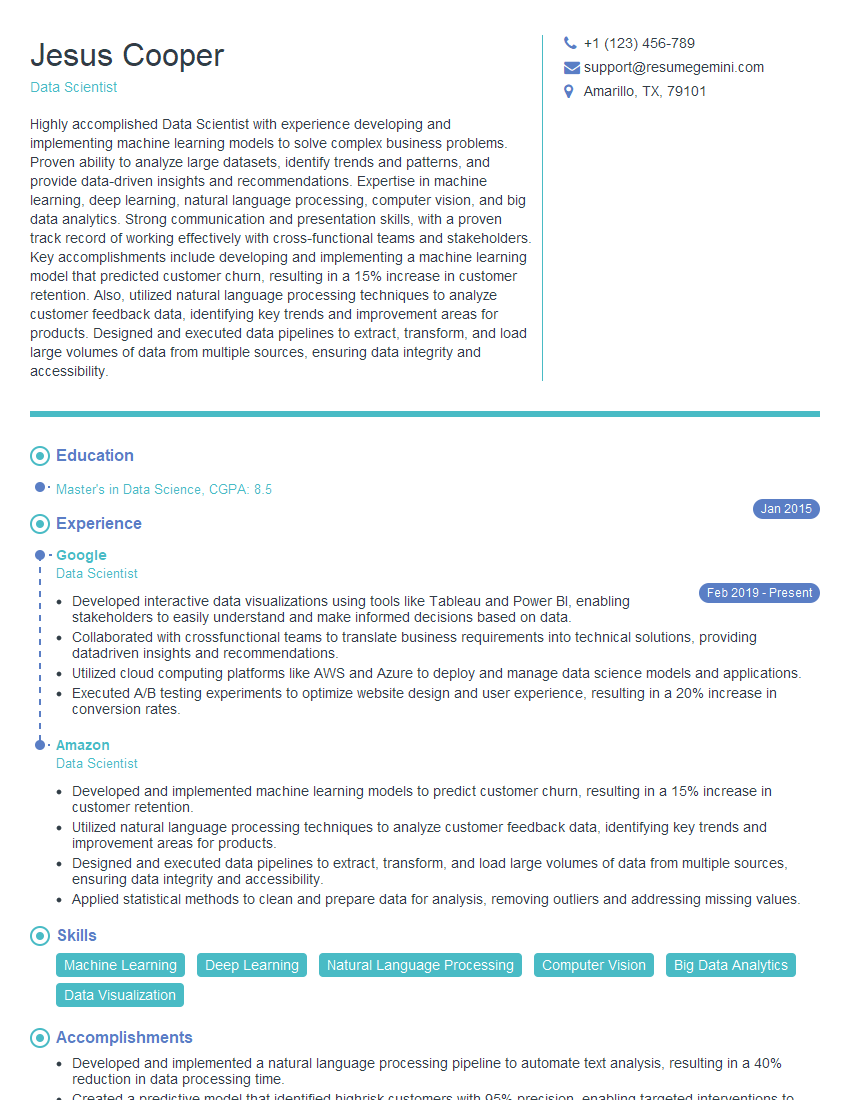
Data Scientist Resume Sample
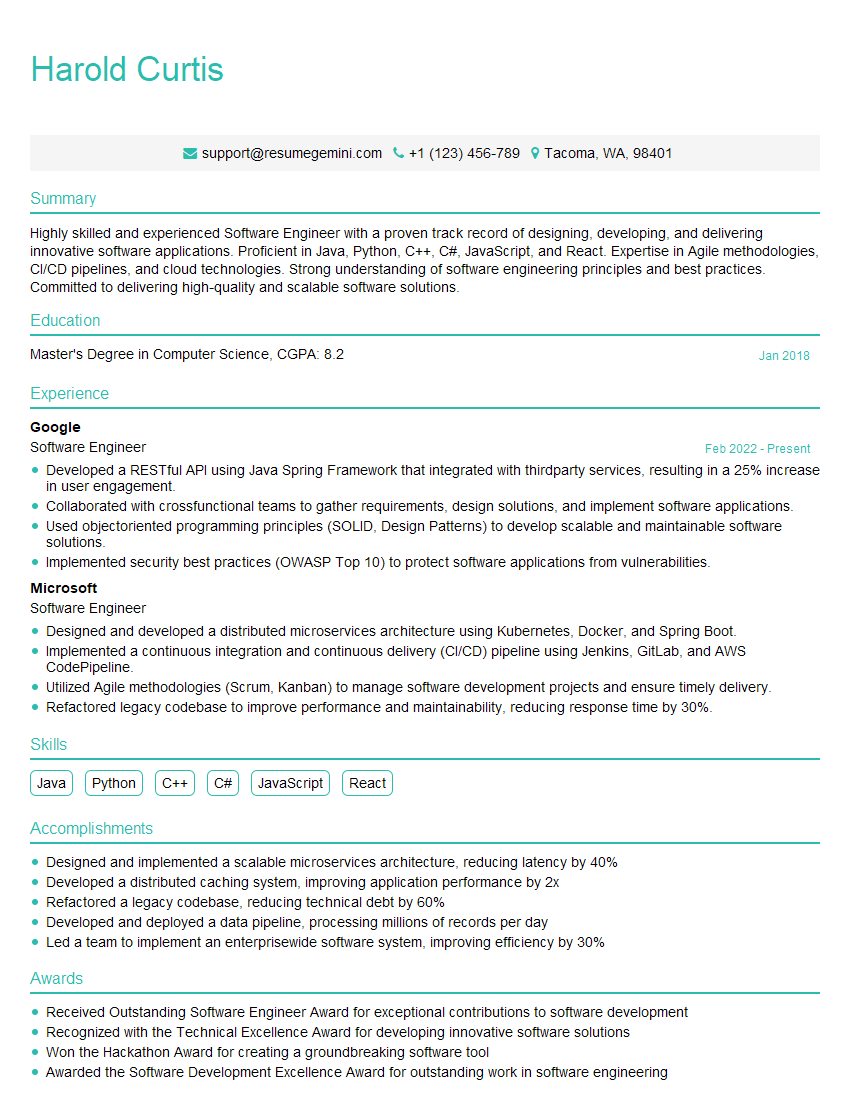
Software Engineer Resume Sample
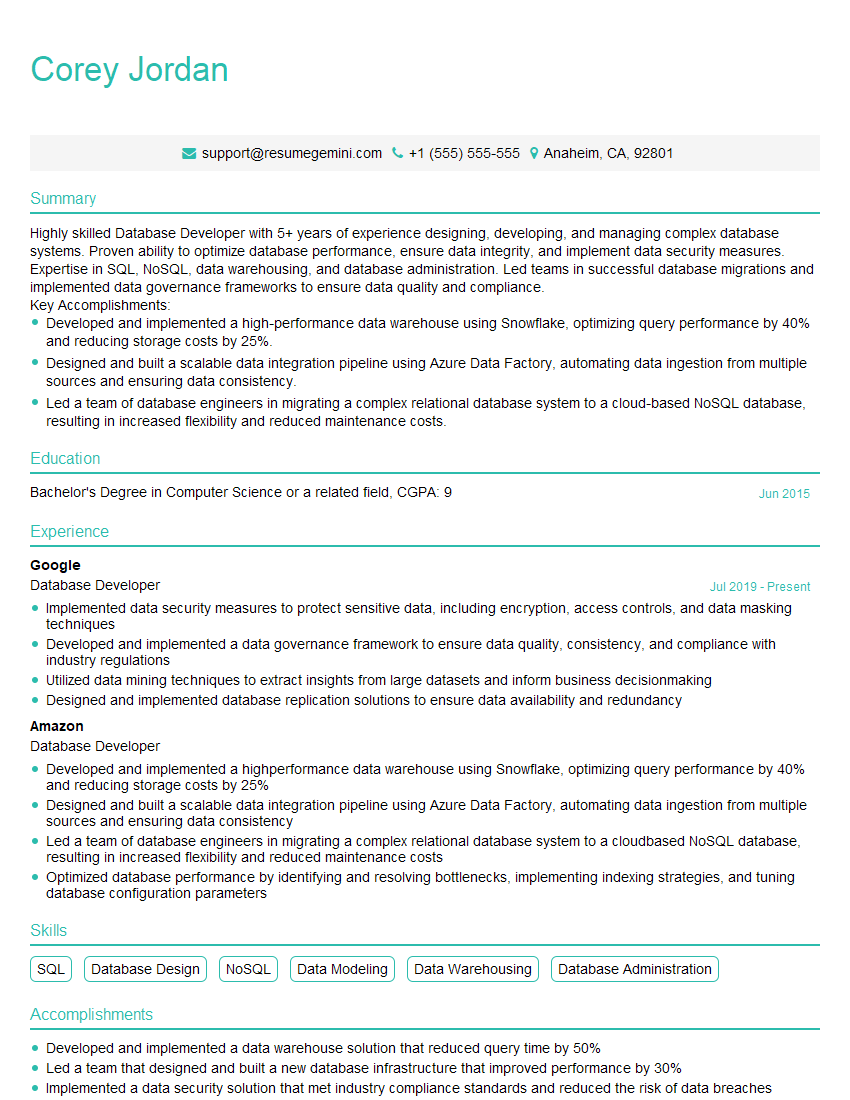
Database Developer Resume Sample
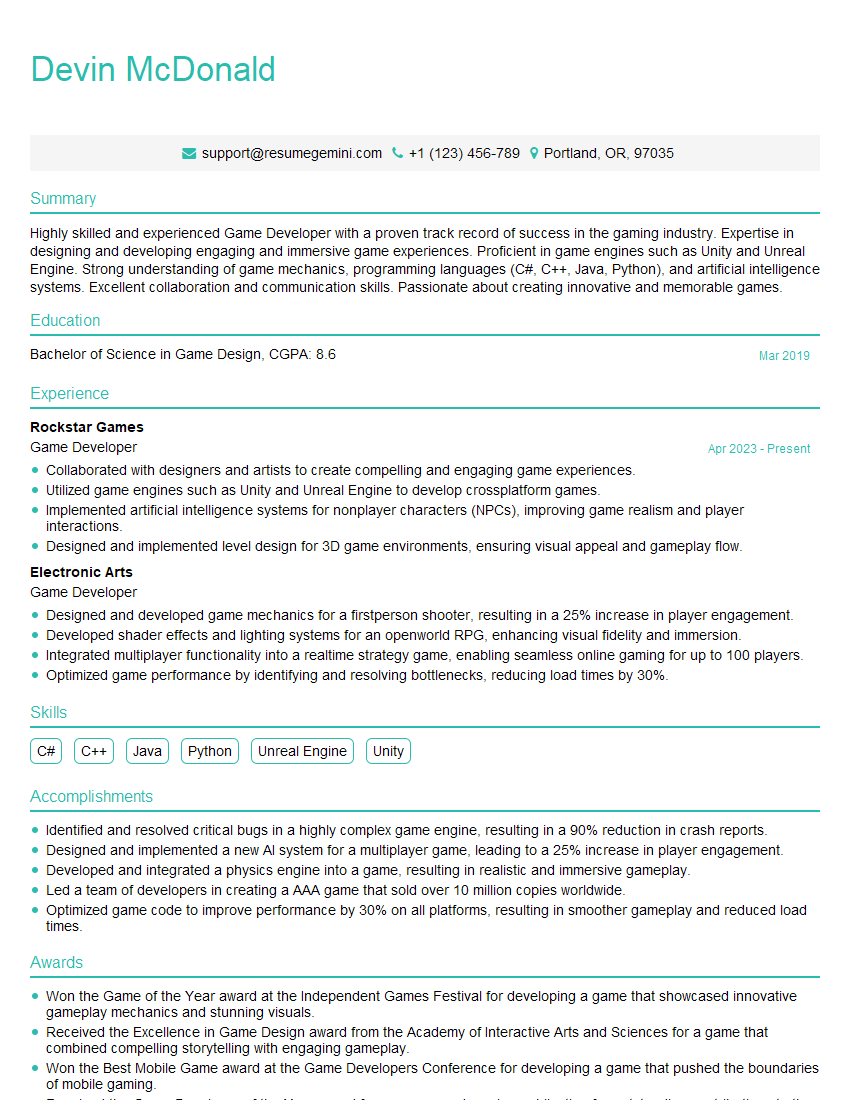
Game Developer Resume Sample
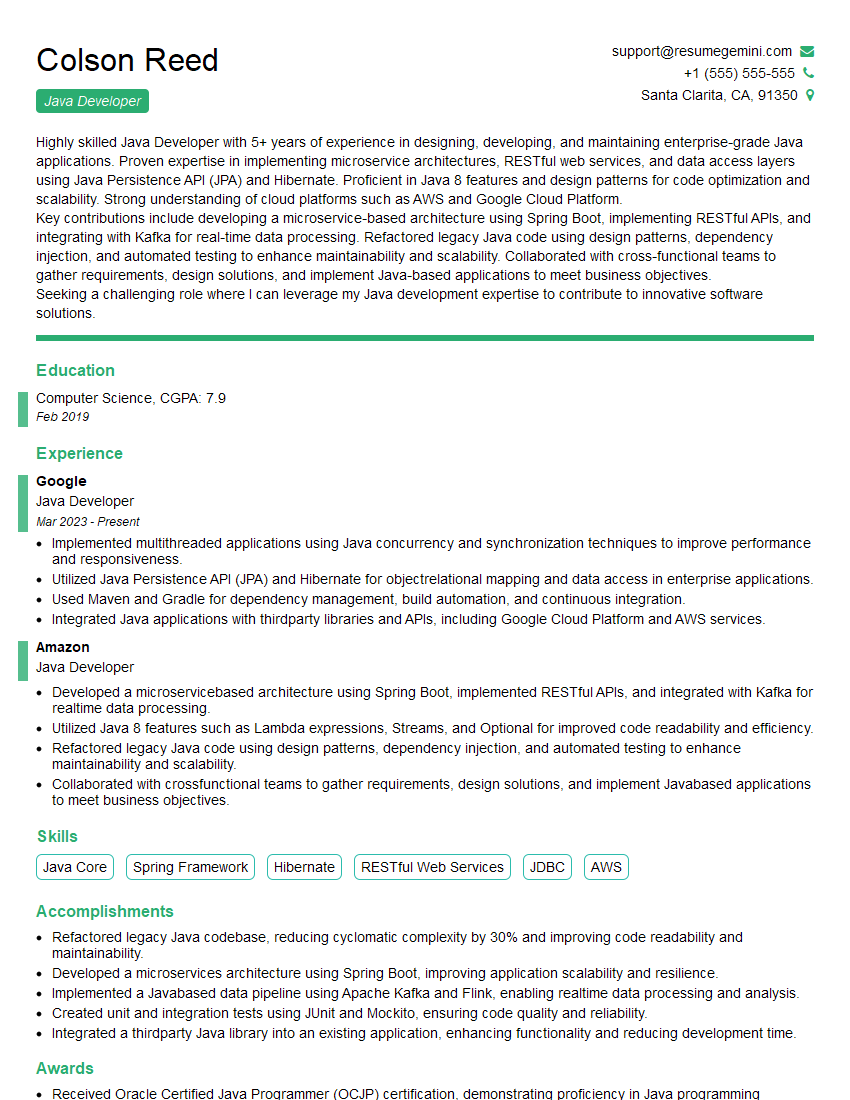
Java Developer Resume Sample
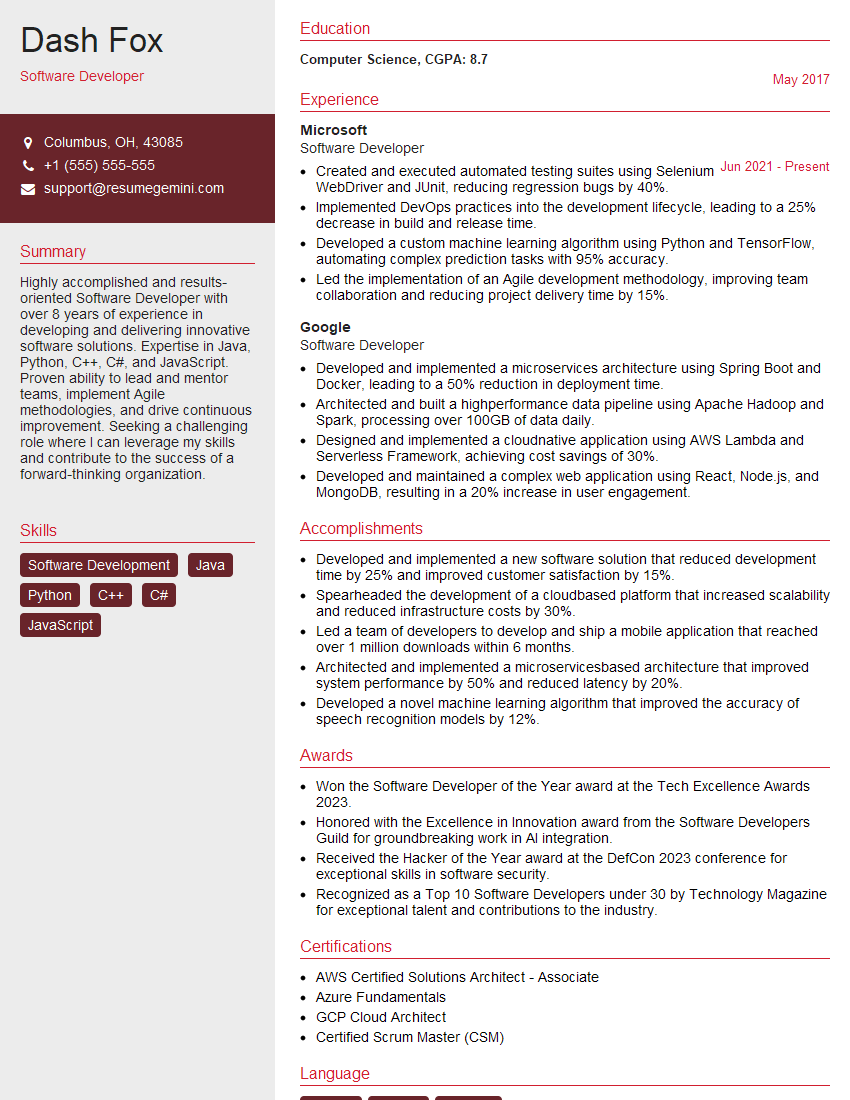
Software Developer Resume Sample
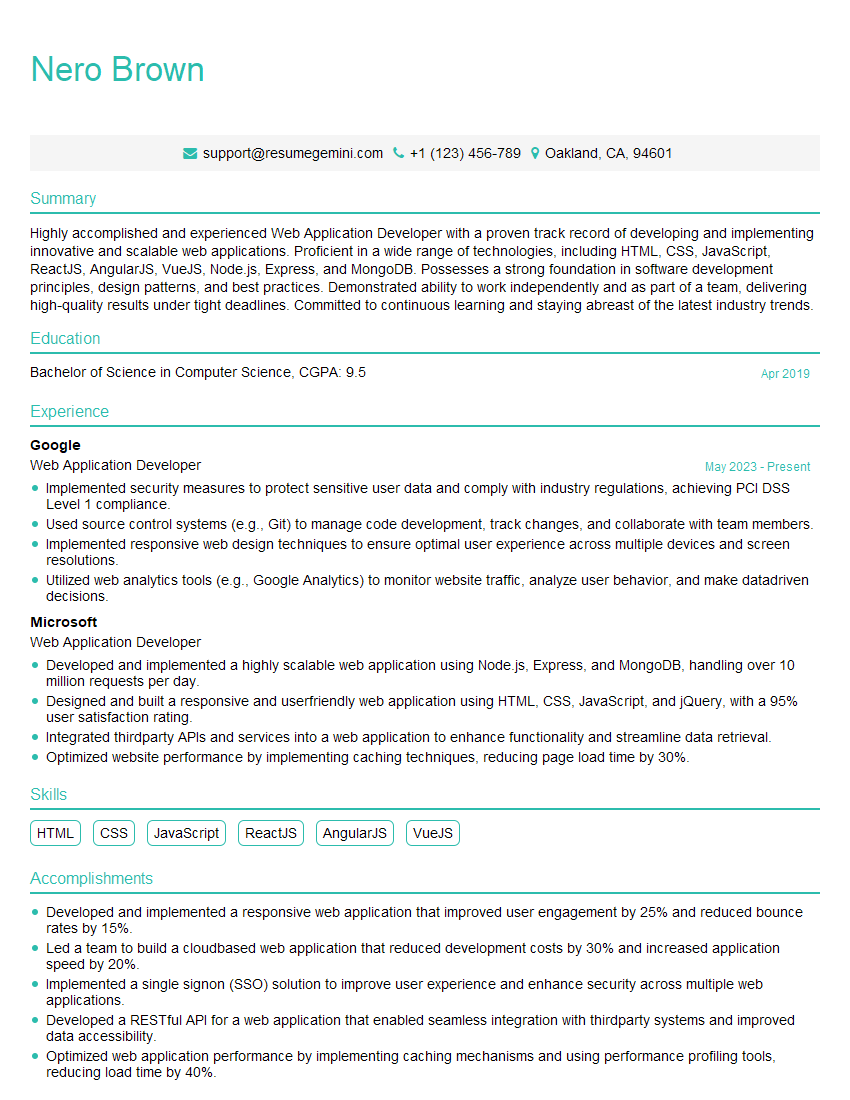
Web Application Developer Resume Sample
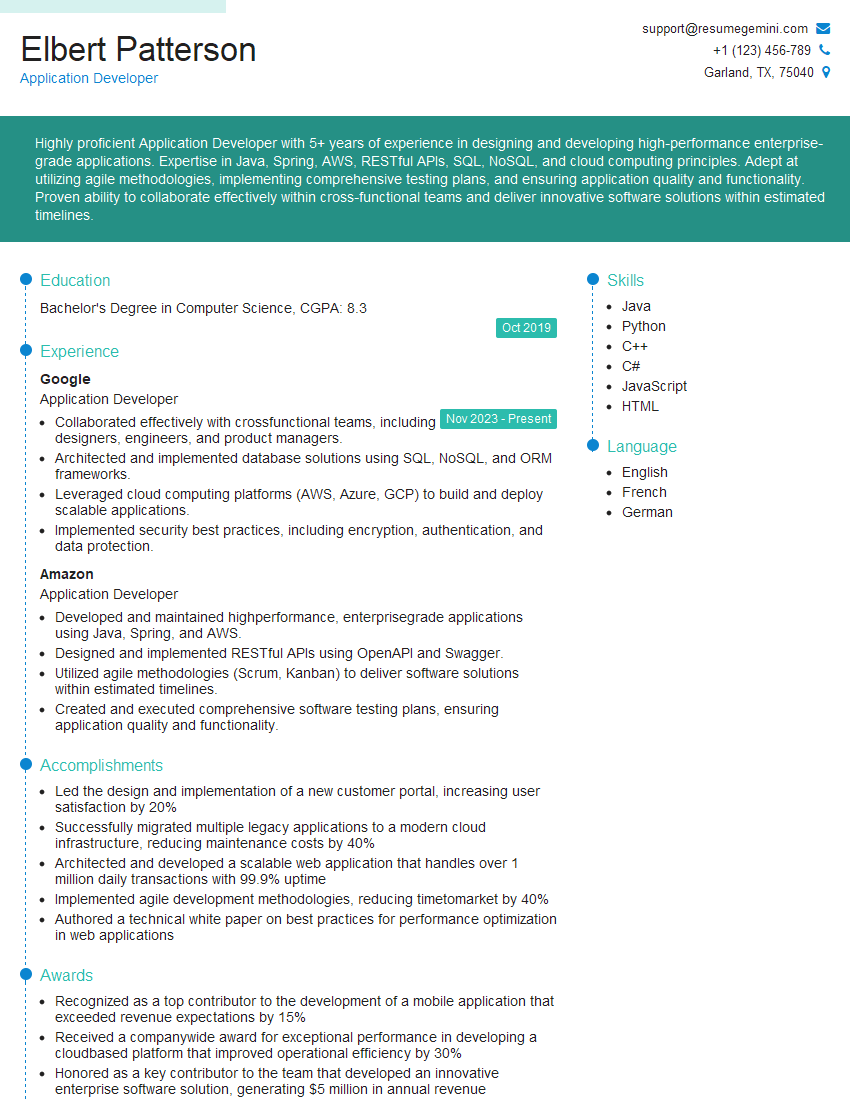
Application Developer Resume Sample
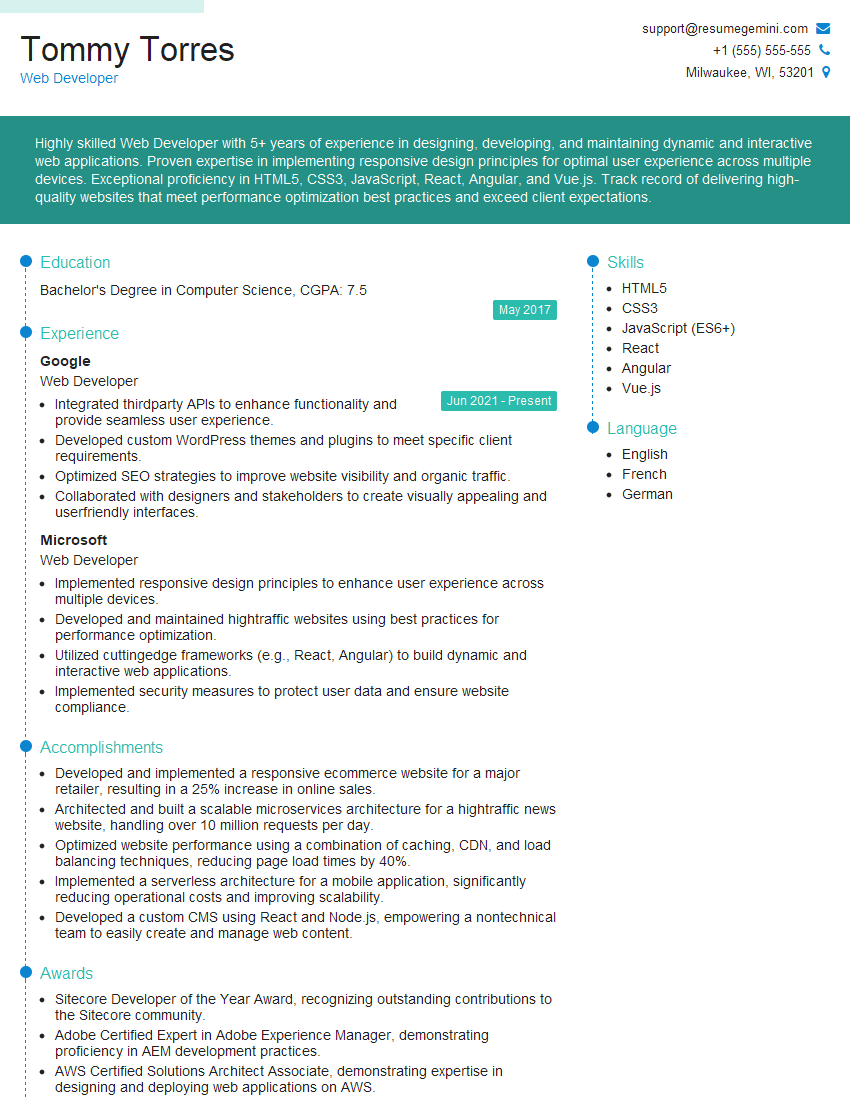
Web Developer Resume Sample
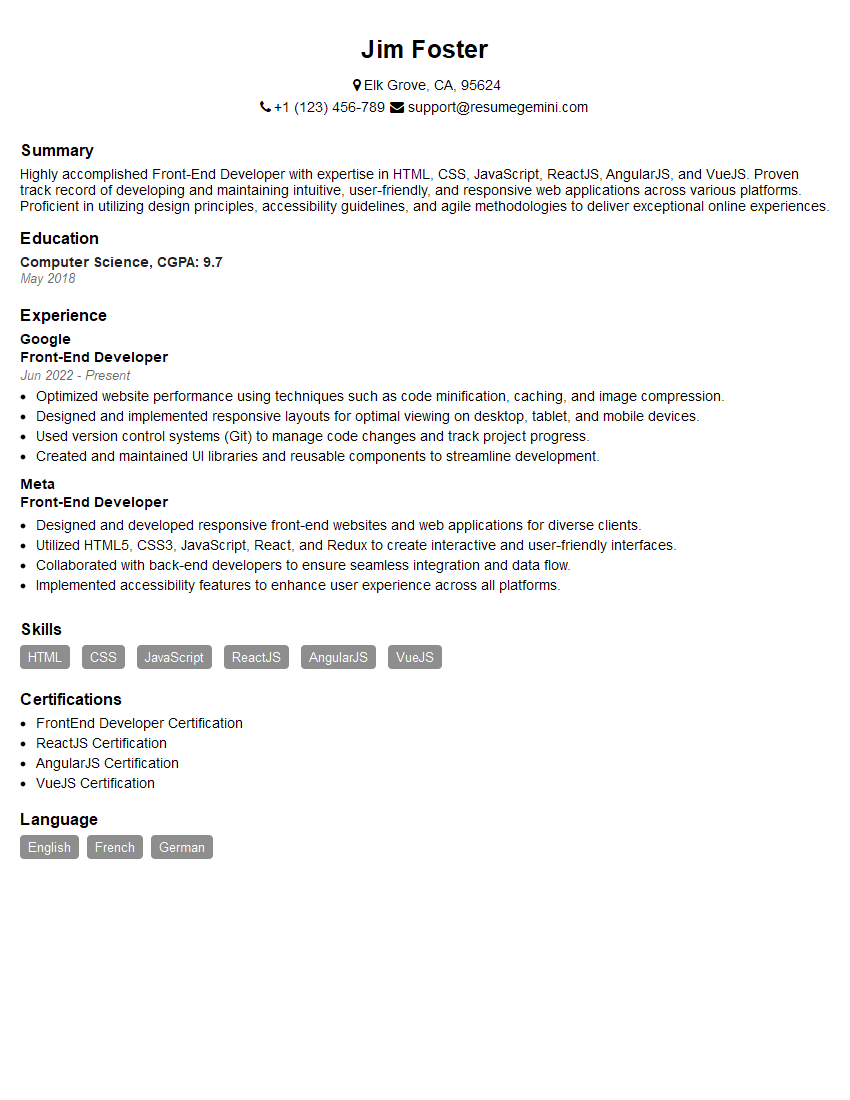
Front-End Developer Resume Sample
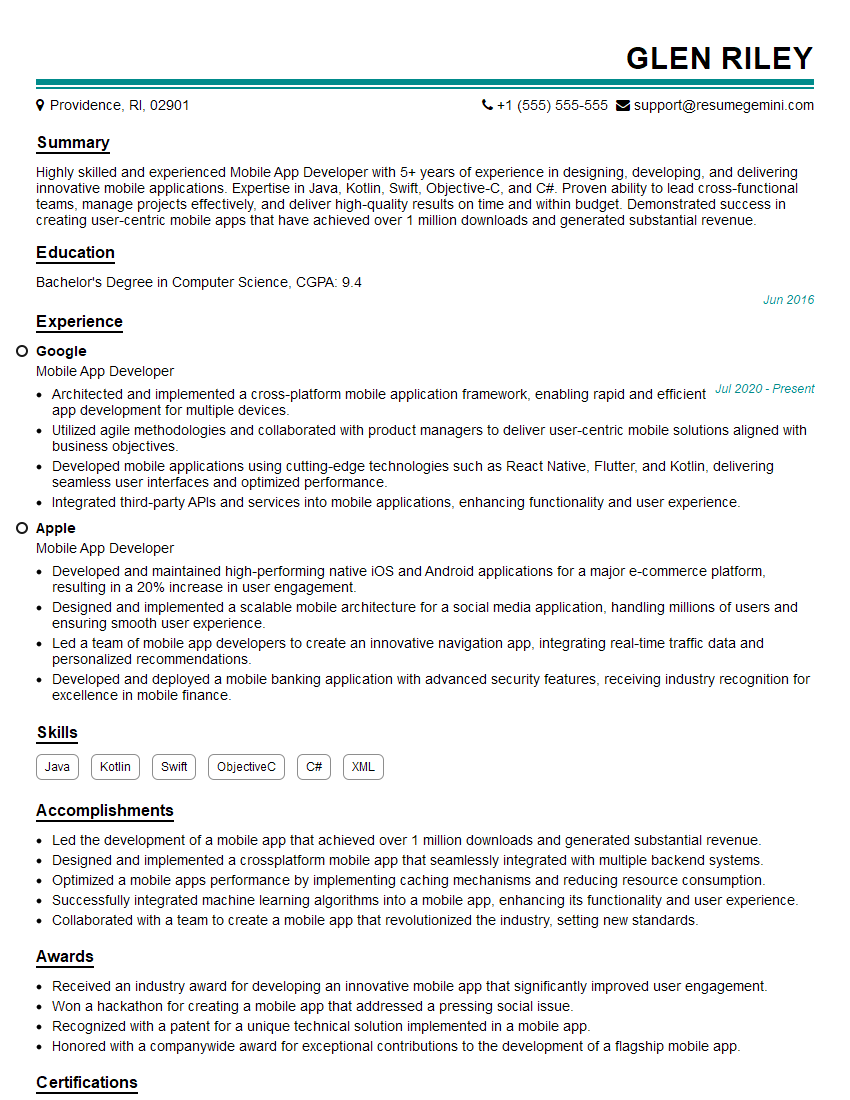
Mobile App Developer Resume Sample
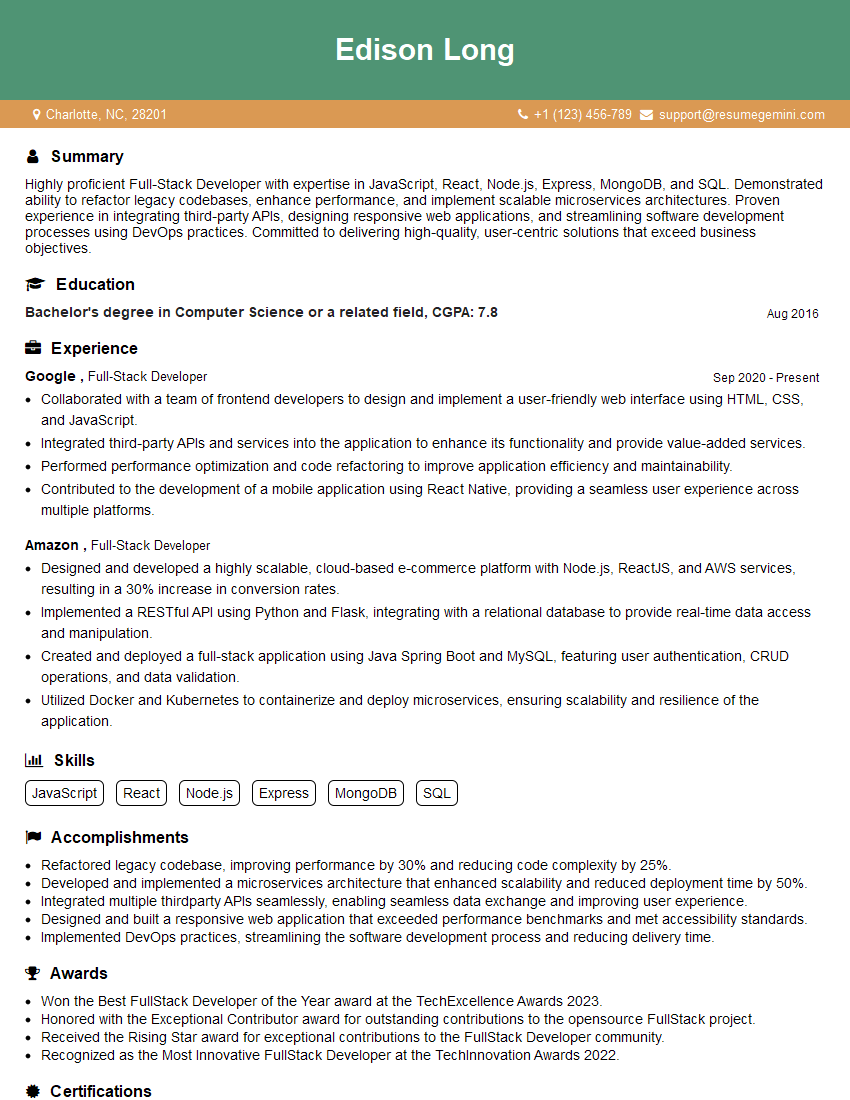
Full-Stack Developer Resume Sample
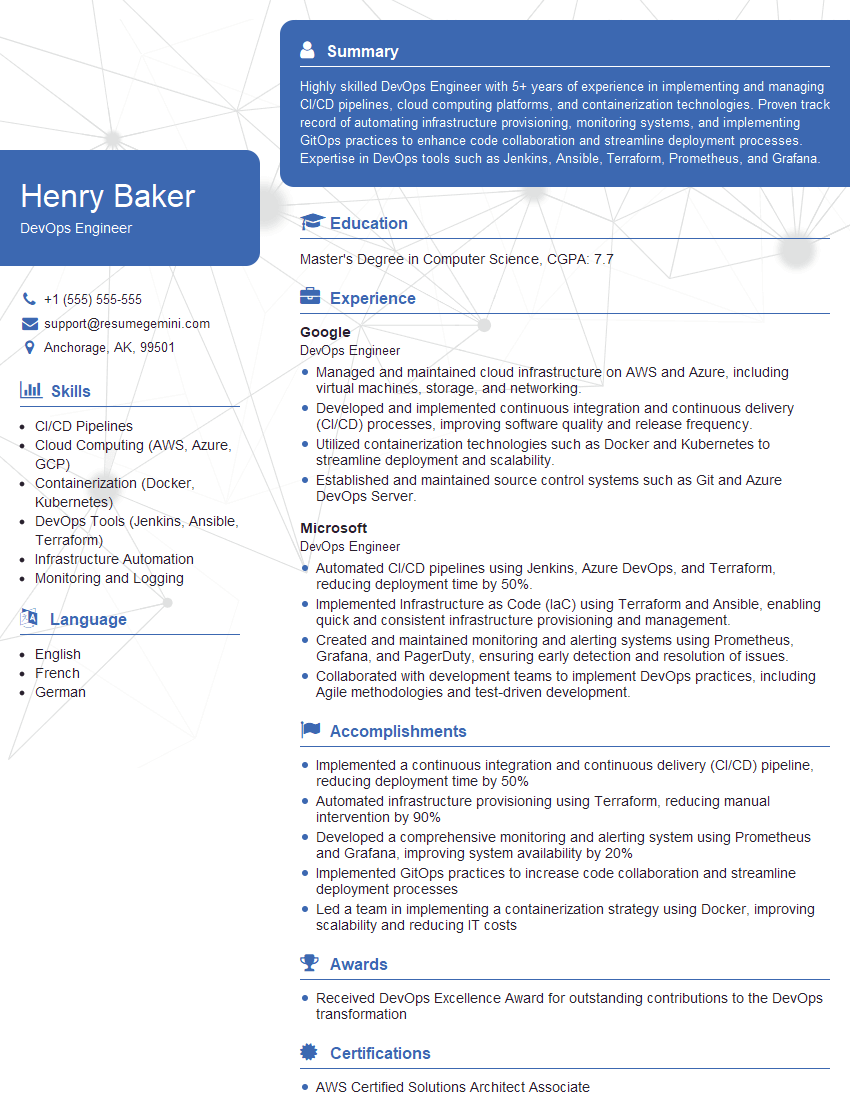
DevOps Engineer Resume Sample
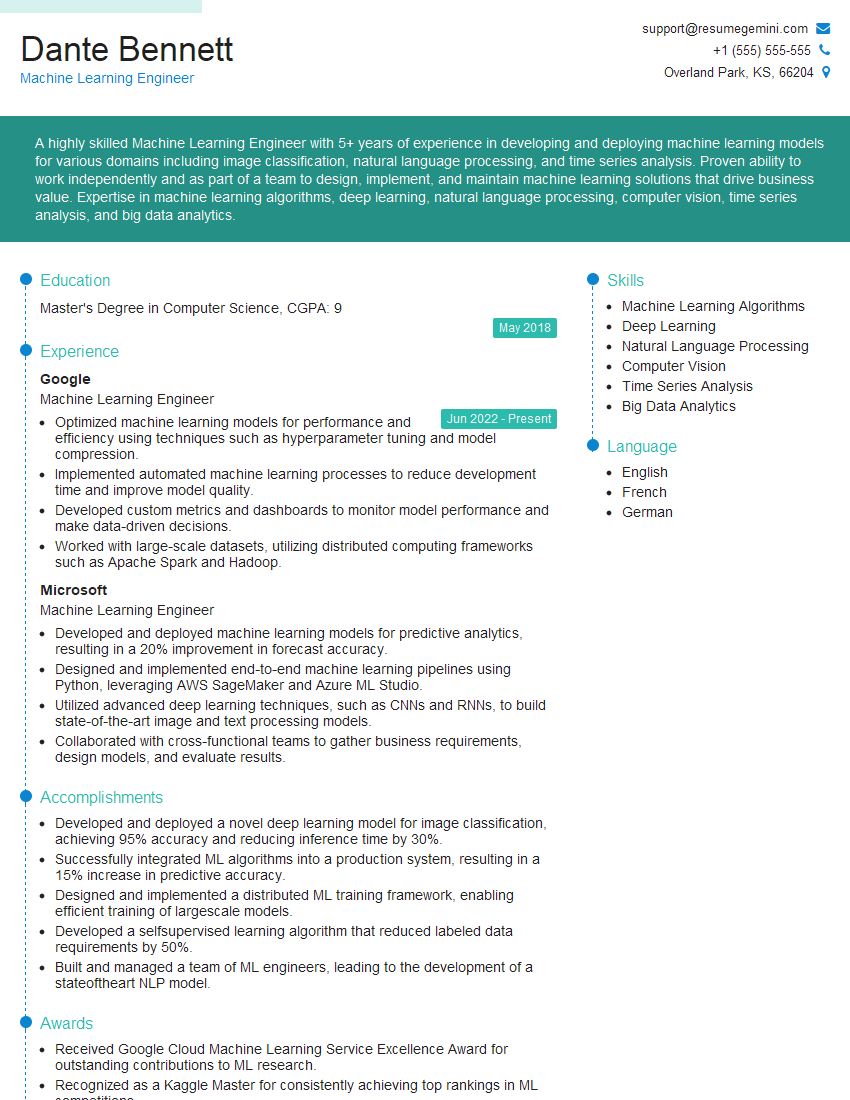
Machine Learning Engineer Resume Sample
Explore more articles
Users Rating of Our Blogs
Share Your Experience
We value your feedback! Please rate our content and share your thoughts (optional).
What Readers Say About Our Blog
Very informative content, great job.
good