Interviews are more than just a Q&A session—they’re a chance to prove your worth. This blog dives into essential Color Theory and Color Management interview questions and expert tips to help you align your answers with what hiring managers are looking for. Start preparing to shine!
Questions Asked in Color Theory and Color Management Interview
Q 1. Explain the difference between additive and subtractive color mixing.
Additive and subtractive color mixing are two fundamental approaches to creating colors, differing primarily in how light and pigment interact. Imagine shining a flashlight (light) on a wall versus mixing paints (pigment).
Additive color mixing is used with light sources, such as monitors and projectors. It starts with black (absence of light) and adds colors to produce other colors. The primary additive colors are red, green, and blue (RGB). When these are combined at full intensity, you get white. Think of your computer screen; each pixel is composed of tiny red, green, and blue sub-pixels. Combining them produces the wide range of colors you see.
Subtractive color mixing deals with pigments, like those found in paints, inks, and dyes. It begins with white (reflection of all light) and subtracts colors by absorbing parts of the spectrum. The primary subtractive colors are cyan, magenta, and yellow (CMY). Combining these at full intensity should ideally yield black, though often a fourth color, black (K), is added (CMYK) to improve the darkness and reduce the amount of other inks needed.
In essence, additive mixing adds light to create color, while subtractive mixing removes light to achieve the same.
Q 2. Describe the CIE color space and its significance.
The CIE (Commission Internationale de l’éclairage) color space is a standardized system for defining and measuring colors. It’s crucial because it provides a universal language for color communication, independent of the devices used to reproduce colors. The CIE 1931 XYZ color space, for instance, is a three-dimensional model. X, Y, and Z represent hypothetical primary colors that, when combined, can match any perceived color. This avoids the limitations of device-dependent color systems, such as RGB or CMYK.
The significance lies in its ability to represent colors precisely and consistently across different devices. This is critical for industries like printing and textile manufacturing where accurate color reproduction is paramount. Imagine designing a company logo; you want to ensure the logo’s colors look exactly the same on a website, printed brochures, and billboards.
Q 3. What are color profiles (e.g., ICC profiles), and why are they important?
Color profiles, often in the form of International Color Consortium (ICC) profiles, are files that describe the color characteristics of a specific device (monitor, printer, scanner) or color space. They act like a ‘translator,’ mapping the device’s colors to a standardized color space, such as sRGB or Adobe RGB. Without these profiles, the colors displayed or printed on one device will likely differ significantly from those on another.
Their importance stems from ensuring color consistency across different devices. For instance, a photographer carefully edits their images using a specific monitor profile. An ICC profile ensures those same colors are reproduced as accurately as possible on a different monitor, when printed, or even viewed on a mobile phone. Without color profiles, color accuracy is highly unreliable.
Q 4. How do you manage color consistency across different devices and output methods?
Managing color consistency across devices involves a multi-step process centered around color management systems (CMS). A CMS uses color profiles to translate colors between different devices and color spaces. Here’s a breakdown:
- Profile all devices: Create or obtain ICC profiles for your monitors, printers, and scanners.
- Soft-proofing: Use software to simulate the final output on different devices before actual printing, allowing for adjustments to match the desired result.
- Color space consistency: Work in a wide-gamut color space (like Adobe RGB) during editing, then convert to the final output color space (like sRGB for web) only during the final stage. This helps preserve more color information.
- Calibration and profiling: Regularly calibrate monitors and printers using specialized tools and software to maintain accuracy over time.
- Controlled environment: Maintain a consistent lighting environment during color critical work. Lighting can drastically affect color perception.
Effective color management reduces waste and rework by ensuring accuracy from start to finish, making it vital for professional print design, photography, and web design.
Q 5. Explain the concept of color gamut and its limitations.
A color gamut is the range of colors a specific device or color space can reproduce. Think of it as the boundaries of the color ‘box’ that a device can create. For example, a monitor has a smaller gamut than a high-end printer.
Limitations arise because no device can reproduce all the colors the human eye can perceive. This is why there’s always a discrepancy between what you see on screen and the printed result. A common limitation is that many devices struggle to reproduce the most saturated colors accurately, leading to duller or less vibrant printed output compared to what’s seen on the screen. The broader the gamut, the more colors a device can reproduce, but wider gamuts often come with more challenges in terms of cost and precision.
Q 6. What are common color spaces used in digital imaging (e.g., sRGB, Adobe RGB)?
Several common color spaces are used in digital imaging. Here are some prominent ones:
- sRGB (Standard Red Green Blue): A widely used color space for the web and internet applications. It’s a relatively small gamut, ensuring compatibility across most devices but sacrificing the range of color reproduction. It is a good choice for images that need broad compatibility and is a good choice for web and social media.
- Adobe RGB (1998): A wider gamut color space than sRGB, offering a richer color reproduction. It’s often preferred for professional photography and printing, where a wider range of colors is needed. However, it comes with compatibility issues; devices that don’t support it might clip the colors outside its gamut, resulting in color shifts.
- ProPhoto RGB: An even wider color space than Adobe RGB. It’s used when the utmost color accuracy is needed; however, it can present significant challenges with color management.
Choosing the right color space depends on the intended use and output of the image.
Q 7. Describe the process of color calibration for monitors and printers.
Color calibration for monitors and printers is essential for accurate color reproduction. It involves using specialized hardware and software to adjust the device’s output to match a known standard.
Monitor Calibration: A colorimeter or spectrophotometer measures the monitor’s output and compares it to a target profile. Calibration software then adjusts the monitor’s settings (brightness, contrast, color balance) to improve accuracy. Regular calibration (every few months) is vital as monitors drift over time.
Printer Calibration: Involves creating a printer profile using a spectrophotometer. The spectrophotometer measures the color output of test prints, enabling the software to generate a profile that precisely describes the printer’s characteristics. This profile can then be applied when sending files to the printer. Calibration involves various tests to account for factors such as ink saturation and paper properties.
Both processes aim to minimize color discrepancies, ensuring what you see on screen closely resembles the printed output. This is particularly important for professionals where accurate color is critical.
Q 8. Explain different color models (RGB, CMYK, LAB).
Color models are mathematical systems for representing colors. Different models are suited to different applications. Three key models are RGB, CMYK, and LAB.
- RGB (Red, Green, Blue): This is an additive color model used for screens and digital displays. It works by combining varying intensities of red, green, and blue light to create a wide range of colors. Each color is represented by a value between 0 and 255 (or 0.0 to 1.0), with (0,0,0) representing black and (255,255,255) representing white. Imagine shining red, green, and blue spotlights on a white wall – where they overlap, you get different colors.
- CMYK (Cyan, Magenta, Yellow, Key [Black]): This is a subtractive color model used for printing. It works by subtracting colors from white light reflected from the paper. Cyan, magenta, and yellow inks are used to absorb specific wavelengths of light, leaving the complementary color behind. Black (K) is added to improve the depth and richness of the darker colors and reduce ink usage. Each color is typically represented as a percentage (0-100%).
- LAB (L*a*b*): This is a device-independent color space designed to mimic human color perception. ‘L’ represents lightness, ranging from 0 (black) to 100 (white). ‘a’ represents the green-red axis, and ‘b’ represents the blue-yellow axis. LAB is useful for comparing colors across different devices and printing processes, as it’s less susceptible to device-specific variations than RGB or CMYK.
Think of it like this: RGB is for light, CMYK is for ink, and LAB is for perception.
Q 9. What is color temperature, and how does it impact perception?
Color temperature refers to the apparent color of a light source, measured in Kelvin (K). It describes the hue of the light, ranging from warm (lower Kelvin values) to cool (higher Kelvin values). Lower temperatures (around 2000K) appear reddish-orange, like a candle flame, while higher temperatures (around 6500K) appear bluish-white, like sunlight.
Color temperature significantly impacts perception. A warm light can create a cozy, inviting atmosphere, while a cool light can feel sterile or professional. For example, a warm-toned room might feel more comfortable for relaxation, whereas a cool-toned office might feel more productive. Incorrect color temperature can also dramatically alter the appearance of colors in images and designs; a photograph shot under a warm incandescent light will look different when viewed under cool fluorescent lighting, affecting the accuracy of color representation.
Q 10. How does color perception vary across different individuals?
Color perception varies significantly between individuals due to several factors, including:
- Age: The lens of the eye yellows with age, affecting color perception, especially in the blue-green range.
- Genetics: Some individuals have genetic variations affecting the cone cells in the retina, responsible for color vision. This can lead to color blindness or variations in color perception.
- Gender: Studies suggest slight differences in color perception between men and women, though the reasons are still under research.
- Experience and Cultural Background: Our understanding of color is also shaped by learned associations and cultural influences. For example, different cultures may have different words for the same color or associate certain colors with specific emotions or meanings.
- Health conditions: Certain medical conditions and medications can impact color vision.
Understanding this variation is critical in design and color management. We need to consider the target audience and strive for consistent color representation that caters to a broad range of perceivers.
Q 11. Explain the concept of color constancy.
Color constancy is the remarkable ability of the human visual system to perceive the consistent color of an object despite changes in the lighting conditions. For example, a red apple will appear red whether it’s lit by sunlight, incandescent light, or fluorescent light. This is not a perfect process, but it’s remarkably effective.
Our brains make complex calculations based on the surrounding environment and the overall lighting situation to compensate for variations in illumination and maintain a stable perception of color. This plays a huge role in ensuring color consistency across varied conditions. For instance, in product photography, ensuring accurate color representation requires controlling lighting to maintain visual consistency.
Q 12. What are metamerism and its implications in color management?
Metamerism occurs when two colors appear identical under one light source but different under another. This happens because different spectral power distributions can stimulate the same response from the three types of cone cells in the human eye, leading to the same perceived color. These colors, though visually identical in one condition, are spectrally distinct.
In color management, metamerism presents significant challenges. Two colors that match on screen (RGB) may not match when printed (CMYK) because of the differences in the way light is produced and absorbed in each process. It is crucial to use calibrated instruments and color management systems to minimize the occurrence of metameric mismatches. This often involves using color standards and controlling the lighting conditions throughout the entire workflow.
Q 13. Describe different color measurement instruments and their applications.
Several instruments measure color. The choice depends on the application:
- Spectrophotometers: These instruments measure the spectral reflectance or transmittance of a sample, providing a detailed spectral curve. This is the most accurate method, as it reveals the precise composition of light reflected from or transmitted through a sample. Spectrophotometers are used for precise color measurement in quality control and research.
- Colorimeters: These measure the tristimulus values (XYZ) of a sample, providing a summary of color perception rather than the complete spectral information. They are more affordable than spectrophotometers and are commonly used for monitoring color consistency in manufacturing.
- Densitometers: These measure the density of ink on printed materials, often used in the printing industry to control ink levels and color accuracy. They are less precise for overall color measurement compared to spectrophotometers or colorimeters but are useful for process control within a printing workflow.
These instruments are crucial in ensuring consistent color across different stages of production, from design to final output.
Q 14. How do you handle color discrepancies between design and final output?
Addressing color discrepancies between design and final output requires a systematic approach:
- Color Profile Management: Ensure that all devices (monitors, printers, scanners) involved in the workflow have accurate color profiles. These profiles describe the device’s color response and allow for color transformations to be applied automatically. A well-calibrated system is crucial.
- Proofing: Utilize soft proofing or hard proofing to preview the final output before actual production. Soft proofing simulates the final output on the screen, while hard proofing involves printing a test sample using the same materials and process as the final product.
- Standardized Color Spaces: Use device-independent color spaces like LAB for design work whenever possible, so the colors remain relatively consistent across different devices and processes. Avoid relying solely on RGB, which is device-dependent.
- Communication: Clear and precise communication between designers, printers, and clients is essential. Standardized color names or codes (Pantone, for example) can aid in color specification.
- Iterative adjustments: In most scenarios, there will be minor color adjustments needed, especially with complex designs. Plan for this iterative process to fine-tune and achieve the desired color accuracy.
By implementing these strategies, you can significantly reduce color discrepancies and achieve more reliable color consistency across the entire workflow.
Q 15. Explain the concept of Delta E and its relevance in color accuracy.
Delta E, or ΔE, quantifies the difference between two colors. It’s essentially a measure of the perceived color difference, not just a numerical difference in RGB or other color spaces. A smaller Delta E value indicates a closer match, while a larger value suggests a more noticeable difference. Its relevance lies in ensuring color accuracy across different devices and processes. For example, a Delta E of 1 might be imperceptible to the human eye, while a Delta E of 5 would be quite noticeable. Different applications have different tolerance levels; a critical application like medical imaging would need much lower Delta E values than, say, a website background color.
Think of it like this: imagine you’re painting a car. You want the paint to perfectly match the color code. Delta E helps you measure how close the final paint color is to the target color. The lower the Delta E, the closer and more accurate the match.
Different Delta E formulas exist, notably ΔE76, ΔE94, ΔE00, and ΔEab. Each addresses perceived color differences slightly differently, considering factors like color saturation and lightness. Choosing the right formula depends on the application and color space used.
Career Expert Tips:
- Ace those interviews! Prepare effectively by reviewing the Top 50 Most Common Interview Questions on ResumeGemini.
- Navigate your job search with confidence! Explore a wide range of Career Tips on ResumeGemini. Learn about common challenges and recommendations to overcome them.
- Craft the perfect resume! Master the Art of Resume Writing with ResumeGemini’s guide. Showcase your unique qualifications and achievements effectively.
- Don’t miss out on holiday savings! Build your dream resume with ResumeGemini’s ATS optimized templates.
Q 16. What are your experiences with color management software?
I have extensive experience with various color management software, including industry-standard tools like Adobe Color Engine, X-Rite i1Profiler, and ColorSync Utility. I’m proficient in creating and managing ICC profiles for different devices (printers, monitors, scanners), ensuring consistent color reproduction across the workflow. I’ve used these tools to calibrate monitors for accurate on-screen representation of colors, build custom profiles for specific printing presses, and troubleshoot color discrepancies in complex print projects. My experience extends beyond profile creation to include the effective use of color transformation and gamut mapping features within these applications. For example, I’ve successfully resolved a client’s color inconsistencies during large-format printing by meticulously crafting a custom ICC profile tailored to their specific printer and paper type.
Q 17. How do you troubleshoot color issues in a print production environment?
Troubleshooting color issues in print production involves a systematic approach. It begins with identifying the source of the problem. This often involves:
- Visual Inspection: Carefully comparing the printed output to the proof and/or the digital design file.
- Device Calibration Verification: Checking the calibration status of all devices involved (printer, monitor, scanner) and ensuring their ICC profiles are up-to-date and correctly applied.
- Ink/Toner Levels: Checking for low ink/toner, as depleted supplies can cause color shifts.
- Substrate Analysis: Evaluating the paper or other printing materials; differences in paper absorption can impact color rendition.
- Profile Analysis: Reviewing the ICC profiles used for each device to identify any inconsistencies or potential conflicts.
- Software Settings Review: Ensuring proper color settings are selected in the RIP (Raster Image Processor) and print driver.
Once the problem area is identified, the solution might involve recalibrating devices, replacing consumables, adjusting print settings, or even re-creating the ICC profiles. It’s a process that requires careful attention to detail and a deep understanding of the entire print workflow.
For example, I once solved a color mismatch problem by discovering that the RIP software was defaulting to a wrong color profile. Simply changing this setting solved the issue.
Q 18. Describe your experience with Pantone Matching System (PMS).
The Pantone Matching System (PMS) is a critical tool in my color management arsenal. I have extensive experience specifying, matching, and verifying PMS colors across various print and digital media. I understand the limitations of spot colors and how to bridge the gap between spot color specifications and the capabilities of different printing processes. My experience involves:
- PMS Color Selection: Choosing the appropriate PMS colors for print projects, considering factors such as cost and print method.
- Color Verification: Using Pantone guides and spectrophotometers to ensure accurate color matching during print production.
- PMS to CMYK Conversion: Understanding the limitations of converting spot colors to process colors (CMYK) and implementing strategies for accurate approximations.
Working with PMS requires precision; a small variation can result in significant color differences. I’ve used this system across a wide range of projects, from corporate branding to packaging design, ensuring brand consistency and visual accuracy.
Q 19. How familiar are you with spectral data and its use in color management?
Spectral data, representing the reflectance or transmittance of light across the visible spectrum, forms the foundation of accurate color management. I’m very familiar with its use. Spectral data allows for a precise, objective measurement of color, independent of device-specific color spaces like RGB or CMYK. This objective data is crucial for:
- ICC Profile Creation: High-quality ICC profiles rely on accurate spectral measurements to define the color characteristics of devices.
- Color Matching: Spectral data enables precise color comparison and matching across different devices and media.
- Color Communication: It provides a common language for color communication between manufacturers, designers, and printers.
- Gamut Mapping: Understanding the spectral limitations of a device aids in accurately mapping colors outside its gamut.
Spectrophotometers and colorimeters are tools that I utilize to collect this crucial spectral data, which is then used to create and refine accurate color profiles and ensure reliable color consistency across diverse production processes.
Q 20. What is your experience with color proofing methods?
My experience encompasses a variety of color proofing methods, ranging from soft proofing (on-screen simulation) to hard proofing (physical prints). I’m proficient in using different types of proofing solutions including:
- Soft Proofing: Utilizing software tools that simulate the appearance of printed output on screen, considering paper type and print technology.
- Hard Proofing: Using professional proofing systems such as Epson Stylus Pro or similar, generating physical proofs that closely mimic the final printed product. This may involve using dedicated proofing papers and inks.
- Contract Proofing: Utilizing high-quality proofing systems to ensure final color accuracy for critical projects.
The choice of method depends on the project’s requirements and budget. For high-stakes projects, contract proofing is often necessary to ensure client approval and minimize costly reprints. I understand the strengths and limitations of each approach and tailor my selection to maximize accuracy and efficiency.
Q 21. How do you ensure color accuracy in web design?
Ensuring color accuracy in web design requires a multi-faceted approach. It’s not simply about choosing pleasing colors; it’s about ensuring those colors appear consistently across different devices and browsers:
- Color Mode: Using sRGB, the standard color space for web design, as a basis for color selection. This ensures broader compatibility.
- CSS Color Specifications: Using hex codes (#RRGGBB) for precise color definition, avoiding subjective color names.
- Browser Compatibility: Testing the website’s appearance on various browsers and devices to identify and address any inconsistencies.
- Image Optimization: Compressing images without sacrificing color accuracy, ensuring proper color profiles are embedded.
- Monitor Calibration: Ensuring the designer’s monitor is properly calibrated to sRGB, to avoid personal bias in color choices.
Using tools like color pickers and color palettes that specify hex codes and sRGB values greatly improves consistency. Regular browser testing and cross-device verification are crucial for ensuring that the final website renders colors as intended across diverse user environments.
Q 22. Explain your workflow for creating color palettes.
Creating a compelling color palette is a crucial step in any design project. My workflow is iterative and involves several key stages: Firstly, I define the project’s mood and target audience. This helps me establish the emotional tone and visual direction. For example, a children’s book might require bright, playful hues, while a corporate website would lean toward sophisticated and professional tones. Secondly, I conduct thorough research, exploring existing palettes that resonate with my initial direction. Tools like Adobe Color and Coolors are invaluable here, offering inspiration and pre-made palettes to spark ideas. I then begin experimenting with different color harmonies – complementary, analogous, triadic, etc. – leveraging color wheels to visualize relationships and ensure visual balance. I might start with a dominant color and then build around it, considering both hue and saturation. For example, selecting a deep teal as a base could lead to exploring its analogous greens and blues, or its complementary oranges and reds for contrast. Throughout this process, I carefully consider accessibility, making sure there’s sufficient contrast for readability. I test the palette in different contexts, such as on screen and in print, to anticipate how the colors will appear in different mediums. Finally, I meticulously document my choices, recording the precise color values (e.g., Hex codes, CMYK, RGB) for consistent use across all project assets.
Q 23. Describe different types of color blindness and how they affect color perception.
Color blindness affects an estimated 8% of men and 0.5% of women, significantly impacting color perception. There are several types, with the most common being:
- Protanopia (Red-Green Color Blindness): Difficulty distinguishing between reds and greens. Reds appear darker, and greens appear more yellowish.
- Deuteranopia (Red-Green Color Blindness): Similar to protanopia, but the impact on color perception is often less severe.
- Tritanopia (Blue-Yellow Color Blindness): Much rarer, characterized by difficulty distinguishing between blues and yellows. Blues appear greener, and yellows appear more whitish.
The effects on color perception vary considerably, ranging from mild difficulty distinguishing certain shades to complete inability to perceive specific colors. In design, we need to be mindful of this. It’s crucial to avoid relying solely on color to convey information. For instance, if a button relies solely on color to indicate interactivity, individuals with color blindness might miss it. Instead, we should incorporate clear text labels, distinct shapes, or patterns to provide alternative cues. Testing palettes with online color blindness simulators can offer valuable insights into how different individuals might experience the design.
Q 24. How do you manage color in different file formats (e.g., JPEG, TIFF, PNG)?
Managing color across different file formats requires understanding each format’s color space and capabilities. JPEG is a lossy format, meaning some color information is discarded during compression, leading to potential color shifts. TIFF, on the other hand, is a lossless format, preserving color information accurately. PNG, also lossless, is often preferred for graphics with sharp edges and transparent backgrounds. For optimal color management:
- Work in a wide-gamut color space (like Adobe RGB or ProPhoto RGB) during design to capture the fullest range of colors. This helps avoid losing information when converting to a smaller gamut for output.
- Use a color profile embedded in your files to specify the color space. This ensures the intended colors are displayed correctly when opened in different software or devices.
- Convert to the target color space (e.g., sRGB for web, CMYK for print) only during the final export, minimizing color degradation. Use appropriate conversion methods within your design software to manage this.
- Soft-proofing is essential, using simulations to preview how the design will look in the final output color space. This helps mitigate surprises during the printing or online publishing process.
For instance, a logo designed in Adobe RGB should be soft-proofed in sRGB before exporting as a JPEG for a website to ensure the colors remain consistent.
Q 25. Explain the concept of gamut mapping.
Gamut mapping is the process of translating colors from one color space (source gamut) to another (destination gamut). This is essential because different devices and media have varying color reproduction capabilities. For example, a monitor’s gamut is wider than a printer’s, meaning some colors visible on screen might not be printable. Gamut mapping addresses this mismatch.
There are various gamut mapping methods, each with different approaches to handling out-of-gamut colors (colors that exist in the source gamut but not the destination):
- Clipping: Simply discarding out-of-gamut colors. This can lead to unexpected and drastic color changes.
- Compression: Scaling down the color saturation to fit within the destination gamut. This preserves the overall color relationships but slightly dulls the colors.
- Perceptual Mapping: Prioritizing the visual appearance and preserving the color relationships as much as possible, even if the exact colors change slightly.
The optimal method depends on the project’s specific needs. Perceptual mapping often produces aesthetically pleasing results, even if colors might not be perfectly accurate, but clipping might be better if maintaining exact color is critical. Software like Adobe Photoshop and Illustrator offer gamut mapping options within their color management settings.
Q 26. What software and hardware are you familiar with for color management?
My experience encompasses a wide range of color management software and hardware. In software, I’m proficient in Adobe Creative Suite (Photoshop, Illustrator, InDesign), which offer robust color management tools including ICC profile support, color adjustments, and soft-proofing capabilities. I also utilize color management features in other professional design software such as Affinity Photo and Designer. Furthermore, I’m familiar with color management systems integrated into operating systems like macOS and Windows.
Regarding hardware, I have experience with calibrated monitors (using Datacolor SpyderX Pro), ensuring accurate color representation on screen. I’ve also worked with calibrated printers and colorimeters, which are crucial for achieving accurate color reproduction in print.
Q 27. Describe your experience in creating and managing color libraries.
Creating and managing color libraries is vital for maintaining consistency across multiple projects. My approach involves organizing color palettes systematically, using descriptive names and metadata to identify each palette’s purpose and context. This might include project names, client information, and color harmony types. I use both digital and physical methods for storage. Digital libraries are maintained using dedicated software or by incorporating palettes into cloud-based systems for easy access and collaboration. Additionally, I often create physical swatches for client presentations or as a quick visual reference.
Example: For a client specializing in interior design, I created a library categorized by color families (earth tones, pastels, jewel tones, etc.), each containing multiple palettes with detailed information about the color usage.
Q 28. How do you approach collaborative color decision making on a project?
Collaborative color decision-making requires clear communication and a structured approach. I typically start by establishing clear objectives and expectations regarding the project’s visual style. Then, I present mood boards and initial color explorations to the team, initiating a collaborative discussion. Tools like online collaborative platforms or shared digital color palettes facilitate this process. I encourage open feedback and actively listen to different perspectives. The team might use online color picker tools to explore variations and adjustments collectively. Using a clear naming convention, such as ‘Palette A (client feedback v2),’ maintains a transparent record of adjustments made. Finally, decisions are documented and communicated to all stakeholders, ensuring everyone is on the same page and understands the reasoning behind the final color choices.
Key Topics to Learn for Your Color Theory and Color Management Interview
- Color Models (RGB, CMYK, LAB): Understand the differences, strengths, and weaknesses of each model and when to apply them in various design and printing contexts. Consider scenarios where color transformations are necessary.
- Color Perception and Psychology: Explore how different colors evoke emotions and how cultural context influences color interpretation. Be ready to discuss the impact of color choices on user experience and branding.
- Color Harmonies and Contrast: Master the principles of complementary, analogous, and triadic color schemes. Practice applying these concepts to create visually appealing and effective designs. Consider accessibility and color blindness awareness.
- Color Management Workflows: Explain your understanding of profile creation, color space conversion, and soft proofing. Be prepared to discuss practical challenges and solutions encountered in managing color accuracy across different devices and workflows.
- Color Calibration and Profiling: Describe the importance of calibrating monitors and printers to achieve accurate color reproduction. Be ready to discuss different calibration methods and their importance in professional environments.
- Pantone Matching System (PMS): Understand the significance of PMS colors in ensuring consistent brand identity across various applications. Be able to explain its practical use in design and printing.
- Troubleshooting Color Issues: Discuss common color-related problems (e.g., color shifts, banding) and the strategies you would use to diagnose and solve them.
Next Steps
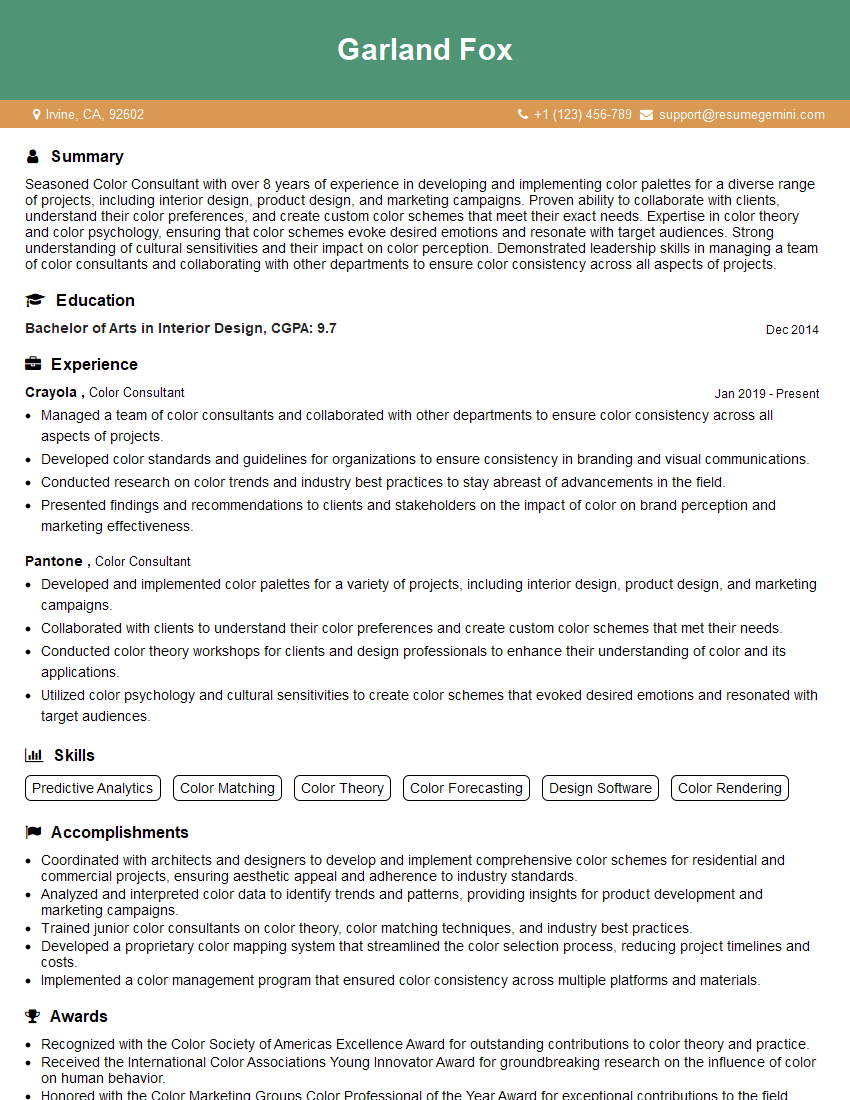
Mastering Color Theory and Color Management is crucial for career advancement in fields like graphic design, web development, and printing. A strong understanding of these concepts will significantly enhance your problem-solving skills and demonstrate your expertise to potential employers. To maximize your job prospects, it’s vital to have an ATS-friendly resume that highlights your skills and experience effectively. Use ResumeGemini to build a professional resume that showcases your capabilities in a clear and compelling manner. ResumeGemini provides examples of resumes tailored to Color Theory and Color Management professionals, helping you craft a document that stands out to recruiters.
Explore more articles
Users Rating of Our Blogs
Share Your Experience
We value your feedback! Please rate our content and share your thoughts (optional).
What Readers Say About Our Blog
Very informative content, great job.
good