Interviews are more than just a Q&A session—they’re a chance to prove your worth. This blog dives into essential Flight Plan Coordination interview questions and expert tips to help you align your answers with what hiring managers are looking for. Start preparing to shine!
Questions Asked in Flight Plan Coordination Interview
Q 1. Explain the process of filing a flight plan.
Filing a flight plan is crucial for safety and air traffic management. It involves submitting a detailed itinerary to air traffic control (ATC) before takeoff, outlining your intended route, altitude, and estimated time of arrival (ETA) at various checkpoints. Think of it like submitting a detailed road trip plan to a highway patrol – it lets them know where you’re going and when, allowing them to manage traffic flow and ensure your safety.
The process typically involves using flight planning software or websites to create the plan, then submitting it electronically or via a phone call to the appropriate ATC authority. This usually happens several hours before departure, allowing ample time for any necessary adjustments or approvals. After submission, you’ll receive a confirmation, often with a flight plan identification number. This number is essential for tracking your flight and communicating any changes to ATC.
- Gather flight data: This includes departure and destination airports, aircraft type, estimated flight time, and desired cruising altitude.
- Choose a route: This often involves selecting airways and waypoints to navigate efficiently while avoiding restricted airspace.
- Calculate fuel requirements: Accurate fuel calculations account for flight distance, weather conditions, and reserves.
- Submit the plan: This is done through approved channels, often electronically, to the relevant ATC.
- Obtain confirmation: ATC confirms receipt and assigns a flight plan number.
Q 2. Describe the different types of flight plans.
Flight plans are categorized in various ways, depending on the regulatory authority and the flight’s complexity. Two primary types are VFR (Visual Flight Rules) and IFR (Instrument Flight Rules) flight plans. A VFR flight plan is filed for flights conducted under visual meteorological conditions (VMC), where the pilot relies primarily on visual references for navigation. It’s simpler and requires less detailed information. Think of a leisurely scenic drive – you mostly rely on the road and your own judgment.
An IFR flight plan is filed for flights conducted under instrument meteorological conditions (IMC), where visibility is reduced, or other weather conditions necessitate instrument navigation. This requires more precision and detailed planning, providing ATC with more information for efficient separation and guidance. Imagine driving in heavy fog – you’ll need very specific directions and guidance.
Further classifications exist, such as domestic versus international flight plans, and plans specific to certain types of operations (e.g., air ambulance or cargo flights). The specifics vary by country and region.
Q 3. What are the key elements of a flight plan?
Key elements of a flight plan ensure consistency and clear communication between pilots and air traffic control. These elements typically include:
- Aircraft identification: Tail number, type, and other relevant aircraft information.
- Departure airport: ICAO code and location.
- Destination airport: ICAO code and location.
- Alternate airport (if required): In case of unforeseen circumstances, a backup landing site.
- Route of flight: A sequence of waypoints or airways.
- Cruising altitude: The planned flight level.
- Estimated time en route (ETE): Projected time needed to complete the flight.
- Estimated time of arrival (ETA): Projected time to reach the destination.
- Total estimated fuel: Fuel needed for the entire flight, including reserves.
- Number of persons on board: Important for emergency services.
- Type of flight plan: VFR or IFR.
The specific format and required information vary depending on the region and regulatory authority.
Q 4. How do you determine the optimal flight route?
Determining the optimal flight route involves a careful consideration of multiple factors, aimed at maximizing efficiency while ensuring safety. It’s like choosing the best highway route – you want the quickest, safest, and most fuel-efficient option.
Factors to consider include:
- Distance: The shortest route isn’t always the best; accounting for wind and terrain is crucial.
- Weather conditions: Avoiding adverse weather conditions like thunderstorms or turbulence is paramount.
- Air traffic congestion: Choosing routes with less traffic reduces delays and improves safety.
- Airspace restrictions: Military airspace, restricted areas, and other no-fly zones must be carefully avoided.
- Fuel efficiency: Choosing a route that minimizes headwinds and takes advantage of tailwinds will help reduce fuel consumption.
- Navigation aids: Utilizing available navigation aids like VORs (VHF Omnidirectional Range) and GPS improves accuracy and reliability.
Flight planning software and online tools use sophisticated algorithms to generate optimized routes based on these factors, providing pilots with the most efficient and safest pathways.
Q 5. What factors influence fuel planning for a flight?
Fuel planning is critical for flight safety and operational efficiency. Running out of fuel is a catastrophic scenario, therefore precise calculations are essential.
Numerous factors influence fuel planning, including:
- Flight distance: Longer distances require more fuel.
- Aircraft type and weight: Heavier aircraft and greater payload consume more fuel.
- Weather conditions: Headwinds increase fuel burn, while tailwinds reduce it.
- Altitude and airspeed: Different altitudes and speeds have varying fuel consumption rates.
- Holding patterns and diversions: Unexpected delays increase fuel usage.
- Reserve fuel: A significant portion of fuel is reserved for unforeseen circumstances, like holding patterns or diversions to alternate airports.
- Temperature: Higher temperatures can slightly reduce engine efficiency and increase fuel consumption.
Pilots use complex equations and often flight planning software to calculate the required fuel, incorporating safety margins and accounting for all the relevant factors.
Q 6. How do you handle unexpected weather changes during a flight?
Unexpected weather changes necessitate swift and decisive action. Pilots constantly monitor weather forecasts and radar imagery throughout their flight. Think of it like checking the weather app on a road trip – you need to adapt your plan based on unexpected changes.
If significant weather changes occur, such as unexpected thunderstorms or reduced visibility, the pilot has several options:
- Request a rerouting: The pilot contacts ATC to request a revised route that avoids the adverse weather.
- Hold at a designated waypoint: The pilot may be instructed to hold at a safe location until the weather improves.
- Divert to an alternate airport: If the weather conditions at the destination airport become unsafe, the pilot will divert to a pre-planned alternate airport with suitable conditions.
- Adjust altitude: Changing altitude can sometimes help avoid severe weather.
- Delay departure or arrival: Waiting for improved weather conditions can be a solution, especially if the change is short-lived.
Effective communication with ATC is paramount during these situations, ensuring safe and efficient management of the flight.
Q 7. What are the regulatory requirements for flight planning?
Regulatory requirements for flight planning vary across countries and regions, but generally aim to ensure safety and efficiency. They are governed by international organizations like ICAO (International Civil Aviation Organization) and national aviation authorities. These regulations may include:
- Filing requirements: Specific rules on when and how flight plans must be filed (e.g., for IFR flights, VFR flights over certain distances, etc.).
- Information required: Prescribed data that must be included in a flight plan (as described previously).
- Airspace regulations: Adherence to airspace restrictions and rules.
- Navigation requirements: Use of approved navigation equipment and procedures.
- Fuel requirements: Minimum fuel reserves must be carried for all flights.
- Weather minimums: Specific weather conditions must be met for different types of flights.
- Aircraft documentation: Ensure that all required aircraft documents are valid and available.
- Pilot qualifications: Pilots must possess the necessary licenses and ratings.
Non-compliance with these regulations can result in penalties, including fines or suspension of flight privileges.
Q 8. Explain the concept of alternate airports.
Alternate airports are crucial in flight planning, acting as backup destinations in case the primary destination becomes inaccessible due to unforeseen circumstances like bad weather, airport closures, or emergencies. They provide a safety net, ensuring a safe landing location for the aircraft.
Selecting an alternate airport involves several factors: its proximity to the primary destination, its weather conditions (including ceiling and visibility minimums), its runway length and availability considering the aircraft’s performance capabilities, and its operational status. For instance, if a flight is going to a small airport with a short runway, the alternate airport must also have a runway capable of accommodating the aircraft. A flight from London to Paris might have an alternate airport like Amsterdam, offering a reasonable distance and likely better weather options in case of a problem at the primary destination.
- Proximity: Ideally, relatively close to the primary destination.
- Weather: Must meet or exceed the weather minimums for the aircraft type.
- Runway Length and Suitability: Able to accommodate the aircraft’s landing characteristics.
- Operational Status: Open and functioning normally.
Q 9. How do you calculate Estimated Time of Arrival (ETA)?
Calculating Estimated Time of Arrival (ETA) requires careful consideration of several factors. It’s not just a simple distance-over-speed calculation, but a nuanced process that accounts for headwinds, tailwinds, and other real-world flight conditions.
The most common method uses the flight’s planned route and the aircraft’s cruising speed. However, wind speed and direction at various points along the route must be incorporated. This often involves consulting weather forecasts and using specialized tools or flight planning software. The software or calculation considers various parameters to arrive at an accurate ETA:
- Distance: The total distance of the flight leg.
- True Airspeed (TAS): The speed of the aircraft relative to the air mass. This considers altitude and temperature effects on air density.
- Wind Component: The component of wind that is directly affecting the aircraft’s progress along the route (headwind or tailwind). A strong headwind will increase flight time, while a tailwind will decrease it.
- Planned Flight Level and Route: These factors influence the prevailing wind conditions.
- Fuel Reserves: Time should be included to account for any necessary holding patterns, diversions, or potential delays.
Imagine a flight with a true airspeed of 400 knots and a planned distance of 800 nautical miles. If there is no wind, the flight time would be 2 hours. However, a 50-knot headwind would significantly increase the total flight time.
Q 10. What is the significance of NOTAMs in flight planning?
NOTAMs, or Notice to Airmen, are essential in flight planning because they provide critical information about potential hazards or changes in conditions that could affect flight safety. They are time-sensitive messages that communicate temporary flight restrictions, airport closures, runway repairs, navigational aid outages, or other relevant information that might not be reflected in standard charts or publications.
Prior to flight planning, and often during the planning process, flight planners diligently search for relevant NOTAMs. Failing to do so could lead to significant operational complications or even hazards. A NOTAM might indicate that a particular runway at the destination airport is closed, meaning a different landing approach might be necessary or that the flight must be rerouted to a different airport entirely. The failure to check for a NOTAM could have major implications for flight safety.
They are easily searchable online through various aviation databases, ensuring that all stakeholders are aware of possible issues.
Q 11. How do you ensure compliance with weight and balance regulations?
Weight and balance is critical for safe and efficient flight operations. Ensuring compliance involves meticulous calculations and checks to determine that the aircraft’s center of gravity remains within the approved limits throughout the flight. This is critical because being outside the allowed range can impact controllability and stability.
The process starts with determining the aircraft’s empty weight and its center of gravity location. Next, the weight and location of all passengers, cargo, and fuel are added. This uses a detailed weight and balance form to track every element. Flight planning software usually incorporates weight and balance calculations. If the resulting center of gravity is outside of certified limits, adjustments must be made, possibly through cargo shifting or adjustments to fuel load. This process guarantees the flight is conducted safely, adhering to strict regulations.
Failure to comply could lead to dangerous flight conditions, making the flight unstable and potentially resulting in accidents.
Q 12. Describe your experience with flight planning software.
I have extensive experience with various flight planning software packages, including industry-leading platforms like Jeppesen FliteDeck and others. I’m proficient in using these tools to create and manage flight plans, including calculating flight times, fuel requirements, and weight and balance. I also regularly utilize these tools to incorporate relevant NOTAMs and weather information.
My expertise extends to inputting flight data, creating custom flight plans, and interpreting the software’s output to ensure optimal efficiency and safety. I’m comfortable with different input methods including data entry, file import, and interfacing with other systems. Furthermore, I can effectively troubleshoot software issues and seek help from technical support when necessary. I regularly utilize the features for automatic calculations, route optimization, and performance analysis to ensure the most effective and safe plans.
Q 13. How do you communicate with pilots regarding flight plan changes?
Communicating flight plan changes to pilots requires clear, concise, and timely information dissemination. The method of communication depends on the urgency and the stage of the flight. For minor adjustments, a simple phone call or text message might suffice, but for more critical changes, a formal notification through the company’s operational control system is required.
For example, if a slight weather change necessitates a minor rerouting, a quick phone call to the pilot relaying the new coordinates might be enough. If, however, significant weather conditions cause a change of destination airport, the communication needs to go through official channels and require formal documentation. This includes the new flight path, estimated time of arrival, and other important details. I always confirm the pilot’s understanding and acknowledgment of the changes.
Clear communication is paramount to avoid any confusion and ensure pilot safety and compliance.
Q 14. What is your process for monitoring a flight in progress?
Monitoring a flight in progress involves consistently tracking its progress against the planned flight plan. This typically involves using flight tracking software and/or radar data to observe the aircraft’s position, altitude, speed, and other key metrics. I also monitor weather conditions along the planned route and at the destination airport.
Discrepancies between the actual flight path and the planned route often arise due to unforeseen circumstances. I continually compare the actual flight progress with the flight plan, noting any deviations. For minor deviations, there’s usually no intervention, but significant deviations require close attention and communication with the flight crew. If a problem is identified, for example, a significant delay or fuel inefficiency, immediate action must be taken. I take necessary measures to support the crew, using my knowledge to evaluate and suggest optimal responses to ensure the flight’s safe and efficient completion.
This proactive monitoring ensures that any potential problems are addressed swiftly.
Q 15. How do you handle flight delays or diversions?
Handling flight delays and diversions requires a proactive and adaptable approach. The first step is always accurate and timely information. We rely on real-time data feeds from various sources, including air traffic control (ATC), weather services, and the airline’s operational control center. Once a delay or diversion is confirmed, the process involves several key actions:
- Re-routing: If a diversion is necessary, we immediately identify alternative airports considering factors like weather, fuel reserves, and airport infrastructure. For example, if severe weather closes the primary destination, we might choose a nearby airport with suitable facilities and sufficient runway length.
- ATC Coordination: We maintain constant communication with ATC to inform them of the situation and request necessary clearances for the revised flight path. This includes filing an amended flight plan to reflect the new route or destination.
- Crew and Passenger Notifications: Keeping the crew and passengers informed is crucial. Clear, concise, and timely communication reduces stress and confusion. For instance, we’d update the crew on the new flight plan and potential delays and relay information to passengers through the airline’s systems.
- Fuel Management: Delays and diversions significantly impact fuel consumption. We carefully calculate the necessary fuel reserves based on the new flight path and weather conditions, requesting additional fuel if required.
- Documentation: Meticulous record-keeping is essential. We meticulously document all communications, decisions, and changes made to the flight plan for safety, regulatory compliance, and post-event analysis.
Think of it like navigating a road trip – unexpected road closures or traffic jams force us to find alternative routes, inform passengers of the delay, and adjust our estimated time of arrival. The same principles of communication, planning, and adaptability apply, only on a much larger and more complex scale.
Career Expert Tips:
- Ace those interviews! Prepare effectively by reviewing the Top 50 Most Common Interview Questions on ResumeGemini.
- Navigate your job search with confidence! Explore a wide range of Career Tips on ResumeGemini. Learn about common challenges and recommendations to overcome them.
- Craft the perfect resume! Master the Art of Resume Writing with ResumeGemini’s guide. Showcase your unique qualifications and achievements effectively.
- Don’t miss out on holiday savings! Build your dream resume with ResumeGemini’s ATS optimized templates.
Q 16. Explain your understanding of airspace classifications.
Airspace classification categorizes airspace based on the level of air traffic control and the associated regulations. This is vital for flight safety and efficiency. Different classes have various rules regarding flight procedures, minimum altitudes, visibility requirements, and communication protocols. Here’s a simplified overview:
- Class A: Highest altitude airspace, requiring IFR (Instrument Flight Rules) operations, and controlled by ATC throughout the flight. Think of it as the busiest highway, with strict speed limits and traffic management.
- Class B: Surrounds major airports, requiring two-way radio communication with ATC and IFR flight plans. It’s like a city center with strict access and speed limits.
- Class C: Similar to Class B but with less stringent requirements, still requiring two-way radio communication and IFR flight plans within the controlled airspace.
- Class D: Similar to Class C but with reduced vertical extent. Think of it as a less congested road with clearly marked lanes.
- Class E: Generally found above Class D and extends upward to higher altitudes. VFR (Visual Flight Rules) operations might be possible under certain conditions. It’s like a countryside road with some traffic but more freedom.
- Class G: Uncontrolled airspace. Generally found below 1,200 feet above ground level. Think of it as an open road with minimal traffic regulations.
Understanding airspace classifications is crucial because it dictates the flight procedures, communication protocols, and required equipment for each phase of flight. Failure to adhere to these rules can pose significant safety risks.
Q 17. How do you coordinate with air traffic control?
Coordination with ATC is a continuous process throughout a flight. It’s a partnership focused on maintaining safe and efficient air traffic flow. We use various communication methods, predominantly voice communication through radio, but increasingly using data link technologies for increased efficiency.
- Pre-flight planning: We file our flight plan electronically with ATC well in advance, outlining the intended route, altitudes, and estimated times of arrival and departure. This allows ATC to manage the airspace effectively.
- Communication during flight: We maintain regular contact with ATC, providing updates on our position, altitude, speed, and any changes in our flight plan. ATC will then provide instructions, such as clearances to change altitude or route, to maintain safe separation from other aircraft.
- Emergency situations: In emergencies, clear and concise communication is paramount. We immediately contact ATC, providing details of the emergency and requesting necessary assistance. ATC will coordinate with emergency services and provide directions to ensure safety.
- Post-flight reporting: After landing, we provide ATC with a post-flight report to ensure proper record keeping and facilitate traffic flow analysis.
Think of ATC as air traffic managers. They have a bird’s eye view and ensure that all aircraft are safely separated and operate efficiently. Our role is to be responsive to their instructions to ensure a harmonious flow of traffic.
Q 18. What is your experience with different navigation systems?
My experience encompasses a wide range of navigation systems, both ground-based and satellite-based. This includes:
- VOR/DME (VHF Omnidirectional Range/Distance Measuring Equipment): A ground-based system providing bearing and distance information.
- ILS (Instrument Landing System): Provides precision guidance for instrument approaches.
- GPS (Global Positioning System): Satellite-based system offering precise position information worldwide.
- RNAV (Area Navigation): Allows navigation along predetermined routes, often using GPS or other satellite-based systems. RNAV is frequently used in conjunction with RNP (Required Navigation Performance).
- ADS-B (Automatic Dependent Surveillance-Broadcast): Broadcasts aircraft position, velocity, and other data, improving situational awareness for both the aircraft and ATC.
Proficiency in these systems is crucial for safe and efficient flight operations. Understanding their capabilities and limitations, as well as the potential impact of system failures, is essential for making sound decisions during flight planning and execution.
Q 19. Describe your experience with performance-based navigation (PBN).
Performance-based navigation (PBN) is a flight planning and execution methodology that focuses on the aircraft’s navigation performance capabilities rather than relying solely on traditional navigation aids. It significantly improves precision, efficiency, and reduces fuel consumption. My experience with PBN includes:
- RNP (Required Navigation Performance): Specifies the accuracy required for a particular flight segment, allowing more precise navigation along a specific route. This minimizes deviations and improves efficiency.
- RNP AR (Authorization Required): A higher level of RNP requiring specific approvals and approvals from ATC.
- RNAV (Area Navigation): Facilitates more flexible and efficient flight paths, often leading to shorter flight times and reduced fuel burn.
- LPV (Localizer Performance with Vertical Guidance): Provides vertical guidance for precision approaches, comparable to ILS, using GPS and other satellite-based technologies.
PBN requires thorough understanding of aircraft capabilities, procedures, and related regulations. It’s a key component of modern flight operations, offering advantages in fuel efficiency, environmental impact reduction, and airspace capacity management. For example, using RNP APCH (approach) allows for more efficient and fuel-saving approaches, especially in challenging terrain or airspace conditions.
Q 20. How do you manage multiple flight plans simultaneously?
Managing multiple flight plans simultaneously requires a robust and systematic approach. It relies on effective organizational skills, advanced flight planning software, and a keen understanding of priority management. My methods include:
- Flight planning software: Utilize specialized software that allows for efficient management of multiple flight plans, including real-time updates and alerts.
- Prioritization: Establish a clear order of priority based on factors such as departure times, aircraft types, crew availability, and weather conditions.
- Dedicated resources: Assign specific personnel or teams to handle individual flight plans to avoid confusion and improve efficiency.
- Real-time monitoring: Constantly monitor all flight plans for delays, diversions, or other potential issues, proactively making adjustments as needed.
- Cross-checking: Implement regular cross-checks between team members to ensure accuracy and catch potential errors.
Imagine a conductor of an orchestra – each flight plan is an instrument. Success comes from organizing, coordinating, and adjusting each instrument to produce a harmonious and efficient operation.
Q 21. What is your experience with flight planning for different aircraft types?
My experience spans various aircraft types, from small single-engine piston aircraft to large, multi-engine jets. The flight planning process adapts based on the aircraft’s capabilities and performance characteristics. Key differences include:
- Performance limitations: Each aircraft has unique performance limitations regarding speed, altitude, fuel consumption, and range. Flight plans must account for these limitations to ensure safe and efficient operation.
- Navigation systems: Different aircraft have various navigation systems installed. Flight plans must leverage the available navigation equipment to optimize the flight.
- Weight and balance: Weight and balance calculations are critical for all aircraft, but even more so for heavier aircraft. These affect fuel consumption and flight performance.
- Regulatory compliance: Specific regulations and operating procedures apply to different aircraft types. Flight plans must comply with these requirements.
For instance, planning a flight for a small piston aircraft involves careful consideration of its limited range and fuel capacity, while a large jet’s flight plan requires attention to its complex systems and higher fuel consumption. The process remains similar – thorough planning, regulatory compliance, and communication with ATC – but the specifics adjust for the aircraft’s unique characteristics.
Q 22. How do you ensure the accuracy of flight plan data?
Ensuring the accuracy of flight plan data is paramount for safety and efficiency. It’s a multi-layered process involving several checks and balances.
- Data Source Verification: We rely on validated databases for navigational data, weather information (METARs, TAFs), and airport information. We cross-reference data from multiple sources to minimize discrepancies. For example, we might compare wind forecasts from two different weather providers.
- Software Validation: Flight planning software is crucial, and its accuracy is regularly checked through internal audits and updates. We also perform manual calculations for critical parameters like fuel calculations to verify software output, acting as a second line of defense.
- Human Review: The most important step! Experienced flight planners meticulously review every aspect of the generated flight plan – route, altitudes, waypoints, estimated times of arrival (ETAs), and fuel requirements. We look for inconsistencies, potential hazards, and adherence to regulations. This often involves visualizing the flight path on a chart to detect potential issues that might be missed in the software.
- Pilot Briefing: Before the flight, we brief the pilots on the flight plan, addressing any concerns and incorporating their input. This collaborative process ensures everyone is on the same page and any last-minute adjustments can be made.
Think of it like building a house – you wouldn’t just trust one contractor; you’d use blueprints, cross-check measurements, and have multiple inspections to ensure everything is accurate and safe. Flight plan accuracy follows the same principle.
Q 23. How do you stay updated on changes in aviation regulations?
Staying updated on aviation regulations is a continuous process. It’s not just about reading notices; it’s about actively engaging with the regulatory landscape.
- Subscription to Regulatory Notices: We subscribe to official aviation authorities’ (e.g., FAA, EASA) notices, circulars, and advisories. This ensures we receive timely updates on changes to procedures, airspace restrictions, and operational limitations.
- Industry Publications and Websites: We regularly consult industry publications and websites that provide analysis and interpretation of regulatory changes. These resources help us understand the implications of new rules and best practices for implementation.
- Professional Development Courses and Seminars: Attending industry events and training courses keeps us abreast of the latest regulations and best practices. This is vital for maintaining our expertise and ensuring our knowledge remains current.
- Internal Training Programs: Many organizations have internal training programs to disseminate information about regulatory changes. Active participation ensures the whole team is well-informed.
Staying updated is akin to a doctor staying current with medical research. Regulations constantly evolve, and continuous learning is crucial for ensuring compliance and safety.
Q 24. Describe a situation where you had to troubleshoot a flight plan issue.
One time, a flight plan we generated showed a significant discrepancy in estimated flight time compared to previous flights on the same route. The software had unexpectedly routed the aircraft through an area with unexpectedly strong headwinds that weren’t fully reflected in the forecast.
Troubleshooting Steps:
- Verify Weather Data: I immediately checked multiple weather sources – including raw METARs and TAFs – to ensure the software was using accurate information.
- Examine Routing: We carefully examined the software’s generated route, comparing it to other recent flights on the same route. This pinpointed the unexpected routing through the high-wind area.
- Manual Recalculation: I performed manual calculations of flight time, considering the actual wind conditions.
- Consult with Meteorology: I consulted with our meteorological team to understand the unexpected wind pattern and get a more refined forecast.
- Replanning: Based on the refined data, we replanned the flight route, avoiding the high-wind area to ensure an accurate ETA and fuel consumption.
- Pilot Notification: Finally, I immediately informed the pilots of the changes and the rationale behind them.
The issue highlighted the importance of cross-referencing data and the value of experienced human oversight in flight planning – even with sophisticated software.
Q 25. How do you prioritize tasks during peak operational periods?
Prioritizing tasks during peak operational periods requires a structured approach. I use a combination of techniques to ensure efficiency and safety.
- Urgency and Importance Matrix: I categorize tasks based on urgency (immediate, soon, later) and importance (critical, important, less important). This allows me to focus on critical and urgent tasks first.
- First-In, First-Out (FIFO): For tasks of equal importance and urgency, a FIFO system ensures fair and equitable processing.
- Communication and Coordination: Clear communication with pilots and other stakeholders is crucial. This helps to manage expectations and ensures everyone understands the priorities.
- Delegation: When appropriate, I delegate tasks to other team members to optimize workload distribution and improve efficiency.
- Technology Utilization: Flight planning software with automation features significantly reduces manual work, enabling us to handle a higher volume of tasks.
Imagine a hospital emergency room – they use a triage system to prioritize patients based on severity of injury. Similarly, in flight planning, prioritizing tasks ensures critical flights are handled efficiently and safely.
Q 26. What is your understanding of fuel efficiency strategies in flight planning?
Fuel efficiency is a critical aspect of flight planning, impacting both cost and environmental impact. Strategies include:
- Optimal Routing: Selecting routes that minimize headwinds and maximize tailwinds, taking into account current weather conditions.
- Optimum Cruise Altitude: Choosing altitudes with favorable winds and minimizing fuel burn. This often involves considering the trade-off between fuel savings and potential delays.
- Step Climbs: Gradually ascending to higher altitudes as the aircraft becomes lighter, reducing drag and improving fuel efficiency.
- Weight Management: Minimizing unnecessary weight on board (e.g., cargo, baggage) can significantly improve fuel efficiency.
- Continuous Descent Approaches: Utilizing continuous descent approaches reduces fuel burn and noise pollution during the approach phase.
- Advanced Flight Planning Software: Utilizing software with features specifically designed for fuel optimization, considering factors like wind and aircraft performance characteristics.
Fuel efficiency isn’t just about cost reduction; it’s about environmental responsibility. By optimizing fuel consumption, we contribute to a more sustainable aviation industry.
Q 27. How do you handle communication breakdowns with pilots or ATC?
Communication breakdowns are rare but can have severe consequences. We employ several strategies to prevent and address them:
- Clear and Concise Communication: We use standardized communication protocols and ensure messages are clear, concise, and unambiguous. We avoid jargon and use plain language whenever possible.
- Multiple Communication Channels: We use multiple communication channels (e.g., phone, email, data link) to enhance redundancy and ensure messages are received.
- Confirmation and Acknowledgement: We always request confirmation and acknowledgement of messages to verify understanding and prevent misunderstandings.
- Escalation Procedures: In case of persistent communication issues, we have established escalation procedures to involve higher authorities to resolve the problem promptly.
- Regular Communication Audits: We conduct regular communication audits to identify potential weaknesses and improve our communication protocols.
Think of it like a pilot’s checklist – multiple layers of confirmation ensure everything is done correctly. Clear and redundant communication is essential for avoiding problems.
Q 28. Explain your knowledge of emergency procedures related to flight planning.
Emergency procedures related to flight planning are designed to ensure safety and efficient response during unforeseen circumstances. These procedures involve:
- Alternate Airport Planning: Flight plans always include alternate airports in case of unforeseen events such as bad weather at the destination. These alternates are selected based on distance, weather conditions, and runway length.
- Emergency Diversion Planning: We have established procedures for quickly replanning flights if a diversion becomes necessary due to emergencies (mechanical issues, medical emergencies, etc.). This involves quickly identifying suitable diversion airports and updating the flight plan accordingly.
- Coordination with ATC and Emergency Services: We have clear procedures for coordinating with air traffic control (ATC) and emergency services in case of an emergency, ensuring efficient communication and assistance.
- Emergency Fuel Calculations: We are trained in performing calculations to determine sufficient fuel reserves for unexpected situations such as diversions or holding patterns.
- Continuous Monitoring and Alert Systems: We utilize monitoring systems that track flight progress in real-time, alerting us to potential issues and allowing for proactive intervention.
Having robust emergency procedures is like having a fire escape plan in a building. While we hope it’s never needed, having a well-defined and practiced plan can make all the difference in a crisis.
Key Topics to Learn for Flight Plan Coordination Interview
- Flight Planning Fundamentals: Understanding the basic principles of flight planning, including flight regulations, airspace classifications, and weather considerations.
- Route Planning & Optimization: Practical application of navigational tools and software to determine the most efficient and safe flight routes, considering factors like fuel consumption, flight time, and potential weather disruptions.
- Weight & Balance Calculations: Mastering the precise calculations to ensure aircraft stability and safety throughout the flight, including passenger and cargo load considerations.
- Navigation Systems & Procedures: Demonstrating familiarity with various navigation systems (e.g., GPS, VOR, RNAV) and standard operating procedures for flight planning and in-flight navigation.
- Fuel Planning & Management: Accurately calculating fuel requirements based on flight distance, weather conditions, and aircraft performance, incorporating contingency fuel reserves.
- Emergency Procedures & Contingency Planning: Understanding and outlining procedures for handling unexpected situations, such as weather diversions, mechanical issues, or other emergencies.
- Communication & Coordination: Effective communication protocols with air traffic control, pilots, and other stakeholders involved in the flight plan process. This includes understanding aviation terminology and radio communication procedures.
- Flight Planning Software & Tools: Proficiency in using various flight planning software and tools to generate and manage flight plans efficiently and accurately. This includes understanding their limitations and capabilities.
- Regulatory Compliance: A strong understanding of relevant aviation regulations and procedures, ensuring compliance with all safety and operational standards.
- Problem-Solving & Decision-Making: Demonstrating the ability to analyze complex scenarios, make sound judgments under pressure, and adapt flight plans as needed based on changing conditions.
Next Steps
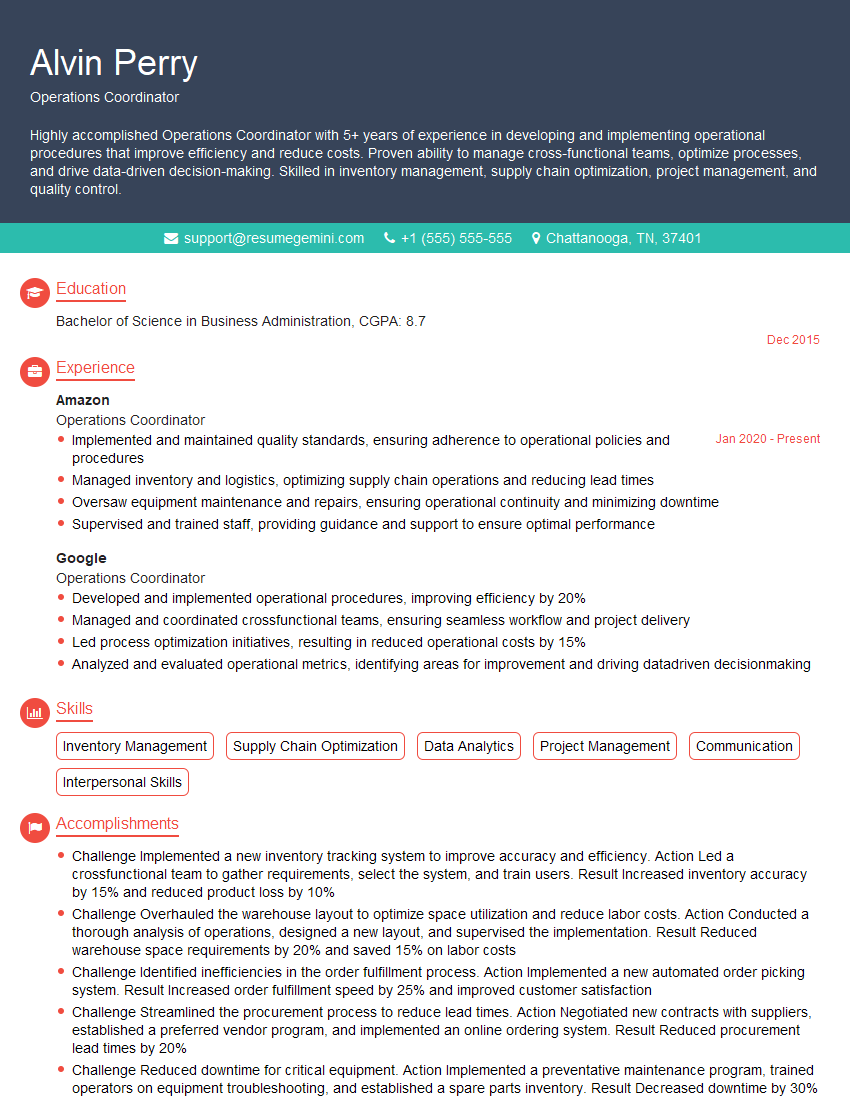
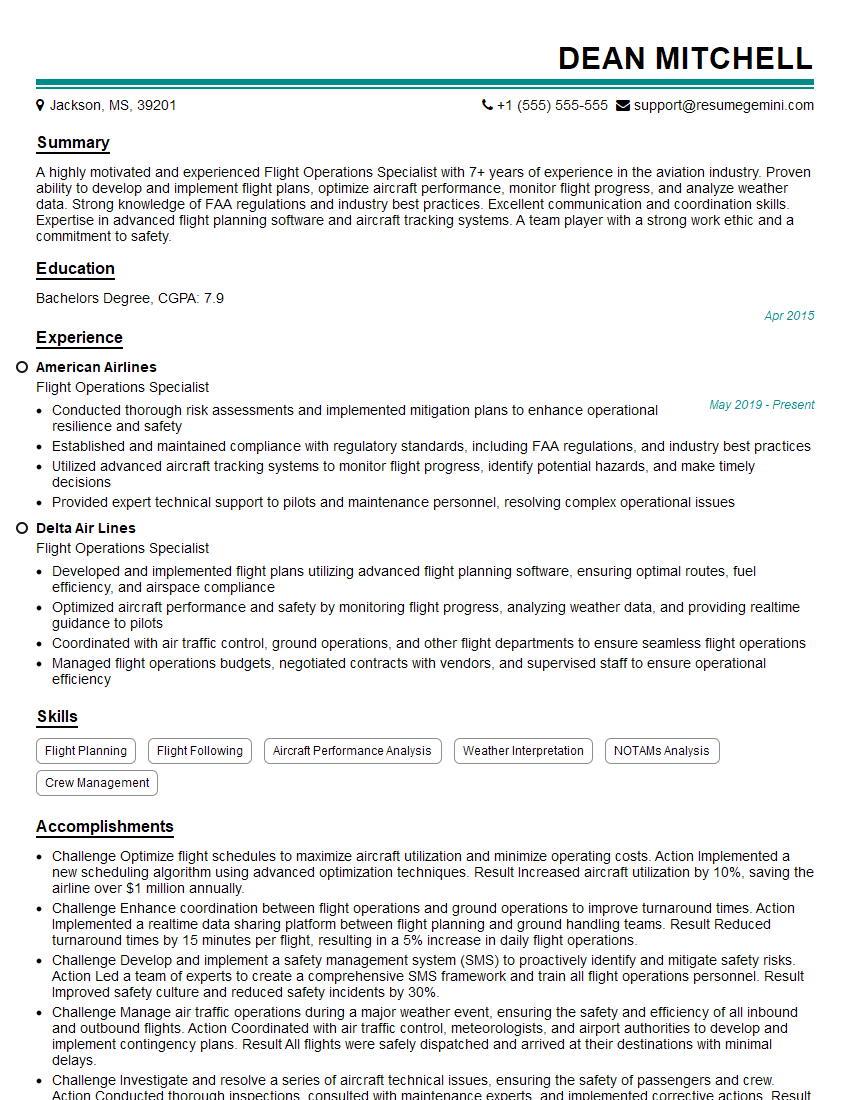
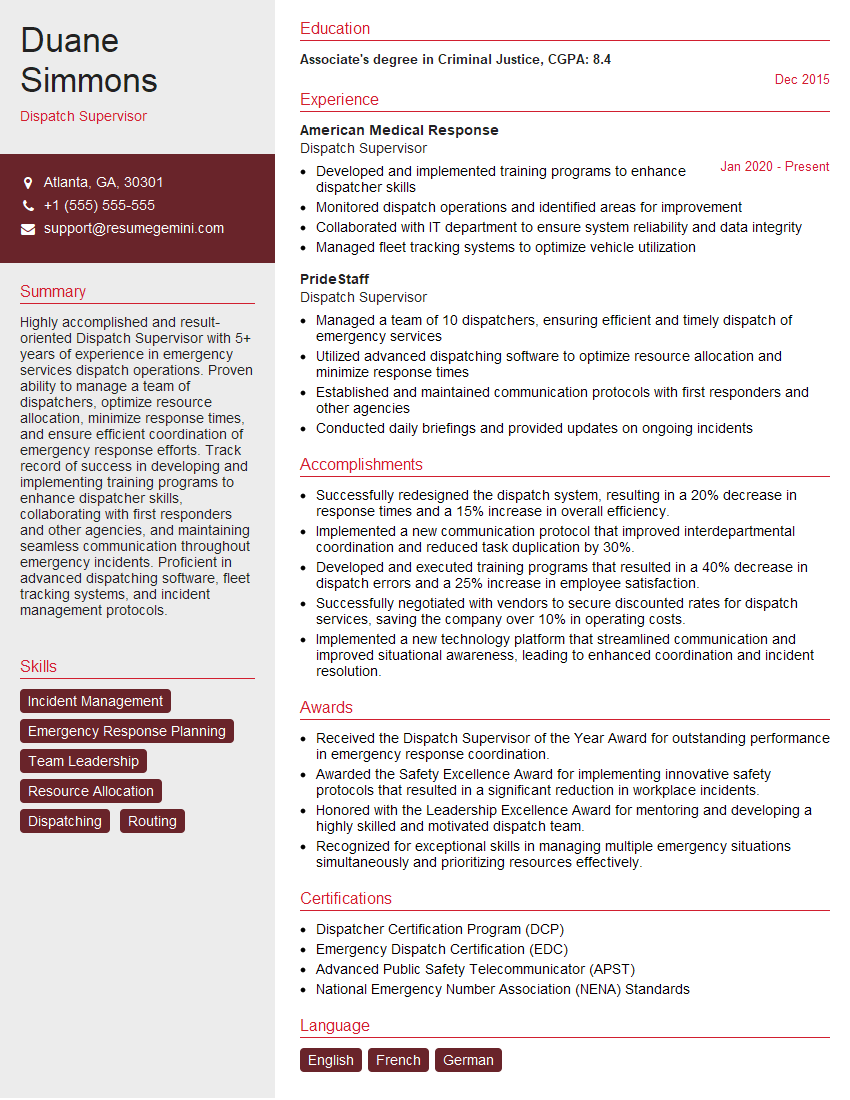
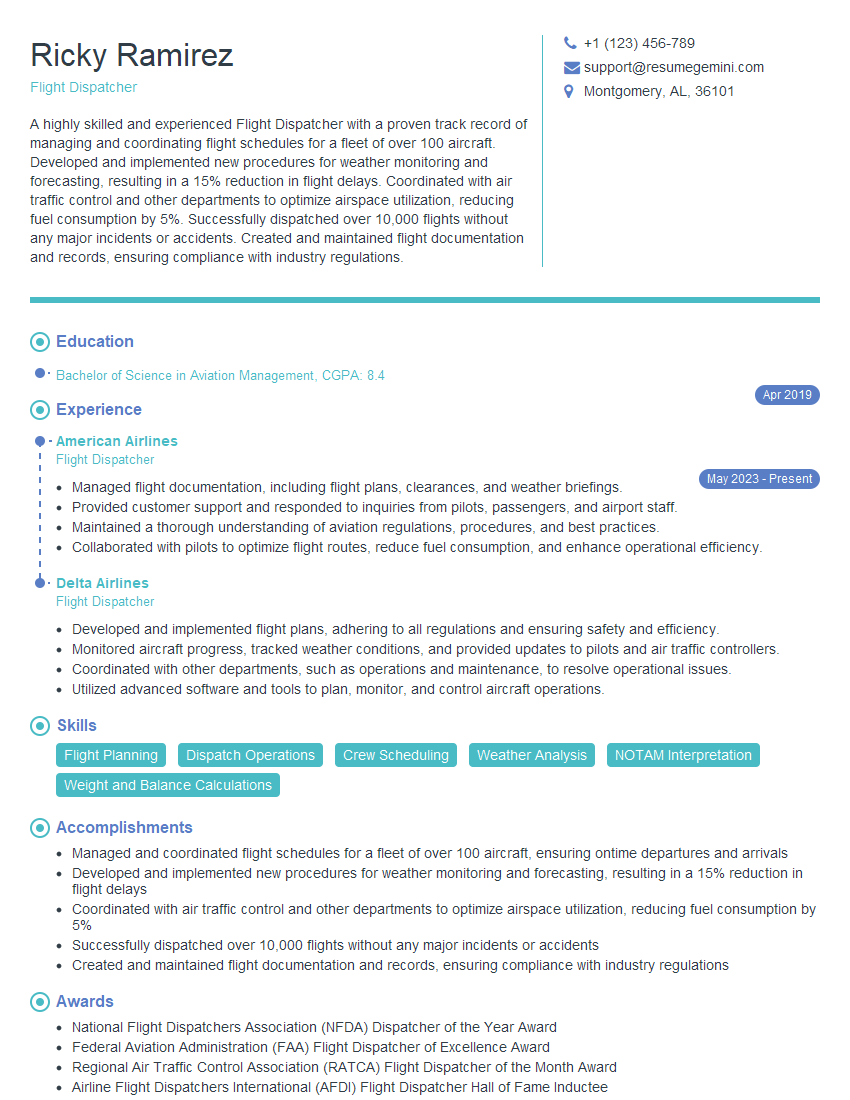
Mastering Flight Plan Coordination significantly enhances your career prospects within the aviation industry, opening doors to roles with greater responsibility and higher earning potential. To maximize your job search success, it’s crucial to create a resume that effectively showcases your skills and experience to Applicant Tracking Systems (ATS). We strongly encourage you to leverage ResumeGemini, a trusted resource for crafting professional, ATS-friendly resumes. Examples of resumes tailored to Flight Plan Coordination are available to help you create a compelling application.
Explore more articles
Users Rating of Our Blogs
Share Your Experience
We value your feedback! Please rate our content and share your thoughts (optional).
What Readers Say About Our Blog
Very informative content, great job.
good