Feeling uncertain about what to expect in your upcoming interview? We’ve got you covered! This blog highlights the most important Screenwriting and Narrative Development interview questions and provides actionable advice to help you stand out as the ideal candidate. Let’s pave the way for your success.
Questions Asked in Screenwriting and Narrative Development Interview
Q 1. Explain the three-act structure and its application in modern screenwriting.
The three-act structure is a foundational storytelling framework, dividing a narrative into three distinct parts: Setup, Confrontation, and Resolution. It’s not a rigid rule, but a helpful guideline.
- Setup (Act I): Introduces the protagonist, their world, and the inciting incident that disrupts their equilibrium. This act establishes the stakes and sets up the central conflict. Think of it as laying the groundwork for the story to come. For example, in Star Wars: A New Hope, the setup introduces Luke Skywalker, his mundane life on Tatooine, and the arrival of Princess Leia and the droids, which sets him on his heroic journey.
- Confrontation (Act II): The protagonist actively pursues their goal, facing escalating challenges and obstacles. This is where most of the plot unfolds, building suspense and raising the stakes. This is where Luke trains with Obi-Wan, faces the Empire, and learns about the Force.
- Resolution (Act III): The climax occurs—the central conflict is confronted directly. The protagonist experiences a decisive victory or defeat, resolving the main plotline. The loose ends are tied up, and the story concludes. In Star Wars, the climax is the Death Star battle, resolving Luke’s journey and the rebellion’s struggle.
Modern screenwriting often adapts or subverts the three-act structure. Some stories use a more fluid approach, focusing on character arcs rather than strict adherence to the act breaks. However, understanding the three-act structure provides a solid foundation for organizing any narrative, regardless of genre or style.
Q 2. Describe your process for developing compelling characters.
Developing compelling characters involves a multi-faceted approach. It’s not just about writing a character’s biography; it’s about bringing them to life through their actions, motivations, and relationships.
- Backstory: A rich backstory isn’t always shown on screen but is crucial for the writer to understand the character’s motivations. What experiences shaped them? What are their deepest desires and fears?
- Goals and Obstacles: Characters need clear, achievable goals that are directly tied to the plot’s progression, but also obstacles to overcome. These obstacles create conflict and drive the narrative forward.
- Flaws and Strengths: Compelling characters are flawed. Their weaknesses create opportunities for growth and make them relatable. But they also possess strengths, abilities, or talents that allow them to tackle their problems.
- Relationships: How the character interacts with other characters is key. Their relationships reveal aspects of their personality and drive the story’s emotional core.
- Consistency: Character behavior should remain consistent with their established personality and backstory, even under pressure. Inconsistencies can break the audience’s suspension of disbelief.
For example, consider Walter White in Breaking Bad. His initial motivation (providing for his family) is understandable, yet his descent into meth production reveals his inner conflicts and flaws, making him a tragically compelling character.
Q 3. How do you create impactful dialogue that moves the plot forward?
Impactful dialogue serves multiple purposes: it reveals character, advances the plot, and creates engaging moments for the audience. Avoid exposition dumps; instead, let the dialogue organically reveal information.
- Subtext: What’s unsaid can be as powerful as what is said. Dialogue should hint at unspoken tensions, desires, or conflicts.
- Action and Reaction: Dialogue should be driven by character actions and reactions. Characters should respond realistically to what others say.
- Avoid Monologues: Keep dialogue concise and impactful. Long speeches can bore the audience. Break them up with reactions and action.
- Unique Voice: Each character should have a distinct voice that reflects their personality, background, and social status.
- Plot Advancement: Use dialogue to reveal crucial information, plant seeds for future conflicts, or raise the stakes.
For example, in Casablanca, the dialogue between Rick and Ilsa is filled with subtext and unspoken emotions. Their conversations aren’t simply about plot points; they are about revealing their complex relationship and past.
Q 4. What are some common pitfalls to avoid when writing a screenplay?
Many pitfalls can derail a screenplay. Here are some common ones to avoid:
- Weak Protagonist: A passive or unrelatable protagonist makes it difficult for the audience to connect with the story.
- Unclear Plot: A confusing or convoluted plotline will lose the audience. Ensure a clear narrative structure and consistent progression.
- Info-dumps: Avoid lengthy exposition that slows the pace and breaks immersion. Reveal information gradually through action and dialogue.
- Unrealistic Dialogue: Dialogue that sounds unnatural or forced can damage the script’s credibility. Read it aloud and see if it sounds conversational.
- Lack of Conflict: Without sufficient conflict, the story becomes flat and uninteresting. Build tension and suspense throughout the narrative.
- Weak Ending: A disappointing or unsatisfying ending can negate the impact of the entire script. Ensure the resolution is well-earned and provides closure.
Remember, strong screenwriting is about crafting a compelling experience for the audience. Careful planning, revision, and feedback are crucial to avoid these pitfalls.
Q 5. Explain the difference between a logline and a synopsis.
A logline and a synopsis are both concise summaries of a screenplay, but they serve different purposes and have different lengths.
- Logline: A one-sentence summary that captures the essence of the story, highlighting the central conflict and protagonist’s goal. It’s a marketing tool designed to pique interest. Example: A washed-up boxer gets a second chance at redemption when he trains a young, talented fighter.
- Synopsis: A longer summary that provides a more detailed overview of the plot, including key characters, the main conflict, and the resolution. It’s used for pitching or as a general overview. Example: A former boxing champion, struggling with addiction and financial ruin, is given the opportunity to train a young, promising boxer. Through the process, he confronts his past demons and rediscovers his own fighting spirit, ultimately achieving both personal and professional redemption.
The logline is a concise hook, while the synopsis is a more comprehensive summary.
Q 6. How do you adapt a story from a different medium (e.g., novel) into a screenplay?
Adapting a story from another medium requires a significant shift in perspective. You’re not simply translating; you’re reimagining.
- Identify the Core: What is the essential story at the heart of the source material? Distill it down to its core themes and conflicts.
- Visualize the Narrative: Translate descriptive passages into cinematic images. Think about what can be effectively shown visually and what must be conveyed through dialogue and action.
- Structure and Pacing: Screenplays have a different structure and pacing than novels. Adapt the story to suit the visual medium. Scenes need to be dynamic and visually compelling.
- Character Adaptation: Characters need to be developed for the screen. Their motivations and relationships might need to be sharpened or condensed to fit the new format.
- Cut Unnecessary Elements: Screenplays are often shorter than novels. Ruthlessly cut anything that doesn’t directly contribute to the core story.
Adapting a novel to a screenplay is a challenging but rewarding process. Remember, the goal is to capture the spirit of the original work while creating a compelling cinematic experience.
Q 7. Discuss the importance of pacing in a narrative.
Pacing is crucial for maintaining audience engagement. It refers to the speed and rhythm at which the narrative unfolds. Poor pacing can lead to boredom or confusion.
- Vary the Tempo: Mix high-action scenes with quieter, more intimate moments. This prevents the story from becoming monotonous.
- Strategic Use of Time: Use time jumps or flashbacks strategically to propel the narrative forward or provide necessary backstory without disrupting the flow.
- Scene Length: Scenes should be appropriately sized. Too short, and they lack impact; too long, and they drag.
- Incidents and Rising Stakes: Introduce escalating conflicts and incidents to build suspense and keep the audience on the edge of their seats.
- Climax and Resolution: The pacing should accelerate towards the climax and then slow down for a satisfying resolution.
Think of pacing as the music of your narrative. A well-paced story keeps the audience invested from beginning to end.
Q 8. How do you handle writer’s block?
Writer’s block is a common challenge for screenwriters, but it’s surmountable. It’s not a lack of creativity, but often a blockage in the creative process. My approach is multifaceted.
- Step away: If I’m stuck, I step away from the script entirely. I might go for a walk, listen to music, read something unrelated, or engage in a completely different activity. This allows my subconscious to work on the problem.
- Freewriting: I’ll often engage in freewriting, simply writing whatever comes to mind without editing or judgment. This helps to unlock ideas and break through mental barriers. Sometimes, the solution is hidden within the seemingly unrelated thoughts.
- Outline Revision: If the block stems from a structural issue, I’ll revisit my outline. Perhaps a scene is misplaced, a plot point needs reworking, or a character arc requires adjustment. A clear outline is your roadmap, and sometimes you need to recalibrate the navigation.
- Talk it out: Discussing my story with a trusted friend, colleague, or writing group can provide fresh perspectives. Sometimes just verbalizing the problem can reveal the solution.
- Change of scenery: A change of environment can be surprisingly effective. Working in a coffee shop, library, or different room in my house can stimulate new ideas.
Remember, writer’s block is temporary. By employing these strategies, you can overcome it and continue crafting your story.
Q 9. Describe your experience with different screenplay software (e.g., Final Draft, Celtx).
I’ve used several screenplay software packages over the years, and each has its strengths and weaknesses. Final Draft is the industry standard, and for good reason. Its features are robust and intuitive, particularly its formatting capabilities which are crucial for adhering to industry standards. The outlining tools are also quite helpful for large projects.
Celtx, on the other hand, is a more collaborative platform, useful for projects involving multiple writers or for those who prefer a more streamlined approach. It’s also a good option for beginners due to its user-friendly interface. While it lacks some of the advanced features of Final Draft, its ease of use and collaboration tools make it a strong contender.
Ultimately, the best software depends on individual preferences and project needs. I tend to favor Final Draft for larger, more complex projects due to its robust formatting and organizational features, but I might utilize Celtx for collaborative brainstorming sessions or smaller, quicker projects.
Q 10. Explain your understanding of different narrative viewpoints (e.g., first-person, third-person omniscient).
Narrative viewpoint is crucial for shaping the audience’s relationship with the story. It dictates the information revealed and the perspective from which it’s presented.
- First-person: The story is told from the ‘I’ perspective of a character within the narrative. This offers intimacy and immediacy, but limits the reader/viewer to that character’s knowledge and biases. Example: The Hunger Games by Suzanne Collins.
- Third-person limited: The story is told from the perspective of a single character, but using ‘he’ or ‘she’. We have access to this character’s thoughts and feelings, but not the other characters’. Example: Harry Potter series by J.K. Rowling (mostly limited to Harry’s perspective).
- Third-person omniscient: The narrator is all-knowing, capable of accessing the thoughts and feelings of multiple characters. This perspective allows for a broader view of the story but can risk detachment if not handled carefully. Example: Many classic novels like Pride and Prejudice by Jane Austen utilize this perspective.
Choosing the right viewpoint dramatically affects the tone and impact of your story. Consider carefully which perspective best serves your narrative and character development.
Q 11. How do you incorporate subtext into your writing?
Subtext is the unspoken meaning or implication beneath the surface of the dialogue or action. It’s what’s implied but not explicitly stated, adding layers of complexity and depth to your storytelling. It’s like an iceberg—only the tip is visible, but the vast majority lies beneath the surface.
I incorporate subtext through:
- Dialogue nuances: A character might say one thing but their tone of voice, body language, or facial expressions convey something entirely different. For example, a character saying ‘I’m fine’ while visibly upset conveys hidden turmoil.
- Strategic omissions: What a character chooses *not* to say can be as revealing as what they do say. Silence, pauses, and evasiveness can all create subtextual tension.
- Character actions: A character’s actions can contradict their words, creating subtextual conflict. For example, a character who claims to love their partner but consistently ignores their calls.
Subtext enhances realism and keeps the audience engaged, prompting them to interpret and draw their conclusions, making your story richer and more memorable.
Q 12. Discuss the role of conflict in driving a narrative.
Conflict is the engine of narrative. Without conflict, there’s no story. Conflict propels the plot forward, forcing characters to make choices, driving them to grow and change, and keeping the audience engaged.
Conflict can take many forms:
- Internal conflict: A character struggles with their own internal demons, doubts, or desires. This creates psychological tension and allows for deep character exploration.
- External conflict: A character confronts an external obstacle, such as another person, a natural disaster, or a societal challenge. This creates physical or dramatic tension.
- Man vs. Man: Direct conflict between two or more characters.
- Man vs. Nature: A character struggles against the forces of nature.
- Man vs. Society: A character challenges societal norms or expectations.
Effective screenwriting requires a careful balance of various conflict types. A compelling story often features a central conflict with interwoven sub-conflicts to keep the narrative dynamic and engaging.
Q 13. Explain the importance of theme in storytelling.
Theme is the underlying message or idea that the story explores. It’s the central idea the writer wants the audience to contemplate, often about human nature or the world. Theme provides meaning and resonance, elevating the story beyond simple entertainment.
A strong theme isn’t explicitly stated; it’s woven subtly throughout the narrative through character actions, plot developments, and dialogue. For instance, a story about a group of people surviving a disaster might explore themes of resilience, hope, and the importance of human connection.
Consider these points when developing your theme:
- Universality: A strong theme resonates with a broad audience, touching upon universal human experiences.
- Subtlety: The theme should be implied, not explicitly stated; it should emerge organically from the story.
- Relevance: The theme should be relevant to the story’s plot and characters.
A well-developed theme adds depth and lasting impact, making your story more meaningful and memorable.
Q 14. How do you revise and polish your screenplays?
Revision and polishing are crucial steps in the screenwriting process. It’s where your initial draft transforms into a polished, professional script. My revision process is iterative, involving several passes.
- Structural Revision: This involves looking at the big picture—plot, pacing, character arcs. Are there any plot holes? Does the story flow logically? Are the character arcs satisfying?
- Scene-by-Scene Revision: I go through each scene, evaluating its effectiveness. Is every scene necessary? Does each scene advance the plot or character development? Do I need to cut, add, or rewrite scenes?
- Dialogue Polish: I scrutinize the dialogue, ensuring it’s realistic, revealing, and serves a purpose. Is the dialogue concise and engaging? Does it reveal character? Does it move the plot forward?
- Line Editing: This is a close read, focusing on word choice, sentence structure, and overall flow. I aim for clarity, concision, and style.
- Feedback Integration: I actively seek feedback from trusted readers or writing groups, integrating constructive criticism into my revisions.
This iterative process allows me to refine my script until it’s both structurally sound and stylistically polished, ready to be shared with potential producers or directors.
Q 15. What are your preferred methods for outlining a screenplay?
My preferred outlining method is a blend of techniques, adapting to the project’s needs. I rarely start with a rigid, beat-by-beat structure, instead preferring a more organic approach. It often begins with a detailed synopsis – a one-page summary of the plot, characters, and themes. This helps solidify the core concept. From there, I might use a combination of methods. Sometimes I create a mind map, visually connecting key plot points, character arcs, and thematic elements. This is great for brainstorming and seeing the interconnectedness of various elements. Other times, I employ a more traditional three-act structure outline, breaking down the story into beginning, middle, and end, focusing on plot points and character turning points. For character-driven narratives, I might build detailed character profiles, outlining their backstories, motivations, and arcs, using these profiles to guide the plot development. The key is flexibility; I don’t adhere strictly to one method but choose what best suits the specific story I’m telling.
For example, in outlining a recent thriller, the mind map was crucial for visually mapping out the intricate web of lies and deception. For a character-driven drama about family relationships, constructing in-depth character profiles was paramount to understanding their motivations and dynamics. Ultimately, the goal is to create a roadmap that allows for creative freedom during the actual writing process.
Career Expert Tips:
- Ace those interviews! Prepare effectively by reviewing the Top 50 Most Common Interview Questions on ResumeGemini.
- Navigate your job search with confidence! Explore a wide range of Career Tips on ResumeGemini. Learn about common challenges and recommendations to overcome them.
- Craft the perfect resume! Master the Art of Resume Writing with ResumeGemini’s guide. Showcase your unique qualifications and achievements effectively.
- Don’t miss out on holiday savings! Build your dream resume with ResumeGemini’s ATS optimized templates.
Q 16. Discuss your experience working with directors and producers.
Collaborating with directors and producers has been a vital part of my screenwriting journey. I’ve learned the importance of clear communication and understanding different perspectives. With directors, the focus often shifts towards the visual aspects of the script – how the story will be translated onto the screen. Open dialogue is essential, discussing character interpretations, scene staging, and the overall tone. I’ve found that actively listening to their insights often leads to significant improvements in the script.
Producers, on the other hand, tend to focus on the commercial viability and practicality of the project. Their feedback is crucial in refining the narrative to fit budgetary constraints and target audiences. A successful collaboration involves a mutual respect for creative vision and practical realities. I’ve had experiences where producers have challenged my initial ideas, leading to better, more realistic storylines. For example, in one project, the producer’s insights on market trends helped us reshape the ending for a wider appeal, without compromising the core emotional impact. This collaborative process is not just about compromise, but about refinement – the refining of a narrative so it becomes both commercially viable and true to the story’s heart.
Q 17. How do you handle feedback on your scripts?
Handling feedback is crucial; it’s not about ego but about crafting the best possible script. I approach feedback with an open mind, actively listening to the critiques, whether positive or negative. I categorize notes into ‘constructive’ and ‘descriptive’. Descriptive feedback points out what’s not working without offering solutions; constructive feedback offers specific suggestions for improvement. I separate the feedback into these categories to effectively address each type of note.
For constructive criticism, I consider the validity of the suggestion, assessing its impact on the story’s overall integrity and effectiveness. If the suggestion improves the script, I incorporate it. If not, I carefully consider why the suggestion doesn’t work. If I disagree, I might explain my reasoning and explore potential compromises. If descriptive feedback reveals problems, I often brainstorm solutions independently before discussing them with the feedback provider. This process ensures a thoughtful and collaborative approach. Remember, the goal is not simply to accept all feedback blindly, but to actively use it to enhance the storytelling.
Q 18. Describe a time you had to overcome a significant challenge during the screenwriting process.
One significant challenge I faced involved a historical drama where the initial research revealed a complex and contradictory set of historical accounts. The story centered around a little-known historical figure, and the available information was fragmented and often conflicting. My initial outline relied heavily on a particular interpretation, but further research showed it was overly simplified and lacked nuance. The challenge was to create a compelling narrative without sacrificing historical accuracy.
To overcome this, I spent considerable time revisiting source materials, cross-referencing information, and consulting with historians. This involved a significant shift in my approach; I had to adjust the storyline to reflect the ambiguities and complexities of the historical context, creating a more layered and nuanced narrative. The result was a richer, more believable story, albeit one significantly different from my original vision. The final script acknowledged the historical uncertainties, which became part of the narrative’s tension and ultimately enriched the story.
Q 19. Explain your understanding of different screenplay formats.
Understanding different screenplay formats is essential for professional screenwriting. The most common is the industry-standard industry script format, which uses specific formatting conventions to ensure readability and consistency. Key elements include scene headings, action lines, dialogue, and character names, all formatted according to precise rules. These rules dictate font size, margins, and spacing to ensure that the script is easy for producers, directors, and actors to read and understand. Deviations from this standard can result in your script not being taken seriously.
Beyond the industry standard, other formats exist, such as a treatment (a prose summary of the screenplay), an outline (a detailed plot summary often broken into acts and sequences), or a one-pager (a single-page summary focusing on logline, synopsis, and key character details). The choice of format depends on the stage of development. A treatment might be used during the initial pitching process, while the industry-standard format is mandatory for a final script. Understanding these differences allows you to tailor your submission to the specific requirements and context.
Q 20. Discuss the significance of foreshadowing and red herrings in storytelling.
Foreshadowing and red herrings are powerful narrative tools that build suspense and engage the audience. Foreshadowing subtly hints at future events, creating anticipation and a sense of dread or excitement. This can be done through dialogue, imagery, or symbolic actions. For instance, a seemingly innocuous line of dialogue might foreshadow a character’s tragic fate. This builds the suspense and forces the reader to actively engage with the story.
Red herrings, on the other hand, are deliberate misdirections, leading the audience to believe something that ultimately proves false. They create a false sense of security or anticipation, subverting expectations, and adding to the complexity of the plot. Think of a detective story where the initial suspect turns out to be innocent; the detective is then forced to reconsider and the reader experiences another layer of suspense. Effective use of foreshadowing and red herrings keeps the audience guessing, elevating the narrative from predictable to enthralling.
Q 21. How do you ensure your scripts are both commercially viable and artistically satisfying?
Balancing commercial viability and artistic satisfaction is a constant challenge in screenwriting. It’s not about compromising artistic integrity for commercial success; rather, it’s about finding a way to create a story that resonates with audiences while remaining true to your vision. This often means understanding the target audience and market trends. Researching popular genres, analyzing successful films, and understanding what resonates with viewers is crucial.
However, simply chasing trends can lead to formulaic and uninspired stories. The key is to find a way to blend commercial appeal with your unique voice and perspective. For instance, you could take a genre trope – like the classic heist movie – and inject it with a fresh, unexpected element, creating something commercially viable that still has an artistic edge. It’s a delicate balancing act, one that requires sensitivity to the market while simultaneously holding firm to the core artistic principles that make your story worth telling. It’s about finding the unique selling point while maintaining integrity and passion.
Q 22. Explain your familiarity with different genres of screenwriting (e.g., action, comedy, drama).
My familiarity with screenwriting genres spans a wide range, from the high-octane thrills of action to the nuanced complexities of drama and the witty wordplay of comedy. Each genre demands a unique approach. Action screenplays prioritize pacing and visual storytelling, relying on dynamic action sequences and concise dialogue. Think of the relentless pace in a film like Die Hard. Comedy requires sharp wit, well-defined comedic timing, and often, a strong reliance on character-driven humor, as seen in Bridesmaids. Drama, conversely, focuses on character arcs, emotional depth, and often explores complex themes and relationships, exemplified by Manchester by the Sea. I understand the specific conventions and audience expectations associated with each, allowing me to craft stories that resonate within their respective frameworks. Beyond these core genres, I’m also comfortable working with hybrids, such as action-comedy or dramatic thrillers, leveraging elements from multiple genres to create unique and compelling narratives.
Q 23. How do you ensure consistency in character development throughout your script?
Consistency in character development is paramount. I approach this through meticulous outlining and character biographies, creating a detailed profile that goes beyond surface traits. This includes their backstory, motivations, strengths, weaknesses, fears, and desires. I then ensure these elements are consistently reflected throughout the script. For instance, a character’s stubbornness might manifest in different ways throughout the narrative – initially as a charming quirk, later as a source of conflict, and ultimately, perhaps, as a catalyst for growth. This requires careful tracking of their actions, dialogue, and internal monologues to ensure they remain believable and true to their established personality. Inconsistency often breaks audience immersion. A well-defined character arc allows the audience to connect emotionally and understand the character’s journey.
Q 24. Describe your experience collaborating with other writers on a screenplay.
Collaborating with other writers is a crucial aspect of screenwriting, especially on larger projects. My experience has shown me the value of open communication, mutual respect, and a shared creative vision. On one project, we utilized a collaborative writing platform where we could all access and edit the script simultaneously, track changes, and leave comments. We held regular brainstorming sessions to address plot points, character development, and overall narrative structure. The key to successful collaboration is to establish clear roles and responsibilities, actively listen to each other’s ideas, and be willing to compromise. It’s about leveraging the strengths of each writer to create a richer and more compelling script. Disagreements are inevitable but are addressed through constructive criticism and a focus on the overall story.
Q 25. Explain the importance of research in screenwriting.
Research is indispensable in screenwriting. It provides the foundation for authenticity and believability. Whether it’s crafting a historical drama, a sci-fi epic, or a contemporary romance, thorough research ensures the accuracy of details and avoids crucial factual errors. For instance, if writing about a specific profession, researching that field will provide insights into the jargon, culture, and daily realities of the characters. Similarly, accurate depiction of historical events or scientific concepts necessitates substantial research to ensure credibility. This research isn’t merely fact-checking; it often inspires creative solutions, revealing unexpected details or perspectives that enrich the story and add layers of depth. It’s a crucial step in building a solid narrative that feels genuine and convincing to the audience.
Q 26. How do you adapt your writing style to suit different target audiences?
Adapting my writing style to different target audiences involves considering their age, background, cultural context, and preferred narrative styles. For younger audiences, the language might be simpler, the pacing faster, and the themes more relatable to their experiences. Older audiences may appreciate more nuanced storytelling, complex characters, and explorations of mature themes. Cultural considerations require sensitivity and accuracy in portraying different communities and avoiding stereotypes. For instance, dialogue, humor, and even the visual style of the script should reflect the specific audience’s preferences and expectations. This requires a deep understanding of audience demographics and a willingness to adapt the storytelling approach to resonate with each target group without sacrificing the core narrative.
Q 27. Discuss your understanding of the screenplay submission process.
The screenplay submission process can vary depending on the outlet (e.g., production companies, film festivals). Generally, it involves identifying potential avenues for submission, researching their specific guidelines, formatting the script according to industry standards (usually following the standard screenplay format), and crafting a compelling query letter or cover letter highlighting the script’s unique aspects. This initial approach is crucial. Often, screenplays are submitted through online platforms or directly to agents or producers. Following up professionally after submission is important, but it’s vital to be patient, as the process can be lengthy. Understanding the submission process and the nuances of each specific route is crucial to maximizing the chances of getting your script noticed.
Q 28. Describe a screenplay you’re particularly proud of and why.
I’m particularly proud of a screenplay I wrote titled “Echoes of the Past.” It’s a historical drama set in 1920s Ireland, exploring the lives of two women from vastly different backgrounds who become unlikely allies during the Irish War of Independence. What makes me proud is the meticulous historical research that went into accurately depicting the period, the complex and well-developed characters, and the emotional resonance of the narrative. The script delves into themes of identity, loyalty, and the cost of freedom. The positive feedback received during early drafts, especially the praise for its authentic portrayal of the historical setting and the compelling female leads, was particularly gratifying. The film, while still in development, has garnered significant attention, and the script itself has been used as a case study in a screenwriting course, which is a significant validation of the work.
Key Topics to Learn for Screenwriting and Narrative Development Interview
- Story Structure & Arcs: Understanding classic narrative structures (e.g., three-act structure, hero’s journey) and how to adapt them to different genres. Consider how to create compelling character arcs and satisfying resolutions.
- Character Development: Creating believable and engaging characters with clear motivations, flaws, and transformations. Practice developing compelling backstories and exploring character relationships.
- Dialogue & Subtext: Mastering the art of writing realistic and impactful dialogue that reveals character and advances the plot. Understand the power of subtext and implication.
- Plot & Conflict: Crafting a compelling plot with rising action, climax, and resolution. Explore different types of conflict (internal, external) and how to build suspense and tension.
- Theme & Message: Identifying and developing a central theme that resonates with the audience. Understanding how to weave thematic elements throughout the narrative without being heavy-handed.
- Genre Conventions & Expectations: Familiarity with various screenwriting genres (e.g., comedy, drama, thriller) and their specific conventions and audience expectations.
- Screenwriting Software & Formatting: Demonstrate proficiency with industry-standard screenwriting software (e.g., Final Draft, Celtx) and understand proper formatting guidelines.
- Collaboration & Feedback: Discuss your approach to receiving and incorporating feedback from collaborators, directors, and producers. Highlight your ability to work effectively in a team environment.
- Adapting Source Material: If applicable, showcase your understanding of adapting novels, short stories, or other source material into screenplays, considering the unique challenges of translation between mediums.
- Pitching & Selling Your Ideas: Practice concisely and effectively summarizing your story concepts and demonstrating your understanding of the pitching process.
Next Steps
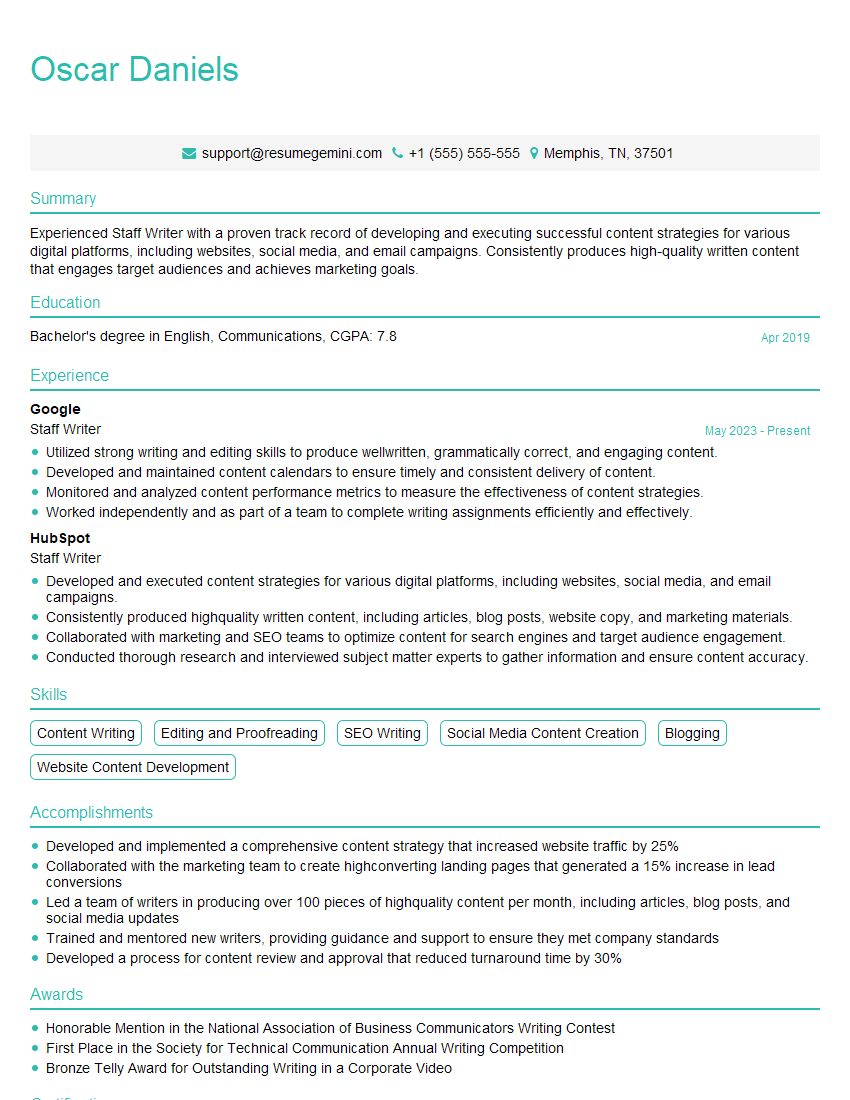
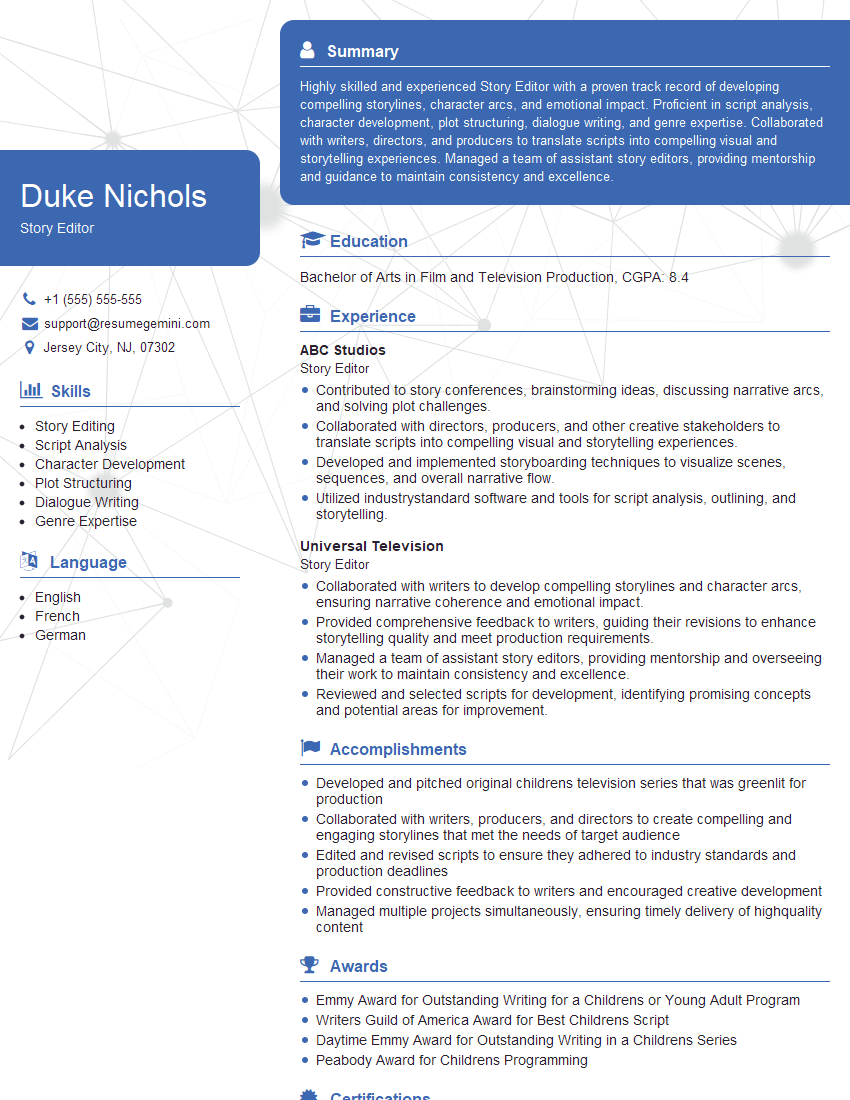
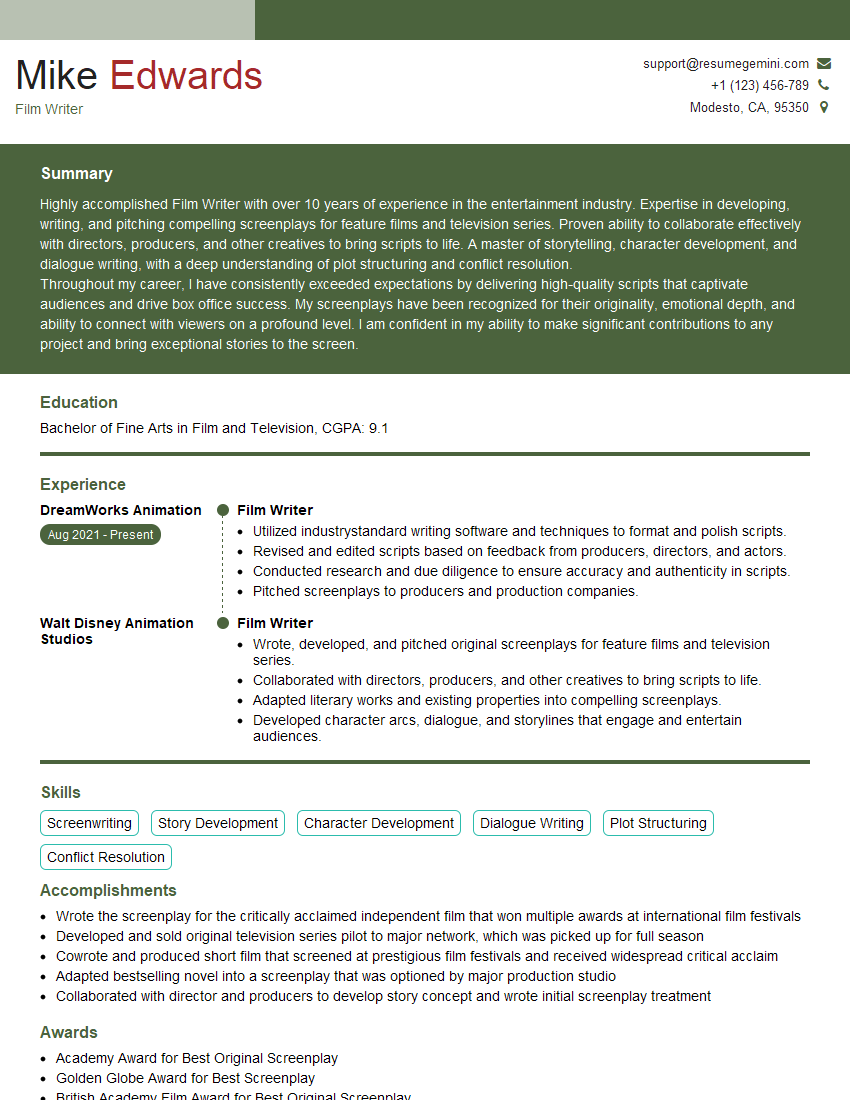
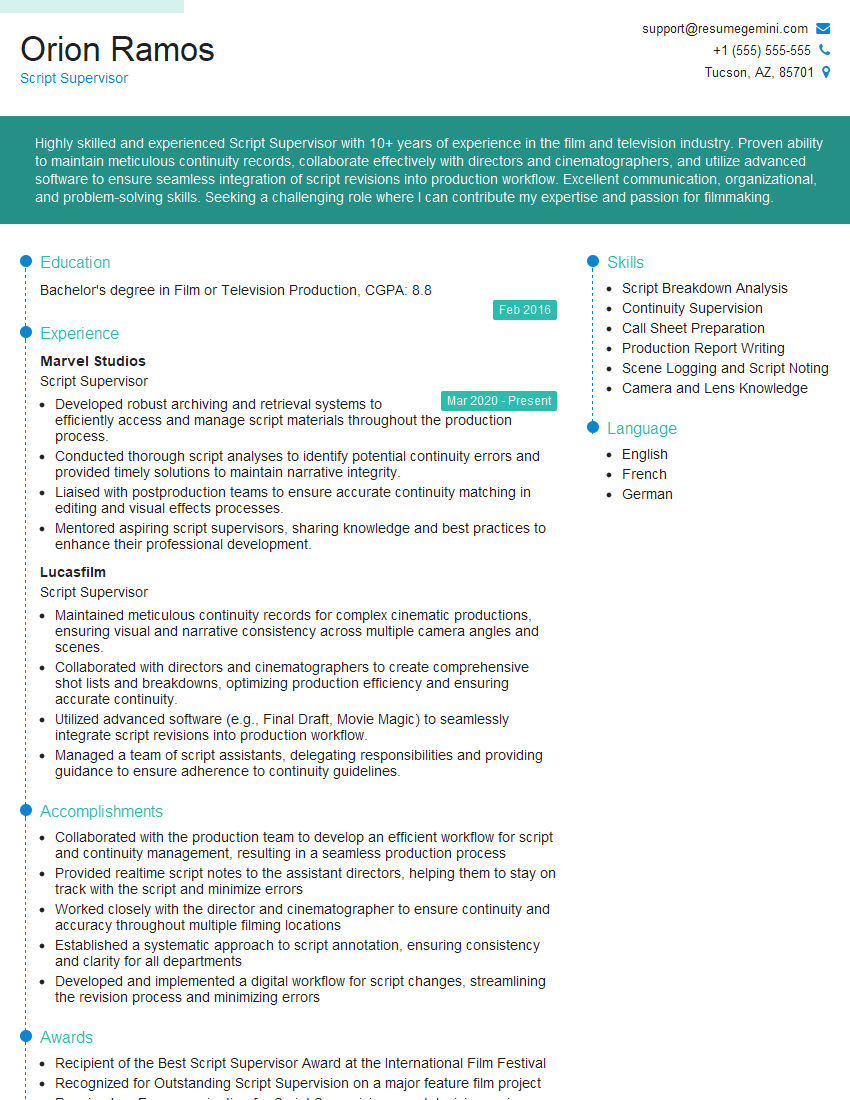
Mastering Screenwriting and Narrative Development is crucial for a successful career in film, television, and interactive media. It opens doors to creative leadership roles and collaborative opportunities within the industry. To maximize your job prospects, create an ATS-friendly resume that highlights your skills and experience effectively. ResumeGemini is a trusted resource that can help you build a professional and impactful resume tailored to the specific requirements of Screenwriting and Narrative Development roles. Examples of resumes tailored to this field are available, showcasing the best practices for highlighting your unique skills and accomplishments.
Explore more articles
Users Rating of Our Blogs
Share Your Experience
We value your feedback! Please rate our content and share your thoughts (optional).
What Readers Say About Our Blog
Very informative content, great job.
good