Preparation is the key to success in any interview. In this post, we’ll explore crucial Lighting for Hospitality and Residential Applications interview questions and equip you with strategies to craft impactful answers. Whether you’re a beginner or a pro, these tips will elevate your preparation.
Questions Asked in Lighting for Hospitality and Residential Applications Interview
Q 1. Explain the difference between illuminance and luminance.
Illuminance and luminance are both measures of light, but they describe different aspects. Think of it like this: illuminance is how much light falls on a surface, while luminance is how much light that surface reflects or emits.
Illuminance (measured in lux) quantifies the amount of luminous flux incident on a surface per unit area. It’s essentially the intensity of light reaching a point. For example, a brightly lit desk has higher illuminance than a dimly lit corner.
Luminance (measured in candelas per square meter, or cd/m², also known as nits), on the other hand, measures the intensity of light emitted or reflected from a surface in a particular direction. A brightly lit white wall will have a higher luminance than a dark-colored carpet under the same illuminance because it reflects more light.
In simpler terms, illuminance is the light arriving, while luminance is the light leaving. Understanding this distinction is crucial for lighting design, as it allows us to control both the overall light level in a space (illuminance) and the brightness of individual surfaces (luminance), leading to a more visually appealing and comfortable environment.
Q 2. What are the key considerations for lighting a hotel lobby?
Designing the lighting for a hotel lobby requires a careful balancing act. We need to create a space that is both welcoming and functional. Key considerations include:
- Ambiance: The lobby sets the tone for the entire hotel experience. We’d typically use a combination of ambient, task, and accent lighting. Ambient lighting provides general illumination, task lighting highlights specific areas like reception desks, and accent lighting enhances architectural features or artwork.
- Functionality: Adequate lighting is crucial for wayfinding and safety. Clear visibility is needed at entrances, elevators, and seating areas. We should also ensure sufficient illuminance levels for reading menus or completing check-in processes.
- Energy Efficiency: LED lighting is often preferred due to its energy savings and long lifespan. Smart lighting controls allow for dimming and scheduling, optimizing energy consumption without sacrificing ambiance.
- Aesthetics: The lighting design should complement the hotel’s overall style and décor. Fixture selection and light color temperature should be carefully chosen to enhance the architectural features and create the desired mood.
- Guest Experience: The lighting needs to cater to the diverse needs of guests. It should be comfortable and avoid harsh glare or shadows. This could include providing adjustable lighting options in some areas.
For example, a luxurious hotel might utilize layered lighting with warm-toned downlights for ambient illumination, track lighting to accentuate artwork, and stylish table lamps for reading areas. Conversely, a more modern hotel might choose minimalist fixtures with integrated LED strips and adjustable color temperatures to create a flexible and dynamic atmosphere.
Q 3. Describe different types of lighting control systems.
Lighting control systems have come a long way, offering greater flexibility and efficiency. Here are a few types:
- Manual Switches: The simplest form, offering on/off control of individual fixtures. Suitable for smaller spaces with basic needs.
- Dimmers: Allow for adjusting light intensity, creating a wide range of ambiance. Can be standalone or incorporated into larger systems.
- Timers: Automatically turn lights on and off at pre-set times, perfect for energy saving and security.
- Occupancy Sensors: Detect the presence of people and automatically switch lights on or off, saving energy in unoccupied spaces. Very common in hallways and restrooms.
- Daylight Harvesting Systems: Automatically adjust artificial lighting based on the availability of natural light, reducing energy consumption and maintaining consistent light levels.
- Smart Lighting Systems: These network-connected systems provide advanced control capabilities, allowing for centralized management, remote control via apps, scene setting, and integration with other smart home devices. These are very popular in larger commercial spaces.
For instance, a residential setting might benefit from a combination of dimmers and occupancy sensors, while a large hotel would benefit from a sophisticated smart lighting system for centralized control and energy management.
Q 4. How do you calculate the appropriate lighting levels for a residential living room?
Calculating appropriate lighting levels for a living room involves considering the room’s function, size, and desired ambiance. We usually refer to illuminance recommendations from various lighting guides.
Step 1: Determine the room’s area: Measure the length and width of the living room and multiply them to get the square footage.
Step 2: Identify the required illuminance: Recommended illuminance levels for living rooms generally range from 150 to 300 lux. Higher levels are suitable for task-oriented areas like reading corners, while lower levels suffice for relaxation zones.
Step 3: Calculate the total luminous flux needed: Multiply the room’s area (in square meters) by the desired illuminance (in lux). This gives you the total luminous flux required in lumens.
Step 4: Select the appropriate light fixtures: Check the lumens output of various light fixtures (lamps, recessed lighting, etc.) and select those that collectively deliver the calculated total lumens. Consider light distribution and avoid overly bright or dark spots.
Example: A 20 square meter living room requiring 200 lux would need 4000 lumens (20 m² x 200 lux = 4000 lumens).
It’s crucial to consider factors beyond pure illuminance calculation. The distribution of light (avoiding harsh shadows), color temperature (warm for relaxation, cooler for task lighting), and glare control are all vital for creating a comfortable and functional living space.
Q 5. What are the benefits of using LED lighting in hospitality settings?
LED lighting offers numerous advantages in hospitality settings:
- Energy Efficiency: LEDs consume significantly less energy compared to traditional lighting, leading to lower electricity bills and a smaller carbon footprint. This is crucial for cost-conscious businesses.
- Long Lifespan: LEDs boast a significantly longer lifespan than incandescent or fluorescent bulbs, reducing maintenance costs and downtime associated with frequent bulb replacements. This is especially beneficial in high-traffic areas like hotel lobbies.
- Design Flexibility: LEDs are available in various shapes, sizes, and color temperatures, offering designers greater flexibility in creating unique and visually appealing lighting schemes. They can be easily integrated into various fixtures.
- Instant On/Off: LEDs provide instant illumination without any warm-up time, improving safety and convenience. This is particularly relevant in scenarios requiring quick lighting adjustments.
- Dimming Capabilities: Most LEDs can be easily dimmed, allowing for flexible ambiance creation and enhanced energy savings.
- Durability: LEDs are highly resistant to shock and vibrations, making them ideal for high-traffic areas and demanding environments.
For instance, a hotel chain can significantly reduce its operational costs by switching to energy-efficient LED lighting across all its properties, showcasing both its financial prudence and commitment to sustainability.
Q 6. Explain the concept of color rendering index (CRI) and its importance.
The Color Rendering Index (CRI) is a measure of how accurately a light source renders the colors of objects compared to a reference light source (usually sunlight). It’s expressed as a number between 0 and 100.
A CRI of 100 indicates perfect color rendering – objects appear as they would under sunlight. Lower CRI values mean that colors appear less natural and may look distorted or muted. For example, a low-CRI light might make a red apple look dull or brownish.
The importance of CRI varies depending on the application. In hospitality settings, high CRI is essential in areas where accurate color representation is crucial, like restaurants or art galleries. A high CRI ensures food looks appealing and artwork appears vibrant. In residential settings, while not as critical, a higher CRI still enhances the overall ambiance and visual comfort.
Choosing light sources with a CRI of 80 or higher is generally recommended for most applications where color accuracy matters. For applications like bathrooms or hallways, a slightly lower CRI might be acceptable if it’s balanced with other design factors. Choosing the appropriate CRI depends on balancing cost and the desired visual impact.
Q 7. How do you address glare issues in lighting design?
Glare is a significant issue in lighting design. It can cause eye strain, discomfort, and even impair visibility. Addressing glare requires a multi-pronged approach:
- Fixture Selection: Choose fixtures with diffusers or lenses designed to distribute light softly and evenly, minimizing direct light sources. Recessed lighting with proper baffles can greatly reduce glare.
- Light Positioning: Avoid placing light sources directly in the line of sight. For example, use indirect lighting techniques like uplighting or wall-washing to bounce light off surfaces, reducing direct glare.
- Shielding: Employ shields or louvers to prevent direct light from reaching the eyes. This is particularly effective for downlights and track lighting.
- Surface Finishes: Consider the reflectivity of surfaces. Matte finishes absorb more light and minimize glare compared to glossy or highly reflective surfaces.
- Light Intensity: Avoid overly bright light sources, especially in spaces with reflective surfaces. Properly calculating the required illuminance levels prevents unnecessary brightness.
- Layering: Combining multiple lighting sources at different intensities creates a more balanced and comfortable lighting environment, reducing the impact of any potential glare from individual sources.
For example, in a restaurant, using recessed downlights with baffles, coupled with warmer-toned indirect lighting for ambient illumination, can create a pleasant and glare-free dining experience. Proper glare control ensures comfort and enhances the overall appeal of the space.
Q 8. Discuss various lighting techniques for highlighting architectural features.
Highlighting architectural features with lighting is all about accentuating their unique qualities – be it texture, form, or material. We achieve this through strategic placement and selection of light sources, controlling both the intensity and direction of the light.
Uplighting: This technique directs light upwards onto the feature, creating a dramatic effect. Think of uplighting a majestic column or a textured wall to emphasize its height and shadows. It’s excellent for adding depth and a sense of grandeur.
Downlighting: Shining light downwards onto a feature is effective for highlighting intricate details or textures. For example, recessed downlights can showcase the grain of a wooden ceiling or the craftsmanship of a decorative molding.
Wall-washing: This technique uses a broad, even light distribution to wash the wall with light, creating a subtle yet effective highlight. It’s ideal for showcasing textured walls or architectural features without harsh shadows. Think of the effect on a textured stone wall in a hotel lobby.
Silhouetting: This creates a dramatic contrast by placing a light source behind a feature, casting its shadow against a background. It’s visually striking but should be used sparingly to avoid overwhelming the space. Imagine a beautifully sculpted staircase silhouetted against a wall.
Grazing: A grazing technique uses low-angle light to skim across a surface, emphasizing its texture and creating dramatic shadows. This is very effective for showcasing materials like stone or wood.
The choice of lighting technique depends heavily on the specific architectural feature and the desired mood. I always consider the surrounding environment and the overall design concept before deciding on the best approach.
Q 9. What are some energy-efficient lighting strategies for residential applications?
Energy efficiency in residential lighting is paramount. It’s about achieving the right ambiance while minimizing energy consumption and environmental impact. Here are some key strategies:
LED Lighting: LEDs are significantly more energy-efficient than incandescent or fluorescent bulbs, lasting longer and consuming less energy. They are also available in a wide variety of color temperatures and styles, making them suitable for any residential application.
Smart Lighting Systems: Smart bulbs and switches allow for automated control of lighting, enabling scheduling, dimming, and even color changing. This reduces energy waste by ensuring lights are only on when needed.
Natural Light Maximization: Optimizing natural light through strategically placed windows and skylights minimizes the reliance on artificial lighting during the day. Using light-colored wall paints and reflective surfaces helps bounce natural light around the space, further reducing the need for electric lights.
Motion Sensors: Motion sensors automatically turn lights on and off based on occupancy, preventing lights from being left on in unoccupied rooms. This is particularly effective in hallways, closets, or bathrooms.
Dimmable Fixtures and Bulbs: Dimmable fixtures and bulbs allow for adjusting light levels to suit different needs and moods. Lowering the light intensity reduces energy consumption without compromising functionality.
Integrating these strategies leads to significant energy savings and a lower carbon footprint. For example, in one project, we replaced incandescent bulbs with LEDs and implemented smart lighting controls, resulting in a 70% reduction in lighting energy consumption.
Q 10. What are the considerations for lighting a kitchen versus a bedroom?
Lighting a kitchen and a bedroom requires entirely different approaches due to their distinct functions and atmospheres.
Kitchen: The kitchen needs bright, functional lighting for food preparation and cleanup. Layered lighting is crucial. This includes task lighting (under-cabinet lighting, pendant lights above islands), ambient lighting (recessed lights for general illumination), and accent lighting (to highlight backsplashes or other architectural features). Color rendering index (CRI) is also important – a higher CRI (above 90) ensures accurate color representation of food.
Bedroom: The bedroom prioritizes a calming and relaxing atmosphere. Soft, warm light is preferred. Ambient lighting (dimmable overhead fixtures or wall sconces) is the primary source, complemented by bedside lamps for reading. Avoid harsh, bright light, and consider incorporating dimmer switches for mood control. Incorporating low-level accent lights adds a touch of elegance.
In essence, the kitchen demands task-oriented, bright, and functional lighting, while the bedroom focuses on creating a relaxing and intimate ambiance.
Q 11. Explain the difference between direct and indirect lighting.
Direct and indirect lighting differ fundamentally in how they distribute light.
Direct Lighting: Directs light directly onto the intended surface. This is achieved using fixtures like spotlights, track lights, or pendant lights. Direct lighting is highly efficient for task lighting, as it provides focused illumination with minimal light loss. However, it can create harsh shadows if not carefully planned.
Indirect Lighting: Illuminates a space by bouncing light off a surface (usually the ceiling or walls) before it reaches the intended area. This is often achieved using recessed uplights or cove lighting. Indirect lighting produces a softer, more diffused light, reducing glare and harsh shadows. It’s excellent for creating a comfortable and ambient atmosphere, but it can be less energy-efficient than direct lighting because some light is lost during reflection.
Many lighting schemes blend both direct and indirect approaches for optimal results. For example, a living room might use indirect lighting from recessed uplights for general illumination and direct lighting from table lamps for reading or task lighting.
Q 12. How do you incorporate sustainable lighting practices into your designs?
Sustainable lighting practices are at the heart of my design philosophy. It’s not just about energy efficiency; it’s about the entire lifecycle of the lighting system.
Energy-Efficient Fixtures and Bulbs: Prioritizing LEDs and other energy-efficient technologies is fundamental. I always specify high-CRI bulbs to ensure color accuracy and long lifespan.
Daylight Harvesting: Maximizing natural light through window placement, light shelves, and other architectural strategies is crucial. This reduces the need for artificial lighting, saving energy and improving occupant well-being.
Control Systems: Implementing smart lighting systems with occupancy sensors, daylight sensors, and dimming capabilities allows for intelligent control of lighting levels, significantly reducing energy waste.
Material Selection: I choose fixtures made from recycled or sustainably sourced materials whenever possible, reducing the environmental impact of the project.
Lifecycle Assessment: I consider the entire lifecycle of lighting systems, from manufacturing to disposal, opting for fixtures with a long lifespan and components that can be easily replaced or recycled.
For instance, in a recent hotel project, we incorporated daylight harvesting strategies along with smart lighting controls and energy-efficient fixtures, resulting in a substantial reduction in the project’s carbon footprint.
Q 13. Describe your experience with lighting design software (e.g., DIALux, Relux).
I’m proficient in several lighting design software packages, most notably DIALux and Relux. These tools are indispensable for creating detailed lighting simulations and ensuring a successful project outcome. They allow me to:
Model the space: I can accurately model the physical space, including walls, furniture, and other obstructions.
Select fixtures: The software databases contain extensive catalogs of lighting products, enabling me to compare different options and select those that best meet the project requirements.
Simulate lighting levels: I can simulate the lighting levels in different parts of the space, ensuring that they meet the required illuminance levels for various tasks and activities.
Visualize the design: The software allows me to create realistic renderings of the lighting scheme, enabling clients to visualize the final result before the installation begins.
Analyze energy consumption: I can analyze the energy consumption of different lighting designs, helping me optimize the design for energy efficiency.
Example: In DIALux, I might use the 'light calculation' function to determine the number and type of luminaires needed to achieve a specified illuminance level in a restaurant dining area.
My experience with these tools has significantly improved the accuracy, efficiency, and effectiveness of my lighting designs.
Q 14. How do you manage a lighting project’s budget and timeline?
Effective budget and timeline management is critical for a successful lighting project. My approach involves several key steps:
Detailed Budgeting: I start by developing a detailed budget that includes all costs, from fixture procurement to installation and labor. I collaborate closely with clients to establish a realistic budget and explore options that balance design goals with cost constraints.
Phased Approach: For larger projects, I often employ a phased approach, breaking down the project into smaller, manageable stages. This allows for better cost control and progress tracking.
Value Engineering: I proactively identify opportunities for value engineering, exploring alternatives that achieve similar design outcomes at a lower cost without compromising quality or performance.
Timeline Development: A realistic timeline is established at the outset, considering all project phases, from design and procurement to installation and commissioning. Contingency time is built into the schedule to account for unexpected delays.
Regular Monitoring and Reporting: I regularly monitor progress against the budget and timeline, providing clients with regular updates and promptly addressing any issues that arise.
Change Management: A formal process for managing changes to the scope, budget, or timeline is implemented to ensure transparency and client approval for all modifications.
For example, in one project where budget limitations were a concern, I proposed a phased installation of lighting fixtures, prioritizing high-impact areas first and installing others later, allowing the client to control costs and spread payments.
Q 15. What are your preferred lighting fixtures for different spaces?
My fixture choices depend heavily on the space’s function and desired aesthetic. For example, in a high-end hotel lobby, I might opt for a combination of statement pendant lights for focal points, recessed downlights for general illumination, and strategically placed wall sconces for ambient lighting. The pendants could be bespoke, perhaps featuring handcrafted glass or intricate metalwork, to enhance the luxurious feel. In a residential dining room, a beautiful chandelier might take center stage, complemented by under-cabinet lighting for task illumination and dimmer-controlled recessed lights for adjustable ambiance. For a modern minimalist living room, I’d prefer sleek, linear track lighting with adjustable heads, offering flexibility and focused illumination. In bedrooms, softer, warmer light sources like bedside lamps with adjustable brightness are essential for relaxation. Each space requires a layered approach, combining ambient, task, and accent lighting to create a holistic and functional lighting scheme.
- Hotels (Lobby): Statement pendants, recessed downlights, wall sconces.
- Residential (Dining Room): Chandelier, under-cabinet lighting, recessed lights.
- Residential (Living Room): Track lighting, accent lighting.
- Residential (Bedroom): Bedside lamps, dimmer-controlled overhead lighting.
Career Expert Tips:
- Ace those interviews! Prepare effectively by reviewing the Top 50 Most Common Interview Questions on ResumeGemini.
- Navigate your job search with confidence! Explore a wide range of Career Tips on ResumeGemini. Learn about common challenges and recommendations to overcome them.
- Craft the perfect resume! Master the Art of Resume Writing with ResumeGemini’s guide. Showcase your unique qualifications and achievements effectively.
- Don’t miss out on holiday savings! Build your dream resume with ResumeGemini’s ATS optimized templates.
Q 16. Explain the importance of lighting in setting the mood and ambiance.
Lighting is paramount in setting the mood and ambiance of any space. Think of it like the soundtrack to a movie – it subtly guides the emotional experience. Warm, low-level lighting creates intimacy and relaxation, perfect for a romantic dinner or a cozy evening at home. Think candlelight, or soft uplighting on walls. Conversely, bright, cool lighting feels invigorating and energizing, ideal for a workplace or a gym. Consider a bustling restaurant; bright, focused light above tables facilitates conversation and dining, while softer ambient lighting sets a relaxed tone around the edges of the room. The color temperature of the light also plays a significant role. Warmer tones (2700K-3000K) tend to feel inviting and comforting, while cooler tones (4000K-6500K) appear more modern and efficient. By carefully controlling the intensity, color temperature, and distribution of light, we can profoundly influence the overall atmosphere and user experience.
Q 17. How do you work with architects and interior designers on lighting projects?
Collaboration is key. I work closely with architects and interior designers from the initial concept phase throughout the project’s completion. We begin with thorough discussions to understand the architectural vision, desired aesthetic, and functional requirements of the space. I use 3D modeling software to create lighting simulations, allowing us to visualize the impact of different lighting schemes before implementation. This collaborative approach ensures that the lighting design not only enhances the space’s beauty but also complements the overall architectural and interior design. Regular meetings and feedback sessions ensure that the project stays on track and that all parties are satisfied with the final result. We often discuss energy efficiency and sustainability early on to integrate these goals into the design.
Q 18. Describe your experience with different types of light sources (e.g., incandescent, fluorescent, LED).
My experience spans various light sources. Incandescent lights, while offering warm, inviting light, are energy inefficient. Fluorescent lighting, though more efficient, can sometimes produce a harsh, unflattering light quality. LEDs have revolutionized the industry, offering significant energy savings, long lifespans, and a wide range of color temperatures and dimming capabilities. I often incorporate LEDs in various applications, from accent lighting with RGBW LEDs for color-changing effects to high-efficacy downlights for energy conservation. Each source has its pros and cons and choosing the appropriate source always involves considering energy efficiency, light quality, cost, and lifespan.
Q 19. How do you ensure lighting designs comply with building codes and safety regulations?
Compliance is non-negotiable. I ensure adherence to all relevant building codes and safety regulations, including those related to emergency lighting, illumination levels, glare control, and energy efficiency. This involves researching local and national standards, using appropriate calculations to verify lighting levels meet requirements, specifying fixtures that meet safety certifications, and documenting all aspects of the lighting design for review and approval by relevant authorities. Regular updates on relevant standards and regulations are crucial. Using certified professionals for installations also mitigates risks related to safety and compliance.
Q 20. How do you address lighting needs for people with visual impairments?
Addressing the lighting needs of visually impaired individuals involves careful consideration of several factors. This includes ensuring adequate illumination levels, minimizing glare and shadows, and using appropriate contrast between light and dark surfaces. Higher illuminance levels are usually needed, and well-defined lighting layers are crucial, especially for orientation and wayfinding. Clear signage with high contrast and strategically placed lighting fixtures can significantly enhance their experience. I also incorporate features like tactile lighting controls for easier operation. Consultations with accessibility specialists are often a valuable part of this process, as understanding different needs and complying with ADA regulations is crucial.
Q 21. Describe your experience with different lighting control technologies (e.g., DMX, DALI).
I have extensive experience with various lighting control technologies, including DMX and DALI. DMX (Digital Multiplex) is a common protocol for controlling stage lighting and complex architectural installations, offering precise control over individual fixtures. DALI (Digital Addressable Lighting Interface) is a digital system ideal for commercial and residential applications, providing individual addressability and dimming control of each fixture, often allowing for energy management and remote control. The choice between these technologies (and others like KNX or BACnet) depends on the project’s scale, complexity, and budget. For instance, DALI might be preferred for a large office building to enable precise control over different zones, while DMX might be suitable for a hotel’s theatrical lighting system. Both offer significant advantages over traditional analog dimming systems, including improved energy efficiency and centralized control.
Q 22. How do you handle client feedback and revisions during the design process?
Client feedback is the cornerstone of a successful lighting design. I actively encourage open communication throughout the process. My approach involves regular check-ins, presenting design options visually through renderings and mock-ups, and soliciting feedback at each stage—from initial concept to final implementation. Revisions are handled iteratively. For example, if a client wants warmer tones in a dining area, we’d adjust the color temperature of the chosen fixtures and re-render the scene to show the impact. We use collaborative tools like online proofing platforms to make the revision process streamlined and transparent. This ensures everyone is on the same page and the final product perfectly reflects the client’s vision.
We document all changes meticulously, creating a detailed record of design iterations. This is crucial for managing expectations and maintaining project clarity, especially in large-scale projects. I believe in a collaborative relationship with the client, not just a transactional one. This approach reduces misunderstandings and ensures a final design that exceeds expectations.
Q 23. What are your strategies for troubleshooting lighting problems?
Troubleshooting lighting problems requires a systematic approach. I start by thoroughly understanding the issue. Is it inadequate illumination, improper color rendering, glare, or something else? Then, I investigate the problem using a combination of techniques. This might include reviewing the original design specifications, conducting site visits to assess the existing conditions (e.g., checking fixture placement, verifying wiring integrity, measuring illuminance levels using a light meter), and interviewing those experiencing the issue to fully grasp their concerns.
For example, if a client complains of insufficient light in a hallway, I’d measure the illuminance levels to see if they meet the standards. If not, we might adjust fixture placement, increase fixture wattage, or add supplemental lighting. If the problem involves color rendering issues, we may need to replace the bulbs with ones with a higher CRI (Color Rendering Index). Documenting every step of the troubleshooting process is crucial for ensuring future consistency and efficient problem resolution.
Q 24. What are some current trends in lighting design for hospitality?
Hospitality lighting is experiencing a fascinating evolution. Human-centric lighting (HCL) is a major trend, using lighting to influence mood and biorhythms. Think circadian lighting systems that adjust color temperature throughout the day, promoting alertness during the day and relaxation in the evening. Another key trend is the integration of smart lighting systems allowing for dynamic control over lighting scenes, optimizing energy efficiency, and enhancing the guest experience. For example, a hotel might use smart lighting to create different atmospheres—romantic, energizing, or calming—in guest rooms simply by using a mobile app.
Sustainability is also paramount. We’re seeing a greater emphasis on energy-efficient technologies like LEDs and daylight harvesting strategies that minimize reliance on artificial light. Beyond functionality, there’s a push for more unique and experiential lighting, where lighting becomes an integral part of the overall design narrative, enhancing the brand identity and creating memorable experiences for guests.
Q 25. What are some current trends in lighting design for residential spaces?
Residential lighting trends reflect a shift towards personalization and wellness. Smart home integration is becoming increasingly popular, allowing homeowners to control lighting through voice assistants or mobile apps. This enables creating custom lighting scenes for different activities and moods—reading, entertaining, or relaxing. Biophilic design, which incorporates natural elements into interiors, is also influencing lighting choices, with a focus on natural light and soft, warm lighting mimicking daylight.
The use of layered lighting—combining ambient, task, and accent lighting—remains essential for creating functional and aesthetically pleasing spaces. This strategy avoids harsh shadows and allows for flexibility in controlling the ambiance of the space. We’re also seeing a growing interest in sustainable and energy-efficient options, with homeowners opting for LED lighting and prioritizing fixtures with long lifespans to reduce waste and environmental impact.
Q 26. How do you select appropriate light fixtures for different styles and aesthetics?
Selecting appropriate light fixtures is a crucial step, requiring a keen understanding of both aesthetics and functionality. I start by analyzing the client’s style preferences and the overall design aesthetic of the space—is it modern, traditional, minimalist, or eclectic? This informs the choice of fixture materials, shapes, and finishes. For instance, a minimalist space might call for sleek, recessed downlights, while a traditional setting could benefit from elegant chandeliers or ornate wall sconces.
Functionality also plays a critical role. The purpose of the space dictates the type of lighting required. Task lighting, like adjustable desk lamps, is essential for workspaces, while ambient lighting, such as recessed lights or chandeliers, sets the overall mood. Accent lighting, provided by track lights or spotlights, highlights artwork or architectural features. I always consider the color temperature (measured in Kelvin) and color rendering index (CRI) of the light source to ensure it complements the space and the client’s vision. Creating mood boards and presenting different options to the client ensures the final selection aligns with their taste and the design goals.
Q 27. Describe your experience with specifying and procuring lighting fixtures.
My experience with specifying and procuring lighting fixtures involves a multi-stage process. I begin by researching and selecting appropriate fixtures based on the design requirements and budget. This includes evaluating factors such as energy efficiency, lifespan, and dimming capabilities. I then obtain detailed specifications and create comprehensive lighting schedules that serve as a blueprint for installation. This includes information on fixture type, quantity, location, and electrical requirements.
I work closely with lighting manufacturers and distributors to ensure the selected fixtures are available and meet the project timeline. This often requires navigating lead times and coordinating deliveries. We also negotiate pricing and ensure that all fixtures meet the necessary safety and quality standards. Finally, I oversee the installation process to ensure the fixtures are installed correctly and meet the specified design criteria. I find that detailed documentation throughout this process is vital for minimizing errors and ensuring smooth project execution.
Q 28. How do you ensure the lighting design is integrated seamlessly with other building systems?
Seamless integration of lighting design with other building systems is paramount. This involves collaboration with other design professionals—architects, electrical engineers, and building automation specialists—from the very beginning of the project. For instance, we coordinate with architects to ensure the placement of lighting fixtures aligns with ceiling design and architectural features. We work with electrical engineers to determine power requirements, wiring diagrams, and control systems. And with building automation specialists, we integrate the lighting system with smart home technology or building management systems (BMS).
This collaborative process is key to ensuring that the lighting system is not only aesthetically pleasing but also energy-efficient and easily managed. For example, we might integrate lighting controls with occupancy sensors to automatically switch lights on and off based on room usage, reducing energy waste. In larger projects, we’ll also coordinate with security systems, ensuring that lighting can be used effectively for security purposes. This holistic approach guarantees a functional, sustainable, and integrated lighting solution.
Key Topics to Learn for Lighting for Hospitality and Residential Applications Interview
- Illumination Design Principles: Understanding luminance, illuminance, color temperature, color rendering index (CRI), and their impact on mood and atmosphere in different spaces.
- Lighting Technologies: Familiarity with LED, incandescent, fluorescent, and other lighting technologies; their pros, cons, and applications in hospitality and residential settings (e.g., energy efficiency, lifespan, dimming capabilities).
- Lighting Control Systems: Knowledge of various control systems (dimmer switches, occupancy sensors, smart home integration) and their implementation to optimize energy consumption and enhance user experience.
- Ambient, Task, and Accent Lighting: Understanding the three key lighting layers and how to effectively combine them to create balanced and functional illumination schemes in various spaces (hotels, restaurants, homes).
- Energy Codes and Regulations: Awareness of relevant building codes and energy efficiency standards related to lighting design and installation.
- Design Software Proficiency: Demonstrating familiarity with lighting design software (e.g., Dialux, Relux, AutoCAD) and their application in creating lighting plans and simulations.
- Safety Standards and Regulations: Understanding relevant safety standards and regulations concerning electrical wiring, installation practices, and compliance with building codes.
- Budgeting and Cost Estimation: Ability to estimate project costs, including materials, labor, and other relevant expenses.
- Client Communication and Collaboration: Demonstrating excellent communication skills and the ability to effectively collaborate with clients, architects, and contractors.
- Troubleshooting and Problem-Solving: Ability to diagnose and resolve lighting system issues, ensuring optimal performance and functionality.
Next Steps
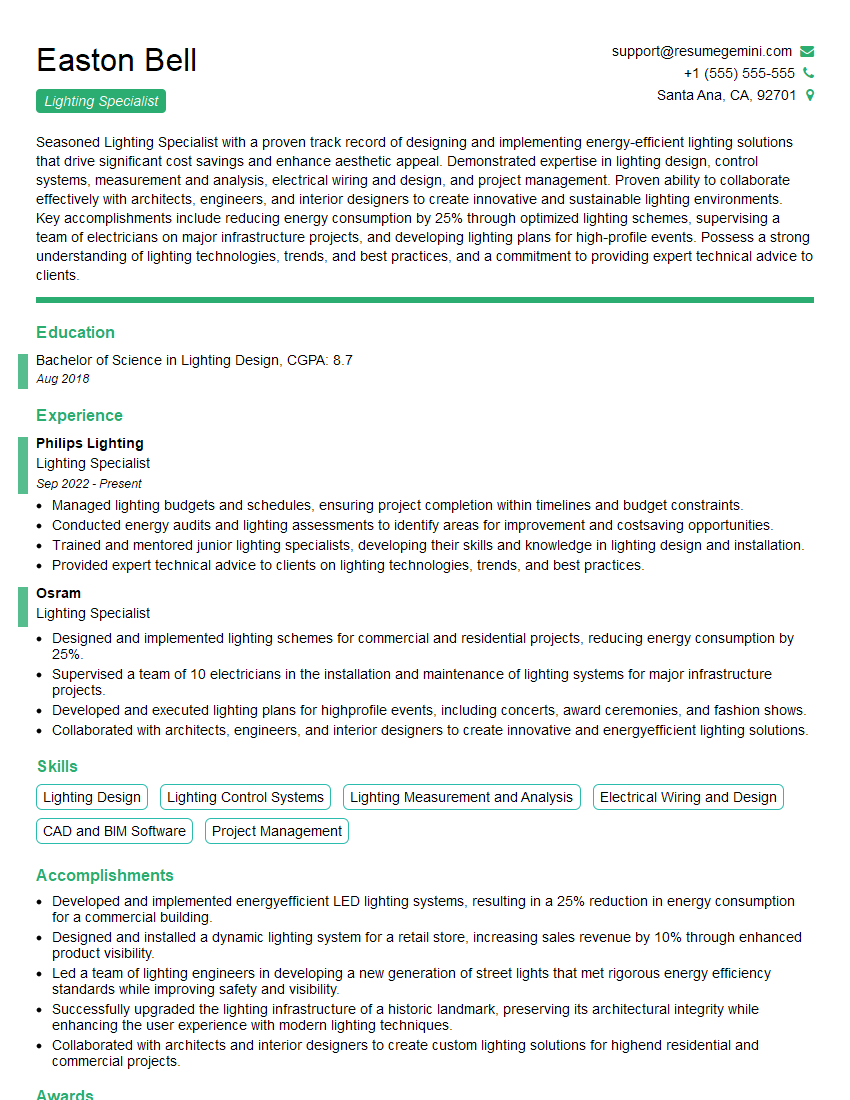
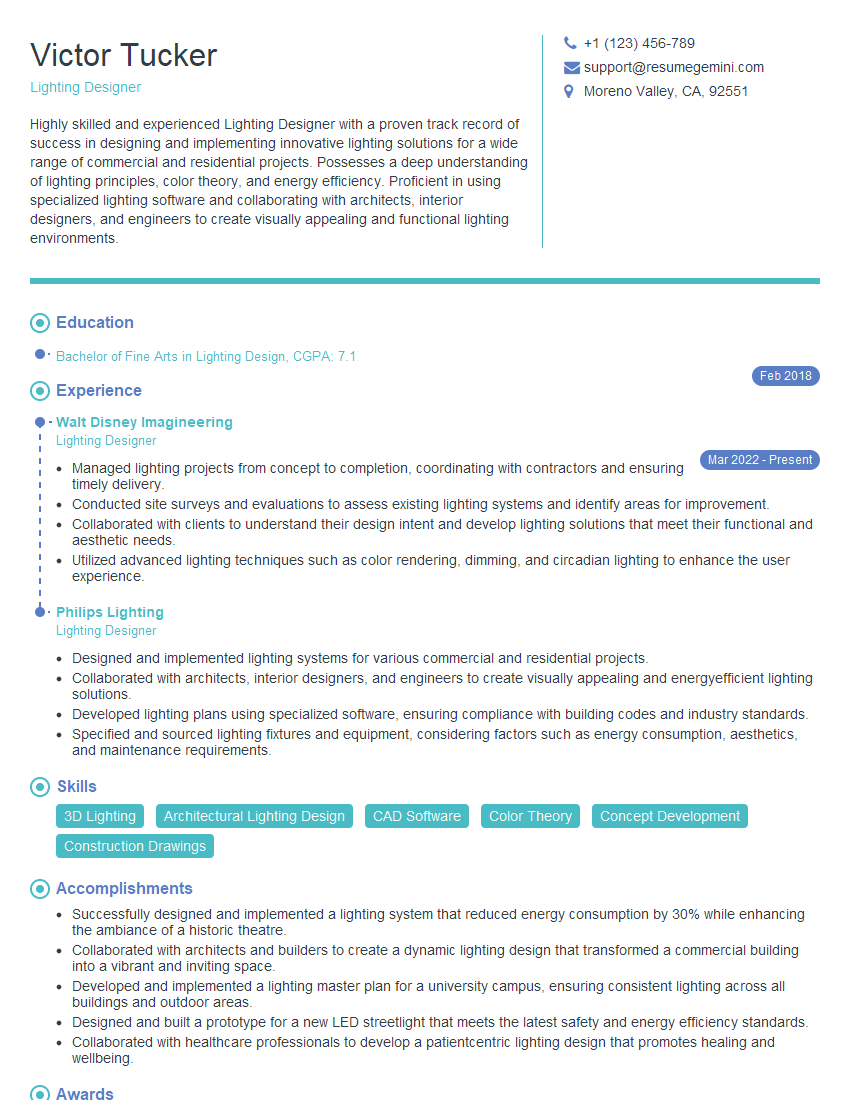
Mastering Lighting for Hospitality and Residential Applications opens doors to exciting career opportunities and showcases your ability to create functional and aesthetically pleasing environments. A strong resume is crucial for highlighting your skills and experience to potential employers. Building an ATS-friendly resume is essential to ensuring your application gets noticed. We strongly recommend using ResumeGemini to create a professional and impactful resume that grabs the attention of recruiters. ResumeGemini provides examples of resumes tailored to Lighting for Hospitality and Residential Applications to help you get started. Invest the time in crafting a compelling resume; it’s your first impression and a key factor in securing your dream job.
Explore more articles
Users Rating of Our Blogs
Share Your Experience
We value your feedback! Please rate our content and share your thoughts (optional).
What Readers Say About Our Blog
Very informative content, great job.
good