Every successful interview starts with knowing what to expect. In this blog, we’ll take you through the top Table Top Fabrication interview questions, breaking them down with expert tips to help you deliver impactful answers. Step into your next interview fully prepared and ready to succeed.
Questions Asked in Table Top Fabrication Interview
Q 1. Describe your experience with various table top materials (wood, laminate, solid surface, etc.).
My experience encompasses a wide range of tabletop materials, each with its own unique properties and challenges. Wood, for instance, offers unparalleled warmth and beauty, but requires careful selection to avoid defects and meticulous preparation to prevent warping or cracking. I’m proficient in working with various wood species, from hardwoods like cherry and walnut, known for their durability and rich grain patterns, to softer woods like pine, ideal for painted finishes. Laminates provide a cost-effective and durable option, offering a vast array of colors and patterns. However, careful handling is crucial during fabrication to avoid chipping or scratching. Solid surface materials, like Corian or Avonite, are non-porous and extremely easy to maintain, making them perfect for high-traffic areas. Their seamless look and ability to be thermoformed allows for impressive design flexibility. I’ve also worked extensively with engineered stone, such as quartz, which boasts exceptional strength and stain resistance, but requires specialized tools for cutting and shaping.
- Wood: I’ve crafted tables from reclaimed wood, showcasing unique character and sustainability.
- Laminate: I’ve successfully incorporated intricate laminate patterns into modern designs.
- Solid Surface: I’ve created seamless, integrated sinks and countertops using solid surface materials.
- Engineered Stone: I’ve built durable, high-end tables using quartz, handling the material’s hardness with precision.
Q 2. Explain your proficiency in using woodworking machinery (e.g., routers, planers, jointers).
My proficiency with woodworking machinery is a cornerstone of my skillset. I’m highly experienced and comfortable operating a variety of tools, including routers, planers, jointers, and thickness planers. I understand the importance of safety protocols and always prioritize safe operation. For example, using a router requires precise control and careful bit selection to achieve the desired profile. I’m adept at using various router bits for creating intricate edges, decorative details, and mortise and tenon joints. The planer is essential for creating perfectly flat and smooth surfaces, while the jointer ensures straight and square edges, crucial for accurate joinery. I regularly maintain and calibrate these machines, ensuring their accuracy and longevity. I also use specialized tools like a shaper for complex molding work.
Think of it like this: each machine is a specialized tool in a surgeon’s kit. A surgeon needs to understand how to use each tool effectively for the best outcome, just as I do when creating a table top.
Q 3. How do you ensure the accuracy and precision of your cuts and joinery?
Accuracy and precision are paramount in table top fabrication. I employ several strategies to ensure exactness. First, meticulous measuring and marking are essential. I use high-quality measuring tools and always double-check my measurements. Before making any cuts, I carefully plan each step, considering the material’s properties and the final design. For example, when cutting a complex curve, I use a template or digital cutting machine to ensure smooth, accurate results. For joinery, I use precise jigs and fixtures to create consistent and perfectly aligned joints. A well-tuned jointer and planer are crucial to getting accurately sized and perfectly flat surfaces. Furthermore, I regularly check my work against the design plans throughout the process to catch any discrepancies early on. This prevents costly mistakes and rework later in the process.
Imagine building a house – if your foundation isn’t perfectly square, the whole structure will be off. The same principle applies to table top fabrication.
Q 4. What finishing techniques are you familiar with (e.g., staining, painting, sealing)?
My finishing techniques are diverse and tailored to the specific material and design. I’m proficient in staining, painting, and sealing, each requiring a different approach. Staining enhances the natural beauty of wood by penetrating the grain, providing depth and richness. I select stains carefully, considering the wood species and the desired final color. Painting provides a uniform, consistent color and is ideal for masking imperfections or achieving specific design aesthetics. I employ multiple coats for durability and evenness. Sealing is a crucial step to protect the finished piece from moisture damage, scratches, and stains. I use various sealers, including polyurethane and lacquer, depending on the material and the desired level of protection. I also use specialized techniques like French polishing for exceptionally smooth and glossy finishes.
- Staining: I’ve used various stain colors and techniques to achieve specific looks.
- Painting: I’ve expertly matched paint colors to client’s preferences, ensuring a perfect match.
- Sealing: I’ve used a variety of sealants, choosing the appropriate one for each project.
Q 5. Describe your experience with edgebanding techniques.
Edge banding is a critical step in table top fabrication, enhancing durability and aesthetics. My experience includes various techniques, depending on the material. For solid wood, I often use solid wood banding, carefully matching the grain and color. For laminate, I use iron-on edge banding, precisely aligning and applying it to create a seamless finish. For solid surface materials, I employ specialized techniques to create a virtually invisible edge. This requires precise measurements and careful heating and shaping. Regardless of the method, the process requires meticulous attention to detail to ensure a clean, even, and visually appealing edge. Poorly applied edge banding can significantly detract from the overall quality of the finished piece.
Think of it like framing a picture; the frame enhances the artwork, and an improperly applied edge is like a poorly fitting frame.
Q 6. How do you handle complex designs or intricate details in table top fabrication?
Handling complex designs and intricate details requires careful planning and precision. I typically start by creating detailed drawings and 3D models to visualize the design and identify potential challenges. I use computer-aided design (CAD) software to refine the design and create accurate cutting patterns. For intricate curves or shapes, I often use CNC routers or templates to ensure accuracy and consistency. I break down complex designs into smaller, manageable components, fabricating each part separately before assembling the final tabletop. This approach allows for better control over the process and helps avoid errors. Furthermore, I use a variety of specialized tools and techniques to achieve the desired details. For instance, I utilize specialized router bits for creating unique edge profiles and carving patterns.
It’s like assembling a complex puzzle; it’s easier to work with smaller sections to create a flawless masterpiece.
Q 7. Explain your process for troubleshooting issues during fabrication.
Troubleshooting is an integral part of the fabrication process. When problems arise, my systematic approach involves first identifying the root cause. I carefully examine the piece, comparing it to the design plans, checking for measurement errors, tool misalignment, or material defects. I often use diagnostic tools, such as measuring squares, levels, and calipers, to identify precise discrepancies. Once the problem is identified, I determine the best solution, which may involve adjusting the machinery, re-cutting a component, or applying different finishing techniques. I document my troubleshooting steps to avoid repeating past mistakes. My experience allows me to recognize common problems and efficiently resolve them, minimizing downtime and rework. For example, if a joint is too loose, I might use wood filler or adjust the joinery technique. If a finish is uneven, I might add additional coats or sand it down for a smoother surface. Ultimately, a problem-solving mindset and a wealth of experience are key to overcoming challenges in fabrication.
It’s like detective work, identifying the clue, and finding the solution to solve the case.
Q 8. How do you ensure the structural integrity of a table top?
Ensuring the structural integrity of a tabletop is paramount. It’s not just about aesthetics; it’s about creating a piece that can withstand daily use and last for years. This involves several key considerations:
- Material Selection: The choice of material significantly impacts strength. Hardwoods like oak or maple are naturally durable, while engineered wood like plywood offers consistent strength and stability. Even materials like high-pressure laminates (HPL) on a strong substrate provide excellent durability.
- Construction Methods: For wood, using proper joinery techniques, such as mortise and tenon or dovetail joints, is critical. These interlock pieces, providing superior strength compared to simple butt joints. For engineered materials, ensuring proper support and avoiding excessive stress points is key. For example, a large tabletop might need additional support beams underneath.
- Support System: The legs or base must be adequately sized and positioned to evenly distribute the weight. A wobbly table is a sign of inadequate support. Consider the table’s size, weight, and intended use when selecting a support system.
- Finishing: While not directly impacting structural integrity, a good finish protects the tabletop from moisture and wear, extending its lifespan and maintaining its structural integrity. This is especially vital for wood tabletops.
For example, I once built a large conference table out of oak. I used mortise and tenon joints to construct the frame and added central support beams to prevent sagging. The legs were substantial, and I used a high-quality polyurethane finish for protection. The resulting table is both beautiful and incredibly sturdy.
Q 9. Describe your experience with different types of table top supports (legs, bases, etc.).
My experience with table top supports is extensive. I’ve worked with a wide range of options, each with its own advantages and disadvantages:
- Pedestal Bases: These offer a clean, modern look and are ideal for smaller tables. However, they might not be as stable as other options for larger tabletops.
- Four-Leg Bases: These are the most common and generally provide excellent stability, particularly when using sturdy, appropriately sized legs. Variations include tapered legs for a more elegant look or square legs for a more rustic feel.
- Trestle Bases: These consist of two supports connected by a horizontal beam, offering a strong and visually interesting alternative to four legs. They’re well-suited for larger tables.
- Custom Bases: I’ve also created completely custom bases from metal, incorporating intricate designs or incorporating unusual materials like reclaimed wood. This allows for maximum design flexibility.
The choice of support depends entirely on the tabletop’s design, size, and intended use. For a heavy dining table, I might opt for a sturdy trestle base. For a small side table, a simple pedestal base might suffice.
Q 10. How do you manage your time and prioritize tasks in a busy shop environment?
In a busy shop, effective time management is crucial. I use a combination of techniques:
- Project Prioritization: I prioritize projects based on deadlines and client needs. Urgent orders take precedence, while longer-term projects are scheduled accordingly. This often involves using a Kanban board to visually manage workflows.
- Detailed Planning: Before starting a project, I create a detailed plan, breaking down the tasks into smaller, manageable steps. This allows for better time estimation and prevents unforeseen delays.
- Efficient Workflow: I optimize my workflow to minimize wasted time. This involves organizing my tools and materials, and utilizing efficient techniques to expedite certain processes.
- Delegation (where applicable): If working with a team, I delegate tasks effectively to ensure optimal use of everyone’s skills and time.
For instance, I might prioritize a rush order for a custom coffee table over a less urgent project, ensuring that the client receives their table on time. Detailed planning for each step of the process allows me to stay on schedule and deliver high-quality work.
Q 11. What quality control measures do you employ to ensure high-quality table tops?
Quality control is ingrained in my process. I employ several measures at different stages:
- Material Inspection: I carefully inspect all materials for defects before starting construction. This includes checking for knots, cracks, or inconsistencies in the wood or any imperfections in other materials.
- Process Monitoring: Throughout the fabrication process, I regularly check for accuracy and precision. This involves verifying measurements, ensuring proper joinery, and confirming that all steps are carried out correctly.
- Intermediate Checks: Before moving to the next step, I conduct intermediate checks to catch potential issues early on. For instance, I’ll check the alignment of legs before attaching the tabletop.
- Final Inspection: After completion, I conduct a thorough final inspection. This involves checking for any imperfections, ensuring stability, and verifying that the final product meets the client’s specifications.
If any defects are found during any of these checks, corrective actions are taken immediately. This proactive approach ensures that only high-quality tabletops leave my shop.
Q 12. Describe your experience with reading and interpreting blueprints or technical drawings.
Reading and interpreting blueprints and technical drawings is fundamental to my work. I’m proficient in understanding various drafting conventions, including orthographic projections, scale drawings, and detailed specifications. I can readily identify dimensions, material specifications, and assembly instructions.
For example, I’ve worked with blueprints that detail intricate joinery techniques or complex curves. I can accurately translate these 2D representations into 3D physical objects. I’m also comfortable using digital design software to visualize and modify designs based on client input.
Q 13. How do you stay updated with the latest trends and techniques in table top fabrication?
Staying updated is essential in this constantly evolving field. I utilize several strategies:
- Industry Publications: I regularly read industry magazines and online publications to stay informed about new materials, techniques, and technologies.
- Trade Shows and Workshops: Attending trade shows and workshops provides opportunities to network with other professionals and see the latest innovations firsthand.
- Online Resources: I actively utilize online resources, such as educational websites and forums, to learn about best practices and new techniques.
- Continuous Learning: I constantly seek opportunities to expand my skills and knowledge, through online courses, training programs, or independent study.
Recently, I learned about a new type of epoxy resin that offers superior clarity and durability. I’ve since incorporated it into several projects, enhancing the quality and aesthetic appeal of my work.
Q 14. What safety precautions do you follow when using power tools and machinery?
Safety is my top priority. I strictly adhere to all safety regulations and guidelines when using power tools and machinery:
- Personal Protective Equipment (PPE): I always wear appropriate PPE, including safety glasses, hearing protection, dust masks, and work gloves.
- Machine Maintenance: I regularly inspect and maintain all machinery to ensure they are in safe working order.
- Proper Tool Usage: I utilize each tool according to the manufacturer’s instructions, ensuring proper technique to prevent accidents.
- Shop Organization: Maintaining a clean and organized workspace is crucial for preventing accidents. Tools are stored properly, and walkways remain clear.
- Emergency Procedures: I am familiar with and follow all emergency procedures in case of accidents or injuries.
For example, before using a table saw, I always check the blade’s sharpness and ensure the blade guard is in place. I never rush when using power tools, and I always focus on maintaining a safe working environment.
Q 15. How do you handle customer requests or special orders?
Handling customer requests is paramount in table top fabrication. It begins with active listening – truly understanding their vision, not just the specifics. I always start by asking clarifying questions: What’s the intended use? What style are they aiming for? What’s their budget? What’s their timeline? This helps avoid misunderstandings later.
For special orders, I meticulously document every detail, including dimensions, materials, finish, and any unique design elements. I provide realistic timelines and cost estimates, factoring in potential challenges and material availability. Throughout the process, I maintain open communication, providing updates and addressing any concerns promptly. I often share visual progress updates, like photos or sketches, to ensure the client remains involved and satisfied. One memorable special order involved creating a custom gaming table with integrated LED lighting and a hidden compartment – a real challenge that resulted in a very happy client.
Career Expert Tips:
- Ace those interviews! Prepare effectively by reviewing the Top 50 Most Common Interview Questions on ResumeGemini.
- Navigate your job search with confidence! Explore a wide range of Career Tips on ResumeGemini. Learn about common challenges and recommendations to overcome them.
- Craft the perfect resume! Master the Art of Resume Writing with ResumeGemini’s guide. Showcase your unique qualifications and achievements effectively.
- Don’t miss out on holiday savings! Build your dream resume with ResumeGemini’s ATS optimized templates.
Q 16. Explain your experience with different types of adhesives and their applications.
My experience with adhesives is extensive, encompassing various types tailored to specific materials and applications. For example, polyurethane glues are exceptional for bonding wood, offering strong, durable bonds with excellent gap-filling capabilities. Epoxy resins excel in creating seamless joints for high-stress applications or where precision is key. Contact adhesives, such as those used in laminate application, provide a strong, instant bond, essential for consistent coverage. I’ve also used specialized adhesives for working with metals, glass, and even certain plastics, ensuring each application uses the most suitable and high-quality adhesive for optimal results.
Choosing the right adhesive is crucial. Consider the materials being joined, the strength required, the working time (open time), and the environmental conditions. Incorrect adhesive selection can lead to joint failure, compromising the table’s integrity and the client’s satisfaction. I’ve learned this firsthand – once, using the wrong adhesive for a high-moisture environment led to a bond failure, teaching me a valuable lesson about selecting the right adhesive for the job.
Q 17. Describe your experience with CNC machining for table top fabrication.
CNC machining is an invaluable asset in table top fabrication, particularly for intricate designs or high-volume production. I’m proficient in operating and programming CNC routers, using software like Vectric VCarve Pro and Mastercam. I can create complex cuts, engravings, and even three-dimensional carvings with high precision and repeatability. This allows for consistent quality, even on large batches.
For example, CNC machining allows me to create perfectly matched table legs with intricate details or cut intricate patterns in the table top itself. The precision of CNC ensures a seamless and professional finish, minimizing the need for extensive hand-finishing and maximizing efficiency. I regularly use CNC machining to create custom inlays, edge profiles, and even complete table designs from digital models.
Q 18. How familiar are you with different types of wood and their properties?
Understanding wood properties is fundamental to successful table top fabrication. I’m familiar with a wide range of hardwoods and softwoods, including their grain patterns, durability, workability, and susceptibility to moisture. For instance, hardwoods like walnut and cherry are prized for their rich color and density, making them excellent for high-end table tops. Softwoods like pine are more readily available and easier to work with, often suitable for less demanding applications. Knowing these differences guides material selection based on the project requirements and the client’s budget.
Beyond the basic species, I consider factors like grain orientation, moisture content, and potential defects. Knowing that certain woods are more prone to warping or cracking helps me select appropriate treatments and construction methods to minimize these risks. For example, using a proper wood drying process and choosing appropriate joinery techniques is crucial for ensuring the longevity of the finished product.
Q 19. What is your experience with laminate application techniques (e.g., vacuum press, contact press)?
I have extensive experience with various laminate application techniques. Vacuum pressing provides superior results for complex curves and ensures consistent adhesion over large surfaces, minimizing air bubbles and imperfections. Contact pressing is simpler and faster for flat surfaces, but requires precise application and good clamping pressure. Both methods require precise preparation of the substrate, ensuring it’s clean, smooth, and properly sized. The correct adhesive selection for the laminate type is critical to success.
I’ve worked with different laminate materials, from high-pressure laminates (HPL) known for their durability and resistance to scratches and heat, to thinner, more affordable options. The choice depends on factors like the intended use and the client’s budget. I’ve even used specialized laminates for specific applications, such as antimicrobial laminates for healthcare settings or highly durable laminates for commercial spaces. Proper preparation and technique are essential to prevent delamination or bubbling.
Q 20. How do you handle surface imperfections or damage during the fabrication process?
Surface imperfections and damage during fabrication are inevitable, but addressing them correctly is crucial for a quality finish. Minor scratches can be sanded and refinished. Larger imperfections, such as chips or gouges, may require more extensive repair using wood filler, followed by sanding and refinishing. For more severe damage, replacement sections might be necessary. Consistent quality control throughout the process helps minimize these issues, but I always have a plan for addressing unexpected occurrences.
I meticulously inspect each piece at every stage of the process, looking for inconsistencies and damage. I understand that these imperfections are part of the natural woodworking process, and I utilize various techniques to minimize or eliminate them. This ranges from simple sanding and filling to more complex repairs that require blending and matching finishes.
Q 21. Describe your experience with repairing or restoring damaged table tops.
Repairing or restoring damaged table tops requires careful assessment and tailored solutions. The approach depends entirely on the nature and extent of the damage. Minor scratches or water rings can often be removed with appropriate cleaning and polishing techniques. More significant damage, such as cracks or chips, may necessitate wood repair techniques, color matching, and refinishing. For severe damage involving structural issues, more extensive repairs might be needed, possibly involving replacing damaged sections.
I prioritize matching the existing finish and material as closely as possible, ensuring a seamless repair. This often involves mixing custom colors and using specialized techniques to blend the repaired area seamlessly with the original surface. A recent project involved repairing a cracked antique table top using traditional wood repair techniques, followed by a meticulous refinishing process to match the original patina – a restoration I was particularly proud of.
Q 22. Explain your understanding of different finishing techniques for various materials.
Finishing techniques for table tops depend heavily on the base material. Think of it like choosing the perfect outfit – the material dictates what accessories and finishing touches work best. For example, a smooth, polished look might be ideal for a glass or lacquered wood tabletop, while a rustic, hand-hewn finish would suit a reclaimed wood piece.
Wood: Options range from simple sanding and sealing with polyurethane (for a durable, clear finish) to staining (to add color and depth) or applying a more decorative finish like paint or epoxy resin (for a modern, sleek look). Advanced techniques include hand-planing for a truly rustic feel or applying a beeswax finish for a subtle, natural sheen.
Metal: Metals like steel or aluminum often require powder coating for durability and a consistent color, or they can be polished to a high shine. Other options include plating (like chrome or nickel plating) for corrosion resistance and aesthetic appeal, or applying a patina for a weathered, aged look.
Stone: Natural stones like granite or marble typically receive a polishing process to enhance their natural beauty and create a smooth, non-porous surface. Sealing is crucial to protect against stains. Honing can provide a more matte finish.
Glass: Glass tabletops usually require minimal finishing beyond cleaning and polishing. However, edge work, such as beveling or polishing the edges, adds both aesthetics and safety.
The choice of finish always considers the desired aesthetic, the material’s properties, and the expected level of durability and maintenance.
Q 23. How do you measure and calculate material requirements for a specific table top design?
Accurately calculating material requirements is fundamental to efficient fabrication and minimizing waste. It’s like baking a cake – you need the right amount of each ingredient! This involves a multi-step process:
Detailed Design: Start with precise dimensions from your design, including the tabletop’s length, width, and thickness. Account for any curves, cutouts, or complex shapes.
Material Properties: Consider the material’s sheet size (if applicable, like plywood or metal sheets). This dictates how many sheets you’ll need and how they’ll be cut.
Waste Calculation: This is crucial. Factor in kerf (the amount of material lost during cutting), which varies by cutting method (e.g., circular saw, laser cutter). Complex shapes generally lead to more waste.
Overage: Always add an overage to account for unexpected errors or material imperfections. A 5-10% overage is a common practice, depending on the complexity of the design.
Software Assistance: CAD software (like AutoCAD or SketchUp) is invaluable in generating accurate cut lists and optimizing material usage to minimize waste. These programs often have nesting capabilities, which arrange multiple pieces efficiently on a single sheet.
For example, if I’m building a rectangular tabletop with dimensions 72” x 36” from a 4′ x 8′ sheet of plywood, I’d need one sheet, though I’d calculate the exact cuts to minimize waste from the remaining area. Adding a 10% overage would mean purchasing another sheet for complex designs.
Q 24. What software programs are you proficient in (e.g., CAD, CAM)?
Proficiency in CAD and CAM software is essential for efficient and accurate table top fabrication. I’m highly proficient in AutoCAD, SketchUp, and Fusion 360 for design and modeling. For CAM (Computer-Aided Manufacturing), I’m skilled in using software specific to my machinery, including VCarve Pro for CNC routing and Mastercam for more advanced machining processes. My experience extends to utilizing these programs for creating detailed drawings, generating CNC toolpaths, optimizing material usage, and simulating the fabrication process before actual production.
Q 25. Describe your experience working with various types of hardware (hinges, brackets, etc.).
Working with hardware is as critical as the tabletop itself—it ensures functionality and durability. My experience encompasses a wide range of hardware, including:
Hinges: From simple butt hinges for cabinet-style bases to concealed hinges for a sleek, modern look. I’m familiar with different hinge types, materials (like steel, brass, or nickel), and installation techniques to ensure smooth operation and longevity.
Brackets: I’ve used various brackets for supporting tabletops, including L-brackets, corner brackets, and specialized brackets for attaching to different base materials (like metal legs or wooden frames). The selection depends on the tabletop’s weight, material, and the desired aesthetic.
Fasteners: Choosing the right screws, bolts, and nuts is crucial. I consider factors like material compatibility, strength, and aesthetics (e.g., using concealed fasteners where appropriate). I also account for the type of wood or metal being used to choose the appropriate screw type to prevent splitting or damage.
My selection process always prioritizes durability, safety, and the overall design aesthetic. A poorly chosen hinge or bracket can compromise the entire piece.
Q 26. How do you ensure the longevity and durability of your fabricated table tops?
Ensuring longevity and durability requires a meticulous approach throughout the entire process, from material selection to finishing. It’s about building something that will last.
Material Selection: Choosing high-quality, durable materials is fundamental. For example, using solid hardwood over particleboard for a tabletop significantly increases its lifespan.
Construction Techniques: Precise joinery (like mortise and tenon joints or dovetail joints) ensures strength and stability. Using appropriate adhesives and reinforcements enhances structural integrity.
Finishing: Proper finishing protects the tabletop from wear and tear, moisture damage, and stains. Applying multiple coats of a high-quality sealant (like polyurethane or epoxy) is essential, especially for wood and stone tabletops.
Hardware Selection: Choosing durable, high-quality hardware (hinges, brackets, etc.) prevents failure over time.
Regular maintenance, such as cleaning and occasional refinishing, further extends the lifespan of the tabletop. It’s a bit like regularly servicing a car—preventative measures prolong its life.
Q 27. Describe a time you had to troubleshoot a complex fabrication problem. What was your solution?
I once faced a challenge with a live-edge walnut tabletop. The wood was incredibly beautiful but had a significant warp. Simply flattening the surface wasn’t an option as it would compromise the natural beauty and structural integrity. My solution involved a combination of techniques:
Epoxy Resin Fill: I filled the gaps and low points using epoxy resin, carefully matching the color to the walnut. This stabilized the tabletop and created a seamless, visually appealing surface.
Strategic Support System: Instead of relying solely on the wood’s strength, I incorporated a hidden support system beneath the tabletop using carefully positioned metal supports to counteract the warp. This provided additional strength and prevented further warping.
Careful Finishing: Once the epoxy cured, I meticulously sanded and finished the surface to maintain the natural beauty of the walnut while ensuring a smooth, durable finish.
The finished product was a stunning tabletop that showcased the natural beauty of the wood while overcoming its inherent challenges. The solution demonstrates my ability to adapt to unforeseen circumstances and devise creative, functional solutions.
Q 28. How do you maintain a clean and organized workspace?
Maintaining a clean and organized workspace is crucial for efficiency, safety, and preventing errors. My approach is based on a few key principles:
5S Methodology: I utilize the 5S methodology – Seiri (Sort), Seiton (Set in Order), Seisō (Shine), Seiketsu (Standardize), and Shitsuke (Sustain) – to maintain a consistently organized environment. This includes regularly clearing clutter, organizing tools and materials efficiently, cleaning the workspace thoroughly, standardizing processes, and maintaining these practices consistently.
Designated Areas: Tools and materials are stored in designated areas, and everything has a place. This prevents searching for items and minimizes downtime.
Regular Cleaning: I clean up after each project, ensuring that sawdust, dust, and debris are removed to prevent accidents and maintain a professional environment.
Inventory Management: Maintaining a clear inventory of materials helps avoid running out of essential supplies and ensures efficient project planning.
A clean and organized workspace enhances creativity and productivity – it’s like having a well-organized kitchen; you can cook more effectively.
Key Topics to Learn for Table Top Fabrication Interview
- Material Selection and Properties: Understanding the characteristics of various materials (wood, glass, metal, composites) and their suitability for different tabletop designs and applications. This includes knowledge of material strengths, weaknesses, and finishing techniques.
- Construction Techniques: Mastery of joinery methods (e.g., dovetail, mortise and tenon, biscuit joining), edge banding, laminating, and other relevant assembly techniques. Be prepared to discuss practical applications of these techniques in creating durable and aesthetically pleasing tabletops.
- Finishing and Refinishing: Knowledge of various finishing processes, including sanding, staining, painting, sealing, and polishing. Understanding the importance of surface preparation and the impact of different finishes on the final product’s durability and appearance. Consider discussing troubleshooting common finishing problems.
- Design Principles and Aesthetics: Demonstrate an understanding of design principles like proportion, balance, and visual weight as they apply to tabletop design. Be ready to discuss different design styles and their appropriate applications.
- Tools and Equipment: Familiarity with hand tools (e.g., saws, chisels, planes) and power tools (e.g., routers, sanders, table saws) commonly used in tabletop fabrication. Understanding safe operating procedures and maintenance is crucial.
- Project Management and Estimation: Ability to estimate material costs, labor time, and project timelines. Discuss your experience in planning and executing projects efficiently and effectively.
- Troubleshooting and Problem-Solving: Be prepared to discuss instances where you encountered challenges during fabrication and how you successfully overcame them. Highlight your problem-solving skills and ability to adapt to unexpected issues.
Next Steps
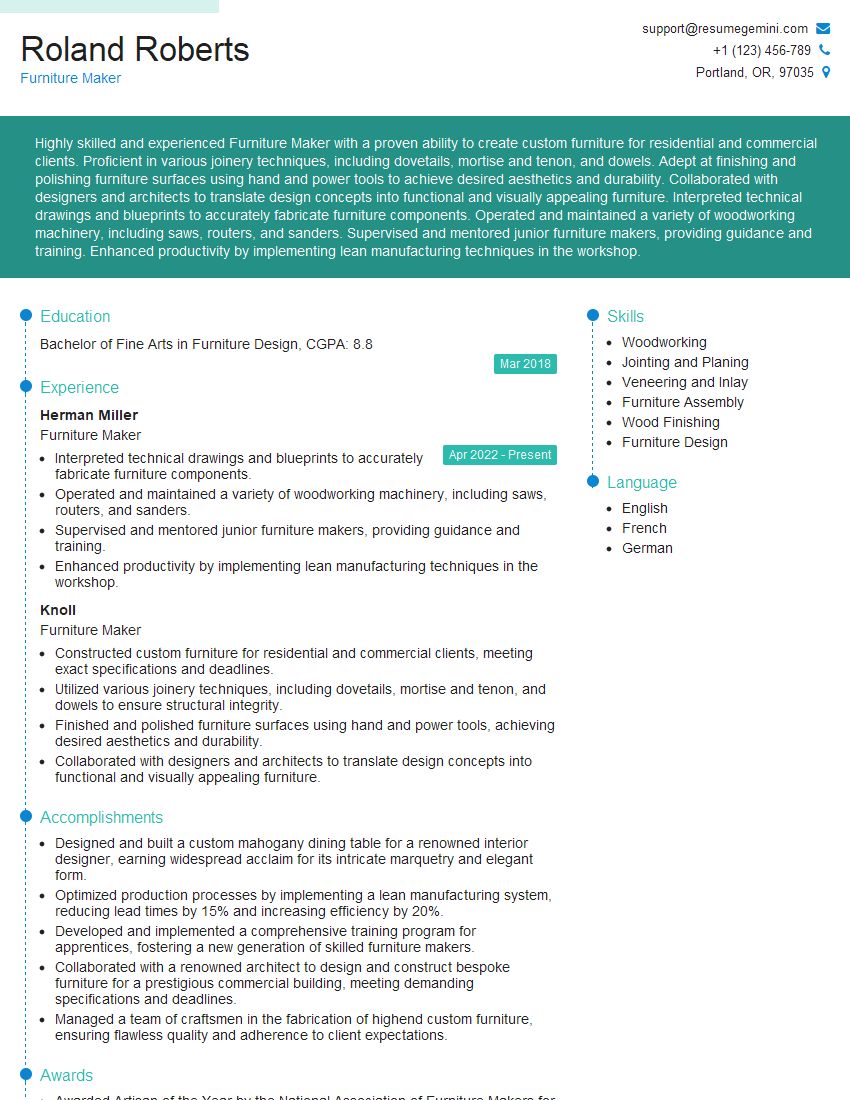
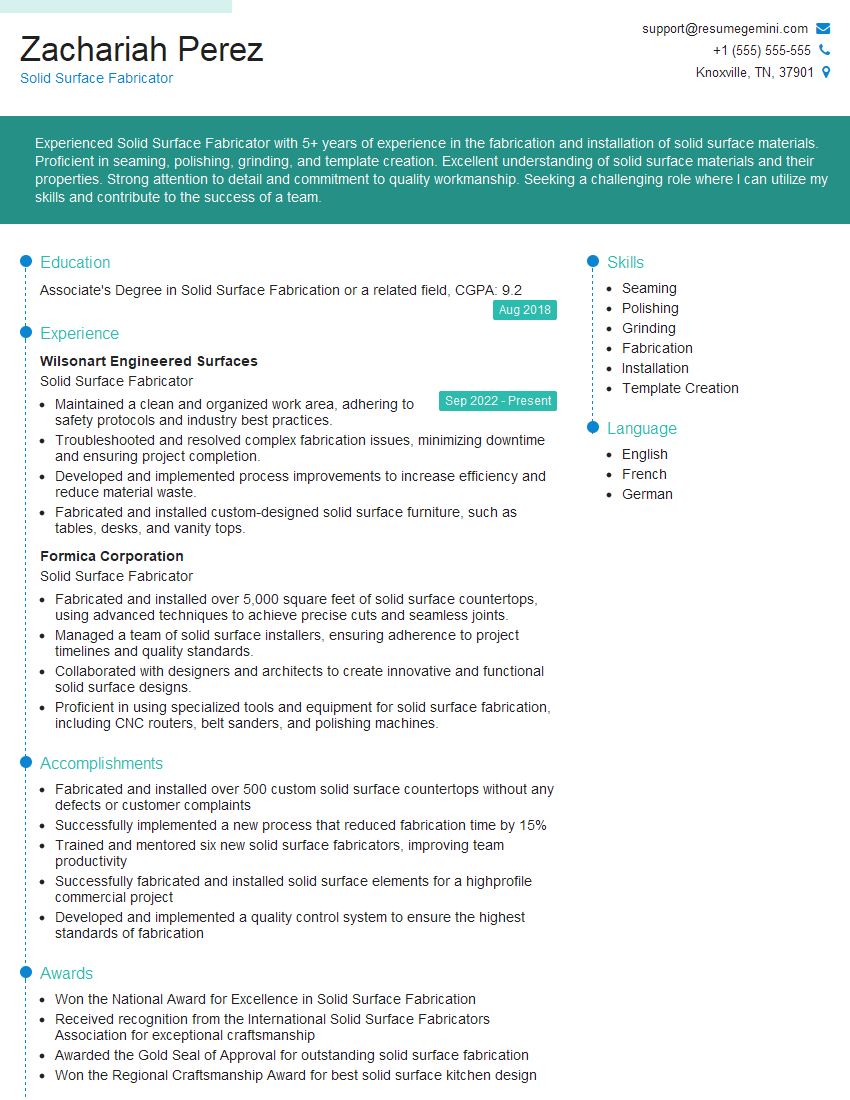
Mastering Table Top Fabrication opens doors to diverse and rewarding career opportunities in woodworking, furniture making, and related fields. A strong understanding of these skills demonstrates your craftsmanship, attention to detail, and problem-solving abilities – highly valued attributes in many industries. To maximize your job prospects, create a compelling and ATS-friendly resume that showcases your expertise. We highly recommend using ResumeGemini to build a professional resume that highlights your skills and experience effectively. Examples of resumes tailored specifically for Table Top Fabrication professionals are available to help you get started.
Explore more articles
Users Rating of Our Blogs
Share Your Experience
We value your feedback! Please rate our content and share your thoughts (optional).
What Readers Say About Our Blog
Very informative content, great job.
good