Cracking a skill-specific interview, like one for Understanding of Optics and Coatings, requires understanding the nuances of the role. In this blog, we present the questions you’re most likely to encounter, along with insights into how to answer them effectively. Let’s ensure you’re ready to make a strong impression.
Questions Asked in Understanding of Optics and Coatings Interview
Q 1. Explain the concept of refractive index and its significance in optical design.
The refractive index (n) is a fundamental property of a material that describes how fast light travels through it relative to its speed in a vacuum. It’s defined as the ratio of the speed of light in a vacuum (c) to the speed of light in the material (v): n = c/v. A higher refractive index means light slows down more significantly within the material. This difference in speed is what causes light to bend (refract) when it passes from one medium to another, such as from air into glass.
In optical design, the refractive index is crucial because it dictates how lenses, prisms, and other optical components will manipulate light. For example, the curvature and material of a lens are selected based on their refractive indices to achieve the desired focusing or diverging effect. Without a precise understanding of refractive indices, it’s impossible to accurately design sophisticated optical systems like microscopes, telescopes, or camera lenses.
Imagine throwing a ball from water onto land. The ball changes direction due to the difference in resistance between the water and the land. Similarly, light changes direction (refracts) when moving from one medium to another due to the difference in refractive index.
Q 2. Describe different types of optical coatings and their applications.
Optical coatings are thin layers of material deposited onto the surface of an optical component to modify its interaction with light. There’s a vast array, categorized by their function:
- Anti-reflection (AR) coatings: Minimize reflections, maximizing transmission. Used in eyeglasses, camera lenses, and solar panels.
- High-reflection (HR) coatings: Maximize reflections, minimizing transmission. Used in mirrors, laser cavities, and optical filters.
- Bandpass filters: Transmit light only within a specific wavelength range, blocking others. Essential in spectroscopy and laser systems.
- Dichroic filters: Reflect some wavelengths while transmitting others. Used to separate colors in lighting and projection systems.
- Polarizing coatings: Transmit light of a specific polarization while blocking others. Used in LCD screens, sunglasses, and scientific instrumentation.
- Protective coatings: Enhance durability and scratch resistance, often a hard, transparent layer added to a functional coating.
The choice of coating depends entirely on the application’s requirements. For instance, a high-quality telescope mirror needs a highly reflective coating with extremely low scatter, while eyeglasses benefit from an anti-reflection coating to improve clarity and reduce glare.
Q 3. What are the key parameters used to characterize optical coatings?
Key parameters for characterizing optical coatings include:
- Refractive index (n): Determines how much the coating bends light.
- Thickness (d): Precise control of thickness is critical for achieving desired optical properties; even small variations can significantly impact performance.
- Spectral properties: Transmission, reflection, and absorption as a function of wavelength. These are often presented as graphs showing the percentage of light transmitted or reflected at different wavelengths.
- Durability and scratch resistance: Crucial for long-term performance and suitability for different environments. Hardness testing is often employed.
- Adhesion: How well the coating adheres to the substrate; poor adhesion can lead to delamination and failure.
- Environmental stability: Resistance to humidity, temperature variations, and other environmental factors.
- Scattering: How much light is scattered instead of being reflected or transmitted. Low scatter is essential for high-resolution imaging systems.
These parameters are interconnected; optimizing one may compromise another, requiring careful balancing during the design and manufacturing process.
Q 4. How does the angle of incidence affect reflection and transmission in optical coatings?
The angle of incidence (the angle at which light strikes a surface) significantly affects reflection and transmission in optical coatings. This is governed by Snell’s Law and Fresnel’s equations. At normal incidence (0°), the reflection and transmission are straightforward to calculate. However, as the angle of incidence increases, the amount of reflected light increases, and the polarization of the reflected and transmitted light changes.
For example, at Brewster’s angle, the reflection of p-polarized light (light with electric field vibrations parallel to the plane of incidence) becomes zero. This phenomenon is exploited in polarizing optics. At high angles of incidence, particularly for multiple-layer coatings, the interference effects that determine the coating’s performance become more complex and sensitive to the angle. This is why many optical coatings are designed to perform optimally within a specific range of angles.
Consider sunglasses, which often utilize polarizing coatings to reduce glare. The effectiveness of these coatings is angle-dependent; they work best when the light reflecting off a surface (like water or pavement) is incident at an angle closer to Brewster’s angle.
Q 5. Explain the concept of anti-reflection coatings and their design principles.
Anti-reflection (AR) coatings are designed to minimize reflections from a surface by using the principle of destructive interference. Light reflected from the top and bottom surfaces of the coating interfere with each other. By carefully selecting the refractive index and thickness of the coating (or multiple coatings), it’s possible to make the reflected waves cancel each other out, resulting in minimal reflection and maximum transmission.
The design principles involve calculating the appropriate thickness and refractive indices of the layers using the following key considerations: The refractive index of the coating material should be roughly the square root of the refractive index of the substrate. Multiple layers can be used to achieve broader bandwidth anti-reflection, which extends the effect over a wider range of wavelengths. Quarter-wave thickness is often used as a starting point for the design, which means that the optical thickness (refractive index multiplied by physical thickness) of each layer is one-quarter of the wavelength of light to be suppressed.
Imagine two waves, identical in size but exactly opposite in phase. When they meet, they cancel each other out. An AR coating uses this principle to effectively “hide” the surface from the light.
Q 6. Describe different techniques for depositing optical coatings (e.g., sputtering, evaporation).
Several techniques are used for depositing optical coatings:
- Sputtering: A physical vapor deposition (PVD) method where a target material is bombarded with ions, ejecting atoms that deposit onto the substrate. Sputtering offers good control over layer thickness and uniformity, and it’s suitable for depositing a wide range of materials, including metals, oxides, and nitrides. It is robust and suitable for high-volume manufacturing.
- Evaporation: Another PVD method where a material is heated in a vacuum until it evaporates. The vapor then condenses onto the substrate. Evaporation is simpler and can be faster than sputtering for some materials, but it may be less precise in terms of thickness control and uniformity.
- Chemical Vapor Deposition (CVD): Chemical reactions are used to deposit a thin film onto a substrate. CVD is often used to deposit materials with specific chemical properties, providing good control over film composition and thickness but can be challenging to achieve good uniformity.
- Sol-gel: A solution containing the desired material precursors is deposited onto the substrate and then undergoes chemical reactions that lead to the formation of a thin film. This method is useful for coatings requiring complex chemical compositions but generally yields less precise thickness control compared to PVD methods.
The choice of technique depends on factors like material properties, desired coating quality, cost, and throughput requirements.
Q 7. What are the challenges in designing and manufacturing high-performance optical coatings?
Designing and manufacturing high-performance optical coatings present several challenges:
- Achieving precise layer thickness and uniformity: Even small deviations from the design specifications can significantly affect the coating’s performance. This requires sophisticated control of deposition processes and meticulous monitoring of film growth.
- Controlling material properties: The optical properties of the deposited films may deviate from the bulk material properties, requiring careful material selection and optimization of deposition parameters.
- Environmental stability: Coatings must withstand environmental factors like humidity, temperature changes, and UV radiation without degradation. This requires selection of durable materials and robust deposition techniques.
- Cost and scalability: Producing high-quality coatings cost-effectively, especially at large scales for mass production, presents a continuous challenge.
- Laser damage threshold: For high-power laser applications, the coating must withstand high-intensity laser pulses without damage. This often involves the use of specialized materials and deposition processes.
- Scattering: Minimizing light scattering is crucial for high-resolution applications. Achieving low scatter requires exceptional control over surface roughness and film quality.
Overcoming these challenges requires a deep understanding of materials science, optical physics, and advanced manufacturing techniques. The development of new materials and improved deposition methods is a continuing area of research in the field.
Q 8. How do you measure the thickness and optical properties of thin films?
Measuring the thickness and optical properties of thin films is crucial for ensuring the performance of optical coatings. We primarily employ two techniques: ellipsometry and profilometry.
Ellipsometry is a non-destructive optical technique that measures the change in polarization of light reflected from a surface. By analyzing this change, we can determine the thickness and refractive index of thin films with high precision. Imagine shining polarized light onto a film; the film alters the polarization state depending on its thickness and refractive index. Ellipsometers precisely measure this alteration, allowing us to calculate these parameters. This technique is particularly useful for thin, transparent films.
Profilometry, on the other hand, provides a topographical profile of the film’s surface. Techniques like atomic force microscopy (AFM) or optical profilometry use a physical probe or optical interference to scan the surface, creating a 3D map. This method is excellent for determining the film’s thickness and surface roughness, but it can be more destructive or less precise for extremely thin films. For example, a scratch on the surface could influence the measured thickness. The choice of technique depends on the film’s properties and the level of accuracy required.
Q 9. Explain the concept of interference in thin films and its role in optical coatings.
Interference in thin films arises from the superposition of light waves reflected from the top and bottom surfaces of the film. When light strikes a film, some light reflects from the top surface, while the rest transmits through. This transmitted light then reflects from the bottom surface and interferes with the light initially reflected from the top. This interference can be constructive (leading to increased intensity) or destructive (leading to decreased intensity), depending on the optical path difference between the two reflected beams. The optical path difference depends on the film’s thickness, refractive index, and the wavelength of the light.
In optical coatings, we exploit this interference to design specific optical filters. For example, a simple anti-reflection coating is designed to create destructive interference for a specific wavelength range, minimizing reflection and maximizing transmission. This is achieved by carefully selecting the refractive index and thickness of the coating to create a 180-degree phase shift between the reflected waves. Conversely, high-reflection coatings use constructive interference to maximize reflectance at specific wavelengths. This effect allows us to create specialized mirrors for various applications.
Q 10. What are the common defects observed in optical coatings, and how can they be prevented?
Common defects in optical coatings include pinholes (small holes in the coating), scratches, delamination (separation of the coating from the substrate), and absorption (light being absorbed instead of transmitted or reflected). These defects degrade the optical performance and durability of the coating.
- Pinholes can be caused by insufficient coating uniformity or contamination during deposition.
- Scratches result from mechanical damage during handling or processing.
- Delamination often arises from poor adhesion between the coating and the substrate or internal stress within the coating.
- Absorption can be caused by impurities within the coating materials.
Preventing these defects involves careful control of the deposition process, meticulous substrate cleaning, and appropriate handling procedures. Optimized deposition parameters like temperature and pressure, the use of high-purity materials, and employing protective layers can all contribute to mitigating defects. Regular quality control during the manufacturing process is crucial for identifying and addressing potential issues early on.
Q 11. Describe different types of optical filters and their applications.
Optical filters selectively transmit or reflect specific wavelengths of light. Several types exist, each with distinct applications:
- Bandpass filters transmit a narrow range of wavelengths and block others. These are widely used in spectroscopy and imaging to isolate specific spectral features.
- Longpass filters transmit wavelengths above a specific cutoff wavelength and block those below. They are commonly employed in fluorescence microscopy to separate excitation and emission light.
- Shortpass filters transmit wavelengths below a specific cutoff and block those above. Applications include removing unwanted infrared radiation.
- Neutral density (ND) filters attenuate light intensity across a wide wavelength range without changing the spectral distribution. They are often used in photography to control exposure.
- Dichroic filters use interference effects to reflect certain wavelengths and transmit others, often used in medical imaging systems or laser systems to separate different wavelengths.
The specific application dictates the type of filter needed. For instance, a bandpass filter centered on the wavelength of interest is crucial for spectroscopy, while an ND filter is necessary in bright sunlight to reduce light intensity without affecting image color.
Q 12. How do you choose the appropriate optical coating for a specific application?
Choosing the right optical coating involves considering several factors:
- Wavelength range of interest: The coating needs to perform optimally within the required spectral region.
- Required transmission or reflection: Is high transmission, high reflection, or a specific balance needed?
- Angle of incidence: The coating’s performance can vary with the angle at which light strikes the surface.
- Durability requirements: Environmental factors such as temperature, humidity, and abrasion resistance must be considered.
- Substrate material: The coating must be compatible with the substrate material to ensure good adhesion.
- Cost and manufacturing constraints: Some coatings are more expensive or difficult to manufacture than others.
For example, an anti-reflection coating for a camera lens requires high transmission across the visible spectrum and good durability, while a high-reflection coating for a laser mirror might require very high reflectivity at a specific wavelength and high laser damage threshold. A thorough understanding of the application’s needs is paramount for selecting the appropriate coating.
Q 13. Explain the concept of optical scattering and its impact on optical systems.
Optical scattering refers to the redirection of light from its original path due to imperfections or inhomogeneities in an optical element. These imperfections can include surface roughness, bulk scattering within the material, and the presence of particles or defects. Scattering reduces the intensity of the transmitted or reflected beam and can affect the image quality by introducing haze or blurring. It’s like shining a flashlight through foggy air – the light gets scattered, reducing its intensity and making the beam appear less focused.
In optical systems, scattering is generally undesirable. It reduces contrast, degrades image resolution, and can lead to stray light, affecting the performance of sensitive instruments. Minimizing scattering is crucial in applications where high image quality and precision are required, such as in telescopes, microscopes, and optical fibers. This is achieved through careful polishing of optical surfaces, using high-quality materials with minimal defects, and employing anti-scattering coatings.
Q 14. What is the difference between dielectric and metallic coatings?
Dielectric and metallic coatings differ significantly in their optical properties and applications.
Dielectric coatings are made of non-conductive materials, such as silicon dioxide (SiO2) or titanium dioxide (TiO2). They primarily work by controlling interference effects to achieve high reflectivity or anti-reflectivity at specific wavelengths. They are typically transparent or translucent and are less absorptive than metallic coatings. Examples include anti-reflection coatings on eyeglasses and high-reflection coatings on mirrors.
Metallic coatings, on the other hand, are composed of conductive materials, such as aluminum, silver, or gold. They achieve high reflectivity across a broad wavelength range primarily due to the interaction of light with free electrons in the metal. They are opaque and often exhibit higher absorption than dielectric coatings. Applications include highly reflective mirrors used in lasers or telescopes. Metallic coatings are also excellent conductors of heat and electricity, unlike dielectric coatings. Choosing between the two is determined by whether you require broad wavelength reflectivity (metallic) or precise wavelength control through interference (dielectric).
Q 15. Describe the different types of optical aberrations and how they can be corrected.
Optical aberrations are imperfections in an optical system that cause light rays to not converge perfectly at a single point, resulting in blurry or distorted images. They arise from the limitations of lenses and mirrors in perfectly focusing light from different points in an object. There are several types:
- Spherical Aberration: Rays passing through the outer edges of a lens focus at a different point than those passing through the center. Think of it like dropping pebbles into a still pond – the ripples from the outer pebbles don’t meet at the same point as those closer to the center. Correction involves using aspherical lenses or lens combinations to counteract the effect.
- Chromatic Aberration: Different wavelengths of light (colors) are refracted differently, resulting in color fringing around the image. Imagine a prism splitting white light into a rainbow – that’s chromatic aberration in action. Achromatic lenses, made from glasses with different refractive indices, minimize this.
- Coma: Off-axis points appear comet-shaped, with rays from a single point fanning out. This is especially noticeable in wide-field telescopes. Correction strategies include using carefully designed lens systems or specialized mirror shapes.
- Astigmatism: Point sources appear as short lines instead of points, due to different focal lengths in different planes. Imagine trying to focus on a distant point through a slightly cylindrical lens. Cylindrical lenses are used to correct astigmatism in some optical systems.
- Distortion: The shape of the image is altered, such as pincushion distortion (edges bowed outwards) or barrel distortion (edges bowed inwards). This is commonly seen in wide-angle lenses and can be corrected through lens design and software post-processing.
- Field Curvature: The image is focused on a curved surface rather than a flat plane, resulting in a blurry image at the edges. This is often tackled using lens combinations that flatten the field.
Corrections are usually achieved through careful lens design, using combinations of lenses with different shapes and refractive indices, or employing aspherical elements and specialized optical coatings. Software simulations play a crucial role in optimizing lens design to minimize aberrations.
Career Expert Tips:
- Ace those interviews! Prepare effectively by reviewing the Top 50 Most Common Interview Questions on ResumeGemini.
- Navigate your job search with confidence! Explore a wide range of Career Tips on ResumeGemini. Learn about common challenges and recommendations to overcome them.
- Craft the perfect resume! Master the Art of Resume Writing with ResumeGemini’s guide. Showcase your unique qualifications and achievements effectively.
- Don’t miss out on holiday savings! Build your dream resume with ResumeGemini’s ATS optimized templates.
Q 16. Explain the concept of Fresnel equations and their relevance in optical design.
Fresnel equations describe the reflection and transmission of light at an interface between two different media, such as air and glass. They are crucial for understanding how light behaves when encountering a change in refractive index. They define the amplitude and phase of the reflected and transmitted waves as a function of the angle of incidence, the polarization of the light, and the refractive indices of the two media.
The equations predict the ratio of reflected and transmitted light intensities. This knowledge is pivotal in optical design because it allows us to predict how much light will be reflected, transmitted, or absorbed at various interfaces in our system. For example, in designing anti-reflection coatings, we use the Fresnel equations to determine the appropriate thickness and refractive index of the coating layers to minimize reflection and maximize transmission.
A practical example is designing optical fibers. The Fresnel equations help in designing the core-cladding interface to ensure efficient light guidance by minimizing reflections at the interface and maximizing total internal reflection within the core.
Q 17. What are the key considerations in designing optical systems for specific wavelengths?
Designing optical systems for specific wavelengths involves careful consideration of several factors. The most important aspects are the material properties of the optical components and the dispersion characteristics of the system.
- Material Dispersion: Different materials have different refractive indices at different wavelengths. This means that light of various colors will travel at slightly different speeds through the optical element, causing chromatic aberration. Choosing materials with low dispersion, or using corrective lens designs, is crucial.
- Material Absorption: Different materials absorb light at specific wavelengths. This absorption can lead to signal loss and heating in the optical system. Therefore, material selection is crucial depending on whether you are working in the visible, ultraviolet, infrared, or other spectral regions.
- Source Characteristics: The properties of the light source (laser, LED, etc.) must be carefully considered, such as its spectral width and coherence length. Incoherence impacts the accuracy of certain techniques.
- Detector Sensitivity: The efficiency of the detector used to measure the transmitted or reflected light is also wavelength-dependent. It is vital to match the detector to the specific operating wavelength.
For instance, designing a system for the UV range requires the use of UV-transparent materials such as fused silica, while an IR system might utilize germanium or chalcogenide glasses. A laser system will have different design considerations than a system using an incandescent light source due to the highly coherent and monochromatic nature of the laser light.
Q 18. Describe different types of optical sensors and their applications.
Optical sensors convert light into electrical signals, providing a wide range of applications. Some key types include:
- Photodiodes: Convert light into electrical current; used in various applications from light meters to medical instruments.
- Phototransistors: Similar to photodiodes, but with internal amplification; commonly used in light switches and sensors.
- Charge-Coupled Devices (CCDs): Array of light-sensitive elements that create a digital image; used in cameras and scientific imaging.
- Complementary Metal-Oxide-Semiconductor (CMOS) Sensors: Another type of image sensor, increasingly replacing CCDs due to lower cost and power consumption; commonly used in smartphone cameras and surveillance systems.
- Photomultiplier Tubes (PMTs): Extremely sensitive to low light levels; commonly employed in astronomical imaging and medical diagnostics.
- Position-Sensitive Detectors (PSDs): Measure the position of a light spot, useful in various applications like tracking and laser scanning.
Applications are vast, ranging from basic light detection in consumer electronics to complex spectroscopic measurements in scientific research. For example, CCDs are used in astronomy to capture faint light from distant stars and galaxies; PMTs are used in medical imaging techniques like PET scanning; and PSDs are found in laser-based alignment systems.
Q 19. What is the role of optical coatings in laser systems?
Optical coatings play a critical role in laser systems by enhancing performance and protecting components. They are crucial for optimizing laser efficiency, beam quality, and durability.
- Anti-reflection coatings: Minimize reflections at interfaces, reducing loss of laser power and improving beam quality. This is particularly crucial for high-power lasers.
- High-reflection coatings: Maximize reflection at specific wavelengths, used in laser resonators to create feedback and amplify the laser beam. These coatings are designed to provide high reflectivity at the laser wavelength while minimizing absorption to avoid damage.
- Output couplers: Partially reflecting coatings used in laser resonators to allow a portion of the generated light to escape as the output beam. These coatings need to be extremely precise to maintain optimal laser performance.
- Polarization-dependent coatings: Control the polarization of the laser beam, useful in applications requiring specific polarization states. These coatings are used in various laser systems for generating or filtering specific polarizations.
- Damage threshold coatings: Enhance the laser-induced damage threshold (LIDT) of optical components, protecting them from damage caused by high-power lasers. This is especially crucial for high-power laser applications to prevent damage to expensive optical components.
Without proper coatings, laser systems would suffer from significant power loss, poor beam quality, and increased susceptibility to damage. The design and application of coatings are critical for ensuring optimal performance and long-term stability.
Q 20. Explain the concept of polarization and its significance in optical systems.
Polarization refers to the orientation of the electric field vector in an electromagnetic wave like light. Light can be linearly polarized (electric field oscillates in a single plane), circularly polarized (electric field vector rotates in a circle), or elliptically polarized (a combination of linear and circular).
Its significance in optical systems is substantial:
- Polarization control: Using polarizers and waveplates, we can selectively manipulate the polarization state of light, which is vital in various applications like optical communication, microscopy, and laser technology.
- Reducing reflections: Polarized light reduces reflection from certain surfaces (Brewster’s angle), useful in optical systems where unwanted reflections can be problematic.
- Enhancement of contrast: Polarization filters are frequently used in photography to reduce glare and improve image contrast.
- Stress analysis: Polarized light is used in photoelasticity to analyze stress distributions in transparent materials.
- Optical sensing: Changes in polarization can be used to sense various physical parameters such as strain, temperature, and magnetic fields.
For instance, liquid crystal displays (LCDs) use polarized light to control the transmission of light, enabling display images. Polarizing filters are essential in many microscopy techniques to improve image quality and reduce background noise.
Q 21. How do you assess the durability and environmental stability of optical coatings?
Assessing the durability and environmental stability of optical coatings is critical for ensuring the long-term performance of optical systems. Several methods are employed:
- Environmental testing: Exposing coatings to various environmental conditions like temperature extremes, humidity, UV radiation, and salt spray to evaluate their resistance to degradation. This often involves accelerated aging tests to simulate years of use in a shorter time.
- Scratch and abrasion resistance testing: Using standardized methods (e.g., Taber abrasion test) to determine the resistance of the coatings to mechanical damage.
- Adhesion testing: Assessing how well the coating adheres to the substrate using techniques like tape testing or scratch testing.
Data obtained from these tests provides information on the coating’s long-term stability and reliability under various operational conditions. This information is essential for selecting appropriate coatings for specific applications and predicting their lifespan.
Q 22. What are the advantages and disadvantages of different coating deposition techniques?
Various techniques exist for depositing optical coatings, each with its own set of advantages and disadvantages. The choice depends heavily on the desired coating properties, substrate material, budget, and production scale.
- Evaporation: This is a relatively simple and cost-effective technique, particularly for depositing single-layer coatings. It involves heating a source material in a vacuum, causing it to evaporate and condense onto the substrate. Advantages: Simple, inexpensive. Disadvantages: Can be challenging to achieve uniform thickness, limited to materials with relatively high vapor pressures.
- Sputtering: In sputtering, a target material is bombarded with ions, causing atoms to be ejected and deposited onto the substrate. It offers better control over film thickness and composition compared to evaporation. Advantages: Good thickness control, can deposit a wide range of materials. Disadvantages: More complex setup, can be slower than evaporation.
- Chemical Vapor Deposition (CVD): This technique involves chemical reactions in a gaseous phase to deposit a thin film. It allows for precise control over the film’s stoichiometry and properties. Advantages: Excellent uniformity and conformality, high deposition rates. Disadvantages: Can be complex to control, requires specialized equipment and precursors.
- Sol-Gel: Sol-gel processing uses chemical solutions to create a gel that is then coated onto a substrate and subsequently heat-treated. It’s particularly useful for creating porous coatings or coatings with complex compositions. Advantages: Simple, versatile, allows for doping. Disadvantages: Can have lower optical quality compared to other methods, slower deposition rates.
For instance, if you need a simple anti-reflection coating on a large number of lenses, evaporation might be the most cost-effective option. However, for high-performance coatings requiring precise control over layer thickness and refractive index, sputtering or CVD would be preferred.
Q 23. Explain the concept of optical coherence and its role in optical imaging.
Optical coherence describes the correlation between the phases of light waves. In simpler terms, it’s a measure of how well two light waves ‘match up’ in terms of their oscillations. This concept is fundamental to optical coherence tomography (OCT), a powerful imaging technique.
In OCT, a low-coherence light source (like a superluminescent diode) is used. The light is split into two beams: one that travels to the sample and reflects back, and one that travels along a reference arm. The interference between these two beams is measured. Because of the low coherence length, only light reflected from a very narrow depth range in the sample will interfere constructively with the reference beam. By varying the path length of the reference arm, we can scan through different depths in the sample, building up a three-dimensional image.
OCT’s high resolution allows for visualizing microscopic structures within biological tissues, making it invaluable in ophthalmology (imaging the retina), cardiology (imaging blood vessels), and dermatology (imaging skin layers).
Q 24. Describe different methods for testing and characterizing the performance of optical coatings.
Testing and characterizing optical coatings involves a variety of techniques depending on the specific properties you need to assess. These methods often focus on spectral characteristics, mechanical durability, and environmental stability.
- Spectrophotometry: This is the most common technique, measuring the transmission and reflection of light as a function of wavelength. This helps determine the coating’s performance in terms of its intended function (e.g., reflectivity or anti-reflectivity).
- Ellipsometry: Measures the polarization changes of light reflected from a surface. It provides information on the thickness, refractive index, and optical constants of individual layers within a multilayer coating.
- Scatterometry: Measures the angular distribution of scattered light. It provides insight into the surface roughness and defects in the coating.
- Environmental Testing: This involves subjecting the coated components to various environmental conditions, including temperature extremes, humidity, and chemical exposure, to assess their long-term stability and durability.
- Mechanical Testing: Techniques like scratch testing and adhesion testing determine the mechanical robustness and adhesion of the coating to the substrate.
For example, a high-power laser mirror coating would be tested rigorously for its laser-induced damage threshold (LIDT) using high-energy laser pulses, in addition to spectrophotometry and environmental testing.
Q 25. What are the challenges associated with designing optical coatings for high-power laser applications?
Designing optical coatings for high-power laser applications presents unique challenges due to the high energy density of the laser beam. Key concerns include:
- Laser-Induced Damage Threshold (LIDT): The coating must withstand high-energy laser pulses without damage. This requires careful selection of materials and deposition techniques to minimize absorption and defects.
- Thermal Management: High-power lasers generate significant heat, which can cause thermal stress and damage to the coating. Coatings need to have high thermal conductivity and low absorption to dissipate heat effectively.
- Nonlinear Effects: At high intensities, nonlinear optical effects can occur, leading to changes in the coating’s properties. This requires careful consideration of the material’s nonlinear refractive index.
- Material Selection: Materials must possess exceptional optical, thermal, and mechanical properties, as well as resistance to the laser wavelength.
For instance, a coating designed for a high-power CO2 laser (10.6 μm wavelength) would require different materials and design considerations compared to a coating for a Nd:YAG laser (1.06 μm wavelength). Robustness, durability, and thermal management are paramount.
Q 26. How do you troubleshoot problems related to optical coating performance?
Troubleshooting optical coating performance issues requires a systematic approach. It often begins with careful examination of the problem and then uses various diagnostic tools.
- Identify the Problem: Precisely define the issue—reduced reflectivity, increased scattering, poor adhesion, etc.—and the conditions under which it occurs (wavelength, power, environment).
- Visual Inspection: A thorough visual examination under a microscope can reveal visible defects like scratches, pinholes, or delamination.
- Spectrophotometry & Ellipsometry: Measure the spectral characteristics to quantify the deviation from the designed performance. Ellipsometry can provide additional insights into the coating’s structure and thickness.
- Scatterometry: Determine the level of light scattering, providing clues about surface roughness or defects.
- Environmental Testing (if applicable): Reproduce the conditions under which the problem occurs to confirm the root cause.
- Root Cause Analysis: Based on the gathered data, pinpoint the potential cause—deposition process issue, material contamination, improper substrate preparation, or environmental degradation.
For example, if a coating shows reduced reflectivity compared to its specification, spectrophotometry would identify the wavelength range affected. This may indicate a problem with the thickness of a specific layer or an absorption issue in the coating material. The root cause could range from issues in the deposition process (e.g., incorrect deposition parameters) to a post-deposition issue such as contamination.
Q 27. Explain the role of optical coatings in enhancing the efficiency of solar cells.
Optical coatings play a crucial role in enhancing the efficiency of solar cells by improving light absorption and reducing reflection losses. They are often referred to as anti-reflection coatings (ARCs) and are designed to minimize the reflection of sunlight at the surface of the solar cell.
Sunlight that is reflected away from the solar cell does not contribute to electricity generation. By applying an ARC, a significant portion of the reflected light is redirected into the solar cell, increasing the amount of light absorbed and, consequently, improving its efficiency. ARCs can either be single-layer coatings (e.g., a thin layer of silicon nitride) or multilayer coatings designed for broader spectral response. In addition to ARCs, some solar cells may employ reflective coatings on the back to increase the effective optical path length, further enhancing light absorption.
For example, a typical silicon solar cell with an ARC can achieve a substantial increase in its energy conversion efficiency compared to an uncoated cell. The benefit depends heavily on the specific design and type of solar cell.
Q 28. Describe the principles of optical lithography and its role in semiconductor manufacturing.
Optical lithography is a crucial technique in semiconductor manufacturing used to transfer patterns from a mask onto a silicon wafer. This process allows for the creation of incredibly small and complex features on integrated circuits (ICs).
The process involves projecting ultraviolet (UV) light through a photomask onto a photosensitive material (photoresist) coated on the wafer. The photoresist is selectively exposed to UV light based on the pattern on the mask. This exposed photoresist is then developed, removing either the exposed or unexposed portions, creating the desired pattern. This pattern is then used to etch or deposit material, defining features on the silicon wafer.
The resolution in optical lithography is limited by the wavelength of the light used and the numerical aperture (NA) of the projection optics. Smaller wavelengths (e.g., deep-ultraviolet, EUV) and high-NA lenses are employed to achieve higher resolution for creating smaller and more densely packed features in modern ICs. The development of advanced immersion lithography techniques and extreme ultraviolet (EUV) lithography are crucial advancements enabling the continual miniaturization of transistors and circuits.
Without optical lithography, the fabrication of the intricate circuitry on modern microchips would not be possible, significantly limiting the progress of microelectronics technology.
Key Topics to Learn for Understanding of Optics and Coatings Interview
- Fundamentals of Light and Optics: Understanding wave-particle duality, reflection, refraction, diffraction, interference, polarization, and Snell’s Law. Be prepared to discuss these concepts theoretically and apply them to practical scenarios.
- Optical Coatings: Explore different types of coatings (e.g., anti-reflective, high-reflective, dichroic) and their design principles. Understand the role of thin-film interference and the impact of material selection on coating performance.
- Optical Systems and Instrumentation: Familiarize yourself with common optical components (lenses, mirrors, prisms) and their applications in various instruments (microscopes, telescopes, spectrometers). Be ready to discuss the principles of image formation and optical system design.
- Material Science for Coatings: Understand the properties of materials used in optical coatings (e.g., refractive index, absorption, durability) and their influence on the overall performance. Discuss deposition techniques and characterization methods.
- Applications of Optics and Coatings: Be ready to discuss practical applications across diverse fields like telecommunications, medical imaging, display technology, and environmental sensing. Consider specific examples and their underlying optical principles.
- Problem-solving and Analytical Skills: Practice applying your knowledge to solve problems related to optical design, coating optimization, and performance analysis. Be prepared to discuss your approach to troubleshooting and resolving technical challenges.
Next Steps
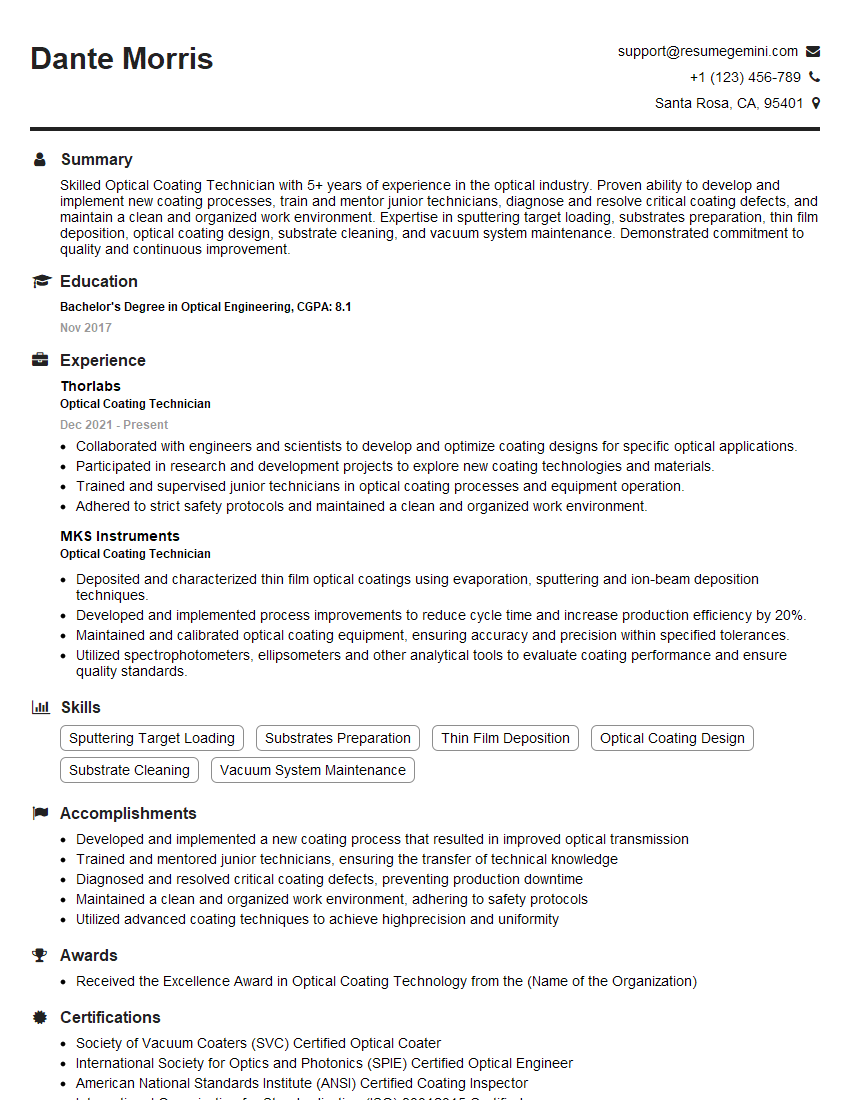
Mastering the principles of Optics and Coatings is crucial for career advancement in many high-demand fields. A strong understanding of these concepts will significantly enhance your job prospects and open doors to exciting opportunities. To maximize your chances of landing your dream job, it’s essential to present your skills effectively through a well-crafted resume. Creating an ATS-friendly resume is paramount in today’s job market. ResumeGemini is a trusted resource that can help you build a professional and impactful resume, tailored to highlight your expertise in Optics and Coatings. Examples of resumes tailored to this field are available to help you get started.

Explore more articles
Users Rating of Our Blogs
Share Your Experience
We value your feedback! Please rate our content and share your thoughts (optional).
What Readers Say About Our Blog
Attention music lovers!
Wow, All the best Sax Summer music !!!
Spotify: https://open.spotify.com/artist/6ShcdIT7rPVVaFEpgZQbUk
Apple Music: https://music.apple.com/fr/artist/jimmy-sax-black/1530501936
YouTube: https://music.youtube.com/browse/VLOLAK5uy_noClmC7abM6YpZsnySxRqt3LoalPf88No
Other Platforms and Free Downloads : https://fanlink.tv/jimmysaxblack
on google : https://www.google.com/search?q=22+AND+22+AND+22
on ChatGPT : https://chat.openai.com?q=who20jlJimmy20Black20Sax20Producer
Get back into the groove with Jimmy sax Black
Best regards,
Jimmy sax Black
www.jimmysaxblack.com
Hi I am a troller at The aquatic interview center and I suddenly went so fast in Roblox and it was gone when I reset.
Hi,
Business owners spend hours every week worrying about their website—or avoiding it because it feels overwhelming.
We’d like to take that off your plate:
$69/month. Everything handled.
Our team will:
Design a custom website—or completely overhaul your current one
Take care of hosting as an option
Handle edits and improvements—up to 60 minutes of work included every month
No setup fees, no annual commitments. Just a site that makes a strong first impression.
Find out if it’s right for you:
https://websolutionsgenius.com/awardwinningwebsites
Hello,
we currently offer a complimentary backlink and URL indexing test for search engine optimization professionals.
You can get complimentary indexing credits to test how link discovery works in practice.
No credit card is required and there is no recurring fee.
You can find details here:
https://wikipedia-backlinks.com/indexing/
Regards
NICE RESPONSE TO Q & A
hi
The aim of this message is regarding an unclaimed deposit of a deceased nationale that bears the same name as you. You are not relate to him as there are millions of people answering the names across around the world. But i will use my position to influence the release of the deposit to you for our mutual benefit.
Respond for full details and how to claim the deposit. This is 100% risk free. Send hello to my email id: lukachachibaialuka@gmail.com
Luka Chachibaialuka
Hey interviewgemini.com, just wanted to follow up on my last email.
We just launched Call the Monster, an parenting app that lets you summon friendly ‘monsters’ kids actually listen to.
We’re also running a giveaway for everyone who downloads the app. Since it’s brand new, there aren’t many users yet, which means you’ve got a much better chance of winning some great prizes.
You can check it out here: https://bit.ly/callamonsterapp
Or follow us on Instagram: https://www.instagram.com/callamonsterapp
Thanks,
Ryan
CEO – Call the Monster App
Hey interviewgemini.com, I saw your website and love your approach.
I just want this to look like spam email, but want to share something important to you. We just launched Call the Monster, a parenting app that lets you summon friendly ‘monsters’ kids actually listen to.
Parents are loving it for calming chaos before bedtime. Thought you might want to try it: https://bit.ly/callamonsterapp or just follow our fun monster lore on Instagram: https://www.instagram.com/callamonsterapp
Thanks,
Ryan
CEO – Call A Monster APP
To the interviewgemini.com Owner.
Dear interviewgemini.com Webmaster!
Hi interviewgemini.com Webmaster!
Dear interviewgemini.com Webmaster!
excellent
Hello,
We found issues with your domain’s email setup that may be sending your messages to spam or blocking them completely. InboxShield Mini shows you how to fix it in minutes — no tech skills required.
Scan your domain now for details: https://inboxshield-mini.com/
— Adam @ InboxShield Mini
support@inboxshield-mini.com
Reply STOP to unsubscribe
Hi, are you owner of interviewgemini.com? What if I told you I could help you find extra time in your schedule, reconnect with leads you didn’t even realize you missed, and bring in more “I want to work with you” conversations, without increasing your ad spend or hiring a full-time employee?
All with a flexible, budget-friendly service that could easily pay for itself. Sounds good?
Would it be nice to jump on a quick 10-minute call so I can show you exactly how we make this work?
Best,
Hapei
Marketing Director
Hey, I know you’re the owner of interviewgemini.com. I’ll be quick.
Fundraising for your business is tough and time-consuming. We make it easier by guaranteeing two private investor meetings each month, for six months. No demos, no pitch events – just direct introductions to active investors matched to your startup.
If youR17;re raising, this could help you build real momentum. Want me to send more info?
Hi, I represent an SEO company that specialises in getting you AI citations and higher rankings on Google. I’d like to offer you a 100% free SEO audit for your website. Would you be interested?
Hi, I represent an SEO company that specialises in getting you AI citations and higher rankings on Google. I’d like to offer you a 100% free SEO audit for your website. Would you be interested?