Preparation is the key to success in any interview. In this post, we’ll explore crucial Color Swatch Analysis interview questions and equip you with strategies to craft impactful answers. Whether you’re a beginner or a pro, these tips will elevate your preparation.
Questions Asked in Color Swatch Analysis Interview
Q 1. Explain the CIE LAB color space and its relevance in color swatch analysis.
The CIE LAB color space is a device-independent color space that describes colors based on human perception. Unlike RGB or CMYK, which are device-dependent, LAB represents colors in a way that’s more consistent across different devices and viewing conditions. It uses three coordinates: L*, a*, and b*. L* represents lightness, ranging from 0 (black) to 100 (white). a* represents the green-red axis, with negative values indicating green and positive values indicating red. b* represents the blue-yellow axis, with negative values indicating blue and positive values indicating yellow.
In color swatch analysis, LAB’s device independence is crucial. Imagine you’re comparing a digital swatch to a physical printed swatch. RGB values from your screen won’t directly translate to the CMYK values of the print. However, both can be converted to LAB, allowing for a more accurate and objective comparison, minimizing discrepancies caused by different devices’ color profiles.
For example, a slight color variation between two seemingly identical fabrics might go unnoticed in RGB, but when converted to LAB, the subtle differences in a* or b* become apparent, highlighting inconsistencies and aiding quality control.
Q 2. Describe the difference between additive and subtractive color mixing.
Additive and subtractive color mixing are two fundamental approaches to creating colors. Additive mixing starts with black (absence of light) and adds light of different colors to produce new colors. Think of your computer screen or television. Red, green, and blue light combine to produce millions of colors; adding all three results in white.
Subtractive mixing, on the other hand, starts with white (reflection of all light) and subtracts light by using pigments or dyes that absorb certain wavelengths. This is how we work with inks, paints, and dyes. Mixing cyan, magenta, and yellow pigments, for instance, ideally produces black; subtracting all colors results in black.
The key difference lies in the nature of the light. Additive uses emitted light, while subtractive uses reflected light. This difference significantly impacts how colors are mixed and perceived in various applications, making understanding this crucial for accurate color swatch analysis across different media.
Q 3. How do metamerism and color constancy affect color swatch matching?
Metamerism refers to the phenomenon where two colors appear identical under one light source but different under another. Color constancy, on the other hand, is our brain’s ability to perceive the same color despite changes in lighting conditions. Both pose significant challenges in color swatch matching.
Metamerism can cause two swatches to match perfectly under a specific light source (e.g., daylight) but appear distinctly different under another (e.g., incandescent light). This is because the spectral power distribution of the light source interacts differently with the pigments in each swatch. Imagine two fabrics looking the same under a store’s fluorescent lights, but one appearing noticeably different at home under natural sunlight. This is metamerism in action.
Color constancy, while helpful in our daily lives, can complicate color matching because our perception might not always align with objective color measurements. Even though lighting conditions might have shifted, we might still perceive the colors as unchanged, leading to subjective judgments that can differ from instrumental measurements.
To mitigate these effects, accurate color measurement under standardized lighting conditions and the use of spectrophotometers (explained below) are crucial for objective color assessment during swatch analysis.
Q 4. What are the common color difference formulas used in color swatch analysis (e.g., Delta E)?
Several color difference formulas quantify the difference between two colors. Delta E (ΔE) is the most commonly used metric, representing the perceived difference between two colors in a given color space. There are different versions of Delta E (e.g., ΔE76, ΔE94, ΔE00, ΔEab) that have evolved to better correlate with human perception. Each formula has strengths and weaknesses and might perform better under certain color ranges.
ΔE values are typically calculated based on the LAB color space coordinates of the two colors being compared. A smaller ΔE value indicates a smaller perceived color difference. The acceptable ΔE value varies depending on the application. In some applications, a ΔE of 1 might be imperceptible, while in others, even a ΔE of 0.5 could be unacceptable.
For example, in textile manufacturing, a low ΔE value ensures color consistency across fabric batches. Other industries, like automotive or packaging, may also define acceptable ΔE tolerances based on their specific needs and materials.
Q 5. Explain the concept of color tolerance and its importance in quality control.
Color tolerance defines the acceptable range of color variation around a target color. It’s expressed as a ΔE value or as a range of acceptable LAB coordinates. Defining color tolerance is critical for quality control because it sets objective limits for acceptable color variations in production. Manufacturing processes rarely result in identical colors in every product, and some variance is inevitable.
Imagine manufacturing a large batch of paint. You wouldn’t expect every can to be precisely the same shade of blue. Instead, you establish a color tolerance, a ΔE value, that defines how much variation is permissible without compromising the product’s quality. Any paint cans outside the tolerance range would be rejected.
This helps ensure that the final products adhere to color standards. Without predefined color tolerances, ensuring consistency across different production runs and across different manufacturing locations becomes considerably more challenging.
Q 6. How would you assess the color consistency of a batch of printed samples using color swatches?
To assess the color consistency of a batch of printed samples using color swatches, I’d follow a systematic approach:
- Select representative samples: Choose a statistically significant number of samples from across the batch.
- Establish a target color: Determine the desired color using a reference swatch, measured with a spectrophotometer (discussed below).
- Measure color using a spectrophotometer: Measure the LAB coordinates of each sample under standardized lighting conditions.
- Calculate color difference: Compare each sample’s LAB coordinates to the target using a relevant ΔE formula (e.g., ΔE00).
- Determine acceptable tolerance: Define a maximum acceptable ΔE value based on application requirements and the nature of the printing process.
- Analyze results: Count the number of samples falling within the acceptable tolerance. This would give you the percentage of acceptable samples and highlight any significant inconsistencies.
- Visual inspection: Always complement the instrumental measurements with visual inspection to confirm that the measured differences are truly imperceptible.
This process gives a quantitative and qualitative assessment of color consistency, ensuring that the printed samples meet predefined quality standards.
Q 7. Describe different methods for measuring color, including spectrophotometry.
Several methods exist for measuring color, each with strengths and weaknesses. Visual assessment is the simplest, relying on human perception, but it’s subjective and prone to error. Instrumental measurements offer objective and repeatable results.
Spectrophotometry is the gold standard for precise color measurement. A spectrophotometer measures the spectral reflectance or transmittance of a sample across the visible spectrum. The measured data are used to calculate color values in different color spaces, such as LAB. Different types of spectrophotometers exist, including:
- 0°/45° spectrophotometers: Measure the reflectance of light at a 45-degree angle from the sample surface, reducing specular reflection (gloss).
- Sphere spectrophotometers: Measure reflectance from all angles, including specular reflection, offering a more comprehensive analysis of color.
Other methods include colorimeters, which measure color by simulating human vision, and densitometers, which are commonly used in the printing industry to measure ink density. The choice of method depends on the accuracy and precision required and the specific application. For precise color swatch analysis, spectrophotometry provides the most objective and repeatable results, particularly when dealing with complex color variations or metamerism.
Q 8. What are some common color measurement instruments and their applications?
Color measurement instruments are crucial for objective color analysis. They quantify color, allowing for precise communication and control throughout the production process. Common instruments include:
- Spectrophotometers: These measure the spectral reflectance or transmittance of a sample, providing detailed data on how it reflects or transmits light at different wavelengths. This is the gold standard for color measurement, offering the most comprehensive color information. Imagine it like a detailed fingerprint for the color.
- Colorimeters: These instruments measure color in terms of CIELAB (L*, a*, b*) or other color spaces, providing a simpler, less detailed color measurement compared to spectrophotometers. Think of them as providing a summary report instead of the full spectral fingerprint.
- Densitometers: Primarily used in printing, these measure the density of ink on a substrate, indirectly relating to color. They are useful for quality control in print production, but less precise for broader color analysis.
Applications vary widely depending on the instrument and industry. Spectrophotometers are used in paint manufacturing for precise color matching, in textile production to ensure consistency across batches, and in quality control across many industries. Colorimeters find use in applications needing less precise but faster color evaluations, while densitometers are indispensable for print shops.
Q 9. How do you handle discrepancies between different color measurement instruments?
Discrepancies between color measurement instruments are common due to differences in instrument design, calibration, and measurement geometry (e.g., 45/0 vs. d/8). To address these discrepancies:
- Calibration: Regular calibration of all instruments against a traceable standard is paramount. This ensures consistent readings across instruments.
- Standardization: Establish a standard measurement protocol specifying the instrument type, measurement conditions (illuminant, observer), and data reporting format. This creates a common baseline.
- Inter-instrument agreement studies: Conduct periodic measurements of the same sample using all instruments. Analyze the differences and establish acceptable tolerances. This helps set realistic expectations and understand instrument-specific biases.
- Data transformation: Use color difference formulas (like Delta E) to compare color data between different instruments and color spaces. Delta E provides a numerical measure of color difference, making discrepancies quantifiable and comparable.
For example, if spectrophotometer A consistently reads a slightly higher ‘a*’ value (redness) than spectrophotometer B, understanding this bias helps correct future measurements. The goal is not perfect agreement, but controlled, consistent differences that are understood and accounted for.
Q 10. Explain the importance of standardized lighting conditions in color swatch analysis.
Standardized lighting is essential for accurate color swatch analysis because color perception is highly dependent on the light source. Different illuminants (like daylight, fluorescent, incandescent) will affect how a color appears.
Inconsistencies in lighting lead to inaccurate color evaluations and mismatches in production. Standardized lighting ensures that color measurements are objective and repeatable, regardless of the observer or the environment. Imagine trying to match paint colors under a dim yellow light vs. bright sunlight – the results would be drastically different!
Common standards include CIE illuminants (e.g., D65 for daylight, C for incandescent). Using a light booth with a calibrated illuminant provides controlled conditions for reliable color evaluation. This is especially crucial in industries like textiles and paints, where color consistency is paramount.
Q 11. What are the challenges in matching colors across different substrates?
Matching colors across different substrates (e.g., cotton, polyester, paper) is challenging because the substrate itself affects how light interacts with the colorant, leading to variations in perceived color. This is known as metamerism.
Challenges include:
- Substrate opacity and translucency: Opaque substrates reflect light, while translucent substrates transmit and reflect light, impacting the final perceived color.
- Substrate texture: Rough textures scatter light differently than smooth surfaces, altering the appearance of the color.
- Substrate color: The inherent color of the substrate can influence the appearance of the applied colorant. For example, a colorant applied to a yellowish fabric will appear different compared to the same colorant on a white fabric.
To address these challenges, one needs to consider:
- Substrate correction: Some spectrophotometers offer substrate correction features to minimize substrate effects. However, this is not a perfect solution.
- Careful colorant selection: Experimentation is key, as different colorants might perform better on different substrates.
- Understanding metamerism: Recognize that a color match under one illuminant might not match under another. Aim for matching across a range of illuminants for the best results.
Q 12. How do you interpret a color swatch’s spectral data?
A color swatch’s spectral data represents the reflectance or transmittance of light across the visible spectrum (typically 380-730 nm). It’s a graph showing the percentage of light reflected or transmitted at each wavelength. This data is far more detailed than simple color values like RGB or CMYK.
Interpretation:
- Peak reflectance/transmittance: Indicates the wavelengths where the colorant reflects or transmits the most light, defining the color’s hue.
- Reflectance/transmittance curve shape: The overall shape of the curve reveals the color’s saturation and brightness. A sharp, narrow peak usually means a high saturation, while a broader curve indicates lower saturation.
- Comparison to standards: The spectral data can be compared to standard spectral curves for color matching, allowing for precise color specification and control.
For instance, a deep blue swatch will have high reflectance in the blue wavelengths and low reflectance in other areas. Analyzing the exact shape of the curve allows for extremely precise comparisons between swatches and ensures consistent color reproduction across batches and different production processes.
Q 13. Describe different types of color spaces and their suitability for different applications.
Different color spaces represent color data in various ways, each suited to different applications. Some key color spaces include:
- RGB (Red, Green, Blue): Additive color model used in screens and displays. It’s intuitive but device-dependent, meaning the same RGB value might look different on different screens. Ideal for digital media and display technologies.
- CMYK (Cyan, Magenta, Yellow, Black): Subtractive color model used in printing. It’s based on ink absorption, and it is also device-dependent. Useful for print design and production.
- CIELAB (L*, a*, b*): Device-independent color space aiming for perceptual uniformity. L* represents lightness, a* represents red-green, and b* represents yellow-blue. It provides a more accurate representation of how humans perceive color, making it suitable for color quality control and color management across different devices and processes.
- CIEXYZ: A fundamental color space representing the response of a standard observer to different wavelengths of light. It forms the base for other color spaces like CIELAB.
Choosing the right color space depends on the application. For example, RGB is suitable for designing a website, while CIELAB is preferred for ensuring consistency in paint manufacturing.
Q 14. Explain the concept of color gamut and its limitations.
A color gamut is the range of colors that a specific device or system can reproduce. Think of it as the boundaries of the color space a technology can achieve. For example, a monitor’s gamut might be limited, whereas a high-end printer might have a wider gamut.
Limitations:
- Device limitations: Devices like monitors and printers have physical limitations in producing certain colors. They can’t reproduce all the colors the human eye can perceive.
- Color gamut mapping: When converting colors between devices with different gamuts, some color information is inevitably lost or altered, leading to inaccuracies.
- Color profile mismatches: Using incompatible color profiles can result in colors looking drastically different on different devices.
Understanding gamut limitations is crucial in color management. It helps to avoid unexpected color shifts when transferring files between devices or reproducing colors across different media. For example, a vibrant color in a design might appear duller when printed due to the printer’s limited gamut.
Q 15. How do you manage color variations due to different printing methods or materials?
Managing color variations across different printing methods and materials is crucial for achieving consistent brand identity and visual appeal. Different substrates (like paper, fabric, or plastic), inks, and printing processes (offset, digital, screen printing) all affect how color is perceived. The key is to understand the color gamut – the range of colors that a particular method can reproduce – and to choose appropriate color profiles and printing techniques.
For example, a vibrant Pantone color might appear duller when printed on uncoated paper compared to glossy paper. To mitigate this, I would:
- Specify color standards: Use a consistent color space like Pantone or a calibrated CMYK profile. Pantone provides physical swatches, ensuring consistency across different printing methods.
- Create color proofs: Always request and meticulously review color proofs from the printer. This allows for adjustments and corrections before mass production.
- Substrate testing: Test colors on the exact material that will be used in final production to anticipate potential variations.
- Understand color profiles: Work closely with the printer to ensure their color profiles are optimized and accurately reflect the desired color space.
By implementing these strategies, I can minimize color discrepancies and ensure visual consistency, saving time and resources by avoiding costly reprints.
Career Expert Tips:
- Ace those interviews! Prepare effectively by reviewing the Top 50 Most Common Interview Questions on ResumeGemini.
- Navigate your job search with confidence! Explore a wide range of Career Tips on ResumeGemini. Learn about common challenges and recommendations to overcome them.
- Craft the perfect resume! Master the Art of Resume Writing with ResumeGemini’s guide. Showcase your unique qualifications and achievements effectively.
- Don’t miss out on holiday savings! Build your dream resume with ResumeGemini’s ATS optimized templates.
Q 16. Describe your experience with color management software (e.g., Adobe Color, X-Rite i1Studio).
I have extensive experience using both Adobe Color and X-Rite i1Studio. Adobe Color is fantastic for exploring color palettes and creating harmonious color schemes; it’s useful in the initial design phase. However, for precise color management and profiling, X-Rite i1Studio is indispensable.
X-Rite i1Studio allows me to accurately profile my monitors, printers, and scanners, ensuring consistent color representation across the entire workflow. This involves using the spectrophotometer to measure the color output of each device, creating custom ICC profiles. This is especially critical when dealing with high-fidelity color reproduction, such as in packaging design or fine art printing.
For example, I recently used X-Rite i1Studio to profile a new printer for a client who required exacting color matching for their product packaging. The customized profile ensured that the printed colors closely matched the digital design, eliminating the need for multiple costly test prints. This highlights the critical role of professional color management software in ensuring accuracy and efficiency.
Q 17. How would you troubleshoot a color mismatch between a digital design and a physical swatch?
Troubleshooting a color mismatch between a digital design and a physical swatch is a systematic process involving several steps:
- Identify the color space: Determine the color space used in the digital design (e.g., RGB, CMYK, Pantone). A mismatch often arises from the conversion between RGB (digital) and CMYK (print).
- Check the color profile: Verify that the correct ICC profile was applied during both the design and printing processes. Incorrect or missing profiles are a major source of error.
- Inspect the printing settings: Review the printer settings, such as ink density, paper type, and color management options. Incorrect settings can significantly alter the final output.
- Analyze the substrate: Examine the physical characteristics of the paper or material used for printing. The material’s absorbency and texture directly impact color appearance.
- Examine the proofing method: Assess the quality of the color proof used. Was it a soft proof or a hard proof? Soft proofs can be misleading, hard proofs are preferable for accuracy.
- Calibrate devices: Ensure that the monitors and printers used are correctly calibrated to avoid inaccuracies.
By systematically investigating these aspects, we can pinpoint the source of the mismatch and implement the necessary corrections. Often, a combination of factors contributes to the problem, emphasizing the need for a methodical approach.
Q 18. Explain the importance of color communication in a team environment.
Effective color communication is paramount in a team environment, particularly in design and production. Misunderstandings about color can lead to delays, rework, and increased costs. Consistent communication ensures everyone is on the same page.
To facilitate clear communication, I use several strategies:
- Specify color standards: Employ a shared color language, using Pantone numbers, hex codes, or other standardized color systems.
- Use shared color libraries: A central color library accessible to all team members ensures consistent color usage throughout a project.
- Utilize color proofs: Regularly share color proofs and solicit feedback, especially in the early stages of a project.
- Regular team meetings: Discuss color choices and challenges in team meetings, fostering collaboration and mutual understanding.
- Maintain thorough documentation: Document all color decisions, including the rationale behind specific color selections and any challenges encountered.
Clear, consistent color communication prevents costly mistakes, streamlines workflows, and ultimately contributes to project success.
Q 19. How do you ensure accurate color reproduction across different devices and media?
Ensuring accurate color reproduction across different devices and media requires a multi-faceted approach focusing on color management and standardization. The goal is to bridge the gap between the digital design and the final output, regardless of the device or medium.
My approach involves:
- Color profile management: Create and use accurate ICC profiles for all devices involved, from monitors to printers to mobile screens.
- Standardized color spaces: Utilize a consistent color space throughout the entire workflow (e.g., sRGB for web, CMYK for print).
- Device calibration: Regularly calibrate monitors, printers, and scanners to maintain color accuracy over time.
- Color proofing: Employ soft and hard proofing methods to preview the final output and identify potential inconsistencies.
- Understanding media limitations: Recognize that different media have varying color gamuts and adjust the design accordingly. For example, screen colors often have a wider gamut than printed materials.
Adopting these strategies ensures that the intended colors are accurately reproduced regardless of the viewing or printing platform.
Q 20. Describe your experience with various types of color swatches (e.g., physical, digital).
My experience encompasses various color swatch types, each serving a distinct purpose:
- Physical Swatches: Pantone books, custom printed swatches, and fabric samples provide tangible representations of colors, crucial for evaluating color in different lighting conditions and on various materials. They’re vital for client approvals and maintaining consistency in manufacturing.
- Digital Swatches: Digital color libraries (Adobe Color, Pantone Connect) enable convenient color selection and palette creation during the design phase. These offer flexibility but require careful color profile management to ensure accuracy during conversion to physical outputs.
- Process Swatches: These are created during the printing process to check for consistency during a print run. They are an invaluable tool for quality control.
Each type of swatch plays a critical role in the overall color management process; using the appropriate type for the specific context is crucial for success.
Q 21. What quality control measures do you employ in your color swatch analysis workflow?
Quality control measures are indispensable in color swatch analysis to maintain accuracy and consistency. My workflow incorporates the following:
- Regular device calibration: This ensures that the tools used for color measurement and evaluation are reliable and accurate.
- Multiple color measurements: For each swatch, I take multiple readings using a spectrophotometer to account for slight variations. Averaging these readings provides a more reliable color value.
- Color difference calculations: Delta E calculations are employed to quantify color differences between the target color and the actual swatch color. Acceptable Delta E values depend on the project’s requirements.
- Standard lighting conditions: All color evaluations are conducted under standardized lighting to minimize variations caused by differing light sources.
- Documentation and record-keeping: A detailed record is maintained of all measurements, including device settings, lighting conditions, and the Delta E values. This allows for tracing and analyzing any inconsistencies.
- Blind testing: In some cases, blind tests are conducted to eliminate bias when evaluating color differences.
These measures ensure the highest level of accuracy and reliability in the color swatch analysis, leading to more consistent and predictable color reproduction.
Q 22. How do you handle color discrepancies due to variations in raw materials or manufacturing processes?
Color discrepancies stemming from raw material or manufacturing process variations are a common challenge in color swatch analysis. We address this through a multi-pronged approach.
- Strict Raw Material Sourcing: We establish rigorous quality control measures for raw materials, specifying tolerances for key color-affecting properties. This minimizes initial variations.
- Process Control Monitoring: Throughout the manufacturing process, we implement regular colorimetric measurements using spectrophotometers. This allows us to identify deviations early and adjust the process accordingly. Control charts track these measurements over time, allowing for proactive adjustments.
- Statistical Process Control (SPC): Applying SPC helps establish acceptable ranges for color variation. Any result outside these limits triggers investigation and corrective actions, ensuring consistent output.
- Color Matching Formulas: We create precise color matching formulas based on standardized color spaces (like CIE LAB) to maintain consistency even with slight raw material fluctuations. These formulas serve as a reference point during manufacturing.
- Regular Audits and Calibration: Periodic audits of equipment and materials ensure that our measurement instruments are properly calibrated and that our processes remain effective in maintaining color accuracy.
Think of it like baking a cake: Slight variations in flour or baking powder can alter the final color. Our methods are designed to minimize these variations and maintain a consistent ‘cake’ color every time.
Q 23. How do you stay updated on the latest developments and standards in color technology?
Staying current in color technology demands continuous learning. I leverage several key strategies:
- Industry Publications and Journals: I regularly read publications like Color Research & Application and attend industry conferences to keep abreast of new technologies, standards, and research in color science.
- Professional Organizations: Active membership in organizations like the Society of Dyers and Colourists (SDC) provides access to webinars, workshops, and networking opportunities with other experts in the field.
- Online Resources and Webinars: I utilize reputable online resources and attend webinars offered by instrument manufacturers and color standard providers to stay updated on software developments and new measurement techniques.
- Collaboration and Networking: Connecting with colleagues and industry professionals through conferences and online forums fosters knowledge sharing and exposes me to new challenges and solutions.
- Vendor Training: Many instrument and software vendors offer training programs on the latest technologies, which I actively participate in to enhance my skills and understanding of the latest developments.
The field of color technology is constantly evolving; continuous learning is not just beneficial, but essential for maintaining expertise.
Q 24. Describe a challenging color matching project you encountered and how you resolved it.
A particularly challenging project involved matching a highly specific, metallic turquoise color for a luxury car manufacturer. The target color had a complex interplay of pearlescent effects, making it difficult to replicate consistently.
Challenges:
- The unique shimmer and depth of the target color were difficult to capture using standard spectrophotometers.
- Small variations in the angle of observation significantly altered the perceived color.
- The client required extremely tight tolerances, significantly challenging to achieve with metallic paints.
Solution:
- Multi-Angle Spectrophotometry: We used a multi-angle spectrophotometer to capture the color’s appearance from various angles, providing a more complete color profile.
- Advanced Color Matching Software: We employed advanced color matching software that could model the complex pearlescent effects and predict color appearance under different lighting conditions.
- Iterative Refinement: We worked in close collaboration with the client, producing and evaluating multiple color samples. Each iteration involved fine-tuning the paint formulation based on feedback and spectrophotometric analysis.
- Comprehensive Quality Control: Throughout the process, rigorous quality control measures were maintained to guarantee consistent color across production batches.
The successful completion of this project demonstrated the importance of utilizing advanced technology, maintaining close communication, and employing rigorous quality control measures in challenging color matching scenarios.
Q 25. What are the key factors to consider when selecting appropriate color swatches for a project?
Selecting appropriate color swatches involves careful consideration of several key factors:
- Project Requirements: The first step is understanding the project’s specific needs. What is the intended application? What level of accuracy is required? Are there specific color standards to adhere to?
- Color Space: Choosing the right color space (e.g., RGB, CMYK, LAB) is critical. LAB is often preferred for its device-independent nature, offering better accuracy in color matching.
- Substrate: The material on which the color will be applied significantly influences the final appearance. Swatches should reflect the intended substrate to avoid inaccuracies.
- Lighting Conditions: Color perception changes under different lighting. Swatches should be viewed under standardized lighting conditions (e.g., D65 illuminant) to ensure consistency.
- Color Standard: Using recognized color standards (e.g., Pantone, Munsell) enhances communication and ensures accuracy across different parties.
- Durability and Stability: The selected swatches should be durable enough to withstand the intended handling and environmental conditions, retaining their color integrity over time.
- Cost and Availability: Finally, consider the cost and availability of the chosen swatches. Balance accuracy with practicality.
Ignoring these factors can lead to inconsistencies and costly rework. A thorough understanding of project requirements is paramount for selecting suitable color swatches.
Q 26. Explain your understanding of different color appearance models.
Color appearance models describe how colors are perceived by the human eye. Several models exist, each with strengths and weaknesses:
- RGB (Red, Green, Blue): An additive color model used in displays. It’s device-dependent, meaning the same RGB values might render differently on various screens.
- CMYK (Cyan, Magenta, Yellow, Key/Black): A subtractive color model used in printing. It’s also device-dependent, influenced by ink properties and printing processes.
- CIE LAB: A device-independent color model that aims to represent colors as perceived by the human eye. It’s based on the CIE 1931 color space and provides more accurate and consistent color representation across different devices and media. It’s widely used in industrial color matching.
- CIE LCh: Similar to LAB, but uses a cylindrical coordinate system. L represents lightness, C chroma, and h hue, making it more intuitive for color manipulation.
Understanding these models is essential for accurate color reproduction and communication. Choosing the appropriate model depends on the project’s specific needs and the intended output method (digital display vs. print).
Q 27. How do you use color swatch analysis to ensure brand consistency?
Color swatch analysis is crucial for maintaining brand consistency. It involves:
- Defining Brand Colors: The first step is to establish a precise definition of the brand’s core colors, using standardized color specifications (e.g., Pantone numbers and CIE LAB values). This ensures everyone involved understands the exact color to be used.
- Creating a Color Library: A comprehensive color library helps maintain consistency across all brand materials. It includes digital and physical swatches representing the brand colors, along with their precise specifications.
- Color Quality Control: During production, color swatch analysis helps monitor adherence to the brand colors. Regular checks of printed materials and products guarantee that the actual colors match the defined specifications.
- Tolerance Definition: Establishing acceptable color tolerances allows for slight variations in production, while still ensuring consistency within the brand’s visual identity. This accounts for the variations inherent in production processes.
- Digital Asset Management: Consistent use of the defined brand colors in digital design and marketing materials is crucial. This requires proper color management techniques and the use of standardized color profiles.
By carefully managing colors using these approaches, companies can build and maintain a strong, consistent visual brand identity across all platforms and products.
Q 28. What is your experience with color standards and color libraries (e.g., Pantone, Munsell)?
I have extensive experience with various color standards and libraries, primarily Pantone and Munsell.
- Pantone: I frequently use Pantone color guides for print projects, particularly in fashion, graphic design, and packaging. Pantone provides a standardized system for specifying colors, ensuring consistency across different printing processes and materials. I’m familiar with various Pantone systems, such as Pantone Matching System (PMS) and Pantone Fashion, Home + Interiors (FHI).
- Munsell: Munsell is a more scientific color system based on a three-dimensional color space. While less frequently used in day-to-day applications than Pantone, I understand its value in colorimetric analysis and research projects where precise color measurements and relationships are crucial.
- Other Systems: Beyond Pantone and Munsell, I am also familiar with other color standards and libraries. My experience encompasses using spectrophotometers and color matching software to translate between different color systems and to ensure accurate color reproduction regardless of the chosen standard.
Understanding the strengths and limitations of each system allows me to choose the most appropriate one for each project, guaranteeing accurate and consistent color reproduction.
Key Topics to Learn for Color Swatch Analysis Interview
- Color Theory Fundamentals: Understanding the color wheel, color harmonies (complementary, analogous, etc.), and color temperature.
- Swatch Organization and Management: Efficient methods for categorizing, labeling, and archiving color swatches, both physical and digital.
- Color Specification Systems: Familiarity with Pantone, RAL, CMYK, RGB, and LAB color spaces and their applications.
- Practical Applications in Design: Understanding how color swatch analysis is used in various design fields (e.g., graphic design, fashion, interior design).
- Color Psychology and its Influence: Analyzing the emotional and psychological impact of color choices on target audiences.
- Digital Color Management: Understanding color profiles, color calibration, and ensuring color consistency across different devices and mediums.
- Problem-Solving with Color Discrepancies: Identifying and resolving issues related to color matching, reproduction, and inconsistencies.
- Industry-Specific Applications: Exploring the unique applications of color swatch analysis within your target industry (e.g., print production, textile manufacturing).
- Data Analysis and Reporting: Utilizing data to track color usage, trends, and effectiveness.
Next Steps
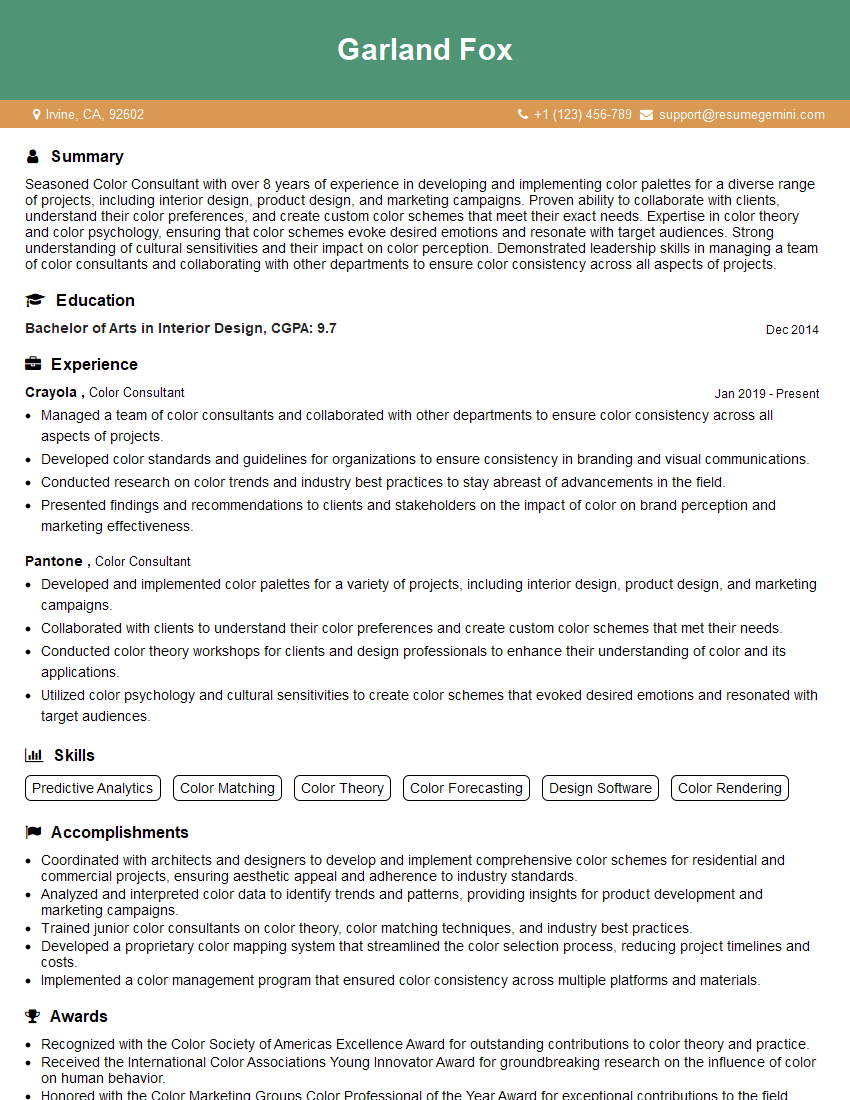
Mastering Color Swatch Analysis opens doors to exciting career opportunities in diverse creative fields. A strong understanding of this skillset demonstrates attention to detail, creative problem-solving, and a keen eye for aesthetics – all highly sought-after qualities in today’s job market. To maximize your job prospects, invest time in crafting an ATS-friendly resume that effectively showcases your expertise. ResumeGemini is a trusted resource to help you build a professional and impactful resume that highlights your skills and experience. Examples of resumes tailored to Color Swatch Analysis are available within ResumeGemini to guide you.
Explore more articles
Users Rating of Our Blogs
Share Your Experience
We value your feedback! Please rate our content and share your thoughts (optional).
What Readers Say About Our Blog
Very informative content, great job.
good