Interviews are opportunities to demonstrate your expertise, and this guide is here to help you shine. Explore the essential Sewing and Tailoring interview questions that employers frequently ask, paired with strategies for crafting responses that set you apart from the competition.
Questions Asked in Sewing and Tailoring Interview
Q 1. What types of sewing machines are you familiar with, and what are their strengths and weaknesses?
My experience encompasses a wide range of sewing machines, from basic mechanical models to advanced computerized machines. Each type offers unique strengths and weaknesses.
- Mechanical Machines: These are reliable workhorses, simple to maintain, and generally less expensive. Their strengths lie in their durability and ease of repair; a simple broken part is easily replaced. However, they lack the advanced features of computerized machines, limiting stitch options and requiring more manual control.
- Computerized Machines: These machines boast a vast array of stitch options, automated features like buttonholes and needle threading, and often include digital displays for precise settings. Their precision and versatility are invaluable for intricate projects. However, they’re generally more expensive, require more complex maintenance, and a malfunction can be challenging to troubleshoot without specialized knowledge.
- Industrial Machines: Built for heavy-duty use, industrial machines are powerful and fast but are typically very specialized and often lack the versatility of home machines. They are perfect for mass production but not ideal for varied projects.
- Sergers (Overlock Machines): These machines are specifically designed for finishing seams, creating professional-looking edges and preventing fraying. While essential for many projects, they aren’t suitable for all sewing tasks.
For example, I use my computerized machine for intricate embroidery and garment construction demanding precision, while my mechanical machine is perfect for quick repairs or projects needing durability.
Q 2. Describe your experience with different types of fabrics and their suitability for various garments.
Fabric selection is crucial for a garment’s success. Different fabrics drape, sew, and wear differently. My experience spans a wide range:
- Cotton: A versatile fabric, breathable and easy to sew. Ideal for everyday wear, from shirts to dresses.
- Linen: Strong and durable with a lovely drape, but can be prone to wrinkling. Excellent for summer garments and home décor.
- Silk: Luxurious and delicate, requiring special handling to avoid damage. Ideal for formal wear or elegant blouses, but needs careful pressing and handling.
- Wool: Warm and durable, often used in outerwear and tailored garments. It can be challenging to work with due to its thickness and tendency to stretch.
- Leather: Requires specialized needles and techniques. Durable and luxurious, but can be difficult to sew neatly.
- Synthetics (Polyester, Nylon): Durable and easy to care for, these are often used in sportswear and other less-demanding garments.
Choosing the right fabric depends not only on the desired aesthetic but also on the garment’s intended use and the wearer’s comfort. For example, a silk blouse would not be suitable for active wear, while a heavy wool coat would be impractical for a summer dress.
Q 3. Explain your pattern-making process, from drafting to adjustments.
My pattern-making process begins with either drafting a pattern from scratch or using a commercial pattern as a base. Drafting from scratch involves precise measurements and calculations to create a block pattern, a basic form of the garment. Commercial patterns provide a shortcut, but often need adjustments.
- Drafting (from scratch): This requires a strong understanding of body measurements, drafting rules, and the principles of garment construction. I use these measurements and specialized tools like rulers and French curves to construct the pattern on paper.
- Using a commercial pattern: I carefully check the size chart to choose the appropriate size. I then trace the pattern pieces onto pattern paper, making any necessary adjustments. This often involves altering the pattern to better fit the individual’s measurements or desired style.
- Adjustments: Adjustments are made by adding or subtracting fabric at various points on the pattern pieces. This could involve adjusting shoulder width, waistline, or sleeve length. I use techniques like ‘slash and spread’ or ‘pivot and slide’ to make these adjustments seamlessly. Muslin mock-ups (test garments) are essential to test the fit before cutting the final fabric.
For instance, if a commercial pattern is too tight in the bust, I’ll add fabric at the side seams and adjust the bust dart to create a better fit.
Q 4. How do you ensure precision and accuracy in your sewing?
Precision and accuracy are paramount. I achieve this through a combination of meticulous techniques:
- Accurate Measurements: Using accurate measuring tools and techniques when drafting and taking body measurements.
- Sharp Needles and Proper Tension: Ensuring my sewing machine is properly threaded and tensioned, and using appropriate needles for the fabric type.
- Precise Cutting: Using sharp shears and rotary cutters to make clean, accurate cuts. Careful attention is paid to grain lines and pattern alignment to prevent distortion.
- Test Garments (Muslins): Using inexpensive fabric to make a test garment (muslin) before cutting into the final fabric. This allows me to adjust the pattern and check the fit before investing time and resources into the final product.
- Use of Marking Tools: Precise marking of pattern pieces and fabric using tailor’s chalk, tracing wheel, or disappearing ink markers ensures accurate seam placement.
- Proper Pressing: Using a steam iron to press seams open or closed, as needed, to create a professional finish and maintain the integrity of the garment.
For example, a slightly off-kilter seam can easily ruin the overall look of a garment, so accuracy in cutting and sewing is crucial.
Q 5. What are your preferred methods for handling difficult fabrics (e.g., silk, leather)?
Working with challenging fabrics like silk and leather requires specialized techniques. The key is to use the right tools and approach.
- Silk: Requires sharp, fine needles, a slow sewing speed, and minimal stretching. I use a walking foot on my sewing machine to feed the fabric evenly and prevent slippage. Hand-basting can be helpful in certain areas. Pressing should be done with low heat and through a press cloth to avoid scorching.
- Leather: Requires heavy-duty needles, specialized leather thread, and a strong machine. A walking foot or roller foot is highly recommended to prevent slippage and ensure even feeding. I often use a hand-sewing technique for areas that are particularly difficult to sew by machine.
For example, when sewing silk, I carefully avoid pulling or stretching the fabric, ensuring the seams lie flat without any puckering.
Q 6. Describe your experience with various sewing techniques (e.g., French seams, bound seams, zippers).
My repertoire of sewing techniques is broad, encompassing various seam finishes and construction methods.
- French Seams: These seams are enclosed, creating a clean, professional finish that’s ideal for sheer or lightweight fabrics. They’re particularly helpful for garments where a smooth, un-fraying inside is critical.
- Bound Seams: Provide a durable and neat finish, often used in outerwear. A strip of fabric is folded around the raw edge of the seam, creating a strong and aesthetically pleasing finish.
- Zippers: I am proficient in installing various types of zippers, including center-front, invisible, and lapped zippers, adapting the technique depending on the fabric and garment design. Precision is key to achieving a smooth, invisible zipper installation.
- Other techniques: I am also skilled in various other techniques like dart manipulation, buttonhole construction (both machine and hand-sewn), appliqué, and various types of closures (hooks and eyes, snaps).
The choice of seam finish depends on the fabric, garment type, and desired aesthetic. For example, I’d use French seams for a delicate silk blouse, but bound seams for a sturdy denim jacket.
Q 7. How do you troubleshoot common sewing machine problems?
Troubleshooting sewing machine problems involves a systematic approach. I start by identifying the symptom, then systematically eliminate possible causes.
- Check the obvious: Is the machine plugged in? Is the needle correctly inserted and not bent? Is the bobbin correctly wound and inserted? Is the thread properly threaded?
- Clean the machine: Lint and dust can accumulate and interfere with the machine’s function. Cleaning the bobbin case, hook area, and feed dogs is crucial.
- Check the tension: Incorrect tension can lead to skipped stitches or broken threads. Adjust the upper and lower tension dials to achieve even stitching.
- Inspect the needle: A bent or dull needle will cause skipped stitches or damage fabric. Replace the needle if necessary.
- Lubricate (if needed): Some machines require regular lubrication to operate smoothly. Consult your machine’s manual for instructions.
- If problems persist: Consult your machine’s manual or seek professional help. There might be internal issues requiring a repair technician.
For instance, if my stitches are uneven, I’ll first check the thread tension, then the needle, and finally, clean the machine. If the problem persists, it might require professional attention.
Q 8. What quality control measures do you employ during the sewing process?
Quality control in sewing is crucial for delivering a high-quality product. My approach is multi-faceted, starting from the initial pattern cutting and extending through each stage of construction. I meticulously inspect the fabric for flaws before cutting, ensuring there are no holes, inconsistencies in weave, or significant discoloration. During cutting, I double-check all measurements against the pattern pieces and the client’s measurements to avoid discrepancies. Throughout the sewing process, I regularly check for even seam allowances, consistent stitch length, and proper alignment of pattern pieces. I also use a seam ripper sparingly but effectively to correct minor mistakes before they become major issues. Finally, a thorough final inspection checks for overall fit, symmetry, and the absence of any loose threads or imperfections before packaging and delivery.
For example, when working on a tailored suit, I’ll perform several checks: after the jacket’s canvas is constructed, I’ll check the drape and fit, before sewing it to the outer fabric. Similarly, on the trousers, I meticulously check the inseam and outseam alignment after the first fitting.
Q 9. How do you adapt patterns to different body types and sizes?
Adapting patterns to different body types requires a keen understanding of body proportions and how they translate into garment construction. I don’t just rely on readily available sizing charts; instead, I take detailed measurements, paying close attention to individual variations like shoulder slope, high or low bust, and waist-to-hip ratio. I use several techniques to adjust patterns, including:
- Grading: This involves proportionally increasing or decreasing the pattern pieces to accommodate different sizes. This often involves making adjustments to specific areas such as the bust, waist, and hip.
- Slash and Spread: This involves strategically cutting and spreading the pattern pieces to add or remove fullness in specific areas, for example, enlarging a sleeve cap for a fuller arm.
- Full-Bust Adjustment (FBA): A common adaptation for women’s garments, the FBA adjusts the pattern pieces in the bust area to provide a comfortable and well-fitting garment across different bust sizes.
- Muslin Fitting: This crucial step involves creating a mock-up garment from inexpensive fabric to test the pattern fit before cutting into the final fabric. This allows for adjustments before any significant work is done on the actual garment.
For instance, if I’m altering a dress pattern for a client with a larger bust, I’ll perform an FBA and perhaps add darts for a better fit. If the client has broad shoulders, I will increase the width of the shoulder seams accordingly. This meticulous attention to detail ensures a perfectly tailored garment for each individual.
Q 10. Explain your experience with alterations, including repairs and customizations.
My experience with alterations encompasses a wide range of services, from simple repairs to extensive customizations. I’ve handled everything from mending tears and replacing zippers to taking in or letting out seams, altering sleeve lengths, and creating custom designs based on client specifications. I’m adept at working with diverse fabrics, including delicate silks, sturdy wools, and everything in between. Each alteration requires a unique approach, beginning with a thorough assessment of the garment’s condition and the desired changes. I explain to the client the necessary steps and the feasibility of achieving their requested modifications. For instance, I recently altered a vintage wedding dress, shortening the length, taking in the waist, and adjusting the bodice to fit the bride perfectly. Another time, I repaired a significant tear in a customer’s favorite leather jacket, ensuring the repair was almost invisible.
Q 11. Describe your understanding of different stitch types and their applications.
A solid understanding of stitch types is paramount for creating durable and aesthetically pleasing garments. Different stitches serve different purposes, and choosing the right one greatly affects the garment’s strength, appearance, and longevity. Here are some examples:
- Straight Stitch: A basic stitch used for seams, topstitching, and edge finishing. It offers good strength and is versatile.
- Zigzag Stitch: Used for finishing seams to prevent fraying, attaching elastic, or creating decorative effects.
- Overlock Stitch (Serger Stitch): A specialized stitch created with an overlock machine, which cuts and finishes raw edges simultaneously, preventing fraying and providing a professional finish.
- Blind Hem Stitch: Creates an almost invisible hem, ideal for tailored garments.
- Buttonhole Stitch: Creates neat and functional buttonholes.
For example, when constructing a tailored blazer, I would use a straight stitch for the main seams and a blind hem stitch for a neat and invisible finish on the hems. The choice of stitch depends on the fabric type and the garment’s intended use; a delicate silk blouse requires a different stitch than a heavy-duty denim jacket.
Q 12. How do you maintain and care for your sewing equipment?
Regular maintenance is essential for the longevity and optimal performance of sewing equipment. My routine includes daily cleaning of my sewing machine, removing lint and dust from the bobbin area, and lubricating moving parts according to the manufacturer’s instructions. I also regularly check and replace the needle, as a bent or dull needle can damage fabric and negatively impact stitch quality. For my overlock machine, I follow a similar maintenance routine. I also keep my irons and pressing equipment clean and properly maintained. Additionally, I store all my equipment in a clean, dry environment to prevent damage from dust, moisture, and accidental damage.
Investing in regular professional servicing for my machines helps prevent costly repairs down the line. Thinking about it like a car, regular maintenance prolongs its life significantly. A well-maintained machine produces high-quality work, reducing errors and saving time in the long run.
Q 13. What software or CAD programs are you proficient in (e.g., Illustrator, Photoshop, Gerber)?
While my expertise primarily lies in hands-on sewing and tailoring, I’m proficient in using industry-standard software to assist in pattern design and creation. I’m familiar with Adobe Illustrator for creating and modifying patterns, using its vector capabilities for precision and scalability. I can also utilize Photoshop for digital fabric manipulation and pattern design. Although I haven’t directly used Gerber software, I understand its capabilities within the industry and could readily learn to operate it if needed.
Q 14. How do you manage your time and prioritize tasks in a fast-paced environment?
Managing time effectively in a fast-paced environment is critical for meeting deadlines and ensuring client satisfaction. I use a combination of techniques to prioritize tasks and maintain efficiency. I begin by carefully reviewing all orders, assessing their complexity and required turnaround time. I then create a schedule, prioritizing urgent tasks based on deadlines and client needs. I break down larger projects into smaller, manageable steps, allowing for better tracking of progress and preventing feeling overwhelmed. I also incorporate buffer time into my schedule to accommodate unforeseen delays or complications, keeping the client informed throughout the process. Furthermore, I avoid multitasking, focusing on one task at a time to maintain accuracy and quality of work. My detailed organization and planning ensures I meet all deadlines while maintaining the highest standard of craftsmanship.
Q 15. Describe your experience working with teams and collaborating on projects.
Throughout my career, I’ve consistently thrived in collaborative environments. I believe effective teamwork hinges on clear communication, mutual respect, and a shared understanding of project goals. For instance, in my previous role at ‘Stitches & Style,’ we collaborated on a bridal gown collection. My expertise in pattern drafting was complemented by my colleague’s skills in embroidery and beading. We held regular meetings, shared progress updates, and actively sought feedback from each other, ensuring a cohesive and high-quality final product. This collaborative approach led to exceeding our sales targets and receiving overwhelmingly positive customer reviews.
- Open Communication: Regular check-ins, brainstorming sessions, and constructive criticism sessions are essential.
- Defined Roles: Clearly outlining each team member’s responsibilities prevents duplication and ensures efficient workflow.
- Shared Vision: A clear understanding of the project’s objective and design aesthetics unites the team and fosters a sense of shared purpose.
Career Expert Tips:
- Ace those interviews! Prepare effectively by reviewing the Top 50 Most Common Interview Questions on ResumeGemini.
- Navigate your job search with confidence! Explore a wide range of Career Tips on ResumeGemini. Learn about common challenges and recommendations to overcome them.
- Craft the perfect resume! Master the Art of Resume Writing with ResumeGemini’s guide. Showcase your unique qualifications and achievements effectively.
- Don’t miss out on holiday savings! Build your dream resume with ResumeGemini’s ATS optimized templates.
Q 16. How do you handle customer feedback and address fitting issues?
Handling customer feedback is crucial for building trust and delivering exceptional service. I actively listen to customer concerns, asking clarifying questions to fully understand the issue. For example, if a client expresses dissatisfaction with a garment’s fit, I would begin by discussing the specific areas of concern – perhaps the sleeves are too tight or the length is inappropriate. I then assess the garment, checking for any potential errors in my construction. This might involve measuring the garment against the client’s measurements and comparing it to the original pattern. If necessary, I make adjustments to the garment; whether that’s a simple alteration or creating a new pattern altogether. I also ensure to document all adjustments to avoid recurring problems. The aim is to find a solution that both resolves the issue and enhances the customer’s experience.
Q 17. What are your strengths and weaknesses as a sewer/tailor?
My strengths lie in my meticulous attention to detail, my proficiency in various sewing techniques (including couture finishing), and my ability to problem-solve creatively. I’m highly adept at pattern drafting, particularly for complex garments requiring intricate fitting. I am also quick to adapt and learn new techniques. However, I sometimes struggle to delegate tasks when working under tight deadlines, preferring to maintain hands-on control. I’m actively working on improving this by prioritizing tasks and assigning responsibilities more effectively. This self-awareness allows for continuous improvement and stronger team management skills.
Q 18. How do you stay updated on the latest trends and techniques in sewing and tailoring?
Staying current in the dynamic world of sewing and tailoring requires a multifaceted approach. I regularly subscribe to industry magazines like ‘Threads’ and ‘Burda Style,’ attend workshops and seminars presented by renowned designers and tailors, and actively participate in online forums and communities dedicated to sewing and tailoring. This allows me to engage with other professionals, exchange ideas and stay abreast of the newest techniques and technologies. Additionally, I explore online resources, such as tutorials on YouTube and masterclasses offered by leading platforms. This continuous learning process ensures my skills remain sharp and my designs are innovative and contemporary.
Q 19. What are your salary expectations?
My salary expectations are commensurate with my experience and expertise in the field, taking into consideration the local market rate for skilled tailors and sewers. I’m confident in my ability to deliver exceptional work, and I’m open to discussing a competitive compensation package that aligns with both my skills and the company’s budget.
Q 20. Describe a challenging sewing project and how you overcame the obstacles.
One of my most challenging projects was creating a wedding gown with a complex, asymmetrical draping detail. The client provided a sketch with a very intricate design that involved several layers of fabric and unusual seam placements. The initial attempts resulted in uneven draping and poor fit. To overcome this, I meticulously studied the drape of fabrics and experimented with various techniques, including muslin mock-ups, to perfect the design. I also consulted several pattern-making and draping manuals to gain a deeper understanding of manipulating fabric to achieve the desired effect. Through persistent refinement and testing, I finally achieved the client’s vision, resulting in a stunning and beautifully fitting gown that the client was overjoyed with. This experience greatly enhanced my draping skills and instilled a higher level of confidence in tackling even the most complicated designs.
Q 21. What safety precautions do you take when using sewing machines and other equipment?
Safety is paramount in my sewing practice. I always ensure my sewing machine is properly grounded and that I use safety pins to prevent accidental needle pricks. When working with sharp objects, like scissors and seam rippers, I keep them in a designated place and away from reach when not in use. I use protective gear like thimbles when necessary and always keep my workspace tidy to avoid tripping hazards. Additionally, I maintain regular maintenance on my equipment, ensuring that all parts are functioning correctly to prevent malfunctions. By adhering to these safety measures, I minimize risks and ensure a secure working environment.
Q 22. How do you calculate fabric yardage for a garment?
Calculating fabric yardage requires careful consideration of several factors. It’s not just about the garment’s measurements; you need to account for fabric width, pattern layout, seam allowances, and potential fabric shrinkage. A simple formula doesn’t exist, as it’s highly dependent on the pattern and fabric.
Step-by-step process:
- Check the pattern instructions: Most patterns provide yardage recommendations for various sizes and fabric widths. This is a great starting point.
- Consider fabric width: Standard fabric widths are 45 inches (114 cm) or 60 inches (152 cm). A wider fabric will often require less yardage.
- Account for pattern layout: Efficiently laying out the pattern pieces on the fabric minimizes waste. Some patterns suggest layouts; otherwise, you’ll need to plan this yourself.
- Add seam allowances: Remember to add seam allowances (usually 5/8 inch or 1.5 cm) to each pattern piece. These are crucial for sewing and finishing.
- Factor in shrinkage: Pre-wash your fabric, especially natural fibers like cotton or linen, to account for potential shrinkage before cutting.
- Add extra: It’s always wise to add extra yardage (1/2 to 1 yard, depending on the garment) to compensate for errors, pattern adjustments, or unexpected issues.
Example: Let’s say a pattern calls for 2 yards of 45-inch fabric. If you’re using a 60-inch fabric, you might need less, but you still need to check the layout to ensure you can fit all pieces without excessive waste.
Q 23. Explain your understanding of different types of seams and finishes.
Seams and seam finishes are fundamental to garment construction, impacting both the garment’s appearance and durability. Different seams are suitable for different fabrics and garment styles.
- Seam Types:
- French Seam: Encloses raw edges, ideal for fine fabrics where a clean finish is essential.
- Flat-felled Seam: Durable and strong, often used in denim or workwear.
- Seam allowance: this is the distance between the stitching line and the raw edge of the fabric
- Overlocked seam: A type of seam used to prevent fraying, usually done with a serger machine.
- Plain seam: The most basic seam type, used mostly in less visible parts of the garment. This is not suitable for the outer layer of garments.
- Seam Finishes:
- Pinked edges: Using pinking shears to create a zigzag edge, preventing fraying.
- Zigzag stitch: A machine stitch that prevents fraying.
- Serging/Overlocking: Uses a specialized machine to create a neat, finished edge, preventing fraying and adding durability.
- Binding: Applying a bias strip of fabric to enclose raw edges, providing a clean and professional finish.
Example: A French seam is perfect for a silk blouse, ensuring an invisible and elegant finish. A flat-felled seam is ideal for jeans, offering both strength and a clean look. A simple zigzag stitch might suffice for a less visible seam in a cotton dress.
Q 24. What are some common sewing mistakes and how do you avoid them?
Many common sewing mistakes stem from improper preparation or rushing the process. Here are some frequent errors and how to avoid them:
- Incorrect fabric cutting: Careless cutting leads to ill-fitting garments. Use sharp scissors, cut on a clean surface, and double-check your measurements.
- Uneven seam allowances: Inconsistent seam allowances ruin the garment’s structure. Use a seam guide or ruler to maintain even allowances.
- Incorrect tension settings: Tension issues lead to puckering, skipped stitches, or broken threads. Adjust your machine’s tension accordingly.
- Improper pressing: Not pressing seams and darts as you sew results in a sloppy finished product. Press each step to maintain accuracy and crisp lines.
- Ignoring pattern instructions: Skipping these vital steps leads to frustration and errors. Carefully read and understand each step.
Example: To avoid uneven seam allowances, always use a ruler and marking tool to guide your stitching. To solve tension problems, test your machine’s stitch on a scrap of fabric before working on your garment.
Q 25. Describe your experience with industrial sewing machines.
My experience with industrial sewing machines spans several years and various models. I’m proficient in operating and maintaining high-speed, heavy-duty machines, including those used for straight stitching, overlocking, and specialized functions. I’m familiar with troubleshooting common industrial machine issues, such as needle breakage, tension problems, and feed dog adjustments. I understand the importance of regular maintenance, including lubrication and cleaning, to ensure optimal performance and longevity.
Example: In a previous role, I used industrial machines to sew hundreds of garments daily, consistently meeting production deadlines while maintaining high-quality standards. I also assisted in training new operators on the proper use and maintenance of these machines.
Q 26. How do you ensure consistent quality in mass production?
Consistent quality in mass production hinges on a multi-faceted approach, encompassing standardized processes, quality control checks, and continuous improvement.
- Standardized patterns and cutting: Precise patterns and consistent cutting methods ensure all garments are the same size and shape.
- Regular machine maintenance: Well-maintained industrial machines reduce errors and downtime, ensuring consistent stitch quality.
- Quality control at each step: Implementing quality checks at every stage of production—cutting, sewing, finishing—identifies and addresses any issues promptly.
- Trained personnel: Employing well-trained staff ensures consistent adherence to procedures and quality standards.
- Regular quality audits: Periodic audits help to identify areas for improvement and maintain high standards.
Example: Implementing a system of regular checks on stitch length and seam allowance during the sewing process helps us maintain consistent quality across all items.
Q 27. How familiar are you with different types of interfacing and their uses?
Interfacing is a crucial component in garment construction, providing support, structure, and stability to various parts of a garment. Different interfacings serve different purposes.
- Woven interfacing: Offers stability and structure, ideal for collars, cuffs, and other areas needing crisp shaping.
- Non-woven interfacing: Fusible or sew-in, provides a soft, lightweight support, suitable for lighter fabrics and less structured areas.
- Knit interfacing: Stretchy, perfect for knit fabrics and areas requiring flexibility.
- Fusible interfacing: Bonds to fabric with heat, quick and efficient for many applications.
- Sew-in interfacing: Stitched to the fabric, generally more durable than fusible interfacing.
Example: Woven interfacing is ideal for a crisp collar on a shirt, while a fusible knit interfacing would be better suited for a neckline on a knit top.
Q 28. What is your preferred method for pressing and finishing garments?
My preferred pressing method involves a combination of techniques tailored to the fabric and garment type. Proper pressing is essential for a professional finish.
- Use a good iron: An iron with a temperature control is vital for tailoring work. The temperature should match the fabric.
- Pressing surface: Use a clean, sturdy surface, like a well-padded ironing board, to avoid marring the fabric.
- Pressing cloths: Pressing cloths protect delicate fabrics from scorching and prevent shine.
- Techniques: I use a combination of techniques, including pressing with the grain, pressing seams open or to one side, and using tailor’s ham or sleeve board for shaping curved areas.
- Steam: Steam can help to create smooth seams and remove wrinkles.
Example: For a crisp collar, I press the interfacing before attaching it to the fabric, ensuring its shape stays consistent. I then carefully press the seams, paying attention to avoid creating creases or impressions on the finished garment. For delicate fabrics like silk or wool, I always use a pressing cloth and a lower temperature setting.
Key Topics to Learn for Your Sewing and Tailoring Interview
- Pattern Making & Draping: Understanding fundamental pattern drafting techniques, including flat pattern making and draping on a dress form. Practical application: Explain your experience adapting patterns for different body types and fabric weights.
- Fabric Selection & Properties: Knowledge of various fabrics (natural and synthetic), their properties (drape, weight, stretch), and suitability for different garments. Practical application: Discuss how you choose the right fabric for a specific project and address potential challenges related to fabric handling.
- Sewing Machine Operation & Maintenance: Proficiency in operating different types of sewing machines, including industrial machines. Practical application: Describe your experience troubleshooting machine malfunctions and maintaining its optimal performance.
- Construction Techniques: Mastery of various sewing techniques such as seams (French seams, flat felled seams), closures (zippers, buttons, hooks and eyes), and finishing techniques (hems, bindings). Practical application: Explain your preferred methods and why you choose them for specific garments.
- Garment Design & Alterations: Ability to interpret design sketches, create custom designs, and alter existing garments to fit individual needs. Practical application: Detail your approach to fitting garments and making adjustments for a perfect fit.
- Quality Control & Finishing: Understanding the importance of meticulous stitching, accurate measurements, and high-quality finishing for a professional look. Practical application: Describe your quality control process and how you ensure consistent standards in your work.
- Industry Standards & Best Practices: Familiarity with industry standards regarding safety, efficiency, and ethical practices. Practical application: Discuss your understanding of sustainable sewing practices and your commitment to quality workmanship.
Next Steps
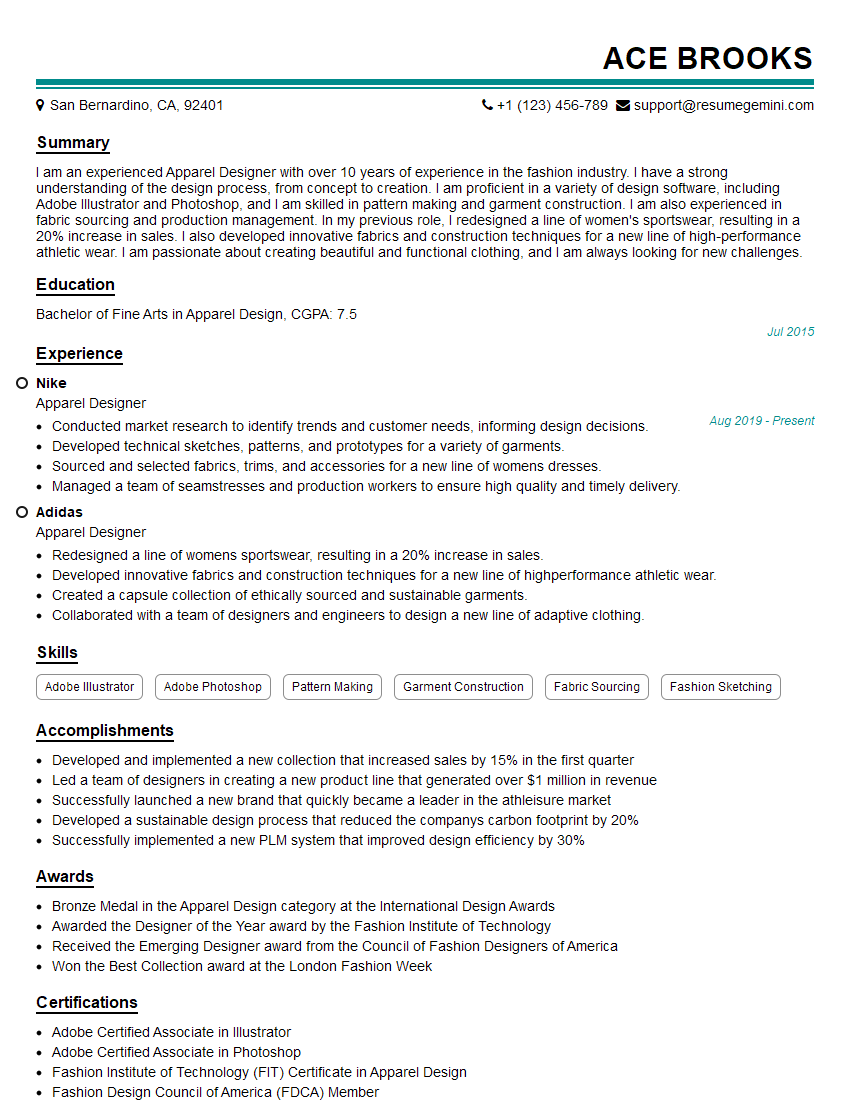
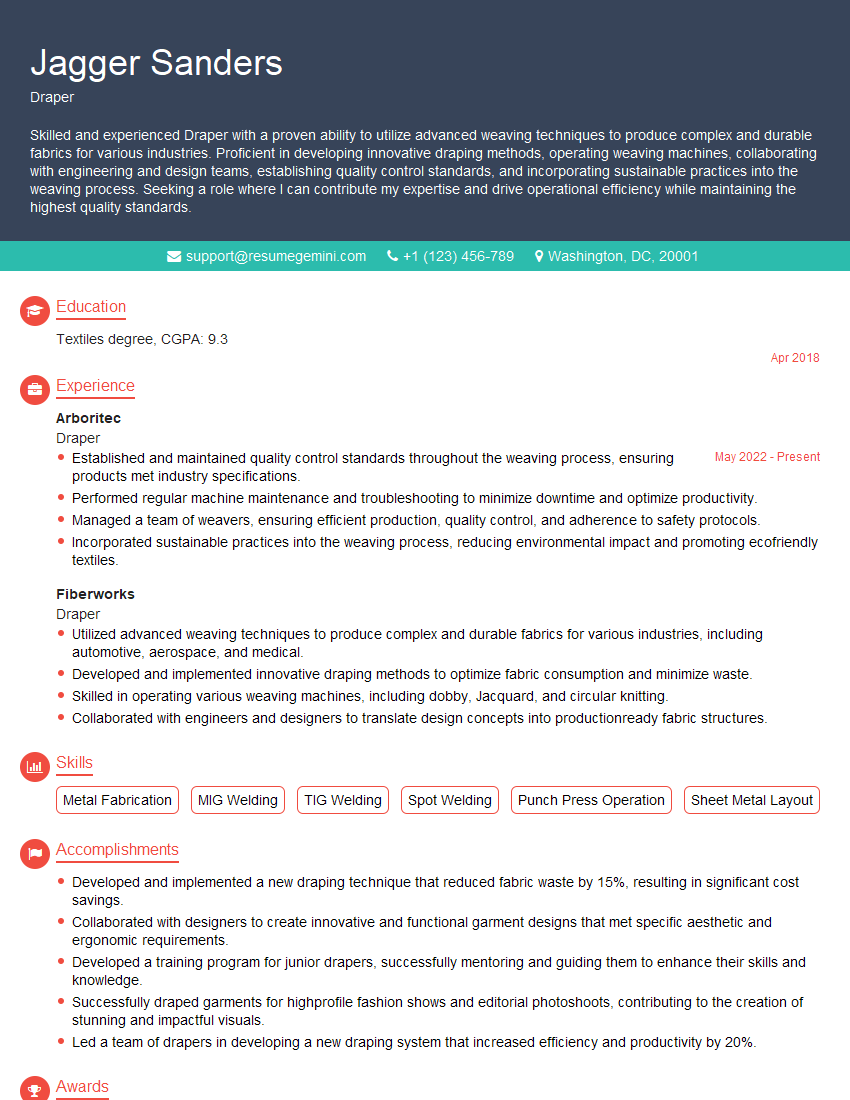
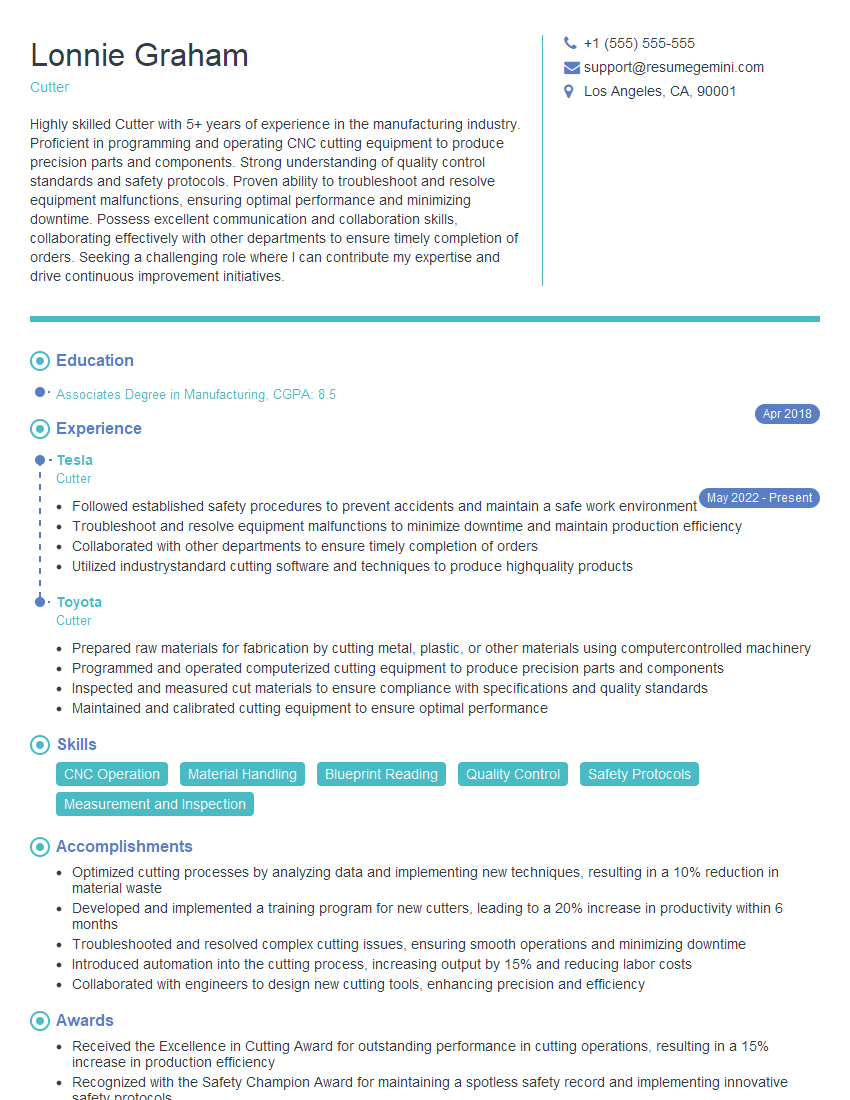
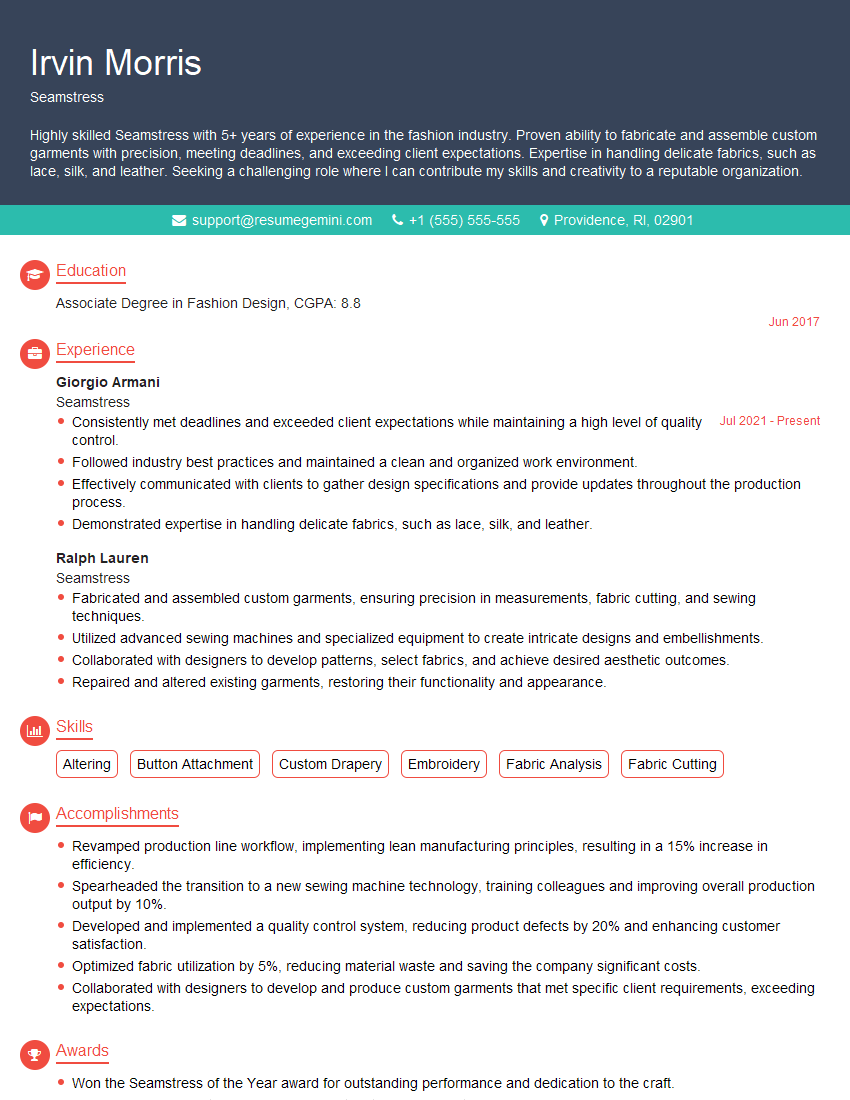
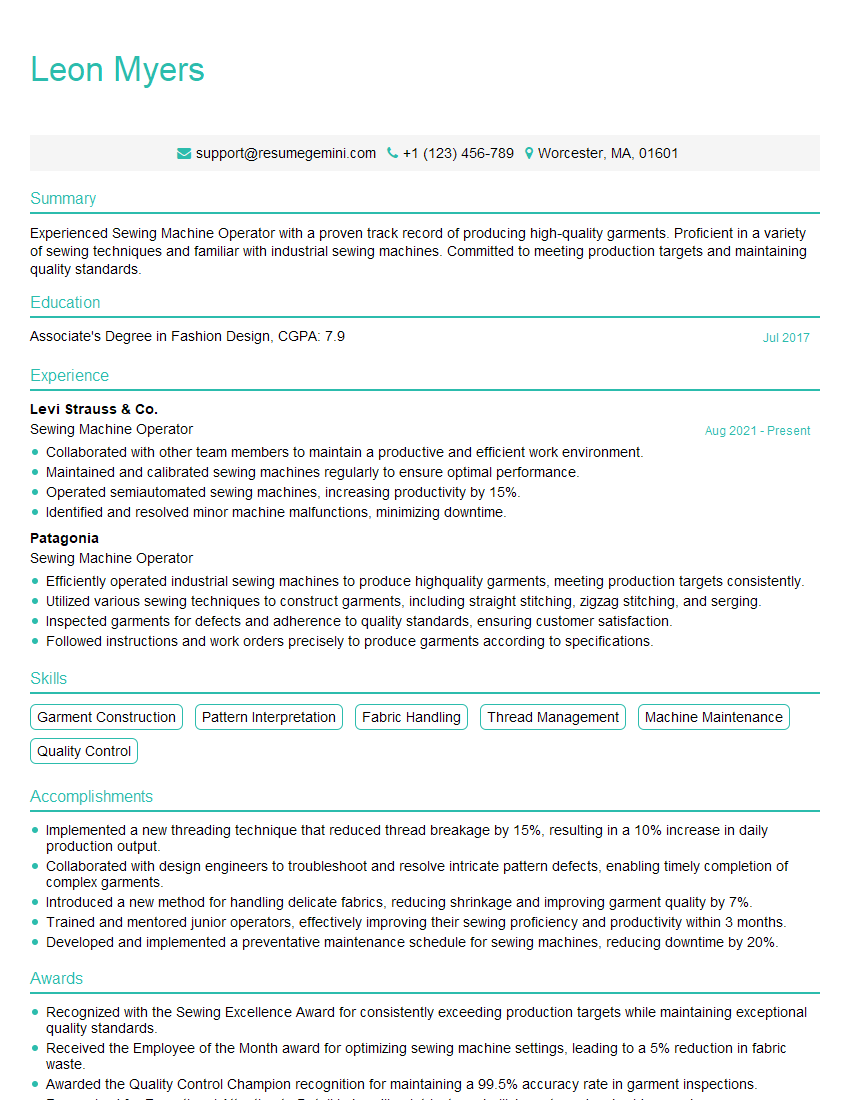
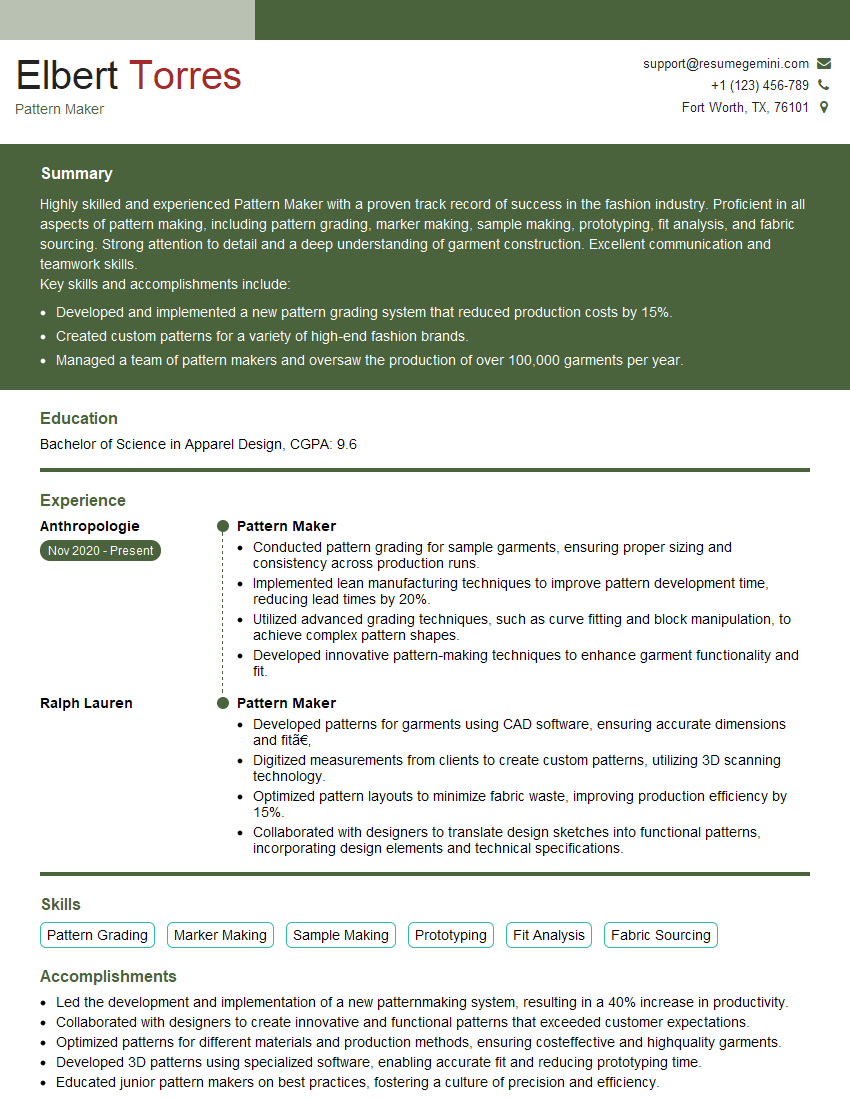
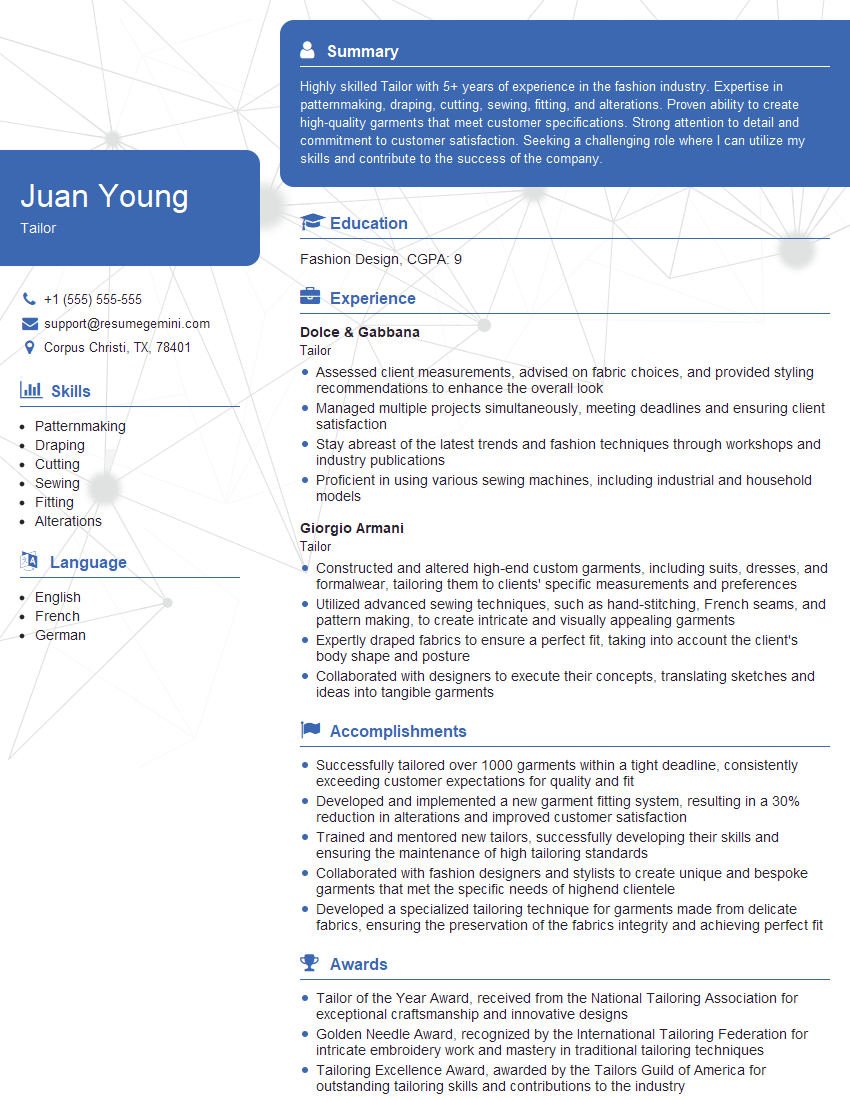
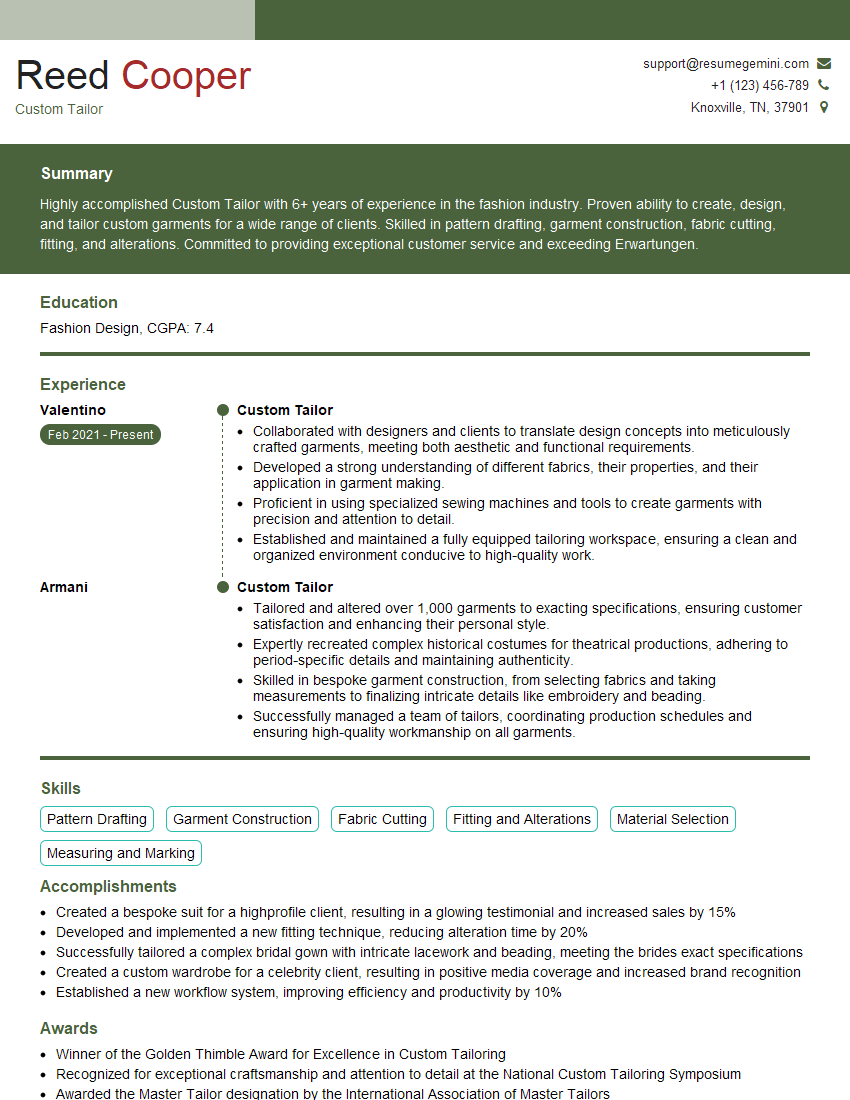
Mastering sewing and tailoring skills opens doors to a rewarding career with diverse opportunities for growth. Whether you’re aiming for a role in haute couture, bespoke tailoring, or ready-to-wear manufacturing, a strong foundation in these techniques is crucial. To maximize your job prospects, focus on creating an ATS-friendly resume that highlights your skills and experience effectively. ResumeGemini is a trusted resource that can help you build a professional and impactful resume tailored to the specific requirements of the sewing and tailoring industry. Examples of resumes tailored to Sewing and Tailoring are provided to further assist you.

Explore more articles
Users Rating of Our Blogs
Share Your Experience
We value your feedback! Please rate our content and share your thoughts (optional).
What Readers Say About Our Blog
Very informative content, great job.
good