Feeling uncertain about what to expect in your upcoming interview? We’ve got you covered! This blog highlights the most important Converter Operations interview questions and provides actionable advice to help you stand out as the ideal candidate. Let’s pave the way for your success.
Questions Asked in Converter Operations Interview
Q 1. Explain the different types of power converters.
Power converters are essential components in various electronic systems, transforming electrical energy from one form to another. They are broadly categorized based on their function:
- DC-DC Converters: These convert a DC voltage to a different DC voltage. Common types include buck (step-down), boost (step-up), buck-boost (both step-up and step-down), and Cuk converters. They are vital in applications like battery management systems and power supplies.
- AC-DC Converters (Rectifiers): These convert AC voltage to DC voltage. They are found in power adapters for laptops and other devices, utilizing techniques like bridge rectification.
- DC-AC Converters (Inverters): These change DC voltage to AC voltage. They are crucial for applications like solar power systems and uninterruptible power supplies (UPS), converting stored DC power into usable AC power for homes and businesses.
- AC-AC Converters: These convert AC voltage from one frequency or voltage level to another. Examples include transformers and cycloconverters, used in power grids and specialized industrial applications.
The choice of converter depends heavily on the application’s specific voltage and power requirements.
Q 2. Describe the operation of a buck converter.
A buck converter, also known as a step-down converter, reduces a higher DC input voltage to a lower DC output voltage. Imagine it like a water valve controlling the flow of water – it regulates the output pressure (voltage). It achieves this using a switching element (typically a MOSFET), an inductor, a capacitor, and a diode.
The MOSFET rapidly switches on and off, creating a pulsed DC current through the inductor. When the MOSFET is on, current flows through the inductor and charges it. When the MOSFET is off, the inductor’s stored energy is released through the diode and capacitor, providing a relatively smooth DC output voltage. The capacitor filters the ripple from the pulsed current, providing a more stable output voltage. The output voltage is controlled by the duty cycle of the MOSFET, the percentage of time it is switched on.
A practical example is in a laptop power adapter, converting the mains voltage to a lower voltage suitable for the laptop’s battery.
Q 3. How does a boost converter work?
A boost converter, or step-up converter, increases a lower DC input voltage to a higher DC output voltage. Think of it as a pump that increases water pressure. It uses a similar topology to the buck converter, but with a different arrangement of components and operational strategy.
When the MOSFET is on, the inductor is charged. When the MOSFET is off, the inductor’s energy is released in series with the input voltage, causing a higher voltage to appear at the output. The output voltage is higher than the input voltage, and the capacitor again smooths out the output voltage.
A common application is in mobile phone chargers that boost the lower voltage from a USB port to a higher voltage needed by the phone’s battery.
Q 4. What is the difference between a buck-boost converter and a Cuk converter?
Both buck-boost and Cuk converters provide both step-up and step-down voltage conversion, but they differ significantly in their topology and how they achieve this conversion.
- Buck-Boost Converter: This converter uses a single inductor and switches the inductor between the input and output circuits. The output voltage polarity is inverted (negative) relative to the input. It’s simpler to control but has higher ripple current compared to the Cuk converter.
- Cuk Converter: This converter uses two capacitors and two inductors. It also inverts the output voltage polarity, but it achieves better efficiency and lower ripple current compared to the buck-boost converter due to the use of two inductors and capacitors. It is often more complex to design and control, however.
The choice between these converters often depends on efficiency and ripple requirements. For applications requiring high efficiency and low ripple, a Cuk converter might be preferred, despite its added complexity.
Q 5. Explain the concept of duty cycle in a PWM converter.
In a Pulse Width Modulation (PWM) converter, the duty cycle is the percentage of time the switching element (e.g., MOSFET) is in the ‘on’ state during one switching period. It’s a crucial parameter controlling the average output voltage.
Imagine a light switch that flickers rapidly on and off. The duty cycle is the proportion of time the light is actually on within each flicker. A 50% duty cycle means the switch is on for half the time and off for half the time. In converters, this ratio directly affects the average voltage delivered to the load.
By adjusting the duty cycle, we can precisely control the output voltage of the converter. For instance, increasing the duty cycle in a buck converter will increase the output voltage.
Q 6. How do you calculate the output voltage of a buck converter?
The output voltage (Vo) of a buck converter is directly proportional to the input voltage (Vin) and the duty cycle (D). It can be calculated using the following formula:
Vo = D * Vinwhere D is the duty cycle (0 ≤ D ≤ 1). For example, if the input voltage is 12V and the duty cycle is 50% (D = 0.5), the output voltage will be 6V (0.5 * 12V = 6V). This assumes ideal conditions (no losses). In real-world scenarios, there will be some voltage drop due to component imperfections, which should be considered for accurate prediction.
Q 7. What are the losses in a power converter and how can they be minimized?
Losses in a power converter reduce efficiency and can generate heat. These losses can be categorized as:
- Conduction Losses: These are due to the resistance of the inductor, capacitor, MOSFET, and diode. Current flowing through these components generates heat (I2R losses).
- Switching Losses: These occur during the switching transitions of the MOSFET. Energy is lost due to the finite switching time and parasitic capacitances.
- Core Losses (inductors): Hysteresis and eddy current losses in the inductor core.
- Diode Losses: Forward voltage drop across the diode causes power dissipation.
Minimizing losses can be achieved by:
- Selecting efficient components: Using low-resistance components with low ESR (Equivalent Series Resistance) capacitors and low on-resistance MOSFETs.
- Optimized switching frequency: Choosing an appropriate switching frequency balances switching losses and component size.
- Using soft-switching techniques: Techniques like zero-voltage switching (ZVS) and zero-current switching (ZCS) can significantly reduce switching losses.
- Thermal management: Employing proper heat sinks and cooling mechanisms to manage the heat generated by losses.
Careful design and component selection are crucial for optimizing converter efficiency and maximizing performance.
Q 8. Explain the role of a filter in a power converter.
Filters in power converters are crucial for suppressing unwanted noise and harmonics present in the input or output waveforms. Think of them as noise-canceling headphones for your power supply. They essentially smooth out the power, making it cleaner and more suitable for the load. This is particularly important in applications requiring a stable and clean power supply, such as sensitive electronic equipment.
Different types of filters exist, including:
- LC filters (Inductor-Capacitor): These are the most common and utilize inductors and capacitors to attenuate high-frequency components. The inductor blocks high-frequency currents, while the capacitor bypasses them to ground.
- RC filters (Resistor-Capacitor): Simpler than LC filters, these are often used for high-frequency noise suppression but generally less effective at lower frequencies.
- Active filters: These employ active components like operational amplifiers to provide more complex filtering characteristics, such as higher attenuation and adjustable cutoff frequencies. They require additional power but offer greater design flexibility.
For example, in a switched-mode power supply (SMPS), an LC filter is commonly placed at the output to smooth the pulsed DC waveform generated by the switching elements into a steady DC voltage suitable for the load.
Q 9. What are the different types of control strategies for power converters?
Power converters employ various control strategies to regulate the output voltage or current. The choice depends on factors like efficiency, cost, and complexity. Some key strategies include:
- Pulse Width Modulation (PWM): This is the most prevalent technique, adjusting the duty cycle (on-time versus off-time) of switching elements to control the average output voltage or current. Think of it like dimming a light – you don’t change the voltage, but you control how much time the light is on.
- Hysteresis Control: This method uses a hysteresis band to compare the output to a setpoint. The converter switches on or off depending on whether the output is within or outside the band. It’s simple to implement but can lead to variable switching frequencies.
- Predictive Control: More advanced control that anticipates changes in the system and adjusts accordingly. It offers better dynamic performance but requires more complex algorithms and computational power.
- Sliding Mode Control (SMC): Robust control technique that’s effective in handling uncertainties and disturbances, making it suitable for applications with varying loads or input voltage fluctuations. However, it can be challenging to design and implement due to its inherent chattering phenomenon.
Each strategy has trade-offs; for instance, PWM is efficient and widely used, while hysteresis control offers simplicity but might introduce noise. The optimal choice depends on the specific application requirements.
Q 10. Describe the operation of a closed-loop control system for a power converter.
A closed-loop control system for a power converter uses feedback to maintain a desired output. Think of it as a thermostat regulating room temperature. It continually monitors the output and adjusts the control signal accordingly to achieve the setpoint.
The system typically involves:
- Sensor: Measures the actual output (voltage or current).
- Comparator: Compares the sensed output with the desired setpoint, generating an error signal.
- Controller: Processes the error signal and generates a control signal to adjust the switching elements of the converter.
- Power Converter: The actual converter stage that converts power.
For example, in a DC-DC converter, a voltage sensor monitors the output voltage. If the voltage drops below the setpoint, the controller increases the duty cycle of the PWM signal, leading to a higher average output voltage. This continuous feedback loop ensures that the output voltage remains stable despite load variations or input voltage fluctuations.
Different controller types, such as Proportional-Integral-Derivative (PID) controllers, can be used to improve performance, tuning parameters to balance response speed and stability.
Q 11. How do you troubleshoot a faulty power converter?
Troubleshooting a faulty power converter requires a systematic approach, combining visual inspection with measurements and testing.
Step-by-step process:
- Visual Inspection: Check for any physical damage like burnt components, loose connections, or unusual signs of overheating.
- Input Voltage and Current Measurement: Verify that the input voltage is within the specified range and that the input current is not excessively high.
- Output Voltage and Current Measurement: Check whether the output voltage and current meet the specifications. Any significant deviation points to a problem.
- Component Testing: Test individual components like semiconductors (MOSFETs, IGBTs, diodes) using a multimeter or specialized equipment to isolate faulty parts.
- Control Signal Analysis: Analyze the control signals using an oscilloscope to identify any anomalies in the PWM signal or other control waveforms.
- Thermal Monitoring: Check for overheating in components or the heatsink using a thermal camera or contact thermometer.
Remember safety precautions – disconnect the power before any physical examination or testing. Proper documentation and systematic analysis are key to efficiently identifying and resolving the fault.
Q 12. What are the safety precautions when working with power converters?
Working with power converters involves high voltages and currents, demanding strict adherence to safety precautions:
- Always disconnect the power supply before working on any component. This is paramount to prevent electric shock.
- Use appropriate personal protective equipment (PPE), including safety glasses, insulated gloves, and safety shoes.
- Ensure proper grounding to prevent electrical hazards.
- Work in a well-ventilated area to avoid exposure to fumes from overheating components.
- Follow manufacturer’s instructions and safety guidelines for each specific device.
- Never work alone. Have another person present for assistance in case of an emergency.
- Use appropriate tools to handle components and connections, preventing accidental short circuits.
Safety should always be the top priority when working with power electronics.
Q 13. Explain the significance of thermal management in power converters.
Thermal management is critical in power converters because switching losses and conduction losses generate significant heat. This heat can damage components, reduce efficiency, and even lead to catastrophic failure if not properly managed. Think of it like a car engine – if it overheats, it can seize up.
Effective thermal management techniques include:
- Heat sinks: Passive cooling solutions that dissipate heat to the surrounding environment through convection and radiation.
- Fans: Active cooling that improves heat dissipation by forced convection.
- Liquid cooling: More advanced technique for high-power applications that utilizes liquid to remove heat efficiently.
- Component selection: Choosing components with lower thermal resistance contributes to better thermal management.
- PCB design: Optimized PCB layout helps improve heat dissipation.
Proper thermal management ensures the longevity and reliable operation of the converter, maintaining its efficiency and performance.
Q 14. What are the different types of semiconductor devices used in power converters?
Power converters use a variety of semiconductor devices depending on the application’s voltage, current, switching frequency, and efficiency requirements. Common types include:
- MOSFETs (Metal-Oxide-Semiconductor Field-Effect Transistors): Widely used for their fast switching speed, low on-resistance, and relatively simple drive circuitry. They’re prevalent in high-frequency converters.
- IGBTs (Insulated Gate Bipolar Transistors): Offer high voltage and current handling capabilities, making them suitable for high-power applications. They are slower switching than MOSFETs.
- Diodes: Essential for rectifying AC to DC and for freewheeling current in switching circuits. Different types, including Schottky diodes and fast recovery diodes, cater to specific needs.
- Thyristors: Used in some lower frequency applications, such as phase-controlled rectifiers, offering high current handling capacity but with relatively slow switching.
- Silicon Carbide (SiC) and Gallium Nitride (GaN) devices: Emerging wide-bandgap semiconductor technologies that offer superior switching speeds and lower conduction losses compared to traditional silicon devices, leading to increased efficiency in high-frequency converters. They are more expensive but improve efficiency at higher switching frequencies.
The selection of the appropriate semiconductor device is crucial for optimizing the converter’s performance and efficiency.
Q 15. Describe the operation of an isolated DC-DC converter.
An isolated DC-DC converter transforms a DC input voltage to a different DC output voltage while providing galvanic isolation between the input and output. This isolation is crucial for safety reasons, preventing potential ground faults from propagating. Think of it like a transformer for DC power. It typically uses a high-frequency transformer to achieve the voltage conversion and isolation.
The operation involves several key stages:
- Input Stage: The input DC voltage is first rectified and filtered to provide a clean DC source for the converter.
- Switching Stage: A switching element (like a MOSFET or IGBT) rapidly switches on and off, creating a pulsed waveform. This pulsed waveform is applied to the primary side of the isolation transformer.
- Transformer Isolation: The high-frequency transformer steps up or steps down the voltage, providing the necessary voltage transformation and crucial galvanic isolation.
- Rectification and Filtering: On the secondary side, a rectifier converts the high-frequency AC waveform from the transformer back into a DC waveform. A filter then smooths out the ripple to produce a clean DC output voltage.
- Feedback Control: A feedback loop monitors the output voltage and adjusts the duty cycle of the switching element to regulate the output voltage at the desired level. This ensures stable output regardless of input voltage variations or load changes.
A common example is a flyback converter used in many wall-wart power adapters. They provide safe, low-voltage DC power from the mains voltage.
Career Expert Tips:
- Ace those interviews! Prepare effectively by reviewing the Top 50 Most Common Interview Questions on ResumeGemini.
- Navigate your job search with confidence! Explore a wide range of Career Tips on ResumeGemini. Learn about common challenges and recommendations to overcome them.
- Craft the perfect resume! Master the Art of Resume Writing with ResumeGemini’s guide. Showcase your unique qualifications and achievements effectively.
- Don’t miss out on holiday savings! Build your dream resume with ResumeGemini’s ATS optimized templates.
Q 16. Explain the concept of efficiency in power converters.
Efficiency in a power converter refers to how effectively it converts input power to output power. Ideally, all the input power would be transformed into useful output power, but in reality, some power is always lost due to various inefficiencies. We want to maximize the ratio of output power to input power.
These losses stem from several sources including:
- Conduction Losses: Resistance in components like MOSFETs, diodes, and wires lead to heat generation (I²R losses).
- Switching Losses: Energy is lost during the transitions between the on and off states of the switching elements. This is especially significant in hard-switching converters.
- Core Losses: In converters using magnetic components (like transformers and inductors), energy is lost due to hysteresis and eddy currents in the core material.
- Capacitive and Leakage Losses: These relate to the energy stored and dissipated in parasitic capacitances and inductances present in the circuit.
High efficiency is crucial for reducing heat generation, improving lifespan, and lowering energy consumption. For example, in electric vehicles, maximizing the efficiency of the DC-DC converter improves the overall driving range.
Q 17. How do you measure the efficiency of a power converter?
Efficiency (η) is measured as the ratio of output power (Pout) to input power (Pin), expressed as a percentage:
η = (Pout / Pin) x 100%
To measure this, you need to measure both the input and output power. This usually involves:
- Measuring Input Voltage (Vin) and Input Current (Iin): Pin = Vin x Iin
- Measuring Output Voltage (Vout) and Output Current (Iout): Pout = Vout x Iout
Specialized instruments like power analyzers can directly measure power, simplifying the process. Careful attention must be paid to the accuracy of the measurements, and the test conditions (input voltage, load current, temperature) should be clearly documented.
Q 18. What is the difference between hard-switching and soft-switching techniques?
The difference between hard-switching and soft-switching lies in how the switching elements (MOSFETs, IGBTs) transition between the on and off states. Hard-switching involves abrupt switching, leading to significant switching losses, while soft-switching techniques aim to minimize these losses.
Hard-switching:
- Abrupt transitions: The switching element changes state rapidly, resulting in high voltage and current spikes.
- High switching losses: These spikes cause significant energy dissipation in the form of heat.
- Electromagnetic Interference (EMI): The fast transitions generate significant EMI which may need filtering.
Soft-switching:
- Gradual transitions: The switching transitions are managed to minimize voltage and current overlap, reducing switching losses.
- Lower switching losses: This translates to higher efficiency and reduced heat dissipation.
- Reduced EMI: The gentler transitions reduce EMI generation.
- More complex circuitry: Requires additional components (like resonant tanks or auxiliary circuits).
Think of it like slamming a door (hard-switching) versus gently closing it (soft-switching). The latter is quieter and requires less effort (energy).
Q 19. Explain the operation of a resonant converter.
Resonant converters utilize the natural resonant frequency of an LC (inductor-capacitor) tank circuit to achieve soft-switching. Instead of abruptly switching the elements, the switching occurs at or near the resonant frequency of the tank. This creates a sinusoidal current waveform, minimizing switching losses and resulting in significantly higher efficiency.
Operation typically involves these stages:
- Resonant Tank: An inductor and capacitor create a resonant tank circuit.
- Zero-Voltage Switching (ZVS) or Zero-Current Switching (ZCS): The switching element transitions at either zero voltage (ZVS) or zero current (ZCS) to minimize switching losses.
- Variable Frequency Control: The switching frequency is often varied to control the output voltage, leveraging the resonant tank’s characteristics.
- Rectification and Filtering: The output waveform is typically rectified and filtered to produce a stable DC output.
Resonant converters are often used in high-power, high-frequency applications where efficiency is paramount, such as in power supplies for telecommunications equipment or industrial applications.
Q 20. What are the advantages and disadvantages of different converter topologies?
Various converter topologies exist, each with its own advantages and disadvantages. The best choice depends on the specific application requirements.
Here’s a comparison of some common topologies:
- Buck Converter:
- Advantages: Simple, high efficiency at lower power levels.
- Disadvantages: Not isolated, output voltage is always lower than the input.
- Boost Converter:
- Advantages: Output voltage is higher than the input, simple.
- Disadvantages: Not isolated, high ripple current.
- Buck-Boost Converter:
- Advantages: Output voltage can be higher or lower than the input, relatively simple.
- Disadvantages: Not isolated, higher component stress.
- Flyback Converter:
- Advantages: Isolated, simple, relatively inexpensive.
- Disadvantages: Higher ripple current, not suitable for very high-power applications.
- Forward Converter:
- Advantages: Isolated, suitable for high-power applications.
- Disadvantages: More complex, can have higher losses than flyback at lower power levels.
- Full-Bridge Converter:
- Advantages: High efficiency at high power, bi-directional power flow.
- Disadvantages: Complex, requires more components.
The choice hinges on factors like voltage levels, power level, required isolation, size, cost, and efficiency requirements.
Q 21. How do you select the appropriate converter topology for a specific application?
Selecting the appropriate converter topology is a critical design decision. It involves a systematic approach considering several key factors:
- Input and Output Voltage Requirements: Determine the required voltage transformation (step-up, step-down, or inversion).
- Power Level: The power level dictates the component ratings and efficiency requirements.
- Isolation Requirements: Is galvanic isolation needed for safety or other reasons?
- Efficiency Goals: The desired efficiency level guides the choice of topology and switching technique.
- Size and Weight Constraints: Smaller, lighter converters are often preferred in portable or space-constrained applications.
- Cost Considerations: Different topologies have varying component counts and complexity, influencing the overall cost.
- Regulatory Compliance: The design needs to meet relevant safety and EMI standards.
A step-by-step selection process might involve:
- Defining specifications: Clearly state all the requirements.
- Evaluating topologies: Consider the pros and cons of various topologies based on the specifications.
- Simulation and analysis: Use software tools to model and analyze the performance of the chosen topology.
- Prototype and testing: Build a prototype and rigorously test its performance under various conditions.
It’s often an iterative process. You might initially choose a topology, analyze its performance, and then iterate based on the results.
Q 22. Describe your experience with different converter control techniques (e.g., PI, PID, etc.).
Converter control is crucial for regulating the output voltage and current of a power converter. I have extensive experience with various control techniques, most commonly Proportional-Integral (PI) and Proportional-Integral-Derivative (PID) controllers. PI controllers are simple and effective for eliminating steady-state error, using proportional gain to address current error and integral gain to address accumulated error. This works well for many applications, but can be prone to overshoot and oscillation in systems with significant inertia or delays.
PID controllers add a derivative term, anticipating future errors based on the rate of change of the error. This allows for faster response times and improved stability compared to PI controllers. I’ve tuned PID controllers using various methods, including Ziegler-Nichols tuning and trial-and-error, adapting the gains (Kp, Ki, Kd) to optimize performance for specific converter topologies and load characteristics. For instance, in a solar inverter project, I successfully tuned a PID controller to minimize harmonic distortion while maintaining efficient power transfer, even under fluctuating solar irradiance. Beyond PI and PID, I’ve also worked with advanced control strategies like predictive control and model predictive control (MPC) for applications requiring highly dynamic and precise regulation.
For more complex systems, I’ve used advanced control techniques like space vector modulation (SVM) to manage the switching patterns of multi-phase converters for reduced switching losses and improved THD (Total Harmonic Distortion).
Q 23. Explain your experience with troubleshooting and maintenance of power converters.
Troubleshooting and maintaining power converters requires a systematic approach. It starts with understanding the symptoms—such as over-temperature warnings, unexpected voltage drops, or erratic switching behavior. I use a combination of diagnostic tools, including oscilloscopes, multimeters, and specialized converter analyzers, to pinpoint the root cause. This often involves checking for component failures (e.g., faulty capacitors, damaged transistors, shorted diodes), loose connections, or control circuit malfunctions.
For example, during a recent project with a grid-tied inverter, I experienced intermittent tripping. Using an oscilloscope, I identified high-frequency oscillations on the DC link, indicating a problem with the control circuit. Through careful analysis of the control signals and parameters, I traced the issue to a faulty operational amplifier within the controller, which was then replaced, resolving the problem. Preventive maintenance is also key—regular inspections, thermal imaging to detect hotspots, and proactive replacement of components nearing their end-of-life are crucial for ensuring reliable operation and preventing catastrophic failures.
Q 24. How do you ensure the safety and reliability of power converter systems?
Safety and reliability are paramount in power converter systems. My approach incorporates several key strategies. First, robust hardware design is essential, employing components rated appropriately for the application’s voltage and current requirements. This includes using over-current protection, over-voltage protection, and short-circuit protection circuits to prevent damage and hazards. Second, careful selection of isolation and grounding techniques minimizes risks of electric shock.
Furthermore, thorough testing, both at the component and system levels, ensures proper functionality and adherence to safety standards like UL and IEC. Software-based safety measures include implementing fail-safe mechanisms and watchdog timers to detect and respond to software malfunctions. For instance, in a motor drive application, I implemented a rapid shutdown mechanism if the motor current exceeded a pre-defined threshold, protecting both the motor and the power converter. Finally, comprehensive documentation and training are critical to ensuring safe operation and maintenance procedures are understood by all involved personnel.
Q 25. Describe your experience with different types of converter testing and validation.
Converter testing and validation involve several stages. Initial testing focuses on validating the design and verifying its functionality through simulations using software tools like PSIM or MATLAB/Simulink. Then, component-level testing verifies individual components’ performance, such as testing MOSFETs for switching speed and losses. System-level testing assesses the overall system performance under various conditions, including transient responses to load changes, harmonic distortion measurements, and efficiency analysis.
I’ve also conducted environmental testing to assess the converter’s performance under extreme temperatures, humidity, and vibrations. Furthermore, specialized tests are done depending on the converter’s specific application. For example, in renewable energy applications, grid compliance tests are essential to ensure the system meets grid codes and safety requirements. Detailed test reports and documentation are meticulously maintained, providing a comprehensive record of testing procedures, results, and any identified issues.
Q 26. What software and tools are you familiar with for designing and simulating power converters?
I am proficient in several software and tools for designing and simulating power converters. MATLAB/Simulink is my primary tool for modeling and simulating converter behavior, including detailed analysis of control loops, switching waveforms, and thermal characteristics. PSIM is another powerful tool I use for simulating a wider range of converters and systems, especially for hardware-in-the-loop (HIL) testing.
For PCB design, I use Altium Designer, incorporating advanced features like thermal analysis and signal integrity checks. I also leverage specialized software for specific tasks such as conducting electromagnetic compatibility (EMC) simulations using CST Studio Suite or ANSYS HFSS. In addition to these, I’m familiar with various programming languages like Python and C for automating simulation processes and data analysis.
Q 27. Explain your experience with different types of power converter applications (e.g., renewable energy, motor drives, etc.).
My experience spans a wide range of power converter applications. I have worked extensively on renewable energy systems, including grid-tied inverters for photovoltaic (PV) systems and wind turbine converters. In these applications, maximum power point tracking (MPPT) algorithms are crucial for maximizing energy extraction from renewable sources. I have experience implementing advanced MPPT algorithms, enhancing energy harvesting efficiency in varying weather conditions.
I also have significant experience with motor drive applications, designing and implementing converters for both AC and DC motors, including high-performance servo drives for industrial robots and variable-speed drives for pumps and fans. Here, the focus is on achieving precise speed and torque control, efficiency optimization, and minimizing harmonic distortion. Other applications include battery chargers, uninterruptible power supplies (UPS), and DC-DC converters used in various industrial and consumer electronics.
Q 28. Describe your experience working in a team environment on power converter projects.
Teamwork is essential in power converter projects. I have consistently worked effectively within multidisciplinary teams, including engineers from hardware, software, and testing departments. I actively participate in design reviews, providing technical expertise and contributing to constructive discussions. I believe in clear and open communication; I clearly articulate technical information to both technical and non-technical audiences.
For example, in one project, I played a key role in coordinating the efforts of hardware and software teams to integrate a complex motor control system. This involved regular meetings, shared documentation, and clear communication protocols to ensure seamless integration and successful project completion. I am adept at sharing knowledge and mentoring junior engineers, creating a collaborative and supportive work environment.
Key Topics to Learn for Converter Operations Interview
- Raw Material Handling and Quality Control: Understanding the properties of various input materials and the procedures for ensuring consistent quality throughout the conversion process. This includes identifying potential issues and implementing corrective actions.
- Process Optimization and Efficiency: Analyzing production data to identify bottlenecks and inefficiencies. Explore Lean Manufacturing principles and their application to enhance speed and reduce waste in converter operations.
- Equipment Operation and Maintenance: Demonstrate a thorough understanding of the machinery used in converter operations, including preventative maintenance schedules and troubleshooting common malfunctions. Practical experience is highly valuable here.
- Safety Regulations and Procedures: Showcase your knowledge of relevant safety protocols and regulations within a converter operation environment. Be prepared to discuss hazard identification and risk mitigation strategies.
- Quality Assurance and Control: Explain the methods used to monitor and maintain product quality throughout the conversion process, including inspection techniques and the use of quality control metrics.
- Production Planning and Scheduling: Demonstrate your understanding of production planning and scheduling techniques, including demand forecasting and capacity planning to optimize resource allocation.
- Waste Management and Sustainability: Discuss environmentally responsible practices within converter operations, such as waste reduction strategies and recycling programs.
- Troubleshooting and Problem-Solving: Be prepared to discuss your approach to problem-solving in a fast-paced manufacturing environment. Illustrate your analytical skills and ability to identify root causes and implement effective solutions.
Next Steps
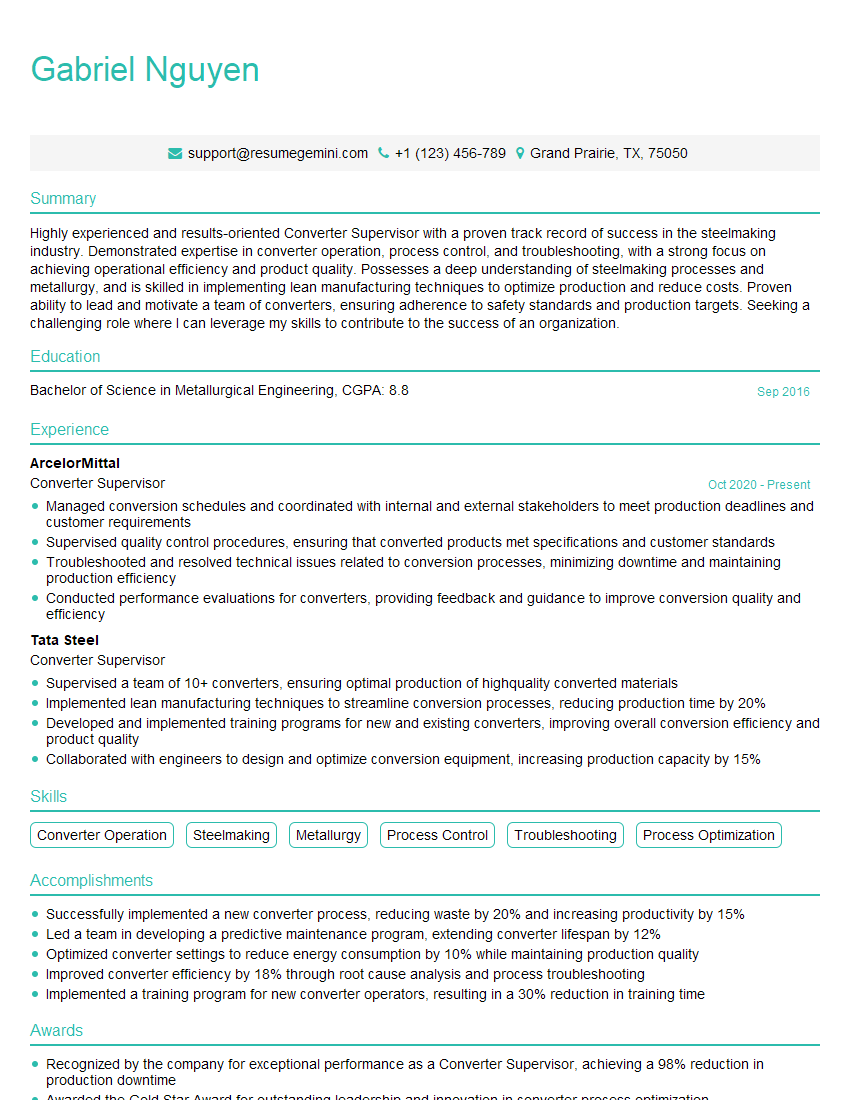
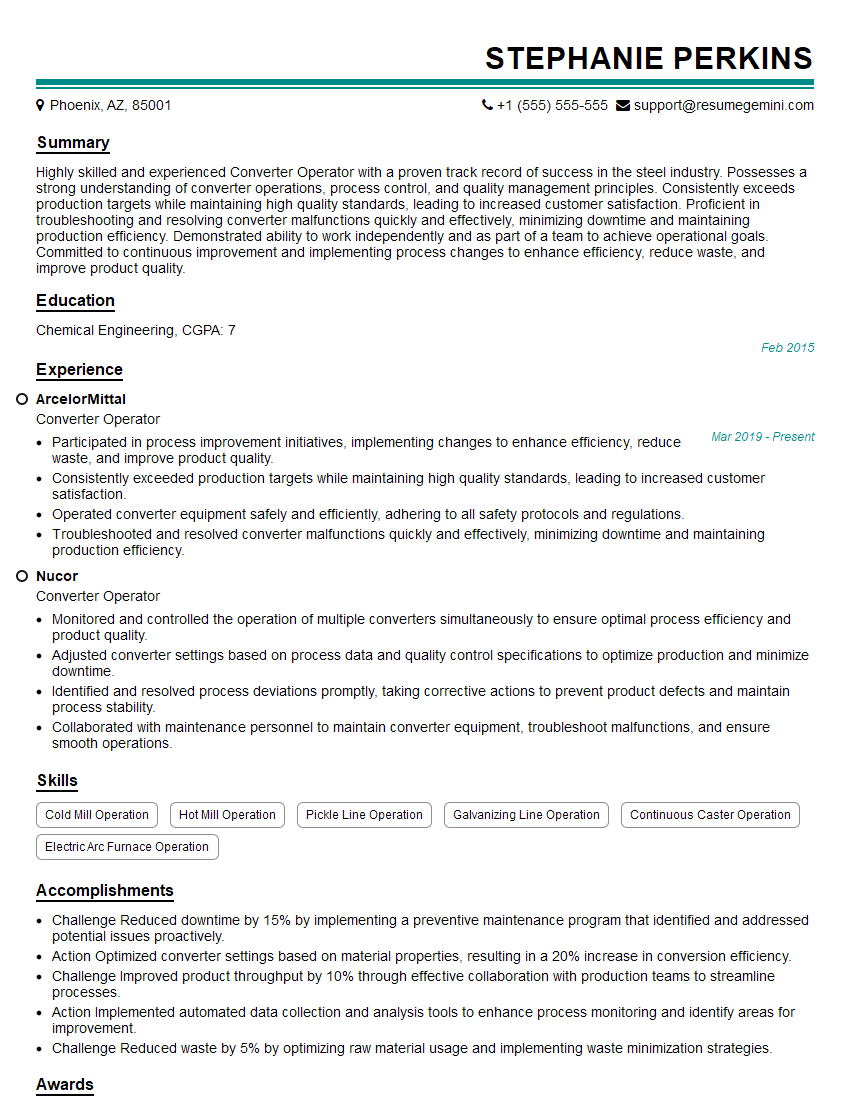
Mastering Converter Operations opens doors to exciting career opportunities with increasing responsibility and earning potential. A strong resume is crucial for showcasing your skills and experience to potential employers. Creating an ATS-friendly resume is essential for getting your application noticed by recruiters and hiring managers. We highly recommend using ResumeGemini, a trusted resource for building professional resumes, to craft a compelling document that highlights your achievements and qualifications. ResumeGemini provides examples of resumes tailored to Converter Operations to help you get started.
Explore more articles
Users Rating of Our Blogs
Share Your Experience
We value your feedback! Please rate our content and share your thoughts (optional).
What Readers Say About Our Blog
Very informative content, great job.
good