The right preparation can turn an interview into an opportunity to showcase your expertise. This guide to OSP Planning and Design interview questions is your ultimate resource, providing key insights and tips to help you ace your responses and stand out as a top candidate.
Questions Asked in OSP Planning and Design Interview
Q 1. Explain the difference between aerial, underground, and buried OSP cable deployments.
OSP cable deployment methods differ significantly based on environmental factors, cost considerations, and required bandwidth. Aerial, underground, and buried deployments each present unique advantages and disadvantages.
- Aerial Deployment: Cables are strung along utility poles or towers. This is cost-effective for shorter distances and in areas with readily available infrastructure. However, it’s susceptible to weather damage and vandalism, and capacity is limited. Think of your typical telephone lines or older cable TV connections.
- Underground Deployment: Cables are placed within conduits or ducts, often buried beneath roadways or sidewalks. This offers superior protection from environmental elements and vandalism, allowing for higher capacity and longer lifespans. However, it’s more expensive to install and repair, and requires careful planning to avoid utility conflicts.
- Buried Deployment: Cables are directly buried in the ground, usually in trenches. This method offers similar protection to underground deployment but is generally less expensive because it eliminates the need for conduits. However, locating and repairing buried cables can be challenging and more disruptive.
The choice depends on a thorough cost-benefit analysis, considering factors like initial investment, maintenance, lifespan, and potential disruption during installation and repair. For example, a high-bandwidth fiber optic network in a densely populated urban area might justify the higher cost of underground deployment for its reliability and scalability, while a low-bandwidth connection in a sparsely populated rural area might favor the cost-effectiveness of aerial deployment.
Q 2. Describe your experience with various cable types (e.g., fiber, copper, coaxial).
My experience encompasses a wide range of cable types, each with its own characteristics and applications. I’ve worked extensively with:
- Fiber Optic Cable: This is my primary focus, particularly single-mode and multi-mode fibers. I’m proficient in designing networks using different fiber types, understanding their bandwidth capabilities, and selecting appropriate connectors and splicing techniques. For instance, I’ve been involved in projects deploying dense wavelength-division multiplexing (DWDM) systems on long-haul fiber links for maximum bandwidth utilization.
- Copper Cable: My experience includes various copper cable types, including twisted pair (for voice and data transmission) and coaxial cable (for legacy applications). I understand the limitations of copper in terms of distance and bandwidth compared to fiber but appreciate its role in some legacy systems and in scenarios where cost is a critical factor. For example, I’ve helped design a hybrid network utilizing copper for shorter runs and fiber for longer distances to optimize cost and performance.
- Coaxial Cable: While less common in modern high-bandwidth networks, I’m familiar with coaxial cable and its use in specific applications, such as older cable television networks. My experience includes understanding attenuation characteristics and signal integrity issues, which are critical in designing these systems.
My expertise allows me to select the appropriate cable type based on the project’s specific needs, considering factors such as distance, bandwidth requirements, cost, and environmental conditions. This ensures optimal performance and longevity of the OSP network.
Q 3. How do you determine the optimal route for OSP cable installation?
Determining the optimal route for OSP cable installation is a critical aspect of OSP planning and requires a multi-faceted approach. It involves balancing various factors to minimize costs and maximize reliability.
- Data Gathering: This involves obtaining high-resolution maps, identifying existing utilities (gas, water, electricity, etc.), surveying terrain, and assessing environmental considerations. GIS software plays a crucial role in this stage.
- Route Optimization Algorithms: Software tools with route optimization algorithms are employed to analyze various potential routes, considering factors like distance, cost (including excavation, permitting, and material), and potential obstructions. These algorithms often weigh factors such as minimizing road crossings and avoiding environmentally sensitive areas.
- Stakeholder Consultation: Collaboration with relevant stakeholders, including landowners, utility companies, and regulatory bodies, is essential. This ensures that the chosen route minimizes disruption and avoids conflicts with existing infrastructure.
- Risk Assessment: Identifying potential risks along each route (e.g., high traffic areas, soil conditions, potential for flooding) is crucial for mitigation planning.
- Regulatory Compliance: The chosen route must comply with all relevant regulations, ensuring permits are obtainable and avoiding costly delays.
For example, in a dense urban environment, a route minimizing road closures and minimizing disruption to traffic would be prioritized, even if it results in slightly increased cable length. In a rural environment, minimizing environmental impact and leveraging existing right-of-ways might be more important.
Q 4. What are the key considerations for designing OSP networks in different environments (urban, suburban, rural)?
Designing OSP networks in different environments requires adapting to unique challenges and constraints. Key considerations include:
- Urban Environments: High population density, congested underground utilities, and complex permitting processes demand meticulous planning and coordination with various stakeholders. Minimizing disruption to traffic and pedestrian access is crucial. Underground deployment is often preferred for its protection and higher capacity needs.
- Suburban Environments: Less congested than urban areas but still requiring coordination with existing utilities. A mix of aerial and underground deployments might be suitable, depending on specific locations and needs. The availability of right-of-ways is a key consideration.
- Rural Environments: Long distances between access points, challenging terrain, and sparse utility infrastructure require careful planning of long spans and consideration of environmental factors. Aerial deployment might be more cost-effective in some areas but needs careful consideration of weather conditions. Right-of-way acquisition might be a complex process.
In all environments, the design needs to account for future growth and scalability, ensuring the network can adapt to increasing bandwidth demands. Choosing cable types with appropriate bandwidth and longevity is critical for long-term cost-effectiveness and minimizing future upgrades.
Q 5. Explain your experience with GIS software in OSP planning.
GIS software is an indispensable tool in OSP planning. My experience includes using ArcGIS and other GIS platforms extensively throughout all phases of OSP projects. I utilize these tools for:
- Data Visualization and Analysis: GIS allows for visualization of existing infrastructure, terrain data, and utility locations, enabling efficient route planning and identification of potential conflicts. This includes using spatial analysis tools to assess distances, optimize routes, and analyze environmental factors.
- Route Planning and Optimization: GIS software incorporates route optimization algorithms that help in finding the most efficient and cost-effective routes, considering factors like distance, terrain, and existing infrastructure. I regularly leverage these functionalities to propose the optimal paths for cable installations.
- Data Management and Collaboration: GIS platforms provide a centralized repository for all project-related data, facilitating seamless collaboration among project teams and stakeholders. This includes sharing maps, updating designs, and tracking progress.
- Permitting and Regulatory Compliance: GIS plays a significant role in preparing maps and documentation for permitting processes, ensuring compliance with relevant regulations.
For example, in a recent project, using GIS allowed us to identify an existing utility corridor, avoiding significant excavation costs and reducing environmental impact. The ability to overlay various data layers within the GIS system was crucial for this optimization.
Q 6. How do you manage risks and challenges associated with OSP projects?
Risk management is integral to successful OSP projects. I employ a proactive approach, identifying and mitigating potential risks throughout the project lifecycle:
- Risk Identification: This involves systematically identifying potential hazards, such as environmental impacts, utility conflicts, permitting delays, and construction-related accidents.
- Risk Assessment: Each identified risk is assessed based on its likelihood and potential impact, using established methodologies like risk matrices. This helps prioritize mitigation efforts.
- Mitigation Strategies: Develop and implement strategies to reduce or eliminate identified risks. This might include contingency planning for weather delays, specialized equipment for difficult terrain, or enhanced safety protocols for construction crews.
- Monitoring and Control: Continuously monitor risks throughout the project’s duration and adapt mitigation strategies as needed. This includes regular site inspections and close collaboration with contractors.
For instance, in a project involving underground cable installation near a river, we incorporated flood mitigation measures and contingency plans for potential disruptions caused by extreme weather events. This proactive approach ensured project completion without significant delays or cost overruns.
Q 7. Describe your experience with permitting and regulatory compliance for OSP projects.
Permitting and regulatory compliance are crucial for OSP projects. My experience includes navigating the complexities of local, state, and federal regulations. This involves:
- Regulatory Research: Thoroughly researching and understanding all applicable regulations, including those related to zoning, environmental protection, and utility access. This often involves coordinating with multiple agencies and obtaining necessary permits.
- Permit Applications: Preparing and submitting comprehensive permit applications, including detailed maps, engineering plans, and environmental impact assessments, to ensure timely approvals.
- Stakeholder Coordination: Collaborating with various regulatory bodies, utility companies, and other stakeholders to ensure smooth and efficient permitting processes. This requires effective communication and negotiation skills.
- Compliance Monitoring: Maintaining meticulous records of all permits and approvals throughout the project lifecycle, ensuring ongoing compliance with regulations.
In one project, securing permits involved navigating complex environmental regulations and coordinating with multiple agencies, including the local planning department, the state environmental agency, and the Federal Communications Commission (FCC). My experience in understanding and meeting these regulatory requirements ensured the project’s successful completion without significant delays or legal challenges.
Q 8. What are the common methods used for splicing fiber optic cables?
Splicing fiber optic cables requires precision and specialized tools to maintain signal integrity. The most common methods involve fusion splicing and mechanical splicing.
Fusion Splicing: This method uses a fusion splicer, a device that precisely aligns the fiber ends and then fuses them together using an electric arc. It creates a strong, low-loss connection, considered the gold standard for its superior performance and durability. Think of it like welding two metal pieces together, but on a microscopic scale. The process is typically automated and requires calibration to ensure accuracy.
Mechanical Splicing: This method uses a mechanical splice protector that holds the fibers together using precision alignment and adhesive. It’s a quicker and sometimes more cost-effective option compared to fusion splicing, but the resulting connection might have slightly higher attenuation (signal loss) and is generally less robust. Imagine it as tightly joining two wires with a connector; it’s simpler but might be less reliable.
The choice between fusion and mechanical splicing depends on factors such as budget, required performance levels, and the environmental conditions where the splice will be located.
Q 9. How do you ensure the safety of OSP crews and the public during construction?
Ensuring the safety of OSP crews and the public is paramount. Our safety protocols are comprehensive and integrated into every stage of a project, from planning to completion.
Pre-Construction Planning: This involves detailed route surveys, identifying potential hazards like underground utilities and environmentally sensitive areas. We use advanced tools like GIS mapping and ground penetrating radar to pinpoint locations accurately. Thorough risk assessments are conducted, identifying potential threats and developing mitigation strategies.
On-Site Safety Measures: Crews are provided with all necessary personal protective equipment (PPE), including high-visibility clothing, safety helmets, and gloves. Work areas are clearly marked and secured, with traffic control measures in place to protect both the crew and the public. Regular safety briefings are held, emphasizing safe work practices and emergency procedures.
Communication and Coordination: Open communication is crucial. We maintain constant contact with local authorities, utility companies, and emergency services to ensure everyone is aware of our activities. Before excavation commences, we always use appropriate locating services to identify existing underground infrastructure.
Post-Construction: Once the project is complete, the work area is cleaned up thoroughly, and any temporary signage or barriers are removed. We carefully document any potential long-term maintenance needs.
Our commitment to safety is reflected in our consistently low incident rates and our dedication to ongoing safety training and awareness initiatives for our teams.
Q 10. What are your preferred CAD software and its applications in OSP design?
My preferred CAD software is AutoCAD, supplemented by specialized OSP design extensions. AutoCAD’s versatility and industry standard compliance are crucial for OSP design.
Network Design: AutoCAD allows for precise mapping of fiber routes, cable placement, and equipment locations. We can model the entire network, from central offices to end users, ensuring optimal connectivity and minimizing infrastructure costs.
Cable Management: We utilize AutoCAD to create detailed cable schematics and diagrams, ensuring accurate cable routing, proper splicing points, and effective management of different fiber types. This precision reduces potential errors during construction and minimizes waste.
3D Modeling: For complex projects involving aerial cable deployments, we incorporate 3D modeling to visualize cable trajectories, pole locations, and potential interference with existing infrastructure, thus reducing design conflicts and unforeseen difficulties.
Documentation: AutoCAD’s powerful annotation tools make it easy to produce comprehensive and easy-to-understand design documents, which are essential for seamless construction and accurate project handover.
The integration of GIS data into AutoCAD further enhances the precision and accuracy of our designs, ensuring compatibility with real-world conditions.
Q 11. Explain the process of creating an OSP design document.
Creating an OSP design document is an iterative process involving several key steps:
Needs Assessment and Requirements Gathering: Defining the project objectives, target coverage area, bandwidth requirements, and customer needs are crucial. This forms the foundation of our design.
Route Planning and Survey: This involves conducting thorough site surveys, analyzing existing infrastructure, and selecting optimal cable routes, considering factors like terrain, access rights, and environmental regulations.
Design Development: Using CAD software, we create detailed drawings showing cable routes, equipment locations, splicing points, and other vital components. We incorporate details about cable types, conduit sizes, and any required infrastructure upgrades.
Material Specification and Bill of Materials (BOM): A detailed BOM is generated, specifying all the required materials, such as fiber optic cables, conduits, poles, and hardware.
Design Review and Approval: The design is thoroughly reviewed by engineers, stakeholders, and relevant authorities to ensure compliance with standards, regulations, and project requirements. Revisions are made as necessary.
Documentation: A complete set of design documents is prepared including maps, drawings, schematics, specifications, and calculations, ensuring clear communication and understanding amongst all parties.
The entire process follows a rigorous quality control methodology, ensuring accuracy and adherence to industry best practices.
Q 12. How do you estimate the cost of an OSP project?
Estimating the cost of an OSP project requires a detailed breakdown of all expenses. It’s not a simple calculation, but rather a thorough process that involves several key elements:
Material Costs: This includes the cost of fiber optic cables, conduits, poles, hardware, and other necessary materials. We consider factors like cable length, type, and market prices.
Labor Costs: We estimate the cost of labor for site surveys, design, construction, testing, and commissioning. Factors such as the complexity of the project and the availability of skilled labor are considered.
Equipment Costs: The cost of specialized equipment such as fusion splicers, trenching machines, and testing equipment is factored into the estimate.
Permits and Licenses: The cost of obtaining necessary permits and licenses is included. These costs vary depending on location and regulatory requirements.
Contingency Costs: A contingency buffer is added to account for unforeseen issues or changes in the project scope. A realistic contingency of 10-15% is typical.
Indirect Costs: Costs associated with project management, administration, insurance, and other overhead expenses are included.
Detailed spreadsheets and software tools are used to manage these various cost components and produce a comprehensive project budget.
Q 13. Describe your experience with project management methodologies in OSP projects.
My experience spans various project management methodologies, including Agile and Waterfall. The choice of methodology depends on the project’s nature and complexity.
Waterfall: For large-scale, well-defined projects with minimal anticipated changes, the Waterfall methodology provides a structured approach with clearly defined phases. This is helpful in ensuring a systematic and predictable workflow. It works well when the project requirements are stable and fully understood upfront.
Agile: For smaller, more dynamic projects where changes are expected, an Agile approach is preferred. This allows for greater flexibility and adaptability. Agile’s iterative nature helps in incorporating feedback and making adjustments throughout the project lifecycle.
Regardless of the methodology used, I emphasize effective communication, risk management, and close collaboration with the team and stakeholders. Key performance indicators (KPIs) such as project milestones, budget adherence, and quality metrics are tracked regularly to ensure the project stays on track.
Q 14. How do you handle unexpected issues or delays during an OSP project?
Handling unexpected issues and delays is an integral part of OSP project management. Our approach involves a proactive, multi-step process:
Immediate Assessment: Upon encountering an unexpected issue, we immediately assess its impact on the project schedule, budget, and overall goals.
Problem Solving: We convene a team meeting to brainstorm solutions and identify the most effective way to mitigate the issue, taking into account risks, costs and time constraints.
Communication: We promptly communicate the issue and proposed solutions to all relevant stakeholders, including clients, contractors, and regulatory authorities.
Contingency Planning: Having a well-defined contingency plan is crucial. This plan outlines alternative strategies to manage potential delays and maintain project momentum.
Documentation: The issue, proposed solutions, and actions taken are meticulously documented for future reference and to facilitate continuous improvement.
Our experience has taught us that effective communication and proactive problem-solving are key to minimizing the impact of unexpected events on OSP projects.
Q 15. Explain your understanding of different types of OSP closures and their applications.
OSP closures are vital components of outside plant (OSP) networks, protecting cable splices and terminations from environmental damage. Different types cater to various needs and deployment scenarios.
- Pedestal Closures: These are surface-mounted enclosures, typically made of plastic or fiberglass, commonly found in residential areas and business parks. They’re easily accessible for maintenance and splicing, and often house fiber optic or copper cables. For example, I’ve used these extensively in fiber-to-the-home (FTTH) projects, where ease of access for technicians is crucial.
- Handhole Closures: These seal the opening of handholes, underground chambers providing access to cables. They’re designed to withstand the weight of the earth above and protect the cables from moisture and flooding. I’ve encountered situations where improperly sealed handhole closures led to water ingress and cable damage, emphasizing the importance of proper selection and installation.
- Splice Closures: These are smaller enclosures specifically designed for splicing optical fibers or copper cables. They protect the delicate splices and offer different capacities, depending on the number of fibers or cables needing connection. In a recent project, we used smaller splice closures for aerial fiber deployments, minimizing weight and maximizing efficiency.
- Wall-Mounted Closures: These enclosures are attached to walls of buildings, providing a convenient access point for terminating cables entering a structure. These are common in enterprise deployments where building penetration is required and are frequently used for demarcation points.
The choice of closure depends on factors such as cable type, environmental conditions, accessibility requirements, and cost. Careful consideration of these factors ensures the longevity and reliability of the OSP network.
Career Expert Tips:
- Ace those interviews! Prepare effectively by reviewing the Top 50 Most Common Interview Questions on ResumeGemini.
- Navigate your job search with confidence! Explore a wide range of Career Tips on ResumeGemini. Learn about common challenges and recommendations to overcome them.
- Craft the perfect resume! Master the Art of Resume Writing with ResumeGemini’s guide. Showcase your unique qualifications and achievements effectively.
- Don’t miss out on holiday savings! Build your dream resume with ResumeGemini’s ATS optimized templates.
Q 16. Describe your experience with trenching and boring methods for cable installation.
Trenching and boring are two primary methods for underground cable installation, each with its own advantages and limitations.
- Trenching: This involves digging a trench, laying the cable, and backfilling. It’s relatively simple and cost-effective for shorter distances and shallower depths, especially in areas with easily manageable soil. I’ve used trenching extensively in suburban deployments, but it can be disruptive to landscaping and traffic flow, hence necessitating permits and careful planning.
- Boring: This uses specialized equipment to create an underground pathway without extensive open-trench excavation. It’s ideal for crossing roads, railways, or environmentally sensitive areas where trenching is impractical or prohibited. Horizontal directional drilling (HDD) is a common boring technique, allowing for precise cable placement. I’ve overseen HDD projects where we had to avoid utility lines underground, a scenario requiring precise planning and skilled operators. This technique minimizes surface disruption and is more suitable for long distances and deeper installations but is more expensive and requires specialized equipment.
The choice between trenching and boring depends on several factors including project budget, site conditions, environmental considerations, and the distance and depth of the cable run. A proper cost-benefit analysis is often needed.
Q 17. What are the key performance indicators (KPIs) you use to monitor OSP project success?
Monitoring OSP project success relies on a set of key performance indicators (KPIs). These help track progress, identify issues, and ensure the project delivers on time and within budget.
- On-Time Completion: Measured as the percentage of project milestones completed on schedule. Delays can be costly and impact service delivery, so this is a critical KPI.
- Budget Adherence: Tracks actual costs against the project budget. Variations should be investigated and addressed promptly.
- Defect Rate: Measures the number of defects or faults discovered during and after installation. A low defect rate indicates high-quality workmanship.
- Material Usage Efficiency: Tracks the ratio of material used to the amount originally planned. Optimizing material use reduces waste and cost.
- Safety Record: Records the number and severity of safety incidents. A strong safety record is paramount.
- Customer Satisfaction: Gathers feedback on the quality of service and installation. This is crucial for long-term success.
Regular monitoring of these KPIs allows for proactive adjustments to project plans, ensuring successful outcomes. For example, a sudden increase in defect rate may indicate a need for retraining or a change in materials.
Q 18. How do you collaborate with different stakeholders involved in OSP projects?
Effective collaboration is crucial for OSP project success. Stakeholders include clients, contractors, regulatory bodies, and internal teams.
- Regular Meetings: Scheduling frequent meetings ensures open communication and addresses potential issues proactively. This includes project kickoff, progress reviews, and post-project analysis.
- Clear Communication Channels: Establishing a centralized communication system (e.g., project management software) facilitates the timely exchange of information. Email, instant messaging, and regular project status reports are essential.
- Joint Site Visits: Conducting site visits with all relevant stakeholders ensures everyone understands project scope, challenges, and progress.
- Conflict Resolution Mechanisms: Establishing a protocol for handling disputes allows for timely resolution and prevents project delays.
- Document Management: A robust system for managing project documents ensures consistency and easy access to critical information.
In a recent project, regular joint site visits helped us identify and resolve a potential conflict with underground utilities early, avoiding potential delays and cost overruns. Open and consistent communication is key.
Q 19. Explain your knowledge of different types of OSP structures (e.g., poles, manholes, handholes).
OSP structures provide support and protection for cables. Different structures are used depending on the environment and cable type.
- Poles: Wooden, concrete, or steel poles are used for aerial cable deployments, often supporting multiple cables and various services. The type of pole selected depends on load capacity and environmental factors.
- Manholes: Large underground chambers that provide access to multiple cables and allow for splicing and maintenance. Manholes are typically used in high-density areas or where many cables converge.
- Handholes: Smaller underground chambers, usually used for cable splicing and access points in less dense areas. They are less expensive and simpler to install than manholes.
- Pedestals: Surface-mounted enclosures providing access points for cables. They are commonly used for residential or smaller business installations.
- Aerial Cable Trays: These provide support for cables in aerial deployments, allowing for organized and efficient cable routing.
- Underground Conduits: These protect cables from environmental damage and provide pathways for cable installation in underground deployments. They can be made of PVC, HDPE, or other materials.
The selection of OSP structures requires careful consideration of several factors such as environmental conditions, cable type, capacity requirements, and cost. Proper design ensures the long-term reliability and maintainability of the network.
Q 20. Describe your experience with cable testing and troubleshooting.
Cable testing and troubleshooting are crucial for ensuring network performance and identifying faults. My experience covers a range of techniques:
- Optical Time-Domain Reflectometry (OTDR): Used to identify faults and measure fiber length in fiber optic cables. OTDR testing helps pinpoint breaks, attenuation, and other problems along the fiber.
- Time-Domain Reflectometry (TDR): Used for copper cable testing to locate faults like shorts, opens, and impedance mismatches.
- Cable Continuity Testing: Verifies the electrical connection between the two ends of a copper cable. A simple but essential test.
- Signal Level Testing: Measures the signal strength at various points in the network. This helps identify weak signals that could cause performance issues.
Troubleshooting involves systematically isolating the fault through a combination of testing and visual inspection. For example, using OTDR to locate a break in a fiber optic cable followed by physical inspection to repair the damaged cable. Efficient troubleshooting requires a strong understanding of cable characteristics and testing methodologies. In one instance, I used OTDR to quickly isolate a fiber cut caused by a third-party excavation, minimizing service disruption.
Q 21. How do you ensure the long-term maintainability of OSP infrastructure?
Long-term maintainability of OSP infrastructure requires a proactive approach. This includes careful planning during the design phase and ongoing maintenance.
- Proper Documentation: Detailed as-built drawings, cable records, and maintenance logs are crucial for efficient troubleshooting and future upgrades. We utilize GIS (Geographic Information Systems) for precise location and mapping of all OSP elements.
- Use of High-Quality Materials: Investing in durable and robust materials minimizes the risk of future failures and reduces the need for frequent repairs.
- Regular Inspections: Conducting routine inspections helps identify potential problems before they escalate into major issues. We incorporate drone technology for aerial inspections in some deployments.
- Access Management: Controlling access to OSP infrastructure prevents unauthorized modifications that could damage the network. Clearly marked access points and security measures are crucial.
- Spare Capacity Planning: Building in spare capacity during the design phase allows for future upgrades and expansion without major disruptions.
A well-maintained OSP infrastructure reduces operational expenses, increases network reliability, and extends the lifespan of the system. Proactive maintenance is significantly more cost-effective than reactive repair in the long run. Adopting a preventive maintenance strategy, as opposed to a solely reactive one, is crucial for maximizing the longevity of an OSP network.
Q 22. Explain your experience with different types of grounding and bonding techniques.
Grounding and bonding are crucial for protecting equipment and personnel from electrical surges and faults in OSP networks. Different techniques are employed depending on factors like soil conductivity, the type of infrastructure (aerial, underground), and the level of protection required.
- Grounding: This involves connecting a structure or equipment to the earth to provide a low-resistance path for fault currents. Common techniques include using ground rods (driven into the earth), ground mats (large conductive surfaces), and counterpoises (buried conductors).
- Bonding: This involves connecting metallic parts of a system together to ensure equipotentiality, preventing potential differences that could lead to dangerous currents. This is critical in situations where different metallic components (e.g., conduit, cable sheathing, equipment enclosures) might come into contact.
- Types of Grounding Systems:
- Plate Grounding: A large conductive plate buried in the ground, ideal for highly conductive soil.
- Rod Grounding: Multiple ground rods driven into the ground, improving ground resistance, especially in less conductive soil.
- Ring Grounding: A circular conductive loop buried in the ground, often used for large facilities.
- Practical Example: In a recent project involving an underground fiber optic cable system, we used a combination of ground rods and a ground mat near the cable termination points to ensure efficient grounding and protection from lightning strikes. This involved careful soil resistivity testing to determine the optimal grounding design.
My experience spans various scenarios, from designing complex grounding systems for large data centers to implementing basic grounding for smaller deployments. I always prioritize safety and compliance with relevant codes and standards (e.g., IEEE, ANSI).
Q 23. How do you handle conflict resolution during OSP project execution?
Conflict resolution is an inevitable part of large-scale OSP projects. My approach is proactive and focuses on collaboration and communication. I employ a structured approach:
- Identify the Issue: Clearly define the conflict, gathering perspectives from all involved parties. What are the differing viewpoints? What are the underlying concerns?
- Understand Perspectives: Actively listen to all sides, showing empathy and understanding. Avoid making premature judgments.
- Find Common Ground: Focus on shared goals and objectives. Where do the parties agree? What common interests can be leveraged?
- Develop Solutions: Brainstorm potential solutions collaboratively. Consider different options and their potential consequences.
- Implement and Monitor: Once a solution is agreed upon, implement it carefully. Regular monitoring is essential to ensure the resolution holds and to address any unforeseen issues.
For example, on a project where there was disagreement between the construction crew and the client regarding the placement of a manhole, I facilitated a meeting where all stakeholders discussed their concerns. We ultimately found a compromise that satisfied both parties by slightly adjusting the manhole location while maintaining the project’s overall integrity.
Q 24. What is your experience with documentation and as-built drawings for OSP projects?
Comprehensive documentation is critical for the success and maintainability of OSP projects. As-built drawings are essential for future maintenance, upgrades, and troubleshooting.
- During Project Execution: I meticulously maintain a detailed record of all activities, including daily progress reports, material usage logs, and any deviations from the original design. I utilize GIS mapping software to create and update digital records of the OSP infrastructure.
- As-Built Drawings: At the end of the project, I produce precise as-built drawings that reflect the final construction. This often involves field verification to ensure accuracy and consistency with the on-site infrastructure. The drawings include details such as cable routes, splice locations, equipment placements, and grounding details.
- Software and Tools: I have extensive experience with various CAD and GIS software packages for creating and managing project documentation, including AutoCAD, ArcGIS, and specialized OSP design software.
- Example: On a recent project, our thorough documentation allowed us to quickly identify a damaged splice location during a maintenance operation, minimizing downtime and repair costs. The precise as-built drawings helped the repair crew navigate the complex cable layout efficiently.
My commitment to precise and comprehensive documentation has resulted in successful project completion and minimized future issues.
Q 25. Describe your understanding of OSP network design standards and best practices.
OSP network design adheres to several key standards and best practices to ensure reliability, scalability, and maintainability. My understanding encompasses:
- TIA-492: This standard covers the grounding and bonding requirements for telecommunications infrastructure.
- TIA-568: While primarily focused on building cabling, its principles of structured cabling systems are relevant to OSP design, emphasizing standardization and modularity.
- Fiber Optic Standards (e.g., IEC, ITU-T): These standards define the specifications for fiber optic cables, connectors, and transmission systems.
- Best Practices: This includes considerations for cable routing, trenching depth, splice protection, and the use of redundant components to enhance network resilience. Using standardized components reduces maintenance complexity and simplifies upgrades.
Example: When designing a new fiber optic ring topology, I’d incorporate multiple protection mechanisms, including redundant fiber paths and diverse routing to protect against single-point failures. Following standards ensures interoperability and compatibility with future upgrades and expansion.
Q 26. How do you incorporate sustainability considerations into OSP planning?
Sustainability is a critical aspect of modern OSP planning. Minimizing environmental impact and resource consumption is paramount. My approach incorporates:
- Route Optimization: Careful planning of cable routes to minimize ground disturbance and land usage, avoiding environmentally sensitive areas whenever possible. This might involve using existing rights-of-way or trenchless installation techniques.
- Material Selection: Choosing recycled or sustainable materials for construction, including using reclaimed conduits and low-environmental-impact cable jackets.
- Energy Efficiency: Optimizing network design for energy efficiency, reducing power consumption through efficient equipment selection and network management practices.
- Lifecycle Assessment: Considering the entire lifecycle of the OSP infrastructure, from material sourcing to decommissioning and recycling, to minimize long-term environmental impacts.
Example: In a recent project, we used horizontal directional drilling (HDD) to install underground fiber optic cables, reducing ground disruption compared to traditional trenching. We also selected recycled plastic conduits for the cable protection, minimizing the use of virgin materials.
Q 27. Explain your experience with utilizing different types of mapping and surveying technologies
Mapping and surveying technologies are fundamental to OSP planning and design. My experience encompasses a range of technologies:
- Geographic Information Systems (GIS): I use GIS software to create and manage spatial data, including terrain models, utility locations, and existing infrastructure. This allows for accurate route planning and the identification of potential conflicts.
- Global Navigation Satellite Systems (GNSS): I utilize GNSS receivers for precise surveying and location tracking during field work. This is critical for accurate as-built drawings and the verification of cable installations.
- LiDAR (Light Detection and Ranging): In complex terrain or dense vegetation, LiDAR provides high-resolution 3D models, facilitating precise route planning and minimizing environmental impact.
- Subsurface Utility Engineering (SUE): Before ground disturbance, SUE is essential to locate and map existing underground utilities to avoid damage and ensure safety.
Example: In a recent project, LiDAR data helped us plan a cable route that minimized tree clearing and avoided sensitive wetlands, enhancing project sustainability.
Q 28. What experience do you have with designing and implementing fiber optic network architectures?
I have extensive experience designing and implementing fiber optic network architectures, ranging from simple point-to-point links to complex metropolitan area networks (MANs). My expertise includes:
- Network Topologies: Designing and implementing various topologies, including ring, star, mesh, and hybrid architectures, depending on the project requirements and redundancy needs.
- Fiber Optic Cable Selection: Selecting appropriate fiber optic cables based on factors like distance, bandwidth requirements, and environmental conditions. This might involve choosing single-mode or multi-mode fiber, different fiber counts, and appropriate cable constructions.
- Optical Components: Specifying and integrating optical components such as optical amplifiers, splitters, and multiplexers to optimize network performance and scalability.
- DWDM (Dense Wavelength Division Multiplexing): Designing and implementing DWDM systems to increase the capacity of existing fiber infrastructure, maximizing the use of existing resources.
Example: I recently led a project to design and deploy a new fiber optic ring network for a major telecommunications provider. The design incorporated DWDM technology to support high-bandwidth services and included redundant paths to ensure high network availability.
Key Topics to Learn for OSP Planning and Design Interview
- Network Topologies: Understanding various OSP network architectures (e.g., ring, star, mesh) and their practical implications for design and cost-effectiveness.
- Fiber Optic Cable Design and Routing: Analyzing terrain, calculating fiber lengths, and planning efficient cable routes minimizing cost and maximizing performance. Consider factors like conduit usage and splicing locations.
- Right-of-Way Acquisition and Permitting: Familiarize yourself with the legal and regulatory aspects of obtaining necessary permits and easements for OSP infrastructure deployment.
- OSP Construction Methods and Standards: Understanding different methods of cable installation (e.g., aerial, underground, buried), industry best practices, and safety regulations.
- Budgeting and Cost Estimation: Developing accurate cost estimations for OSP projects, considering materials, labor, and permitting fees. This includes understanding different pricing models.
- Project Management Principles: Applying project management methodologies to OSP projects, including planning, scheduling, execution, and monitoring progress within budget and timelines.
- Documentation and As-Built Drawings: Understanding the importance of accurate and up-to-date documentation for maintenance and future expansion of the OSP network.
- Troubleshooting and Problem Solving: Developing strategies to identify and resolve issues related to OSP infrastructure, including fault location and repair techniques.
- Sustainability and Environmental Considerations: Understanding the environmental impact of OSP projects and incorporating sustainable practices into the design and construction process.
- Emerging Technologies: Staying updated on the latest trends and technologies in OSP planning and design, such as 5G infrastructure and fiber optic advancements.
Next Steps
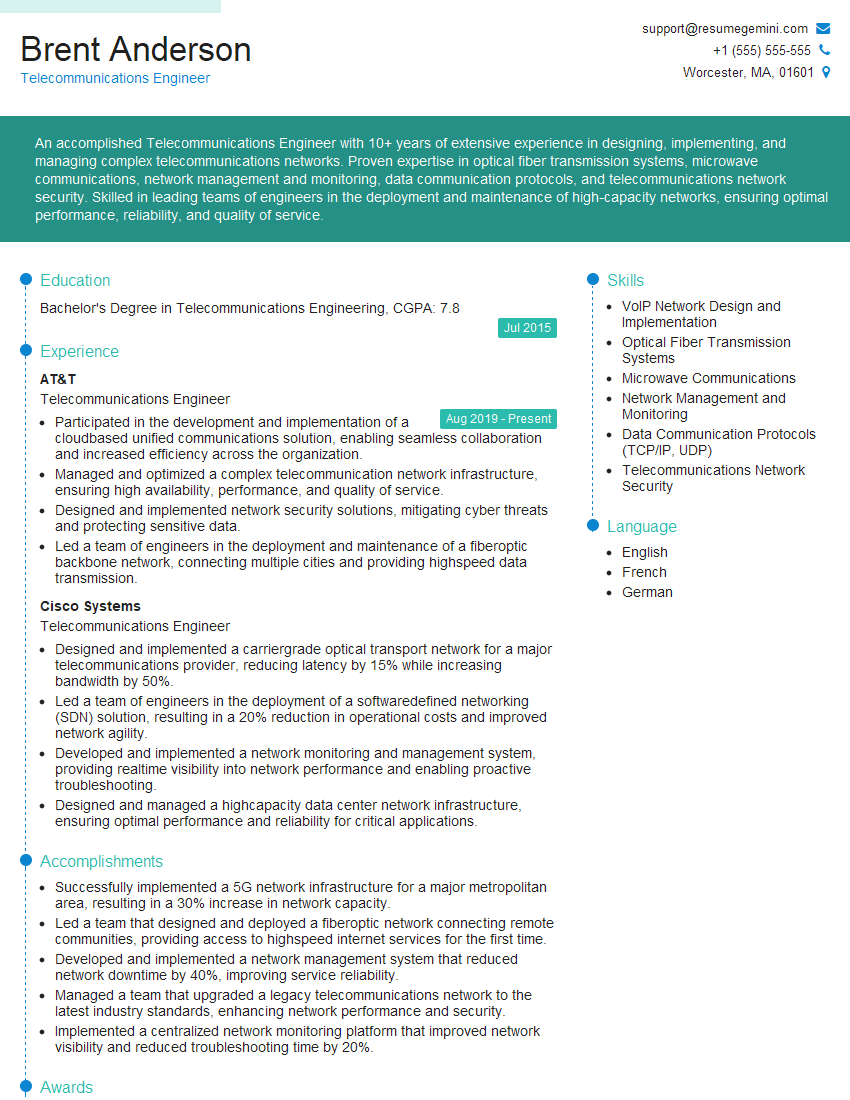
Mastering OSP Planning and Design opens doors to exciting and rewarding career opportunities within the telecommunications and infrastructure sectors. Strong skills in this area are highly sought after, leading to increased earning potential and career advancement. To maximize your job prospects, it’s crucial to present your skills effectively. Create an ATS-friendly resume that highlights your expertise and experience. ResumeGemini is a trusted resource that can help you build a professional and impactful resume. We offer examples of resumes tailored to OSP Planning and Design to help you get started.
Explore more articles
Users Rating of Our Blogs
Share Your Experience
We value your feedback! Please rate our content and share your thoughts (optional).