Cracking a skill-specific interview, like one for Cylinder Press Operation, requires understanding the nuances of the role. In this blog, we present the questions you’re most likely to encounter, along with insights into how to answer them effectively. Let’s ensure you’re ready to make a strong impression.
Questions Asked in Cylinder Press Operation Interview
Q 1. Explain the principle of operation of a cylinder press.
A cylinder press operates on the principle of transferring ink from an inked roller system onto a printing plate, which then impresses the image onto a substrate (like paper) using pressure. Imagine a giant rolling pin (the cylinder) pressing a stamp (the printing plate) onto a sheet of paper. The cylinder’s consistent rotation ensures even pressure and ink distribution across the entire printing area, resulting in high-quality prints.
The process begins with the paper feeding onto the impression cylinder. Simultaneously, the plate cylinder, carrying the inked image, rotates and comes into contact with the impression cylinder, transferring the ink to the substrate. The pressure applied between these cylinders firmly presses the ink onto the paper, creating a crisp and clean print.
Q 2. Describe the different types of cylinder presses.
Cylinder presses come in various types, categorized mainly by their size and functionality. Some common types include:
- Sheet-fed presses: These feed individual sheets of paper into the press, offering flexibility for different paper sizes and stocks. They are commonly used for high-quality print jobs like brochures and business cards.
- Perfector presses: These print on both sides of the sheet in one pass, improving efficiency and reducing handling. Imagine printing a postcard—both the front and back are done simultaneously.
- Web presses (or roll-fed presses): These use continuous rolls of paper, ideal for high-volume printing like newspapers or magazines. The roll of paper resembles a giant scroll.
- Single-color vs. multi-color presses: These differentiate by the number of printing units. A single-color press prints one color at a time, while a multi-color press can print multiple colors in one pass, significantly speeding up the process.
Q 3. What are the key components of a cylinder press and their functions?
Key components of a cylinder press and their functions are:
- Impression Cylinder: This large cylinder applies the pressure needed to transfer the ink from the plate to the substrate. Think of it as the ‘pressing’ element.
- Plate Cylinder: This cylinder holds the printing plate, which contains the image to be printed. The plate is carefully secured and adjusted for precise image placement.
- Ink System: This comprises rollers that distribute ink evenly to the printing plate. A well-balanced ink system is crucial for consistent color and sharpness.
- Dampening System: This system applies a controlled amount of dampening solution (water) to the plate to prevent the ink from smudging and to maintain good ink/water balance. Think of it as controlling the ink’s ‘stickiness’.
- Feedboard: This mechanism accurately feeds the sheets of paper or the web into the press. Precise feeding is paramount for avoiding misregistration issues.
- Delivery System: This stack of printed sheets or a re-winder takes the printed material after it has passed through the press. A reliable delivery system ensures neat and orderly output.
Q 4. How do you set up a cylinder press for a specific job?
Setting up a cylinder press for a specific job involves a series of precise steps. First, the printing plates are mounted onto the plate cylinder with meticulous accuracy to avoid misregistration (incorrect alignment of colors). The ink and dampening systems are then adjusted to achieve the desired ink density and water balance. This is where experience plays a crucial role—adjusting these settings requires a keen eye and a good understanding of the interplay between ink, water, and paper. Paper type and size are carefully considered, with the feedboard adjusted accordingly. Finally, a test run is performed to evaluate the print quality before beginning the full production run.
For example, if printing a four-color brochure, each color’s plate needs to be aligned perfectly. A misalignment would cause blurry or misplaced images. Similarly, the ink density is adjusted to match the client’s specifications. Too much ink can lead to smearing, while too little results in pale colors.
Q 5. Explain the process of makeready on a cylinder press.
Makeready, the process of preparing the press for printing, is critical for high-quality output. It involves several steps:
- Plate mounting: Carefully attaching the printing plates to the plate cylinder, ensuring precise registration.
- Ink and water setting: Adjusting the ink and dampening system rollers to achieve the correct ink density and water balance, crucial for vibrant, clean prints.
- Paper setting: Adjusting the feedboard and delivery system to correctly accommodate the paper size and weight.
- Test run: Printing a few sample sheets to check registration, color consistency, and overall print quality before full production.
- Fine tuning: Making minor adjustments to the ink, water, and pressure as needed to perfect the print quality.
A well-executed makeready significantly reduces waste, ensures consistent quality, and streamlines the entire printing process. Think of it as the ‘dress rehearsal’ before the main performance.
Q 6. How do you adjust ink density and water balance on a cylinder press?
Adjusting ink density and water balance is a crucial aspect of cylinder press operation. Ink density is controlled by adjusting the ink roller settings and the amount of ink delivered to the plate. Too much ink leads to smudging; too little results in weak colors. Water balance is adjusted by modifying the dampening roller settings. The correct water balance prevents ink from smearing while ensuring sharp, clean prints. The goal is to achieve the perfect balance—enough ink for vibrant colors, enough water to prevent smudging, but not so much water that it weakens the ink.
This is a delicate balance, requiring experience and a keen eye. Changes are made incrementally, with the press operator constantly monitoring the print output for any adjustments.
Q 7. What are the common printing defects encountered on a cylinder press and how are they corrected?
Common printing defects encountered on a cylinder press and their corrections:
- Misregistration: Incorrect alignment of colors. Correction: Precise adjustments to plate positioning on the cylinder.
- Set-off: Ink transfer from one sheet to the next. Correction: Reduce ink density, use a different type of ink, or add powder to the printed sheet.
- Mottle: Uneven ink distribution. Correction: Check ink roller settings, ensure sufficient ink flow, and clean the rollers.
- Hickeys: Small specks of foreign material in the print. Correction: Thorough cleaning of the press and careful handling of materials.
- Streaks: Uneven application of ink. Correction: Clean rollers, adjust ink distribution, check dampening solution levels.
Troubleshooting these issues involves systematic checks of all press components, understanding the relationships between different settings (ink, water, pressure, etc.), and using a combination of adjustments to correct the problem.
Q 8. Describe your experience with different types of printing plates.
My experience encompasses a wide range of printing plates, each with its own strengths and weaknesses. I’m proficient with traditional letterpress plates, which require careful setting and adjustment for optimal ink transfer. I’ve also worked extensively with photopolymer plates, known for their durability and ability to reproduce fine details. These are particularly useful for longer print runs. I’m familiar with the intricacies of preparing and mounting both types of plates, ensuring proper registration and minimizing waste. Furthermore, I have experience with flexographic plates, commonly used for packaging printing, and understand their specific requirements for mounting and cleaning. Choosing the right plate type is crucial, depending on the project’s requirements, such as the run length, image complexity, and substrate being printed on. For instance, for a short-run, high-quality art print, photopolymer plates might be ideal, whereas a long-run job requiring fast turnaround might necessitate flexographic plates.
Q 9. How do you maintain the quality of print throughout a long run?
Maintaining print quality throughout a long run requires meticulous attention to detail and proactive maintenance. This begins with a thorough press setup, ensuring proper ink-water balance, consistent impression pressure, and accurate registration. Regular monitoring of the ink viscosity and density is paramount. I use color control strips to check for consistency throughout the print and make adjustments to the ink keys and fountain solution accordingly. The paper itself plays a key role; maintaining a consistent supply of properly conditioned paper prevents variations in absorbency and color reproduction. Regular cleaning of the rollers and dampening system also contributes to consistent ink transfer and prevents buildup that can affect color quality. Finally, scheduled preventative maintenance, such as replacing worn parts, reduces the risk of unexpected issues that could compromise quality and efficiency. For example, noticing even slight changes in ink density, I would adjust the ink flow or dampen system accordingly to prevent significant deviations from the target color.
Q 10. Explain the importance of proper paper handling in cylinder press operation.
Proper paper handling is absolutely crucial for successful cylinder press operation. Improper handling can lead to paper jams, misfeeds, and uneven printing. It starts with proper storage: paper should be stored in a climate-controlled environment to prevent warping or damage. Before the print run, the paper needs to be properly conditioned – acclimated to the pressroom’s humidity and temperature – to prevent expansion or shrinkage which can cause registration issues. The paper feed system needs to be carefully adjusted to match the paper’s thickness and weight to ensure smooth and reliable feeding. The paper path needs to be clean and free from any obstructions to prevent jams. Also, the operator must ensure that the paper is correctly aligned to prevent skewed or misregistered printing. Think of it like a well-oiled machine; each step in paper handling contributes to the machine’s overall performance. For example, if the paper is too dry, it will feed poorly and prone to jamming. Conversely, paper that’s too humid can stretch and cause registration issues, resulting in misaligned colors or text.
Q 11. How do you troubleshoot common mechanical issues on a cylinder press?
Troubleshooting mechanical issues requires a systematic approach. I start by identifying the problem: is it a feeding issue, an inking problem, or a registration problem? Once the area is pinpointed, I carefully inspect the relevant components. For instance, a paper jam might involve checking the feed rollers, grippers, and delivery system for obstructions or misalignment. Inking problems could indicate issues with the ink rollers, fountain solution, or ink ducts. Registration problems often point to problems in the feeder or impression cylinders, needing precise adjustments. My experience allows me to quickly diagnose the root cause. For example, if the print is blurry or inconsistent, I would check the impression cylinder for even pressure and look for worn rollers. I always prioritize safety; ensuring the press is shut down and locked out before performing any maintenance or repairs.
Q 12. What safety procedures do you follow when operating a cylinder press?
Safety is paramount when operating a cylinder press. Before starting any work, I always conduct a thorough safety inspection, ensuring all guards are in place, emergency stops are functioning correctly, and the press area is clear of obstructions. I wear appropriate personal protective equipment (PPE), including safety glasses and gloves. Before any adjustments or maintenance, I ensure the press is fully stopped and locked out using the appropriate safety procedures, preventing accidental starting. I never reach into the press while it’s running or in motion. I adhere to all company safety guidelines and report any unsafe conditions or equipment malfunctions immediately. Training and continuous awareness are key aspects of my safety practices. Safe operation of heavy machinery depends upon constant diligence, attention to detail, and adherence to established procedures.
Q 13. Describe your experience with pre-press procedures.
My pre-press experience is extensive, covering file preparation, color management, and proofing. I’m proficient in various software applications used for image editing and imposition. I work closely with designers to ensure files are prepared according to the press’s capabilities, optimizing images for best results and minimizing potential issues. Accurate color management is critical; I use color profiles and proofing methods to ensure the printed output accurately matches the client’s expectations. I’m involved in the creation of imposition layouts, carefully arranging pages for efficient printing and binding. This stage involves identifying potential issues like image resolution or color variations before the printing starts, ultimately preventing wasted materials and time. The accuracy and efficiency of the pre-press stage directly impact the quality of the final printed output and the overall workflow.
Q 14. How do you perform a press wash-up?
Press wash-up is a critical process to maintain the press’s cleanliness and prevent ink contamination. I follow a specific procedure, starting by shutting down the press and locking out the power. The next step involves removing all plates and carefully cleaning each one using appropriate solvents. The ink rollers are cleaned thoroughly, often requiring specialized cleaning solutions and techniques depending on the type of ink. The dampening system is flushed and cleaned to remove any residual ink or fountain solution. The impression cylinder, blankets, and other press components are also cleaned and inspected for wear. Finally, the press is thoroughly wiped down, and all cleaning materials are properly disposed of according to environmental regulations. A well-executed wash-up ensures the press is ready for the next job without any color contamination and helps extend its lifespan. Skipping steps or using incorrect cleaning methods can lead to the degradation of press components and quality issues in subsequent print runs.
Q 15. What is your experience with different types of inks?
My experience encompasses a wide range of inks, from conventional oil-based inks to UV-curable and water-based varieties. Understanding ink properties is crucial for optimal print quality and press performance. Oil-based inks, for instance, offer vibrant colors and excellent rub resistance, but require longer drying times and careful handling due to their solvent content. UV-curable inks, on the other hand, cure instantly upon exposure to UV light, allowing for faster production and immediate post-press finishing. This speed is a significant advantage, especially in high-volume jobs. Water-based inks are increasingly popular due to their eco-friendliness, but they sometimes present challenges regarding color vibrancy and drying speed depending on the substrate. I’ve worked extensively with each type, adjusting press settings – such as ink viscosity and durometer – to achieve the desired results for each project and ink type. For example, on a recent project requiring a high-gloss finish on coated stock, we utilized a UV-curable ink to achieve both brilliant color and immediate drying for immediate further processing.
Career Expert Tips:
- Ace those interviews! Prepare effectively by reviewing the Top 50 Most Common Interview Questions on ResumeGemini.
- Navigate your job search with confidence! Explore a wide range of Career Tips on ResumeGemini. Learn about common challenges and recommendations to overcome them.
- Craft the perfect resume! Master the Art of Resume Writing with ResumeGemini’s guide. Showcase your unique qualifications and achievements effectively.
- Don’t miss out on holiday savings! Build your dream resume with ResumeGemini’s ATS optimized templates.
Q 16. How do you manage waste during a print run?
Waste management is a critical aspect of cylinder press operation. My approach is multifaceted and focuses on minimizing waste at every stage. This starts with meticulous pre-press planning, ensuring accurate imposition and minimizing material spoilage due to errors. During the print run, I closely monitor the press for any issues causing waste, such as misregistration or ink-related problems, correcting them promptly. We recycle all possible materials, including paper scraps, which are segregated and sent to a recycling facility. Ink and cleaning solvent waste are managed through proper disposal procedures in compliance with all environmental regulations, often using dedicated waste containers and recycling programs for solvents and their containers. Regular maintenance of the press is key to minimizing waste caused by machine malfunctions, and we track our waste output to identify areas for improvement and efficiency gains. For example, by implementing a more efficient cleaning procedure, we were able to reduce solvent waste by 15% on a recent long run.
Q 17. How do you ensure color consistency throughout a print job?
Maintaining color consistency is paramount. We achieve this through a combination of careful color calibration, precise ink management, and regular quality control checks. The process begins with profiling the press and the specific paper stock used, ensuring the color output aligns with the design specifications. We use color management software to create accurate color profiles and monitor color consistency throughout the run. Regular color checks are performed using a densitometer, comparing readings against target values. Small adjustments to ink keys and densities are made as needed to maintain consistency. Furthermore, we maintain strict control over the environment, including temperature and humidity, as these factors can influence color reproduction. A standardized workflow, training, and a proactive approach to troubleshooting are all essential to ensure the quality and consistency of each print.
Q 18. Describe your experience with different paper stocks.
My experience spans a wide range of paper stocks, from lightweight papers used for brochures and flyers to heavier stocks employed for packaging and high-end print projects. Understanding paper characteristics is crucial for selecting the correct paper for each job and optimizing press settings. This includes understanding gsm (grams per square meter), grain direction, surface coating (coated, uncoated, etc.), and paper caliper. For example, a coated paper will handle inks differently than an uncoated stock; coated paper may need less ink and will offer a higher gloss. Heavier stocks require adjustments to the press’s impression and feeding systems to avoid paper jams and ensure proper registration. I have extensive experience working with various paper types, including offset, uncoated, gloss, matte, and specialty papers such as textured or metallic stocks. Choosing the right paper stock is a crucial step in achieving the desired print results and is selected based on the overall project design and requirements.
Q 19. Explain your understanding of color management systems (CMS).
Color Management Systems (CMS) are vital for ensuring consistent and accurate color reproduction across different devices and stages of the printing process. I’m proficient in utilizing CMS software, understanding its role in converting digital files into accurate print output. A CMS uses color profiles – essentially mathematical representations of a device’s color capabilities – to translate color data from the design software (like Adobe Illustrator or InDesign) to the printer. This ensures that the colors on the screen match the colors printed on the press as closely as possible. We typically utilize a workflow involving ICC profiles (International Color Consortium) to manage color throughout the production pipeline. A proper CMS implementation is crucial for eliminating the discrepancies that can arise between the digital design and the final printed output, ensuring accurate and consistent color across all projects.
Q 20. How familiar are you with different types of printing substrates?
My familiarity extends beyond standard paper stocks to include a variety of printing substrates. I’ve worked with various materials, including cardboards of different weights and textures used in packaging, vinyl for banners and signage, and plastics and synthetics for specialized applications. Each substrate presents unique challenges regarding ink adhesion, drying time, and press settings. For instance, printing on plastic often requires specialized inks and techniques to ensure proper adhesion and prevent smudging. Understanding the properties of each substrate is crucial for selecting appropriate inks, adjusting press settings (like impression pressure and speed), and preventing issues such as delamination or ink bleeding. This experience ensures adaptability and efficient handling of diverse print jobs.
Q 21. What is your experience with automated press controls?
I possess extensive experience with automated press controls, including computer-to-plate (CTP) workflows, automated color control systems, and advanced press management software. This allows for precise control over various aspects of the printing process, enhancing efficiency and ensuring consistent quality. My expertise includes programming automated functions, troubleshooting system errors, and optimizing press settings for different substrates and ink types. Automated controls provide data-driven insights into press performance, enabling preventative maintenance and maximizing uptime. For instance, automated color control systems allow for real-time adjustments based on color readings, ensuring consistent color output throughout the entire run, eliminating the need for constant manual adjustments. The use of such systems reduces waste and optimizes printing speed for better efficiency.
Q 22. How do you monitor and maintain press performance metrics?
Monitoring and maintaining press performance metrics is crucial for ensuring efficiency and quality in cylinder press operation. It involves tracking key indicators to identify areas for improvement and prevent potential problems. This typically involves a combination of real-time monitoring and periodic data analysis.
Real-time Monitoring: I constantly observe the press during operation, noting factors like speed, ink density, register accuracy, and waste. Modern presses often have built-in monitoring systems providing digital readouts of these metrics. Any deviation from the expected parameters is immediately investigated.
Data Analysis: At the end of each job or shift, I review collected data. This may include the number of impressions, makeready time, downtime, and the amount of waste generated. I use this information to calculate metrics like Overall Equipment Effectiveness (OEE), which helps assess the press’s overall efficiency. For example, if makeready time is consistently high, it flags a need for process improvement.
Key Performance Indicators (KPIs): Some vital KPIs I track include print quality (measured through color density and register), press speed, waste percentage, and uptime. These KPIs are compared to established benchmarks, and any significant variations trigger investigation and corrective actions.
By consistently tracking and analyzing these metrics, I can identify trends, predict potential issues, and implement improvements to optimize press performance. This data-driven approach is key to maximizing productivity and minimizing waste.
Q 23. How do you handle job changes efficiently on the press?
Efficient job changes on a cylinder press are paramount for minimizing downtime and maintaining productivity. This involves a systematic approach, incorporating meticulous planning and execution.
Pre-Press Planning: Before the job change, I carefully review the specifications of the new job, including paper size, ink colors, and plate configurations. This allows me to pre-stage the necessary materials and tools, ensuring a smooth transition. I’ll also check the availability of inks, plates and appropriate paper stock.
Organized Changeover: The actual changeover involves a structured sequence of steps. This includes removing old plates, cleaning the ink system, installing new plates, adjusting the grippers for the new paper size and ensuring proper ink settings, all whilst meticulously cleaning the inking unit, and carefully checking the paper path. I always follow the manufacturer’s guidelines to prevent damage to the press.
Makeready and Test Prints: After installing new plates and making the necessary adjustments, I run a series of test prints to verify proper registration, color accuracy, and overall print quality before proceeding with the full production run.
Waste Minimization: During the changeover process, I carefully manage waste generation by closely monitoring ink flow and paper usage. Using pre-press planning and standardized procedures, the amount of waste material during make-ready is kept to a minimum.
By following this structured approach, I can minimize the time required for job changes, reducing downtime and maximizing the press’s overall efficiency. This efficiency translates to lower costs and faster turnaround times for our clients.
Q 24. What is your experience with preventative maintenance?
Preventative maintenance is essential for ensuring the longevity and reliability of a cylinder press. It’s a proactive approach that aims to prevent problems before they arise, rather than reacting to failures. My experience involves a comprehensive program that covers various aspects of press maintenance.
Scheduled Maintenance: I adhere to a strict schedule of regular maintenance tasks, including cleaning and lubricating critical components, inspecting belts and rollers, and checking for any signs of wear or tear. This schedule is based on the manufacturer’s recommendations and my own observations of the press’s performance.
Lubrication: Regular lubrication of moving parts is crucial to prevent friction and wear. I use the correct lubricants and follow the manufacturer’s recommendations for lubrication points and frequencies.
Cleaning: Keeping the press clean is paramount. I regularly clean ink fountains, rollers, and other components to prevent ink buildup and ensure consistent print quality. This includes using appropriate cleaning solvents and adhering to safety protocols.
Component Inspections: I perform regular visual inspections of components like rollers, blankets, and plates, checking for wear and tear, damage or misalignment. Any issues are addressed promptly to prevent major problems.
My proactive approach to preventative maintenance has significantly reduced downtime and extended the lifespan of the presses I’ve operated. It also contributes to maintaining consistent print quality and minimizing the risk of costly repairs.
Q 25. Describe your experience with troubleshooting and resolving printing problems.
Troubleshooting and resolving printing problems requires a systematic and analytical approach. My experience encompasses a wide range of issues, from simple adjustments to complex mechanical problems.
Systematic Approach: When a problem arises, I follow a structured troubleshooting process. I start by carefully observing the issue, noting any visible signs or patterns. I then consult relevant documentation, including the press’s manual and past maintenance records, to identify potential causes.
Testing and Elimination: I systematically test different components and settings to pinpoint the source of the problem. For example, if the print is blurry, I might check the rollers, blankets, and plates for wear or damage. If the colors are off, I check ink settings, ink viscosity, and for any color imbalance.
Documentation: I meticulously document the troubleshooting process, including the problem description, the steps taken, and the results. This documentation is invaluable for future reference and helps prevent recurring issues.
Seeking Assistance: If I cannot resolve the problem using my own expertise, I don’t hesitate to seek assistance from experienced colleagues or the manufacturer’s technical support. This ensures that problems are resolved quickly and efficiently.
Through experience and a methodical approach, I’ve developed a keen ability to diagnose and resolve a wide array of printing problems, ranging from minor adjustments to more complex mechanical repairs. This ensures minimal downtime and maintains high levels of quality.
Q 26. How do you ensure the accuracy of the printed material?
Ensuring the accuracy of printed material involves a multi-faceted approach, incorporating both pre-press and press-side quality control measures. Accuracy encompasses color consistency, register, and image sharpness.
Pre-press Verification: I meticulously review the pre-press files, ensuring proper color separation, image resolution, and accurate imposition before plates are made. I also check the proofs against the original artwork to verify accuracy.
Press-side Controls: During printing, I constantly monitor the press’s performance, paying close attention to register, color density, and ink consistency. I use color measurement devices (densitometers, spectrophotometers) to ensure accurate color reproduction and maintain consistency throughout the run.
Regular Checks: I perform regular checks of the printed output, visually inspecting for any defects or inconsistencies. This includes checking for proper registration, consistent ink coverage, and the absence of any print defects.
Waste Management: During the initial stages of a printing job, I make sure to keep a few sheets for waste checking, to monitor for any quality issues, enabling me to address any problems before they become major issues. I’ll also check the sheets regularly throughout the run to ensure consistency.
By implementing these measures, I can maintain tight control over the printing process, ensuring that the final product meets the highest standards of accuracy and quality. This commitment to precision is crucial for client satisfaction.
Q 27. What are your skills in using press-related software?
I’m proficient in using various press-related software packages, including those used for pre-press preparation, press control, and quality assurance. My experience covers both traditional and modern systems.
Pre-press Software: I’m familiar with software such as Adobe Acrobat, for reviewing and proofing PDF files, and software like Esko, for creating and preparing plates for the press. This expertise ensures that the files sent to the press are accurate and ready for printing.
Press Control Systems: Many modern presses utilize sophisticated control systems, often incorporating touchscreen interfaces and data acquisition capabilities. I’m adept at using these systems to monitor and control various press parameters, including speed, ink density, and register. I can also use the software to analyze the data for performance monitoring and process optimization.
Quality Control Software: Software solutions designed for color measurement and quality control are also a part of my skill set. These tools allow me to accurately measure color, monitor consistency, and detect deviations from the target values. This enhances precision and speeds up the entire process.
My proficiency in these software packages ensures that I can effectively manage the entire printing process, from pre-press preparation to final quality control. This software knowledge is essential in ensuring efficiency and quality control in modern printing environments.
Q 28. How do you prioritize tasks during peak production periods?
Prioritizing tasks during peak production periods is critical for maintaining efficiency and meeting deadlines. My approach involves a combination of planning, communication, and effective time management.
Job Prioritization: I work closely with the scheduling department to understand the urgency of each job and prioritize accordingly. This involves considering factors such as deadlines, job complexity, and client expectations. Urgent jobs with tight deadlines are given priority.
Workflow Optimization: I optimize the workflow to maximize efficiency. This may involve streamlining processes, identifying bottlenecks, and proactively addressing potential problems to avoid delays.
Teamwork and Communication: Effective communication with team members is essential during peak periods. I keep the team informed about job priorities and any potential delays. Clear communication ensures everyone is working together towards common goals.
Flexibility and Adaptability: During peak production periods, unexpected issues may arise. I’m adaptable and flexible, able to adjust priorities as needed to keep the workflow moving smoothly. I can prioritize tasks and make quick decisions to address any disruptions effectively.
By using this systematic approach, I can effectively manage tasks during high-pressure situations, ensuring that all jobs are completed on time and to the required standards. This is crucial for meeting client deadlines and maintaining the reputation of our printing facility.
Key Topics to Learn for Cylinder Press Operation Interview
- Understanding Cylinder Press Mechanics: Grasp the fundamental principles of how a cylinder press functions, including the interplay of rollers, impression cylinders, and ink distribution systems. This includes understanding different press types and their capabilities.
- Practical Application: Setup and Operation: Demonstrate knowledge of the practical steps involved in setting up a cylinder press for a specific job, including makeready, ink adjustments, and sheet feeding. Be prepared to discuss troubleshooting common operational issues.
- Color Management and Ink Control: Explain your understanding of color theory as it relates to printing, including ink mixing, color matching, and achieving consistent color reproduction across a print run. Be ready to discuss different methods of color calibration.
- Safety Procedures and Maintenance: Showcase your awareness of critical safety protocols associated with operating a cylinder press and performing routine maintenance tasks. Highlight your experience with preventative maintenance to minimize downtime.
- Quality Control and Troubleshooting: Discuss your approach to identifying and resolving print defects, such as misregistration, slurring, and color inconsistencies. Explain how you monitor print quality throughout the production process.
- Understanding Different Printing Processes: Show familiarity with various printing techniques used on cylinder presses, such as offset lithography, and their applications to different substrates (paper types).
- Production Planning and Efficiency: Discuss your experience with optimizing press settings and workflows to achieve maximum efficiency and minimize waste. Be prepared to discuss your experience with job scheduling and prioritization.
Next Steps
Mastering Cylinder Press Operation opens doors to a rewarding career with excellent growth potential. As you advance, opportunities to specialize in areas like pre-press, quality control, or press management become available. To maximize your job prospects, invest in creating an ATS-friendly resume that highlights your skills and experience effectively. ResumeGemini is a trusted resource for building professional resumes that get noticed. They provide examples of resumes tailored to Cylinder Press Operation, ensuring your application stands out. Take the next step in building your successful career today.

Print Production Manager Resume Sample

Pressroom Supervisor Resume Sample
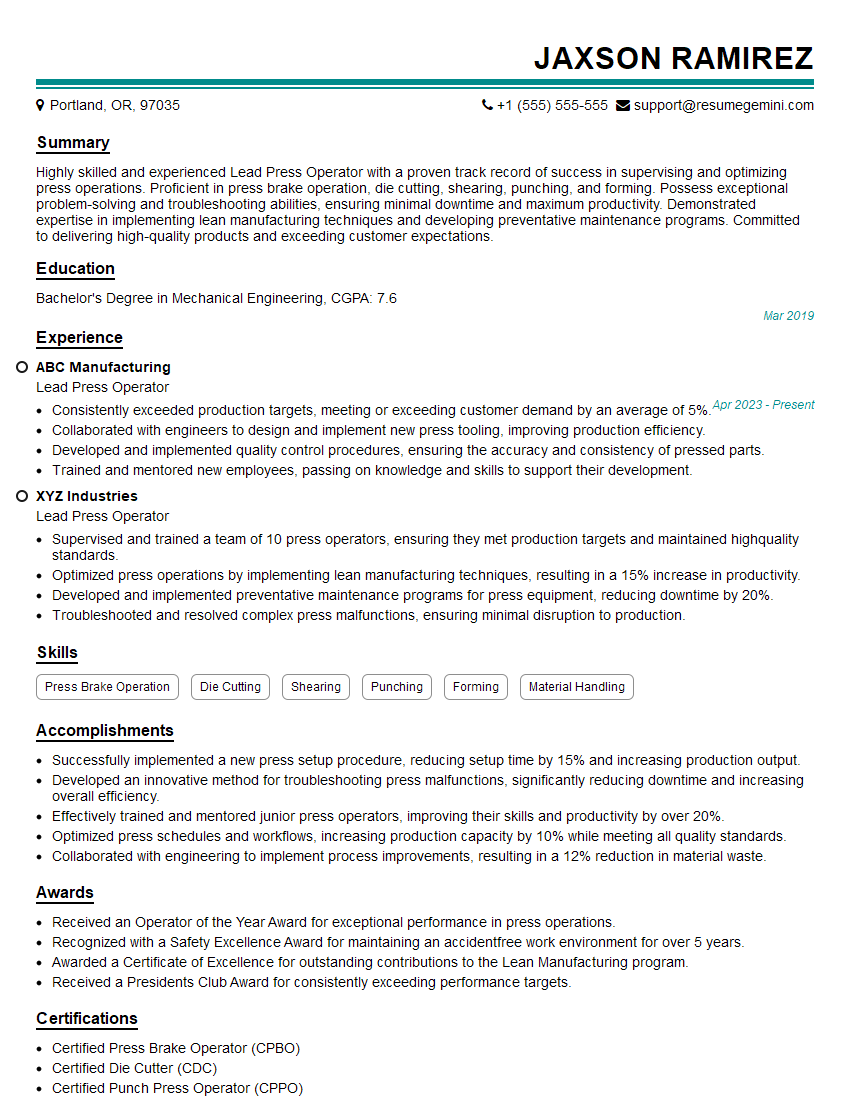
Lead Press Operator Resume Sample
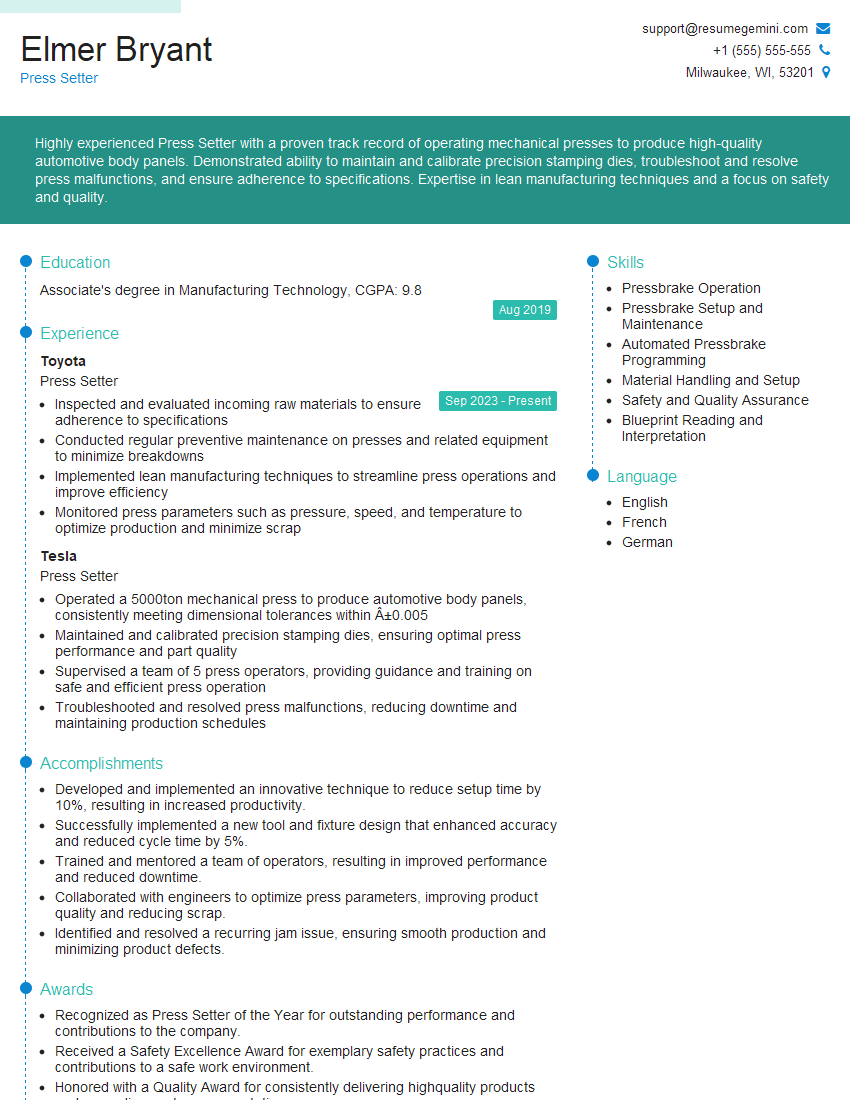
Press Setter Resume Sample
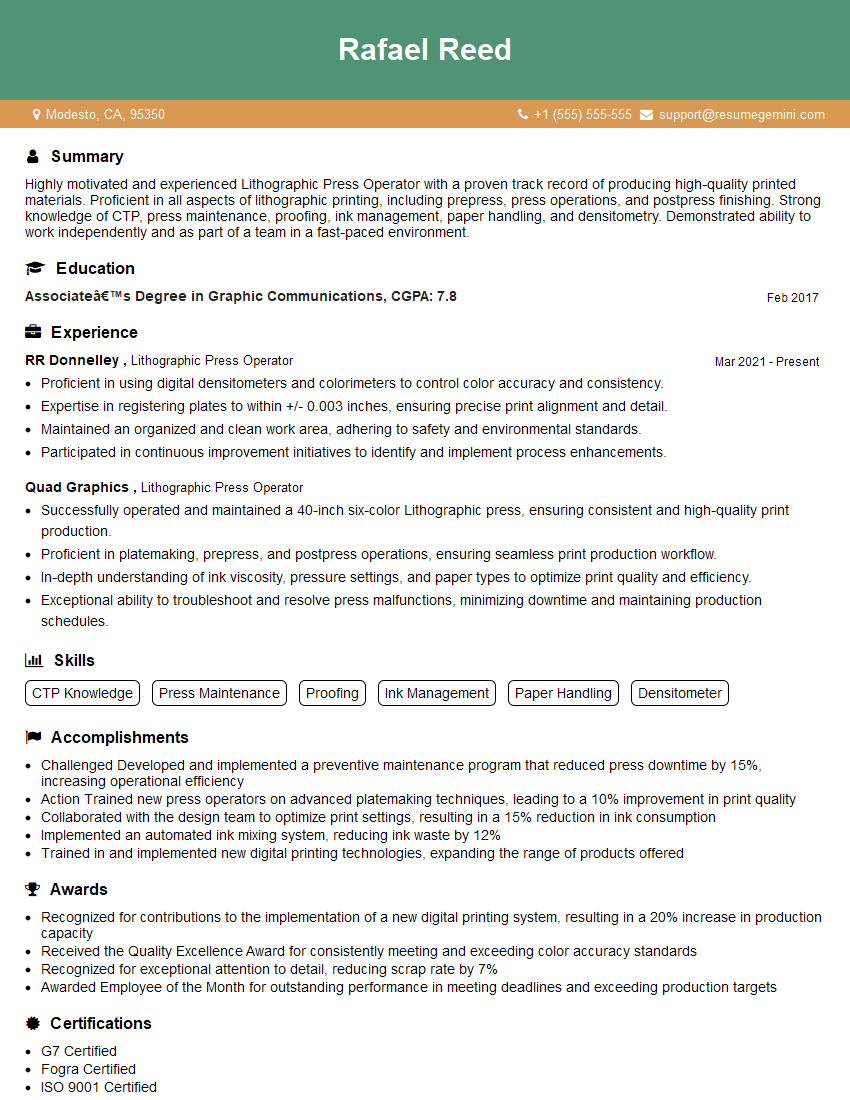
Lithographic Press Operator Resume Sample
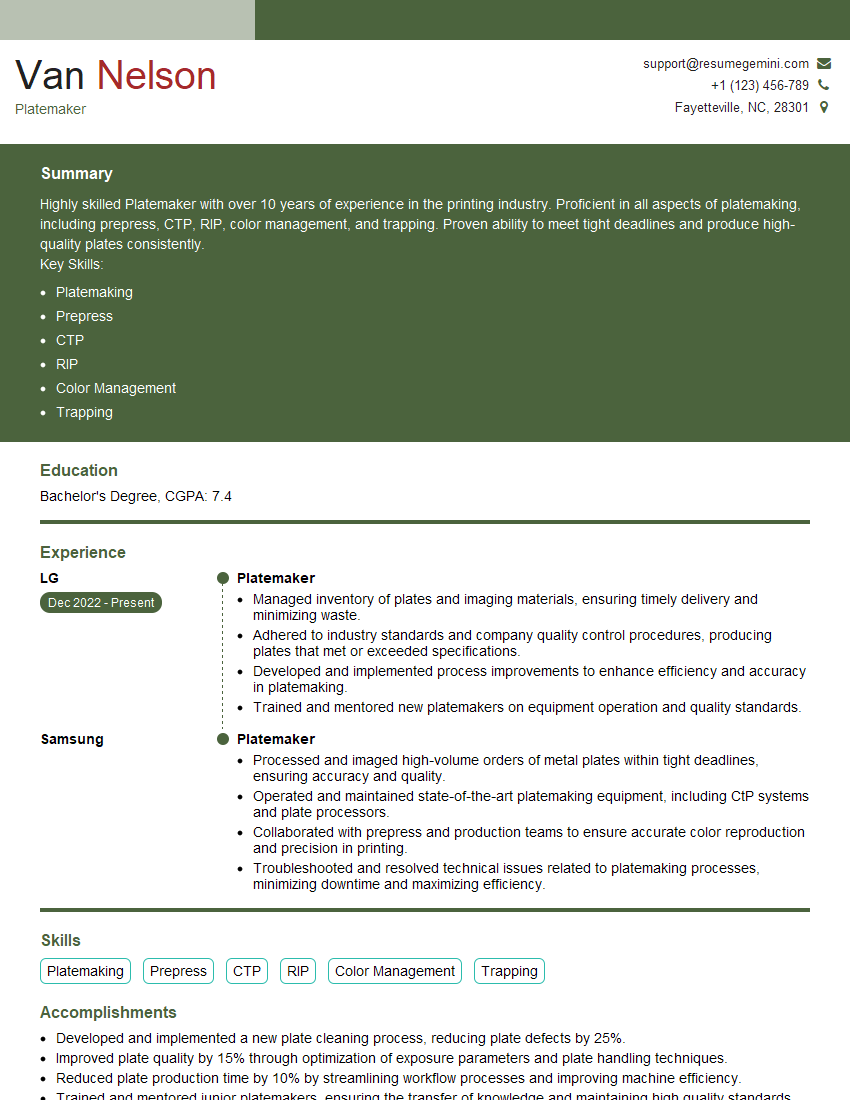
Platemaker Resume Sample
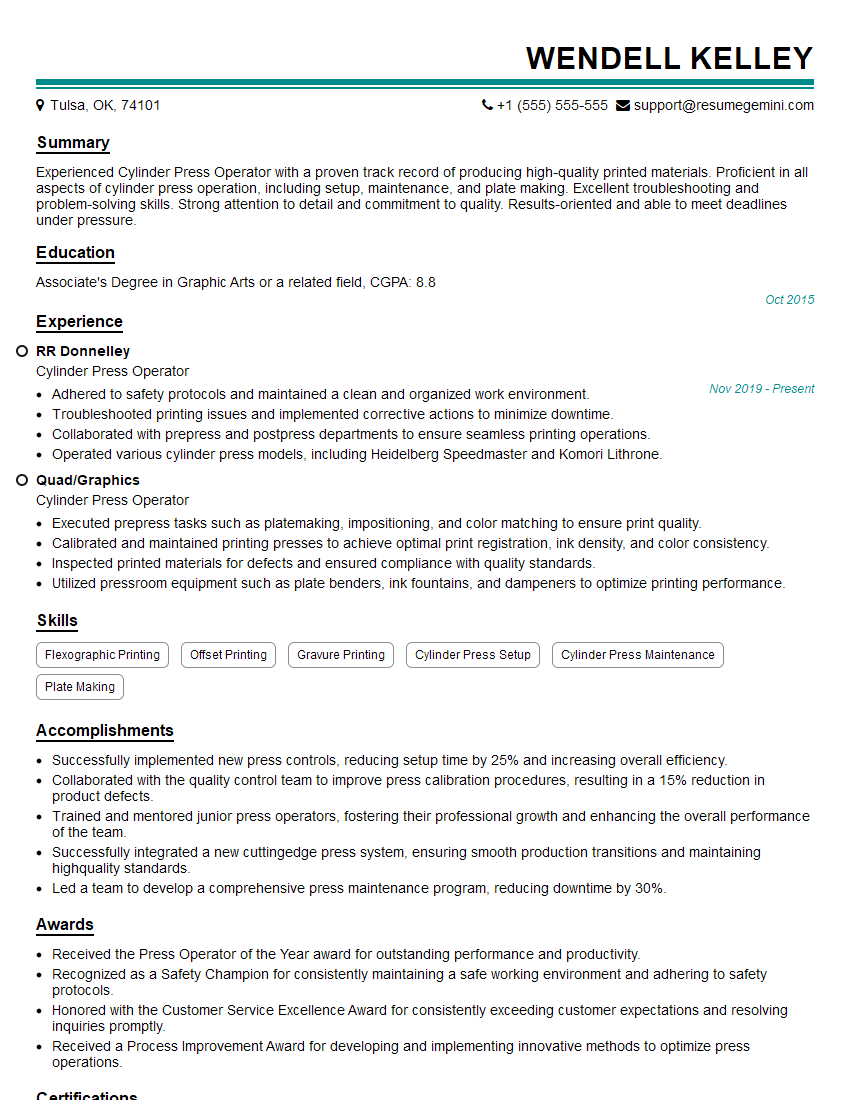
Cylinder Press Operator Resume Sample
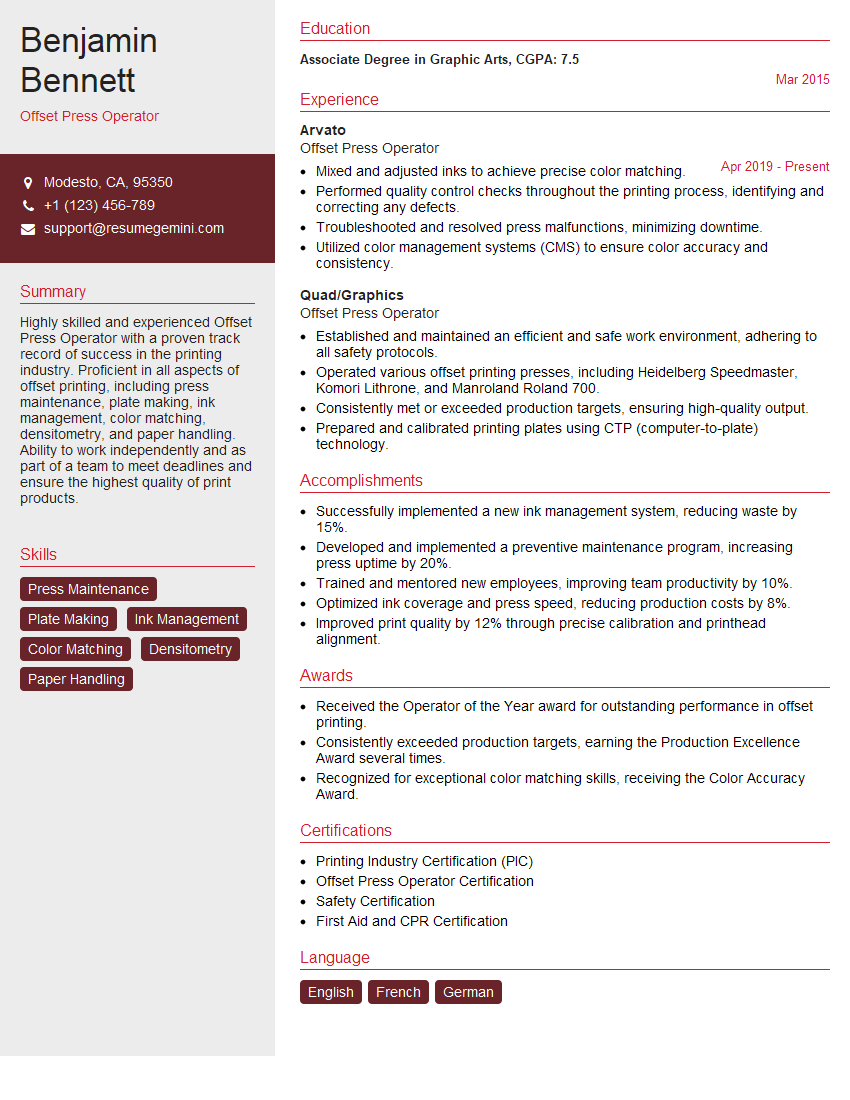
Offset Press Operator Resume Sample
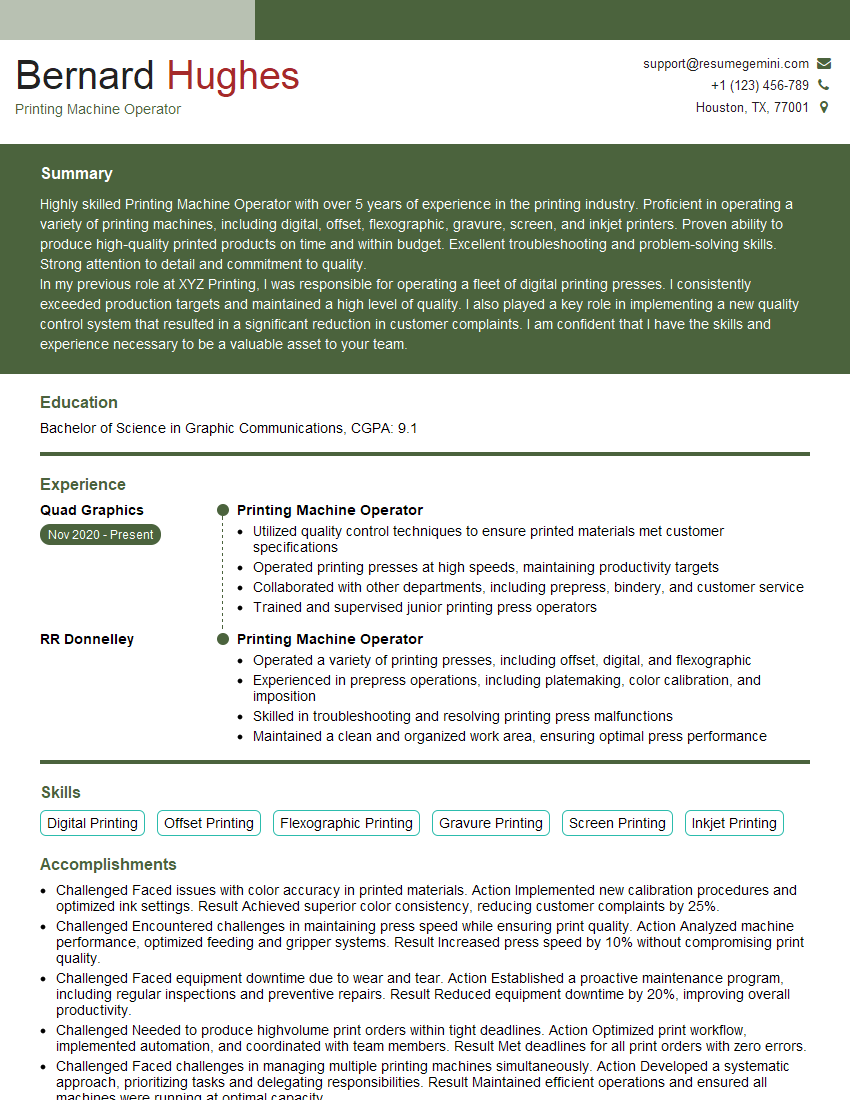
Printing Machine Operator Resume Sample
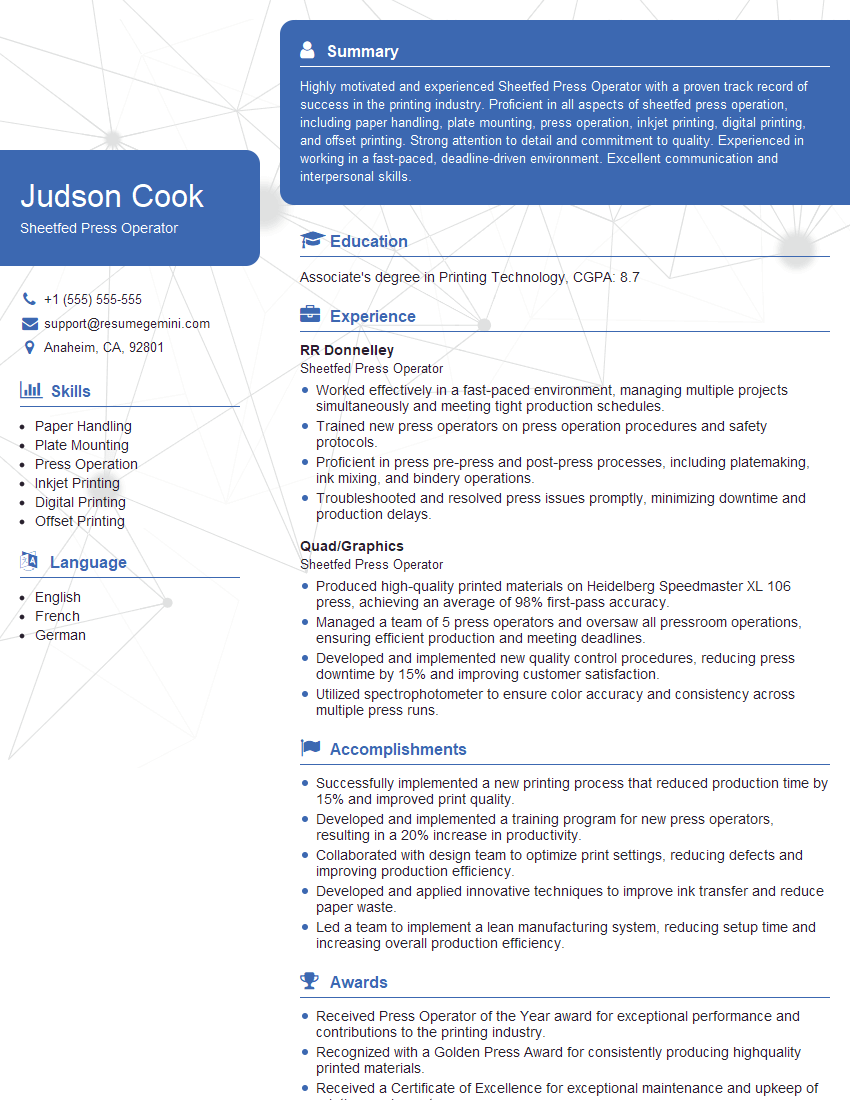
Sheetfed Press Operator Resume Sample
Explore more articles
Users Rating of Our Blogs
Share Your Experience
We value your feedback! Please rate our content and share your thoughts (optional).
What Readers Say About Our Blog
Very informative content, great job.
good