Feeling uncertain about what to expect in your upcoming interview? We’ve got you covered! This blog highlights the most important Splicing Techniques (e.g., Fusion, Mechanical) interview questions and provides actionable advice to help you stand out as the ideal candidate. Let’s pave the way for your success.
Questions Asked in Splicing Techniques (e.g., Fusion, Mechanical) Interview
Q 1. Explain the difference between fusion and mechanical splicing.
Fusion splicing and mechanical splicing are two distinct methods for joining optical fibers. Fusion splicing uses an electric arc to melt and fuse the fiber ends together, creating a permanent, high-strength connection. Think of it like welding two metal pieces together—a seamless bond. Mechanical splicing, on the other hand, uses a precisely engineered connector to hold the fiber ends in close proximity. This is more like using a clamp to hold two pieces of wood together; the connection relies on the mechanical alignment and the connector’s design.
The key difference lies in the nature of the connection: fusion creates a homogenous, glass-to-glass connection resulting in lower loss and better long-term reliability, while mechanical splicing provides a quicker, less expensive solution albeit with potentially higher loss and reduced durability.
Q 2. Describe the process of preparing fiber optic cable for fusion splicing.
Preparing fiber optic cable for fusion splicing is a meticulous process crucial for achieving a high-quality splice. It involves several key steps:
- Cleaning: Thoroughly cleaning the fiber ends is paramount. Any dust, oil, or debris will severely impact the splice quality. Isopropyl alcohol and lint-free wipes are commonly used. You’d be surprised how a tiny speck of dust can cause significant signal loss.
- Cutting: A precise cleave is essential. Specialized cleavers are used to create a perpendicular, smooth end face. Even a slight angle or imperfection can introduce significant losses. Imagine trying to join two pieces of glass at an angle – it won’t fit perfectly.
- Inspection: Inspecting the cleaved fiber end under a microscope is vital to ensure it’s clean and free of imperfections. This visual check helps prevent poor splices and wasted effort.
- Stripping and Cleaning (Cable Preparation): Before cleaving, you need to carefully remove the outer jacket, buffer coating, and sometimes even the primary coating, exposing the bare fiber for splicing. The process varies depending on the type of cable, and care is needed to avoid damaging the fiber during stripping.
These steps, when executed precisely, ensure optimal conditions for the fusion splicing process, leading to a strong and low-loss connection.
Q 3. What are the critical safety precautions when performing fiber optic splicing?
Safety is paramount when working with fiber optic equipment. Here’s a breakdown of critical safety precautions:
- Eye Protection: Always wear appropriate eye protection. The arc generated during fusion splicing can emit harmful UV light.
- Protective Clothing: Wear gloves to prevent cuts from the fiber and to keep the fiber clean.
- Proper Ventilation: Ensure adequate ventilation to prevent exposure to any fumes or gases produced during the splicing process, particularly in enclosed areas.
- Laser Safety (if applicable): If using a laser-based cleaver or inspection tool, follow all laser safety guidelines and wear appropriate laser safety glasses.
- Grounding: Ensure proper grounding of the equipment to prevent electrical shocks.
- Training: Always receive proper training and certification before attempting fiber optic splicing to ensure safe procedures are followed.
Ignoring these precautions can lead to serious injury or damage to equipment. Safety should always be the top priority.
Q 4. How do you identify and troubleshoot common fusion splicing errors?
Identifying and troubleshooting fusion splicing errors requires a systematic approach. Common errors include:
- High Loss: This could be due to a poor cleave, dirty fiber ends, insufficient fusion, or improper alignment. The optical time-domain reflectometer (OTDR) is an invaluable tool for pinpointing the location and magnitude of losses.
- Weak Splice: A weak splice might result from insufficient fusion power or contamination. Visual inspection can sometimes reveal issues like incomplete fusion.
- Misalignment: Incorrect alignment leads to significant loss. The fusion splicer typically provides visual alignment feedback.
- Bubbles: Air bubbles within the fusion splice are a common problem, often caused by unclean fibers. Microscopic inspection will quickly detect this.
Troubleshooting involves carefully examining the splice using a microscope, checking the OTDR traces, and reviewing the splicing parameters. If the problem persists, you might need to recleave the fibers and repeat the process. Sometimes even the expertise of a field engineer is required for complicated cases.
Q 5. What are the advantages and disadvantages of fusion splicing compared to mechanical splicing?
Fusion and mechanical splicing each offer unique advantages and disadvantages:
| Feature | Fusion Splicing | Mechanical Splicing |
|---|---|---|
| Loss | Typically lower (0.02dB or less) | Higher (0.2dB or more) |
| Reliability | Higher long-term reliability | Lower long-term reliability |
| Speed | Slower | Faster |
| Cost | Higher initial cost of equipment | Lower initial cost |
| Durability | More durable | Less durable |
| Skill Required | Requires higher skill level | Requires less skill |
In essence, fusion splicing offers superior performance and longevity but requires specialized equipment and expertise. Mechanical splicing is a quicker and more cost-effective solution when high performance isn’t the primary concern. The choice often depends on the specific application and project budget.
Q 6. Describe the different types of mechanical splices.
Several types of mechanical splices exist, each with its design characteristics:
- Pre-connectorized Splices: These pre-assembled connectors simply require the fiber to be inserted and secured. They are incredibly easy to use but can be more expensive and less compact.
- Clamp Splices: These utilize a spring-loaded clamp to hold the fibers precisely aligned. They are generally more robust than other mechanical methods.
- Alignment Splices: These use precision alignment mechanisms to minimize loss. They are often favored in applications demanding high performance but are generally more complicated to install.
- V-groove Splices: These splices use a precisely machined V-shaped groove to hold the fiber in place, offering simplicity and cost-effectiveness but sometimes a higher insertion loss.
The choice of mechanical splice type depends on factors like the budget, required performance, and ease of installation. For example, in a temporary setup where speed and low cost are prioritized, a pre-connectorized splice is appropriate. On the other hand, high-bandwidth applications usually benefit from the better performance of an alignment splice, despite the added cost and complexity.
Q 7. Explain how to properly cleave a fiber optic cable.
Properly cleaving a fiber optic cable is critical for achieving low-loss splices. Here’s a step-by-step process:
- Fiber Preparation: Strip the cable to expose several centimeters of the bare fiber, ensuring cleanliness.
- Fiber Insertion: Carefully insert the fiber into the cleaver, ensuring it’s straight and firmly seated.
- Cleave Action: Activate the cleaver mechanism to create a precise cut. Avoid applying excessive force which could damage the fiber.
- Inspection: Inspect the cleaved surface under a microscope to check for imperfections like chips or angles. A perfect cleave will have a smooth, flat, and mirror-like surface.
- Re-cleave (If Necessary): If the cleave is unsatisfactory, repeat the process.
Using a high-quality cleaver, appropriate technique, and careful inspection ensures a high-quality, low-loss fiber end. Think of it like cutting glass – a clean, straight cut makes a much better fit than a rough, chipped one. A good cleave is fundamental to successful splicing.
Q 8. What tools and equipment are required for fusion splicing?
Fusion splicing, the most common method for joining optical fibers, requires specialized equipment to achieve a precise and low-loss connection. Think of it like perfectly welding two extremely thin glass strands together.
- Optical Fiber Cleaver: This tool precisely cleaves the fiber end face to create a perfectly flat and perpendicular surface, crucial for optimal fusion. A poor cleave leads to significant signal loss. Imagine trying to weld two pieces of metal together with uneven edges – the result wouldn’t be strong or smooth.
- Fusion Splicer: This is the heart of the process. It aligns the fiber ends with microscopic accuracy and uses an electric arc to melt and fuse the fibers together. Different models offer varying levels of automation and precision. Some even have built-in cleavers for efficiency.
- Fiber Optic Microscope: Used to inspect the cleaved fiber ends before and after splicing to ensure they are clean and properly aligned. It’s like using a magnifying glass to check for imperfections before welding.
- Power Meter and Optical Light Source (OLS): Essential for testing the splice’s quality after fusion. These instruments measure the optical signal strength before and after the splice to quantify any loss.
- Protective Sleeves and Splice Trays: These protect the splices from physical damage and environmental factors. They’re crucial for the longevity and integrity of the fiber connection.
- Fiber Strippers and Cleaning Tools: These prepare the fiber for splicing by removing the protective coatings. Using clean tools prevents contamination, ensuring a strong and low-loss splice.
Q 9. How do you test the quality of a completed splice?
Testing a completed splice is vital to ensure signal integrity. We primarily use an Optical Time-Domain Reflectometer (OTDR) and a power meter.
OTDR: Think of an OTDR as a radar for fiber optics. It sends light pulses down the fiber and analyzes the reflections to detect any flaws, including the splice itself. It provides a visual representation of the fiber link, showing the splice location and the amount of loss incurred. A good splice will show a minimal loss reflected in the OTDR trace.
Power Meter and Light Source: This method measures the optical power before and after the splice. The difference represents splice loss. We’ll use a stable light source and measure the power at the input and output of the splice with a power meter. The lower the difference (measured in dB), the better the splice quality.
In summary, OTDR gives an overall view of the fiber link while power meter provides a specific measurement of loss at the splice point. Both methods are used for comprehensive testing.
Q 10. What are the different types of fiber optic connectors?
Fiber optic connectors provide a detachable interface for fiber optic cables. Choosing the right connector depends on the application and environment.
- SC (Subscriber Connector): One of the oldest and most common connectors, known for its simplicity and reliability. It’s like a standard electrical plug.
- FC (Ferrule Connector): Featuring a threaded coupling, it provides excellent repeatability and stability in demanding applications.
- LC (Lucent Connector): A compact and high-density connector, ideal for applications where space is limited, like in high-density data centers.
- ST (Straight Tip): Uses a bayonet-style coupling, offering quick and easy connection and disconnection.
- MT-RJ (Mechanical Transfer – Reduced Jacket): A high-density connector designed for multi-fiber applications. Imagine a single connector carrying multiple fibers.
These are just a few common types. Specialized connectors exist for various applications, like underwater or harsh environmental conditions.
Q 11. Explain the concept of splice loss and how it’s measured.
Splice loss is the reduction in optical power that occurs when two optical fibers are joined together. Think of it as a tiny bit of light lost at the junction. It’s undesirable because it weakens the signal and can affect the overall system performance. It’s measured in decibels (dB).
Measurement: Splice loss is typically measured using a power meter and an optical light source. The power is measured before and after the splice. The loss is calculated as the difference between these two measurements:
Splice Loss (dB) = 10 * log10 (Power Before / Power After)
A lower splice loss value is always better (e.g., 0.2dB is significantly better than 1.0dB). High splice loss indicates a poor connection and may require re-splicing.
Q 12. How do you maintain a clean working environment during splicing?
Maintaining a clean working environment is paramount for successful splicing. Even tiny dust particles can significantly affect the quality of the splice, leading to increased loss. Imagine trying to glue two pieces of glass together with dust in between – the bond won’t be strong.
- Clean Room or Controlled Environment: Ideal for minimizing airborne contaminants. If this is not feasible, use a clean, well-lit area with minimal air movement.
- Isopropyl Alcohol (IPA): Used to clean the fiber ends before splicing. Use lint-free wipes or swabs to avoid introducing contaminants. Never reuse wipes.
- Compressed Air: Gently remove larger debris before cleaning with IPA. Avoid excessive blowing to prevent electrostatic discharge.
- Protective Clothing and Gloves: Minimize introducing contaminants from clothing and hands.
- Clean Splice Trays: Use clean and dust-free splice trays to place the spliced fibers.
A clean working environment prevents dust and debris from contaminating the fiber ends, ensuring a clean and reliable splice with minimum signal loss.
Q 13. Describe the process of terminating a fiber optic cable.
Terminating a fiber optic cable involves preparing the cable end to connect to a connector or other equipment. It’s like preparing the end of an electrical wire to attach to a plug.
- Strip the Outer Jacket: Carefully remove the outer protective jacket of the cable, exposing the buffer coating and fibers. Use a specialized stripping tool to avoid damaging the fibers.
- Strip the Buffer Coating: Expose the fiber end carefully. The length of exposed fiber is determined by the type of connector.
- Clean the Fiber End: Clean the exposed fiber end thoroughly with IPA and a lint-free wipe to remove any dirt or debris.
- Prepare the Connector: This step varies depending on the type of connector, whether it’s a mechanical splice or a fusion splice. It often involves inserting the fiber into the connector ferrule.
- Cure or Attach the Connector: Connectors might need curing with UV light (for some types of epoxy), or they might have a mechanical fastening mechanism.
- Test the Termination: Test the connection using a power meter and optical light source to ensure minimal loss and correct operation.
Q 14. What is the importance of proper cable preparation in splicing?
Proper cable preparation is critical for achieving low-loss splices and robust terminations. Neglecting this step can result in high splice loss, connector failures, and overall poor network performance.
Key aspects of proper cable preparation:
- Accurate Stripping: Precisely removing the outer jacket and buffer coating without damaging the fiber is crucial. Improper stripping can lead to stress on the fiber, resulting in higher attenuation and even breakage.
- Clean Fiber Ends: Ensuring the fiber end is free of any debris or contamination is critical for optimal coupling efficiency. Contaminants can significantly increase splice loss.
- Proper Cleaving: Creating a precise, perpendicular cleave is essential for fusion splicing and achieving low-loss connections. An angled or damaged cleave results in increased reflection and loss.
- Correct Fiber Length: Preparing the fiber to the correct length is essential for proper connector insertion and reliable connection. Incorrect fiber length can result in a poor connection.
In summary, thorough and precise cable preparation ensures a robust and reliable fiber optic network. It directly impacts signal quality, reducing the risk of failures and maintaining the integrity of the system.
Q 15. What are the limitations of mechanical splicing?
Mechanical splicing, while simpler and often faster than fusion splicing, has several limitations. Its primary drawback is higher signal loss compared to fusion splicing. This is because the mechanical splice relies on precise alignment of the fibers within a sleeve, but imperfections can lead to increased attenuation. Think of it like trying to connect two garden hoses perfectly – even a tiny misalignment will restrict water flow. Another limitation is its susceptibility to environmental factors. Changes in temperature and vibration can affect the connection, leading to instability over time. Finally, mechanical splicing is generally less durable and less suitable for high-bandwidth applications, making fusion splicing the preferred method for critical infrastructure. For instance, in a long-haul telecommunications network, the consistent performance demanded would favor fusion splicing.
Career Expert Tips:
- Ace those interviews! Prepare effectively by reviewing the Top 50 Most Common Interview Questions on ResumeGemini.
- Navigate your job search with confidence! Explore a wide range of Career Tips on ResumeGemini. Learn about common challenges and recommendations to overcome them.
- Craft the perfect resume! Master the Art of Resume Writing with ResumeGemini’s guide. Showcase your unique qualifications and achievements effectively.
- Don’t miss out on holiday savings! Build your dream resume with ResumeGemini’s ATS optimized templates.
Q 16. Explain the different types of fusion splicers.
Fusion splicers use an electric arc to melt and fuse the ends of optical fibers together, creating a seamless, low-loss connection. They primarily come in two types: arc-discharge and electric-arc fusion splicers. Both use a controlled electric arc to melt the fiber ends, but they differ in the way the arc is generated and controlled. Arc-discharge fusion splicers use a small, high-voltage arc to melt the fiber, offering greater precision. Electric-arc fusion splicers utilize a larger arc for faster splicing but can be less precise. There are also different *classes* of fusion splicers, differentiated by their accuracy, speed, and features such as cleaving and imaging capabilities. Higher-end models often include automated alignment and monitoring for improved speed and reduced human error.
Q 17. How do you handle damaged fiber during splicing?
Handling damaged fiber during splicing requires careful assessment and appropriate action. First, I would visually inspect the fiber for any cracks, scratches, or other damage. Depending on the severity of the damage, different strategies are employed. Minor scratches might be acceptable with careful cleaning and splicing. However, significant damage often necessitates cutting back the fiber until a clean, undamaged section is reached. This ensures the integrity of the splice and minimizes signal loss. If a significant length of fiber is damaged, a new fiber may be needed, requiring re-routing or a complete section replacement. The key is to ensure a clean and precise fiber end to optimize the splice quality, remembering that even minor damage will negatively impact the signal transmission quality.
Q 18. What are the industry standards and best practices for splicing?
Industry standards and best practices for splicing are crucial for ensuring reliable and consistent network performance. Key standards include those from organizations such as TIA (Telecommunications Industry Association) and IEC (International Electrotechnical Commission). These standards define procedures for fiber preparation, splicing techniques, testing, and documentation. Best practices include using high-quality equipment, following manufacturer’s instructions meticulously, employing proper safety precautions, and maintaining detailed records. Regular training and certification of splicing technicians are paramount. For example, proper cleaning of fiber ends before splicing is critical to prevent contamination that can lead to increased attenuation and splice failure. Proper documentation helps with future troubleshooting and network maintenance. Furthermore, using appropriate storage and handling methods for the fiber cable and splices are critical to maintain their longevity.
Q 19. Describe your experience with different types of fiber optic cable.
My experience encompasses a wide range of fiber optic cables, including single-mode and multi-mode fibers of various types. Single-mode fibers, characterized by their smaller core diameter, are ideal for long-distance, high-bandwidth applications such as long-haul telecommunications. I have worked with different types of single-mode fiber, like G.652 and G.655, each with specific characteristics related to dispersion and attenuation. Multi-mode fibers, with larger core diameters, are typically used for shorter distances and lower bandwidth applications, like local area networks. I’m familiar with the different types of multi-mode fibers and their various advantages in different settings. My experience also includes working with different types of fiber cable constructions, including loose tube, tight buffer, and ribbon cables, each presenting its unique challenges and advantages during splicing.
Q 20. How do you troubleshoot a splice that shows high attenuation?
Troubleshooting a splice with high attenuation involves a systematic approach. First, I would visually inspect the splice for any obvious problems, such as misalignment or contamination. Then, I would use an optical time-domain reflectometer (OTDR) to pinpoint the location and measure the exact loss at the splice. High attenuation can result from several factors, including poor cleave quality, improper fiber alignment during splicing, contamination within the splice, or even microbends in the fiber near the splice point. I would carefully examine the OTDR trace to identify the source of the high attenuation. If the problem is due to poor cleave quality, I would recleave the fibers and re-splice. If contamination is suspected, I would carefully clean the splice and attempt to re-splice. If the problem persists, more advanced troubleshooting would be required, potentially involving microscopic inspection of the splice to identify subtle imperfections.
Q 21. Explain the process of documenting a completed splice.
Documenting a completed splice is critical for network maintenance and troubleshooting. The documentation should include several key pieces of information. At a minimum, this includes the splice location, date and time of the splice, type of splice (fusion or mechanical), splice loss measurement (obtained via OTDR or power meter), the splice identification number, and the names or IDs of the technicians involved. Additionally, it’s useful to include any relevant notes such as challenges encountered during the splicing process or any specific details about the fiber cable. A clear photographic record of the splice (before and after) is also highly recommended to allow for easy identification and verification. Digital records, often kept in an organized database, are increasingly common and are easily searchable in comparison to manual logging.
Q 22. What are the environmental factors that can affect splice performance?
Environmental factors significantly impact splice performance, particularly in outdoor deployments. Think of it like trying to build a Lego castle in a hurricane – the conditions drastically affect the structure’s stability.
- Temperature: Extreme heat can soften the splice materials, compromising its mechanical strength, while extreme cold can make fibers brittle and prone to fracturing during handling or stress.
- Humidity: High humidity accelerates corrosion and can lead to water ingress into the splice, causing attenuation (signal loss) and ultimately failure. Imagine a leaky roof in your Lego castle; water seeps in, weakening the structure.
- UV Radiation: Prolonged exposure to ultraviolet (UV) radiation degrades the protective coatings and splice materials, reducing their lifespan and increasing vulnerability to environmental stressors. Sunlight’s UV rays are like the sun slowly bleaching and weakening the Lego bricks.
- Vibration & Mechanical Stress: Constant vibrations from traffic or wind can cause micro-bending of the fibers within the splice, leading to increased attenuation. Imagine someone constantly shaking your Lego castle; the connections will become loose and eventually fall apart.
- Contamination: Dust, dirt, and other contaminants can interfere with the optical connection, resulting in signal loss. Think of sand getting into your Lego castle’s joints, making them unstable.
Proper selection of splice enclosures, protective coatings, and careful installation techniques are crucial in mitigating these environmental effects and ensuring long-term performance.
Q 23. How do you ensure the longevity and reliability of your splices?
Ensuring the longevity and reliability of splices requires a multi-faceted approach, combining careful planning, meticulous execution, and rigorous testing. It’s like building a house to last for generations – you need a solid foundation and quality materials.
- Proper Splice Technique: Choosing the appropriate splicing technique (fusion or mechanical) based on fiber type and application is paramount. A well-executed fusion splice, for instance, provides superior performance and longevity compared to a poorly executed mechanical splice.
- High-Quality Materials: Using high-quality splice protectors, enclosures, and fiber-optic cables with durable coatings is essential. Inferior materials will degrade faster and compromise the splice.
- Environmental Protection: Selecting the right splice enclosure for the specific environment is critical in protecting the splice from water ingress, UV radiation, and other environmental hazards. Think of it as choosing the right roofing material based on your climate.
- Regular Inspection & Maintenance: Periodic inspection of the splices and enclosures using tools like OTDRs (Optical Time Domain Reflectometers) helps identify potential problems before they cause significant issues. Regular home maintenance checks are key to avoiding big problems.
- Documentation: Maintaining detailed records of the splicing process, including location, date, and splice parameters, is essential for future maintenance and troubleshooting.
By following these practices, we significantly increase the lifespan and reliability of fiber optic splices, minimizing costly repairs and downtime.
Q 24. Describe a time you had to troubleshoot a complex splicing problem.
During a large-scale fiber optic cable installation, we encountered unexpectedly high attenuation in a specific section. Initially, we suspected a faulty cable, but after careful testing with the OTDR, we ruled that out. The problem wasn’t what we expected, it was more like finding a hidden leak in a vast network of pipes.
Our troubleshooting steps included:
- Visual Inspection: We meticulously inspected the splices and enclosures in the problematic section, looking for any signs of damage, contamination, or improper installation.
- OTDR Testing: We performed detailed OTDR measurements to pinpoint the location and nature of the attenuation. This revealed multiple Fresnel reflections, indicating poor fiber end-face preparation.
- Microscopic Examination: We used a microscope to carefully examine the fiber end faces in the suspect splices. This revealed microscopic cracks and debris that weren’t visible to the naked eye.
- Re-Splicing: We carefully cleaned the fiber ends, performed precise re-cleaving, and re-spliced the affected sections. This improved the quality of the splice dramatically, resulting in attenuation levels within acceptable limits.
The root cause was identified as improper cleaning and cleaving techniques during the initial splicing. This incident highlighted the critical importance of meticulous attention to detail at every stage of the splicing process. It’s like finding the smallest, almost invisible piece that makes the whole machine malfunction.
Q 25. What are your skills in using OTDR (Optical Time Domain Reflectometer)?
I possess extensive experience using OTDRs (Optical Time Domain Reflectometers). I’m proficient in using OTDRs to identify faults, measure attenuation, and locate splices within fiber optic cables. It’s like having X-ray vision for fiber optic networks.
- Fault Location: I can accurately pinpoint the location of faults such as breaks, macrobends, and connector problems within the fiber optic cable.
- Attenuation Measurement: I am skilled in measuring the optical loss at various points in the fiber cable, allowing for the identification of splice loss and other sources of attenuation.
- Splice Loss Measurement: I use OTDR to measure the loss introduced by each splice and assess its quality. This allows me to identify poorly performed splices which often leads to other issues.
- Data Interpretation: I proficiently interpret OTDR traces, identifying different events and analyzing the data to provide accurate diagnostics and recommendations.
- OTDR Equipment: I am familiar with using different OTDR models, various wavelengths, and pulse widths. This adaptability is crucial for working with different network configurations.
My OTDR skills are an invaluable asset in troubleshooting and maintaining fiber optic networks, ensuring optimal performance and minimizing downtime.
Q 26. How do you manage your time effectively during a large-scale splicing project?
Managing time effectively during a large-scale splicing project requires careful planning and efficient execution. It’s like orchestrating a symphony – each section needs to be played in harmony.
- Detailed Project Planning: Before commencing the project, I create a detailed schedule that includes task assignments, resource allocation, and timelines. This involves breaking the project down into smaller, manageable tasks.
- Team Coordination: I effectively coordinate the team’s efforts, ensuring that everyone understands their roles and responsibilities. Clear communication and collaborative teamwork are essential.
- Prioritization: I prioritize tasks based on their importance and urgency, focusing on critical path activities first. This ensures timely project completion.
- Resource Management: I efficiently manage resources such as equipment, materials, and personnel, ensuring that everything is available when and where it is needed.
- Regular Monitoring & Adjustment: I regularly monitor progress against the schedule and make adjustments as needed to address unexpected delays or challenges.
By employing these strategies, I can ensure that large-scale splicing projects are completed on time and within budget, maintaining a high level of quality and efficiency.
Q 27. Describe your experience working with different types of splice closures.
My experience encompasses a wide range of splice closures, each with its own unique characteristics and applications. Think of them as different types of protective cases for your valuable splices.
- Small Splice Closures: These are ideal for single-fiber or small-count fiber splices in applications where space is limited. They’re like small, protective boxes.
- Modular Splice Closures: These offer greater flexibility and scalability, allowing for the addition of more splices as needed. They’re like expandable storage containers.
- Wall-Mount Splice Closures: Designed for mounting on walls or racks, these are often used in central offices or data centers. They’re like secured cabinets for your splices.
- Aerial Splice Closures: These are specifically designed for outdoor use, providing protection against the elements. They’re like weatherproof shelters for your splices.
- Submarine Splice Closures: These closures are specifically designed for underwater use and are required for submarine cable systems, offering extreme protection against water pressure and corrosion. Think of them as deep-sea submersibles for splices.
My familiarity with various closure types allows me to choose the most appropriate one for any given application, ensuring optimum protection and performance of the splices.
Q 28. How do you stay updated with the latest advancements in splicing technology?
Staying updated with the latest advancements in splicing technology is a continuous process, similar to regularly updating software on your computer. It’s crucial to maintain a high level of proficiency.
- Industry Publications & Journals: I regularly read industry publications and journals to keep abreast of the latest developments in fiber optic technology, splicing techniques, and equipment.
- Trade Shows & Conferences: I attend industry trade shows and conferences to network with peers and learn about new products and techniques.
- Manufacturer Websites & Training: I regularly consult the websites of major fiber optic equipment manufacturers to stay informed about their latest products and training opportunities.
- Online Courses & Webinars: I participate in online courses and webinars to expand my knowledge and learn new skills.
- Professional Organizations: I am an active member of professional organizations related to fiber optics, which provide valuable resources and networking opportunities.
This ongoing commitment to professional development ensures I remain at the forefront of the field, employing the most efficient and effective splicing techniques and using the most up-to-date equipment.
Key Topics to Learn for Splicing Techniques (Fusion & Mechanical) Interviews
- Fusion Splicing: Understanding the principles of fiber optic fusion splicing, including different types of fusion splicers and their functionalities. Theoretical understanding of arc discharge and fiber alignment mechanisms.
- Mechanical Splicing: Mastering various mechanical splicing techniques, including their advantages and limitations in different applications. Familiarity with connector types and installation procedures.
- Fiber Optic Cable Preparation: Proper techniques for stripping, cleaning, and cleaving fiber optic cables. Understanding the impact of improper preparation on splice quality and performance.
- Loss Budget and Testing: Calculating loss budgets and understanding the importance of testing procedures (e.g., OTDR) to ensure splice quality and network performance. Troubleshooting common issues related to high loss.
- Safety Procedures: Adhering to safety regulations and best practices during fiber optic splicing. Understanding potential hazards and mitigation strategies.
- Different Fiber Types: Understanding the properties and applications of various fiber types (e.g., single-mode, multi-mode) and their impact on splicing techniques.
- Practical Applications: Discussing real-world applications of fusion and mechanical splicing in various industries like telecommunications, data centers, and cable television.
- Problem-Solving: Preparing to discuss troubleshooting techniques for common splicing issues, including identifying and rectifying splice losses and other related problems.
Next Steps
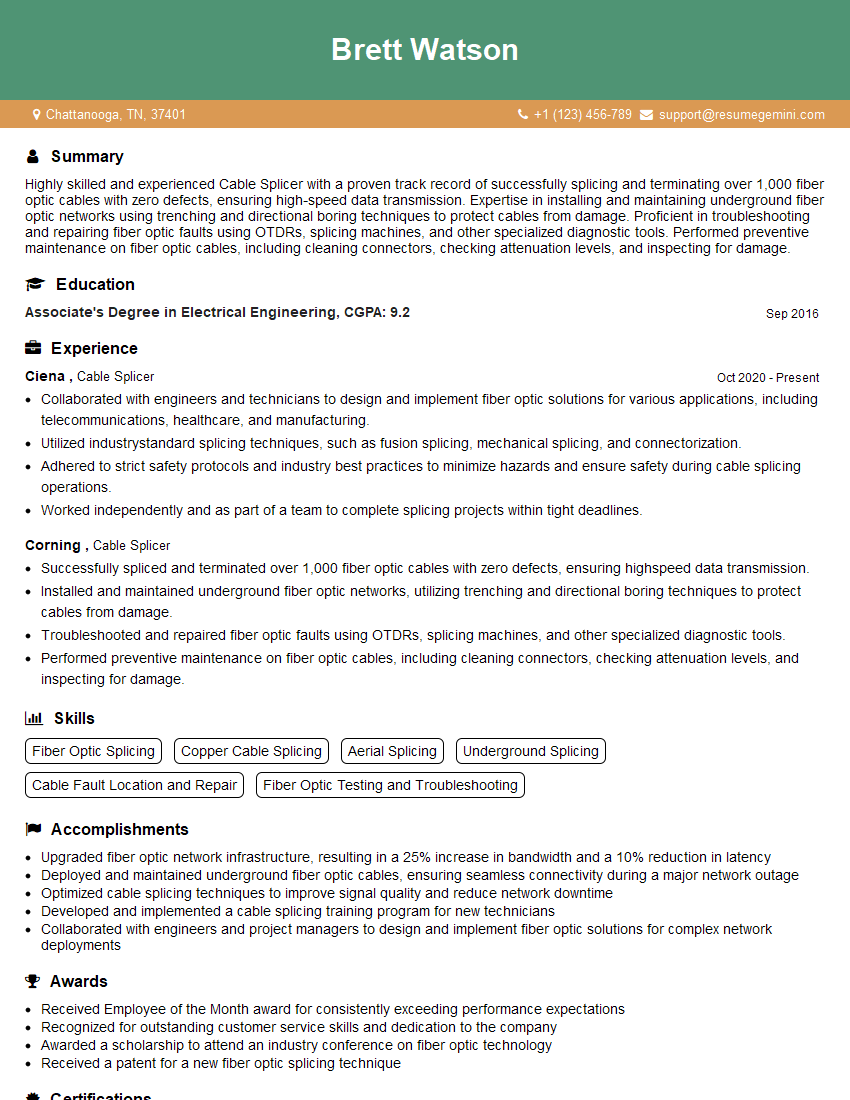
Mastering fusion and mechanical splicing techniques is crucial for a successful and rewarding career in telecommunications and related fields. These skills are highly sought after, opening doors to diverse opportunities and career advancement. To maximize your job prospects, it’s essential to present your skills effectively. Creating an ATS-friendly resume is key to getting your application noticed. ResumeGemini can help you build a professional and impactful resume that highlights your expertise in splicing techniques. Examples of resumes tailored to Splicing Techniques (Fusion & Mechanical) are available to guide you through the process. Invest in your future – craft a compelling resume that showcases your skills and experience.
Explore more articles
Users Rating of Our Blogs
Share Your Experience
We value your feedback! Please rate our content and share your thoughts (optional).
What Readers Say About Our Blog
Very informative content, great job.
good