The thought of an interview can be nerve-wracking, but the right preparation can make all the difference. Explore this comprehensive guide to Band Sawing interview questions and gain the confidence you need to showcase your abilities and secure the role.
Questions Asked in Band Sawing Interview
Q 1. Explain the different types of band saw blades and their applications.
Band saw blades are categorized primarily by their tooth configuration, material, and set. The choice of blade significantly impacts cutting performance and the type of material being cut. Let’s break down the common types:
- Skip-Tooth Blades: These blades have large gaps between teeth, ideal for rough cutting, removing large amounts of material quickly. Think of them as the ‘bulldozer’ of band saw blades, perfect for initial shaping of large pieces of wood.
- Standard Tooth Blades: Featuring evenly spaced teeth, these are versatile blades suitable for general-purpose cutting of various materials, offering a balance between speed and smoothness. They’re like the ‘all-rounder’ in your toolbox.
- Fine-Tooth Blades: With closely spaced teeth, these blades produce smoother, more precise cuts, ideal for intricate work and detailed cuts in softer materials. Think of them as the ‘precision instrument’ for detailed work.
- Hook Tooth Blades: These blades are designed for cutting curves and intricate shapes. The hook-shaped teeth help facilitate cleaner, smoother cuts in both wood and metal applications.
- Variable Tooth Blades: These blades combine different tooth configurations along their length, offering both roughing and finishing capabilities in a single blade. This is incredibly efficient for projects requiring both initial shaping and fine detailing.
- Material Considerations: Blades are also chosen based on material – high-speed steel (HSS) for general use, bi-metal (HSS teeth on a flexible steel backing) for longer life and harder materials, and carbide-tipped for extremely hard materials like hardened steel.
Choosing the right blade is crucial. For instance, using a fine-tooth blade on rough lumber would quickly dull the blade, while a skip-tooth blade on delicate work would produce a ragged cut. Always match the blade to the task and material for optimal results.
Q 2. Describe the proper procedure for changing a band saw blade.
Changing a band saw blade requires precision and care to avoid injury and damage to the saw. Always disconnect the power before starting! Here’s the step-by-step procedure:
- Disconnect Power: Ensure the band saw is completely unplugged from the power source.
- Loosen Blade Tension: Use the tension release mechanism on your saw to relieve the tension on the blade. This is crucial to prevent the blade from snapping during removal.
- Remove the Blade: Carefully guide the blade off the wheels, noting the direction of rotation. Most saws have guides and clamps to help remove the blade. Use gloves for protection.
- Inspect the Wheels: Check the wheels for any damage, debris, or wear. Clean the wheels thoroughly before installing the new blade.
- Install New Blade: Carefully thread the new blade around the wheels, ensuring it’s correctly oriented and tracks in the correct direction. Refer to the blade’s markings and the band saw’s instructions.
- Tensioning the Blade: Slowly apply tension to the new blade using the tensioning mechanism. Refer to your band saw’s manual for correct tension values, often specified in pounds or a range of values.
- Track Adjustment: Once tensioned, check the tracking of the blade and make adjustments as needed. Most saws have tracking adjustments that allow you to slightly shift the blade’s position.
- Test Run: After making adjustments, run the saw briefly at low speed to ensure the blade is tracking correctly and there is no vibration. Then proceed to work with the saw.
Always consult your band saw’s manual for specific instructions, as procedures may vary slightly between models.
Q 3. How do you ensure the correct blade tension for optimal cutting performance?
Correct blade tension is critical for optimal cutting performance and blade longevity. Too little tension results in blade wander and poor cuts, while too much tension can lead to blade breakage. Many band saws have tension gauges, but here’s how to ensure proper tension, often expressed as a range:
- Consult the Manual: The manufacturer’s instructions provide the ideal tension range for your specific band saw and blade type. This is the most reliable method.
- Visual Inspection: Observe the blade for any sagging or bowing. A properly tensioned blade should exhibit minimal deflection when gently pressed in the middle.
- Sound Test: Listen to the blade as it runs. Excessive vibration indicates either too much or too little tension. A properly tensioned blade should run smoothly and quietly.
- Tensioning Adjustment: Gradually adjust the tension using the saw’s mechanism, testing and re-adjusting until you find the optimal balance of a snug yet not overstretched blade. Small adjustments are key.
The ‘plunge test’ is often recommended. With the saw running, gently push the blade toward the table. If it bends too much, the blade’s too loose; if it bends barely, it is tight.
Remember that blade tension might need slight adjustments depending on the material being cut, the blade’s age, and the ambient temperature.
Q 4. What safety precautions must be followed when operating a band saw?
Safety should always be the top priority when operating a band saw. Here’s a summary of essential precautions:
- Eye Protection: Always wear safety glasses or a face shield to protect your eyes from flying debris.
- Hearing Protection: Band saws can be noisy; consider using earplugs or earmuffs, especially during extended use.
- Proper Clothing: Wear close-fitting clothing to prevent entanglement in the moving blade. Avoid loose sleeves, ties, or jewelry.
- Hand Position: Keep your hands clear of the blade and use push sticks to feed material, particularly when cutting smaller pieces.
- Blade Guards: Ensure all blade guards are in place and functioning correctly to protect your hands.
- Work Area: Maintain a clean and organized work area to reduce the risk of tripping or accidents.
- Emergency Stop: Familiarize yourself with the location and operation of the emergency stop switch.
- Material Support: Support long workpieces adequately to prevent them from binding or tipping during cutting.
- Regular Inspection: Before each use, inspect the saw for any damage, loose parts, or wear, and address these issues before operation.
Never operate a band saw if you are fatigued or under the influence of drugs or alcohol.
Q 5. How do you identify and address common band saw blade problems (e.g., breakage, tracking issues)?
Identifying and addressing band saw blade problems is crucial for safety and efficient operation. Let’s explore common issues:
- Blade Breakage: Often caused by excessive tension, dull blades, improper tracking, or hitting a hard object. Prevention involves proper tension, regular inspection, and sharp blades. Replace broken blades immediately.
- Tracking Issues: The blade deviates from the straight line, causing poor cuts or even accidents. Common causes are bent blades, uneven wheel wear, or incorrect guide post settings. Adjustment of tracking mechanisms and possibly replacement of the blade is needed.
- Dull Blades: Result in slower cutting speeds, rough cuts, and increased blade wear. Regular sharpening or replacement is necessary. The frequency depends on usage and material.
- Blade Chatter: Vibrations during cutting create rough cuts. This is often due to a dull blade, incorrect tension, or material issues like knots in wood. A sharp blade and correct tension are crucial fixes.
- Blade Binding: Happens when a blade jams. This can be due to incorrect blade selection for the material or poor material support. Always ensure the blade is appropriate for the task and support your work properly.
Regular inspection of the blade and the machine is paramount. A proactive approach can prevent many issues, leading to safer and more efficient work.
Q 6. Explain the process of setting up a band saw for a specific material and cut.
Setting up a band saw for a specific material and cut involves selecting the appropriate blade and adjusting the machine accordingly. Here’s a breakdown:
- Material Assessment: Identify the material (wood, metal, plastic, etc.) and its hardness. This dictates blade selection – harder materials need tougher blades.
- Blade Selection: Choose the right blade based on material and the desired cut finish (rough or fine). Consult the blade manufacturer’s recommendations and the band saw’s manual.
- Blade Installation: Install the blade correctly, ensuring it’s properly tensioned (refer to question 3).
- Guide Post Adjustment: Adjust the guide posts to be close to the blade but not touching it. The distance depends on material thickness, blade type, and band saw design. Too close, and it’ll bind; too far, and it’ll wander.
- Table Angle (if applicable): Some band saws allow adjusting the table angle for bevel cuts. Set the angle based on the desired cut.
- Fence Adjustment (if applicable): If using a fence for straight cuts, position it accurately to maintain consistent cutting width.
- Speed Adjustment: Adjust the cutting speed based on material. Harder materials usually require slower speeds.
A test cut on a scrap piece of the same material is highly recommended before cutting the final piece. This allows fine-tuning of the setup for optimal results.
Q 7. How do you measure and adjust the band saw’s guide post settings?
Guide posts are crucial for supporting the blade and preventing it from wandering. Their height and positioning must be correctly adjusted for optimal cutting:
- Measuring: Most band saws have markings or measurements to guide you, usually relating to the blade’s thickness and the material being cut. Refer to the manufacturer’s manual for detailed instructions and recommended settings.
- Adjustments: Start with the guide posts close to the blade but with a slight clearance. The clearance prevents binding and friction. A little space is best to start; you can adjust tighter only if the blade wanders.
- Material Thickness: For thicker materials, the guides might need to be positioned further apart from the blade to accommodate the wider cut.
- Blade Width: A wider blade may necessitate greater distances between the guides for proper support.
- Testing: After adjusting, always run a test cut on scrap material. Observe the blade’s tracking and make adjustments as needed. Listen for any signs of binding.
Incorrect guide post settings can cause blade breakage, poor cut quality, and unsafe operation. Always prioritize accurate settings, carefully monitoring the process.
Q 8. Describe different types of band saw guides and their functions.
Band saw guides are crucial for maintaining blade stability and preventing blade wander, which directly impacts cut accuracy and safety. Different types offer varying levels of support and are chosen based on the material being cut and the saw’s capacity.
- Roller Guides: These are the most common type, utilizing several rollers to support the blade. They’re relatively simple, offer good guidance, and are suitable for a wide range of materials. Think of them as a set of tiny wheels ensuring the blade stays on track.
- Ceramic Guides: These offer superior wear resistance compared to roller guides, especially when cutting abrasive materials like stainless steel. The ceramic surfaces minimize friction and extend blade life. Imagine them as high-performance bearings for your blade.
- Ball Bearing Guides: These guides use ball bearings for even smoother blade movement and minimal friction, resulting in improved accuracy and reduced blade wear. They are particularly useful for delicate cuts or when working with thin materials where precision is paramount.
- Solid State Guides: These are advanced guides employing a solid material like hardened steel to offer exceptional support and durability, especially for heavier-duty sawing applications and thicker materials. They are less common due to their higher price point.
The function of all guides is to consistently support the blade, preventing it from drifting, vibrating, or binding. Regular adjustment and maintenance are key to ensuring their effectiveness.
Q 9. How do you maintain the cleanliness and lubrication of a band saw?
Maintaining a clean and well-lubricated band saw is essential for both its longevity and the quality of the cuts produced. Neglecting this aspect can lead to premature wear, inaccurate cuts, and even safety hazards.
- Cleanliness: Regularly remove sawdust and debris from around the blade, guides, and wheels using a brush or compressed air. Pay particular attention to the areas near the blade where chips can accumulate. A build-up of debris can cause the blade to bind and eventually break.
- Lubrication: Use a high-quality band saw lubricant, specifically designed for the machine and the materials you’re cutting. Apply lubricant to the blade guide surfaces, as well as the upper and lower wheels, according to the manufacturer’s recommendations. Insufficient lubrication can increase friction, leading to blade wear and overheating.
Think of it like regularly servicing your car – neglecting routine maintenance will eventually lead to more significant and costly problems.
Q 10. What are the signs of a worn or damaged band saw blade?
A worn or damaged band saw blade significantly impacts cut quality and safety. Recognizing the signs early allows for timely replacement, preventing accidents and wasted material.
- Set Loss: The teeth will appear less aggressive and may even lie flat, resulting in poor cutting performance and potentially a broken blade. The blade might appear duller and less aggressive than before.
- Cracks or Breaks: Obvious cracks or breaks in the blade are serious and require immediate replacement. Operating a blade with cracks is extremely hazardous and can lead to blade failure and injury.
- Teeth Damage: Chipped, broken, or bent teeth will produce rough cuts and reduce the efficiency of the blade. You may hear a grating or uneven sound during cutting.
- Rust or Corrosion: Rust and corrosion weaken the blade, reducing its overall strength and durability. This is often evident through discoloration of the blade.
- Excessive Vibration: This often indicates a problem with the blade’s tension, or a blade that is worn and no longer running true.
Regular inspection of the blade before each use is crucial to identify such issues proactively. Remember, a sharp blade is a safe blade.
Q 11. Explain the importance of proper blade tracking and how to adjust it.
Proper blade tracking is paramount for straight, accurate cuts. A blade that’s not tracking correctly will wander, leading to inaccurate cuts, potentially damaging the workpiece and the saw itself. It’s like steering a car – if the steering is off, you’ll end up going where you don’t intend to go!
Adjusting Blade Tracking: Most band saws have adjustment mechanisms, usually screws or knobs near the upper wheel. These allow you to subtly shift the blade’s position. The specific process varies slightly depending on the saw’s model, but the general principle remains consistent.
- Check the Blade: Ensure the blade is properly tensioned and seated correctly.
- Identify the Tracking Adjustment: Locate the adjustment screws or knobs. Usually, turning one screw will move the blade left or right.
- Make Small Adjustments: Turn the adjustment screw a small amount, only a fraction of a turn at a time. Run the saw for a few seconds to see the effect.
- Repeat Until Straight: Repeat steps 2 and 3 until the blade runs perfectly straight. Over-adjustment can lead to more problems.
If you’re struggling, consult your saw’s manual for specific instructions.
Q 12. How do you handle different types of materials on a band saw (e.g., wood, metal, plastics)?
Handling different materials on a band saw requires adjusting blade type, speed, and feed rate for optimal results and safety. Different materials have different properties, demanding specific approaches.
- Wood: Use a blade with a high tooth count (more teeth) for smoother cuts and a lower tooth set for cleaner, less tear-out. Moderate feed rate is key.
- Metal: Employ a blade with fewer teeth, a higher tooth set, and use a cutting fluid (coolant) to prevent overheating and extend blade life. Slower feed rates are crucial for precision and to avoid damage to the blade.
- Plastics: Use a blade with a high tooth count and minimal set, avoiding excessive pressure to prevent melting or chipping. The cutting speed needs to be adjusted depending on the type of plastic.
Always choose the correct blade for the material, and adjust the speed and feed rate accordingly. Remember, safety precautions like using appropriate personal protective equipment (PPE) are always vital.
Q 13. What are the different types of band saw machines?
Band saw machines come in a variety of types, categorized primarily by their size, design, and intended use.
- Horizontal Band Saws: These are the most common type, featuring a horizontal blade and are versatile for various cutting tasks. They range from small benchtop models ideal for hobbyists to large industrial saws capable of cutting huge timbers.
- Vertical Band Saws: These saws have a vertical blade, best suited for cutting intricate shapes and smaller parts. They are often preferred for precision work in metalworking and woodworking.
- Contour Band Saws: These allow for cutting complex curves and irregular shapes in materials. They use a blade guided to follow a template or pattern, commonly found in specialized workshops.
- Portable Band Saws: Smaller and more portable versions designed for on-site cutting or tasks where mobility is important.
The choice of band saw depends heavily on the type of work to be done, the material being cut, and the budget.
Q 14. Describe the process of troubleshooting a band saw that is not cutting straight.
Troubleshooting a band saw that’s not cutting straight involves a systematic approach, eliminating potential causes one by one.
- Blade Tension: Incorrect blade tension is a frequent culprit. Ensure the blade is tensioned correctly according to the manufacturer’s specifications.
- Blade Tracking: Adjust the blade tracking mechanism, as described earlier, to ensure the blade runs straight and true through the guides.
- Guide Alignment: Check that the guides are properly aligned and adjusted. Misaligned guides are a common reason for crooked cuts.
- Wheel Alignment: Ensure both wheels are correctly aligned, both vertically and horizontally. Misaligned wheels will cause the blade to wander.
- Blade Condition: Inspect the blade for damage, wear, or defects, replacing it if necessary. A damaged blade won’t cut straight.
- Material Defects: Sometimes the problem lies in the material itself. Uneven wood grain or internal stresses in metal can lead to crooked cuts.
By systematically checking these aspects, you’ll effectively pinpoint the cause and restore straight cutting performance.
Q 15. How do you calculate the feed rate for various materials and cutting conditions?
Calculating the optimal feed rate for band sawing is crucial for efficient cutting and preventing blade breakage. It’s not a single formula, but rather a careful consideration of several factors. Think of it like baking a cake – you need the right balance of ingredients (parameters) for the best result.
- Material Hardness: Harder materials like hardened steel require significantly slower feed rates than softer materials like aluminum. Imagine trying to cut through a tough steak versus a soft tomato – you’d adjust your knife speed accordingly.
- Blade Type and Teeth: A blade with more teeth per inch (TPI) allows for a faster feed rate, especially on thinner materials, as more teeth engage with the workpiece simultaneously. A coarse-toothed blade is better suited for rough cuts and faster feed rates on thicker materials.
- Blade Speed: The correct blade speed is determined by the material and blade type; it’s usually specified by the blade manufacturer. Too fast, and the blade will overheat and break; too slow, and the cut will be rough.
- Thickness of Material: Thicker materials necessitate slower feed rates to prevent overloading the blade. Think of it as trying to saw through a large log versus a small branch – the larger requires more controlled, slower movements.
While there isn’t one universal formula, most band saw machines have a feed rate dial or setting. It’s best to start with a conservative feed rate for a given material and gradually increase it while monitoring the blade for signs of strain or overheating. Manufacturers often provide charts or guidelines for recommended feed rates.
Career Expert Tips:
- Ace those interviews! Prepare effectively by reviewing the Top 50 Most Common Interview Questions on ResumeGemini.
- Navigate your job search with confidence! Explore a wide range of Career Tips on ResumeGemini. Learn about common challenges and recommendations to overcome them.
- Craft the perfect resume! Master the Art of Resume Writing with ResumeGemini’s guide. Showcase your unique qualifications and achievements effectively.
- Don’t miss out on holiday savings! Build your dream resume with ResumeGemini’s ATS optimized templates.
Q 16. What are the common causes of blade breakage and how to prevent them?
Blade breakage is a common problem in band sawing, often caused by a combination of factors. Preventing it is paramount for safety and efficiency.
- Improper Blade Tension: Insufficient tension leads to blade wander and increased risk of breakage. Too much tension can lead to premature wear and snapping. Imagine a guitar string – it needs to be tuned just right.
- Incorrect Blade Speed: Running the blade too fast (especially for hard materials) generates excessive heat, leading to weakening and fracture. Running it too slowly can lead to dulling and binding.
- Dull Blades: Dull blades are much more prone to breakage due to increased friction and vibration. Think of trying to cut wood with a blunt knife – it requires more force and is more likely to snap.
- Overfeeding: Forcing the blade through too much material at once puts excessive stress on it. Similar to trying to cut through too much with a single stroke.
- Poor Blade Tracking: If the blade is misaligned or wanders, it increases friction and wear, increasing the risk of breakage. Think of a car tire – if it’s not aligned, it will wear down unevenly.
- Material Defects: Internal cracks or hard spots in the workpiece can easily snap a blade. Think of trying to saw a log with hidden knots.
Preventing blade breakage requires regular inspection, proper machine setup, and adherence to recommended feed rates and blade speeds.
Q 17. Explain the importance of regular band saw maintenance.
Regular band saw maintenance is essential for ensuring safe and efficient operation, extending blade life, and maintaining accuracy. Neglecting it is akin to ignoring a car’s routine maintenance – eventually, significant problems will arise.
- Blade Cleaning and Inspection: Regularly inspect for damage, such as cracks, chips, or excessive wear. Remove any debris from the blade to prevent damage.
- Upper and Lower Wheel Alignment: Misalignment can cause blade deflection, vibration, and premature wear. Regular alignment checks are crucial.
- Tension Adjustment: The correct blade tension is vital for accurate cutting and preventing breakage. Check and adjust regularly.
- Guide Adjustment: Properly aligned guides ensure smooth blade tracking and prevent excessive wear. Incorrect adjustment leads to blade wander and breakage.
- Lubrication: Keeping moving parts lubricated prevents premature wear and tear on the machine itself, particularly the bearings and gears.
- Cleaning: Regular removal of metal chips, sawdust and other debris minimizes the risk of fire, damage, and premature wear.
A well-maintained band saw operates smoothly, cuts accurately, and minimizes downtime. A preventative maintenance schedule is highly recommended.
Q 18. Describe your experience with different types of band saw cutting fluids.
Cutting fluids are crucial in band sawing, especially when working with metal, to reduce friction, heat, and wear on the blade and improve cutting performance. The choice of fluid depends on the material being cut and the desired outcome.
- Water-Based Fluids (Soluble Oils): These are commonly used and relatively inexpensive. They offer good cooling and lubrication properties, but may require more frequent changes.
- Synthetic Fluids: These offer excellent cooling and lubrication, often better than water-based fluids, and often have longer life spans.
- Oil-Based Fluids: These are generally used for heavier-duty applications and provide excellent lubrication but may require more careful disposal due to environmental concerns.
My experience spans using all three types. Water-based fluids are suitable for many applications, offering a good balance of cost and performance. However, for particularly tough materials or high-precision work, synthetic fluids provide superior results. In my experience, selecting the right fluid is critical for minimizing blade wear and maintaining surface finish. Improper selection can lead to poor cuts and premature blade failure.
Q 19. How do you ensure the accuracy of cuts using a band saw?
Ensuring accurate cuts on a band saw involves a multi-faceted approach, much like a skilled craftsman using precision instruments.
- Accurate Material Clamping: Secure and stable clamping prevents movement during cutting, ensuring straight, precise cuts.
- Blade Alignment and Tension: A properly aligned blade under the correct tension is fundamental to straight, accurate cuts. Improper alignment leads to wandering and inaccurate cuts.
- Guide Adjustment: Correctly adjusted guides keep the blade tracking straight, crucial for precise cuts.
- Blade Selection: Using a blade with the appropriate TPI (Teeth Per Inch) for the material and cut type is critical for accuracy.
- Feed Rate Control: Maintaining a consistent feed rate prevents uneven cuts and blade damage.
- Use of Jigs and Fixtures: For complex or repetitive cuts, jigs and fixtures provide precision guidance.
In my experience, combining these techniques leads to consistent, accurate cuts. For example, working with intricate metal parts requires precise jigs and careful attention to blade alignment to maintain tolerances.
Q 20. Explain the concept of kerf and its implications on cutting.
The kerf refers to the width of the cut made by the band saw blade. Think of it as the ‘path’ the blade makes through the material. It’s crucial because it directly impacts the dimensional accuracy of the final product and material waste.
A wider kerf (a wider cut) means more material is removed. This is significant in situations where material cost is high or where precise dimensions are critical. Thinner blades generally result in narrower kerfs, minimizing waste. However, too thin a blade can be prone to breakage. The selection of blade width is a balancing act between material removal, the desired finish, and blade durability.
Q 21. How do you address issues related to blade deflection?
Blade deflection refers to the bending of the blade during the cutting process. This can lead to inaccurate cuts, poor surface finish, and even blade breakage.
- Blade Tension: Insufficient tension is a primary cause. Increase blade tension, but avoid over-tensioning, which can cause breakage.
- Guide Alignment: Misaligned guides are a common culprit. Adjust the guides to ensure proper blade tracking.
- Blade Type and Condition: A dull or damaged blade is more prone to deflection. Replace dull or damaged blades.
- Material Hardness: Cutting extremely hard materials can lead to deflection. Use a slower feed rate and consider using a more aggressive blade.
- Workpiece Support: Inadequate support for the workpiece can contribute to deflection. Ensure the workpiece is firmly supported.
Addressing deflection involves a systematic approach, starting with the most likely causes – tension, alignment, and blade condition – then working towards the less common factors, ensuring a proper diagnostic process is followed.
Q 22. Describe your experience with different types of band saw fences.
Band saw fences are crucial for accurate cuts, and my experience encompasses various types. The most common is the standard rip fence, adjustable for parallel cuts. I’ve also extensively used miter gauges, which allow angled cuts. More advanced systems include adjustable fences with micro-adjustments for incredibly precise work, often found on larger industrial saws. Finally, I’m familiar with specialty fences designed for specific tasks like cutting curves or complex shapes using specialized jigs. For example, on a recent project involving intricate inlay work, a highly adjustable fence with a fine-tuning mechanism was vital for maintaining consistent tolerances. The choice of fence depends heavily on the job’s complexity and required accuracy.
Q 23. What are your troubleshooting methods for a band saw that is vibrating excessively?
Excessive vibration in a band saw is a serious issue that can lead to inaccurate cuts and even blade breakage. My troubleshooting approach is systematic. First, I check the blade tension. A loose blade is a major culprit, causing significant vibration. Second, I inspect the blade itself for damage – bent teeth, cracks, or even dullness can all lead to increased vibration. Third, I examine the alignment of the wheels; even slight misalignment will trigger vibration. Fourth, I check the table for stability; any wobble or looseness can transfer to the blade. Finally, I check the motor mount for any issues that might cause uneven rotation. Often, a simple adjustment, like tightening a loose bolt or replacing a damaged blade, resolves the problem. For instance, I once diagnosed a persistent vibration to a slightly bent upper wheel, easily corrected with a wheel alignment adjustment. Addressing these potential problems in a sequential manner usually isolates the source quickly.
Q 24. How do you determine the appropriate cutting speed for different materials?
Selecting the right cutting speed is critical for efficient and safe band sawing. It’s material-specific; each material has an optimal speed range. Too fast, and the blade may overheat, leading to blunting and potentially breaking. Too slow, and the cut will be rough and inefficient. I typically consult a chart or the manufacturer’s recommendations for the blade type and material. For instance, hardwoods generally require slower speeds than softwoods. Metals require even more careful consideration, adjusting speed based on the alloy and hardness. I also consider the thickness of the material; thicker materials often need a slightly lower speed. Experienced judgement also plays a role, making fine adjustments based on observation. For example, when cutting a particularly dense hardwood, I start slower and gradually increase speed until I achieve a clean, smooth cut without excessive heat.
Q 25. How do you address issues related to workpiece clamping and stability?
Workpiece clamping and stability are essential for accurate and safe cutting. I use a variety of techniques depending on the workpiece size, shape, and material. For smaller pieces, I use vise clamps or hold-downs directly to the band saw table. For larger, more complex pieces, I might use additional support structures or utilize outfeed and infeed supports to prevent warping or shifting during the cut. It’s crucial to consider the material; some materials are more prone to movement than others. For example, thin sheet metal requires careful clamping to prevent buckling. Always ensure the workpiece is firmly secured to avoid kickback or movement that could lead to injury. I’ve had instances where poorly secured workpieces resulted in slight miscuts, demonstrating the importance of proper clamping technique. Always prioritize safety – a well-secured workpiece is a safer workpiece.
Q 26. Describe your experience working with different types of band saw controls (manual, automated).
My experience ranges from manual band saws with simple on/off switches to highly automated CNC band saws. Manual saws are straightforward, requiring manual control of the blade speed and feed rate. This approach demands skill and precision, making it ideal for smaller shops or one-off projects. Automated systems, however, offer programmed control over speed, feed rate, and cutting path. These CNC machines are particularly useful for high-volume, repetitive cutting operations, greatly increasing efficiency and accuracy. For instance, I once worked on a project utilizing a CNC band saw that needed thousands of precisely cut pieces; the automated system delivered both speed and consistency that was unattainable manually. The choice between manual and automated control depends primarily on the scale and complexity of the job.
Q 27. What are the differences between horizontal and vertical band saws?
Horizontal and vertical band saws are designed for different types of cutting tasks. Horizontal band saws typically have a larger cutting capacity, making them suitable for larger and heavier workpieces. They are often used in industrial settings for cutting large beams, pipes, or other heavy materials. Vertical band saws, conversely, are better suited for smaller, more intricate work. They are often found in smaller shops or used for detailed cutting of thinner materials. The choice depends on the type of material being cut, its size, and the required precision. For example, a metal fabricator might prefer a horizontal band saw for cutting steel beams, whereas a woodworker might utilize a vertical band saw for detailed cuts in a wooden chair leg.
Q 28. Explain your approach to ensuring a safe and efficient band saw operation.
Safety and efficiency are paramount in band saw operation. My approach focuses on a few key areas. First, always use appropriate personal protective equipment (PPE), including safety glasses, hearing protection, and dust masks as needed. Second, ensure the machine is properly maintained, with regular checks on the blade tension, wheel alignment, and overall condition. Third, follow safe operating procedures; always ensure the workpiece is securely clamped and that your body is positioned safely away from the blade’s path. Fourth, never reach across the blade while it is running. Lastly, regular training and refresher courses are critical to reinforce safe practices. I’ve seen firsthand how neglecting even a small safety measure can result in injury or damage. By focusing on these points, I can ensure safe and efficient band saw operation while optimizing output.
Key Topics to Learn for Band Sawing Interview
- Band Saw Anatomy and Operation: Understanding the different components of a band saw (blades, wheels, guides, tensioning system) and their functions. This includes safe operating procedures and preventative maintenance.
- Blade Selection and Maintenance: Knowing how to select the appropriate blade type (material, tooth configuration, width) for different materials and cuts. Mastering blade sharpening, tensioning, and troubleshooting common blade issues.
- Cutting Techniques and Strategies: Developing proficiency in various cutting techniques, including straight cuts, curves, bevels, and resawing. Understanding the impact of feed rate, blade speed, and workpiece clamping on cut quality and safety.
- Material Selection and Properties: Familiarizing yourself with the properties of various materials commonly processed with band saws (wood, metal, plastics) and how these properties influence cutting parameters.
- Safety Procedures and Regulations: Demonstrating a thorough understanding of safety protocols, including personal protective equipment (PPE) usage, machine guarding, and emergency procedures. Knowledge of relevant safety regulations is crucial.
- Troubleshooting and Problem Solving: Developing the ability to diagnose and solve common problems encountered during band sawing operations, such as blade breakage, inaccurate cuts, and machine malfunctions.
- Advanced Techniques (Optional): Explore topics like precision cutting, complex curves, and specialized band saw applications (e.g., contour cutting, coping).
Next Steps
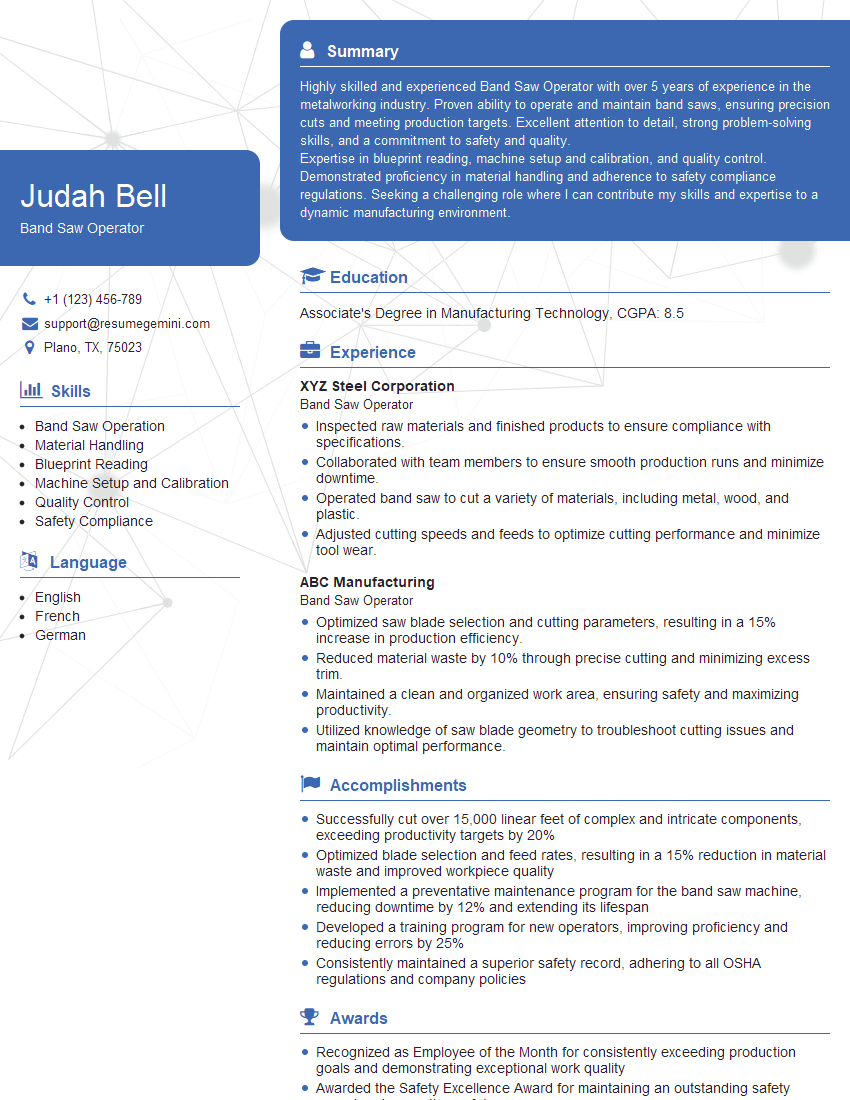
Mastering band sawing opens doors to numerous skilled trades and manufacturing roles, offering excellent career growth potential. A strong resume is your key to unlocking these opportunities. To ensure your application stands out, create an ATS-friendly resume that effectively highlights your skills and experience. ResumeGemini is a trusted resource to help you build a professional and impactful resume. We provide examples of resumes tailored to the band sawing industry to guide you through the process. Take the next step towards your dream job – craft a winning resume today!
Explore more articles
Users Rating of Our Blogs
Share Your Experience
We value your feedback! Please rate our content and share your thoughts (optional).
What Readers Say About Our Blog
Very informative content, great job.
good