The thought of an interview can be nerve-wracking, but the right preparation can make all the difference. Explore this comprehensive guide to Environmental Management Systems (EMS) Auditing interview questions and gain the confidence you need to showcase your abilities and secure the role.
Questions Asked in Environmental Management Systems (EMS) Auditing Interview
Q 1. Describe the key elements of an effective Environmental Management System (EMS).
An effective Environmental Management System (EMS) is a set of processes and practices that an organization implements to minimize its environmental impact. It’s like a well-oiled machine, designed to ensure environmental responsibility is integrated into every aspect of the business. Key elements include:
- Environmental Policy: A formal statement of the organization’s commitment to environmental protection, defining its goals and objectives. Think of it as the company’s environmental mission statement.
- Planning: Identifying environmental aspects (activities that can impact the environment) and impacts (actual or potential consequences of those aspects). This involves setting targets and objectives to improve environmental performance, much like setting sales targets for improved business performance.
- Implementation and Operation: Putting the plan into action. This involves resource allocation, training, communication, and operational control. Think of this as the ‘doing’ phase – actually putting the environmental plan into practice.
- Monitoring and Measurement: Tracking environmental performance against set targets and objectives. This involves data collection, analysis, and reporting. It’s like regularly checking the dashboard of your car to ensure everything is running smoothly.
- Review: Regularly assessing the effectiveness of the EMS. This includes management reviews, internal audits, and corrective actions. This phase is similar to yearly performance appraisals, enabling course correction where needed.
- Continual Improvement: Constantly striving to improve environmental performance. This is an ongoing process of refinement and enhancement, reflecting the dynamic nature of environmental challenges.
Q 2. Explain the PDCA cycle in the context of EMS.
The PDCA cycle (Plan-Do-Check-Act) is a continuous improvement methodology integral to EMS. It’s a cyclical process that helps organizations systematically manage and improve environmental performance. Imagine it as a never-ending circle of refinement.
- Plan: Establish environmental objectives and processes necessary to deliver results in accordance with the environmental policy. This includes identifying environmental aspects, impacts, and setting targets.
- Do: Implement the planned actions and processes.
- Check: Monitor and measure the results of the implemented processes, and compare these to the set objectives. This often involves internal audits and performance reviews.
- Act: Take actions to address any discrepancies between actual and planned results. This could involve corrective actions, preventive actions, or even updating the plan altogether.
The cycle repeats continuously, leading to ongoing improvement and refinement of the EMS.
Q 3. What are the main differences between ISO 14001:2015 and previous versions?
ISO 14001:2015 introduced significant changes compared to previous versions, shifting the focus towards a more risk-based approach and increased integration with other management systems. Key differences include:
- Risk-Based Thinking: 2015 emphasizes proactive identification and mitigation of environmental risks and opportunities, whereas previous versions focused primarily on reactive compliance.
- Leadership Engagement: The 2015 version requires more demonstrable commitment and involvement from top management. It’s no longer enough for environmental responsibility to reside in a single department; it requires leadership buy-in.
- Context of the Organization: Organizations must consider their external and internal context – their surroundings and internal operations – to establish the scope of their EMS.
- Life Cycle Thinking: While not explicitly mandated, the standard encourages considering the environmental impact of a product or service throughout its entire life cycle, from cradle to grave.
- Integrated Management Systems: The 2015 standard facilitates easier integration with other management systems, like quality management (ISO 9001) or occupational health and safety management (ISO 45001).
Q 4. How do you conduct a gap analysis for an EMS?
A gap analysis compares the current state of an organization’s EMS against the requirements of a standard, typically ISO 14001. It helps identify areas needing improvement or where the organization falls short. Think of it as a diagnostic tool that highlights areas for development.
Steps involved:
- Define the Standard: Determine the specific EMS standard to use as a benchmark (e.g., ISO 14001:2015).
- Document Current EMS: Analyze existing policies, procedures, records, and practices. This could involve reviewing documentation, interviewing personnel, and conducting site visits.
- Compare Current to Standard: Systematically compare the current state against the requirements of the chosen standard. This may involve using checklists, matrices, or software to facilitate comparison.
- Identify Gaps: Document any discrepancies between the current EMS and the standard’s requirements. These are your areas for improvement.
- Prioritize Gaps: Prioritize gaps based on factors such as environmental impact, regulatory requirements, and feasibility of implementation.
- Develop an Improvement Plan: Develop a plan outlining actions to close identified gaps and achieve compliance with the standard.
Q 5. Explain the process of conducting an internal EMS audit.
Conducting an internal EMS audit involves a systematic and independent examination of the organization’s EMS to determine its effectiveness and compliance with established requirements. It’s like giving the EMS a thorough health check.
Process steps:
- Planning: Define the audit scope, objectives, criteria, and schedule. Identify the audit team and resources needed.
- Documentation Review: Review relevant documents such as the environmental policy, procedures, records, and other supporting documentation.
- On-Site Assessment: Conduct on-site observations, interviews, and inspections to verify the implementation of the EMS.
- Evidence Gathering: Gather evidence through observation, interviews, record review, and data analysis.
- Finding Reporting: Document the findings of the audit, including both conformances (areas meeting requirements) and non-conformances (areas not meeting requirements).
- Reporting and Follow-up: Prepare an audit report summarizing findings and recommendations for corrective actions. Ensure follow-up on corrective actions to verify their effectiveness.
Q 6. What are the common non-conformances found during EMS audits?
Common non-conformances found during EMS audits often stem from a lack of implementation or documentation. Some examples include:
- Inadequate Environmental Policy: The policy may lack specificity, commitment, or be outdated.
- Lack of Procedures: Missing or inadequate procedures for managing environmental aspects.
- Incomplete Records: Missing or incomplete environmental records, making it difficult to track performance.
- Ineffective Training: Employees lack sufficient training on environmental procedures and responsibilities.
- Poor Waste Management: Inefficient waste segregation, handling, and disposal practices.
- Lack of Emergency Preparedness: Insufficient plans or procedures to handle environmental emergencies.
- Non-Compliance with Regulations: Failure to meet specific environmental regulations or permits.
The specific non-conformances encountered will vary greatly depending on the industry and the organization’s specific context.
Q 7. How do you handle disagreements with auditees during an audit?
Disagreements with auditees during an audit are not uncommon and should be handled professionally and objectively. The goal is to resolve differences and reach a mutual understanding.
Strategies for handling disagreements:
- Maintain Professionalism: Remain calm, respectful, and objective throughout the discussion.
- Clarify Understanding: Ensure both parties understand the issue clearly. Rephrase statements and ask clarifying questions.
- Present Evidence: Support assertions with clear and verifiable evidence. This might include documented procedures, data, or records.
- Document the Disagreement: Record the disagreement and the steps taken to resolve it in the audit report.
- Escalate if Necessary: If the disagreement cannot be resolved, escalate it to higher management for resolution.
- Focus on Improvement: Frame the discussion around improvement rather than blame. The goal is to identify solutions and prevent future issues.
Open communication and a collaborative approach are crucial to resolving disagreements constructively.
Q 8. Describe your experience with different auditing methodologies.
My experience encompasses a range of auditing methodologies, from the widely used ISO 14001 standard to more specialized approaches tailored to specific industry sectors or environmental concerns. I’m proficient in both compliance audits, which focus on verifying adherence to regulations and standards, and performance audits, which delve deeper into the effectiveness of the EMS in achieving environmental objectives.
For example, I’ve conducted numerous ISO 14001 audits, employing a systematic approach involving document review, site visits, interviews with staff at various levels, and observation of operational processes. I also have experience with integrated management system audits, combining environmental aspects with other management systems like quality or occupational health and safety. In one project, we integrated the environmental, quality and safety management systems for a manufacturing plant, identifying synergistic improvements and reducing overall audit workload.
In addition, I am adept at utilizing risk-based auditing techniques, focusing resources on areas with the highest environmental impact or greatest potential for non-compliance. This prioritization ensures efficient use of time and resources while maximizing impact. For instance, I helped a client prioritize their audit by first identifying high-risk areas based on the quantity of hazardous waste they generated and the potential for environmental incidents.
Q 9. How do you ensure the objectivity and impartiality of your audits?
Objectivity and impartiality are paramount in EMS auditing. To ensure this, I maintain a strict code of ethics, avoiding any conflicts of interest. Before commencing an audit, I declare any potential conflicts of interest, such as prior relationships with the auditee. This transparency fosters trust and ensures the credibility of the audit findings.
Furthermore, I rigorously follow established audit procedures and methodologies, applying consistent criteria across all audits. This minimizes bias and promotes fairness. I use pre-defined checklists and sampling techniques to ensure a representative assessment of the auditee’s EMS.
I also regularly seek peer review of my audit reports to ensure objectivity and quality. This collaborative approach helps identify potential biases and strengthens the overall rigor of my work. Finally, I maintain continuous professional development to stay current with best practices in auditing and environmental management, enhancing my objectivity and analytical skills.
Q 10. How do you document audit findings and prepare a report?
Documentation of audit findings is crucial for clarity and traceability. I meticulously document all aspects of the audit process, including the audit plan, evidence gathered (e.g., photographs, interview notes, test results), and observations made.
This documentation is organized systematically using a standardized format, often within a dedicated audit management software. This digital approach enables easy access to all relevant information and ensures efficient report generation. I use a clear and concise language in my reports, avoiding technical jargon where possible and ensuring the findings are easily understood by the intended audience.
The audit report typically includes an executive summary outlining key findings, a detailed description of the audit process, a list of non-conformances (if any) with supporting evidence, and recommendations for corrective actions. I utilize clear, descriptive language and photographs in order to make the report easy to follow and more impactful. For example, instead of simply stating ‘insufficient training,’ I’d state ‘Insufficient training evident based on observation of employee X incorrectly handling hazardous waste (see photo 3).’
Q 11. What is your experience with corrective and preventative actions (CAPAs)?
My experience with Corrective and Preventative Actions (CAPAs) is extensive, extending from guiding auditees in developing effective CAPA plans to verifying the effectiveness of implemented actions. I assist organizations in identifying root causes of non-conformances and developing targeted corrective actions.
I help them create a documented system for tracking and verifying the effectiveness of these actions. I’ve used various techniques such as 5 Whys, Fishbone diagrams, and Fault Tree Analysis to help pinpoint the root cause of a problem. For example, for a recurring spillage of chemicals, we identified the root cause to be inadequate training in handling procedures, leading to changes in training, improved signage and a review of the operational procedures.
Beyond corrective actions, I also stress the importance of preventative actions, which aim to prevent similar issues from occurring in the future. A well-structured CAPA system is essential for continuous improvement within the EMS and demonstrably reduces environmental risks.
Q 12. Explain the importance of environmental performance indicators (KPIs).
Environmental Performance Indicators (KPIs) are vital for monitoring and improving environmental performance. KPIs provide quantifiable measures of an organization’s environmental impact, allowing for tracking progress towards environmental objectives and identifying areas for improvement. They provide a clear picture of the effectiveness of the EMS.
Examples of KPIs include energy consumption, waste generation, greenhouse gas emissions, water usage, and compliance rates. The selection of appropriate KPIs depends on the organization’s context and its environmental objectives.
Choosing the right KPIs is crucial. They must be relevant, measurable, achievable, relevant, and time-bound (SMART). For example, instead of setting a KPI to ‘reduce waste,’ a more effective KPI would be ‘reduce waste generation by 15% within the next year.’ Regular monitoring and reporting on KPIs are crucial for effective environmental management.
Q 13. How do you verify the effectiveness of implemented CAPAs?
Verifying the effectiveness of implemented CAPAs is crucial to ensuring continuous improvement. This involves a follow-up audit or review to assess whether the corrective and preventative actions have been implemented effectively and have resolved the underlying issues.
This follow-up might involve reviewing documentation, observing processes, and interviewing staff. I typically use a structured approach, revisiting the original non-conformances and assessing whether the implemented CAPAs have successfully addressed them.
For example, if a CAPA involved improved employee training, the follow-up would involve observing employees performing the task and confirming they are using the new procedures correctly. Evidence demonstrating successful implementation of the CAPA and its lasting impact is key to demonstrating effective environmental management.
Q 14. How do you manage audit scope and schedule effectively?
Effective management of audit scope and schedule is vital for efficient and impactful audits. The audit scope is defined upfront, based on the auditee’s EMS, its environmental impacts, and relevant legislation. A clear scope statement prevents scope creep and ensures focus on the most critical aspects.
The schedule is developed collaboratively with the auditee to ensure it aligns with their operational realities and resource availability. Realistic timelines are set, considering the complexity of the EMS and the resources required for the audit.
For example, a large manufacturing plant with numerous facilities would require a phased audit approach, addressing different parts of the organization over a longer period, with clear milestones. Project management techniques and tools such as Gantt charts are utilized for effective scheduling and tracking of progress. Effective communication is paramount throughout the entire process to ensure all stakeholders are informed and aligned.
Q 15. What is your experience with environmental legislation and regulations?
My experience with environmental legislation and regulations is extensive. I’ve worked directly with regulations like the Clean Air Act, Clean Water Act, and Resource Conservation and Recovery Act (RCRA) in the United States, as well as equivalent legislation in other countries. This includes understanding permit requirements, effluent limitations, hazardous waste management protocols, and reporting obligations. I understand the nuances of these regulations, which often differ depending on the industry, location, and specific activity. For instance, a manufacturing facility handling hazardous waste will face significantly different regulatory requirements than a small office building. My work has involved interpreting complex legal language, ensuring compliance, and identifying potential non-compliance issues during audits.
I have a keen understanding of how these regulations impact Environmental Management Systems (EMS), and I am adept at integrating legislative requirements into an organization’s EMS framework. This is crucial for achieving and maintaining regulatory compliance.
Career Expert Tips:
- Ace those interviews! Prepare effectively by reviewing the Top 50 Most Common Interview Questions on ResumeGemini.
- Navigate your job search with confidence! Explore a wide range of Career Tips on ResumeGemini. Learn about common challenges and recommendations to overcome them.
- Craft the perfect resume! Master the Art of Resume Writing with ResumeGemini’s guide. Showcase your unique qualifications and achievements effectively.
- Don’t miss out on holiday savings! Build your dream resume with ResumeGemini’s ATS optimized templates.
Q 16. Describe your experience with different types of environmental audits (e.g., first-party, second-party, third-party).
I have extensive experience conducting all three types of environmental audits – first-party, second-party, and third-party. First-party audits, or internal audits, are conducted by the organization itself to assess its EMS against its own standards and objectives. I’ve led numerous internal audits, helping organizations identify areas for improvement and strengthen their EMS. Second-party audits are conducted by one organization on another, often within a supply chain. For example, a large retailer might audit its suppliers to ensure environmental compliance. I’ve participated in several second-party audits, both as the auditor and the auditee, offering valuable insights into both perspectives.
Third-party audits, conducted by independent certification bodies, verify compliance with standards like ISO 14001. I have been a lead auditor for numerous third-party certification audits, meticulously assessing organizations’ EMS against the requirements of the standard. I’m proficient in documenting findings, verifying corrective actions, and providing objective and impartial assessments. Each audit type demands a unique approach, requiring adaptability and a deep understanding of the different objectives and perspectives involved.
Q 17. How do you prioritize audit findings based on risk levels?
Prioritizing audit findings based on risk levels is crucial for effective resource allocation and remediation. I use a risk-based approach that considers the likelihood of an event occurring (probability) and the potential severity of its consequences (impact). This is often represented in a risk matrix.
For example, a high-probability, high-impact finding (e.g., a significant spill risk with potential for environmental damage and hefty fines) would be prioritized immediately. Conversely, a low-probability, low-impact finding (e.g., a minor documentation error) might be addressed later. The process involves:
- Identifying potential environmental impacts: This involves analyzing processes and activities to pinpoint potential environmental risks.
- Assessing the likelihood and severity of each impact: This often involves using a risk matrix to score each risk based on likelihood and consequence.
- Developing a prioritized list of findings: Findings are ranked according to their overall risk score. High-risk findings receive immediate attention.
- Developing corrective actions: Corrective actions are developed to mitigate identified risks.
- Verification of implemented corrective actions: The effectiveness of corrective actions is verified through monitoring and follow-up audits.
This method ensures that resources are focused on addressing the most critical issues first, leading to more effective environmental management.
Q 18. Explain your understanding of environmental aspects and impacts.
Environmental aspects and impacts are fundamental concepts in EMS. Environmental aspects are elements of an organization’s activities, products, or services that can interact with the environment. These are things the organization *does* that could affect the environment. Examples include energy consumption, water usage, waste generation, and emissions to air. Environmental impacts, on the other hand, are changes to the environment, whether adverse or beneficial, wholly or partially resulting from an organization’s environmental aspects. These are the *results* of the organization’s actions on the environment. For example, the aspect ‘energy consumption’ might lead to the impact ‘greenhouse gas emissions’.
Understanding the relationship between aspects and impacts is critical for identifying significant environmental aspects and managing them effectively. A thorough assessment of aspects and impacts is the foundation of any effective EMS. This process commonly involves conducting an environmental aspects and impacts register, which documents all identified aspects and their potential impacts.
Q 19. What is your experience with environmental management software?
I have experience using several environmental management software packages, including [Mention specific software names e.g., Intelex, Enablon, Sphera]. These platforms help organizations manage their environmental data, track performance against targets, and streamline various processes related to compliance and sustainability reporting. My experience encompasses data entry, report generation, and analysis of environmental key performance indicators (KPIs). I’m proficient in using these tools to improve efficiency and accuracy in environmental management. For instance, I’ve used software to track waste generation data, identify trends, and implement targeted waste reduction strategies. This allows for efficient data management and analysis crucial for effective EMS operation. I am also familiar with integrating such software with other enterprise systems for a seamless workflow.
Q 20. How do you communicate audit findings effectively to different audiences?
Effective communication of audit findings is paramount. I tailor my communication style to the audience. For senior management, I focus on high-level summaries, emphasizing the strategic implications of findings and recommendations. For operational staff, I provide more detailed explanations and actionable steps. I use various communication tools depending on the audience and the message. For instance, I might use a formal report for senior management, a presentation for a large team, and one-on-one meetings for specific clarifications.
Visual aids, such as charts, graphs, and photographs, are used to enhance understanding. My goal is to ensure that everyone understands the findings, their implications, and the necessary corrective actions. Clear and concise language, free from technical jargon unless necessary, is always prioritized. Feedback mechanisms are used to ensure the message has been received and understood.
Q 21. How do you stay updated with changes in environmental regulations and standards?
Staying current with changes in environmental regulations and standards is crucial for any EMS professional. I utilize several strategies to achieve this:
- Subscription to professional journals and newsletters: This keeps me abreast of the latest developments in the field.
- Participation in industry conferences and workshops: These events often feature presentations on new regulations and best practices.
- Networking with other professionals: Sharing knowledge and insights with colleagues helps to stay informed about emerging issues.
- Monitoring government websites and regulatory agencies: This provides direct access to updates on environmental legislation.
- Utilizing online resources and databases: Many organizations provide access to updated information on environmental regulations and standards.
Continuous learning is paramount. This proactive approach ensures that my audit work remains accurate, compliant, and aligns with the latest environmental requirements.
Q 22. Describe a situation where you had to deal with a difficult auditee.
During an EMS audit of a large manufacturing facility, I encountered resistance from the plant manager. He was dismissive of the audit process, claiming it was a waste of time and resources. He refused to provide crucial documentation and even attempted to obstruct access to certain areas of the plant.
My approach involved a combination of diplomacy and firmness. First, I reiterated the importance of the audit in ensuring compliance with environmental regulations and demonstrating their commitment to sustainable practices. I explained that the process wasn’t about finding fault but about identifying areas for improvement. I then strategically used the information I *had* gathered to highlight areas where improvements *could* be made, subtly demonstrating the value of cooperation. This shifted the conversation from confrontation to a collaborative problem-solving approach. Finally, I escalated the issue to higher management, explaining the situation and the potential repercussions of non-compliance. This action prompted the plant manager to change his attitude and cooperate fully in completing the audit.
This situation highlighted the importance of effective communication, strategic negotiation, and the ability to escalate issues when necessary in EMS auditing. It’s crucial to remember that building rapport and understanding the auditee’s perspective is key, even when faced with resistance.
Q 23. How do you handle confidential information obtained during an audit?
Confidentiality is paramount in EMS auditing. All information obtained during an audit, including sensitive environmental data, operational processes, and financial details, is treated as strictly confidential. This is usually covered by a Non-Disclosure Agreement (NDA) that’s signed by both the auditor and the auditee before the audit commences. I adhere to the highest ethical standards, ensuring that all information remains private and is only shared on a need-to-know basis within my organization or regulatory bodies, always with the appropriate authorization.
For example, if I discover a potential environmental violation during an audit, I would document my findings in a secure manner and report them through the proper channels within my firm. I would never discuss this finding publicly or share it with unrelated third parties. My reports are also reviewed internally to ensure objectivity and adherence to confidentiality policies. This rigorous approach safeguards the interests of both the auditee and the regulatory bodies involved, maintaining trust and integrity within the EMS auditing profession.
Q 24. What are your strengths and weaknesses as an EMS auditor?
My strengths as an EMS auditor include a deep understanding of ISO 14001 and other relevant environmental standards, coupled with strong analytical and problem-solving skills. I possess excellent communication and interpersonal skills, allowing me to build rapport with auditees and effectively communicate complex information. My experience in various industries across the manufacturing, energy, and healthcare sectors has broadened my perspective and adaptability. I am meticulous in my work, ensuring accuracy and thoroughness in all audit procedures.
One area I am continuously working to improve is my time management skills in handling multiple audits simultaneously. While I am efficient, sometimes juggling the diverse demands of multiple projects can be challenging. To address this, I am implementing project management techniques such as prioritizing tasks based on urgency and importance, and utilizing scheduling tools to ensure effective time allocation.
Q 25. What are your salary expectations?
My salary expectations are in line with the industry standards for experienced EMS auditors with my qualifications and experience. I am open to discussing a specific range based on the responsibilities of this position and the overall compensation package offered.
Q 26. Why are you interested in this position?
I am highly interested in this position due to your company’s reputation for environmental leadership and commitment to sustainability. The opportunity to contribute my expertise to a forward-thinking organization that actively works towards reducing its environmental impact is very appealing. I have been particularly impressed by [mention a specific company initiative or project], and I believe my skills and experience would be a valuable asset to your team.
Q 27. Where do you see yourself in 5 years?
In five years, I see myself as a highly respected and influential EMS auditor within your organization. I envision playing a key role in developing and implementing innovative environmental management strategies. I hope to mentor junior auditors, sharing my knowledge and experience to help grow the team’s capabilities. I also aspire to become a recognized expert in a specific area of environmental management, perhaps specializing in carbon footprint reduction or circular economy principles.
Q 28. Do you have any questions for me?
Yes, I do. I am particularly interested in learning more about [mention specific aspects of the role, company culture or future projects] and how this position contributes to the overall environmental objectives of the company.
Key Topics to Learn for Environmental Management Systems (EMS) Auditing Interview
- ISO 14001 Standard: Thorough understanding of the requirements, clauses, and implications of this international standard for EMS. This includes understanding the Plan-Do-Check-Act (PDCA) cycle within the context of environmental management.
- Environmental Auditing Principles: Grasping the core principles of objectivity, impartiality, and due professional care. Practice applying these principles in hypothetical scenarios involving diverse environmental impacts.
- Audit Techniques and Methodologies: Familiarize yourself with various audit approaches, including compliance audits, management system audits, and environmental performance audits. Understand the differences and when to apply each.
- Legal and Regulatory Compliance: Demonstrate knowledge of relevant environmental laws, regulations, and permits. Be prepared to discuss how these regulations impact EMS implementation and auditing.
- Environmental Aspects and Impacts: Master the ability to identify, assess, and manage significant environmental aspects and their associated impacts within an organization’s operations.
- Data Analysis and Reporting: Practice interpreting environmental data, identifying trends, and presenting findings in clear and concise reports. This includes understanding various metrics and key performance indicators (KPIs).
- Communication and Stakeholder Engagement: Develop your skills in communicating effectively with auditees, management, and other stakeholders. Be prepared to discuss strategies for collaborative problem-solving.
- Corrective and Preventive Actions (CAPA): Understand the process of identifying, investigating, and implementing CAPAs to address nonconformities and prevent recurrence.
- Continuous Improvement: Demonstrate an understanding of how EMS auditing contributes to the continuous improvement of an organization’s environmental performance.
- Emerging Environmental Issues: Stay updated on current environmental challenges and their relevance to EMS auditing, such as climate change, biodiversity loss, and circular economy principles.
Next Steps
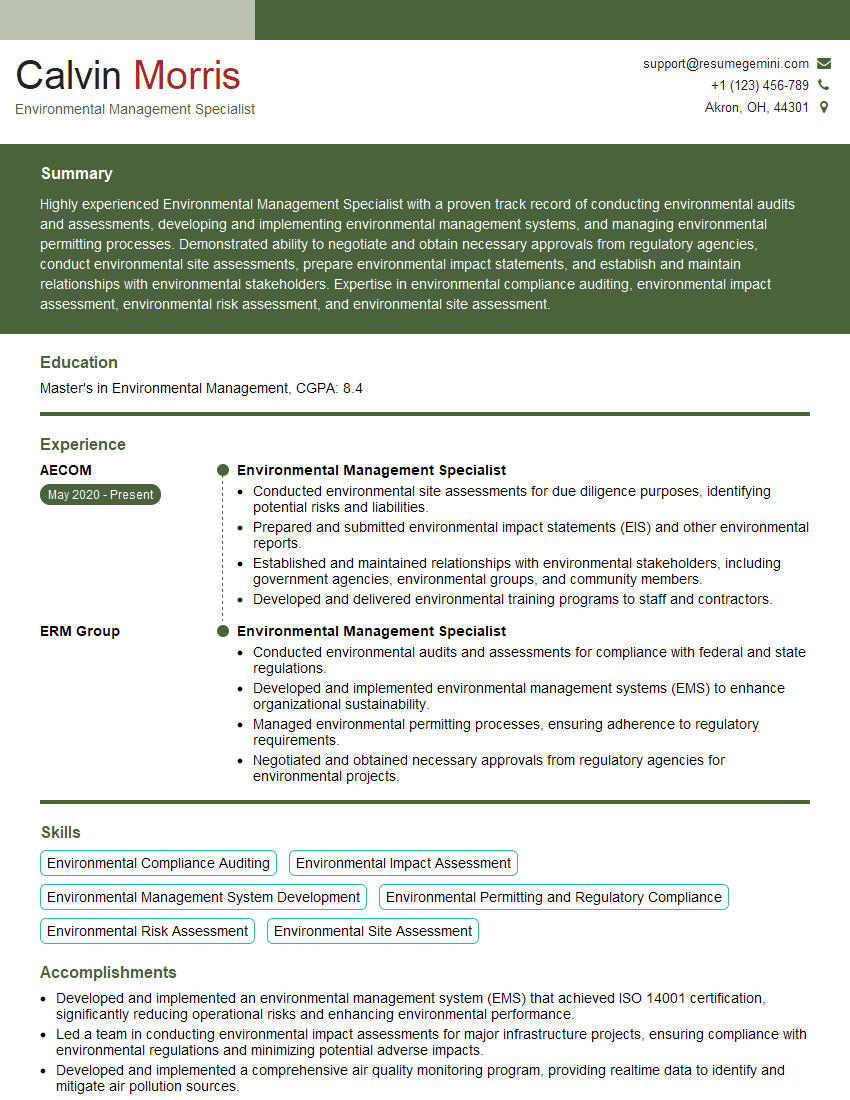
Mastering Environmental Management Systems (EMS) Auditing opens doors to exciting career opportunities in a rapidly growing field. Demonstrating your expertise through a strong resume is crucial. An ATS-friendly resume increases your chances of getting your application noticed by recruiters. ResumeGemini is a trusted resource to help you craft a professional and impactful resume that highlights your skills and experience. Examples of resumes tailored to Environmental Management Systems (EMS) Auditing are available to guide your creation process. Invest the time to create a compelling resume – it’s your first impression and a key step in advancing your career.

Explore more articles
Users Rating of Our Blogs
Share Your Experience
We value your feedback! Please rate our content and share your thoughts (optional).
What Readers Say About Our Blog
Very informative content, great job.
good