Cracking a skill-specific interview, like one for Floral Training, requires understanding the nuances of the role. In this blog, we present the questions you’re most likely to encounter, along with insights into how to answer them effectively. Let’s ensure you’re ready to make a strong impression.
Questions Asked in Floral Training Interview
Q 1. Explain the different types of floral arrangements.
Floral arrangements can be categorized in many ways, but some common types include:
- Bouquets: Handheld arrangements, often for weddings or special occasions. These can range from simple hand-tied designs to elaborate, structured creations.
- Centerpieces: Designed for tables, varying in size and style to suit the event. They can be low and spreading or tall and dramatic.
- Corsages & Boutonnieres: Smaller arrangements worn as accessories, typically for formal events. Corsages are usually worn on the wrist or lapel, while boutonnieres are worn on the lapel.
- Wreaths: Circular arrangements, often used for holidays or memorial services. They can be made with a variety of materials, including flowers, foliage, and ribbons.
- Arrangements in containers: Flowers arranged within vases, baskets, or other containers. The choice of container significantly impacts the overall design and style.
- Floral installations: Large-scale designs, often incorporating multiple arrangements and elements, for events or venues. These could include floral walls, arches, or ceilings.
The distinction often lies in the purpose, size, and intended placement of the arrangement.
Q 2. Describe your experience with various floral design styles (e.g., modern, traditional, rustic).
My experience spans a wide range of floral design styles. In modern design, I focus on clean lines, minimalist aesthetics, and often utilize a limited color palette with a focus on texture and form. Think asymmetrical arrangements with striking, singular blooms. For instance, a modern arrangement might feature a few bold orchids and architectural foliage in a sleek, transparent vase.
Traditional arrangements, on the other hand, emphasize symmetry, balanced compositions, and a more classic color scheme. These often involve a greater variety of flower types and a fuller, more rounded form. A traditional bridal bouquet might incorporate roses, lilies, and hydrangeas in soft pastel shades.
Rustic styles are characterized by their use of natural elements, such as wildflowers, textured foliage, and often incorporate elements like wood or burlap. These styles lean towards a more informal, relaxed aesthetic. A rustic centerpiece might include sunflowers, dahlias, and greenery in a wooden crate or galvanized tin.
I seamlessly blend these styles to create unique and personalized arrangements based on client preferences and event themes.
Q 3. How do you select appropriate flowers and foliage for a specific event or occasion?
Selecting appropriate flowers and foliage starts with understanding the event’s theme, color palette, and overall atmosphere. For a wedding, for instance, the bride’s dress, the venue, and the season all inform flower selection. A summer beach wedding might call for vibrant, tropical flowers, while a formal winter wedding might demand elegant, white blooms.
I always consider the occasion’s formality. A casual birthday party would allow for a more relaxed, whimsical approach, while a corporate event might require a more sophisticated and restrained selection. The durability of flowers is also vital; I choose flowers that will last through the event. The venue’s lighting and temperature also impact my choice to ensure longevity and visual appeal.
Beyond aesthetics, I consider the symbolism of flowers in various cultures and traditions, incorporating them thoughtfully and respectfully. For example, white lilies often signify sympathy, whereas red roses signify love and passion.
Q 4. What are the key principles of floral design (e.g., line, form, color, texture)?
The key principles of floral design are interwoven and essential for creating visually appealing and balanced arrangements. These include:
- Line: Creating a sense of movement and direction through the placement of stems and foliage. Think of the tallest stems as leading lines.
- Form: The shape and silhouette of the arrangement as a whole. This could be round, triangular, crescent-shaped, or any other form that complements the occasion.
- Color: The use of color to create mood and impact. Color theory guides me in creating harmonious or contrasting color schemes. Using a color wheel helps create balance and visual appeal.
- Texture: The variety of textures in the arrangement, including smooth petals, rough bark, and feathery foliage. This adds depth and visual interest.
- Scale and Proportion: The relationship between the size of the flowers, foliage, and container. The arrangement must be proportionate to its surroundings.
- Balance: Creating a sense of visual equilibrium. This can be symmetrical (formal) or asymmetrical (informal).
Mastering these principles allows me to create arrangements that are not only beautiful but also well-balanced and harmonious.
Q 5. Describe your process for creating a floral arrangement from concept to completion.
My process for creating a floral arrangement is a structured approach that combines creativity and precision. It begins with a consultation to understand the client’s vision, event details, and budget.
- Concept Development: I brainstorm ideas based on the client’s requirements, sketching initial designs and selecting a color palette.
- Flower Selection: I source the appropriate flowers and foliage, considering their availability, quality, and durability.
- Preparation: This involves cleaning, conditioning, and preparing the flowers and foliage for arrangement.
- Arrangement: I begin constructing the arrangement, focusing on the principles of design: line, form, color, texture, scale, and balance. I start with the focal flowers and then build around them.
- Refinement: I carefully adjust and refine the arrangement, ensuring a balanced and harmonious composition.
- Finishing Touches: I add any finishing touches, such as ribbons or decorative elements.
- Delivery or Installation: I ensure the arrangement is safely delivered or installed at the event venue.
Throughout the process, I maintain open communication with the client, ensuring that the final product meets their expectations.
Q 6. How do you handle difficult or challenging floral design requests?
Handling challenging requests involves creative problem-solving and adapting my skills. If a client requests a flower that is out of season or unavailable, I explore suitable alternatives that maintain the desired aesthetic. I might suggest a similar flower with a comparable color and texture or incorporate other elements to achieve a similar effect.
Budget constraints are another common challenge. I work closely with clients to find cost-effective solutions without compromising the quality or design. This could involve using a mix of high-end and more affordable flowers or adjusting the scale of the arrangement.
Difficult logistical challenges, such as limited space or unusual venues, require adapting the design to the circumstances. For instance, for a narrow space, I would focus on a taller, narrower arrangement rather than a wider one. Flexibility, resourcefulness, and open communication are crucial in overcoming these challenges.
Q 7. What are your preferred floral design tools and techniques?
My preferred tools and techniques are a blend of traditional methods and modern technologies. For example, I use floral shears for precise cutting, floral tape for securing stems, and various types of wire for supporting heavier blooms. I utilize floral foam for creating structured arrangements, but I also embrace more sustainable and natural methods where appropriate.
I find digital design tools beneficial for planning complex arrangements and creating initial sketches for clients. I often use software that allows for 3D modeling to present the client with the final design before starting the actual process.
My techniques encompass both traditional hand-tying methods for bouquets and more structured techniques for centerpieces and other arrangements. I believe in continuous learning and experimentation to expand my skillset and stay current with design trends and innovations.
Q 8. How do you maintain the freshness and longevity of cut flowers?
Maintaining the freshness of cut flowers is crucial for their longevity and visual appeal. It’s a multi-step process focusing on hydration, sanitation, and proper environment.
- Hydration: The most critical aspect. Immediately upon receiving flowers, recut stems at a 45-degree angle underwater to prevent air bubbles from blocking water uptake. Use a clean, sharp knife or shears. Remove lower leaves that would otherwise rot in the water.
- Sanitation: Bacterial growth is a major cause of wilting. Use a floral preservative solution, which typically contains sugar for nourishment and biocides to inhibit bacterial growth. Change the water daily, ensuring the vase is thoroughly cleaned each time.
- Environment: Avoid placing flowers in direct sunlight, near heat sources, or drafty areas. These factors accelerate dehydration. Cooler temperatures (around 65-70°F) are ideal. Keep flowers away from ripening fruits, which release ethylene gas, a natural plant hormone that speeds up wilting.
For example, I once received a large shipment of lilies just before a major wedding. By meticulously following these steps – recutting stems, using preservative, and strategically placing them in a cool, shaded area – I ensured every single bloom was perfect for the event.
Q 9. Explain your knowledge of different flower types, their characteristics, and care requirements.
My knowledge of flower types extends to a wide range, encompassing their unique characteristics and specific care needs. Roses, for instance, require frequent water changes and are sensitive to ethylene gas. Lilies, on the other hand, are more resilient but need support as they grow tall. Tulips and other spring bulbs are known for their dramatic opening and need a cool environment. Different flower types have diverse needs.
- Roses: Thorny stems, require precise cutting and frequent water changes. Prone to wilting if exposed to ethylene gas.
- Lilies (Oriental, Asiatic, etc.): Strong stems, but can become top-heavy; often need support. Pollen can stain fabrics, so be mindful of placement.
- Tulips: Tend to droop easily, especially in warmer environments. They often drink a lot of water, requiring diligent monitoring.
- Hydrangeas: Thirsty plants needing plenty of water to stay hydrated and vibrant. Very sensitive to changes in water temperature.
- Sunflowers: Large, vibrant blooms that require a lot of support because of their size and weight.
Understanding these nuances is critical for creating long-lasting and visually stunning arrangements. For example, in a recent arrangement featuring roses and lilies, I used floral foam to support the lilies and ensured the roses were placed strategically to maximize their visibility and prevent them from being overshadowed.
Q 10. How do you manage your time and workflow when working on multiple floral arrangements simultaneously?
Managing multiple floral arrangements simultaneously requires a structured approach to time management and workflow. I typically employ a system that prioritizes tasks based on deadlines and complexity.
- Prioritization: I start by identifying the most time-sensitive or intricate arrangements and allocate the necessary resources first. This ensures that critical deadlines are met.
- Batching: Similar tasks are grouped together. For example, I’ll prep all the roses for several arrangements at once, rather than switching between roses, lilies, and other flowers repeatedly. This improves efficiency.
- Delegation: Where possible, I delegate simpler tasks such as cleaning vases or prepping basic greens to my assistants. This allows me to focus on the more demanding design aspects.
- Time Blocking: I allocate specific time slots for each phase of arrangement creation—from prepping flowers to final assembly and finishing touches. This helps prevent delays and keeps me on schedule.
For instance, when preparing for a large corporate event needing 50 centerpieces and 10 bouquets, I meticulously planned out my workflow, delegating tasks to junior florists and focusing my time on the most complex arrangements. This ensured smooth production and timely delivery.
Q 11. Describe your experience with floral preservation techniques.
Floral preservation techniques extend the life of flowers beyond their natural lifespan, allowing for longer enjoyment and the creation of lasting keepsakes. Several methods exist, each with its own advantages and disadvantages.
- Drying: Air drying, silica gel drying, and pressing are common techniques to preserve flowers’ shape and color, though some shrinkage and color alteration are expected.
- Freezing: While less common for delicate flowers, freezing can preserve some species for later use in projects like resin art.
- Pressing: Ideal for creating flat, two-dimensional specimens, often used for artwork or scrapbooking.
- Glycerin preservation: A process that replaces the water within the flower’s cells with glycerin, keeping the plant pliable but potentially darkening the color slightly.
I’ve successfully preserved wedding bouquets using silica gel, resulting in beautiful keepsakes for the happy couple. Each method necessitates attention to detail and careful execution to achieve optimal results. I choose the method based on the type of flower and the desired outcome.
Q 12. How do you handle customer feedback and address concerns regarding floral arrangements?
Handling customer feedback is a crucial aspect of providing excellent service. I approach feedback constructively, viewing it as an opportunity for improvement.
- Active Listening: I carefully listen to the customer’s concerns, allowing them to fully express their thoughts without interruption.
- Empathy: I acknowledge their feelings and validate their perspective. This demonstrates respect and builds rapport.
- Problem-Solving: I work collaboratively with the customer to find a suitable solution. This could involve offering a refund, replacement, or redesigning the arrangement based on their feedback.
- Documentation: I maintain detailed records of all customer interactions and feedback to track trends and identify areas for improvement.
For example, once a client expressed concern about the color scheme of a large event arrangement. By engaging in open communication and understanding their preferences, I was able to quickly re-design the arrangement to their satisfaction. Maintaining positive relationships with clients is paramount.
Q 13. What software or tools do you use for floral design planning or budgeting?
While there isn’t industry-standard software specifically designed for floral design planning and budgeting, I utilize a combination of tools to streamline these processes.
- Spreadsheet Software (e.g., Microsoft Excel, Google Sheets): I use spreadsheets for creating detailed floral design plans, including a list of flowers, quantities, and costs. This allows for accurate budgeting and inventory tracking.
- Project Management Software (e.g., Asana, Trello): For larger events, project management tools help organize tasks, assign responsibilities, and track progress. This is especially useful when collaborating with a team.
- Floral Design Software (various niche options): Some specialized software exists, providing features like flower arrangement visualization tools, but these are less commonly used for simple budgeting.
By combining these tools, I can efficiently manage projects, ensuring accurate cost estimations and smooth workflow.
Q 14. How do you stay updated on current trends in floral design?
Staying current with floral design trends is essential for maintaining a competitive edge and offering clients innovative and appealing arrangements.
- Industry Publications and Websites: I regularly read floral design magazines and visit websites dedicated to floral design to learn about the latest styles, techniques, and flower varieties.
- Trade Shows and Workshops: Attending industry events provides opportunities to network with other florists, see new products, and learn from experienced professionals.
- Social Media: Platforms like Instagram and Pinterest are valuable resources for visual inspiration. I follow prominent floral designers and industry influencers to observe current trends and creative ideas.
- Continuing Education: I regularly participate in workshops and training courses to expand my skills and knowledge, keeping my designs fresh and cutting-edge.
For example, recently I attended a workshop on sustainable floral design, learning about eco-friendly sourcing practices and innovative techniques. This knowledge helps me design arrangements that are both aesthetically pleasing and environmentally responsible. Constant learning and adaptation are critical.
Q 15. Explain your understanding of floral color theory and its application in design.
Floral color theory is fundamental to creating visually appealing and impactful arrangements. It’s based on the color wheel, understanding color harmonies, and the psychological effects of color on the viewer. Think of it like painting a picture, but with flowers instead of paint.
We use the color wheel to identify different color schemes. For example:
- Monochromatic: Using various shades and tints of a single color. A stunning arrangement could be created using various shades of purple, from light lavender to deep violet, creating a cohesive and sophisticated feel.
- Analogous: Combining colors that are adjacent on the color wheel, like blue, blue-green, and green. This creates a calming and harmonious effect, perfect for a tranquil setting.
- Complementary: Pairing colors opposite each other on the wheel, such as red and green or yellow and purple. This creates a vibrant and high-contrast look, ideal for making a bold statement.
- Triadic: Using three colors equally spaced on the color wheel, such as red, yellow, and blue. This creates a balanced and energetic effect, offering a wide range of creative possibilities.
Understanding these schemes allows me to create arrangements that evoke specific moods and match event styles. For a romantic wedding, I might use soft analogous colors, while a corporate event might call for a more energetic triadic scheme.
Career Expert Tips:
- Ace those interviews! Prepare effectively by reviewing the Top 50 Most Common Interview Questions on ResumeGemini.
- Navigate your job search with confidence! Explore a wide range of Career Tips on ResumeGemini. Learn about common challenges and recommendations to overcome them.
- Craft the perfect resume! Master the Art of Resume Writing with ResumeGemini’s guide. Showcase your unique qualifications and achievements effectively.
- Don’t miss out on holiday savings! Build your dream resume with ResumeGemini’s ATS optimized templates.
Q 16. Describe your experience with working with different floral budgets.
I’ve had extensive experience working with floral budgets of all sizes. From lavish, high-end weddings with unlimited budgets to smaller, more intimate events with stricter financial constraints, I understand the importance of balancing creativity with practicality.
For high-budget events, I can source the most exclusive and rare blooms, incorporating unique elements like custom-made vases or elaborate installations. For events with tighter budgets, I focus on finding cost-effective alternatives without compromising on design aesthetics. This might involve using more seasonal blooms, selecting flowers with longer vase life, and strategically employing filler greens to maximize visual impact.
My approach always involves a detailed consultation with the client to understand their vision and budget limitations. From there, I develop a design proposal that outlines options and costs, allowing the client to make informed decisions that align with their financial plan. I am skilled at suggesting substitutes for expensive flowers without sacrificing the overall beauty and feeling of the arrangement.
Q 17. How do you source your floral materials (e.g., wholesalers, growers)?
Sourcing high-quality floral materials is crucial for creating exceptional arrangements. My network includes both local growers and reputable wholesalers. I build strong relationships with both.
Local Growers: Working with local growers offers several advantages. I get access to fresh, seasonal flowers, supporting sustainable agriculture practices and reducing the environmental impact of transportation. It also often allows for more unique and unusual varieties.
Wholesalers: Wholesalers provide access to a broader range of flowers and supplies, particularly those not readily available locally, allowing me to fulfill even the most unique requests. They often offer competitive pricing and reliable delivery, particularly important for large events.
My sourcing strategy is tailored to the specific project requirements. For example, a wedding requiring large quantities of specific blooms would likely involve a wholesaler, whereas a smaller event focusing on locally-grown seasonal flowers might primarily utilize local growers.
Q 18. Explain your knowledge of floral mechanics and wiring techniques.
Floral mechanics are the techniques used to create the structural integrity and longevity of an arrangement. This includes wiring, taping, and the proper use of floral foam. Wiring, in particular, is essential for working with delicate flowers or creating specific shapes.
I’m proficient in various wiring techniques, such as:
- Straight Wiring: A single wire is inserted into the stem, providing support for individual flowers or delicate stems.
- Cross Wiring: Using two wires crossed to provide stronger support, ideal for heavier blooms.
- Hook Wiring: Creating a small hook at the end of the wire, allowing for easy attachment to floral foam or other structural elements.
Proper wiring ensures that the flowers remain upright, reducing the risk of drooping or wilting. I use different gauges of wire depending on the stem’s thickness and the flower’s weight. My attention to detail in this area is critical to the longevity and overall beauty of the arrangement.
Q 19. How do you incorporate seasonal flowers into your designs?
Incorporating seasonal flowers is vital for creating both beautiful and sustainable arrangements. Seasonal flowers are not only visually stunning but also often more affordable and readily available than out-of-season blooms.
My approach involves staying informed about the seasonal availability of flowers in my region. I often collaborate with local growers to stay up-to-date on what is in peak bloom. This allows me to design arrangements that are not only visually appealing but also environmentally responsible and cost-effective.
For example, during spring, I might incorporate tulips, daffodils, and ranunculus; in summer, sunflowers, hydrangeas, and zinnias; and in autumn, dahlias, asters, and chrysanthemums. I tailor the color palettes and design to complement the natural beauty and character of the seasonal flowers.
Q 20. Describe your experience with creating floral arrangements for different venues (e.g., weddings, corporate events).
I have extensive experience creating floral arrangements for a variety of venues, including weddings, corporate events, and private parties. Each event demands a unique approach.
Weddings: Wedding floral design requires a deep understanding of the couple’s style, the venue’s architecture, and the overall wedding theme. I work closely with the couple to create a cohesive design that enhances the event’s ambiance. This can range from intimate bridal bouquets and boutonnieres to large-scale installations and ceremony backdrops.
Corporate Events: Corporate events often require a more formal and sophisticated style. Arrangements should reflect the company’s brand identity and create a professional and welcoming atmosphere. I focus on creating elegant centerpieces and incorporating flowers that are appropriate for the setting.
Private Parties: Private parties allow for more creative freedom. I collaborate with clients to create personalized arrangements that reflect their individual taste and the occasion’s specific needs. This could range from vibrant birthday centerpieces to elegant anniversary arrangements.
Q 21. What is your experience with designing centerpieces?
Centerpieces are a focal point of any event, so their design requires careful consideration. I approach centerpiece design by considering the event’s style, the venue’s size and shape, and the overall table setting.
My process typically includes:
- Consultation: Understanding the client’s vision, budget, and preferred color palette.
- Sketching and Design: Creating preliminary sketches to visualize the arrangement’s size, shape, and floral composition.
- Material Selection: Choosing flowers, foliage, and containers that complement the overall event theme and design.
- Arrangement Creation: Assembling the centerpiece with attention to detail, balance, and proportion.
I’ve created a wide variety of centerpieces, from low and sprawling designs ideal for long tables to taller, more dramatic arrangements perfect for round tables. My goal is always to create a centerpiece that is both visually stunning and complements the surrounding décor.
Q 22. How do you manage inventory and ordering of floral supplies?
Effective inventory management is crucial for a floral business. It ensures you have the right flowers, at the right time, and in the right quantities. My approach combines careful tracking with proactive ordering.
I utilize a digital inventory system, regularly updating stock levels after each event or order. This system allows me to track not only the quantity of each flower type but also their condition and expected lifespan. For instance, I might note the arrival date of a batch of roses and their expected bloom duration, enabling precise forecasting of when they’ll be at their peak.
My ordering process is strategic. I analyze past sales data to predict demand for specific flowers during peak seasons (like Valentine’s Day or Mother’s Day) and adjust accordingly. I also build relationships with reliable suppliers, ensuring timely deliveries and consistent quality. Regular communication with suppliers allows me to anticipate any potential shortages and make alternative arrangements.
Finally, I implement a system for managing perishables. This involves a ‘first in, first out’ (FIFO) approach, ensuring that older flowers are used first to minimize waste. I also carefully monitor storage conditions (temperature, humidity) to extend the lifespan of my stock.
Q 23. Explain your understanding of floral design sustainability practices.
Floral design sustainability is a significant concern, and I integrate various practices to minimize my environmental impact. This includes sourcing locally grown flowers whenever possible. Local sourcing reduces transportation emissions and supports local farmers.
I prioritize the use of seasonal flowers. These are naturally abundant, reducing the need for energy-intensive greenhouse cultivation and transportation from faraway lands. For example, I’d use sunflowers in the summer instead of forcing blooms out of season.
Reducing waste is another core aspect. I meticulously plan designs to minimize flower waste, repurposing leftover blooms for smaller arrangements or compost. I also reuse floral containers whenever appropriate and encourage clients to consider the longevity of their floral purchases.
Furthermore, I choose suppliers committed to sustainable practices such as water conservation and reduced pesticide use. This commitment extends to my workshop, where I strive to minimize water usage and recycle materials whenever possible. Selecting sustainable packaging is another crucial step in the process. I often use recycled or biodegradable materials, reducing the overall carbon footprint of my creations.
Q 24. How do you deal with damaged or wilting flowers?
Dealing with damaged or wilting flowers requires quick action to salvage the arrangement and maintain its quality. My first step is assessment. I carefully examine the affected flowers, determining the extent of damage. For minor wilting, I might rehydrate them by submerging the stems in cool water for a few hours or using a flower food solution.
For more significant damage, such as broken petals or significant wilting, I might remove the affected parts or replace the flower entirely, depending on the overall design and the severity of the damage. I always maintain a reserve stock of healthy replacement blooms. This allows me to efficiently fix any issues and maintain the integrity of the final arrangement.
Prevention is key. I handle flowers with care during transport and storage, taking precautions to avoid bruising or crushing. Regularly checking the water levels and replenishing the flower food in vases is crucial for preventing premature wilting.
In some instances, clever design choices can mask minor imperfections. For example, strategically placing other flowers and foliage can cleverly conceal a slightly wilted bloom.
Q 25. What are your skills in creating boutonnieres and corsages?
Creating boutonnieres and corsages requires precision and an eye for detail. I’m proficient in crafting both, utilizing a range of techniques to achieve diverse styles. My skills extend beyond simple designs; I can create intricate and elegant pieces tailored to specific events and personal preferences.
For boutonnieres, I’m skilled in creating both classic designs using simple elements and more elaborate styles incorporating multiple flower types, ribbons, and foliage. My approach prioritizes balance and proportion, resulting in a piece that complements the wearer’s attire without being overwhelming.
Corsages, similarly, are crafted with meticulous attention to detail. I can create wrist corsages, pin-on corsages, and even more unique designs, adapting to different dress styles and personal tastes. I’m adept at using a variety of wiring techniques to secure the flowers and maintain their shape and freshness.
I’m comfortable working with various flower types, from roses and lilies to more delicate blooms. I also incorporate different ribbons and embellishments to match the overall theme and occasion.
Q 26. Describe your knowledge of different floral containers and their suitability.
Selecting the right floral container is essential for enhancing the overall aesthetic appeal and longevity of an arrangement. My knowledge spans various container types, each with unique properties and suitability for different floral designs.
For example, I utilize classic vases in various shapes and sizes, considering the scale and style of the arrangement. Tall, slender vases are perfect for elegant, vertical arrangements, while wider, shorter vases are more suitable for cascading or spreading designs. The material also matters; glass vases offer a clean, modern look, while ceramic or metallic containers can add texture and visual interest.
Beyond vases, I utilize a wide range of containers, including baskets, bowls, teacups, and even unusual repurposed items to create unique and eye-catching arrangements. The choice of container depends heavily on the design style, the flowers used, and the overall occasion. A rustic arrangement might look best in a woven basket, while a modern minimalist design might be displayed in a sleek, geometric container. I also consider the container’s practicality, such as its water-holding capacity and drainage properties.
Furthermore, I assess the container’s size and proportion relative to the floral design. An oversized container can dwarf the flowers, while an undersized one can appear cramped and unbalanced. Careful consideration ensures a harmonious balance between the container and the arrangement.
Q 27. How do you handle client consultations and understand their floral needs?
Client consultations are pivotal for creating floral arrangements that meet their vision and exceed their expectations. My approach is collaborative and focuses on active listening and clear communication.
I begin by asking open-ended questions to understand the client’s preferences, the occasion, the overall style, and their budget. I encourage them to share visual inspiration, such as images from magazines, websites, or even sketches. This allows me to grasp their aesthetic preferences and translate them into a tangible floral design.
I discuss the available flowers and their suitability based on the season and budget. I present various design options, explaining the pros and cons of each, and providing a realistic estimate of costs. I address any questions or concerns the client might have, ensuring complete transparency throughout the process.
The consultation isn’t just about gathering information; it’s about building rapport and understanding the client’s emotional connection to the event. For a wedding, for instance, I aim to understand the couple’s vision for their special day, ensuring the flowers enhance the overall atmosphere and reflect their personality.
Q 28. What is your experience with creating large-scale floral installations?
I possess extensive experience in creating large-scale floral installations, ranging from wedding backdrops to corporate event displays and large-scale public installations. My approach is methodical and involves detailed planning, coordination, and execution.
The process begins with a comprehensive design concept, often involving sketches and 3D renderings to visualize the final outcome. This involves considering the scale of the installation, the available space, the overall theme, and the structural requirements.
Efficient sourcing and logistical planning are crucial for large-scale projects. I establish close communication with suppliers to ensure the timely delivery of a large quantity of flowers and materials. I also coordinate with event staff, venue management, and other vendors to ensure seamless installation and removal. I often assemble a dedicated team to facilitate the timely completion of the installation.
Examples of past projects include designing the floral centerpiece for a large corporate gala, creating a dramatic floral archway for a wedding ceremony, and designing a stunning floral installation for a city park. These projects required meticulous planning, attention to detail, and a collaborative spirit.
Key Topics to Learn for Your Floral Training Interview
- Floral Design Principles: Understanding the elements and principles of design (line, form, color, texture, space) as applied to floral arrangements. Practical application includes analyzing existing designs and creating your own concept sketches.
- Flower Care and Handling: Proper techniques for receiving, processing, and storing flowers to maximize their lifespan and aesthetic appeal. This includes understanding different flower types and their specific needs.
- Floral Mechanics and Techniques: Mastering various wiring, taping, and arranging methods for creating professional-looking bouquets, centerpieces, and other floral designs. Consider exploring different design styles (e.g., European, round, cascading).
- Plant Biology and Horticulture Basics: A foundational understanding of plant growth, health, and common issues. This includes recognizing signs of disease or pests and implementing appropriate care strategies.
- Event Styling and Floral Design: Learning to integrate floral designs into different event settings, considering themes, color palettes, and overall event aesthetics. This includes understanding client consultation and project management.
- Business and Retail Aspects: Understanding pricing strategies, inventory management, customer service, and potentially marketing for floral businesses. This is particularly relevant for roles in retail floristry.
- Sustainability and Ethical Sourcing: Increasingly important is knowledge of sustainable practices in the floral industry, including eco-friendly materials and ethical sourcing of flowers and supplies.
Next Steps
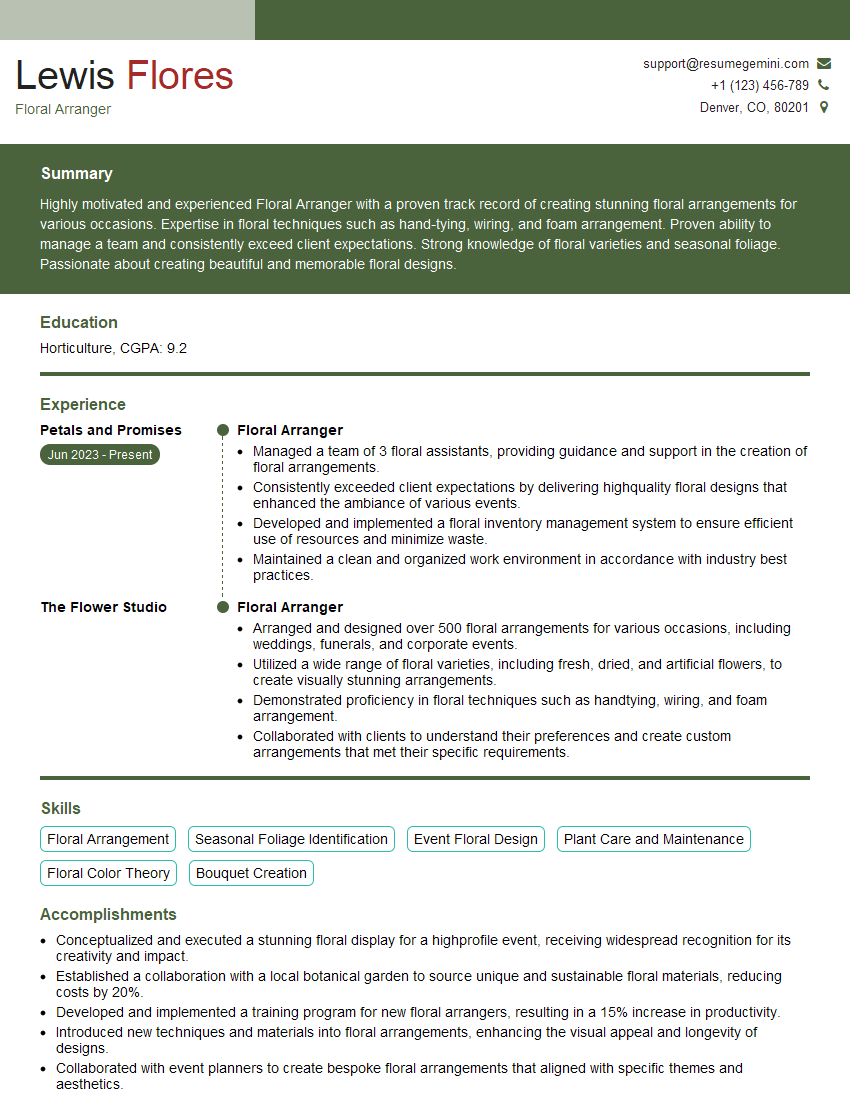
Mastering floral training opens doors to exciting careers in a creative and dynamic industry, offering opportunities for growth in various roles from event florist to floral designer to retail manager. To significantly improve your job prospects, create a resume that is optimized for Applicant Tracking Systems (ATS). ResumeGemini is a trusted resource that can help you build a professional and impactful resume, ensuring your application stands out. Examples of resumes tailored to Floral Training are available to help guide you. Take the next step towards your dream floral career!
Explore more articles
Users Rating of Our Blogs
Share Your Experience
We value your feedback! Please rate our content and share your thoughts (optional).
What Readers Say About Our Blog
Very informative content, great job.
good