The thought of an interview can be nerve-wracking, but the right preparation can make all the difference. Explore this comprehensive guide to Stone Sawing interview questions and gain the confidence you need to showcase your abilities and secure the role.
Questions Asked in Stone Sawing Interview
Q 1. What types of stone saws are you familiar with (e.g., bridge saws, gang saws, etc.)?
My experience encompasses a wide range of stone saws, each suited for different applications and stone types. These include:
- Bridge saws: These are large, robust saws ideal for cutting large slabs of stone with high precision. I’ve used them extensively for projects requiring large, consistently sized pieces, like flooring tiles or countertop slabs.
- Gang saws: These saws utilize multiple blades to cut numerous slabs simultaneously, significantly increasing efficiency. They are perfect for mass production of smaller, standardized stone pieces.
- Circular saws (including wet saws and dry saws): These versatile saws are smaller and more portable, making them ideal for on-site cutting and smaller projects. Wet saws, which use water to cool the blade and reduce dust, are particularly useful for delicate stones prone to cracking.
- Wire saws: These utilize a continuous wire loop with diamond abrasive to cut extremely hard or large stones. I’ve used these for specialized applications involving exceptionally large blocks of granite or marble.
- Waterjet cutters: While technically not a ‘saw’ in the traditional sense, waterjet cutters use high-pressure water to cut stone, offering excellent precision and the ability to cut intricate designs. I’ve used these for artistic and specialized applications.
Each saw type demands a specific skillset and understanding of its limitations. My expertise lies in selecting the optimal saw type based on the project requirements and the stone properties.
Q 2. Describe your experience with different blade types and their applications.
Blade selection is critical for successful stone sawing. The blade’s material, segment type, and kerf (width of the cut) directly influence the quality and efficiency of the cut. I’ve worked with various blade types, including:
- Diamond blades: These are the most common type, utilizing diamond segments embedded in a metal matrix. Different diamond concentrations and segment configurations (e.g., turbo, laser, segmented) are selected based on the stone’s hardness and the desired cut quality. For example, a softer stone might use a blade with a lower diamond concentration to prevent excessive wear. A harder stone would require a blade with a higher concentration.
- Abrasive blades: While less common for stone, abrasive blades can be used for softer stones or for specific applications. They are typically less expensive than diamond blades but may wear out more quickly.
My experience helps me choose the right blade for the job. For instance, cutting granite requires a high-quality diamond blade with a robust segment design to withstand the stone’s hardness and abrasive nature. Marble, being softer, might use a different blade to achieve a smoother finish with less chipping.
Q 3. How do you determine the appropriate blade speed and feed rate for various stone types?
Determining the optimal blade speed and feed rate is crucial for preventing blade damage, ensuring a clean cut, and maximizing productivity. This is heavily dependent on the stone type and the chosen blade. It’s not simply a case of using the fastest speed possible; this often leads to premature blade wear or damage.
I generally start by consulting the manufacturer’s recommendations for the specific blade and stone type. From there, I’ll adjust based on what I see and hear in real-time.
Factors I consider include:
- Stone hardness: Harder stones like granite typically require slower feed rates and sometimes lower blade speeds to avoid blade overload.
- Blade type and condition: A new blade might require a slightly different setting than a well-used one. A worn blade may necessitate reduced speed.
- Desired finish: A rougher cut may permit faster feed rates, while a polished finish necessitates a slower, more precise approach.
I continuously monitor the cutting process, listening for unusual sounds (e.g., squealing or grinding), observing the cut quality, and checking the blade for signs of wear. This iterative process enables me to refine the settings throughout the cutting operation to achieve optimal results.
Q 4. Explain the process of calibrating and maintaining a stone saw.
Regular calibration and maintenance are crucial for ensuring the accuracy and longevity of stone saws. Calibration usually involves checking the alignment of the blade and ensuring the saw’s components are properly adjusted. This often involves adjusting various tensioning screws, bearings and making sure the saw table is level.
Maintenance procedures include:
- Blade cleaning and inspection: Regularly inspect the blade for wear, damage (chips or cracks), and cleanliness. Clean the blade after each use to remove accumulated stone dust. A dirty blade reduces cutting efficiency and can lead to uneven cuts.
- Water system maintenance (for wet saws): Keep the water pump and lines clean and free from blockages. The water helps to cool the blade and remove debris. Regular checks help prevent premature blade wear and potential damage to the saw itself.
- Bearing lubrication: Regularly lubricate bearings to maintain smooth operation and extend lifespan. This reduces friction and heat, preventing damage to the saw mechanism.
- Blade changing: Follow the manufacturer’s instructions for safely changing blades. Improper blade changing can be dangerous and can damage the saw.
I meticulously document all maintenance activities, which enables better tracking, troubleshooting, and predictive maintenance.
Q 5. How do you identify and address common issues encountered during stone sawing (e.g., blade breakage, chipping)?
Common issues during stone sawing often stem from improper blade selection, incorrect settings, or insufficient maintenance. Here’s how I address some common problems:
- Blade breakage: This is usually caused by excessive feed rates, improper blade selection for the stone type, or a worn blade. The solution involves reducing the feed rate, selecting a more appropriate blade, or replacing the broken blade.
- Chipping: Chipping often results from too high a blade speed, improper cooling (especially in dry cutting), or a dull blade. Reducing the blade speed, using wet cutting techniques where appropriate, and ensuring the blade is sharp usually mitigate this issue.
- Uneven cuts: This can be caused by blade misalignment, an uneven saw table, or improper feed rate. Addressing these underlying problems solves this issue. Re-calibration of the saw and careful attention to the feed rate are crucial.
- Excessive vibration: Vibration often points to worn bearings, blade imbalance, or issues with the saw’s alignment. Addressing this typically involves regular maintenance, lubrication, and checks for any misalignment or worn components.
Through careful observation and diagnostic skills, I can quickly identify the root cause and take the appropriate corrective actions.
Q 6. What safety precautions do you follow when operating stone saws?
Safety is paramount in stone sawing. I rigorously follow safety protocols to minimize the risk of injury or damage. My safety procedures include:
- Personal Protective Equipment (PPE): Always wear safety glasses, hearing protection, a dust mask (especially when dry cutting), and appropriate gloves.
- Machine guarding: Ensure all safety guards are in place and functioning correctly before operating the saw.
- Proper handling of blades: Always handle blades with care and use appropriate lifting techniques to avoid cuts or injuries.
- Work area safety: Maintain a clean and organized work area, free from obstructions. Make sure there’s adequate lighting.
- Emergency procedures: Be familiar with the emergency shutdown procedures for the specific saw and have a plan for handling any accidents or emergencies. It’s important to know the location of first aid supplies.
Regular safety inspections and training are key to maintaining a safe work environment.
Q 7. Describe your experience with different stone cutting techniques.
My experience covers a variety of stone cutting techniques, tailored to the specific stone and desired outcome:
- Straight cuts: The most common technique, used for creating straight edges and precise dimensions. This technique is fundamental for various applications, from creating tiles to cutting slabs for countertops.
- Angle cuts: Creating angled cuts requires precise adjustments to the saw’s miter gauge or specialized jigs, ensuring accurate angles. This is crucial for creating mitered edges for custom projects.
- Curved cuts: Cutting curves often requires specialized equipment like a waterjet cutter or hand-guided tools, and necessitates meticulous control to achieve the desired shape and finish. I’ve used specialized jigs and templates for more controlled curved cuts.
- Freehand cutting: Less precise, but sometimes necessary for rough shaping or quick adjustments. Requires a high level of skill to avoid mistakes.
The choice of cutting technique depends heavily on the project’s specifications, the stone type, and the available tools. My expertise lies in selecting the most efficient and accurate method for each specific situation.
Q 8. How do you ensure the accuracy and precision of your cuts?
Accuracy and precision in stone sawing are paramount. It’s not just about making a cut; it’s about making the right cut. We achieve this through a multi-faceted approach.
Precise Measurement and Marking: Before any cutting begins, meticulous measurements are taken using calibrated tools like digital calipers and laser measuring devices. These measurements are then transferred to the stone using precise marking techniques, often with the aid of templates or CAD generated layouts.
Blade Selection and Maintenance: The right blade is crucial. Different stones require different blades – diamond blades with varying grit sizes for various hardness levels. Regular blade maintenance, including dressing and cleaning, is essential to maintain sharpness and ensure clean cuts. A dull blade leads to chipping, inaccuracy, and potentially dangerous vibrations.
Machine Calibration and Operation: Our cutting machinery is regularly calibrated to ensure accuracy. This includes verifying blade alignment, checking the precision of the cutting head, and ensuring the smooth and controlled movement of the stone. Proper operational techniques, learned through extensive training and experience, are paramount. For example, consistent feed rates are critical to preventing blade wandering.
Technology Integration: We often use CNC (Computer Numerical Control) saws for complex shapes and intricate designs. CNC technology allows for highly accurate automated cutting based on digitally created designs. This drastically minimizes human error and ensures consistent precision across multiple pieces.
For example, when working on a intricate countertop design, the CNC machine allows us to cut complex curves and shapes with tolerances measured in millimeters – a level of precision simply unattainable through manual methods.
Q 9. What are the key factors to consider when selecting a stone for a specific application?
Selecting the right stone for a specific application requires careful consideration of its properties and the intended use. It’s a balance of aesthetics, performance, and practicality.
Intended Use: Is the stone for a kitchen countertop, a bathroom vanity, an exterior cladding, or a sculpture? Each application has different durability requirements. A countertop needs to withstand daily wear and tear, while exterior cladding must resist weathering and temperature fluctuations.
Durability and Hardness: Hardness, measured on the Mohs scale, indicates the stone’s resistance to scratching and abrasion. Harder stones are generally more durable but can be more challenging to work with. For example, granite is harder than marble and better suited for high-traffic areas.
Porosity and Absorption: Porous stones absorb liquids, making them susceptible to staining. This is a critical factor for kitchen countertops and bathroom vanities. Sealing is often necessary to mitigate this. Low porosity materials like granite are often preferred in these areas.
Aesthetics: Color, veining, and texture are important aesthetic considerations. The stone’s visual appeal should complement the overall design of the project. This often involves careful selection from a range of samples to find the perfect match for the clients’ taste.
For instance, when specifying stone for a pool surround, we might choose a stone with low water absorption and high resistance to freezing and thawing cycles, such as certain types of limestone or quartzite. For a kitchen countertop, we’d prioritize hardness, stain resistance, and heat tolerance – favoring granite or quartz.
Q 10. Explain your understanding of stone properties (e.g., hardness, porosity, etc.) and their impact on cutting.
Understanding stone properties is fundamental to successful stone sawing. Different stones behave differently under the saw blade.
Hardness: Hardness dictates the type of blade required and the cutting speed. Harder stones like granite demand diamond blades with a harder matrix and potentially slower cutting speeds to prevent blade damage. Softer stones like marble can be cut with softer blades at faster speeds.
Porosity: Porous stones are more susceptible to damage during cutting, as the blade can easily tear or chip the stone. This often necessitates using water-cooled blades to reduce friction and heat, which can worsen the damage in porous stones.
Fracture Toughness: This property describes a stone’s resistance to cracking and chipping. Stones with low fracture toughness are more prone to breaking during cutting, requiring careful handling and potentially slower cutting speeds.
Abrasiveness: Some stones are more abrasive than others, leading to faster wear on the saw blade. This necessitates regular blade maintenance and potentially the use of specialized blades designed for abrasive materials.
Think of it like cutting different types of wood. A soft wood like pine requires a different approach than cutting hard oak. Similarly, the properties of the stone dictate the cutting parameters we employ.
Q 11. How do you handle variations in stone density and texture during the cutting process?
Variations in stone density and texture present challenges, but we address them through adaptive techniques.
Blade Adjustment: For denser areas, we might slow down the cutting speed to prevent blade overload and potential damage to both the blade and the stone. Conversely, for less dense areas, a slightly faster feed rate might be appropriate.
Water Cooling: Consistent water cooling is crucial, especially when dealing with variations in density. This helps to manage heat generation and prevent cracking, particularly in less dense areas that may be more susceptible to heat damage.
Blade Selection: Choosing the appropriate blade for the specific stone type is paramount. A blade optimized for a specific hardness and texture helps to minimize inconsistencies in the cutting process.
Operator Skill and Experience: Experienced operators can recognize and react to variations in real-time, adjusting cutting parameters to maintain a consistent, clean cut. This includes making minor adjustments to the feed rate, blade angle or water flow based on the feel of the cut.
Imagine cutting through a piece of wood with embedded knots. You would adjust your saw’s speed and pressure to navigate those denser areas and avoid splitting the wood. The same principle applies to stone sawing.
Q 12. Describe your experience with different finishing techniques (e.g., polishing, honing).
Finishing techniques are essential for achieving the desired aesthetic and enhancing the stone’s durability. We have expertise in various methods.
Polishing: Polishing uses progressively finer abrasive compounds to create a high-gloss, reflective surface. It’s common for countertops and other high-end applications. The process typically involves multiple stages, starting with coarser abrasives and ending with extremely fine polishing compounds. The result is a smooth, lustrous finish.
Honing: Honing produces a smoother, satin-like finish, less reflective than polishing. It’s achieved using honing compounds and is suitable for applications where a matte or less glossy finish is preferred.
Flamed: This technique uses high-temperature flames to create a textured surface with a rough, slightly uneven look. This is often used for outdoor applications where a non-slip surface is desired.
Sandblasting: This technique uses pressurized air and abrasive media to create a variety of textures, from subtly textured to deeply etched patterns. This is often used to create unique surface designs.
The choice of finishing technique depends on the type of stone, the intended application, and the client’s aesthetic preferences. For example, a honed finish might be preferred for bathroom vanities to provide a subtle elegance, whereas a polished finish is often favored for kitchen countertops for their shine and easy maintenance.
Q 13. How do you measure and interpret stone dimensions?
Accurate stone dimensioning is crucial. We use a combination of methods to ensure precision.
Digital Calipers and Measuring Tapes: These tools provide accurate linear measurements, essential for determining the length, width, and thickness of the stone slabs.
Laser Measuring Tools: Laser measuring tools offer quick and precise measurements, especially for larger slabs and complex shapes. They minimize human error associated with manual tape measures.
Digital Level: Ensuring perfectly level surfaces is important, especially for countertops. Digital levels provide accurate readings to ensure proper leveling before cutting or installation.
Templates: Templates are used for replicating complex shapes and patterns. They ensure accuracy and consistency when making multiple cuts from the same design. They’re especially important for intricate designs.
We record all measurements meticulously, ensuring that they are documented accurately and are easily referenced throughout the fabrication process. A slight error in measurement can lead to significant issues later in the process, so accuracy is our top priority.
Q 14. What software or CAD programs are you proficient in for stone fabrication?
Proficiency in CAD software is essential for modern stone fabrication. It allows for precise design, efficient material utilization, and seamless communication with clients.
AutoCAD: We are highly proficient in AutoCAD for creating detailed 2D drawings and layouts, ensuring precise dimensions and placement of cutouts and features.
SketchUp: SketchUp allows us to create 3D models of the stone projects, providing a clearer visualization for both us and our clients. This is particularly helpful for complex designs and allows for early identification of potential issues.
Specialized Stone Fabrication Software: We also use specialized software packages specifically designed for stone fabrication. These programs often have built-in tools for generating CNC cutting paths, optimizing material usage, and creating detailed fabrication plans.
Using this software, we translate the client’s vision into precise digital models that can be used to create accurate templates and cutting paths. This allows us to deliver highly precise and customized stone work.
Q 15. Explain your experience with reading and interpreting blueprints and technical drawings.
Reading and interpreting blueprints and technical drawings is fundamental to accurate stone sawing. My experience encompasses years of working with various drawing formats, from hand-drawn sketches to sophisticated CAD designs. I’m proficient in understanding scale, dimensions, annotations, and material specifications. This includes identifying different stone types, their properties (e.g., hardness, porosity), and understanding the implications for cutting techniques and blade selection.
For example, I recently worked on a project with intricate curves and complex angles. The blueprint clearly indicated the specific type of granite to be used and detailed the tolerances for each cut. By carefully analyzing the drawings, I was able to plan the cutting process efficiently, minimizing waste and ensuring the final product met the client’s exacting specifications. I also understand the importance of identifying potential issues from the blueprint, like conflicts between different elements or unrealistic dimensions, before cutting begins.
My skill extends to communicating effectively with architects and designers about potential challenges or clarifications needed from the blueprints. This collaborative approach ensures a smooth workflow and reduces costly errors during the fabrication phase.
Career Expert Tips:
- Ace those interviews! Prepare effectively by reviewing the Top 50 Most Common Interview Questions on ResumeGemini.
- Navigate your job search with confidence! Explore a wide range of Career Tips on ResumeGemini. Learn about common challenges and recommendations to overcome them.
- Craft the perfect resume! Master the Art of Resume Writing with ResumeGemini’s guide. Showcase your unique qualifications and achievements effectively.
- Don’t miss out on holiday savings! Build your dream resume with ResumeGemini’s ATS optimized templates.
Q 16. How do you manage inventory of stone materials and consumables?
Inventory management in stone sawing is crucial for efficient operations and cost control. I utilize a combination of physical inventory checks and digital record-keeping to track all stone materials and consumables. This includes maintaining detailed records of stone slabs, including type, dimensions, quantity, and location within the warehouse. Consumables like diamond blades, polishing pads, and lubricants are also meticulously tracked, using a first-in-first-out (FIFO) system to minimize waste and ensure timely replacement.
For stone slabs, we use a barcoding system. Each slab is barcoded and its information (type, size, quality grade, etc.) is logged in our database. This allows us to easily locate specific slabs and track their usage. For consumables, we maintain a reorder point system triggered by usage tracking software connected to our machinery. When the inventory of a specific blade type drops to a pre-determined level, the system automatically generates a purchase order. This prevents stockouts and ensures minimal downtime. Regular physical audits help to reconcile the physical inventory with the digital records, identifying any discrepancies.
Q 17. Describe your troubleshooting skills related to stone sawing equipment.
Troubleshooting stone sawing equipment requires a systematic approach. I begin by carefully assessing the problem, considering factors like the type of malfunction, the machine’s operating parameters at the time of failure, and any unusual noises or vibrations. My experience covers a broad range of equipment malfunctions – from blade misalignment, water pump failures, to electrical issues and control system problems.
For instance, if a blade is breaking frequently, I’d systematically check the blade type’s suitability for the stone being cut, blade tension, coolant flow, and the overall machine alignment. Similarly, if the machine is producing inaccurate cuts, the cause may be a worn or misaligned guide system, a faulty control unit, or even improper blade selection. I use a combination of diagnostic tools, technical manuals, and my extensive knowledge of stone sawing mechanics to identify the root cause and implement the appropriate corrective measures. I always prioritize safety and will de-energize equipment before performing any repairs or maintenance.
Q 18. What is your experience with preventative maintenance of stone sawing equipment?
Preventative maintenance is key to maximizing the lifespan and efficiency of stone sawing equipment. I follow a rigorous schedule that includes daily, weekly, and monthly checks. Daily checks focus on operational aspects such as coolant levels, blade condition, and machine alignment. Weekly checks are more in-depth, involving lubrication of moving parts, inspection of wear components, and checking for any signs of damage or potential failures. Monthly maintenance might include more extensive cleaning, lubrication, or component replacements.
We maintain detailed logs for every piece of equipment, recording all maintenance activities, spare parts used, and any observed anomalies. This allows us to track performance trends, predict potential failures, and optimize the maintenance schedule. For example, we might replace a specific type of blade more frequently if we find it wears out quicker on a particular type of stone. This proactive approach minimizes downtime, extends equipment life, and ultimately improves efficiency.
Q 19. How do you ensure the quality of your work meets or exceeds industry standards?
Ensuring quality in stone sawing involves meticulous attention to detail at every stage, from material selection to final polishing. I adhere strictly to industry standards and best practices, using precision measurement tools to guarantee accurate cuts and consistent finishes. Quality control checks are implemented throughout the process. For instance, I regularly inspect cut pieces for surface imperfections, chipping, or cracks.
My team and I also employ advanced technology like digital templates and laser guidance systems to enhance accuracy. We continuously calibrate our equipment to maintain optimal performance. Furthermore, we actively seek feedback from clients and use it to identify areas for improvement in our processes and techniques. We also regularly participate in industry training to stay abreast of the latest technologies and best practices to ensure we consistently exceed standards.
Q 20. Describe a situation where you had to solve a complex problem during stone cutting.
During a recent project involving a highly intricate marble sculpture, we encountered a problem with a deeply embedded, unseen fissure within the stone. This fissure, only discovered during the cutting process, posed a significant risk of breakage. The initial plan was compromised, and we were facing a tight deadline.
To overcome this challenge, I collaborated with the engineering team to develop a modified cutting plan. This involved adjusting the blade path to carefully navigate around the fissure, using a slower cutting speed and increased coolant flow to minimize stress on the stone. We also implemented additional support structures to prevent vibrations during the cutting process. Through careful planning and execution, we successfully completed the project without compromising the integrity of the sculpture, meeting the client’s satisfaction and the deadline.
Q 21. How do you handle challenging or difficult clients or projects?
Handling challenging clients and projects requires strong communication, problem-solving skills, and a proactive approach. I start by actively listening to the client’s concerns and clearly understanding their expectations. If there are conflicts or disagreements, I strive to find a mutually acceptable solution through open and respectful dialogue. I firmly believe in transparency, keeping clients informed about project progress, potential challenges, and any necessary adjustments.
For instance, I once worked with a client who had unrealistic expectations for the project timeline and budget. I presented them with a realistic schedule and cost breakdown, explaining the complexities involved in working with the chosen stone material. Through clear communication and a collaborative approach, we were able to find a compromise that satisfied both parties. Maintaining a professional and positive attitude throughout the process is crucial, even when facing difficult situations. Building trust and rapport with clients is key to managing difficult projects successfully.
Q 22. Explain your understanding of OSHA regulations related to stone sawing.
OSHA regulations concerning stone sawing are paramount for workplace safety. They primarily focus on controlling silica dust, a significant health hazard. This involves the use of engineered controls like water suppression systems on saws to minimize dust generation. Personal protective equipment (PPE) is also critical, including respirators (ideally N95 or better) to prevent inhalation of respirable crystalline silica, safety glasses to protect the eyes from flying debris, and hearing protection due to the loud noise generated by many sawing operations. Regular machine maintenance is crucial to prevent malfunctions that could lead to accidents. Furthermore, OSHA mandates proper training for all workers on safe operating procedures, emergency response, and the hazards associated with stone sawing. Failure to comply can result in hefty fines and potential legal action. I’ve always prioritized adhering to and exceeding these standards throughout my career, viewing them not just as regulations but as essential practices for safeguarding the well-being of myself and my colleagues.
For example, on one project involving intricate marble carving, I implemented a localized dust collection system in addition to the standard water suppression on the saw. This extra measure significantly reduced airborne silica, creating a healthier working environment. This went beyond the minimum OSHA requirements, reflecting my commitment to proactive safety.
Q 23. Describe your experience working with different types of stone (granite, marble, etc.)
My experience encompasses a wide range of stone types, each requiring a unique approach. Granite, known for its hardness and density, demands specialized diamond blades and often higher water pressure for effective cutting. The abrasive nature of granite also necessitates careful blade selection to avoid premature wear and tear. Marble, conversely, is more susceptible to chipping and cracking, demanding a gentler cutting technique and potentially lower blade speeds. I’ve also worked extensively with limestone, travertine, and onyx, each presenting its own set of challenges. Limestone, for instance, can be porous, necessitating careful control of water flow to prevent damage. Understanding the specific properties of each stone – its hardness, density, porosity, and fracture toughness – is crucial for selecting the correct tools and techniques to achieve precise and damage-free cuts. This knowledge is gained through years of hands-on experience and continuous learning.
For instance, a recent project involved creating a complex mosaic using a variety of stones, including highly sensitive onyx. My experience allowed me to select the appropriate blades, adjust cutting parameters, and manage water pressure with precision, ensuring that each delicate piece was cut flawlessly without damage.
Q 24. How do you ensure the safety and cleanliness of your work area?
Maintaining a safe and clean work area is not just a matter of compliance; it’s fundamental to efficiency and safety. Before any sawing begins, I meticulously clean the area, ensuring the floor is clear of obstructions and any debris is properly disposed of. This prevents accidents caused by slips, trips, or falls. Appropriate signage is in place to warn of potential hazards. During the sawing process, the use of water suppression systems is crucial for dust control, and regular checks of the equipment and blades are performed to ensure safe operation. After the sawing is complete, all tools and materials are stored safely and the area is thoroughly cleaned to eliminate dust and any residual cutting fluids. Proper disposal of waste materials, in accordance with local regulations, is a priority. A clean and organized workspace promotes efficiency and reduces the likelihood of accidents.
In one instance, I noticed a slight crack in the floor near the sawing area. I immediately addressed this, flagging the area and requesting repairs to prevent a potential tripping hazard. This proactive approach prevented a possible injury.
Q 25. What is your experience with different types of cutting fluids and their applications?
Cutting fluids are essential in stone sawing for several reasons: they cool the blade, reduce friction, and suppress dust. Different stones require different cutting fluids. Water is often the primary coolant, especially for softer stones, but specialized water-based lubricants may be used with harder stones like granite to improve cutting performance and extend blade life. In some cases, oil-based fluids are used, though they pose environmental concerns and require careful handling. The choice of cutting fluid depends heavily on the type of stone, the blade type, and the desired finish. I’ve had experience with a variety of water-soluble and oil-based fluids, always ensuring that the chosen fluid is compatible with the materials and environment.
For example, when cutting delicate marble, I often use a specialized water-based lubricant with added cooling agents. This minimizes heat buildup, prevents damage to the stone, and extends the life of the diamond blade.
Q 26. How do you determine the best approach for cutting complex shapes or designs in stone?
Cutting complex shapes and designs requires a combination of skill, precision, and the right tools. The approach begins with careful planning. A detailed design is necessary, often created using CAD software, translating the design into a set of precise cutting instructions. This could involve creating templates or jigs to guide the saw, especially for repetitive cuts. Different cutting techniques may be employed depending on the complexity of the design. This might include using multiple blades with varying profiles or employing specialized tooling for intricate curves and angles. For very complex designs, numerical control (NC) or computer numerical control (CNC) machines might be used for automated cutting, ensuring high accuracy and repeatability. Throughout this process, regular quality checks are performed to ensure the cut is progressing as planned and corrections are made as needed.
In a recent project, we had to cut a complex, curved design into a large granite slab. We used a combination of CNC cutting for the major portions and hand-guided cutting for finer details. This precise, multi-stage approach yielded a flawless result.
Q 27. Describe your experience with waterjet cutting or other advanced stone cutting techniques.
Waterjet cutting offers a highly precise and versatile method for cutting stone, allowing for intricate designs and minimal material waste. I have significant experience using waterjet cutters, appreciating their ability to handle various stone types with minimal heat-affected zones, preserving the stone’s integrity. The high-pressure water jet, combined with an abrasive material, allows for precise cutting of complex shapes and designs. While I am proficient with waterjet cutting, I also possess experience with other advanced techniques such as laser cutting, which offers speed and precision but might have limitations regarding the thickness of the stone it can effectively cut. Each technique has its advantages and disadvantages, and the selection depends on the project’s specific requirements – the stone’s type, the complexity of the design, and the desired surface finish.
A recent project utilizing waterjet cutting involved creating customized countertop shapes for a high-end kitchen renovation. The waterjet’s precision and ability to cut intricate designs allowed us to create a truly unique and high-quality product.
Q 28. What are your salary expectations for this position?
My salary expectations are commensurate with my experience and expertise in stone sawing. Considering my extensive knowledge of various stone types, advanced cutting techniques, safety regulations, and my proven ability to deliver high-quality work on complex projects, I am seeking a competitive salary within the range of [Insert Salary Range]. This range reflects the current market rates for professionals with my qualifications and accomplishments. I am open to discussing this further based on the specifics of the position and company benefits package.
Key Topics to Learn for Your Stone Sawing Interview
- Stone Types and Properties: Understanding the characteristics of various stones (granite, marble, limestone, etc.) and how these properties influence cutting techniques and blade selection is crucial. Consider the hardness, grain structure, and potential for fracturing.
- Sawing Techniques and Equipment: Familiarize yourself with different sawing methods (wet cutting, dry cutting, wire sawing, etc.) and the operation of various sawing machines. Be prepared to discuss the advantages and disadvantages of each.
- Blade Selection and Maintenance: Knowing how to choose the appropriate blade for a specific stone type and application is essential. Understanding blade maintenance, including sharpening, repair, and replacement, demonstrates practical experience.
- Safety Procedures and Regulations: Stone sawing involves significant safety risks. Demonstrate your knowledge of relevant safety protocols, personal protective equipment (PPE), and industry regulations.
- Troubleshooting and Problem-Solving: Be ready to discuss common problems encountered during stone sawing (e.g., blade breakage, stone chipping, machine malfunctions) and how you would approach troubleshooting and resolving these issues.
- Project Planning and Execution: Discuss your experience in planning stone sawing projects, including estimating time and material requirements, and effectively executing the project to meet deadlines and specifications.
- Quality Control and Inspection: Explain your understanding of quality control measures used in stone sawing to ensure the final product meets the required standards of precision and finish.
Next Steps
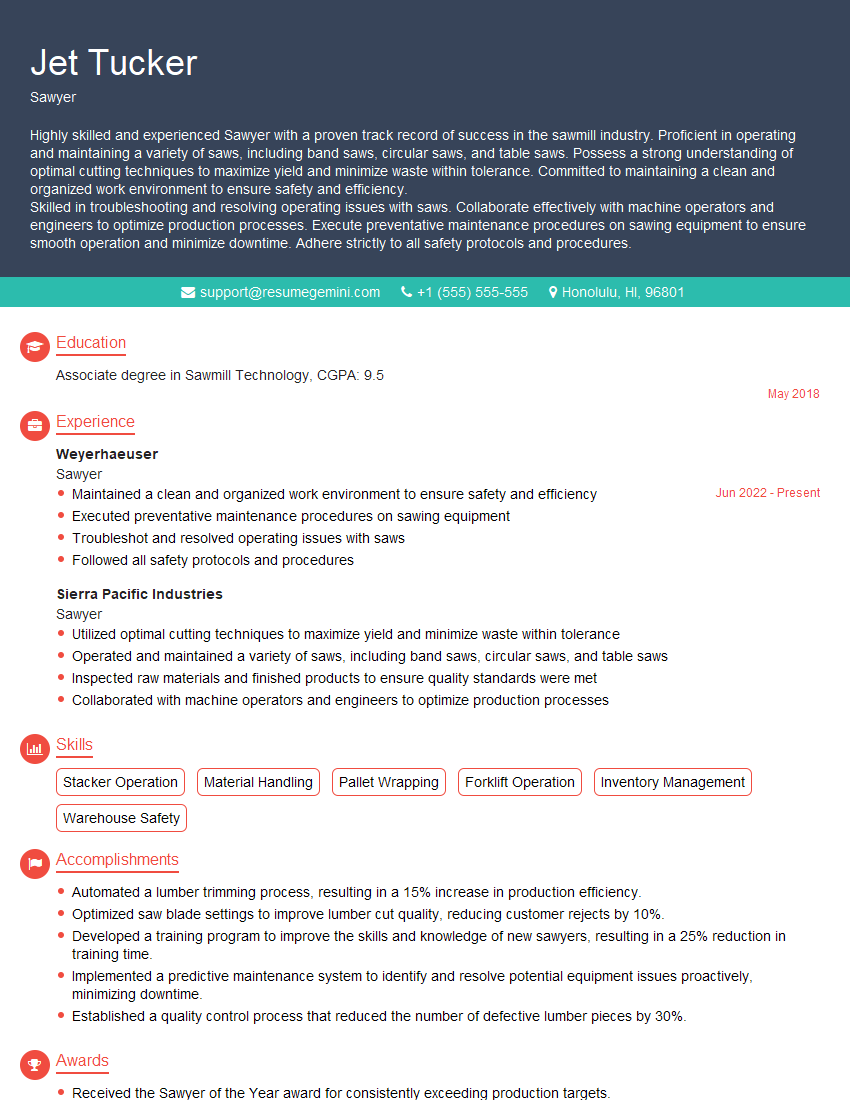
Mastering stone sawing opens doors to exciting career opportunities in construction, fabrication, and restoration. To maximize your job prospects, a well-crafted resume is essential. An ATS-friendly resume, optimized for Applicant Tracking Systems, significantly increases your chances of getting noticed by potential employers. ResumeGemini is a trusted resource to help you create a professional and effective resume that highlights your skills and experience in stone sawing. Examples of resumes tailored specifically to the stone sawing industry are available to help guide you.




Explore more articles
Users Rating of Our Blogs
Share Your Experience
We value your feedback! Please rate our content and share your thoughts (optional).
What Readers Say About Our Blog
Very informative content, great job.
good