The thought of an interview can be nerve-wracking, but the right preparation can make all the difference. Explore this comprehensive guide to Spring Coiling Machinery Operation interview questions and gain the confidence you need to showcase your abilities and secure the role.
Questions Asked in Spring Coiling Machinery Operation Interview
Q 1. Describe your experience operating different types of spring coiling machines.
Throughout my career, I’ve operated a variety of spring coiling machines, ranging from fully automated CNC machines to more manual, cam-operated models. My experience includes working with machines capable of producing different spring types, including compression springs, extension springs, torsion springs, and even more complex shapes like wire forms. For example, I’ve extensively used CNC machines like those from (Manufacturer name 1) and (Manufacturer name 2), which are highly precise and allow for complex spring designs. I also have experience with older, cam-operated machines from (Manufacturer name 3), which while less automated, provide valuable insight into the fundamental mechanics of spring coiling.
This diverse experience enables me to quickly adapt to new equipment and efficiently troubleshoot issues across various machine types. The key difference often lies in the control systems – some are computer-numerical-control (CNC) and others are mechanically controlled via cams and gears. However, the core principles of wire feeding, coiling, and forming remain consistent.
Q 2. Explain the process of setting up a spring coiling machine for a new job.
Setting up a spring coiling machine for a new job is a methodical process requiring precision. It starts with a thorough review of the spring design specifications, including the wire diameter, spring index, number of coils, spring length, and material type. This information dictates the machine settings.
- Die Selection: The correct die set must be chosen, matching the wire diameter and the desired spring’s outside diameter. Incorrect dies can result in deformed or unusable springs.
- Wire Feed Adjustment: The wire feed mechanism must be calibrated to deliver the precise length of wire needed for each coil. Inconsistent feeding results in inconsistent spring lengths.
- Coil Tension Adjustment: Tension control is vital. Too much tension can cause wire breakage, while too little leads to inconsistent coil pitch and loose springs. This often involves adjusting the machine’s tensioning mechanism and potentially altering the coiling speed.
- Machine Speed Adjustment: The optimal coiling speed is crucial for producing high-quality springs while ensuring efficient production. Excessive speed can result in overheating and inconsistent springs.
- Testing: Once setup is complete, I run a small batch of test springs and inspect them meticulously, comparing their dimensions and quality with the design specifications. Adjustments are made iteratively until the specifications are met.
Think of it like baking a cake; the recipe (spring specifications) guides the process, but slight adjustments to temperature (speed) and ingredient proportions (wire feed) can significantly affect the final product’s quality.
Q 3. How do you troubleshoot common malfunctions on a spring coiling machine?
Troubleshooting spring coiling machines requires a systematic approach. I start by observing the problem closely, noting the type of malfunction and when it occurs. Common issues include wire breakage, inconsistent spring dimensions, or machine jams.
- Wire Breakage: This often points to excessive tension, improper wire feeding, or a faulty wire reel. I check the tension settings, the wire path for obstructions, and the wire reel for flaws.
- Inconsistent Spring Dimensions: This might indicate problems with the die, incorrect machine settings (wire feed or speed), or inconsistent wire diameter. I’ll inspect the dies for wear or damage, review the machine settings, and verify the wire diameter using a micrometer.
- Machine Jams: Jams are often caused by material buildup or misaligned parts. I carefully clean the machine, paying attention to the wire feed path and ensuring all moving parts are aligned correctly.
My approach involves a combination of visual inspection, checking machine settings, and using diagnostic tools (if available) provided by the machine manufacturer. I’ve learned to recognize patterns in malfunctions, making troubleshooting faster and more efficient over time. I also meticulously document troubleshooting steps, which helps with future similar problems.
Q 4. What safety precautions do you take while operating spring coiling machinery?
Safety is paramount when operating spring coiling machinery. My safety practices include:
- Personal Protective Equipment (PPE): Always wearing safety glasses, gloves, and hearing protection. Depending on the machine, additional PPE like safety shoes or a face shield might be necessary.
- Machine Guards: Ensuring all safety guards are in place and functioning correctly before operating the machine. Never bypass or disable safety features.
- Lockout/Tagout Procedures: Following established lockout/tagout procedures before performing maintenance or repairs to prevent accidental startup.
- Regular Inspections: Conducting regular inspections of the machine for any signs of wear, damage, or loose parts. Reporting any safety concerns immediately.
- Proper Training: Ensuring I am properly trained and authorized to operate the specific machine before starting work.
I treat every operation as if a potential hazard exists. My focus is on proactive prevention, not just reactive response. I believe safety is not just a set of rules but a mindset.
Q 5. How do you ensure the quality and consistency of springs produced?
Ensuring consistent spring quality involves a multi-faceted approach:
- Regular Calibration: Regularly calibrating the spring coiling machine using precision measuring tools like micrometers and calipers. This ensures accurate measurements and consistent spring dimensions.
- Process Monitoring: Closely monitoring the coiling process, checking spring dimensions and quality at regular intervals. Any deviation from the specification calls for immediate investigation and adjustment.
- Statistical Process Control (SPC): Utilizing SPC techniques to track and analyze the production process, identifying trends and patterns that could affect spring quality. This allows for proactive adjustments.
- Material Control: Maintaining a strict inventory management system for spring wire, ensuring consistent material properties and minimizing variations.
- Regular Maintenance: Performing regular preventative maintenance on the machine to keep it in optimal operating condition. Well-maintained equipment produces consistently high-quality springs.
Imagine it like a chef maintaining the consistency of their dishes; careful ingredient selection, precise measurements, and consistent cooking techniques ensure delicious results each time.
Q 6. Explain the different types of spring wire and their applications.
Spring wire comes in a variety of materials, each with its own properties and applications:
- High-Carbon Steel: This is the most common material for springs, offering high strength and fatigue resistance. It’s suitable for a wide range of applications where high load-bearing capacity is needed.
- Stainless Steel: Offers excellent corrosion resistance, making it ideal for outdoor or harsh environment applications. Various grades exist, each with slightly different strength and corrosion resistance.
- Phosphor Bronze: Exhibits good electrical conductivity and corrosion resistance. It’s used in applications requiring electrical contact and good spring properties.
- Music Wire: Known for its high tensile strength and fatigue resistance, often used in precision springs where consistent performance is crucial.
The choice of wire material depends heavily on the application’s requirements. For example, a suspension spring in a car would likely use high-carbon steel for its high strength, while a spring used in a medical device might require stainless steel for its biocompatibility and corrosion resistance.
Q 7. Describe your experience with different types of spring coiling machine dies.
I have experience with various spring coiling machine dies, each designed for specific spring geometries and wire diameters. The choice of die is critical, directly impacting the spring’s quality and consistency.
- Progressive Dies: Used for high-volume production of simple spring designs. They form the spring in a series of progressive steps.
- Multi-stage Dies: More complex dies capable of producing springs with intricate shapes and multiple coils.
- Transfer Dies: Used for making more complex shapes or springs that require specialized forming processes.
Die selection depends on the spring’s design and the desired production volume. Proper die maintenance – cleaning, lubrication, and regular inspection for wear and tear – is crucial for maintaining spring quality and preventing damage to the machine. A worn or damaged die can lead to inconsistent spring dimensions and even machine malfunctions.
Q 8. How do you calculate the spring rate and other spring parameters?
Calculating spring rate and other parameters involves understanding the fundamental spring design equations. The most crucial parameter is the spring rate (or spring constant), which defines the force required to compress or extend the spring a unit distance. This is typically calculated using the following formula for a helical compression spring:
k = (Gd^4)/(8D^3N)
Where:
kis the spring rate (force/distance)Gis the shear modulus of the spring material (a material property)dis the wire diameterDis the mean coil diameterNis the number of active coils
Other important parameters include:
- Solid Height: The height of the spring when fully compressed. This is calculated as
Nd + 2d, roughly. - Free Length: The length of the spring when unloaded. This is typically the solid height plus the desired deflection.
- Spring Index: The ratio of the mean coil diameter (D) to the wire diameter (d) – (D/d). This is important for predicting spring behavior and selecting appropriate materials.
- Stress: The stress on the spring wire due to loading, often calculated to ensure it stays below the material’s yield strength.
In practice, I use spring design software and hand calculations to ensure accuracy and to consider factors like end conditions (squared and ground, plain ends, etc.), which can slightly alter the spring rate calculation. For instance, a change in end type requires adjusting the effective number of active coils (N) in the equation. I always double-check my calculations to prevent costly mistakes and ensure the spring meets its intended design specifications.
Q 9. What are the common causes of spring breakage during production?
Spring breakage during production can stem from several factors, and identifying the root cause is critical for preventing future failures. Common causes include:
- Material Defects: Inclusions, surface imperfections, or inconsistencies in the material’s microstructure can create weak points that lead to breakage. Regular material inspection is key here.
- Improper Heat Treatment: Incorrect heat treatment can result in inadequate hardness or excessive brittleness, making springs susceptible to fracture. This requires precise control of the heating and cooling process.
- Excessive Stress: Overloading the spring beyond its design limits, caused by faulty design, incorrect operation, or unexpected external forces. Proper load testing is essential.
- Fatigue: Repeated cycling of stress can lead to fatigue failure. This is particularly relevant for springs that endure many loading cycles. Careful selection of material and design for fatigue resistance are important.
- Poor Winding Technique: Irregular coil spacing or winding defects can create stress concentrations, leading to premature breakage. This emphasizes the importance of well-maintained machinery and experienced operators.
- Corrosion: Environmental conditions or exposure to corrosive substances can weaken the spring material over time.
Troubleshooting involves carefully examining broken springs, checking machine settings, and reviewing the design specifications. Often, a combination of factors contributes to the failure.
Q 10. How do you maintain and perform preventative maintenance on spring coiling machinery?
Preventative maintenance is crucial for the longevity and efficiency of spring coiling machinery. My routine includes:
- Regular Lubrication: Applying the correct type and amount of lubricant to moving parts reduces friction and wear, prolonging machine lifespan. I meticulously follow the manufacturer’s recommendations.
- Inspection of Wear Parts: Regularly checking for wear on dies, collets, and other components. Excessive wear indicates the need for replacement or adjustment to prevent damage to the machine and the springs themselves. I maintain detailed records of these inspections.
- Cleaning: Keeping the machine clean of debris and metal shavings is vital for preventing jams and ensuring accurate operation. I use appropriate cleaning tools and solvents without damaging delicate components.
- Calibration and Adjustment: Periodically calibrating the machine’s settings using standardized test springs to ensure accuracy and consistency. I make small adjustments to maintain optimal performance.
- Tightening of Fasteners: Regularly inspecting and tightening all bolts and screws to prevent loosening and potential damage from vibrations.
- Safety Checks: Ensuring all safety guards are in place and functioning correctly to protect the operator.
A well-maintained machine not only produces high-quality springs but also reduces downtime and maintenance costs. I adopt a proactive approach to maintenance rather than reactive, preventing larger issues from arising.
Q 11. What is your experience with CNC spring coiling machines?
I have extensive experience operating CNC (Computer Numerical Control) spring coiling machines. These machines offer significant advantages over traditional machines, including:
- Increased Precision: CNC machines allow for highly accurate control over spring dimensions, ensuring consistent quality and reducing waste.
- Automated Processes: The ability to program complex spring designs and automate production reduces manual labor and increases efficiency.
- Improved Repeatability: Once a program is set, the machine can consistently produce identical springs, essential for mass production.
- Flexibility: CNC machines can easily switch between different spring designs with minimal setup time, facilitating quick changeovers.
My experience encompasses programming, setting up, and troubleshooting CNC spring coiling machines. I’m familiar with various programming languages and control systems commonly used in this industry. I can adapt to different machine models and quickly learn new systems.
For example, I once resolved a recurring issue on a CNC machine where the springs were exhibiting inconsistent coil pitch. By analyzing the machine’s logs and carefully adjusting the feed rate and other parameters, I identified the cause as a slight misalignment in the winding mechanism, which I successfully corrected.
Q 12. Describe your experience with automated spring coiling systems.
My experience with automated spring coiling systems includes working with fully automated lines that integrate CNC machines, material handling systems, and quality control processes. These systems offer:
- Increased Throughput: Significantly higher production rates compared to manual or semi-automated systems.
- Reduced Labor Costs: Less reliance on manual labor lowers production costs.
- Improved Quality Control: Automated inspection systems ensure that only springs meeting specifications are produced.
- Enhanced Safety: Automation eliminates many of the hazards associated with manual spring coiling.
I am proficient in troubleshooting automated systems, familiar with various sensors and control systems used in these environments. My understanding extends to integration with ERP (Enterprise Resource Planning) systems for real-time production monitoring and inventory management. In a previous role, I was instrumental in implementing a new automated system, which resulted in a 30% increase in production efficiency and a significant reduction in defect rates.
Q 13. How do you interpret and follow engineering drawings and specifications?
Interpreting engineering drawings and specifications is fundamental to my work. I am adept at reading and understanding technical drawings, including dimensions, tolerances, material specifications, and surface finish requirements. I pay close attention to details such as:
- Spring Dimensions: Wire diameter, mean coil diameter, free length, solid height, and number of coils. Any deviations from specifications can significantly affect spring performance.
- Material Specifications: The type of spring material (e.g., music wire, stainless steel, phosphor bronze) and its properties (e.g., tensile strength, yield strength, fatigue limit).
- Tolerances: The permissible variations in spring dimensions, which must be adhered to for proper functionality.
- Surface Finish: Requirements for surface treatments (e.g., plating, coating) to enhance corrosion resistance or appearance.
- End Conditions: Specifications for the spring’s end configuration (e.g., squared and ground, plain ends), which affect the spring’s behavior and calculations.
If there are any ambiguities or inconsistencies in the drawings or specifications, I proactively seek clarification from the engineering team to avoid producing non-conforming springs. Accuracy is paramount; a misunderstanding can have serious consequences.
Q 14. What are your experience with different spring materials?
My experience encompasses a broad range of spring materials, each with its unique properties and applications:
- Music Wire: High tensile strength, excellent fatigue resistance, making it ideal for high-cycle applications.
- Stainless Steel: Corrosion resistance, good strength, suitable for applications in harsh environments.
- Phosphor Bronze: High conductivity, good spring properties, often used in electrical applications.
- Oil-Tempered Wire: Good balance of strength, ductility, and fatigue resistance.
- Hard-Drawn Wire: High tensile strength, good for applications requiring high load capacity.
The selection of the appropriate material depends heavily on the intended application of the spring. Factors like load requirements, operating environment, and fatigue life expectations guide the material choice. I understand the nuances of each material’s properties and can select the optimal material to meet specific design criteria. Improper material selection can lead to spring failures; choosing the right material ensures longevity and performance.
Q 15. What is your experience with using measuring tools such as calipers and micrometers?
Accurate measurements are paramount in spring coiling. My experience with calipers and micrometers is extensive, encompassing both vernier and digital types. I’m proficient in using them to measure wire diameter, spring length, coil diameter, and other crucial dimensions with high precision. For instance, I regularly use vernier calipers to measure the precise diameter of the wire feedstock before it enters the coiling machine, ensuring that the springs meet the required specifications. Micrometers, on the other hand, are essential for verifying the extremely tight tolerances often required on smaller springs, allowing me to detect even minute variations in dimensions.
Beyond the basic measurement, I understand the importance of proper techniques to avoid measurement errors – things like ensuring the jaws are clean, applying even pressure, and reading the scales correctly. I can also identify the limitations of each tool and choose the most appropriate one for the task at hand. For example, a micrometer is far more precise for small-diameter wire, while a caliper is more suitable for larger spring dimensions.
Career Expert Tips:
- Ace those interviews! Prepare effectively by reviewing the Top 50 Most Common Interview Questions on ResumeGemini.
- Navigate your job search with confidence! Explore a wide range of Career Tips on ResumeGemini. Learn about common challenges and recommendations to overcome them.
- Craft the perfect resume! Master the Art of Resume Writing with ResumeGemini’s guide. Showcase your unique qualifications and achievements effectively.
- Don’t miss out on holiday savings! Build your dream resume with ResumeGemini’s ATS optimized templates.
Q 16. Describe a time you had to troubleshoot a complex problem on a spring coiling machine.
During a production run of compression springs for a critical automotive application, we encountered a sudden increase in spring breakage. Initially, the issue appeared intermittent, but it progressively worsened. The initial troubleshooting involved checking the obvious: wire feed tension, coiling speed, and the heating element temperature. These were all within specifications. The problem, however, persisted.
It was only after carefully examining the broken springs under a magnifying glass that I noticed microscopic cracks developing at the point of highest stress—the end coils. This suggested a problem with the material’s fatigue strength or perhaps a defect in the wire itself. We then analyzed the coil spring design using finite element analysis (FEA) software to simulate stresses under load. This revealed that the design’s stress concentration at the end coils was higher than anticipated, exceeding the yield strength of the wire, which was previously thought sufficient.
The solution involved a collaborative effort. We modified the design to reduce stress concentration by changing the end coil configuration, and we worked with our wire supplier to ensure a consistent, high-quality supply of material. This involved several rounds of testing to find the ideal combination of design and material. This careful investigation, involving hands-on analysis and simulation, effectively solved the complex issue and prevented further losses.
Q 17. How do you handle production bottlenecks or downtime on the spring coiling line?
Production bottlenecks on a spring coiling line can stem from various sources, including machine malfunctions, material shortages, or even operator errors. My approach involves a systematic troubleshooting process.
- Immediate Response: First, I identify the root cause of the bottleneck. Is it a machine malfunction? A material shortage? A quality control issue? I prioritize addressing the immediate problem to minimize downtime.
- Problem Diagnosis: Once the cause is identified, I begin systematic troubleshooting. This might involve checking machine settings, inspecting components, or investigating the material supply chain.
- Preventive Measures: After resolving the immediate problem, I focus on implementing preventive measures. This includes regular machine maintenance, improved material handling procedures, and more robust operator training to reduce the likelihood of future bottlenecks.
- Production Optimization: A temporary fix isn’t always enough. I analyze the production process to optimize efficiency. This might involve adjusting machine parameters, fine-tuning the coiling process, or streamlining workflows.
For example, if a material shortage causes a bottleneck, I work with procurement to prioritize delivery, and explore alternative suppliers to avoid future shortages. If a machine consistently malfunctions, I might recommend preventative maintenance to minimize downtime.
Q 18. What is your understanding of spring design principles?
My understanding of spring design principles is comprehensive, encompassing the relationship between spring material properties (Young’s modulus, shear modulus, yield strength, fatigue strength), spring geometry (wire diameter, coil diameter, number of coils, free length, end configuration), and spring performance characteristics (spring rate, deflection, load capacity, fatigue life). I’m familiar with different spring types such as compression springs, extension springs, torsion springs, and constant force springs, and I know how to select the appropriate type and design for a given application.
For instance, I understand the critical role of spring index (ratio of coil diameter to wire diameter) in determining spring stress and fatigue life. A higher spring index generally reduces stress but also increases the spring’s overall size. Choosing the correct spring index is crucial for optimizing performance and cost. I also understand the implications of various end configurations, such as plain ends, ground ends, and closed ends, on spring behavior and load characteristics. Furthermore, I have experience using software such as SolidWorks Simulation to perform Finite Element Analysis (FEA) simulations to optimize spring designs for various applications. This allows for the verification of spring performance and stress levels under various loading conditions, ensuring the reliability and safety of the design.
Q 19. Explain your experience with different types of spring finishes.
Spring finishes play a crucial role in enhancing the performance and lifespan of springs. I have experience with various finishes, including:
- Zinc Plating: Provides corrosion resistance and lubricity. A common choice for general applications.
- Cadmium Plating: Offers excellent corrosion resistance, but its use is now restricted due to environmental concerns. Its use is generally replaced by Zinc.
- Powder Coating: Offers excellent corrosion resistance and a wide range of color options; a good choice for aesthetic applications.
- Passivation: A chemical treatment that enhances the corrosion resistance of stainless steel springs.
- Shot Peening: A surface treatment that introduces compressive stresses, increasing fatigue resistance and strength.
The choice of finish depends on the specific application requirements. For example, springs used outdoors require corrosion-resistant finishes like zinc plating or powder coating, while springs under high cyclic loading might benefit from shot peening to enhance fatigue life.
Q 20. How do you ensure the accuracy and precision of the springs produced?
Ensuring the accuracy and precision of springs involves a multi-faceted approach that starts even before the coiling process itself. It begins with careful selection of high-quality raw materials. Precise measurement of the wire diameter using micrometers is crucial. During the coiling process, the machine parameters such as wire feed rate, coil pitch, and tension are carefully monitored and controlled. Regular calibration of the machine’s sensors is also essential. Real-time monitoring systems help in detecting and correcting deviations promptly.
Post-production, statistical process control (SPC) techniques are used to analyze the dimensions and properties of a sample of the produced springs to ensure they remain within the defined tolerances. This involves using control charts to track key parameters like spring length, diameter, and spring rate. Any significant deviations indicate potential issues that need immediate attention. We also frequently use automated inspection equipment, such as CMM (Coordinate Measuring Machine) systems, for high-precision dimensional verification to ensure quality and consistency.
Q 21. What quality control measures do you implement during spring coiling?
Quality control in spring coiling is implemented throughout the entire production process, from raw material inspection to final product verification. Key measures include:
- Incoming Material Inspection: Thorough inspection of wire coils for defects, such as surface imperfections, diameter inconsistencies, and material composition discrepancies.
- Process Monitoring: Continuous monitoring of machine parameters such as wire feed speed, tension, and coiling pitch using sensors and control systems.
- In-Process Inspection: Regular sampling and inspection of springs during production to detect deviations from specifications early on.
- Dimensional Measurement: Precise measurement of spring dimensions using calipers, micrometers, and potentially CMM machines to verify conformance to design specifications.
- Spring Testing: Functional testing of springs, such as compression testing or tension testing, to ensure they meet the required load-deflection characteristics and fatigue life.
- Visual Inspection: Careful visual inspection of the springs for surface defects such as scratches, burrs, or discoloration.
- Statistical Process Control (SPC): Using control charts to track key parameters and identify trends, ensuring consistent production quality.
These measures ensure the production of high-quality springs that meet customer specifications and industry standards. Data is meticulously documented and archived for traceability and future reference.
Q 22. Describe your experience with different types of coil spring designs.
My experience encompasses a wide range of coil spring designs, from the simplest compression springs to more complex torsion, extension, and conical springs. I understand the intricacies of each design and how different parameters like wire diameter, spring index, number of coils, and end type influence the spring’s characteristics, such as spring rate, load capacity, and fatigue life.
- Compression Springs: These are perhaps the most common type, used extensively in applications requiring force and energy storage. I’ve worked with various configurations, including open and closed ends, squared and ground ends, affecting their performance and manufacturing process.
- Extension Springs: These springs are designed to be stretched, often incorporating hooks or loops at their ends for attachment. My experience includes working with different hook designs to optimize their strength and durability.
- Torsion Springs: These springs are designed to resist twisting, and I’m familiar with various winding techniques and end configurations that impact their torque and longevity. I’ve worked with both single- and double-end torsion springs.
- Conical Springs: These springs offer variable spring rates, providing a progressive increase in force as they are compressed or extended. Understanding their design and manufacturing is crucial, and I’ve gained experience in setting up machines for their specific requirements.
I can easily adapt to new designs and calculate the necessary parameters for achieving specific spring characteristics using established engineering formulas and software.
Q 23. How do you handle different types of spring materials (e.g., steel, stainless steel)?
Handling different spring materials requires a nuanced approach due to their varying properties. For example, high-carbon steel offers high strength but can be prone to breakage if not handled correctly during coiling. Stainless steel, while offering superior corrosion resistance, may require different coiling parameters to avoid work hardening or other issues.
My experience includes working with:
- High-Carbon Steel: This is a workhorse material, and I’m adept at selecting the appropriate grade based on the required spring strength and fatigue life. I understand the importance of proper heat treatment to achieve optimal properties.
- Stainless Steel: I’m experienced in working with various grades of stainless steel, recognizing their different formability and requiring adjustments in machine settings to prevent spring breakage or deformation.
- Other Materials: I’ve also worked with other materials such as phosphor bronze, music wire, and various alloys, understanding their specific properties and how they influence the coiling process.
I always prioritize selecting the appropriate material for the intended application and carefully monitor the coiling process to prevent defects.
Q 24. What is your understanding of the different types of spring coiling processes?
Spring coiling processes can be broadly categorized into two main types: cold coiling and hot coiling. My expertise primarily lies in cold coiling, which is the most common method for manufacturing springs.
- Cold Coiling: This process involves forming the spring from a coil of wire at room temperature. It offers high precision and good surface finish, making it ideal for many applications. I’m proficient in various cold coiling techniques, including:
- Rotary Coiling: A common method where a rotating wire is wound around a mandrel.
- Progressive Coiling: A high-speed technique that involves continuously feeding and winding wire.
- Hot Coiling: Used for larger diameter springs or materials that are difficult to coil at room temperature. The wire is heated before coiling, which makes it more malleable. While I have some familiarity, my primary experience is in cold coiling.
Understanding the nuances of each process allows me to select the most efficient and cost-effective method for producing the desired spring.
Q 25. Explain your experience working with different types of spring manufacturing equipment?
My experience encompasses a variety of spring manufacturing equipment, including both CNC and manual machines. I’m comfortable operating and maintaining a range of machinery, understanding their capabilities and limitations.
- CNC Spring Coiling Machines: These highly automated machines offer precision and high production rates. I’m adept at programming and operating these machines, optimizing settings for various spring designs and materials. This includes setting parameters for wire feed, coiling speed, and tension.
- Manual Spring Coiling Machines: While less efficient, these machines are sometimes necessary for smaller production runs or specialized springs. I’m proficient in their operation and understand the importance of precision in achieving consistent spring quality.
- Secondary Operations Equipment: This encompasses equipment used for finishing and testing springs, such as shot peening machines, heat treatment furnaces, and spring testers. I’m familiar with their operation and maintenance procedures.
My knowledge extends beyond just operation to maintenance and troubleshooting. I can identify and rectify common machine issues, minimizing downtime and maximizing efficiency.
Q 26. Describe your experience with the use of programmable logic controllers (PLCs) in spring coiling.
Programmable Logic Controllers (PLCs) are integral to modern spring coiling machinery. I’m experienced in using PLCs to control and monitor various aspects of the coiling process.
My experience includes:
- Programming PLCs: I can use PLC programming software (e.g., Allen-Bradley RSLogix, Siemens TIA Portal) to create and modify programs for controlling machine parameters like wire feed rate, coiling speed, and tension.
- Troubleshooting PLC Programs: I can effectively diagnose and resolve issues within PLC programs, minimizing downtime and ensuring smooth operation.
- Monitoring Machine Performance: PLCs allow for real-time monitoring of key process parameters. I utilize this data to optimize the coiling process and ensure consistent spring quality.
For example, I’ve used PLCs to implement automatic shut-off mechanisms in case of wire breakage or other malfunctions, enhancing both safety and productivity. This includes integrating with sensors to detect errors and trigger appropriate responses.
Q 27. How do you ensure the safety of yourself and your coworkers while working with spring coiling machinery?
Safety is my paramount concern. Working with spring coiling machinery necessitates strict adherence to safety protocols to prevent injuries. My experience includes:
- Personal Protective Equipment (PPE): I consistently use appropriate PPE, including safety glasses, gloves, and hearing protection.
- Machine Safeguards: I carefully check and ensure that all machine safeguards, such as emergency stop buttons and light curtains, are functioning correctly before operating any equipment.
- Lockout/Tagout Procedures: I strictly follow lockout/tagout procedures before performing any maintenance or repairs on spring coiling machinery to prevent accidental start-ups.
- Regular Inspections: I participate in regular safety inspections to identify and address potential hazards.
- Training and Awareness: I actively participate in safety training programs and remain aware of potential hazards associated with operating spring coiling machinery. I also ensure that I actively share my knowledge to enhance safety awareness among my colleagues.
I believe that a safe work environment is a productive work environment, and I’m committed to fostering a culture of safety among my colleagues.
Q 28. What are your career goals related to spring coiling machinery operation?
My career goals involve continuous improvement and advancement in the field of spring coiling machinery operation. I aim to further develop my expertise in advanced CNC machine programming and automation. I’m particularly interested in exploring the use of robotics and advanced process control systems to enhance efficiency and precision in spring manufacturing.
Long-term, I aspire to take on a leadership role, perhaps as a supervisor or team lead, where I can leverage my experience to mentor and guide others, contributing to a culture of continuous improvement and safety within the team. I am also interested in exploring opportunities to design and implement process improvements to increase production efficiency and reduce manufacturing costs. Ultimately, my goal is to become a highly respected expert in the field, known for my skill, efficiency, and commitment to safety.
Key Topics to Learn for Spring Coiling Machinery Operation Interview
- Machine Setup and Operation: Understanding the various types of spring coiling machines, their components, and the procedures for safe and efficient setup and operation. This includes pre-operational checks, material handling, and adjustment of machine parameters.
- Spring Design and Specifications: Familiarity with spring design principles, including wire diameter, coil diameter, number of coils, and spring rate. Understanding how these parameters affect spring performance and how to interpret engineering drawings and specifications.
- Material Properties and Selection: Knowledge of different materials used in spring manufacturing (e.g., steel alloys, stainless steel) and their properties (e.g., tensile strength, fatigue resistance). Understanding how material selection impacts spring performance and longevity.
- Quality Control and Inspection: Proficiency in inspecting finished springs for defects, using appropriate measuring tools and techniques to ensure adherence to quality standards. Understanding quality control processes and documentation.
- Troubleshooting and Maintenance: Ability to identify and troubleshoot common machine malfunctions, perform basic maintenance tasks, and understand preventative maintenance schedules. This includes recognizing signs of wear and tear and knowing when to seek expert assistance.
- Safety Procedures and Regulations: Thorough understanding and adherence to all safety protocols related to operating spring coiling machinery, including proper use of personal protective equipment (PPE) and emergency procedures.
- Production Optimization: Understanding techniques to maximize production efficiency, minimize waste, and improve overall output while maintaining quality standards. This includes understanding production targets and optimizing machine settings.
Next Steps
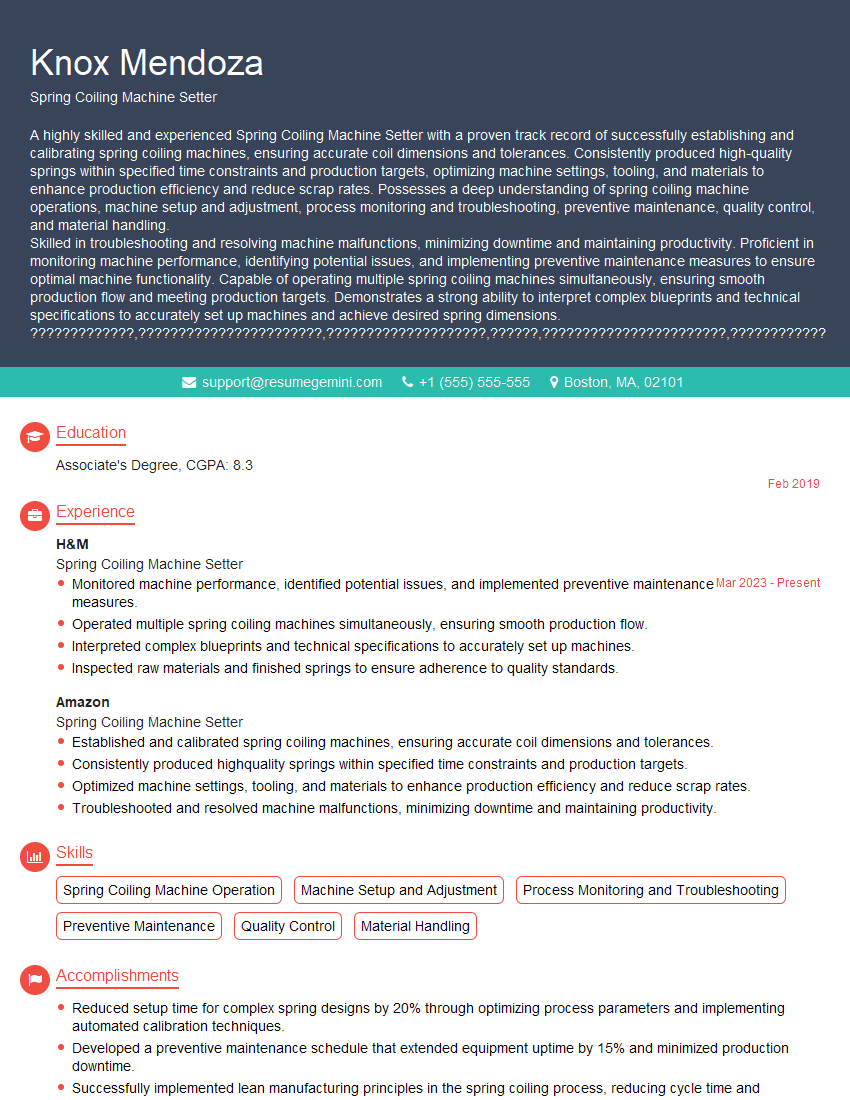
Mastering Spring Coiling Machinery Operation opens doors to rewarding careers in manufacturing and engineering, offering opportunities for advancement and specialization. To maximize your job prospects, crafting a strong, ATS-friendly resume is crucial. ResumeGemini is a trusted resource that can help you build a professional and impactful resume tailored to the specific requirements of this field. Examples of resumes tailored to Spring Coiling Machinery Operation are available to guide you through the process, showcasing your skills and experience effectively. Invest the time to create a compelling resume—it’s your first impression on potential employers.
Explore more articles
Users Rating of Our Blogs
Share Your Experience
We value your feedback! Please rate our content and share your thoughts (optional).
What Readers Say About Our Blog
Very informative content, great job.
good