Feeling uncertain about what to expect in your upcoming interview? We’ve got you covered! This blog highlights the most important In-Store Product Display interview questions and provides actionable advice to help you stand out as the ideal candidate. Let’s pave the way for your success.
Questions Asked in In-Store Product Display Interview
Q 1. Describe your experience creating impactful in-store displays.
Creating impactful in-store displays is about more than just making things look pretty; it’s about strategically driving sales and enhancing the customer experience. My approach involves a deep understanding of the target audience, the product’s unique selling points, and the overall retail environment. I begin by analyzing sales data and market trends to identify key opportunities. For example, I once worked with a sporting goods retailer to boost sales of their new line of running shoes. By creating a dynamic display that showcased the shoes’ technical features – using interactive elements and highlighting customer testimonials – we saw a 30% increase in sales within the first month. Another project involved designing a display for a new organic food brand that emphasized its sustainable practices and healthy ingredients. We achieved this by using natural materials, earthy tones, and clear, concise messaging.
I always consider the placement of the display within the store – high-traffic areas, end caps, and checkout lanes are prime real estate. Furthermore, I ensure that the display is visually appealing, easy to navigate, and consistent with the brand’s overall image. Ultimately, a successful in-store display is a carefully orchestrated blend of visual merchandising, data-driven insights, and a deep understanding of customer psychology.
Q 2. Explain your understanding of planograms and their importance.
Planograms are essentially detailed diagrams that illustrate the precise placement of products on shelves or in displays. They are crucial for maximizing shelf space, improving product visibility, and ensuring consistent brand presentation across multiple retail locations. Think of them as blueprints for optimizing in-store product placement. A well-designed planogram considers factors like product size, facing (the number of product units visible to the customer), shelf height, and customer flow. For instance, high-demand products should typically be placed at eye level and within easy reach. Similarly, complementary products should be clustered together to encourage impulse purchases. Without planograms, product placement can become inconsistent, leading to lost sales opportunities and a disorganized shopping experience. I utilize planogram software to create and manage these diagrams, ensuring that all locations adhere to a unified strategy. In a recent project, optimizing our planograms for a major grocery chain resulted in a 15% increase in sales of a specific product line.
Q 3. How do you measure the success of an in-store display?
Measuring the success of an in-store display involves a multifaceted approach, going beyond just visual appeal. Key metrics include sales lift (the increase in sales attributed to the display), conversion rates (the percentage of shoppers who see the display and make a purchase), dwell time (how long shoppers spend interacting with the display), and customer feedback. I often use sales data from the period before and after the display’s implementation to calculate the sales lift. Furthermore, I use point-of-sale (POS) data to track sales of products featured in the display. Customer surveys and observational studies also provide valuable qualitative data regarding customer engagement and satisfaction. In addition, I leverage analytics from cameras or other tracking technologies to measure dwell time and traffic patterns around the display. This holistic approach allows me to assess both the quantitative and qualitative impact of the display and to make data-driven improvements in future projects.
Q 4. What software or tools are you proficient in for creating displays?
I’m proficient in several software and tools for creating impactful in-store displays. These include:
- Planogram software: JDA, Spaceman, and Apollo are industry-standard software that allows for the creation, management, and analysis of planograms.
- CAD software: AutoCAD and similar programs are useful for creating detailed 3D models of displays, ensuring accurate dimensions and aesthetics.
- Graphic design software: Adobe Photoshop and Illustrator are essential for creating visually appealing graphics and signage.
- Data analysis tools: Microsoft Excel and various business intelligence (BI) tools are crucial for analyzing sales data and other relevant metrics to inform design decisions.
My proficiency in these tools allows me to seamlessly integrate design, data, and strategy to create highly effective displays.
Q 5. How do you adapt displays for different seasons or promotions?
Adapting displays for different seasons or promotions is a key aspect of maintaining a dynamic and engaging retail environment. This often involves changing the featured products, updating the color schemes and messaging, and incorporating seasonal themes. For example, during the holiday season, displays might feature festive colors, decorations, and gift-giving suggestions. In the spring, displays might highlight lighter colors and products associated with outdoor activities. I leverage marketing calendars and promotional plans to anticipate upcoming seasons and promotions, and I begin the design process well in advance. This allows enough time to source materials, create marketing materials, and prepare the displays for timely implementation. By constantly adapting displays, we can keep the retail space fresh and relevant, capturing the attention of customers and driving sales throughout the year.
Q 6. Describe your experience working with different retail environments.
My experience spans diverse retail environments, including grocery stores, apparel boutiques, electronics retailers, and pharmacies. Each environment presents unique challenges and opportunities. Grocery stores, for instance, require a focus on efficient product organization and high-volume sales, while apparel boutiques may prioritize a more aesthetically driven approach. In electronics retail, interactive displays and clear product information are critical. Pharmacies require displays that adhere to strict regulations and highlight health and wellness products. Understanding the specific needs and characteristics of each retail environment is vital for designing effective displays. I consistently adapt my strategies to suit the store’s layout, target customer, and overall brand identity.
Q 7. How do you handle unexpected challenges or setbacks in display implementation?
Unexpected challenges are inevitable in display implementation. These could range from logistical issues like delayed shipments to unforeseen structural limitations within the store. My approach involves proactive planning and contingency measures. For example, I always include buffer time in project timelines to accommodate potential delays. I also maintain close communication with all stakeholders—from store managers to suppliers—to ensure that everyone is informed and aligned. Should unforeseen issues arise, I prioritize problem-solving through creative solutions and swift adaptation. For instance, if a crucial component of a display is unavailable, I have a backup plan readily available. This might involve using alternative materials or adjusting the design to utilize what’s already on hand. Effective communication and a flexible, solution-oriented mindset are crucial in navigating and overcoming such obstacles.
Q 8. How do you incorporate brand guidelines into in-store displays?
Incorporating brand guidelines into in-store displays is crucial for maintaining brand consistency and recognition. It’s more than just using the logo; it’s about translating the brand’s personality, values, and messaging into a visually compelling experience. This involves a multi-step process:
- Understanding the Brand Book: Thoroughly reviewing the brand’s style guide, which dictates logo usage, color palettes, typography, imagery style, and overall tone. For example, a luxury brand might favor elegant fonts and muted colors, while a playful brand might use bright colors and quirky fonts.
- Applying Guidelines to Design: Translating these guidelines into the actual display design. This means selecting appropriate materials, ensuring consistent color use, and choosing imagery that aligns with the brand’s aesthetic. Consider how lighting can enhance the brand’s image; soft lighting might be ideal for a sophisticated brand, while vibrant lighting might suit a youthful one.
- Maintaining Consistency: Implementing rigorous quality control measures to ensure all displays across different locations adhere to the brand guidelines. This could involve creating detailed design templates or utilizing digital mock-ups for approval before production.
- Adapting for Context: While adhering strictly to guidelines is vital, sometimes subtle adaptations are necessary based on the specific store location and target audience. This requires a balance between brand consistency and contextual relevance.
For instance, I worked with a coffee company that emphasized sustainability. We incorporated recycled materials into their displays and used earthy color palettes, reflecting their brand values and attracting environmentally conscious customers.
Q 9. Explain your understanding of customer flow and how it impacts display placement.
Customer flow is the path customers naturally take through a retail space. Understanding this is paramount for effective display placement. Displays strategically placed along high-traffic areas maximize visibility and encourage impulse purchases.
- High-Traffic Zones: These are areas where customers naturally congregate, such as store entrances, checkout lanes, and aisle ends. High-impact displays showcasing key products or promotions should be located here.
- Decompression Zone: The area immediately after the store entrance where customers decompress and orient themselves. This is a great place to present a captivating visual overview of the store’s offerings.
- Power Walls: Large, visually dominant displays strategically located to capture attention. These are often found near entrances or at the end of aisles.
- Eye-Level Placement: Most effective for displaying key products and promotions, maximizing customer visibility.
- Impulse Buys: Placing high-margin items or complementary products near checkout counters to encourage last-minute purchases. This technique can substantially increase overall sales.
Think of it like a well-designed theme park – strategically guiding the customer through a curated experience. Poor placement, like a poorly-placed roller coaster, will lead to missed opportunities.
Q 10. How do you prioritize different product categories within a display?
Prioritizing product categories within a display involves a blend of strategic thinking and data analysis. Factors to consider include:
- Sales Data: Analyzing sales data to identify top-performing and underperforming products. High-performing products deserve prime placement.
- Profitability: Prioritizing higher-margin products to maximize profit potential. Even if a product doesn’t sell as frequently, its profit margin might warrant prominent placement.
- New Products/Promotions: Highlighting new products or seasonal promotions to drive interest and sales. These might temporarily take precedence over consistently strong sellers to create excitement and attract attention.
- Complementary Products: Grouping related products together to encourage customers to buy multiple items. For example, displaying shirts, pants, and accessories together for a coordinated outfit.
- Seasonal Trends: Adjusting product placement to reflect current trends and customer demand. This requires staying updated on market trends and adapting your display strategy accordingly.
A good approach is to use a weighted scoring system, assigning points based on sales data, profitability, and marketing goals. This allows for a more objective prioritization than relying solely on gut feeling.
Q 11. Describe your experience with managing budgets for in-store displays.
Managing budgets for in-store displays requires a detailed, phased approach. I typically begin with:
- Defining Objectives: Clearly articulating the goals for the displays – increased sales, brand awareness, promotion of a specific product, etc. This helps determine the necessary scope and budget.
- Estimating Costs: Breaking down costs into categories such as design, materials, production, installation, and transportation. This involves sourcing quotes from vendors and factoring in potential contingencies.
- Allocating Resources: Determining the budget allocation for each store location based on factors like store size, traffic, and sales potential. Prioritizing higher-impact locations for larger investments.
- Tracking Expenditures: Monitoring spending throughout the project to ensure adherence to the budget. Regular reviews are essential for identifying potential cost overruns and making adjustments.
- Measuring ROI: Analyzing sales data and other relevant metrics after the display implementation to assess the return on investment. This allows for future budget optimization.
In a recent project, I used a spreadsheet to track all expenses. This transparency allowed for better budget management and decision-making.
Q 12. How do you ensure consistency across multiple store locations?
Ensuring consistency across multiple store locations involves a robust strategy encompassing:
- Centralized Design: Creating a standardized set of display templates and guidelines to ensure uniformity in design and messaging across all locations.
- Detailed Specifications: Providing clear, detailed specifications for materials, dimensions, and construction to ensure each display is built identically.
- Visual Merchandising Manuals: Creating comprehensive manuals containing detailed instructions and visuals for setting up and maintaining displays. This ensures staff can replicate displays accurately, regardless of location.
- Regular Audits: Conducting regular audits and inspections to assess the consistency of displays across locations. This includes in-person visits or using high-quality photographs for remote audits.
- Training Programs: Implementing training programs for store staff on proper display setup and maintenance. Consistent training minimizes deviations from the standardized design.
Technology plays a vital role; using digital mock-ups and virtual reality can ensure everyone understands the final visual and is held accountable for consistent execution.
Q 13. How familiar are you with different display materials and their properties?
Familiarity with various display materials and their properties is crucial for creating effective and durable displays. My experience encompasses:
- Wood: Durable, versatile, and lends itself to various finishes. However, it can be expensive and susceptible to damage.
- Metal: Strong and long-lasting, ideal for heavy-duty displays. Different metals offer varied aesthetics and price points.
- Acrylic: Lightweight, transparent, and easy to fabricate. It’s suitable for sleek, modern displays but can scratch easily.
- Cardboard: Cost-effective and easily recyclable, excellent for temporary displays or smaller point-of-sale units. Its structural limitations need to be considered.
- Fabric: Versatile and allows for diverse branding opportunities. However, it requires careful handling and maintenance.
I consider factors like durability, cost, brand suitability, and the overall message when selecting materials. For example, using recycled cardboard for an eco-conscious brand aligns both function and brand identity.
Q 14. How do you stay current with the latest trends in visual merchandising?
Staying current with trends in visual merchandising is an ongoing process that involves:
- Industry Publications: Regularly reading trade magazines, blogs, and online resources focused on visual merchandising and retail design. This keeps me informed about emerging trends and best practices.
- Retail Store Visits: Visiting various retail stores to observe effective and innovative display strategies firsthand. This provides real-world context and inspiration.
- Trade Shows & Conferences: Attending industry trade shows and conferences to learn about new materials, technologies, and design trends from experts.
- Social Media: Following key influencers and brands on social media platforms like Instagram and Pinterest for visual inspiration. It allows for a quick pulse on the latest design trends.
- Competitor Analysis: Analyzing the visual merchandising strategies of competitors to identify successful approaches and areas for improvement. This provides benchmarks and inspiration.
I actively participate in online communities and forums to discuss innovative display ideas and learn from other visual merchandising professionals. This collaborative approach ensures my practice remains current and competitive.
Q 15. Explain your process for designing a compelling product display from concept to completion.
Designing a compelling product display is a multi-stage process that begins with a deep understanding of the product, target audience, and retail environment. It’s like crafting a story that needs to grab the shopper’s attention within seconds.
- Concept Development: This stage involves market research, analyzing sales data, understanding competitor displays, and defining the key message we want to communicate. For example, if we’re showcasing a new line of organic skincare, the concept might focus on natural ingredients and healthy living.
- Design & Layout: We create visual mock-ups and 3D renderings to visualize the display, considering factors like product placement, color schemes, lighting, and signage. We ensure clear sightlines and easy access to the products. Think of it as staging a scene in a play – every element has a purpose.
- Prototyping & Testing: Before full-scale production, we build a prototype to test the design’s effectiveness in a real-world setting. This helps us identify potential issues with visibility, accessibility, or structural integrity. This is crucial; it’s like a dress rehearsal before the grand opening.
- Production & Installation: Once the prototype is approved, we move into production and arrange for professional installation at the retail location. This involves coordinating with store personnel to minimize disruption to regular operations.
- Post-Launch Evaluation: We monitor the display’s performance, gathering data on sales, customer engagement, and overall effectiveness. This feedback informs future display designs and optimization efforts. This step is vital for continuous improvement.
Career Expert Tips:
- Ace those interviews! Prepare effectively by reviewing the Top 50 Most Common Interview Questions on ResumeGemini.
- Navigate your job search with confidence! Explore a wide range of Career Tips on ResumeGemini. Learn about common challenges and recommendations to overcome them.
- Craft the perfect resume! Master the Art of Resume Writing with ResumeGemini’s guide. Showcase your unique qualifications and achievements effectively.
- Don’t miss out on holiday savings! Build your dream resume with ResumeGemini’s ATS optimized templates.
Q 16. How do you incorporate storytelling into your in-store displays?
Storytelling in in-store displays is crucial for capturing attention and creating emotional connections with consumers. We avoid simply showcasing the product; instead, we craft a narrative around it.
For instance, for a new line of hiking boots, instead of just showing the boots, we might create a display that depicts a scenic mountain trail. We’d use imagery, props (like a map or compass), and even sound elements (like birdsong) to immerse the shopper in the experience. We might even feature testimonials from satisfied customers, weaving their stories of adventure and triumph into the overall narrative. The goal is to create an immersive experience that evokes emotions and inspires purchase. The display wouldn’t just be about the boots; it would be about the journey, the adventure, and the sense of accomplishment.
Q 17. Describe a time you had to solve a problem related to a display malfunction.
During a major promotion for a new line of electronics, a significant portion of the display’s LED lighting malfunctioned just days before the launch. It was a crucial display, positioned at a high-traffic area in a major retailer. The initial panic was palpable!
However, instead of being overwhelmed, we immediately implemented a problem-solving framework:
- Assess the Damage: We quickly determined the extent of the failure and identified the faulty components.
- Explore Solutions: We explored several options, including temporary fixes like replacing the LED strips with alternative lighting, and also contacted the display manufacturer for expedited repair/replacement parts.
- Implement a Solution: Considering the time constraint, we opted for a temporary replacement with spot lighting, which successfully illuminated the product until the original LED lights could be repaired.
- Prevent Future Issues: Following the incident, we implemented more rigorous quality checks during the prototyping and testing phases, and ensured we had backup plans for critical components.
The incident highlighted the importance of proactive risk management and the ability to think on your feet. While the initial problem was frustrating, the quick and efficient resolution prevented significant losses and preserved the campaign’s success.
Q 18. How do you collaborate with other teams (marketing, sales, etc.) on in-store displays?
Collaboration is key to successful in-store displays. We work closely with marketing, sales, and store operations teams throughout the entire process. We utilize tools like shared documents, project management software, and regular meetings to ensure everyone is aligned.
- Marketing: We collaborate with marketing to ensure the display aligns with the overall brand messaging and marketing campaigns. They provide insights into target audience preferences and campaign themes.
- Sales: We work with the sales team to understand sales goals, product performance, and any potential sales challenges. This helps inform the design and placement of products within the display.
- Store Operations: We coordinate with store operations to ensure the display is installed correctly, doesn’t interfere with other store fixtures, and adheres to store guidelines. They provide crucial on-the-ground insight into logistical challenges and store-specific needs.
Effective communication and a shared understanding of objectives are critical for seamless collaboration and a successful outcome. We consider ourselves facilitators, bringing together the expertise of various teams to create a powerful and cohesive display.
Q 19. What is your experience with analyzing sales data to optimize display performance?
Analyzing sales data is crucial for optimizing display performance. We use sales data to assess the effectiveness of different display designs and placements.
For example, we might track sales figures before and after implementing a new display design. This allows us to quantify the impact of the changes, assessing metrics like conversion rates and average transaction values. We also analyze which products are performing well within a display, and which are underperforming, informing adjustments to product placement or promotions. This data-driven approach ensures that our displays are not just aesthetically pleasing, but also effective at driving sales. We use software like Excel, Tableau, or dedicated retail analytics platforms for in-depth analysis.
Q 20. How do you utilize data and analytics to inform display decisions?
Data and analytics are integral to informing display decisions. We collect data from various sources, including sales figures, customer surveys, and even shopper traffic patterns. This allows us to create a holistic view of display performance.
For instance, if we notice a decrease in sales from a specific display, we would investigate the possible causes, analyzing data such as product placement, lighting, signage, and even the overall store layout. We may use heat maps to understand customer traffic flow and identify areas of high engagement or neglect. Then, we develop hypotheses and test modifications to optimize the display’s effectiveness. It’s an iterative process of testing, measuring, and refining.
Q 21. Describe your experience with different display types (e.g., endcaps, gondola shelving).
I have extensive experience with various display types, each requiring a unique approach to design and implementation.
- Endcaps: These high-impact displays offer significant visibility and are ideally suited for showcasing new products or promotional offers. The design must be bold and attention-grabbing to maximize their potential.
- Gondola Shelving: These versatile displays allow for a more organized and systematic presentation of products, perfect for categories with many SKUs. Careful consideration of product placement and visual merchandising is vital to maintain shopper interest.
- Freestanding Displays: These offer flexibility in terms of placement and design, allowing for creative and unique presentations. They are often used for showcasing premium or flagship products.
- Counter Displays: Smaller displays, often used near checkout counters, are excellent for impulse purchases. Their design should be concise and visually appealing to maximize sales opportunities.
My expertise allows me to select the most appropriate display type based on the product, location, and marketing objectives. Each display type presents unique design challenges and opportunities, and understanding these nuances is critical to successful display design.
Q 22. How do you balance aesthetics with functionality in your displays?
Balancing aesthetics and functionality in in-store displays is crucial for maximizing impact. It’s not about choosing one over the other; it’s about achieving synergy. A beautiful display that’s impractical is useless, and a functional one that’s visually unappealing will fail to attract attention.
My approach involves a multi-stage process. First, I deeply understand the product and target audience. This informs the design concept – for example, a sleek, minimalist display might suit high-end electronics, while a vibrant, playful display would be better for children’s toys. Then, I consider the practical aspects: product placement for easy access, clear signage, sufficient space for customer movement, and integration with existing store layout. I use mood boards and sketches to visualize the balance, ensuring that both visual appeal and practical usability are addressed from the initial concept stage. Finally, I conduct thorough testing, gathering feedback on both the aesthetics and functionality before final implementation.
For example, I once worked on a display for a new line of organic skincare products. The aesthetic focused on natural materials like wood and bamboo, creating a calming, earthy atmosphere. Functionally, we incorporated interactive elements like touchscreens to provide product information and customer reviews, ensuring the display was engaging and informative.
Q 23. Explain your understanding of ergonomics and how it impacts display design.
Ergonomics, the study of people’s efficiency in their working environment, is paramount in in-store display design. It focuses on optimizing the interaction between people and their surroundings to enhance comfort, efficiency, and safety. Ignoring ergonomic principles can lead to cluttered displays, difficult product access, and even injuries for customers or staff.
In my designs, I carefully consider several ergonomic factors. Product placement needs to be at a comfortable height for most shoppers, avoiding awkward reaching or bending. Signage must be easily readable from a distance and at various viewing angles. Aisle widths should adhere to safety standards, allowing for smooth customer traffic flow. Displays incorporating interactive elements should be intuitively designed, and any physical components should be sturdy and easy to manipulate.
For instance, when designing a display for a grocery store, I would ensure heavy items are placed lower on shelves, lighter ones higher, minimizing strain on shoppers. I would also avoid placing sharp objects or fragile items at eye level where accidental knocks are more likely. Careful consideration of these factors can dramatically improve the shopping experience and prevent potential accidents.
Q 24. How do you address concerns about safety and accessibility in display design?
Safety and accessibility are fundamental concerns in my design process. I consider them not as afterthoughts, but as integral components, alongside aesthetics and functionality. This involves careful attention to materials, structural integrity, and adherence to relevant safety standards and accessibility guidelines.
Safety considerations include using non-toxic and durable materials, designing displays with stable structures to prevent collapses, ensuring proper lighting to prevent glare or shadows, and implementing safety features for potentially hazardous products. Accessibility features cater to diverse customer needs, such as clear and unambiguous signage, appropriate height and reach for product placement, and provisions for customers with disabilities, including wheelchair accessibility and alternative methods for product interaction.
For example, I would never use sharp or easily breakable materials near walkways, and I always ensure that displays comply with ADA (Americans with Disabilities Act) guidelines, including appropriate counter heights and clear auditory cues for visually impaired customers. This is not only ethical but also crucial for creating a welcoming and inclusive shopping environment.
Q 25. Describe your experience managing a team involved in in-store display implementation.
My experience managing teams in in-store display implementation involves fostering collaboration, clear communication, and efficient project management. I believe in delegating tasks based on team members’ strengths, providing regular feedback and support, and fostering a positive work environment that encourages creative problem-solving and innovation.
In one project, we had a tight deadline for a large-scale retail launch. I organized the team into smaller, specialized units—design, production, installation, and logistics—each with a dedicated leader. Regular progress meetings, with detailed task breakdowns and clear communication channels, kept everyone aligned and on schedule. This approach allowed for efficient task completion, while also fostering a collaborative and empowering team dynamic. Through careful planning and effective communication, we successfully launched the displays on time and within budget, exceeding client expectations.
Q 26. How do you handle conflict with other departments regarding display placement?
Conflict resolution is an inevitable part of the job. When disagreements arise regarding display placement with other departments (e.g., marketing, store operations), my strategy focuses on collaborative problem-solving and data-driven decision-making. I avoid confrontational approaches; instead, I prioritize open communication and a mutual understanding of goals.
I begin by actively listening to concerns from all stakeholders, gathering data on foot traffic patterns, sales data for similar product placements, and customer feedback. I then present a range of options, highlighting the pros and cons of each, backed by data. The goal is to find a solution that satisfies all stakeholders’ needs as much as possible while keeping the ultimate goal of optimizing sales and customer experience in mind. Sometimes, compromise is necessary, but the process should be transparent and collaborative to build trust and maintain positive working relationships.
Q 27. How do you adapt displays for different customer demographics?
Adapting displays for different customer demographics involves understanding the unique needs, preferences, and behaviors of each target group. It’s about tailoring the design to resonate with their specific values and lifestyle. This includes considerations such as age, gender, cultural background, purchasing power, and interests.
For instance, a display targeting teenagers might emphasize bright colors, trending designs, and interactive elements, while a display targeting senior citizens might prioritize clear, easy-to-read signage, comfortable viewing heights, and ample space for movement. Cultural considerations involve appropriate imagery, language, and symbolic representations. Furthermore, understanding purchasing power allows tailoring of product presentation and pricing strategies within the display.
I often use market research, customer surveys, and demographic data to inform these adaptations. For example, I might use A/B testing different display designs to see which resonates better with specific demographic groups. This iterative approach ensures that the final display is optimized for maximum impact with the target audience.
Q 28. What are your salary expectations for this role?
My salary expectations are commensurate with my experience and skills, and reflect the market value for a senior-level in-store display specialist with my proven track record of success. I am open to discussing a competitive compensation package that includes base salary, benefits, and potential bonuses based on performance metrics.
I am confident that my contributions to this role will significantly outweigh the investment, resulting in a high return on investment for your company. I would be happy to provide further details regarding my salary expectations during the next stage of the interview process after learning more about the specific responsibilities and compensation structure of this position.
Key Topics to Learn for In-Store Product Display Interview
- Visual Merchandising Principles: Understanding the fundamentals of color theory, space planning, and visual hierarchy to create compelling displays.
- Product Knowledge & Storytelling: Demonstrating a deep understanding of the products being displayed and crafting a narrative that resonates with customers.
- Planogram Development & Implementation: Creating and executing planograms (schematic diagrams of product placement) to maximize sales and brand visibility.
- Space Optimization & Fixture Utilization: Effectively using available space and fixtures to create impactful and efficient displays.
- Branding & Brand Consistency: Ensuring displays align with brand guidelines and maintain a consistent brand image across all retail locations.
- Measuring & Analyzing Display Performance: Tracking key metrics (e.g., sales lift, customer engagement) to evaluate display effectiveness and make data-driven improvements.
- Trends in Retail Display: Staying current with emerging technologies and design trends impacting in-store product presentation (e.g., interactive displays, digital signage).
- Problem-solving & Adaptability: Demonstrating the ability to troubleshoot display issues, adapt to changing store layouts, and work effectively under pressure.
- Teamwork & Collaboration: Highlighting experience in collaborating with cross-functional teams (e.g., marketing, sales, store management) to achieve common goals.
Next Steps
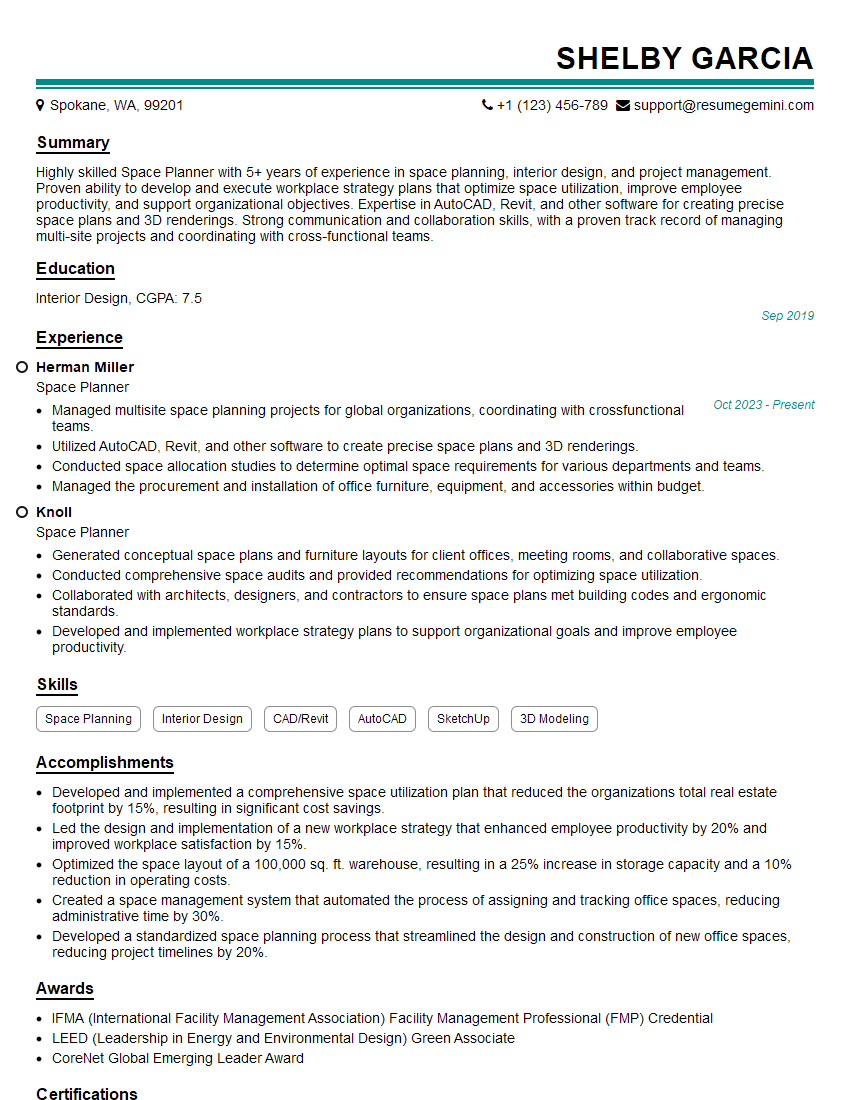
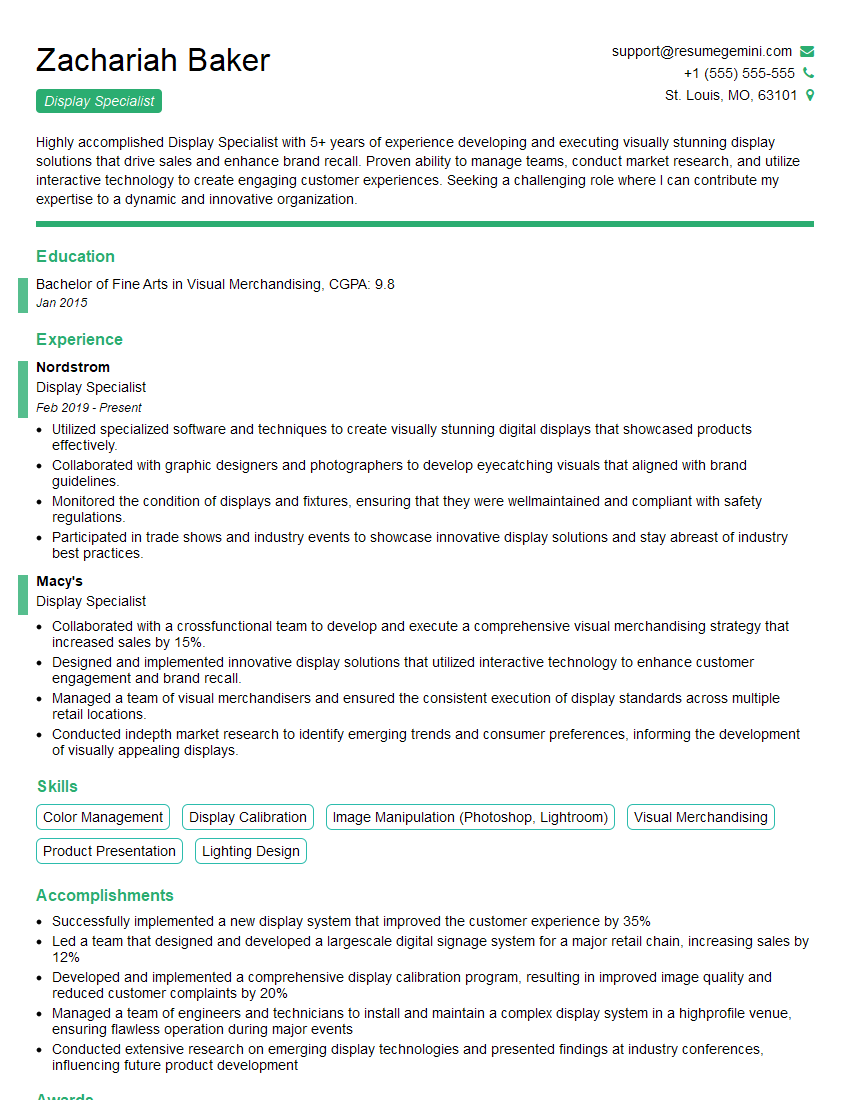
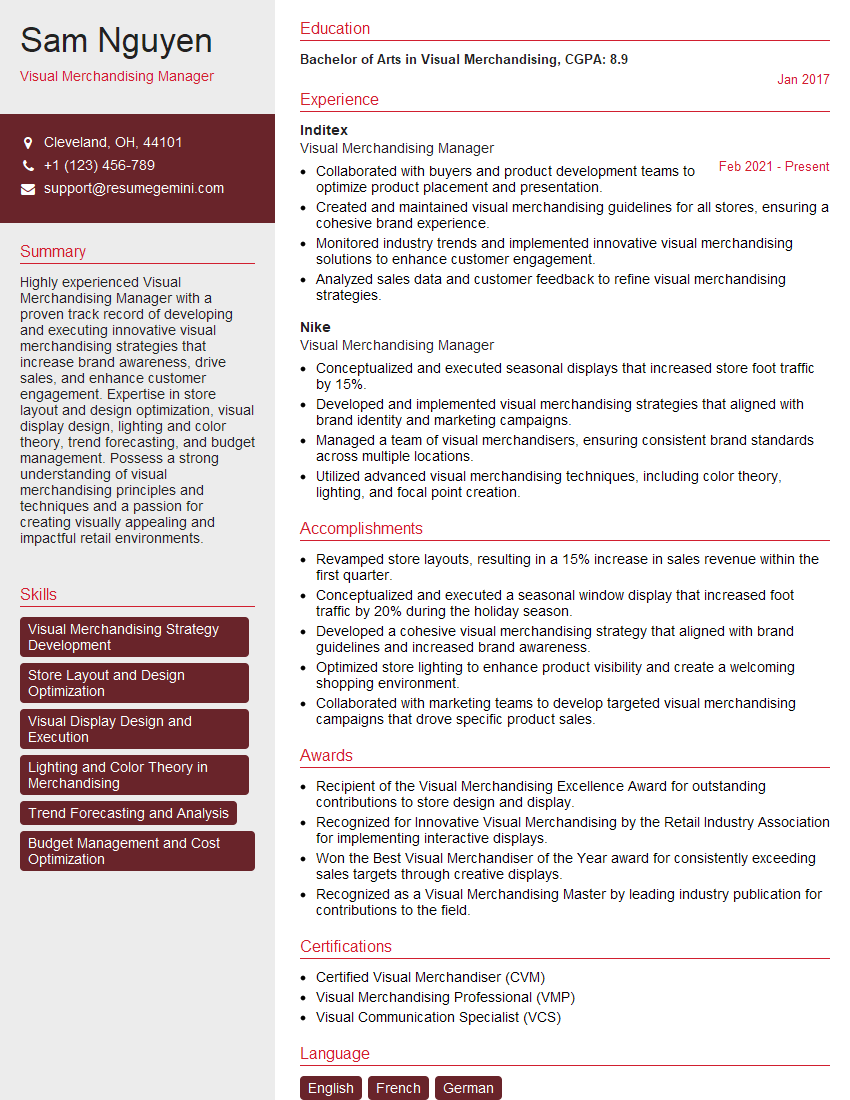
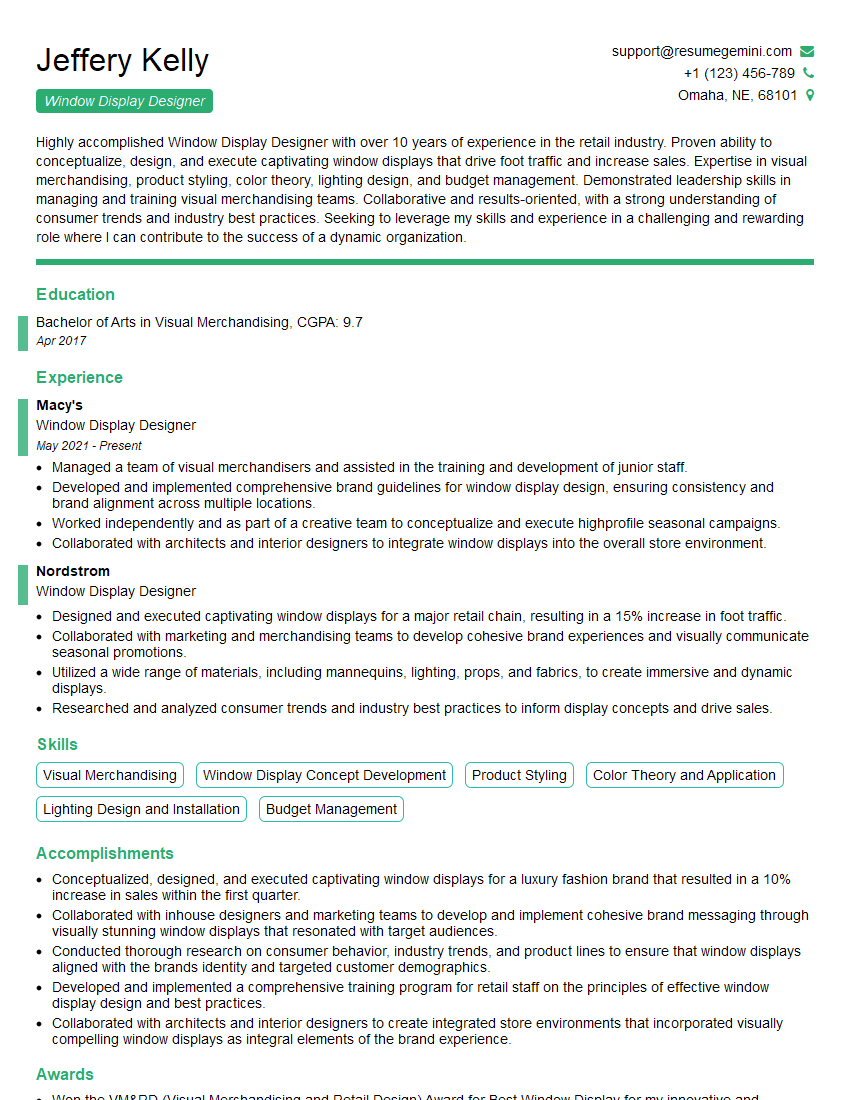
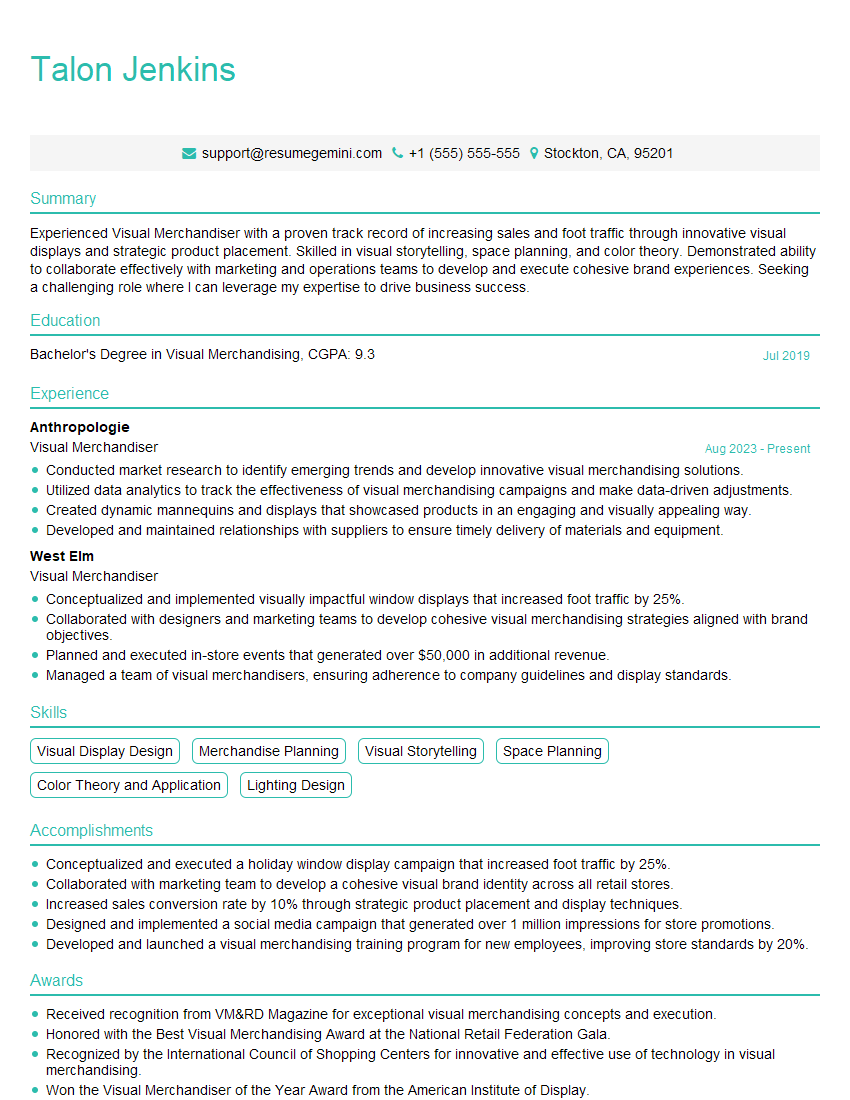
Mastering In-Store Product Display opens doors to exciting career opportunities in visual merchandising, retail management, and brand marketing. A strong resume is your key to unlocking these opportunities. Creating an ATS-friendly resume is crucial for getting your application noticed by recruiters. To help you build a compelling and effective resume, we recommend using ResumeGemini. ResumeGemini provides a user-friendly platform and offers examples of resumes tailored to In-Store Product Display, ensuring your qualifications shine. Invest time in crafting a professional resume – it’s an investment in your future.
Explore more articles
Users Rating of Our Blogs
Share Your Experience
We value your feedback! Please rate our content and share your thoughts (optional).
What Readers Say About Our Blog
Attention music lovers!
Wow, All the best Sax Summer music !!!
Spotify: https://open.spotify.com/artist/6ShcdIT7rPVVaFEpgZQbUk
Apple Music: https://music.apple.com/fr/artist/jimmy-sax-black/1530501936
YouTube: https://music.youtube.com/browse/VLOLAK5uy_noClmC7abM6YpZsnySxRqt3LoalPf88No
Other Platforms and Free Downloads : https://fanlink.tv/jimmysaxblack
on google : https://www.google.com/search?q=22+AND+22+AND+22
on ChatGPT : https://chat.openai.com?q=who20jlJimmy20Black20Sax20Producer
Get back into the groove with Jimmy sax Black
Best regards,
Jimmy sax Black
www.jimmysaxblack.com
Hi I am a troller at The aquatic interview center and I suddenly went so fast in Roblox and it was gone when I reset.
Hi,
Business owners spend hours every week worrying about their website—or avoiding it because it feels overwhelming.
We’d like to take that off your plate:
$69/month. Everything handled.
Our team will:
Design a custom website—or completely overhaul your current one
Take care of hosting as an option
Handle edits and improvements—up to 60 minutes of work included every month
No setup fees, no annual commitments. Just a site that makes a strong first impression.
Find out if it’s right for you:
https://websolutionsgenius.com/awardwinningwebsites
Hello,
we currently offer a complimentary backlink and URL indexing test for search engine optimization professionals.
You can get complimentary indexing credits to test how link discovery works in practice.
No credit card is required and there is no recurring fee.
You can find details here:
https://wikipedia-backlinks.com/indexing/
Regards
NICE RESPONSE TO Q & A
hi
The aim of this message is regarding an unclaimed deposit of a deceased nationale that bears the same name as you. You are not relate to him as there are millions of people answering the names across around the world. But i will use my position to influence the release of the deposit to you for our mutual benefit.
Respond for full details and how to claim the deposit. This is 100% risk free. Send hello to my email id: lukachachibaialuka@gmail.com
Luka Chachibaialuka
Hey interviewgemini.com, just wanted to follow up on my last email.
We just launched Call the Monster, an parenting app that lets you summon friendly ‘monsters’ kids actually listen to.
We’re also running a giveaway for everyone who downloads the app. Since it’s brand new, there aren’t many users yet, which means you’ve got a much better chance of winning some great prizes.
You can check it out here: https://bit.ly/callamonsterapp
Or follow us on Instagram: https://www.instagram.com/callamonsterapp
Thanks,
Ryan
CEO – Call the Monster App
Hey interviewgemini.com, I saw your website and love your approach.
I just want this to look like spam email, but want to share something important to you. We just launched Call the Monster, a parenting app that lets you summon friendly ‘monsters’ kids actually listen to.
Parents are loving it for calming chaos before bedtime. Thought you might want to try it: https://bit.ly/callamonsterapp or just follow our fun monster lore on Instagram: https://www.instagram.com/callamonsterapp
Thanks,
Ryan
CEO – Call A Monster APP
To the interviewgemini.com Owner.
Dear interviewgemini.com Webmaster!
Hi interviewgemini.com Webmaster!
Dear interviewgemini.com Webmaster!
excellent
Hello,
We found issues with your domain’s email setup that may be sending your messages to spam or blocking them completely. InboxShield Mini shows you how to fix it in minutes — no tech skills required.
Scan your domain now for details: https://inboxshield-mini.com/
— Adam @ InboxShield Mini
support@inboxshield-mini.com
Reply STOP to unsubscribe
Hi, are you owner of interviewgemini.com? What if I told you I could help you find extra time in your schedule, reconnect with leads you didn’t even realize you missed, and bring in more “I want to work with you” conversations, without increasing your ad spend or hiring a full-time employee?
All with a flexible, budget-friendly service that could easily pay for itself. Sounds good?
Would it be nice to jump on a quick 10-minute call so I can show you exactly how we make this work?
Best,
Hapei
Marketing Director
Hey, I know you’re the owner of interviewgemini.com. I’ll be quick.
Fundraising for your business is tough and time-consuming. We make it easier by guaranteeing two private investor meetings each month, for six months. No demos, no pitch events – just direct introductions to active investors matched to your startup.
If youR17;re raising, this could help you build real momentum. Want me to send more info?
Hi, I represent an SEO company that specialises in getting you AI citations and higher rankings on Google. I’d like to offer you a 100% free SEO audit for your website. Would you be interested?
Hi, I represent an SEO company that specialises in getting you AI citations and higher rankings on Google. I’d like to offer you a 100% free SEO audit for your website. Would you be interested?