Are you ready to stand out in your next interview? Understanding and preparing for Electrotyping interview questions is a game-changer. In this blog, we’ve compiled key questions and expert advice to help you showcase your skills with confidence and precision. Let’s get started on your journey to acing the interview.
Questions Asked in Electrotyping Interview
Q 1. Explain the electrotyping process step-by-step.
Electrotyping is a process of creating a highly accurate metal duplicate of an original object, typically a printing plate. It’s like making a perfect metal copy of a master image. Here’s a step-by-step breakdown:
- Mold Making: A mold of the original object is created using materials like wax, resin, or a special electroforming solution. This mold captures every detail of the original.
- Mold Preparation: The mold is carefully cleaned and treated. This might involve applying a conductive layer, often graphite, to ensure proper electrical contact during the electroplating process. Think of this as prepping the canvas for a painting.
- Electroplating: The prepared mold is immersed in an electrolyte solution containing metal ions (usually nickel, copper, or a combination). A direct current is applied, causing the metal ions to deposit onto the mold, forming a thin layer. This is where the magic happens – the metal grows layer by layer, conforming perfectly to the mold’s shape.
- Backing: Once the desired thickness is achieved, a backing layer, usually a more robust metal like lead, is added to reinforce the electrotype. This ensures durability for printing or other applications.
- Separation and Finishing: The electrotype is carefully separated from the mold. Any excess material is trimmed or filed, and the surface might be polished to achieve a high-quality finish. This step reveals the perfect metal replica!
Q 2. What are the different types of electrotyping solutions used?
The choice of electrotyping solution depends on the desired properties of the final electrotype. Common solutions include:
- Nickel sulfate solutions: Produce hard, durable electrotypes with excellent wear resistance. This is a popular choice for printing plates where long life is important.
- Copper sulfate solutions: Provide a relatively fast deposition rate, offering a cost-effective option. They are less hard-wearing than nickel, hence used less frequently for printing.
- Acid copper baths: These offer improved conductivity and a smoother deposit compared to the sulfate counterpart, particularly useful for high-fidelity reproductions.
- Proprietary solutions: Several manufacturers offer specialized solutions often containing additives to improve properties like brightness, ductility, or stress reduction in the electrotype.
The choice often involves balancing cost, deposition rate, and the desired mechanical and aesthetic properties of the final product.
Q 3. Describe the role of current density in electrotyping.
Current density, measured in amperes per square decimeter (A/dm²), is crucial in electrotyping. It dictates the rate of metal deposition and significantly influences the quality of the electrotype. A higher current density generally leads to faster deposition but might also result in a rougher, less refined surface finish or even cause defects like burning or pitting. Conversely, a lower current density results in slower deposition but improves the smoothness and quality of the electrotype, similar to the difference between a quick, rough sketch and a meticulously detailed drawing. Finding the optimal current density is key to achieving the desired balance between speed and quality, which usually needs to be tailored to the specific electroplating bath and the object being replicated.
Q 4. How do you control the thickness of the electrotyped deposit?
Thickness control in electrotyping is achieved by carefully managing several factors:
- Current Density: As explained earlier, a lower current density leads to slower deposition and thinner electrotypes.
- Electroplating Time: Longer plating times naturally result in thicker deposits. Precise timers are crucial for consistent thickness.
- Solution Composition and Temperature: Optimized electrolyte composition and temperature influence the deposition rate and therefore affect thickness.
- Monitoring and Measurement: Regular monitoring of the plating process and measurements using techniques like micrometers ensure accurate thickness control. This is especially important for high-precision applications.
For example, a thick electrotype might be needed for durable printing plates that will withstand many impressions, whereas a thinner electrotype might suffice for a decorative element.
Q 5. What are the common defects encountered in electrotyping and how are they addressed?
Several defects can occur during electrotyping. Here are some common ones and their solutions:
- Pitting: Small holes or pits on the surface, often caused by impurities in the solution or insufficient cleaning of the mold. Solution: Thorough cleaning of the mold, filtering the electrolyte solution, and adjusting the current density.
- Burning: Irregularities and uneven surface caused by excessively high current density. Solution: Reducing the current density and ensuring adequate agitation of the solution.
- Roughness: An uneven, coarse surface, often due to high current density or poor mold preparation. Solution: Reducing the current density, improving mold preparation (e.g., better graphite application), and optimizing the electrolyte bath composition.
- Treeing: Irregular, dendritic growths of metal, caused by localized high current density. Solution: Optimizing the bath conditions and reducing the current density.
- Nodules: Small, irregular growths on the surface, caused by impurities or poor agitation. Solution: Improving solution filtration and agitation.
Defect analysis is critical, identifying the root cause and implementing necessary adjustments.
Q 6. Explain the importance of substrate preparation in electrotyping.
Substrate preparation is paramount in electrotyping. It directly impacts the quality, adhesion, and overall success of the process. Think of it as laying a foundation for a house – a poor foundation will lead to structural problems. Inadequate substrate preparation can result in poor adhesion of the electroplated layer, leading to peeling or separation. The key is to create a surface that is perfectly clean, free from contaminants, and electrically conductive. Common methods involve thorough cleaning, sometimes using ultrasonic baths, and applying a conductive layer (e.g., graphite) to ensure a strong bond between the mold and the electroplated metal. A smooth, clean surface guarantees a superior quality electrotype.
Q 7. What are the different types of substrates used in electrotyping?
Various substrates are used in electrotyping, depending on the original object and the intended use of the electrotype. These include:
- Wax: A common material for creating molds, particularly for objects with intricate detail. It’s relatively inexpensive and easy to work with, but it’s less durable than some other options.
- Resins: Offer better dimensional stability and durability compared to wax, and are often used for more demanding applications.
- Electroforming solutions: Specialized conductive solutions can be used to create molds directly, offering high-fidelity reproduction.
- Metals: In some instances, a metal master might be directly used as a substrate, eliminating the mold-making step. This often occurs when working with already-existing metal prototypes.
The substrate choice involves considering the complexity of the original object, the desired quality and durability of the electrotype, and the overall cost-effectiveness of the process.
Q 8. How do you determine the appropriate electroplating solution for a specific application?
Selecting the right electroplating solution is crucial for a successful electrotyping process. The choice depends heavily on the base material, the desired metal layer properties (thickness, hardness, corrosion resistance), and the overall application. For example, copper sulfate solutions are commonly used for copper electrotyping due to their relatively low cost and ease of use. Nickel solutions provide greater hardness and corrosion resistance, making them suitable for applications requiring durability. Gold electroplating is chosen for its excellent conductivity and corrosion resistance in electronics.
The decision-making process involves considering several factors:
- Base Material: The solution must be compatible with the material being electrotyped (e.g., a wax mold, a master plate). A solution that reacts aggressively with the base material will ruin the process.
- Desired Metal: Different metals require different solutions. Copper, nickel, silver, gold, and chromium are common choices, each with its specific electrolyte.
- Required Properties: Do you need a highly conductive layer? A corrosion-resistant layer? A hard, wear-resistant layer? These requirements dictate the metal and the solution composition.
- Cost: Some solutions, like those containing precious metals, are significantly more expensive than others.
Often, a trial-and-error approach, combined with established industry best practices and datasheets provided by chemical suppliers, is necessary to optimize the solution for a specific application. It’s not uncommon to adjust parameters like current density, temperature, and solution concentration to fine-tune the plating process.
Q 9. Describe the role of additives in electrotyping solutions.
Additives play a vital role in electrotyping solutions, modifying the plating process to achieve desired characteristics. They are usually organic compounds added in small concentrations. Think of them as fine-tuning the process. Without them, the deposited metal might be rough, porous, or prone to defects.
- Brighteners: These additives produce a smoother, brighter finish on the electrotyped layer. They often work by influencing the crystal growth process.
- Levelers: Levelers improve the uniformity of the deposit, especially on complex shapes, ensuring even thickness across all surfaces. This is critical for accurate replication.
- Stress Modifiers: Internal stresses in the electroplated layer can lead to cracking or warping. Stress modifiers adjust these stresses, improving the layer’s stability.
- Grain Refiners: These additives reduce the grain size of the deposited metal, enhancing its strength and hardness.
- Carriers: Some additives enhance the conductivity or stability of the plating bath.
The type and concentration of additives are carefully selected based on the specific application and desired properties. For example, a high-quality electrotype used for printing might require the use of several different additives to ensure a bright, smooth, and durable surface. Incorrect additive selection or concentration can lead to poor plating quality.
Q 10. What are the safety precautions involved in electrotyping?
Electrotyping involves working with chemicals and electrical currents, demanding strict adherence to safety protocols. The primary hazards include:
- Chemical Burns: Electroplating solutions are often corrosive and can cause severe burns to skin and eyes. Always wear appropriate personal protective equipment (PPE), including gloves, eye protection, and lab coats.
- Electrical Shock: The process involves handling electrical equipment and solutions that conduct electricity. Ensure all equipment is properly grounded, and never work with wet hands or near water.
- Inhalation Hazards: Some electroplating solutions release fumes or mists that can be harmful if inhaled. Work in a well-ventilated area or use respirators when necessary.
- Metal Toxicity: Depending on the metals used, exposure to certain metals (e.g., lead, chromium) can be toxic. Handle all materials carefully and dispose of waste according to local regulations.
Regular safety training and a well-maintained laboratory are crucial for preventing accidents. Emergency showers and eye wash stations should be readily available.
Q 11. How do you measure the thickness of the electrotyped layer?
Measuring the thickness of an electrotyped layer is essential for quality control. Several methods are available:
- Microscopy: Cross-sectional microscopy involves cutting a sample, polishing it, and examining it under a microscope to directly measure the layer’s thickness.
- Electrochemical Methods: Techniques like anodic stripping voltammetry can measure the amount of metal deposited, allowing calculation of the thickness.
- Magnetic Methods: For certain metals, magnetic methods can estimate the thickness based on magnetic properties.
- X-Ray Fluorescence (XRF): XRF is a non-destructive technique that measures the elemental composition and can determine the thickness of the layer.
The choice of method depends on factors such as the desired accuracy, the type of metal, the substrate material, and whether destructive testing is acceptable. In many industrial settings, a combination of techniques is used for verification and quality control.
Q 12. What is the difference between electrotyping and electroforming?
While both electrotyping and electroforming utilize electrodeposition, their purposes differ significantly. Electrotyping creates a replica of an object, essentially a copy. Electroforming creates a free-standing object from electrodeposition.
- Electrotyping: Starts with a master object (e.g., a printing plate, a coin). A conductive mold is made from this master, and a metal layer is deposited on the mold. This layer is then separated from the mold, creating an exact replica. Think of making multiple copies of a master stamp.
- Electroforming: Doesn’t use a master object in the same way. It builds up a metal layer on a mandrel or a form. After deposition, the mandrel is removed, leaving a free-standing, hollow metal object. This is how complex shapes are created in metal without machining.
In essence, electrotyping is about replication, while electroforming is about fabrication.
Q 13. Explain the concept of throwing power in electrotyping.
Throwing power in electrotyping refers to the ability of an electroplating solution to deposit a uniform layer of metal on an object with complex shapes or recesses. A solution with good throwing power will deposit metal evenly across all surfaces, even those that are shielded or difficult to reach. A solution with poor throwing power will result in a thicker layer in easily accessible areas and a thinner layer in recessed areas.
Think of throwing a ball – good throwing power means the ball lands evenly across a large, uneven area; poor throwing power means the ball lands unevenly, concentrating in areas closer to the thrower. Factors affecting throwing power include the solution’s conductivity, current density, and the presence of additives. Additives such as levelers are specifically designed to improve throwing power. It is crucial for obtaining consistent and high-quality electrotypes, particularly when dealing with intricate designs.
Q 14. How do you troubleshoot common problems in the electrotyping process?
Troubleshooting in electrotyping requires systematic investigation to identify the root cause of the problem. Common issues include:
- Rough or pitted deposits: This often indicates impurities in the solution, incorrect current density, or improper agitation.
- Uneven plating thickness: Could be due to poor throwing power, inadequate solution circulation, or masking issues.
- Burning or dendrite formation: Too high a current density can cause localized overheating, resulting in burning or dendrites (needle-like growths).
- Poor adhesion: Insufficient cleaning of the mold or an incompatible solution can lead to poor adhesion.
- Blistering or peeling: Internal stresses in the deposit or inadequate pre-treatment can cause blistering or peeling.
Troubleshooting involves:
- Careful observation: Inspect the electrotype for visual defects and note the location and characteristics of the problem.
- Analysis of parameters: Review the process parameters such as current density, temperature, agitation, and solution composition.
- Solution analysis: Test the electroplating solution for impurities or concentration variations.
- Process adjustments: Based on the analysis, adjust the process parameters.
- Re-plating: If the problem persists, the electrotyping process may need to be repeated.
Record-keeping is critical; documenting every step of the process allows for easier troubleshooting and identification of recurring problems.
Q 15. What are the environmental considerations related to electrotyping?
Electrotyping, while offering a precise replication method, does carry environmental considerations. The primary concern revolves around the chemicals used. We’re talking about solutions containing heavy metals like copper, nickel, and sometimes silver, along with acids and other electrolytes. Improper disposal of these solutions can lead to soil and water contamination, harming ecosystems and potentially human health. Another aspect is energy consumption. The process requires electricity for the electrolytic deposition, contributing to greenhouse gas emissions. Responsible electrotyping necessitates stringent waste management protocols and energy-efficient practices.
For example, in my previous role, we implemented a closed-loop system for recovering and recycling the plating solutions, significantly reducing our environmental footprint. We also invested in energy-efficient power supplies for our electroplating baths. This resulted in a substantial decrease in both waste and energy consumption.
Career Expert Tips:
- Ace those interviews! Prepare effectively by reviewing the Top 50 Most Common Interview Questions on ResumeGemini.
- Navigate your job search with confidence! Explore a wide range of Career Tips on ResumeGemini. Learn about common challenges and recommendations to overcome them.
- Craft the perfect resume! Master the Art of Resume Writing with ResumeGemini’s guide. Showcase your unique qualifications and achievements effectively.
- Don’t miss out on holiday savings! Build your dream resume with ResumeGemini’s ATS optimized templates.
Q 16. Describe the maintenance procedures for electrotyping equipment.
Maintaining electrotyping equipment is crucial for consistent product quality and operator safety. This involves regular cleaning of the plating baths to remove sludge and impurities that can affect the plating process. The anodes need periodic inspection and replacement to ensure even current distribution. We also check the rectifiers, ensuring they deliver the correct voltage and amperage. Regular inspections and calibration of temperature controllers are also crucial, as slight temperature fluctuations can impact plating quality. Safety measures, such as proper ventilation and the use of personal protective equipment (PPE) like gloves, goggles, and aprons, are paramount.
Think of it like maintaining a finely tuned engine; regular servicing ensures optimal performance. Ignoring maintenance can lead to equipment malfunction, poor-quality products, and even potential safety hazards.
Q 17. How do you ensure the quality of the electrotyped product?
Ensuring the quality of an electrotyped product involves a multi-faceted approach. It starts with the quality of the mandrel – a perfect replica needs a perfect original. We then monitor the plating process meticulously, controlling variables such as current density, temperature, and solution concentration. Regular thickness measurements throughout the process ensure the plating is uniform and meets specifications. After the plating, the electrotype is inspected for imperfections such as pitting, nodules, or uneven thickness. In my experience, microscopic examination is often necessary to identify subtle defects. Finally, a rigorous quality control process including dimensional checks and surface finish evaluation guarantees the final product meets the required standards.
For example, if we detect inconsistencies in thickness during the plating, we adjust parameters such as current density or solution agitation to correct the issue, ensuring the final product meets our quality standards.
Q 18. What are the advantages and disadvantages of electrotyping compared to other replication methods?
Electrotyping, compared to other replication methods like molding or casting, offers unique advantages and disadvantages. A major advantage is its ability to produce highly accurate, durable, and fine-detailed replicas. This makes it ideal for applications requiring high fidelity, such as printing plates or creating master copies for artwork. Electrotypes can also withstand multiple uses, unlike some other methods. However, electrotyping is a more complex and time-consuming process compared to simpler methods like molding. It also requires specialized equipment and skilled labor, making it a more expensive option.
Think of it like comparing hand-carved woodwork to mass-produced furniture. The hand-carved piece may be more expensive and time-consuming to produce, but the detail and quality are often unmatched.
Q 19. Describe your experience with different types of electrotyping mandrels.
My experience encompasses various mandrel types, each suited for specific applications. Wax mandrels, traditionally used, are relatively inexpensive but require careful handling to avoid distortion. We’ve also worked extensively with resin mandrels, offering improved durability and dimensional stability compared to wax. Metal mandrels, such as nickel or copper shells, provide the highest level of accuracy but come with a higher initial cost. The choice depends on the complexity of the original, the required number of replicas, and the budget.
For instance, when replicating intricate sculptures, we’d often choose resin mandrels for their robustness and accuracy, while for high-volume printing plate production, a more cost-effective wax mandrel might be suitable.
Q 20. Explain the importance of proper waste disposal in electrotyping.
Proper waste disposal in electrotyping is paramount for environmental protection and worker safety. Heavy metal-containing solutions cannot be disposed of in regular drains or landfills. We follow strict procedures adhering to all relevant environmental regulations. This includes neutralization of acidic solutions, separation of different waste streams, and utilizing specialized waste contractors licensed to handle hazardous materials. Regular monitoring and documentation of waste disposal are crucial for maintaining compliance.
Failing to adhere to these procedures can lead to severe environmental damage and legal repercussions. Safety is also paramount, as improper handling can expose workers to hazardous chemicals.
Q 21. How do you ensure the consistency of the electrotyping process?
Consistency in electrotyping is achieved through meticulous control of the process parameters. This includes maintaining precise temperature control of the plating baths, ensuring consistent current density across the mandrel, and using high-quality chemicals with precisely controlled concentrations. Regular monitoring of solution conductivity and pH is essential. We also implement stringent quality control measures at every stage, from mandrel preparation to final inspection. Statistical Process Control (SPC) techniques are employed to track key parameters and identify any deviations from the established norms. Consistent operator training is also crucial.
Think of it like baking a cake; consistent results require precise measurement and careful adherence to the recipe. Deviation from established parameters will result in inconsistent results.
Q 22. Describe your experience with different types of electroplating baths.
My experience with electroplating baths spans a wide range of chemistries, each tailored to specific metal deposition requirements. I’ve worked extensively with cyanide-based baths, primarily for gold and silver electrotyping, recognizing the importance of careful handling and disposal due to their toxicity. These baths provide excellent throwing power, ensuring uniform plating even on complex shapes. However, I’ve also become proficient in using more environmentally friendly alternatives like sulfamate and acid-based baths for nickel, copper, and chromium electrotyping. Acid baths, while potentially less forgiving in terms of throwing power, offer advantages in terms of operational cost and safety. Selecting the appropriate bath depends heavily on the base metal, the desired finish, and environmental regulations. For instance, for high-quality reproduction of fine detail, a cyanide-based silver bath might be preferred, whereas a nickel sulfamate bath might be chosen for its durability and ease of maintenance in a high-volume production setting.
- Cyanide Baths (Gold, Silver): Excellent throwing power, highly effective for intricate details, but require rigorous safety precautions.
- Acid Baths (Copper, Nickel, Chromium): Generally safer and more cost-effective, but throwing power may be less ideal for complex geometries. Careful control of pH and temperature is crucial.
- Sulfamate Baths (Nickel): Offer high plating rates and good deposit quality; a popular choice in industrial applications.
Q 23. What types of metals are commonly used in electrotyping?
Electrotyping commonly utilizes metals chosen for their specific properties, balancing cost-effectiveness with the desired outcome. Copper is a cornerstone metal due to its excellent conductivity, ease of plating, and relatively low cost, making it suitable for many applications. Nickel is frequently employed as an underplate to enhance durability, corrosion resistance, and provide a better base for subsequent plating of other metals like gold or silver. Silver is used for its high conductivity and reflectivity, making it ideal for applications requiring excellent signal transmission or high-fidelity reproduction. Gold is chosen for its excellent corrosion resistance and its inherent value, often used as a final layer to protect against oxidation and enhance the longevity of the electrotype. The choice of metal depends heavily on the intended use of the electrotype.
- Copper: Excellent conductivity and affordability, ideal for base layers.
- Nickel: Durability and corrosion resistance, often used as an underplate.
- Silver: High conductivity and reflectivity.
- Gold: Corrosion resistance and high value, often used as a final layer.
Q 24. How do you handle different types of metal alloys in electrotyping?
Handling different metal alloys in electrotyping requires a nuanced approach, adapting the plating process to the specific characteristics of each alloy. The composition of the alloy significantly influences its reactivity and plating behavior. For example, brass, an alloy of copper and zinc, may require a modified electroplating bath compared to pure copper to achieve a uniform and adherent deposit. Similarly, stainless steel’s chromium content impacts its passivation and requires careful pre-treatment, often including cleaning and activation steps, before electroplating. I use specialized pre-plating treatments and solutions to address issues like passivation layers and variations in alloy composition ensuring a strong bond between the electrotype and the base metal. Analyzing the specific alloy composition is crucial for selecting the appropriate electroplating parameters, like current density and bath composition. Failure to do so can result in poor adhesion, pitting, or uneven plating.
In practice, this often involves careful pre-treatment of the surface, perhaps through mechanical polishing or chemical etching, to remove oxides or other contaminants before the actual electroplating process. Precise control over bath chemistry, temperature, and current density is essential for successful plating.
Q 25. Describe your experience with automated electrotyping systems.
My experience with automated electrotyping systems encompasses working with computer-controlled plating lines equipped with automated handling and monitoring systems. These systems offer significant advantages over manual processes, including improved consistency, reduced labor costs, and increased throughput. I’m familiar with programmable logic controllers (PLCs) and supervisory control and data acquisition (SCADA) systems used to control and monitor plating parameters like current density, temperature, and solution concentration. These systems often integrate automated pre-treatment and post-treatment stages, optimizing the entire electrotyping process. Automated systems allow for precision control, leading to higher quality and more consistent electrotypes. Furthermore, they facilitate data logging for quality control purposes and enable the development of detailed process optimization strategies.
For example, I’ve worked with systems that automate the entire process from loading the substrate to final rinsing and drying, significantly improving productivity and reducing the risk of human error.
Q 26. What are the different applications of electrotyping in various industries?
Electrotyping finds applications across numerous industries, leveraging its ability to create high-fidelity replicas of complex shapes. In the printing industry, electrotypes are used to create durable printing plates for high-volume reproduction. In the electronics industry, they’re crucial for producing high-precision components, especially for integrated circuits and other microelectronics. The jewelry industry benefits from electrotyping for creating intricate designs and replicating valuable gemstones. In the automotive industry, it plays a role in producing decorative elements, and in the arts, electroforming is used to create unique sculptures and artwork. The versatility of electrotyping makes it a valuable technique in diverse fields requiring accurate reproduction of detailed three-dimensional objects.
- Printing: Creating durable printing plates.
- Electronics: Manufacturing precise components.
- Jewelry: Replicating designs and gemstones.
- Automotive: Creating decorative elements.
- Arts: Producing unique sculptures and artwork.
Q 27. How do you optimize the electrotyping process for specific applications?
Optimizing the electrotyping process for specific applications involves a multi-faceted approach, tailoring the process parameters to meet the unique demands of each project. This includes careful selection of the base metal and plating metals, precise control over bath chemistry, current density, and temperature, and consideration of the substrate’s characteristics. For instance, if creating a printing plate, optimizing for wear resistance would be paramount, potentially necessitating a thicker nickel underplate. Conversely, when replicating a delicate jewelry design, maintaining fine detail would be the primary concern, requiring a plating process with excellent throwing power and minimizing the risk of distortion. Data analysis and experimentation play a crucial role in determining the optimal parameters, often employing statistical methods to identify the most effective combinations of factors. The ultimate goal is to achieve the desired balance of cost-effectiveness, speed of production, and the quality of the final electrotype.
Q 28. Describe your experience with quality control testing in electrotyping.
Quality control in electrotyping is critical to ensure the final product meets the required specifications. This involves a series of tests throughout the process, starting with rigorous inspection of the original master form to identify any defects or imperfections that could affect the final electrotype. During the electroplating process, regular monitoring of bath chemistry, temperature, and current density is conducted to maintain consistent plating. After plating, destructive and non-destructive testing methods are employed. Non-destructive testing might involve visual inspection for surface defects, thickness measurements using non-contact methods, and conductivity testing. Destructive testing might involve cross-sectional analysis of the electrotype to evaluate the uniformity of the deposit and assess the adhesion between different layers. Microscopic examination can reveal structural defects, and mechanical tests such as tensile strength testing can be done to assess the durability of the electrotype. Data from these tests are crucial for continuous process improvement and maintaining high quality standards.
Key Topics to Learn for Electrotyping Interview
- Electrolyte Chemistry: Understanding the chemical reactions involved in the electroplating process, including factors influencing conductivity, current efficiency, and deposit quality. Consider different electrolyte types and their applications.
- Electrodeposition Principles: Grasping Faraday’s laws of electrolysis and their practical implications in controlling deposit thickness and uniformity. Explore the role of current density, voltage, and temperature.
- Substrate Preparation: Mastering surface cleaning, pre-treatment techniques (e.g., degreasing, etching), and their impact on adhesion and overall electrotype quality. Understand different substrate materials and their suitability.
- Mold Making and Replication: Familiarize yourself with the creation of molds (wax, resin, etc.) and the subsequent electroforming process. Understand the challenges and quality control measures involved in achieving precise replication.
- Troubleshooting and Quality Control: Developing a problem-solving approach to identify and rectify common issues such as pitting, nodules, and poor adhesion. Know the various inspection and testing methods used to ensure quality.
- Safety Procedures and Regulations: Demonstrate understanding of the safety precautions and regulatory compliance associated with handling chemicals, electricity, and heavy equipment.
- Applications of Electrotyping: Discuss the diverse applications of electrotyping across different industries, such as printing, manufacturing, and electronics. Be ready to provide specific examples.
Next Steps
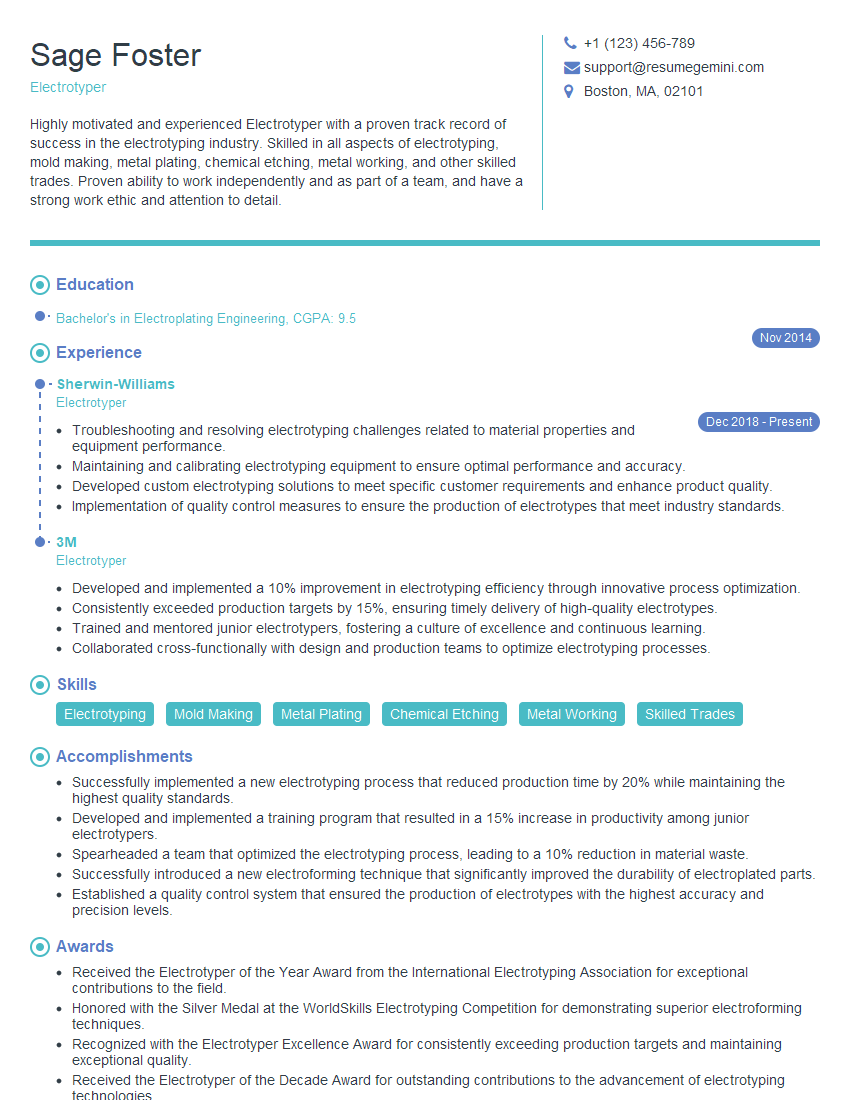
Mastering electrotyping opens doors to exciting career opportunities in a specialized and in-demand field. To maximize your job prospects, it’s crucial to present your skills effectively through a well-crafted resume. An ATS-friendly resume is key to getting noticed by potential employers. To help you build a strong and impactful resume, we recommend using ResumeGemini, a trusted resource for creating professional resumes. ResumeGemini provides examples of resumes tailored to the Electrotyping industry to guide you in showcasing your qualifications effectively.
Explore more articles
Users Rating of Our Blogs
Share Your Experience
We value your feedback! Please rate our content and share your thoughts (optional).
What Readers Say About Our Blog
Attention music lovers!
Wow, All the best Sax Summer music !!!
Spotify: https://open.spotify.com/artist/6ShcdIT7rPVVaFEpgZQbUk
Apple Music: https://music.apple.com/fr/artist/jimmy-sax-black/1530501936
YouTube: https://music.youtube.com/browse/VLOLAK5uy_noClmC7abM6YpZsnySxRqt3LoalPf88No
Other Platforms and Free Downloads : https://fanlink.tv/jimmysaxblack
on google : https://www.google.com/search?q=22+AND+22+AND+22
on ChatGPT : https://chat.openai.com?q=who20jlJimmy20Black20Sax20Producer
Get back into the groove with Jimmy sax Black
Best regards,
Jimmy sax Black
www.jimmysaxblack.com
Hi I am a troller at The aquatic interview center and I suddenly went so fast in Roblox and it was gone when I reset.
Hi,
Business owners spend hours every week worrying about their website—or avoiding it because it feels overwhelming.
We’d like to take that off your plate:
$69/month. Everything handled.
Our team will:
Design a custom website—or completely overhaul your current one
Take care of hosting as an option
Handle edits and improvements—up to 60 minutes of work included every month
No setup fees, no annual commitments. Just a site that makes a strong first impression.
Find out if it’s right for you:
https://websolutionsgenius.com/awardwinningwebsites
Hello,
we currently offer a complimentary backlink and URL indexing test for search engine optimization professionals.
You can get complimentary indexing credits to test how link discovery works in practice.
No credit card is required and there is no recurring fee.
You can find details here:
https://wikipedia-backlinks.com/indexing/
Regards
NICE RESPONSE TO Q & A
hi
The aim of this message is regarding an unclaimed deposit of a deceased nationale that bears the same name as you. You are not relate to him as there are millions of people answering the names across around the world. But i will use my position to influence the release of the deposit to you for our mutual benefit.
Respond for full details and how to claim the deposit. This is 100% risk free. Send hello to my email id: lukachachibaialuka@gmail.com
Luka Chachibaialuka
Hey interviewgemini.com, just wanted to follow up on my last email.
We just launched Call the Monster, an parenting app that lets you summon friendly ‘monsters’ kids actually listen to.
We’re also running a giveaway for everyone who downloads the app. Since it’s brand new, there aren’t many users yet, which means you’ve got a much better chance of winning some great prizes.
You can check it out here: https://bit.ly/callamonsterapp
Or follow us on Instagram: https://www.instagram.com/callamonsterapp
Thanks,
Ryan
CEO – Call the Monster App
Hey interviewgemini.com, I saw your website and love your approach.
I just want this to look like spam email, but want to share something important to you. We just launched Call the Monster, a parenting app that lets you summon friendly ‘monsters’ kids actually listen to.
Parents are loving it for calming chaos before bedtime. Thought you might want to try it: https://bit.ly/callamonsterapp or just follow our fun monster lore on Instagram: https://www.instagram.com/callamonsterapp
Thanks,
Ryan
CEO – Call A Monster APP
To the interviewgemini.com Owner.
Dear interviewgemini.com Webmaster!
Hi interviewgemini.com Webmaster!
Dear interviewgemini.com Webmaster!
excellent
Hello,
We found issues with your domain’s email setup that may be sending your messages to spam or blocking them completely. InboxShield Mini shows you how to fix it in minutes — no tech skills required.
Scan your domain now for details: https://inboxshield-mini.com/
— Adam @ InboxShield Mini
support@inboxshield-mini.com
Reply STOP to unsubscribe
Hi, are you owner of interviewgemini.com? What if I told you I could help you find extra time in your schedule, reconnect with leads you didn’t even realize you missed, and bring in more “I want to work with you” conversations, without increasing your ad spend or hiring a full-time employee?
All with a flexible, budget-friendly service that could easily pay for itself. Sounds good?
Would it be nice to jump on a quick 10-minute call so I can show you exactly how we make this work?
Best,
Hapei
Marketing Director
Hey, I know you’re the owner of interviewgemini.com. I’ll be quick.
Fundraising for your business is tough and time-consuming. We make it easier by guaranteeing two private investor meetings each month, for six months. No demos, no pitch events – just direct introductions to active investors matched to your startup.
If youR17;re raising, this could help you build real momentum. Want me to send more info?
Hi, I represent an SEO company that specialises in getting you AI citations and higher rankings on Google. I’d like to offer you a 100% free SEO audit for your website. Would you be interested?
Hi, I represent an SEO company that specialises in getting you AI citations and higher rankings on Google. I’d like to offer you a 100% free SEO audit for your website. Would you be interested?