The right preparation can turn an interview into an opportunity to showcase your expertise. This guide to Irrigating Crops interview questions is your ultimate resource, providing key insights and tips to help you ace your responses and stand out as a top candidate.
Questions Asked in Irrigating Crops Interview
Q 1. Explain the difference between drip and sprinkler irrigation.
Drip and sprinkler irrigation are two common methods for delivering water to crops, but they differ significantly in their application techniques and water efficiency. Drip irrigation, also known as micro-irrigation, delivers water directly to the plant roots through a network of tubes and emitters. This targeted approach minimizes water loss through evaporation and runoff. Imagine a slow, steady drip of water at the base of each plant, like a personalized watering can. In contrast, sprinkler irrigation distributes water through a series of sprinklers that spray water over a larger area. While more convenient for larger fields, it’s less efficient because a significant portion of the water evaporates before reaching the soil, especially in windy conditions. Think of a lawn sprinkler – water is sprayed widely, with some inevitably falling on bare ground.
The main differences can be summarized as follows:
- Water Efficiency: Drip irrigation is significantly more efficient, reducing water waste. Sprinkler irrigation loses more water to evaporation and runoff.
- Application Method: Drip irrigation delivers water directly to the roots; sprinkler irrigation sprays water over a wider area.
- Cost: Drip irrigation systems tend to have a higher initial cost but lower operational costs due to water savings. Sprinkler systems are generally less expensive to install but more costly to operate.
- Suitability: Drip irrigation is ideal for row crops, orchards, and high-value crops where water conservation is paramount. Sprinkler irrigation is suitable for larger fields and crops that tolerate overhead watering.
Q 2. Describe the principles of water infiltration and its impact on irrigation scheduling.
Water infiltration is the process by which water moves from the soil surface into the soil profile. It’s governed by several factors including soil texture, soil structure, organic matter content, and the intensity of the irrigation application. Sandy soils, for example, have larger pore spaces and thus higher infiltration rates than clay soils, which have smaller pore spaces and slower infiltration rates. Understanding infiltration is critical for irrigation scheduling because it directly affects how much water the soil can absorb and how much will run off.
Impact on Irrigation Scheduling: If infiltration is slow, it means the soil is not quickly absorbing the water delivered by the irrigation system. This leads to increased runoff, potentially causing soil erosion and nutrient loss. A good irrigation schedule therefore considers the soil’s infiltration rate. To compensate for slow infiltration, you might need to use a slower application rate, applying water over a longer period to allow the soil to fully absorb the water. Conversely, if infiltration is rapid, you may need shorter irrigation times to prevent deep percolation and unnecessary water use. This knowledge allows for designing efficient and effective irrigation schedules tailored to specific soil conditions. For example, using a soil moisture sensor coupled with an infiltration rate calculation enables precise timing and duration of irrigation events to optimize water use while ensuring adequate moisture for crop growth. Ignoring infiltration leads to either under-watering, causing stress on plants, or over-watering, resulting in leaching of nutrients and wasted water.
Q 3. What are the key factors to consider when designing an irrigation system for a specific crop?
Designing an effective irrigation system involves careful consideration of several key factors:
- Crop Water Requirements: The specific water needs of the crop vary depending on the species, growth stage, and climate. For example, a water-intensive crop like rice requires far more water than a drought-tolerant crop like barley.
- Soil Type and Properties: Soil texture, structure, and water-holding capacity determine the frequency and amount of irrigation needed. Sandy soils require more frequent irrigation than clay soils.
- Climate Conditions: Temperature, rainfall, humidity, wind speed, and solar radiation all influence evapotranspiration (ET), a key factor in determining irrigation needs. Hot, dry, and windy conditions will increase ET and thus irrigation requirements.
- Topography: The slope of the land affects water distribution and can influence the type of irrigation system best suited for the site. Steep slopes may require terracing or other techniques to prevent erosion and efficient water delivery.
- Water Source and Availability: The quality and quantity of available water, along with its accessibility, determine the feasibility of different irrigation options. A reliable water source with sufficient capacity is essential for a successful system.
- Economic Considerations: Initial investment costs, operational expenses, and potential return on investment must be considered when selecting an irrigation system.
- Environmental Concerns: Minimizing water waste, preventing salt accumulation in the soil, and reducing the impact on the surrounding environment are vital aspects of the design process.
Q 4. How do you calculate the water requirement for a particular crop?
Calculating crop water requirements is crucial for efficient irrigation management. Several methods exist, with varying levels of complexity. A simplified approach involves using crop coefficients (Kc) and reference evapotranspiration (ET0) data. ET0 represents the evapotranspiration of a reference crop (often short grass) under specific climate conditions. This data is often obtained from weather stations or meteorological databases. The crop coefficient (Kc) is a factor that adjusts ET0 to reflect the specific water requirements of the target crop at different growth stages. Crop coefficients are obtained from literature or experimental data.
The calculation is straightforward: Crop water requirement (ETc) = ET0 * Kc
Example: Let’s say ET0 is 5 mm/day, and the Kc for a particular crop at its current growth stage is 1.2. Then, the crop water requirement is: ETc = 5 mm/day * 1.2 = 6 mm/day. This means the crop needs 6 mm of water per day to maintain optimal growth. Remember that this is a simplified example. More accurate estimations involve considering factors like soil water content, drainage, and plant growth stage more comprehensively, often using more sophisticated models and sensors.
Q 5. Explain the concept of evapotranspiration and its role in irrigation management.
Evapotranspiration (ET) is the combined process of water loss from the soil surface through evaporation and water loss from plants through transpiration. It’s a crucial factor in determining a crop’s water needs and therefore plays a pivotal role in irrigation management. Evaporation is the loss of water from the soil surface into the atmosphere, while transpiration is the process by which plants release water vapor through their leaves. Think of it as the plant ‘breathing’ out water. Both processes are driven by environmental factors such as temperature, humidity, solar radiation, and wind speed.
Role in Irrigation Management: Accurate estimation of ET is vital for efficient irrigation scheduling. By monitoring ET, irrigators can determine how much water is being lost from the soil-plant system and adjust irrigation accordingly. Regular ET monitoring helps prevent both under-watering (leading to crop stress and reduced yields) and over-watering (resulting in water wastage, nutrient leaching, and potential soil salinity problems). ET data, combined with soil moisture measurements, can inform precision irrigation strategies, optimizing water use while maintaining optimum crop growth. Techniques like using weather stations and employing crop coefficients allow for reasonably accurate ET estimates to be incorporated into sophisticated irrigation scheduling programs.
Q 6. What are the common methods for measuring soil moisture?
Several methods are used to measure soil moisture, each with its advantages and disadvantages:
- Gravimetric Method: This involves collecting a soil sample, weighing it, drying it in an oven, and then weighing it again. The difference in weight represents the soil water content. This is accurate but time-consuming and destructive.
- Tensiometers: These measure the soil water tension (suction) – a measure of how tightly the soil holds onto water. They provide a continuous reading of soil water availability but are only accurate over a specific soil moisture range.
- Time Domain Reflectometry (TDR): This uses electromagnetic pulses to measure the dielectric constant of the soil, which is related to the soil water content. It’s a rapid and relatively accurate method, but the equipment is relatively expensive.
- Neutron Probes: These emit neutrons that interact with hydrogen atoms in the soil water. The backscattered radiation is measured and used to calculate soil water content. These are very accurate, but require specialized training and are expensive.
- Soil Moisture Sensors: These are increasingly common in modern irrigation systems. They measure soil moisture volumetrically or gravimetrically and provide real-time data that can be used to automatically control irrigation schedules. These are becoming increasingly popular for precision irrigation.
Q 7. Describe different types of irrigation scheduling methods.
Different methods exist for scheduling irrigation, each with its own merits and drawbacks:
- Calendar-Based Scheduling: This involves irrigating at fixed intervals, regardless of actual soil moisture conditions. This is the simplest method but the least efficient, potentially leading to over- or under-watering.
- Soil Moisture-Based Scheduling: This involves monitoring soil moisture using sensors or other methods and irrigating only when the soil moisture content drops below a predetermined threshold. This is more efficient than calendar-based scheduling.
- Evapotranspiration-Based Scheduling: This involves using weather data and crop coefficients to estimate the crop’s water requirements and schedule irrigation accordingly. This is a more sophisticated approach that considers climatic variables influencing ET.
- Crop Coefficient-Based Scheduling: This relies on data specific to plant type and growth stage to determine how much water is needed. It is more precise than generalized methods but requires knowledge of the specific crop and the use of appropriate crop coefficients.
- Irrigation Scheduling Software/Apps: These utilize climate data, sensor data, and various algorithms to provide more refined and precise irrigation scheduling recommendations. They often offer significant improvements over manual methods and allow for the integration of weather forecasts into the decision-making process.
The choice of scheduling method depends on the specific crop, soil conditions, climate, available resources, and level of technological sophistication. Many modern irrigation systems now utilize a combination of methods to optimize water use and maximize crop yields.
Q 8. How do you determine the appropriate irrigation frequency and duration?
Determining the right irrigation frequency and duration is crucial for optimal crop growth and efficient water use. It’s not a one-size-fits-all approach; it depends heavily on several factors. Think of it like watering your houseplants – you wouldn’t water a cactus as often as an orchid.
- Soil type: Sandy soils drain quickly, requiring more frequent but shorter irrigation cycles. Clay soils retain water longer, needing less frequent but longer watering sessions.
- Climate: Hot, windy conditions increase evapotranspiration (water loss from plants and soil), necessitating more frequent irrigation. Cooler, humid climates require less frequent watering.
- Crop type: Different plants have different water requirements. A water-intensive crop like corn needs much more irrigation than a drought-tolerant crop like sorghum.
- Growth stage: Young seedlings typically need less water than mature plants, which have larger root systems and higher transpiration rates. Irrigation scheduling should adapt to these growth stages.
- Soil moisture monitoring: This is the most accurate way to determine irrigation needs. Tools like soil moisture sensors provide real-time data on soil water content, guiding irrigation decisions.
For example, a farmer growing tomatoes in sandy soil during a hot summer might need to irrigate daily for short durations, while the same farmer growing wheat in clay soil during a cooler season might irrigate only once a week for a longer period.
Q 9. What are the advantages and disadvantages of using different irrigation technologies (e.g., drip, sprinkler, subsurface)?
Different irrigation technologies offer unique advantages and disadvantages. The best choice depends on factors like crop type, soil conditions, water availability, and budget.
- Drip Irrigation:
- Advantages: High water use efficiency, minimizes water loss through evaporation and runoff, delivers water directly to plant roots, suitable for various terrains.
- Disadvantages: Higher initial cost compared to sprinklers, can clog easily, may require more maintenance, not suitable for all crops (e.g., crops requiring high rainfall simulation).
- Sprinkler Irrigation:
- Advantages: Relatively low cost, easy to install and maintain, suitable for larger areas, can be used for various crops.
- Disadvantages: Higher water loss through evaporation and wind drift, can wet foliage, leading to disease problems, not as efficient as drip irrigation.
- Subsurface Irrigation:
- Advantages: High water use efficiency, minimizes evaporation losses, reduces weed growth, less affected by wind.
- Disadvantages: High installation costs, requires precise design and installation, limited suitability depending on soil conditions and crops, potential for salinity buildup.
For instance, a high-value vineyard might benefit from the precise water delivery of drip irrigation, while a large field of wheat could be effectively irrigated using sprinklers, balancing cost and efficiency.
Q 10. How do you troubleshoot common irrigation system problems (e.g., leaks, clogging, low pressure)?
Troubleshooting irrigation system problems requires a systematic approach. Think of it like diagnosing a car problem – you need to identify the symptoms and then find the root cause.
- Leaks: Regularly inspect pipes and fittings for cracks or loose connections. Use a pressure test to pinpoint leaks in buried lines.
- Clogging: Flush the system regularly to remove debris. Use filters to prevent clogging. For drip systems, check emitters for blockages.
- Low pressure: Check the pump for proper function. Inspect the system for leaks that reduce pressure. Ensure the valves are open properly.
Example: If you notice a section of your lawn isn’t getting enough water, you’d first check the sprinkler heads in that area for clogs. If that doesn’t solve it, you’d then inspect the pipes leading to that section for leaks or blockages.
Q 11. Explain the importance of water quality in irrigation.
Water quality is paramount in irrigation. Just like you wouldn’t drink contaminated water, plants can’t thrive on poor quality irrigation water.
- Salinity: High salt concentrations can damage plants and reduce yields. Regular monitoring of salinity levels is crucial.
- pH: Extreme pH levels can affect nutrient availability and plant health. Adjusting pH to the optimal range is essential.
- Nutrients: Irrigation water may contain essential nutrients or harmful substances. Understanding the nutrient content is crucial for proper fertilization strategies.
- Pathogens: Contaminated water can introduce diseases to plants. Proper water treatment or source selection is necessary to prevent this.
For example, using water with high sodium levels can lead to soil salinity, hindering water uptake by plant roots. Regular water testing and appropriate soil amendments can mitigate this.
Q 12. What are the environmental concerns associated with irrigation?
Irrigation, while essential for food production, has significant environmental concerns.
- Water depletion: Over-extraction of groundwater for irrigation can lead to aquifer depletion and land subsidence.
- Salinization: Irrigation water often contains salts, which can accumulate in soils, reducing soil fertility and affecting water quality.
- Nutrient runoff: Excess fertilizers and pesticides applied to irrigated fields can run off into waterways, causing water pollution and harming aquatic ecosystems.
- Greenhouse gas emissions: Energy consumption for pumping and distributing irrigation water contributes to greenhouse gas emissions.
Sustainable irrigation practices, such as water-efficient technologies and precision irrigation techniques, are crucial to minimize these negative impacts. Responsible water management is key for environmental protection.
Q 13. How can you improve irrigation efficiency?
Improving irrigation efficiency involves implementing practices that maximize water use while minimizing water loss and environmental impact.
- Water-efficient technologies: Switching to drip or subsurface irrigation systems can significantly reduce water waste.
- Precision irrigation: Using soil moisture sensors and weather data to schedule irrigation precisely meets crop needs and avoids overwatering.
- Proper system maintenance: Regularly checking for leaks, cleaning filters, and repairing damaged components prevents water loss and ensures efficient operation.
- Water harvesting: Collecting rainwater can supplement irrigation water, reducing reliance on other sources.
- Mulching: Applying mulch around plants reduces evaporation and helps retain soil moisture.
For example, installing a pressure-compensating drip irrigation system ensures uniform water distribution, preventing overwatering in some areas while under-watering others.
Q 14. What are the different types of irrigation controllers and their functionalities?
Irrigation controllers automate the irrigation process, improving efficiency and convenience. They vary in complexity and features.
- Time-clock controllers: These simple controllers turn the system on and off at pre-programmed times, regardless of weather conditions or soil moisture.
- Sensor-based controllers: These controllers use sensors (e.g., soil moisture, rain sensors) to adjust irrigation based on real-time conditions, optimizing water use.
- Smart controllers: These controllers incorporate weather data, evapotranspiration models, and other factors to create highly customized and efficient irrigation schedules. They often offer remote monitoring and control.
A farmer with a large field might use a smart controller that integrates weather data and soil moisture sensors to optimize irrigation scheduling and minimize water waste, while a homeowner might use a simple time-clock controller for a small residential lawn.
Q 15. Describe your experience with maintaining and repairing irrigation equipment.
Maintaining and repairing irrigation equipment is crucial for efficient and reliable water delivery. My experience encompasses a wide range of tasks, from routine maintenance like cleaning filters and inspecting pumps to more complex repairs involving pipe replacements and controller troubleshooting. I’m proficient in working with various irrigation system components, including center pivots, drip irrigation systems, and sprinkler systems. For instance, I once diagnosed a significant drop in water pressure in a large center pivot system. Through systematic checks, I identified a partially clogged main line, which I successfully cleared, restoring optimal irrigation performance. My approach involves preventative maintenance schedules to minimize breakdowns, and a thorough understanding of hydraulics and electrical systems ensures timely and effective repairs. I also possess the skills to interpret technical manuals and schematics for various brands of equipment, which is crucial for complex repairs.
Career Expert Tips:
- Ace those interviews! Prepare effectively by reviewing the Top 50 Most Common Interview Questions on ResumeGemini.
- Navigate your job search with confidence! Explore a wide range of Career Tips on ResumeGemini. Learn about common challenges and recommendations to overcome them.
- Craft the perfect resume! Master the Art of Resume Writing with ResumeGemini’s guide. Showcase your unique qualifications and achievements effectively.
- Don’t miss out on holiday savings! Build your dream resume with ResumeGemini’s ATS optimized templates.
Q 16. How do you monitor and evaluate the effectiveness of an irrigation system?
Monitoring and evaluating irrigation system effectiveness involves a multi-faceted approach. I begin with regular visual inspections, checking for leaks, clogged emitters, and proper sprinkler function. Beyond visual checks, I use soil moisture sensors to assess the actual water content in the root zone, comparing it to the target soil moisture level for optimal crop growth. I also employ techniques like measuring water application rates using catch cans at various points within the field to ensure uniform water distribution. Yield monitoring and crop growth assessments provide important feedback on the overall effectiveness of the irrigation strategy. For example, I once identified an area of inconsistent water application in a field using catch cans. This led to adjusting the emitter spacing and pressure, which resulted in a significant improvement in crop yield in that specific zone. Data analysis, including comparing water usage with yield data, allows for continuous improvement and optimization of the irrigation strategy.
Q 17. Explain the role of sensors and data logging in modern irrigation systems.
Sensors and data logging are transforming modern irrigation systems, enabling precision and efficiency. Soil moisture sensors provide real-time data on soil water content, eliminating guesswork and allowing for irrigation only when needed. Flow meters monitor water usage, detecting leaks and helping to optimize water distribution. Weather stations integrate data like rainfall, temperature, and evapotranspiration, which are critical inputs for scheduling irrigation. All this data is logged and analyzed, providing valuable insights into system performance. For example, I’ve used data from soil moisture sensors combined with weather data to develop a sophisticated irrigation schedule for a vineyard. This schedule dynamically adjusts irrigation based on real-time conditions, resulting in significant water savings and improved grape quality.
Data logging facilitates the creation of reports and visualizations that provide a comprehensive picture of water usage patterns, helping to identify areas for improvement and prevent water waste. The ability to remotely monitor these systems, thanks to data logging and connectivity, allows for proactive management and reduces the need for frequent site visits.
Q 18. What are your experiences with precision irrigation technologies?
My experience with precision irrigation technologies includes working with variable rate irrigation (VRI) systems, GPS-guided irrigation, and subsurface drip irrigation (SDI). VRI allows for applying different amounts of water across the field based on the specific needs of each zone, optimizing water usage and crop yield. GPS guidance ensures accurate application of water, minimizing overlaps and ensuring that the correct amount reaches the target area. SDI provides efficient water delivery directly to the plant roots, reducing water loss through evaporation and runoff. In one project, implementing VRI based on soil variability maps led to a 15% reduction in water consumption while maintaining similar crop yields. This proves that precision irrigation not only conserves water but also significantly improves the efficiency and profitability of agricultural operations.
Q 19. How do you incorporate weather data into irrigation scheduling?
Incorporating weather data into irrigation scheduling is critical for optimizing water use and crop health. I utilize weather stations, both on-site and remote, to gather data on rainfall, temperature, solar radiation, wind speed, and humidity. This data is then used in conjunction with crop-specific evapotranspiration (ET) models to determine the crop’s water needs. For example, I use a Penman-Monteith equation to calculate daily ET, taking into account the weather parameters. By subtracting the amount of water received from rainfall from the calculated ET, I determine the irrigation requirement. This approach allows for precise irrigation scheduling, reducing water waste and preventing both over-watering and under-watering, both detrimental to crop health. Software programs and mobile apps facilitate this process by integrating weather forecasts and historical data, providing a dynamic and adaptive irrigation plan.
Q 20. What is your experience with different types of soil and their water holding capacity?
My experience covers a broad range of soil types, from sandy soils with low water-holding capacity to clay soils with high water-holding capacity. Understanding soil texture and structure is crucial for effective irrigation management. Sandy soils drain quickly, requiring more frequent but less intense irrigation. Clay soils, on the other hand, retain water for extended periods, necessitating less frequent but potentially higher volume irrigation. I use soil texture analysis, either through laboratory testing or field assessments, to determine the water-holding capacity of each soil type. I also consider factors such as soil organic matter, which impacts water infiltration and retention. For example, a sandy loam soil might require daily irrigation during hot, dry periods, while a clay loam soil might only require irrigation every few days. This knowledge ensures appropriate irrigation strategies are implemented for different soil types.
Q 21. How do you manage irrigation in different soil types?
Managing irrigation across diverse soil types requires a tailored approach. For sandy soils, I use frequent, shorter irrigation durations to avoid runoff and ensure efficient water uptake. Drip irrigation is particularly well-suited for sandy soils, delivering water directly to the plant roots and minimizing evaporation. In clay soils, infrequent, deeper irrigation is preferred to allow for sufficient water penetration and to avoid surface runoff. Subsurface drip irrigation is also effective in clay soils, preventing surface crusting and delivering water directly to the roots. I always monitor soil moisture levels closely, adjusting irrigation schedules based on actual soil conditions rather than relying on a fixed schedule. In fields with heterogeneous soil types, I often employ zone-based irrigation, dividing the field into smaller areas with similar soil characteristics and applying water accordingly. This ensures optimal water management and improved crop uniformity across diverse soil profiles.
Q 22. Describe your experience with different types of crops and their water requirements.
Understanding a crop’s water needs is fundamental to successful irrigation. Different crops have vastly different water requirements depending on factors like their growth stage, climate, and soil type. For example, water-intensive crops like rice require consistent flooding, while drought-tolerant crops like sorghum need significantly less water. My experience spans a wide range of crops, including:
- High-water-demand crops: Rice, cotton, and sugarcane demand consistent and ample water throughout their growing cycle. I’ve worked extensively with optimizing irrigation schedules for rice paddies, ensuring proper water levels and minimizing runoff.
- Moderate-water-demand crops: Corn, soybeans, and many vegetables require regular watering, but their needs are less extreme than high-demand crops. My expertise here involves utilizing drip irrigation or micro-sprinklers for efficient water delivery, optimizing water use based on soil moisture monitoring.
- Low-water-demand crops: Certain fruits (like olives), some vegetables (like certain beans), and drought-resistant grains need significantly less water. My experience includes designing efficient irrigation systems that conserve water without compromising yield, often incorporating techniques like rainwater harvesting and soil moisture sensors.
I use a variety of methods to determine a crop’s water requirement, including studying evapotranspiration rates, analyzing soil moisture levels, and considering the crop’s specific growth stages. This approach ensures efficient irrigation practices that avoid both water stress and waterlogging.
Q 23. How do you address water scarcity in irrigation practices?
Addressing water scarcity requires a multifaceted approach. Simply reducing water usage isn’t always enough; we need to increase water-use efficiency. My strategies include:
- Implementing water-efficient irrigation technologies: Drip irrigation and micro-sprinklers deliver water directly to the plant roots, minimizing evaporation and runoff. I’ve successfully transitioned many farms from flood irrigation to these more efficient systems, resulting in significant water savings.
- Utilizing soil moisture sensors: These sensors provide real-time data on soil moisture content, allowing for precise irrigation scheduling. This eliminates guesswork and prevents overwatering, a major contributor to water waste. I’ve trained farmers on the use and interpretation of this data, empowering them to make informed decisions.
- Rainwater harvesting: Collecting rainwater for later use can significantly supplement irrigation needs, reducing reliance on external water sources. I have designed and implemented several rainwater harvesting systems for farms, which also have the added benefit of reducing runoff and soil erosion.
- Promoting drought-resistant crops: Choosing crops adapted to arid or semi-arid conditions can reduce overall water demands. I advise farmers on appropriate crop selection based on their specific climate and soil conditions.
- Improving irrigation scheduling: Applying water only when and where it’s needed through careful scheduling minimizes waste. I regularly review irrigation schedules with farmers, making adjustments as needed based on weather patterns and crop growth stages.
Water scarcity is a growing concern, and adopting these strategies is crucial for sustainable agriculture.
Q 24. What are the economic aspects of irrigation management?
The economics of irrigation management are complex, balancing the costs of irrigation with the potential increase in crop yield and revenue. Key economic aspects include:
- Initial investment costs: Installing an irrigation system involves significant upfront costs, including equipment, labor, and infrastructure. I help farmers evaluate different irrigation systems and their respective costs, taking into account factors such as farm size and crop type.
- Operating costs: These costs include energy consumption for pumping water, maintenance of the irrigation system, and labor for operation and upkeep. Proper maintenance is critical; neglecting it leads to higher costs in the long run.
- Increased crop yields: Efficient irrigation can lead to significantly higher crop yields, increasing the farm’s overall revenue. I meticulously analyze historical yield data and simulate yield potential under different irrigation scenarios to help farmers make informed decisions.
- Water costs: The price of water, whether sourced from a well, surface water, or municipal supply, heavily influences irrigation economics. I advise farmers on water conservation techniques that lower their overall water costs.
- Return on investment (ROI): Analyzing the ROI of irrigation investments is crucial. I conduct detailed cost-benefit analyses to determine the financial feasibility of different irrigation solutions.
A holistic approach that considers all these factors is essential for financially sound irrigation management. A well-designed irrigation system can offer a significant return on investment, but it requires careful planning and execution.
Q 25. Explain your understanding of water rights and regulations.
Water rights and regulations are critical to irrigation management. They govern who has access to water, how much water they can use, and how it can be used. These regulations vary widely depending on location and legal frameworks. My understanding includes:
- Prior appropriation doctrine: In some regions, water rights are allocated based on the principle of “first in time, first in right,” where the first users establish senior rights. I help farmers understand their water rights within this framework and navigate any potential conflicts.
- Riparian rights: In other regions, landowners with property bordering a water source have the right to use that water. I advise farmers on how to manage their water use in accordance with these rights.
- Water allocation permits: Many jurisdictions require permits for water withdrawals for irrigation. I assist farmers in obtaining the necessary permits and ensuring compliance with all regulatory requirements.
- Water conservation regulations: Many regions have regulations promoting water conservation in agriculture. I help farmers comply with these regulations and implement water-efficient practices.
- Environmental regulations: Irrigated agriculture can have significant environmental impacts, leading to regulations related to water quality, habitat protection, and groundwater management. I am aware of these regulations and incorporate them into irrigation planning to avoid violations.
Navigating water rights and regulations effectively is crucial to avoiding legal issues and ensuring sustainable water use in agriculture. I stay up-to-date on current regulations and work closely with legal professionals when necessary.
Q 26. How do you ensure the sustainability of irrigation practices?
Sustainable irrigation practices focus on long-term water conservation and environmental protection. My approach centers on:
- Water-efficient irrigation technologies: Minimizing water waste through drip irrigation, micro-sprinklers, and other efficient technologies is key. Regular system maintenance is crucial for sustained efficiency.
- Soil health improvement: Healthy soil retains more water, reducing irrigation needs. I promote practices such as cover cropping and no-till farming to improve soil structure and water-holding capacity.
- Crop rotation and diversification: Rotating crops can improve soil health and reduce the overall water demand compared to monoculture. Diversifying crops also promotes resilience to environmental changes.
- Integrated pest management (IPM): Using IPM methods reduces the need for pesticides and fertilizers, which can impact water quality. Adopting IPM minimizes environmental damage and reduces resource use.
- Monitoring and evaluation: Regularly monitoring water use, crop yields, and environmental impacts is crucial to assess the effectiveness of sustainability measures. I utilize data analytics and remote sensing to assess irrigation effectiveness and make informed adjustments.
Sustainable irrigation is not just about saving water; it’s about safeguarding the long-term productivity of the land and protecting the environment. I am committed to helping farmers adopt these methods.
Q 27. Describe your experience working with irrigation software or management systems.
I have extensive experience using various irrigation software and management systems, ranging from simple scheduling programs to sophisticated decision support systems. My experience includes:
- Irrigation scheduling software: These programs help determine optimal irrigation schedules based on weather data, soil type, and crop evapotranspiration. I’ve used programs that incorporate weather forecasts and soil moisture sensor data for precise scheduling. For example, I have worked with software that calculates daily water requirements for individual fields, greatly enhancing irrigation efficiency.
- Geographic Information System (GIS) software: GIS allows for precise mapping of fields, irrigation infrastructure, and water sources. This is particularly valuable for optimizing water delivery and managing irrigation infrastructure. I’ve used GIS to create detailed irrigation plans, incorporating field topography and soil variability.
- Remote sensing technologies: Data from satellites and drones can be integrated into management systems to monitor crop health, identify areas requiring irrigation, and estimate water requirements. I use satellite imagery to monitor crop water stress indicators and optimize irrigation scheduling accordingly.
- Data logging and analysis: I utilize software and hardware to log irrigation data, soil moisture, and weather patterns. This data is used for evaluating irrigation efficiency, identifying areas for improvement, and informing future irrigation decisions. This allows me to monitor irrigation performance and make data-driven improvements.
The effective use of technology plays a critical role in optimizing irrigation management, boosting efficiency, and enhancing sustainability.
Q 28. How do you communicate effectively with farmers and other stakeholders regarding irrigation needs?
Effective communication is crucial for successful irrigation management. I employ a variety of methods to communicate with farmers and stakeholders, ensuring clear understanding and collaboration. My approach involves:
- On-farm visits and demonstrations: Direct interaction on the farm allows for personalized instruction, problem-solving, and hands-on demonstrations of irrigation techniques and technology. I explain complex concepts in simple terms, using visual aids when needed.
- Workshops and training sessions: Group training provides a platform to share knowledge and best practices with multiple farmers simultaneously. I create interactive sessions that encourage questions and open discussion.
- Written reports and documentation: Detailed reports on irrigation assessments, recommendations, and system designs provide a written record for farmers and other stakeholders. I use clear, concise language and visual aids to enhance understanding.
- Use of technology for communication: Utilizing emails, messaging apps, and online platforms facilitates quick communication and updates. I use digital tools to share data, reports, and training materials.
- Active listening and feedback: I make it a point to actively listen to the farmers’ concerns and incorporate their feedback into my recommendations. This collaborative approach enhances trust and ensures that the solutions are practical and fit their specific needs.
Open communication, tailored to the audience’s understanding, is key to successful implementation of irrigation strategies.
Key Topics to Learn for Irrigating Crops Interview
- Water Sources and Management: Understanding various water sources (surface water, groundwater, recycled water), their availability, and sustainable management practices. Practical application: Analyzing water rights and permits, optimizing irrigation scheduling based on water availability.
- Irrigation Methods: Familiarization with different irrigation techniques (drip, sprinkler, flood, furrow) and their suitability for various crops and soil types. Practical application: Selecting the most efficient irrigation method for a specific crop and climate, calculating water application rates.
- Soil Science and Water Infiltration: Knowledge of soil properties affecting water infiltration and retention (texture, structure, organic matter). Practical application: Determining appropriate irrigation frequency and depth based on soil characteristics and crop needs.
- Crop Water Requirements: Understanding evapotranspiration (ET) and crop coefficients, using weather data to estimate irrigation needs. Practical application: Implementing ET-based irrigation scheduling to optimize water use and crop yield.
- Irrigation System Design and Maintenance: Knowledge of designing and maintaining efficient irrigation systems, including pump selection, pipe sizing, and pressure regulation. Practical application: Troubleshooting irrigation system malfunctions, performing routine maintenance tasks.
- Irrigation Scheduling and Monitoring: Utilizing tools and techniques for monitoring soil moisture and plant water stress. Practical application: Implementing real-time irrigation scheduling based on sensor data, identifying and addressing water stress in crops.
- Water Quality and Salinity: Understanding the impact of water quality (salinity, nutrient content) on crop growth and soil health. Practical application: Selecting appropriate irrigation water sources and implementing strategies to manage salinity.
- Environmental Considerations: Knowledge of the environmental impact of irrigation, including water depletion, energy consumption, and nutrient runoff. Practical application: Implementing water-efficient irrigation practices, minimizing environmental impact.
Next Steps
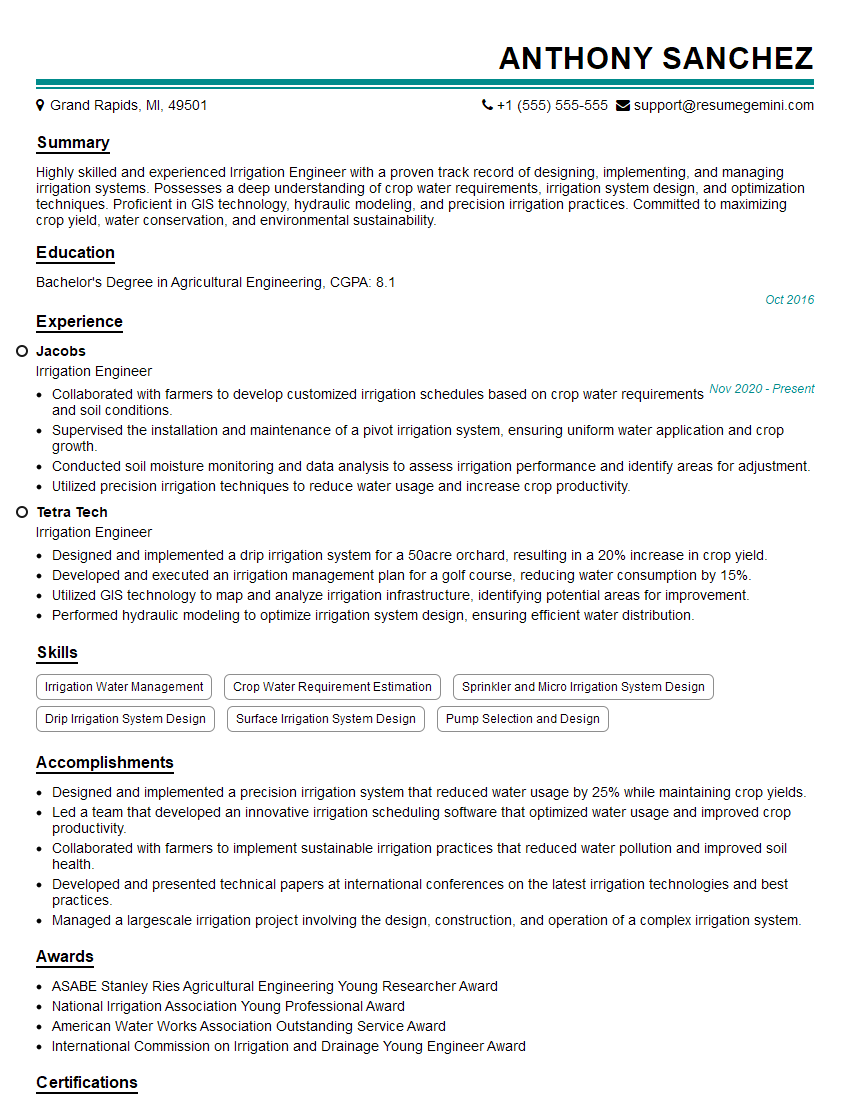
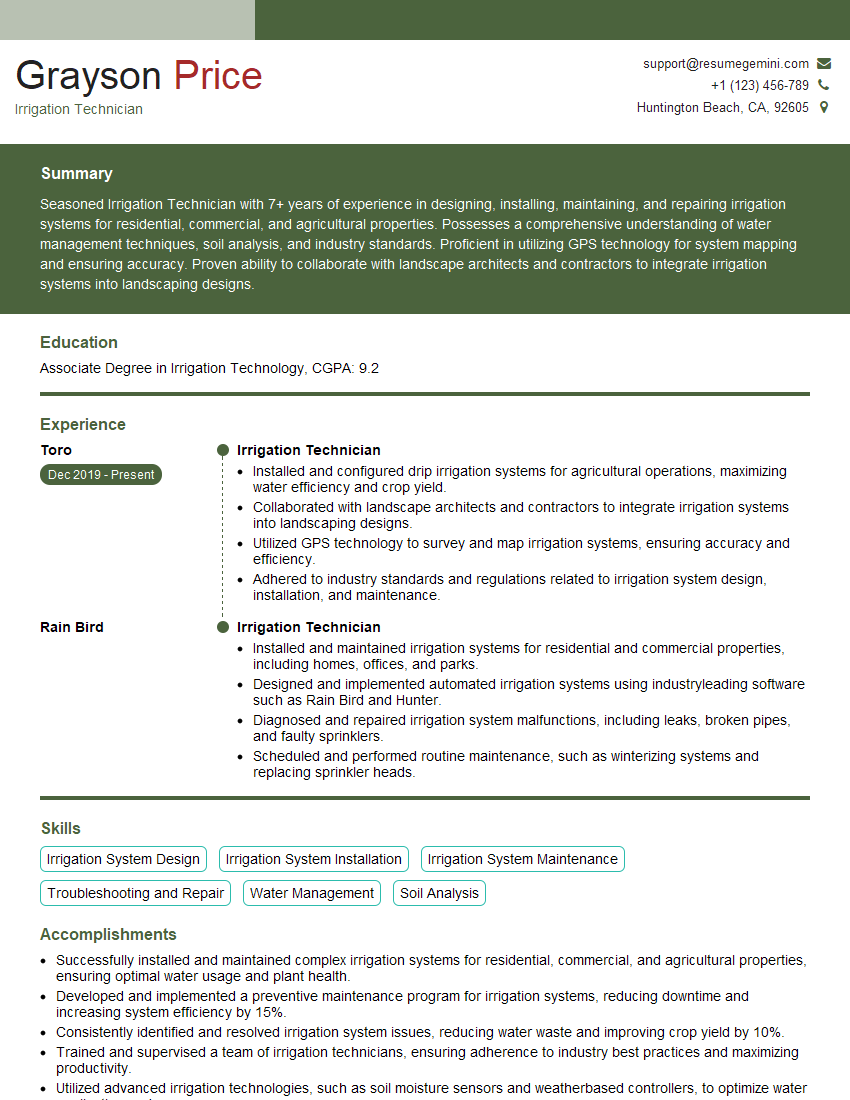
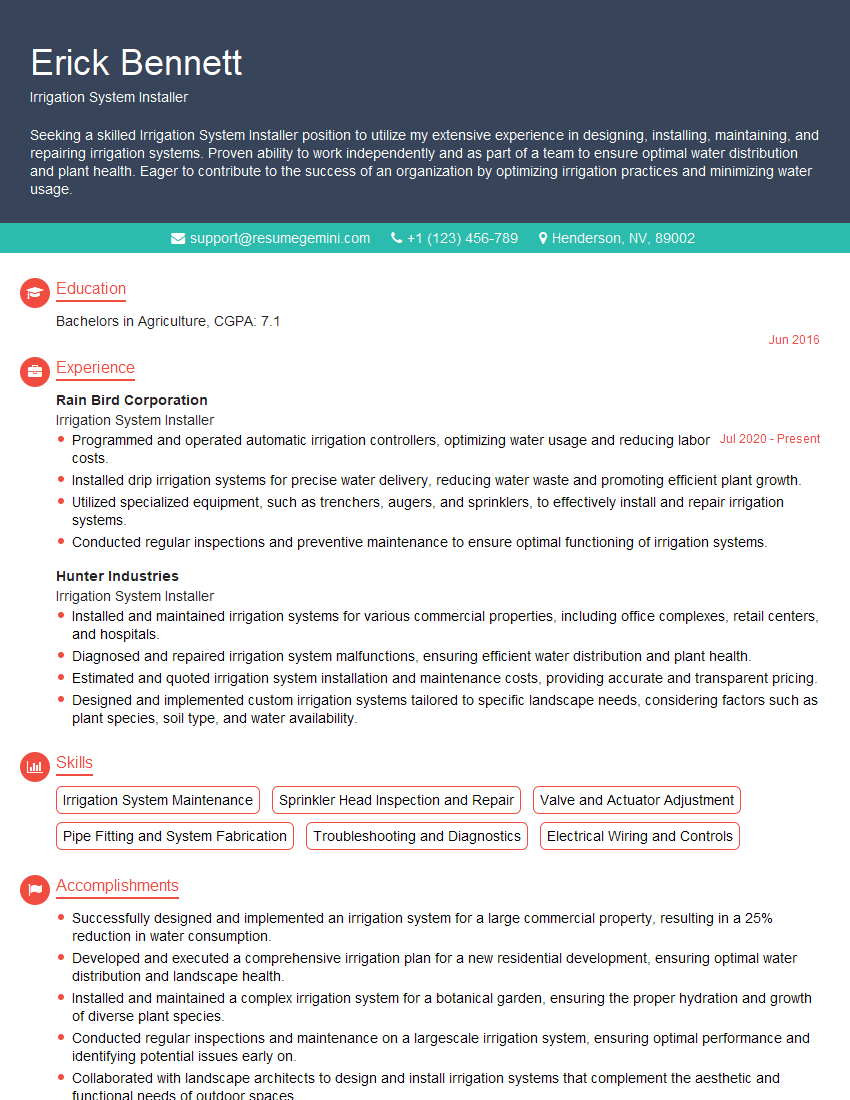
Mastering the principles of irrigating crops is crucial for a successful career in agriculture, opening doors to diverse roles and opportunities for growth. A strong resume is your key to unlocking these opportunities. Creating an ATS-friendly resume is essential for getting your application noticed by employers. To enhance your resume-building experience and increase your chances of landing your dream job, leverage ResumeGemini. ResumeGemini offers a powerful platform to create professional resumes, and we provide examples tailored specifically to the field of Irrigating Crops to help you get started.

Explore more articles
Users Rating of Our Blogs
Share Your Experience
We value your feedback! Please rate our content and share your thoughts (optional).
What Readers Say About Our Blog
Attention music lovers!
Wow, All the best Sax Summer music !!!
Spotify: https://open.spotify.com/artist/6ShcdIT7rPVVaFEpgZQbUk
Apple Music: https://music.apple.com/fr/artist/jimmy-sax-black/1530501936
YouTube: https://music.youtube.com/browse/VLOLAK5uy_noClmC7abM6YpZsnySxRqt3LoalPf88No
Other Platforms and Free Downloads : https://fanlink.tv/jimmysaxblack
on google : https://www.google.com/search?q=22+AND+22+AND+22
on ChatGPT : https://chat.openai.com?q=who20jlJimmy20Black20Sax20Producer
Get back into the groove with Jimmy sax Black
Best regards,
Jimmy sax Black
www.jimmysaxblack.com
Hi I am a troller at The aquatic interview center and I suddenly went so fast in Roblox and it was gone when I reset.
Hi,
Business owners spend hours every week worrying about their website—or avoiding it because it feels overwhelming.
We’d like to take that off your plate:
$69/month. Everything handled.
Our team will:
Design a custom website—or completely overhaul your current one
Take care of hosting as an option
Handle edits and improvements—up to 60 minutes of work included every month
No setup fees, no annual commitments. Just a site that makes a strong first impression.
Find out if it’s right for you:
https://websolutionsgenius.com/awardwinningwebsites
Hello,
we currently offer a complimentary backlink and URL indexing test for search engine optimization professionals.
You can get complimentary indexing credits to test how link discovery works in practice.
No credit card is required and there is no recurring fee.
You can find details here:
https://wikipedia-backlinks.com/indexing/
Regards
NICE RESPONSE TO Q & A
hi
The aim of this message is regarding an unclaimed deposit of a deceased nationale that bears the same name as you. You are not relate to him as there are millions of people answering the names across around the world. But i will use my position to influence the release of the deposit to you for our mutual benefit.
Respond for full details and how to claim the deposit. This is 100% risk free. Send hello to my email id: lukachachibaialuka@gmail.com
Luka Chachibaialuka
Hey interviewgemini.com, just wanted to follow up on my last email.
We just launched Call the Monster, an parenting app that lets you summon friendly ‘monsters’ kids actually listen to.
We’re also running a giveaway for everyone who downloads the app. Since it’s brand new, there aren’t many users yet, which means you’ve got a much better chance of winning some great prizes.
You can check it out here: https://bit.ly/callamonsterapp
Or follow us on Instagram: https://www.instagram.com/callamonsterapp
Thanks,
Ryan
CEO – Call the Monster App
Hey interviewgemini.com, I saw your website and love your approach.
I just want this to look like spam email, but want to share something important to you. We just launched Call the Monster, a parenting app that lets you summon friendly ‘monsters’ kids actually listen to.
Parents are loving it for calming chaos before bedtime. Thought you might want to try it: https://bit.ly/callamonsterapp or just follow our fun monster lore on Instagram: https://www.instagram.com/callamonsterapp
Thanks,
Ryan
CEO – Call A Monster APP
To the interviewgemini.com Owner.
Dear interviewgemini.com Webmaster!
Hi interviewgemini.com Webmaster!
Dear interviewgemini.com Webmaster!
excellent
Hello,
We found issues with your domain’s email setup that may be sending your messages to spam or blocking them completely. InboxShield Mini shows you how to fix it in minutes — no tech skills required.
Scan your domain now for details: https://inboxshield-mini.com/
— Adam @ InboxShield Mini
support@inboxshield-mini.com
Reply STOP to unsubscribe
Hi, are you owner of interviewgemini.com? What if I told you I could help you find extra time in your schedule, reconnect with leads you didn’t even realize you missed, and bring in more “I want to work with you” conversations, without increasing your ad spend or hiring a full-time employee?
All with a flexible, budget-friendly service that could easily pay for itself. Sounds good?
Would it be nice to jump on a quick 10-minute call so I can show you exactly how we make this work?
Best,
Hapei
Marketing Director
Hey, I know you’re the owner of interviewgemini.com. I’ll be quick.
Fundraising for your business is tough and time-consuming. We make it easier by guaranteeing two private investor meetings each month, for six months. No demos, no pitch events – just direct introductions to active investors matched to your startup.
If youR17;re raising, this could help you build real momentum. Want me to send more info?
Hi, I represent an SEO company that specialises in getting you AI citations and higher rankings on Google. I’d like to offer you a 100% free SEO audit for your website. Would you be interested?
Hi, I represent an SEO company that specialises in getting you AI citations and higher rankings on Google. I’d like to offer you a 100% free SEO audit for your website. Would you be interested?