Are you ready to stand out in your next interview? Understanding and preparing for IEC 60601-1 Electrical Safety Testing interview questions is a game-changer. In this blog, we’ve compiled key questions and expert advice to help you showcase your skills with confidence and precision. Let’s get started on your journey to acing the interview.
Questions Asked in IEC 60601-1 Electrical Safety Testing Interview
Q 1. Explain the key differences between IEC 60601-1 and other safety standards.
IEC 60601-1 is the cornerstone international standard for the safety of medical electrical equipment. Unlike general electrical safety standards like IEC 60950 (now largely superseded by IEC 62368-1), which cover IT equipment, or IEC 60335 for household appliances, IEC 60601-1 specifically addresses the unique risks associated with medical devices used in a healthcare environment. These risks include the potential for electric shock to patients and medical personnel, as well as the risk of fire and burns, electromagnetic interference, and mechanical hazards. Its focus is patient safety, which necessitates more stringent requirements and detailed testing protocols than those applied to other types of equipment.
For instance, while a hairdryer might only require basic insulation testing, a medical defibrillator needs far more extensive testing to ensure safety in the presence of body fluids, high voltages, and the potential for life-threatening consequences from a malfunction. The difference boils down to the critical nature of the application and the potentially severe repercussions of failure.
Q 2. Describe the various types of tests conducted according to IEC 60601-1.
IEC 60601-1 mandates a comprehensive suite of tests designed to assess various aspects of medical device safety. These can be broadly categorized as:
- Basic Insulation Tests: These verify the integrity of insulation between live parts and accessible conductive parts, ensuring protection from electric shock. This includes tests like dielectric strength tests (withstand voltage) at different frequencies, and insulation resistance measurements.
- Grounding/Earthing Tests: These tests verify the effectiveness of the protective earthing system to prevent dangerous voltages from appearing on accessible conductive parts.
- Leakage Current Tests: These measure the current leaking from the device to the patient or the ground, ensuring it remains within safe limits. Different types of leakage current are measured (e.g., patient leakage current, earth leakage current).
- Creepage and Clearance Tests: These tests verify sufficient distances between live parts and other parts to prevent flashover or electric shock. This is especially critical in the presence of moisture or contamination.
- Electromagnetic Compatibility (EMC) Tests: These ensure the device doesn’t emit harmful electromagnetic interference and can withstand interference from other equipment, which could affect its function or safety.
- Mechanical Tests: These include testing for mechanical strength, stability, and protection against ingress of water and foreign objects.
- Fire Safety Tests: Tests designed to evaluate the flammability of materials used in the construction of the device and the device’s ability to withstand fire exposure.
The specific tests required depend on the device’s classification and intended use. A simple blood pressure monitor requires a different set of tests than a complex surgical laser system.
Q 3. What are the essential safety requirements defined in IEC 60601-1?
IEC 60601-1 sets forth a series of essential safety requirements designed to minimize risks to patients and operators. These requirements encompass many aspects, but some key ones include:
- Protection against electric shock: This involves appropriate insulation, grounding, leakage current limitations, and protective measures to mitigate the risk of electric shock.
- Protection against fire: Using materials with low flammability and implementing design features to minimize the risk of fire hazards.
- Protection against mechanical hazards: Designing the device to prevent injury from moving parts, sharp edges, or excessive heat.
- Protection against radiation: This can apply to electromagnetic radiation, or if the device uses ionizing radiation, ensuring safe limits are met.
- Protection against ingress of liquids: Preventing damage and maintaining safety even if liquids come into contact with the device.
- Means of protection against hazardous voltages and currents: Implementing suitable MOPs (discussed further in the next answer).
These requirements are not exhaustive but illustrate the breadth of safety considerations. Each clause within the standard provides specific detail and guidance on how to meet these safety requirements.
Q 4. Explain the concept of Means of Protection (MOPs) in IEC 60601-1.
Means of Protection (MOPs) in IEC 60601-1 represent the strategies employed to reduce or eliminate the risks associated with electrical hazards. They are classified into different classes (class I, class II, class III, and others) each employing different protection strategies.
- Class I: Relies on basic insulation and protective earthing (grounding) to provide protection. A fault current flows to ground, tripping a circuit breaker. This is represented by the ground symbol on the device.
- Class II: Provides double or reinforced insulation. This means that even if the basic insulation fails, sufficient insulation remains to prevent hazardous voltage from reaching accessible parts. It is identified by a double square symbol.
- Class III: Uses safety extra-low voltage (SELV), typically below 50 V AC or 120 V DC, reducing the risk to almost zero. The voltage level itself provides the main protection.
Think of MOPs as layers of protection. A Class I device has one main layer (earthing), while a Class II device has two (double insulation). Class III provides protection through inherently safe voltage levels. Some devices may use a combination of MOPs for enhanced safety.
Q 5. How do you determine the appropriate test levels for a medical device?
Determining the appropriate test levels for a medical device is a crucial step in ensuring its compliance with IEC 60601-1. This is done by referring to the standard itself, which specifies test levels based on several factors:
- Device Classification: The device’s classification (e.g., B, BF, CF) dictates the applied parts, and therefore, the test voltages. A device intended for use in direct contact with patients will require higher test levels than one only used indirectly.
- Applied Part Type: Whether the device is a body-worn, patient-applied, or other type of applied part, dictates the level of protection required, thereby influencing the test levels for applied parts.
- Intended Use and Environment: The intended use and operational environment (e.g., operating room, home setting) affect the severity of the potential hazards and, consequently, the appropriate test levels.
- Manufacturer’s Declaration: The manufacturer declares the intended environment and the conditions under which the device will be used. This declaration is crucial for setting appropriate test levels.
Essentially, a risk assessment process is involved to determine the appropriate test levels. This process considers various factors such as the severity of potential hazards, likelihood of their occurrence, and the effectiveness of the implemented safety measures. The test levels are not arbitrary but are carefully selected based on a comprehensive risk analysis. Often this involves referencing tables and guidelines provided within the standard.
Q 6. What are the implications of non-compliance with IEC 60601-1?
Non-compliance with IEC 60601-1 carries significant implications:
- Legal and Regulatory Penalties: Failure to meet the standard can result in hefty fines, product recalls, and legal action from regulatory bodies. Depending on the jurisdiction and the severity of the non-compliance, this could lead to legal action from injured parties.
- Market Access Restrictions: Many countries require medical devices to comply with IEC 60601-1 before they can be sold or used within their borders. Non-compliance means the product cannot be sold in these markets.
- Reputational Damage: Non-compliance can severely damage the manufacturer’s reputation, leading to loss of consumer trust and potential financial losses.
- Patient Safety Risks: The most critical consequence of non-compliance is the potential for harm or injury to patients. This is the primary reason for the standard’s existence.
The potential consequences highlight the importance of thorough testing and adherence to the standard during the design, development, and manufacturing processes of medical devices. A proactive approach to compliance, through careful design and rigorous testing, is far more cost-effective than dealing with the consequences of non-compliance.
Q 7. Describe your experience with different testing equipment used in IEC 60601-1 testing.
Throughout my career, I’ve extensively utilized a variety of equipment for IEC 60601-1 testing. This includes:
- High-Voltage Test Sets: These are used to conduct dielectric strength tests and insulation resistance measurements. I have experience with both automated and manual test systems, allowing for precise control of voltage and frequency.
- Leakage Current Testers: These devices accurately measure leakage currents to ensure they fall within the specified limits. Different types are used for measuring various leakage currents.
- EMC Test Equipment: This includes various chambers and instruments used to assess the device’s electromagnetic compatibility. This includes equipment for measuring emissions and immunity to interference.
- Insulation Resistance Testers: These measure the resistance of insulation materials to determine their effectiveness in preventing leakage currents.
- Oscilloscope and other data acquisition systems: These are essential for monitoring waveforms and documenting test results.
Experience with different brands and models of testing equipment is critical in understanding their capabilities and limitations. Accurate calibration and proper maintenance of this equipment are paramount to ensuring reliable and accurate test results. I am also familiar with data analysis software to manage and interpret large datasets from various testing methods. Furthermore, my experience covers various types of safety testers with different capabilities.
Q 8. Explain the process of risk management related to IEC 60601-1.
Risk management in IEC 60601-1 is a systematic process to identify, analyze, and control hazards associated with medical electrical equipment. It’s not just about meeting the standard’s requirements; it’s about proactively minimizing the risk of patient harm and ensuring the safety of healthcare professionals.
Hazard Identification: This involves systematically reviewing the design, intended use, and foreseeable misuse of the medical device to identify potential hazards. For example, a high-voltage power supply might pose a shock hazard, or a faulty temperature sensor in an incubator could cause overheating.
Risk Analysis: Once hazards are identified, we analyze the severity of potential harm (e.g., death, serious injury, minor injury), the probability of occurrence, and the potential for exposure. This allows us to prioritize risks.
Risk Control: This is where we implement measures to mitigate the identified risks. These could include design modifications (e.g., adding protective insulation, implementing safety interlocks), incorporating warning labels, or developing specific operating procedures. We might use a risk matrix to visualize and track the effectiveness of these controls.
Risk Evaluation: After implementing risk controls, we re-evaluate the risks to ensure they’ve been adequately reduced to an acceptable level. This is an iterative process. Documentation is crucial throughout this entire process.
Imagine designing a defibrillator. A major hazard is accidental shock. Risk analysis might reveal a high probability of accidental contact during use. Therefore, risk controls might include insulated handles, clear warning labels, and a safety interlock to prevent accidental discharge.
Q 9. How do you interpret test reports and identify potential safety hazards?
Interpreting test reports and identifying hazards involves a thorough understanding of the standard and the device’s functionality. I look for deviations from the specified limits in various tests. For instance, a high leakage current might indicate a fault in the insulation or grounding, posing an electric shock risk. Similarly, a failure in the dielectric strength test suggests compromised insulation, leading to potential shock or fire hazards. I always correlate test results with the device’s operational characteristics and design.
Let’s say a report shows a leakage current significantly exceeding the IEC 60601-1 limit. This could stem from several things: damaged insulation, a faulty component, or a design flaw. Further investigation, including visual inspection and component testing, is needed to pinpoint the root cause and implement corrective actions. It is about problem-solving and understanding the underlying physics.
Q 10. Explain your understanding of different types of electrical leakage currents.
IEC 60601-1 defines several types of leakage currents, all related to the current that unintentionally flows from the device’s live parts to the accessible parts or the earth. Understanding these is crucial for assessing safety.
Earth Leakage Current (ILEAK): This is the current leaking to earth, measured between the protective earth terminal and the chassis. High values suggest poor grounding or insulation failure.
Patient Leakage Current (IP): This is the current that could flow through a patient connected to the device. Limits are much stricter here, reflecting the higher risk to the patient.
Equipment Leakage Current (IPE): This current flows between the live parts and the protective earth terminal. It’s an indication of insulation degradation.
Body Leakage Current (IB): This is the current that could flow through the patient’s body if they simultaneously touched the equipment’s accessible conductive parts and the earth or another conducting surface. This is the most critical current and needs to be controlled within strict limits.
Measuring these currents involves specialized equipment like leakage current testers. Exceeding the limits implies immediate action to identify and fix the safety issues. These values should always be compared with regulatory limits to evaluate compliance.
Q 11. Describe your experience with different types of grounding systems.
My experience encompasses various grounding systems commonly employed in medical equipment, each with its advantages and disadvantages.
Class I Equipment: This relies on a protective earth connection (grounding wire) for safety. This is the most common type, offering protection against electric shock by diverting fault currents to earth. A good earth connection is vital here. We test the earth impedance to ensure adequate protection.
Class II Equipment (Double Insulated): These devices have double insulation, eliminating the need for a protective earth connection. The extra layer of insulation provides inherent safety against electric shock, even with a ground fault.
Class III Equipment (Safety Extra-Low Voltage): These operate at extremely low voltages, minimizing shock hazards. They are designed for specific applications.
The choice of grounding system depends on the device’s design and intended use. For instance, a Class I device might be preferred where a robust earth connection is readily available. A Class II device is preferable in applications where a reliable earth connection is uncertain or impractical. I’ve worked with each class, ensuring the system’s efficacy and compliance with relevant standards.
Q 12. How do you handle discrepancies between test results and specifications?
Discrepancies between test results and specifications require a methodical investigation to identify the root cause. It’s not sufficient to just record the discrepancy; we must understand why it exists.
Repeat the Test: First, we repeat the tests to ensure the initial results weren’t due to errors in measurement or testing procedure.
Review Test Setup: We meticulously review the test setup to ensure it conformed to the standard’s requirements. A small error in the setup can lead to significant deviations.
Inspect the Device: A thorough visual inspection of the device, including internal components, is crucial. We look for physical damage, loose connections, or other anomalies that might cause the discrepancy.
Investigate the Cause: Based on the findings, we determine the root cause. This may involve more detailed testing or analysis, perhaps using specialized equipment.
Corrective Actions: Once the cause is identified, we implement appropriate corrective actions. This might include repairing or replacing faulty components, redesigning the device, or improving manufacturing processes.
Retesting: Finally, we retest the device to verify that the corrective actions have resolved the discrepancy and the device is compliant with the standard.
Consider a case where the measured leakage current is higher than specified. We might discover a faulty capacitor during inspection. Replacing the capacitor and retesting would then confirm that the issue is resolved.
Q 13. Explain the importance of proper documentation in IEC 60601-1 testing.
Proper documentation is paramount in IEC 60601-1 testing, ensuring traceability, accountability, and the ability to reproduce the testing process. Comprehensive records are critical for demonstrating compliance, troubleshooting issues, and supporting regulatory audits.
Test Procedures: Detailed documentation of the test procedures followed, including any deviations from the standard, is essential. This allows for accurate replication of the testing by others.
Test Equipment: Records of the test equipment used, including calibration certificates, are required to demonstrate the accuracy and validity of the measurements.
Test Results: Complete records of all test results, both pass and fail, are kept. Any anomalies or deviations from expected results are thoroughly documented and investigated.
Corrective Actions: If any non-conformities are identified, the corrective actions taken are documented, including the effectiveness of the actions.
Test Report: A final comprehensive test report summarizes the testing, findings, and conclusions. This report forms the basis for the declaration of conformity.
Imagine a situation where a test report is needed for regulatory approval. The complete, well-maintained documentation ensures clear evidence that the device meets all safety requirements, saving time and avoiding potential delays.
Q 14. What is your experience with conducting and analyzing dielectric strength tests?
Dielectric strength testing is a crucial aspect of IEC 60601-1 compliance, assessing the insulation’s ability to withstand high voltages without breakdown. It helps determine the effectiveness of the insulation in preventing electric shocks and fire hazards.
My experience includes conducting both AC and DC dielectric strength tests, using high-voltage test equipment. I’m proficient in preparing test samples, applying the specified voltage, and monitoring for any signs of insulation breakdown (e.g., arcing, puncture). The test setup should follow the specifications precisely, paying close attention to the electrode placement and the environmental conditions. Analyzing the results involves verifying that the device withstands the specified voltage without any breakdown or failure.
I’ve handled discrepancies, too. For instance, a lower-than-expected dielectric strength might indicate degradation of insulation material due to age, exposure to moisture, or manufacturing defects. This necessitates thorough investigation, potentially involving material analysis, to identify the root cause.
Q 15. Describe your experience with conducting and analyzing earth leakage current tests.
Earth leakage current testing is crucial for ensuring the safety of medical devices. It measures the current leaking to earth from the device, which could cause electric shock if it exceeds safe limits. My experience involves performing these tests using a variety of methods, from basic hand-held instruments to automated test systems. I’m proficient in interpreting the results, identifying potential faults, and recommending corrective actions. For example, I recently worked on a project where a patient monitor showed unexpectedly high leakage current. Through systematic investigation, I identified a faulty capacitor in the power supply. Replacing it brought the leakage current within the acceptable limits defined by IEC 60601-1.
The process typically involves connecting the device under test to a dedicated earth leakage current tester. The device is then powered up, and the leakage current is measured under various operating conditions. This includes both normal operation and any potential fault conditions, such as a single fault condition. The results are then compared to the limits specified in IEC 60601-1. Beyond the basic measurement, I’m experienced in analyzing the waveform of the leakage current to identify the source of the leakage and predict any potential risks associated with it.
Career Expert Tips:
- Ace those interviews! Prepare effectively by reviewing the Top 50 Most Common Interview Questions on ResumeGemini.
- Navigate your job search with confidence! Explore a wide range of Career Tips on ResumeGemini. Learn about common challenges and recommendations to overcome them.
- Craft the perfect resume! Master the Art of Resume Writing with ResumeGemini’s guide. Showcase your unique qualifications and achievements effectively.
- Don’t miss out on holiday savings! Build your dream resume with ResumeGemini’s ATS optimized templates.
Q 16. How do you ensure the accuracy and reliability of your test results?
Accuracy and reliability in IEC 60601-1 testing are paramount. I ensure this through a multi-faceted approach. Firstly, I meticulously calibrate all testing equipment according to manufacturer’s instructions and maintain detailed calibration records. This includes regularly checking the accuracy of our earth leakage current testers, multimeters, and other instruments using traceable standards.
Secondly, I employ rigorous testing procedures, following the guidelines outlined in IEC 60601-1 strictly. This includes using appropriate test fixtures and ensuring that the test environment is controlled and free from interference. Thirdly, I perform multiple measurements and compare the results. Inconsistent results trigger a thorough investigation of potential sources of error, such as faulty connections or environmental factors. Finally, I meticulously document every step of the testing process, including equipment details, test conditions, and results. This comprehensive documentation ensures the traceability and reliability of our findings, allowing for easy verification and audit trails if needed. Think of it like building a solid case – every piece of evidence must be accurate and traceable to support the overall conclusion.
Q 17. Explain the process of writing a test plan according to IEC 60601-1.
A well-structured test plan is fundamental to successful IEC 60601-1 compliance testing. It acts as a roadmap, ensuring comprehensive coverage of all required tests. The plan typically begins with a clear definition of the medical device’s scope, including its intended use and operating conditions. Next, I identify all applicable clauses within IEC 60601-1 and any relevant particular standards.
The plan then outlines the specific tests to be performed, specifying the test methods, equipment, and acceptance criteria. This includes not only electrical safety tests but also tests related to electromagnetic compatibility (EMC) if applicable. I also outline the required documentation, including test reports and certificates of compliance. For example, a test plan for a defibrillator would extensively cover tests related to high voltage isolation, leakage current, and patient leakage current. Furthermore, it will specify all relevant test conditions, such as the different operation modes and likely fault modes that could occur. Crucially, the plan also includes a risk assessment identifying any potential hazards during the testing process and outlining mitigation strategies. The final plan is reviewed and approved by stakeholders before commencement of testing.
Q 18. Explain your understanding of the different classes of equipment protection.
IEC 60601-1 defines different classes of equipment protection based on the level of protection provided against electric shock. These classes represent the degree of insulation and isolation incorporated into the device design.
- Class I: These devices rely on basic insulation and require an earth ground connection for protection. A fault in the basic insulation will cause a dangerous situation unless it is grounded. Think of a typical grounded appliance, a fault leads to current flow to ground.
- Class II: These devices have double or reinforced insulation, eliminating the need for an earth ground connection. A double insulation implies two levels of insulation separating the hazardous parts from accessible parts. This means that even with a fault in one insulation level, the remaining insulation should be sufficient to prevent dangerous voltages from reaching accessible parts.
- Class III: These devices are powered by a safety extra-low voltage (SELV) power supply, typically less than 50V. The inherent low voltage minimizes the risk of electric shock, even if there’s a fault. A great example is a device powered by batteries only.
Understanding these classes is crucial for selecting appropriate test methods and evaluating the safety of medical devices. Each class has specific test requirements outlined in IEC 60601-1 to ensure the device meets the safety requirements for its intended class.
Q 19. What are the challenges in testing complex medical devices according to IEC 60601-1?
Testing complex medical devices presents unique challenges. The intricacy of their design and functionality significantly increases the complexity of testing and the number of tests that must be conducted. For instance, a complex cardiac monitoring system might incorporate multiple interconnected subsystems, each with its own electrical safety requirements. This necessitates a thorough understanding of the device’s interactions, potentially requiring specialized test setups to simulate realistic operating conditions. Another challenge is identifying all potential fault conditions. The more complex the device, the higher the number of potential failure modes. This requires a methodical and systematic approach, often involving fault injection techniques to simulate potential failures.
Moreover, the integration of software and firmware adds another layer of complexity. Software-related faults can lead to unexpected electrical behavior, making it essential to test the device under various software configurations and operational states. Finally, the sheer number of tests required to ensure complete coverage can be time-consuming and resource-intensive. Careful planning and efficient test methodologies are crucial to manage these challenges effectively.
Q 20. How do you stay updated on the latest revisions and amendments to IEC 60601-1?
Staying updated on IEC 60601-1 revisions is critical for maintaining competency and ensuring compliance. I actively participate in industry events, conferences, and webinars focused on medical device safety. These events provide updates on the latest regulations, interpretations, and testing methodologies. I also subscribe to relevant industry publications and newsletters that provide updates and news related to medical device safety regulations. Additionally, I regularly review the IEC website and other relevant regulatory agency websites to check for announcements and updates on the standards. Having access to the latest version of the standard is vital, as changes and clarifications often address emerging safety issues and reflect advancements in technology. This continuous learning ensures that my testing practices are always aligned with current best practices and legal requirements.
Q 21. Describe your experience working with regulatory bodies regarding IEC 60601-1 compliance.
I have extensive experience interacting with regulatory bodies such as the FDA (in the US) and similar bodies internationally concerning IEC 60601-1 compliance. This includes preparing and submitting technical documentation, responding to inquiries, and participating in audits. For instance, I supported a manufacturer in obtaining FDA clearance for a new infusion pump. This involved preparing a comprehensive safety file demonstrating compliance with all relevant IEC standards, including IEC 60601-1. My role included working with the internal team, providing technical guidance for testing, and collaborating with external test labs to ensure compliance with FDA standards. This also included explaining testing methodologies and results to auditors during the review process. I’m familiar with the nuances of these regulations, allowing me to effectively navigate the compliance process and ensure our client’s products meet the high standards required by regulatory authorities worldwide. A key aspect is proactively addressing any deficiencies identified by auditors and implementing corrective actions to achieve full compliance.
Q 22. How do you ensure the safety of both the equipment under test and the testing personnel?
Ensuring safety during IEC 60601-1 testing is paramount. We achieve this through a multi-layered approach focusing on both equipment and personnel protection. For the equipment under test (EUT), we utilize appropriate test fixtures designed to prevent damage or unintended operation during testing. This includes using isolation transformers to prevent ground faults from affecting the test equipment or the mains supply. We also meticulously follow the test procedures outlined in the standard, ensuring that the EUT is subjected to the correct levels of stress without causing permanent damage.
For personnel safety, we adhere strictly to safety protocols. This includes wearing appropriate personal protective equipment (PPE) such as safety glasses and gloves, working in a controlled test environment, and following lockout/tagout procedures to prevent accidental energization. The test area itself is designed to minimize hazards, with proper grounding and shielding to prevent exposure to potentially harmful voltages or electromagnetic fields. Regular calibration and maintenance of the test equipment are crucial to ensure accurate and safe operation. Finally, a thorough risk assessment is performed before each test to identify and mitigate potential hazards.
Q 23. Explain your experience in using and interpreting IEC 60601-1-2 (EMC) standards.
IEC 60601-1-2 covers electromagnetic compatibility (EMC) of medical electrical equipment. My experience encompasses the entire testing process, from initial planning and setup to data analysis and report generation. I’m proficient in using various EMC test equipment, including emission receivers, immunity test generators, and network analyzers. I’ve conducted tests to assess both radiated and conducted emissions and immunity against electrostatic discharge (ESD), electromagnetic fields, and power frequency disturbances.
Interpreting the results requires a deep understanding of the standard’s limits and tolerances. For instance, identifying whether a particular emission peak is within the allowable limits necessitates considering factors like frequency, amplitude, and the specific test conditions. I’ve successfully helped resolve numerous EMC issues, ranging from simple filter adjustments to redesigning critical circuit components to meet regulatory requirements. A particular project involved troubleshooting EMI issues in a new patient monitor. By carefully analyzing the emission spectrum and identifying the offending frequencies, we were able to implement a combination of shielding and filtering solutions, ensuring compliance with the standard.
Q 24. Describe a situation where you had to troubleshoot a complex electrical safety issue.
During testing of a new defibrillator, we encountered a seemingly random leakage current issue. The readings were inconsistent and exceeded the allowable limits intermittently. Initial troubleshooting focused on the power supply and main circuitry, but the problem persisted. We systematically investigated each component, applying methodical fault finding techniques. Ultimately, the problem was traced to a faulty capacitor within the high-voltage circuit. This capacitor was exhibiting intermittent dielectric breakdown due to degradation caused by the high voltage stresses during the operation. The resolution involved replacing the capacitor with a higher-quality, more robust component and further testing showed the issue had been resolved. This experience highlighted the importance of thorough component selection and stress testing during the design phase.
Q 25. What is your familiarity with different types of medical device classifications?
Medical device classifications, as defined by regulatory bodies like the FDA and the EU’s MDR, are crucial for determining the level of safety and regulatory scrutiny. I’m familiar with the various classifications, including Class I (general-purpose devices requiring basic protection), Class II (devices with reinforced insulation or double insulation), Class III (devices operating from a separate safety extra-low voltage source), and Class IIb (reinforced insulation, often with additional protection measures). I also understand how different classifications impact the testing requirements. For example, Class III devices undergo less stringent leakage current testing compared to Class I or II devices due to the inherent safety features of their power supply. The classification also influences the required levels of documentation and clinical evaluations.
Q 26. Explain the importance of applying risk management principles during the design phase.
Applying risk management principles during the design phase is critical for ensuring the safety and efficacy of medical devices. It’s a proactive approach that identifies and mitigates potential hazards early in the development process. This involves a systematic process such as Hazard Analysis and Risk Control (HARC) which allows us to identify potential hazards associated with the device. By considering factors like patient interaction, environmental conditions, and component failure modes, we can implement design features to minimize or eliminate these risks. This might involve selecting components with higher reliability, incorporating redundant systems, or developing fail-safe mechanisms. Early risk management significantly reduces the costs and delays associated with rectifying safety issues later in the development cycle, ultimately leading to a safer and more robust product. For example, designing in a robust protection scheme against the potential for overcurrent significantly reduces the risk of fire or equipment damage, rather than trying to deal with this as an afterthought.
Q 27. Explain your understanding of the concept of ‘essential performance’ in relation to safety.
‘Essential performance’ refers to the fundamental functions of a medical device that are necessary for its intended use and are directly related to patient safety. Failure of essential performance can lead to serious harm or death. For instance, in a defibrillator, essential performance includes delivering the correct energy level at the appropriate time. In a ventilator, it includes maintaining adequate oxygen supply and ventilation. Ensuring essential performance involves rigorous testing and verification throughout the design and manufacturing process, often involving redundancy and fail-safe mechanisms. In safety analysis, we must ensure the device will continue to deliver its essential performance even in cases of partial failure. This critical function drives many of the safety requirements found in IEC 60601-1.
Q 28. How would you approach the testing of a new, innovative medical device with unique safety considerations?
Testing a new, innovative medical device requires a tailored approach that addresses its unique safety considerations. The process begins with a comprehensive risk assessment specific to the device’s novel features. This might involve identifying potential hazards unique to its functionality. We would then develop a test plan that addresses these hazards. This might involve creating customized test fixtures or adapting existing standards to accurately evaluate the unique safety features. Collaboration with the device’s designers is crucial to understand the intended functionality and potential failure modes. For example, if it incorporates novel materials or utilizes advanced technologies, we would need to design appropriate tests to assess the long-term safety and reliability of these components. Simulation of extreme use cases and conditions may be necessary to reveal any potential safety issues that might not be found under more typical testing. This iterative process, involving design adjustments and subsequent testing, ensures the device meets the required safety standards.
Key Topics to Learn for IEC 60601-1 Electrical Safety Testing Interview
- Basic Safety Requirements: Understanding the fundamental principles and clauses within IEC 60601-1, including the definition of Medical Electrical Equipment (MEE) and patient safety.
- Risk Management: Applying risk management methodologies to identify and mitigate hazards associated with MEE, and documenting the process effectively.
- Means of Protection: Thoroughly understanding and explaining various means of protection against electric shock (e.g., basic insulation, applied parts, means of patient protection).
- Testing and Measurement: Practical experience with common IEC 60601-1 tests, including leakage current measurements, ground impedance testing, and dielectric strength testing. Understanding the equipment and procedures involved.
- Interpretation of Standards: Ability to interpret and apply the relevant clauses of IEC 60601-1 to specific medical devices and scenarios. This includes understanding the terminology and classifications within the standard.
- Troubleshooting and Problem Solving: Demonstrating the ability to diagnose and solve problems related to electrical safety in medical equipment, including identifying non-compliances and proposing solutions.
- Documentation and Reporting: Familiarity with creating comprehensive test reports and documenting findings in accordance with regulatory requirements.
- EMC Considerations: Understanding the interaction between electrical safety and electromagnetic compatibility (EMC) and how they impact the testing process.
- Specific Device Classes: Familiarity with testing requirements specific to different classes of medical equipment (e.g., Class I, Class II, Type B, Type BF).
Next Steps
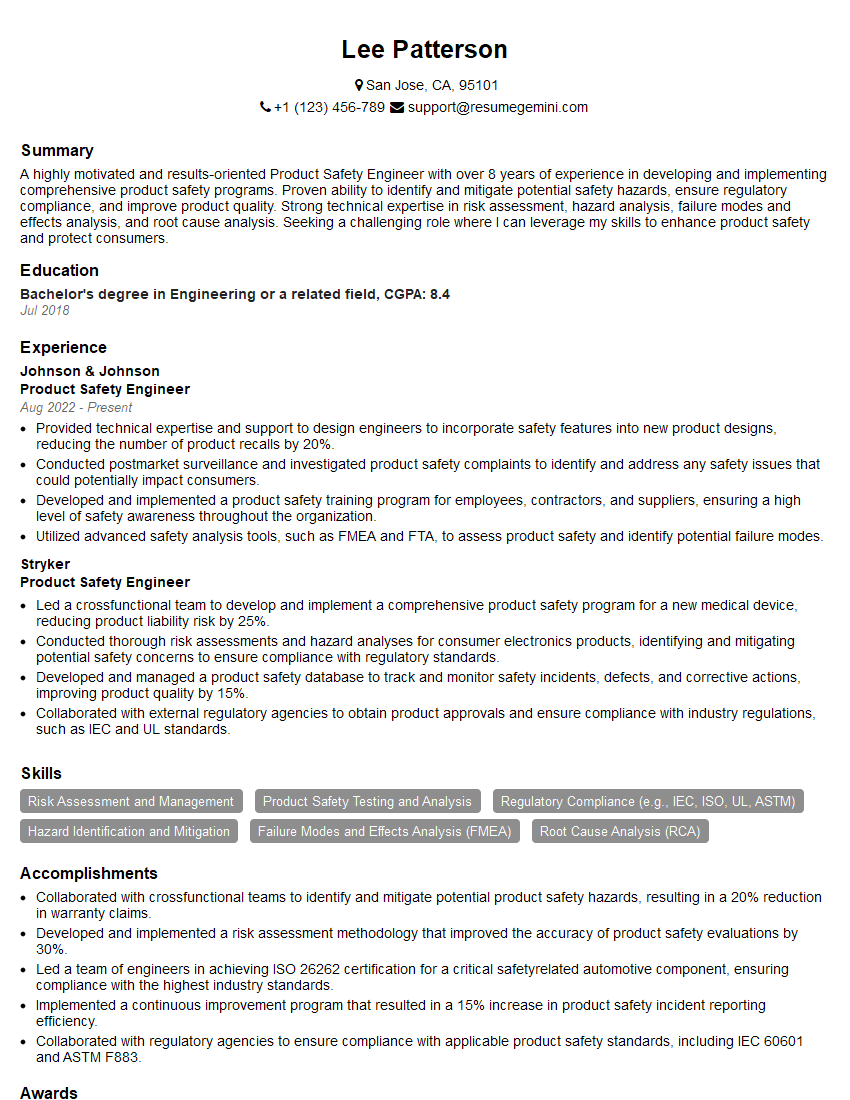
Mastering IEC 60601-1 Electrical Safety Testing opens doors to exciting career opportunities in a rapidly growing field. Proficiency in this area demonstrates a high level of technical expertise and commitment to patient safety, making you a highly sought-after candidate. To significantly increase your chances of landing your dream role, crafting a compelling and ATS-friendly resume is crucial. ResumeGemini can help you build a professional, impactful resume that highlights your skills and experience effectively. ResumeGemini provides examples of resumes tailored to IEC 60601-1 Electrical Safety Testing professionals, allowing you to craft a document that showcases your expertise and gets you noticed. Take the next step in your career journey – build a winning resume today!

Explore more articles
Users Rating of Our Blogs
Share Your Experience
We value your feedback! Please rate our content and share your thoughts (optional).
What Readers Say About Our Blog
Very informative content, great job.
good