Interviews are more than just a Q&A session—they’re a chance to prove your worth. This blog dives into essential Fruit Cutting interview questions and expert tips to help you align your answers with what hiring managers are looking for. Start preparing to shine!
Questions Asked in Fruit Cutting Interview
Q 1. What are the most common methods for cutting various fruits?
Fruit cutting methods vary greatly depending on the fruit’s characteristics and the desired outcome. For example, soft fruits like berries are best handled gently, often requiring only a simple cut or slice. Firmer fruits like apples and pears lend themselves to various techniques: dicing (cutting into small cubes), julienning (cutting into thin matchsticks), chopping (irregularly sized pieces), and slicing (thin or thick segments). Citrus fruits often necessitate specific tools like a citrus juicer or a paring knife for precise peeling and segmenting. Melons benefit from a carving approach, often involving a sharp knife for creating intricate shapes or simple wedges.
- Berries: Simple halving or quartering.
- Apples/Pears: Dicing, julienning, slicing, coring.
- Citrus Fruits: Peeling, segmenting, juicing.
- Melons: Wedging, balling, carving.
The choice of method depends on the final application; a fruit salad requires different cuts than a fruit tart.
Q 2. Describe your experience with different types of knives used in fruit cutting.
My experience spans a wide range of knives, each suited for specific tasks. Paring knives are invaluable for delicate work like peeling and trimming. Their small, sharp blades offer excellent control. Chef’s knives are my go-to for most chopping and dicing tasks; their versatility is unmatched. A serrated knife is essential for cutting through fruits with tough skins, like tomatoes or pineapples, without crushing the flesh. Finally, specialized tools like melon ballers or citrus zesters enhance efficiency and precision for particular fruit types. I prefer high-carbon stainless steel knives for their durability and sharpness retention. Regular honing and sharpening are crucial to maintain their performance and safety.
Q 3. How do you ensure consistent fruit size and shape during preparation?
Consistency in fruit size and shape is crucial for both aesthetics and functionality, particularly in professional settings. I achieve this through a combination of techniques. First, I select fruits of similar size and ripeness. Using a mandoline slicer or a vegetable peeler for fruits like apples can dramatically speed up the process and produce perfectly even slices. For hand-cutting, I employ guiding tools like measuring guides or templates to ensure uniform dimensions. Practice and a keen eye for detail are key; with experience, you develop an intuitive sense of how to achieve consistent cuts freehand.
Q 4. What are your techniques for minimizing fruit waste during cutting?
Minimizing fruit waste involves strategic cutting and utilization of all edible parts. For example, fruit peels can be candied or used for flavoring. Cores can be used to make fruit leather or even compost. Instead of discarding small scraps, I often dice or puree them for sauces, jams, or smoothies. Careful planning is also vital; I estimate quantities beforehand to avoid buying more than necessary, and I cut fruits only as needed for immediate use. Properly storing cut fruit to prevent spoilage is a huge part of minimizing waste.
Q 5. Explain your approach to maintaining hygiene and food safety standards while cutting fruit.
Maintaining hygiene and food safety is paramount. I begin by thoroughly washing my hands and all surfaces with hot, soapy water. I use separate cutting boards for fruits and other foods to prevent cross-contamination. Knives and other tools are cleaned and sanitized regularly, and any damaged or compromised fruits are discarded immediately. Following proper refrigeration protocols for storing cut fruit is also crucial for maintaining safety and quality. Regular handwashing and cleaning throughout the process greatly reduces the risk of foodborne illness.
Q 6. How do you handle different fruit textures and ripeness levels during cutting?
Fruit texture and ripeness significantly impact cutting techniques. Ripe fruits are softer and more prone to bruising, requiring a gentler touch. I use sharper knives to minimize pressure needed. Underripe fruits are firmer, requiring more force, but can be easily damaged by dull blades. Different textures also necessitate adjustments: a firm apple requires a different approach than a delicate peach. I adapt my technique based on the individual fruit’s properties, always prioritizing avoiding unnecessary damage.
Q 7. What are the safety precautions you follow when using knives for fruit cutting?
Knife safety is my top priority. I always use sharp knives – a dull knife requires more force, increasing the risk of slips and accidents. I maintain a firm grip on the knife and keep my fingers tucked in when cutting. I work on stable surfaces and avoid distractions. I store knives safely in a knife block or magnetic strip after use. When cutting, I focus my attention on the task at hand. Following these guidelines significantly reduces the risk of cuts and injuries.
Q 8. Describe your experience with various fruit cutting tools and equipment.
My experience with fruit cutting tools and equipment spans a wide range, from basic knives to specialized machinery. I’m proficient with various types of knives, including paring knives for intricate work, chef’s knives for efficient chopping, and serrated knives for softer fruits like tomatoes. I’ve also worked extensively with commercial-grade equipment such as mandolines (for even slicing), vegetable dicers (for consistent cuts), and fruit pitting machines. Each tool has its strengths and weaknesses, and selecting the right one depends heavily on the fruit type, desired cut, and scale of the operation. For example, a paring knife is perfect for creating delicate garnishes on strawberries, while a mandoline is invaluable when preparing large quantities of fruit salad.
- Paring knives: Ideal for delicate work and smaller fruits.
- Chef’s knives: Versatile for chopping, dicing, and slicing.
- Serrated knives: Best for soft fruits that tend to crumble.
- Mandolines: Produce uniform slices efficiently.
- Vegetable dicers: Create consistent cubes and dice quickly.
- Fruit pitting machines: Automate the process of removing pits from cherries, plums, etc.
Q 9. How do you efficiently cut large quantities of fruit for high-volume operations?
Efficiently cutting large quantities of fruit for high-volume operations hinges on optimizing the process and leveraging appropriate equipment. This involves careful planning, pre-preparation (washing, sorting), and the selection of tools designed for speed and consistency. For instance, using a mandoline or commercial dicer drastically reduces prep time compared to using only knives. I always prioritize a workflow that minimizes movement and maximizes the use of both hands. Furthermore, efficient team coordination is essential. If working with a team, assigning specific tasks – like one person washing, another peeling, and another slicing – dramatically improves speed.
Think of an assembly line: each person has a specific task, leading to a significant increase in output. For instance, when preparing fruit for a large catering event, we’d assign different team members to different fruit types based on their individual skills and the complexity of the task. We’d also use a combination of hand tools and commercial equipment to maximize speed and consistency of the cuts.
Q 10. What are your strategies for optimizing workflow and maximizing efficiency in fruit cutting?
Optimizing workflow and maximizing efficiency in fruit cutting involves a multi-pronged approach. It starts with proper mise en place—having all the necessary tools, ingredients, and equipment organized and readily available. This eliminates wasted time searching for things. Next, I focus on streamlining the process. This could include pre-washing fruits, removing stems and seeds beforehand, and employing techniques like pre-portioning to maintain consistency. Regularly cleaning workspaces and tools also helps to prevent delays. Finally, utilizing appropriate tools significantly improves efficiency. Using a commercial-grade slicer is far more efficient than manually slicing a large quantity of fruit by hand.
For example, I once streamlined a fruit salad preparation by organizing the ingredients by color, making assembly of the final product much quicker and more visually appealing. It’s all about breaking down the larger task into smaller, manageable ones, performed in the most efficient order.
Q 11. How do you identify and prevent common fruit cutting errors?
Common fruit cutting errors include uneven slices, bruised fruit, dull knives, and cross-contamination. To prevent uneven slices, using a mandoline or following a consistent cutting technique is key. Bruising is minimized by handling fruit gently. Sharp knives are crucial for clean cuts and prevent accidents. To avoid cross-contamination, I use separate cutting boards and tools for different fruits. This is especially important when dealing with fruits with varying levels of ripeness or different potential allergens.
Regular knife sharpening is non-negotiable. A dull knife is more likely to slip and cause injuries, and it creates ragged cuts that affect the overall presentation. We also use color-coded cutting boards to prevent cross-contamination. This is a widely adopted safety measure in food preparation.
Q 12. Describe your experience with different fruit cutting styles for garnishes and presentations.
My experience with different fruit cutting styles for garnishes and presentations is extensive. I’m adept at various techniques, including creating simple wedges, elegant brunoise (small dice), julienne (thin strips), and more intricate designs like carved fruit sculptures. The choice of cutting style depends entirely on the desired aesthetic and the fruit itself. For example, strawberries are often sliced or hulled and halved, while melons can be scooped into balls or carved into decorative shapes. I also consider the overall presentation of the dish, ensuring the fruit garnish complements the rest of the food.
For a sophisticated dessert, I might use a melon baller to create perfect spheres of cantaloupe, while for a rustic salad, I might simply roughly chop the fruit into bite-sized pieces. The key is adaptability and understanding the effect each cut has on the final presentation.
Q 13. How do you ensure the freshness and quality of cut fruit during storage?
Ensuring the freshness and quality of cut fruit during storage involves several crucial steps. Proper refrigeration is paramount to slow down enzymatic browning and microbial growth. I typically use airtight containers to minimize exposure to air, and I sometimes add a small amount of lemon juice or ascorbic acid to help prevent discoloration. Furthermore, avoiding over-crowding within the containers ensures proper air circulation. Ideally, cut fruits should be stored in a cool, dark place and used as quickly as possible to maintain optimal quality.
In a large-scale operation, we often use specialized food-grade containers designed to maintain fruit quality and prevent cross-contamination. We also monitor storage temperatures regularly to ensure consistent freshness. It’s a balance of speed and care, ensuring that the fruit retains its quality until it reaches the customer.
Q 14. How do you handle different types of fruit peels and seeds during the cutting process?
Handling different types of fruit peels and seeds during the cutting process involves selecting appropriate tools and techniques. For example, I use a peeler for fruits like apples and pears, while I might use a specific tool, or even my fingers, to remove citrus zest delicately. For fruits with pits like cherries or plums, I use a pitter or carefully remove them with a small knife. Seeds from fruits like melons or berries are often removed after cutting, depending on the application. Waste management is also an important consideration; we compost or otherwise dispose of peels and seeds responsibly, in accordance with health and safety regulations.
Efficient seed and peel removal is crucial not only for the presentation but also for food safety. Certain peels can contain pesticides and need proper handling to avoid contamination. We often utilize dedicated waste disposal systems that separate organic waste from other types of trash to support environmentally friendly practices.
Q 15. What is your experience with using specialized cutting tools such as mandolines?
Mandolines are invaluable tools for achieving consistent, even cuts, especially when dealing with large volumes of fruit or needing precise thicknesses. My experience with them spans several years, encompassing various models from simple hand-held versions to more complex motorized ones. I’m proficient in using different attachments for varied cuts – julienne, chiffonade, and various thicknesses of slices. Safety is paramount; I always utilize the safety guard and follow the manufacturer’s instructions meticulously. For instance, when slicing delicate fruits like strawberries, I use the thinnest blade and adjust the slicing speed accordingly. With harder fruits like apples, the thicker blades and higher speed are appropriate. Regular cleaning and maintenance are crucial to prolong the mandoline’s lifespan and ensure sharp blades for clean cuts, preventing any accidents.
Career Expert Tips:
- Ace those interviews! Prepare effectively by reviewing the Top 50 Most Common Interview Questions on ResumeGemini.
- Navigate your job search with confidence! Explore a wide range of Career Tips on ResumeGemini. Learn about common challenges and recommendations to overcome them.
- Craft the perfect resume! Master the Art of Resume Writing with ResumeGemini’s guide. Showcase your unique qualifications and achievements effectively.
- Don’t miss out on holiday savings! Build your dream resume with ResumeGemini’s ATS optimized templates.
Q 16. How do you adapt your fruit cutting techniques to different customer needs or recipes?
Adaptability is key in fruit cutting. Customer needs might range from simple fruit salads to elaborate garnishes. For instance, a fruit platter for a children’s party requires larger, easily-handled pieces, while a sophisticated dessert might demand precise, miniature cuts. Recipes are equally diverse. A crumble calls for roughly chopped fruit, whereas a fruit tart requires uniformly sized pieces for even baking. My technique adapts by considering the final presentation and function of the fruit. I always ask clarifying questions about the intended use to ensure the cuts precisely meet the requirements, whether it’s the size, shape, or uniformity of the pieces.
Q 17. Describe your experience with portion control when cutting fruits.
Portion control is essential for consistency and minimizing waste. I use various methods depending on the fruit and the recipe. For instance, when preparing individual fruit cups, I use a scoop to measure equal amounts of each fruit. For fruit salads, I weigh the fruit beforehand and portion it accordingly. For garnishes, visual estimation plays a role. Experience enables accurate and rapid portioning based on the number of servings required. Precision is paramount; I regularly calibrate my measurements to ensure accuracy and minimize variability between portions. It is important to note that some fruits are denser than others, so simply using volume is not always ideal for accurate portion control. Therefore, I often utilize both weight and volume to ensure accuracy and consistency.
Q 18. Explain your knowledge of different fruit types and their appropriate cutting methods.
Different fruits require specific cutting techniques. Soft fruits like berries are best handled gently to avoid bruising. Firm fruits like apples and pears can tolerate more aggressive cutting methods. Stone fruits like peaches and nectarines often benefit from a slight scoring action before cutting to prevent tearing. Melons and pineapples require specialized techniques for cutting around the core and peeling. For instance, I use a paring knife for intricate cuts on softer fruits, while a chef’s knife is ideal for chopping harder fruits. Understanding the structural properties of each fruit helps to achieve optimal results and avoid mistakes. I always ensure my knives are sharp; this prevents crushing and allows for cleaner, more precise cuts.
Q 19. How do you maintain the quality and appearance of cut fruits over time?
Maintaining the quality and appearance of cut fruits requires careful handling and storage. To prevent enzymatic browning, especially in apples and bananas, I often treat them with a citric acid solution (like lemon juice). Cold storage at temperatures just above freezing is optimal for maintaining freshness. I also consider factors such as the humidity levels inside the refrigerator and ensure the cut fruits are properly covered to avoid drying out and oxidation. Presentation is also vital. I arrange cut fruits attractively in airtight containers or on platters for visual appeal and to prevent damage during transit.
Q 20. What are your methods for dealing with bruised or damaged fruit during cutting?
Dealing with bruised or damaged fruit requires careful assessment. Severely damaged areas should be removed completely. For minor bruising, I carefully trim around the affected area, removing only the damaged tissue to salvage as much of the fruit as possible. I never compromise on quality or safety; if the damage is extensive, the fruit is discarded. Trimming techniques ensure that only the damaged portion is removed and the remaining fruit is usable and appealing. This step can significantly reduce waste and maintain the overall quality of the final product.
Q 21. How do you prioritize speed and accuracy in fruit cutting tasks?
Prioritizing speed and accuracy requires a combination of technique, practice, and tool selection. Sharp knives are essential for clean, quick cuts. Proper knife handling and efficient cutting methods are crucial. I use a rhythmic, controlled approach, minimizing unnecessary movements. Experience allows for efficient estimation of cut sizes and quantities, optimizing workflow. For high-volume tasks, I utilize tools like mandolines to enhance efficiency and maintain consistent sizing. Regular practice sharpens not only my knife skills but also my ability to assess and execute cutting tasks rapidly and precisely.
Q 22. Describe a time you had to improve the efficiency of your fruit cutting process.
Improving efficiency in fruit cutting is all about optimizing workflow and minimizing wasted time and motion. In one instance, we were processing a large volume of mangoes for a catering event. Our initial method involved individual cutting of each mango, which proved incredibly time-consuming. To improve efficiency, I implemented a standardized slicing technique, pre-cutting larger batches and then portioning into individual serving sizes. This involved training the team on the new technique, ensuring consistency and speed. We also reorganized our workspace to optimize the flow of mangoes from washing to cutting to packaging. The result was a 30% increase in throughput with no compromise on quality.
Another example involved using specialized tools. When cutting pineapples, we switched from using knives to a pineapple corer and slicer. This reduced preparation time significantly and minimized waste. It’s all about finding the right balance between technique, tools, and team training.
Q 23. How do you handle different orders and requests during peak hours in fruit cutting?
Handling diverse orders during peak hours requires a structured approach. We utilize a ticketing system where each order is prioritized based on its urgency and complexity. Simple cuts like slicing apples for a pie may have lower priority than intricate fruit carvings for a high-end event. We assign team members to specific tasks based on their expertise and the order’s requirements. A key element is clear communication—we use a whiteboard to track order progress and any potential bottlenecks. This visual management allows us to quickly identify and address issues. Cross-training also plays a crucial role. Every team member is proficient in basic fruit cutting and can step in to assist others if needed, which is crucial in peak periods.
Q 24. What are your strategies for working effectively with a team in a fruit preparation setting?
Effective teamwork in fruit preparation hinges on clear roles, open communication, and mutual respect. We often divide tasks based on individual strengths. For instance, someone particularly adept at knife skills handles the more intricate cuts, while another team member might excel at portioning and packaging. Regular team meetings allow us to address concerns, share best practices, and discuss any improvements to our workflow. We encourage a collaborative environment where everyone feels comfortable offering suggestions. The goal is not just to get the job done, but to do it efficiently and safely as a team, fostering a sense of camaraderie and shared responsibility.
Q 25. How do you prevent cross-contamination when handling different fruits?
Preventing cross-contamination is paramount in any food preparation setting. We strictly adhere to a color-coded system for cutting boards and utensils. For example, we use a separate board and knife for melons compared to berries, and another set entirely for citrus fruits. This prevents accidental transfer of bacteria or allergens between different fruits. Thorough washing and sanitizing of all equipment between uses is a must, and hands are washed frequently. Furthermore, we always ensure proper storage of cut fruits to avoid cross-contamination, utilizing separate containers and labeling them clearly.
Q 26. Describe your experience with proper knife sharpening and maintenance.
Proper knife sharpening and maintenance is crucial for both safety and efficiency. Dull knives are more prone to slips, increasing the risk of accidents. I regularly hone my knives using a honing steel before each shift and have them professionally sharpened every few months. We also maintain a designated knife cleaning and storage area to ensure they are clean and protected from damage. The proper care and maintenance of our knives directly impacts our ability to work efficiently and safely, producing consistent and high-quality cuts.
Q 27. How do you stay up-to-date on current trends and best practices in fruit cutting techniques?
Staying current with fruit cutting trends and best practices requires ongoing learning. I regularly attend industry workshops and conferences where experienced professionals share new techniques and approaches. Industry publications, online forums, and videos are also great resources for learning about the newest tools and methods. Networking with other fruit cutting professionals is also invaluable, exchanging ideas and learning from each other’s experiences. The field is constantly evolving, so continuous learning is essential to staying at the forefront.
Q 28. Explain your understanding of food safety regulations related to fruit preparation.
Food safety regulations concerning fruit preparation are very important and we follow them strictly. These regulations cover various aspects, including proper hand washing, temperature control, sanitation procedures, and preventing cross-contamination. We maintain a detailed log of our cleaning and sanitizing procedures, adhering to all health codes and regulations. Our team receives regular training on these regulations to ensure everyone is aware of best practices and their responsibilities. Compliance with food safety regulations is not just about following rules, it’s about protecting the health of our customers and maintaining a high standard of quality.
Key Topics to Learn for Fruit Cutting Interview
- Knife Skills & Safety: Understanding various knife cuts (dice, julienne, brunoise), proper knife handling techniques, and safety protocols to prevent accidents.
- Fruit Selection & Handling: Identifying ripe and high-quality fruits, proper storage techniques to maintain freshness, and understanding how to handle different fruit types based on their texture and structure.
- Efficient Cutting Techniques: Mastering speed and precision while maintaining consistent size and shape, minimizing waste, and adapting techniques based on the desired outcome (e.g., garnishes, salads, desserts).
- Yield & Waste Management: Calculating the yield of different fruits after cutting, minimizing waste through efficient techniques, and understanding the importance of portion control.
- Hygiene & Sanitation: Maintaining a clean and sanitary work environment, following proper handwashing procedures, and understanding food safety regulations related to fruit handling and cutting.
- Understanding Fruit Anatomy: Knowing the structure of different fruits to optimize cutting techniques and minimize damage to the fruit’s appearance.
- Equipment Knowledge: Familiarity with various cutting tools (knives, mandolines, slicers) and their appropriate uses.
- Problem-Solving & Adaptability: Demonstrating the ability to quickly adapt to changing situations, such as dealing with damaged fruit or unexpected orders, and finding efficient solutions to challenges.
Next Steps
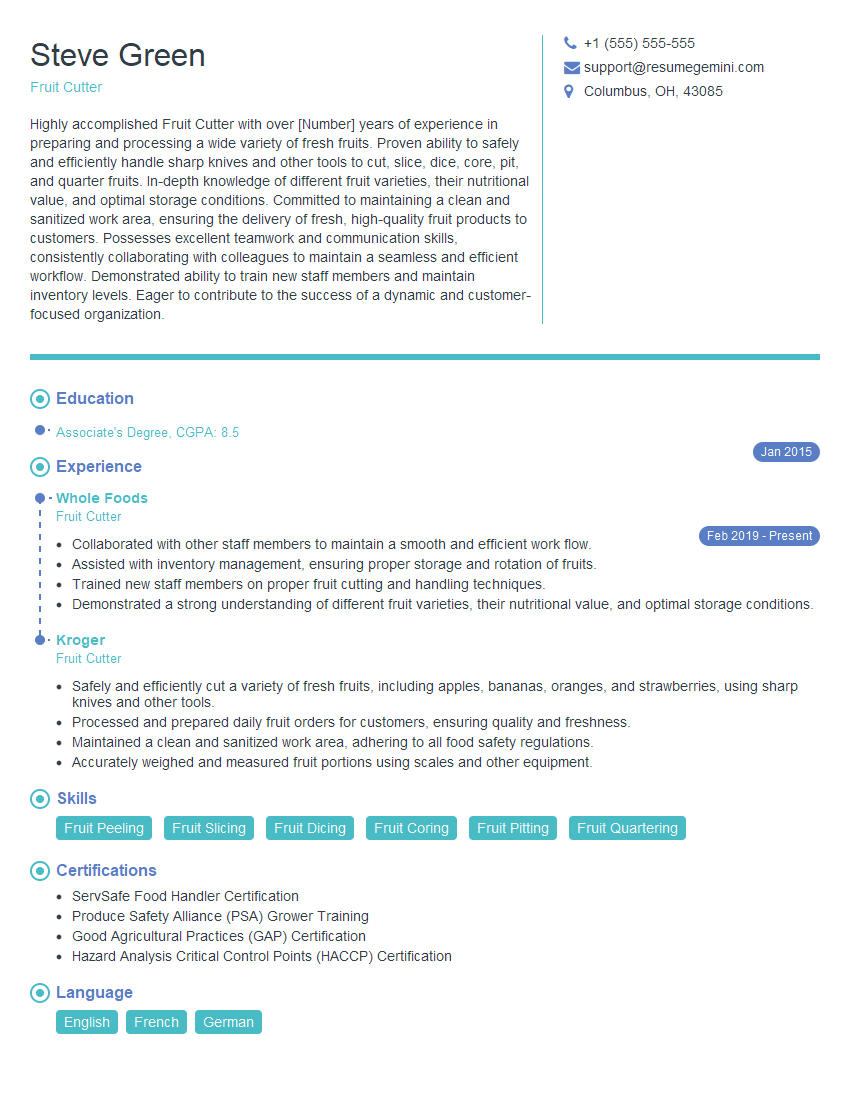
Mastering fruit cutting skills is essential for advancement in many culinary and food service roles, opening doors to exciting opportunities and higher earning potential. A strong resume is crucial for showcasing your abilities to potential employers. Creating an ATS-friendly resume significantly increases your chances of getting your application noticed. We highly recommend using ResumeGemini to build a professional and effective resume that highlights your skills and experience. ResumeGemini offers examples of resumes tailored to Fruit Cutting, providing you with valuable templates and guidance.
Explore more articles
Users Rating of Our Blogs
Share Your Experience
We value your feedback! Please rate our content and share your thoughts (optional).
What Readers Say About Our Blog
Very informative content, great job.
good