The thought of an interview can be nerve-wracking, but the right preparation can make all the difference. Explore this comprehensive guide to Yarn Weaving interview questions and gain the confidence you need to showcase your abilities and secure the role.
Questions Asked in Yarn Weaving Interview
Q 1. Describe the different types of yarn used in weaving.
Yarn selection is crucial in weaving, influencing the final fabric’s texture, drape, and durability. The type of yarn used depends heavily on the desired outcome of the woven fabric. There’s a vast array of options, categorized primarily by fiber content, structure, and twist.
- Fiber Content: This refers to the raw material used. Common fibers include cotton (soft, absorbent), wool (warm, resilient), linen (strong, crisp), silk (luxurious, smooth), and synthetic fibers like polyester (durable, wrinkle-resistant), acrylic (soft, affordable), and nylon (strong, elastic).
- Structure: Yarns can be single-ply (a single strand of fiber), or plied (multiple strands twisted together for increased strength and evenness). Ply count affects the yarn’s thickness and durability. Some yarns also have a core-spun structure (e.g., a core of synthetic material wrapped with a finer natural fiber) for specific qualities like durability and softness.
- Twist: The amount of twist in a yarn significantly impacts its texture and strength. High twist yarns are stronger and less prone to pilling, while low twist yarns are softer but may be more delicate.
Example: A fine, tightly twisted linen yarn would be ideal for a crisp, durable tablecloth, whereas a loosely twisted wool yarn would be better suited for a soft, warm blanket.
Q 2. Explain the process of warping a loom.
Warping is the process of preparing the warp yarns—the lengthwise threads—for weaving. It’s a crucial step that ensures even tension and prevents issues during the weaving process. Think of it like creating the foundation of a building before construction begins.
- Calculating Warp Length: The desired length of the finished fabric plus allowances for weaving-in the ends, selvedges, and take-up (shrinkage) needs to be determined.
- Winding the Warp: The warp yarns are individually wound onto a warp beam or a warping board. This needs to be done with consistent tension to prevent unevenness in the final fabric.
- Beaming the Warp: The wound warp yarns are transferred from the warping board or spool to the warp beam of the loom. Tension is carefully managed during this step to maintain evenness across the entire warp.
- Dressing the Loom: The warp yarns are then threaded through the heddles (a series of harnesses that control the lifting and lowering of warp threads) and reed (comb-like structure that beats the weft yarns into place). The process requires meticulous attention to detail, ensuring each yarn is in its correct place.
Example: When warping for a large tapestry, careful calculation and a warping mill may be necessary. For smaller projects a warping board is more suitable. Maintaining consistent tension during each stage is critical for uniform fabric.
Q 3. What are the different types of weaving structures?
Weaving structures determine the appearance and properties of the finished fabric. They are defined by how the warp and weft yarns interlace. Here are some key examples:
- Plain Weave: The simplest structure. Each weft yarn passes over one warp yarn and under the next, creating a simple, balanced fabric (e.g., cotton shirting).
- Twill Weave: Creates diagonal lines on the fabric surface due to the weft yarn passing over two or more warp yarns before going under one. This structure provides greater strength and durability (e.g., denim).
- Satin Weave: Characterized by a smooth, lustrous surface. The weft yarn floats over several warp yarns before passing under one, creating a long float. It tends to be less durable but more luxurious (e.g., satin fabric).
- Pile Weave: Creates a raised surface, such as in velvet or terry cloth. Extra yarns are looped or knotted to form the pile.
These are just a few; many variations and combinations exist, allowing for an almost endless range of fabric textures and qualities.
Q 4. How do you calculate the warp and weft density?
Warp and weft density refer to the number of threads per inch (or centimeter) in each direction. Accurate calculation ensures the desired fabric quality and weight.
- Warp Density: Calculated by counting the number of warp threads within one inch (or centimeter) of the fabric’s width.
- Weft Density: Calculated by counting the number of weft threads within one inch (or centimeter) of the fabric’s length.
Formula: Density (threads per inch) = Number of threads / Length in inches
Example: If a fabric sample has 30 warp threads and 25 weft threads within one inch, its warp density is 30 epi (ends per inch) and its weft density is 25 ppi (picks per inch).
Measuring density is crucial for quality control and consistency; it allows weavers to reproduce desired fabrics and troubleshoot issues. Higher density generally leads to denser, stronger fabrics, while lower density creates lighter, more open fabrics.
Q 5. Describe the different types of looms and their applications.
Various looms exist, each suited for different weaving styles and scales. The choice depends on the project’s complexity and production needs.
- Backstrap Loom: A simple, portable loom ideal for smaller projects and beginners. It’s often used for creating intricate patterns and tapestries.
- Table Loom: A more structured loom suitable for various weaving techniques. It offers greater control over tension and allows for larger projects.
- Floor Loom: A larger, more complex loom used for substantial projects like rugs, blankets, and upholstery fabrics. It offers superior control over the weaving process.
- Jacquard Loom: A sophisticated loom using punched cards or electronic controls to create complex, intricate patterns. It’s essential for producing highly detailed textiles.
- Industrial Looms: Used for mass production of textiles, employing high speed and automation to increase production efficiency.
The choice of loom depends heavily on the scale and complexity of the weaving project. A beginner might start with a backstrap loom, while a professional weaver might use a floor loom or an industrial loom for large-scale production.
Q 6. Explain the process of weft insertion.
Weft insertion is the process of adding the weft yarns (crosswise threads) to the warp yarns. It’s a repetitive process that builds the fabric one row at a time. The method differs based on the loom type and weaving technique.
- Shuttle: In many looms, a shuttle carries the weft yarn across the shed (the opening created between the warp yarns). This is a classic method, requiring skill and coordination.
- Pick-Up Stick: For certain techniques, a pick-up stick is used to individually pick up warp threads and weave the weft yarn around them. It enables intricate patterns but is more time-consuming.
- Other techniques: Some specialized looms use methods like weft-faced weaving, where the weft yarns are prominently featured on the fabric surface.
Example: On a floor loom, a shuttle is passed through the shed, and the weft yarn is then beaten into place by the reed. This process is repeated row after row, building up the fabric structure.
Precision and even tension are key to successful weft insertion. Incorrect tension can lead to uneven fabric and weaving defects. The speed and technique vary based on the project and the weaver’s experience.
Q 7. What are the common weaving defects and how are they corrected?
Several weaving defects can occur during the weaving process, resulting in imperfect fabrics. Identifying and correcting them is crucial for quality control.
- Broken Warp Threads: These can be easily mended by re-threading or splicing the broken thread. Preventing them involves careful warp preparation and handling.
- Missed Weft Threads: Often due to incorrect shuttle usage or inconsistent rhythm. Repair may involve carefully inserting the missed weft yarn.
- Uneven Tension: Leads to puckering or loose areas. Careful monitoring of warp and weft tension during the entire weaving process is essential.
- Slendering or Widening: A change in fabric width during the weaving process. This is usually caused by uneven tension in the warp threads. Adjusting the tension can often correct this.
- Float: When the weft floats too long across the warp yarns, resulting in weakness and potentially causing snag. This can be corrected by carefully adjusting the weft and warp tension.
Prevention is key: Careful planning, loom preparation, and consistent weaving techniques can significantly minimize the occurrence of these defects. Regular inspection during weaving also allows for early detection and correction of any problems.
Q 8. How do you maintain the quality of the woven fabric?
Maintaining the quality of woven fabric is a multifaceted process that begins long before the loom even starts. It involves careful selection of high-quality yarn, consistent yarn preparation (including proper winding and warping), meticulous loom setup, and vigilant monitoring throughout the weaving process.
Yarn Selection: The type of fiber (cotton, wool, silk, etc.), its fineness, strength, and evenness directly impact the final fabric’s quality. Using consistent, high-quality yarn is paramount. Think of it like building a house – you wouldn’t use weak bricks or unevenly sized lumber.
Warping and Weaving Preparation: Proper warping (preparing the lengthwise yarns) ensures even tension across the width of the fabric. This prevents later issues like uneven selvedges (the edges of the fabric) or distortions in the finished piece. A slight imperfection at this stage can result in a noticeable flaw in the final product.
Loom Setup and Maintenance: Regularly checking and adjusting the loom’s components is crucial. This includes ensuring that the heddles (the parts that lift and lower the warp yarns) are properly aligned, the reed (which spaces and beats the weft yarns) is clean and undamaged, and the shuttles (which carry the weft yarn) run smoothly. Ignoring maintenance can lead to broken yarns, missed picks (weft passes), and overall inconsistent fabric.
Monitoring the Weaving Process: Constant vigilance during weaving helps detect and correct minor issues promptly. This might involve adjusting tension, cleaning the reed, or replacing broken yarns before they significantly impact the fabric’s quality. Think of it like a chef constantly tasting the food – they make minor adjustments throughout the cooking process to ensure the final dish is perfect.
Q 9. Explain the importance of tension control in weaving.
Tension control is absolutely critical in weaving. It determines the fabric’s evenness, strength, and overall quality. Inconsistent tension leads to a variety of problems, from loose and uneven fabric to broken yarns and damaged equipment.
Warp Tension: Even tension across all warp yarns is essential to prevent distortions. Uneven warp tension can cause the fabric to ripple, creating an uneven surface and potentially weakening the structure. Imagine trying to weave with some warp yarns too tight and others too loose – the fabric would be extremely uneven and possibly break.
Weft Tension: Consistent weft tension ensures that the weft yarns are properly interwoven with the warp yarns, creating a strong and stable fabric. Too much tension can cause the warp yarns to break or the fabric to become too dense; too little tension can result in a loose, flimsy fabric. This is analogous to tying a knot – if it’s too tight, the string breaks; too loose, and the knot comes undone.
Overall Tension Balance: The balance between warp and weft tension is crucial. The ideal balance depends on the fiber type and desired fabric structure. This requires experience and understanding of the materials being used. Think of it like a tightrope walker – the balance between left and right foot determines their success.
Techniques for Tension Control: Various techniques, including using calibrated tensioning devices, adjusting the loom’s braking systems, and adopting appropriate weaving techniques, aid in achieving precise tension control. Using the wrong techniques can lead to disastrous results.
Q 10. Describe the different types of weaving patterns.
Weaving patterns are incredibly diverse, created by altering the arrangement of warp and weft yarns. Some common types include:
- Plain Weave: The simplest weave, where the weft yarn passes alternately over and under the warp yarns. This creates a basic, strong fabric like cotton sheeting.
- Twill Weave: Characterized by diagonal lines, twill weaves are created by passing the weft yarn over several warp yarns, then under one, creating a stepped pattern. Denim and gabardine are examples.
- Satin Weave: Known for its smooth, lustrous surface, satin weave involves passing the weft yarn over many warp yarns before going under one. The long floats on the surface create the characteristic sheen.
- Damask Weave: A complex weave that combines satin and twill structures to create intricate patterns. It’s often used for upholstery and table linens.
- Brocade Weave: Features raised, decorative patterns created by supplementary weft yarns. These yarns are woven in along with the main weft yarn to create the design. It’s often used for elaborate fabrics.
Beyond these basic types, there are countless variations and combinations, leading to an almost endless array of textures and patterns. The creativity in weaving is only limited by the weaver’s imagination and skill.
Q 11. How do you read and interpret a weaving draft?
A weaving draft is a visual representation of a weaving pattern, acting as a blueprint for creating the fabric. It uses symbols to indicate how the warp yarns are lifted and the weft yarn is passed. Understanding how to read a draft is crucial for successful weaving.
Understanding the Symbols: Each symbol in a draft represents a specific warp yarn’s position (lifted or not lifted) during a particular weft pass. Different drafts use slightly different symbols. For example, a square might represent a lifted yarn and a blank space a dropped yarn. Some drafts even use different symbols for different types of weft threads.
Following the Sequence: The draft is read sequentially, with each row representing a weft pass. The pattern of lifted and dropped yarns determines the interlacement of warp and weft and thus creates the woven structure. Think of it as following a recipe carefully – each step matters.
Interpreting the Structure: By following the pattern in the draft, one can predict the resulting fabric’s structure and pattern. Understanding the draft enables the weaver to select the appropriate yarns, setting the loom correctly and anticipating any potential challenges.
Example: Let’s say a draft shows a sequence like ‘□ □ ■ ■’. This might mean that in the first two passes, the first two warp threads are raised for the weft to pass under, while in the next two passes, the last two are raised. Repeating this sequence would give a simple repeat pattern. The exact meaning depends on the specific conventions used by the drafter.
Q 12. What are the safety precautions you follow while operating a loom?
Safety is paramount when operating a loom. Ignoring safety precautions can lead to serious injury. Here are some key precautions:
- Proper Clothing: Wear close-fitting clothing to prevent it from getting caught in the moving parts of the loom. Long hair should be tied back securely.
- Machine Guarding: Ensure all safety guards are in place and functioning correctly before starting the loom. These guards protect from moving parts.
- Clear Workspace: Keep the area around the loom clear of obstructions to prevent tripping hazards. Make sure there’s adequate space to move around the machine easily.
- Sharp Objects: Handle any sharp tools like scissors and needles with extreme care. Never reach across moving parts of the loom to pick up anything.
- Regular Maintenance: Regular inspections and maintenance help prevent mechanical failures that could lead to injuries. A well-maintained loom is a safer loom.
- Eye Protection: Flying fragments of yarn are common. Safety glasses protect your eyes from injury.
It’s always best to receive formal training on safe loom operation before using any weaving equipment.
Q 13. How do you troubleshoot common weaving machine problems?
Troubleshooting weaving machine problems requires systematic investigation. Here’s a step-by-step approach:
- Identify the Problem: Carefully examine the fabric and loom to pinpoint the exact nature of the problem. Is it a broken yarn, inconsistent tension, a skipped weft pass, or something else? Observing the problem is the first step towards solving it.
- Check the Yarn: Inspect the warp and weft yarns for breaks, knots, or inconsistencies. Replacing a broken yarn is usually a simple fix but requires knowing how to do it without causing more damage.
- Examine the Loom: Check the heddles for proper alignment, the reed for cleanliness and damage, and the shuttle for smooth movement. Any misalignment or damage could cause weaving issues. Regular maintenance can help identify and prevent such issues.
- Tension Adjustments: Adjust the warp and weft tension as needed. A simple tension adjustment can often resolve issues related to unevenness or broken yarns. Too much tension can break threads while too little can result in loose fabric.
- Check the Beat-Up Mechanism: Ensure that the beat-up mechanism (which compresses each weft pass) is functioning correctly. A faulty beat-up mechanism can result in loosely woven fabric.
- Consult Resources: If the problem persists, consult manuals, online resources, or experienced weavers for additional guidance. Sometimes seeking help from experts can prove useful.
Remember to always prioritize safety during troubleshooting. Never try to fix a problem while the loom is running.
Q 14. Explain the concept of shedding, picking, and beating-up in weaving.
Shedding, picking, and beating-up are the three fundamental movements in weaving, creating the fabric structure. They happen in a cyclical pattern that repeats for every weft insertion.
Shedding: This is the process of raising and lowering specific warp yarns to create a space (the shed) for the weft yarn to pass through. The heddles (harness) control which warp yarns are lifted and lowered, creating the opening for the weft. Think of this like parting your hair – creating a space to insert a ribbon.
Picking (or Weft Insertion): This is the process of inserting the weft yarn across the shed created by the shedding process. The shuttle or other weft-insertion device carries the weft yarn across the loom. The method of picking varies based on the type of loom and materials. Different shuttle types exist, from hand-held to automated.
Beating-up (or Battening): This is the process of pushing (beating) the newly inserted weft yarn into place against the previously woven fabric, compacting the structure. The reed (a comb-like device) carries out this beating-up action, pushing the new weft yarn firmly against the previous one. Think of it as pressing down on the ribbon to keep it secure in the hair.
These three actions—shedding, picking, and beating-up—are repeated for every weft pass, gradually building the woven fabric. The sequence and coordination of these movements are crucial for creating even and well-structured fabric.
Q 15. What are the different types of selvedges and their importance?
Selvedges are the finished edges of a woven fabric, crucial for preventing unraveling. Different types offer varying degrees of strength and aesthetic appeal.
- Standard Selvedge: This is the most common type, created by the loom’s mechanism itself. It’s usually quite sturdy and relatively simple in appearance. Think of the neatly finished edges on a commercially produced cotton shirt.
- Mock Selvedge: This is often created by adding extra warp threads and weaving them tightly to mimic the appearance of a true selvedge, even if the edge isn’t as inherently stable. It’s a cost-saving measure sometimes seen in mass-produced textiles.
- Finished Selvedge: In this case, the raw selvedge is further processed to improve its appearance and durability. This might involve binding the edge, creating a decorative finish, or adding a protective coating. This is common in high-end fabrics where aesthetics are paramount.
- Overlocked Selvedge: This is a technique often used after weaving, where the raw edges are stitched using an overlock machine. This provides a secure and neatly finished edge. Think of the cleanly finished seams on a well-made garment.
The importance of selvedges lies in their role in maintaining fabric integrity. A poorly finished selvedge can unravel easily, leading to damaged garments or unusable fabric. Choosing the right selvedge type depends on the intended use of the fabric – a sturdy selvedge is crucial for a heavy-duty application, while a decorative selvedge might be preferable for a high-fashion garment.
Career Expert Tips:
- Ace those interviews! Prepare effectively by reviewing the Top 50 Most Common Interview Questions on ResumeGemini.
- Navigate your job search with confidence! Explore a wide range of Career Tips on ResumeGemini. Learn about common challenges and recommendations to overcome them.
- Craft the perfect resume! Master the Art of Resume Writing with ResumeGemini’s guide. Showcase your unique qualifications and achievements effectively.
- Don’t miss out on holiday savings! Build your dream resume with ResumeGemini’s ATS optimized templates.
Q 16. How do you determine the appropriate yarn count for a specific project?
Determining the appropriate yarn count (the number of fibers twisted together to form a single yarn) for a project involves considering several factors: the desired fabric weight, drape, texture, and the type of project.
For example, a lightweight shawl might require a fine yarn count like 2/16s (meaning two plies of a 16s single), whereas a sturdy rug would benefit from a thicker, coarser yarn count like a 6/2. The higher the yarn number (e.g., 40s), the finer the yarn. Similarly, the project’s design and desired aesthetic will influence the choice; a delicate lace requires a fine yarn, while a chunky knit calls for a thick one. I also consider the fiber content – different fibers have varying strengths and thicknesses, influencing the final yarn count. For instance, cashmere will inherently result in a finer yarn than jute, even if both were spun to the same yarn count number.
In practice, I often start with yarn samples, creating small swatches with different counts to assess the final result. This allows for a hands-on experience and a more accurate assessment of the texture and drape before committing to a large project. It’s a crucial step in achieving the desired outcome.
Q 17. Describe your experience with different types of weaving software.
My experience with weaving software spans various programs. I’ve extensively used both commercial packages like [WeavePoint] and [another commercial weaving software], and also explored open-source options. These tools are invaluable for designing and planning complex weaving patterns. They often allow for the creation of draft charts, showing the precise arrangement of warp and weft threads, simulating different weaving structures, and calculating yarn requirements. They are essential for accuracy and efficiency, especially in intricate projects.
I appreciate the ability of these software to simulate different weaving techniques, allowing me to visualize the final fabric’s drape and texture before I begin weaving. For instance, I can use software to experiment with different twill angles to understand their impact on the final appearance, ensuring my patterns are visually stunning and structurally sound.
While I find commercial software quite versatile, I’ve also successfully employed open-source options for simple projects; this offers flexibility but may lack some of the advanced features of commercial software.
Q 18. Explain your experience with different types of weaving materials (e.g., cotton, silk, wool).
My experience with various weaving materials is extensive. Each material presents unique challenges and opportunities.
- Cotton: Durable, readily available, and easy to work with, cotton is perfect for everyday items like towels and kitchen linens. However, it can be prone to shrinkage, and its strength varies depending on the type.
- Silk: Luxurious and incredibly strong for its weight, silk requires meticulous handling and creates beautifully flowing fabrics. The challenge lies in its delicate nature and the potential for breakage if not handled carefully.
- Wool: Warm, naturally water-resistant, and available in a wide range of textures, wool offers versatility but needs careful attention during washing and finishing; it can also felt easily if treated incorrectly.
Working with each fiber requires adjusting my weaving technique and loom setup. For instance, the finer yarns of silk require a higher tension on the loom to prevent slippage, while wool’s tendency to felt might require adjustments to the beat-up process.
Beyond these, I have also worked with linen, hemp, ramie and other natural fibers, each providing a distinctive character to the final fabric. Understanding the individual properties of each fiber is essential to successfully manipulate and weave them.
Q 19. How do you handle variations in yarn quality?
Variations in yarn quality are inevitable, and handling them requires careful attention to detail and problem-solving skills.
First, I thoroughly inspect the yarn before starting a project, checking for inconsistencies in thickness, color, and strength. If significant variations are found, I might sort the yarn into batches based on quality, using the highest quality for the most visible areas of the project. This ensures a consistent final product.
For minor variations, I might adjust my tension and weaving technique to compensate for irregularities. For instance, thicker sections might require slightly less tension to prevent puckering, while thinner sections need a bit more to prevent looseness. I also keep detailed notes on the yarn’s behavior throughout the weaving process so that I can accurately adjust the subsequent weaving if needed.
In extreme cases, I might need to substitute a small portion of yarn, but this is a last resort, as it risks introducing subtle color variations.
Q 20. Describe your experience with different weaving techniques (e.g., plain weave, twill weave, satin weave).
My experience encompasses a wide range of weaving techniques, each producing a unique fabric structure and aesthetic.
- Plain Weave: The simplest and most fundamental weave, it involves alternating warp and weft threads over and under each other, creating a basic, sturdy fabric suitable for everyday use.
- Twill Weave: This technique creates diagonal lines on the fabric surface, characterized by its strength and durability. Different twill angles and variations produce varying textures and aesthetics. The iconic denim fabric is a prime example of twill weave.
- Satin Weave: Known for its smooth, lustrous surface and drape, satin weave involves a float of warp or weft threads across several other threads, resulting in a luxurious fabric.
Beyond these, I’m proficient in more complex weaves such as basket weave, double cloth, and various tapestry techniques. My understanding extends to adapting and combining these techniques to create innovative and unique textile designs. Each technique requires a different approach in terms of warp and weft yarn selection, loom setup, and weaving process.
Q 21. Explain your experience with loom maintenance and repair.
Loom maintenance and repair are essential for ensuring the smooth operation and longevity of the weaving equipment. My experience covers various aspects, from routine cleaning and lubrication to more complex repairs.
Regular maintenance involves cleaning the shuttle race, oiling moving parts, and checking for loose screws or damaged parts. I meticulously inspect the loom before each weaving session, replacing worn parts as necessary to ensure both the fabric’s quality and my own safety. I also have experience in troubleshooting mechanical problems. For example, I understand how to adjust heddles, reeds, and the overall tensioning system to ensure accurate and consistent weaving. Should a more significant problem arise, I have the skills to diagnose the cause and undertake repair works; and if not, I know which professionals to contact for specialized assistance.
I believe preventative maintenance is paramount to avoid costly repairs and extended downtime. Regular upkeep not only prolongs the loom’s lifespan but also ensures the production of high-quality woven fabrics. A well-maintained loom is both a tool and a partner in the weaving process.
Q 22. What are your skills in pattern design and creation for weaving?
Pattern design in weaving is the art of translating a creative vision into a structured plan that dictates the arrangement of warp and weft yarns to create a specific textile. My skills encompass the entire process, from initial conceptualization to the final execution.
Drafting: I’m proficient in creating drafts (plans) using both traditional methods – like graph paper and point paper – and modern digital weaving software like WeavePoint or AVL software. This includes determining the sett (density of warp threads), identifying appropriate yarn types, and designing the threading sequence.
Treadling: This involves meticulously planning the order in which the heddles (harness frames) are raised and lowered to create the desired pattern. I’m skilled in creating both simple and complex treadlings, including those that produce intricate twill, satin, damask, and tapestry weaves. I understand how different treadlings affect the drape, texture, and visual appeal of the finished fabric.
Warping: My experience extends to planning the warping process, including the calculations for the required warp length and the techniques used for winding the warp yarns onto the warping mill. This ensures an even and consistent tension during weaving.
Pattern Modification and Adaptation: I’m capable of adapting existing patterns to suit different yarn counts, materials, and loom types. For example, I can modify a pattern designed for a floor loom to work on a smaller table loom by adjusting the sett and possibly simplifying the treadling.
I can create patterns for a diverse range of textile applications, from simple household fabrics to intricate artistic tapestries. My portfolio includes examples of both geometric and pictorial designs, showcasing my versatility and expertise.
Q 23. Describe your experience working with a team in a weaving environment.
Teamwork is integral to successful weaving, especially in larger-scale production environments. In my previous role at [Previous Company Name], I was part of a team of five, responsible for the production of [Type of Fabric].
Collaboration: We effectively collaborated on the planning and execution of projects. This involved discussing design options, selecting appropriate materials, assigning tasks based on individual strengths, and troubleshooting technical challenges together.
Communication: Open and clear communication was crucial. We regularly held meetings to discuss progress, identify potential bottlenecks, and coordinate our efforts. This prevented misunderstandings and ensured that everyone was on the same page.
Problem-solving: When we encountered weaving defects or production delays, we worked collaboratively to analyze the root cause, brainstorm solutions, and implement corrective actions. One instance involved a consistent weft yarn breakages; through teamwork, we identified it was due to an overly tight tension. After adjusting the tension, the issue was resolved.
Mentorship: I also mentored junior weavers, guiding them on weaving techniques, pattern design, and quality control procedures. This fostered a supportive and collaborative team environment.
My ability to effectively communicate, collaborate, and mentor others within a team setting makes me a valuable asset to any weaving operation.
Q 24. How do you adapt to changes in production requirements?
Adaptability is paramount in the weaving industry, where production requirements can change frequently due to market demands or client specifications. My approach to adapting to changes involves a structured process.
Understanding the Change: I first thoroughly understand the nature and scope of the change in requirements. This might involve reviewing updated specifications, discussing the changes with the team lead, or consulting relevant documents.
Assessment and Planning: I then assess the impact of the change on existing workflows and production schedules. This may involve adjusting loom settings, modifying weaving patterns, or re-allocating resources.
Implementation and Monitoring: I implement the necessary changes systematically, ensuring that all team members are informed and trained accordingly. I closely monitor the production process, making adjustments as needed to maintain quality and efficiency. For instance, if a client requests a change in color, I would update the yarn selection, and ensure proper color consistency throughout the weaving process.
Continuous Improvement: I use each change as an opportunity to learn and improve. I reflect on the process, identifying areas where we can improve efficiency and reduce waste in the future.
This systematic approach allows me to respond effectively to changes while maintaining productivity and quality.
Q 25. What is your understanding of quality control procedures in weaving?
Quality control in weaving is crucial for ensuring that the finished product meets the required standards of quality and consistency. My understanding encompasses several key aspects.
Warp and Weft Inspection: Before weaving begins, I meticulously inspect the warp and weft yarns for defects such as unevenness, slubs (thick spots), or broken threads. This early detection prevents flaws in the finished fabric.
Monitoring the Weaving Process: During the weaving process, I regularly monitor the loom’s performance, checking for correct tension, even shedding (separation of warp threads), and proper weft insertion. Any irregularities are addressed immediately.
Fabric Inspection: After weaving, I inspect the finished fabric for various defects, including broken or missing ends, loose floats (unwoven warp or weft threads), and variations in density or color. I usually use a specific checklist to ensure thoroughness.
Defect Analysis: When defects are identified, I analyze the root cause to prevent their recurrence. This might involve adjusting loom settings, improving yarn handling, or modifying weaving techniques.
Documentation: Accurate record-keeping is vital. I meticulously document all quality control checks, including dates, times, and any identified defects, along with corrective actions taken. This helps to track performance over time and identify trends.
My commitment to rigorous quality control procedures ensures that the finished product is of the highest standard.
Q 26. Describe your problem-solving skills related to weaving challenges.
Problem-solving is a daily occurrence in weaving. My approach involves a methodical process.
Identification: I clearly identify the problem. This may involve examining the fabric for defects, analyzing production data, or consulting with other team members.
Analysis: I systematically analyze the problem to determine its root cause. This might involve checking loom settings, examining yarn quality, or investigating the weaving process itself. For instance, if there are noticeable slubs in the fabric, I’d examine the yarn for imperfections.
Brainstorming Solutions: I brainstorm potential solutions, considering different approaches and their potential consequences. I draw upon my experience and knowledge of weaving techniques and technologies.
Implementation and Testing: I implement the chosen solution, carefully monitoring the results. If necessary, I might make adjustments to refine the solution.
Documentation: Finally, I document the problem, the solution implemented, and the outcome. This enables me to learn from past experiences and prevent similar problems in the future.
My problem-solving skills are honed through years of experience and a commitment to continuous learning. I am adept at handling a wide range of weaving challenges, from minor technical glitches to major production issues.
Q 27. How do you stay updated on the latest trends and technologies in weaving?
Staying updated on the latest trends and technologies in weaving is essential for maintaining competitiveness and innovation. My approach involves several strategies.
Industry Publications: I regularly read trade publications and journals such as [Mention specific publications relevant to weaving], which keep me informed about new materials, techniques, and technologies.
Conferences and Workshops: I attend industry conferences and workshops whenever possible, networking with other professionals and learning about the latest advancements. This allows me to learn from experts and gain firsthand insights into new developments.
Online Resources: I leverage online resources such as professional weaving forums and websites to stay abreast of current trends and emerging technologies. This includes participating in online discussions and following industry leaders.
Experimentation: I actively experiment with new materials and techniques in my own projects. This hands-on approach helps me to gain practical experience and refine my skills.
This multi-faceted approach ensures I remain at the forefront of the weaving industry, consistently expanding my knowledge and expertise.
Key Topics to Learn for Your Yarn Weaving Interview
- Yarn Properties & Selection: Understanding fiber types (cotton, wool, silk, synthetics), yarn counts, ply, twist, and their impact on fabric properties and weaving performance. Practical application: Explaining your choices for specific projects based on desired drape, durability, and texture.
- Weaving Techniques & Loom Operation: Familiarity with various weaving techniques (plain weave, twill weave, satin weave, jacquard), loom setup, warp and weft preparation, shedding, picking, and beating-up processes. Practical application: Describing troubleshooting experiences with loom malfunctions or fabric imperfections.
- Weaving Calculations & Design: Understanding warp and weft calculations, designing patterns, creating drafts, and manipulating yarn tension for desired results. Practical application: Demonstrating your ability to calculate yarn requirements for a specific project or adjust a pattern to achieve a different outcome.
- Fabric Structure & Analysis: Identifying different weave structures, analyzing fabric properties (density, drape, strength), and understanding the relationship between yarn properties and fabric characteristics. Practical application: Critically evaluating the quality of woven fabrics and identifying potential defects.
- Troubleshooting & Quality Control: Identifying common weaving problems (broken yarns, uneven tension, incorrect sett), implementing quality control measures, and developing solutions to improve weaving efficiency and fabric quality. Practical application: Describing a situation where you identified and resolved a weaving issue.
- Health and Safety in Weaving: Understanding and adhering to safety regulations related to loom operation, yarn handling, and working with potentially hazardous materials. Practical application: Demonstrating awareness of safety protocols and best practices.
Next Steps
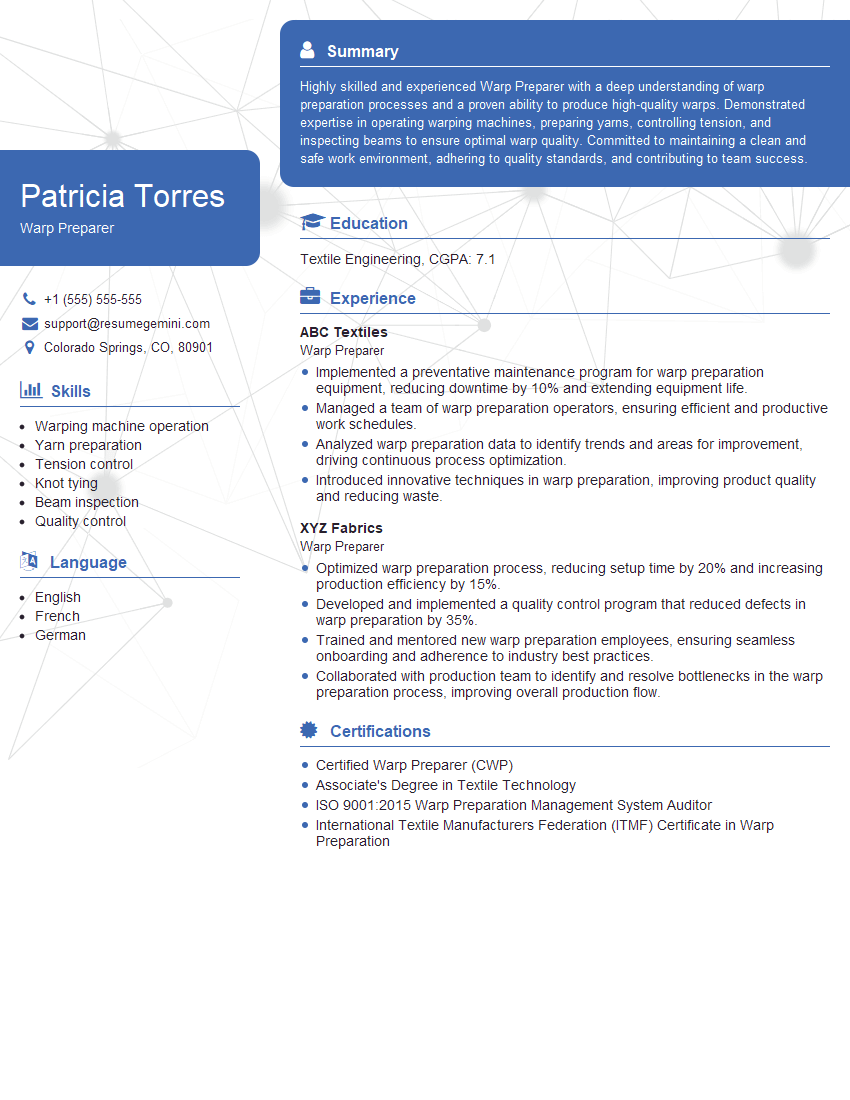
Mastering yarn weaving opens doors to exciting career opportunities in textiles, fashion, and design. To stand out, a strong, ATS-friendly resume is crucial. ResumeGemini is a trusted resource to help you craft a compelling resume that showcases your skills and experience effectively. Take advantage of their tools and resources – examples of resumes tailored to Yarn Weaving are available to help you build a truly impactful application. Invest the time to build a powerful resume; it’s your first impression and key to securing your dream role.




Explore more articles
Users Rating of Our Blogs
Share Your Experience
We value your feedback! Please rate our content and share your thoughts (optional).
What Readers Say About Our Blog
Very informative content, great job.
good