Every successful interview starts with knowing what to expect. In this blog, we’ll take you through the top Experience with software development interview questions, breaking them down with expert tips to help you deliver impactful answers. Step into your next interview fully prepared and ready to succeed.
Questions Asked in Experience with software development Interview
Q 1. Explain the difference between object-oriented and procedural programming.
Procedural programming and object-oriented programming (OOP) represent two fundamental approaches to software development. Procedural programming structures code as a sequence of instructions or procedures, focusing on ‘how’ to accomplish a task. In contrast, OOP organizes code around ‘objects’ that encapsulate data (attributes) and methods (functions) that operate on that data. This object-centric approach emphasizes ‘what’ needs to be done, promoting modularity, reusability, and maintainability.
Think of it like building with LEGOs. Procedural programming is like giving instructions: ‘Take this brick, put it here, then take that brick and place it on top.’ OOP is like using pre-assembled modules (objects): ‘Use the ‘car’ module, then attach the ‘engine’ module.’ The ‘car’ object already contains its parts and functions (like ‘drive’).
- Procedural: Focuses on procedures or functions. Data and functions are separate. Example: C, Pascal.
- Object-Oriented: Focuses on objects that combine data and functions. Encapsulation, inheritance, and polymorphism are key features. Example: Java, Python, C++.
In a real-world project, choosing between the two depends on the project’s complexity and requirements. Smaller projects might benefit from the simplicity of procedural programming, while larger, more complex projects are often better suited to the organization and reusability offered by OOP.
Q 2. Describe your experience with Agile development methodologies.
My experience with Agile methodologies is extensive, spanning several years and numerous projects. I’ve worked primarily with Scrum and Kanban, adapting my approach depending on project needs. In Scrum, I’ve participated in sprint planning, daily stand-ups, sprint reviews, and retrospectives. I’ve found the iterative nature of Scrum invaluable for adapting to changing requirements and delivering value incrementally. I’ve also used Kanban for managing workflow, visualizing bottlenecks, and limiting work in progress, particularly useful in maintaining a steady flow of tasks and prioritizing high-value items.
In one particular project, we transitioned from a waterfall methodology to Scrum. This involved initial challenges in team adaptation and the need to establish clear definitions of ‘done’ and sprint goals. However, through consistent retrospectives and process improvements, the team effectively embraced the Agile principles, leading to improved collaboration, increased efficiency, and higher quality deliverables. The continuous feedback loops and adaptive planning inherent in Agile proved crucial in navigating unexpected challenges and ensuring the successful completion of the project.
Q 3. What are the SOLID principles of object-oriented design?
The SOLID principles are a set of five design principles intended to make software designs more understandable, flexible, and maintainable. They are:
- Single Responsibility Principle (SRP): A class should have only one reason to change. This promotes modularity and reduces coupling.
- Open/Closed Principle (OCP): Software entities (classes, modules, functions, etc.) should be open for extension, but closed for modification. This allows adding new functionality without altering existing code.
- Liskov Substitution Principle (LSP): Subtypes should be substitutable for their base types without altering the correctness of the program. This ensures that derived classes behave as expected.
- Interface Segregation Principle (ISP): Clients should not be forced to depend upon interfaces they don’t use. This avoids creating large, bloated interfaces.
- Dependency Inversion Principle (DIP): Depend upon abstractions, not concretions. This promotes loose coupling and allows for flexibility in choosing implementations.
Applying SOLID principles leads to more robust, maintainable, and testable code. For instance, violating SRP by creating a class with multiple responsibilities can lead to tight coupling and difficulty in testing and maintaining that class. Adhering to these principles helps prevent such issues by promoting modularity and clear separation of concerns.
Q 4. Explain the concept of RESTful APIs.
A RESTful API (Representational State Transfer Application Programming Interface) is an architectural style for designing network APIs. It uses HTTP methods (GET, POST, PUT, DELETE) to interact with resources, identified by URIs. Key features include:
- Statelessness: Each request contains all the information needed to understand it; the server doesn’t store context between requests.
- Client-Server: Clear separation of concerns between the client and server.
- Cacheable: Responses can be cached to improve performance.
- Uniform Interface: A consistent way to interact with resources using standard HTTP methods.
- Layered System: Client doesn’t need to know about the internal structure of the server.
- Code on Demand (Optional): The server can optionally provide client functionality via code.
Imagine ordering food online. The RESTful API would be the system that takes your order (POST), retrieves your order status (GET), updates your address (PUT), or cancels your order (DELETE). Each action uses a specific HTTP method and interacts with resources (orders, addresses, etc.) identified by URIs.
Q 5. What is version control and why is it important?
Version control is a system that records changes to a file or set of files over time so that you can recall specific versions later. Think of it as a detailed history of your project’s development. It’s crucial because it allows for:
- Tracking Changes: See who made what changes and when.
- Collaboration: Multiple developers can work on the same project simultaneously without overwriting each other’s work.
- Reverting Changes: Easily undo mistakes or revert to previous versions.
- Branching and Merging: Experiment with new features without affecting the main codebase.
- Backup and Recovery: Provides a secure backup of your project.
Without version control, collaborating on a software project becomes extremely difficult and risky. The potential for lost work, conflicts, and a lack of transparency is significant. Version control provides a safety net and a structured approach to managing changes.
Q 6. Describe your experience with Git and common Git commands.
I have extensive experience with Git, a widely used distributed version control system. I’m proficient in using the command line interface and familiar with various GUI clients. Some common Git commands I frequently use include:
git init: Initialize a new Git repository.git clone: Create a local copy of a remote repository.git add: Stage changes for commit.git commit: Save changes with a descriptive message.git push: Upload local commits to a remote repository.git pull: Download changes from a remote repository.git branch: Manage branches (create, list, switch, delete).git merge: Combine changes from different branches.git log: View the commit history.git status: Check the status of the working directory.
In a recent project, we used Git’s branching capabilities to develop and test new features independently. This minimized the risk of disrupting the main codebase and allowed us to merge the tested features seamlessly once they were ready. Git’s collaboration tools were also essential in facilitating seamless teamwork among multiple developers working concurrently on various aspects of the project.
Q 7. Explain the difference between a stack and a queue.
Stacks and queues are both abstract data types used to store and manage collections of elements, but they differ significantly in how elements are added and removed.
- Stack: Follows the Last-In, First-Out (LIFO) principle. Imagine a stack of plates; you can only add a new plate to the top, and you can only remove the top plate. Common operations are
push(add an element to the top) andpop(remove the element from the top). - Queue: Follows the First-In, First-Out (FIFO) principle. Think of a line at a store; the first person in line is the first person served. Common operations are
enqueue(add an element to the rear) anddequeue(remove the element from the front).
In software development, stacks are commonly used in function call management (the call stack), undo/redo functionalities, and expression evaluation. Queues are frequently used in managing tasks in a system, handling requests in a server, and implementing breadth-first search algorithms. The choice between a stack and a queue depends entirely on the specific requirements of the application, dictating whether LIFO or FIFO behavior is more appropriate for the task at hand.
Q 8. What are different database types and their use cases?
Databases are crucial for storing and managing data in software applications. Different database types cater to various needs based on data structure, scalability, and performance requirements. Here are some common types:
- Relational Databases (RDBMS): These databases organize data into tables with rows (records) and columns (fields), linked through relationships. Examples include MySQL, PostgreSQL, Oracle, and SQL Server. They are excellent for structured data requiring ACID properties (Atomicity, Consistency, Isolation, Durability) – ensuring data integrity in transactions. Use Case: E-commerce platforms, banking systems, where data integrity and transactional consistency are paramount.
- NoSQL Databases: These are non-relational databases that offer more flexibility in data modeling. They handle large volumes of unstructured or semi-structured data effectively. Examples include MongoDB (document database), Cassandra (wide-column store), Redis (in-memory data structure store). Use Case: Social media applications (handling user profiles and posts), IoT devices (managing sensor data), and real-time analytics.
- Graph Databases: These databases represent data as nodes and edges, ideal for managing relationships between data points. Examples include Neo4j and Amazon Neptune. Use Case: Social networks (connections between users), recommendation systems (item-to-item relationships), and knowledge graphs.
The choice of database depends on factors like data volume, structure, query patterns, scalability needs, and transaction requirements. A well-chosen database significantly impacts application performance and maintainability.
Q 9. How do you handle conflicting priorities in a project?
Conflicting priorities are a common challenge in software development. My approach involves a structured process to ensure a balanced outcome:
- Prioritization Meeting: I facilitate a meeting with stakeholders to clearly define all priorities. This includes discussing the business value, technical feasibility, and dependencies of each item.
- Prioritization Framework: We use a framework like MoSCoW (Must have, Should have, Could have, Won’t have) to categorize the priorities. This provides a clear understanding of what’s essential, desirable, and can be deferred.
- Trade-off Analysis: We analyze the trade-offs involved in choosing one priority over another, assessing the impact on the project timeline, budget, and overall goals.
- Documentation & Communication: The agreed-upon priorities are clearly documented and communicated to the entire team to ensure everyone is on the same page.
- Regular Review: Priorities are reviewed periodically to adapt to changing circumstances or new information.
For instance, in a project with conflicting deadlines for two crucial features, we might use the MoSCoW method to identify one as a ‘Must have’ and the other as a ‘Should have,’ prioritizing the ‘Must have’ and potentially delaying or scaling back the ‘Should have’ feature.
Q 10. Explain your experience with testing methodologies (unit, integration, system).
Testing is an integral part of my development process, ensuring high-quality software. I’m experienced in various methodologies:
- Unit Testing: This involves testing individual units or components of code in isolation to verify their functionality. I usually employ frameworks like JUnit (Java) or pytest (Python) to write automated unit tests. This approach helps catch bugs early and makes refactoring easier. Example: Testing a single function that calculates the area of a circle.
- Integration Testing: This tests the interaction between different units or modules to ensure they work together correctly. We often use mocking to simulate dependencies during integration testing. Example: Testing the interaction between a user interface component and a database.
- System Testing: This is end-to-end testing of the entire system to validate that all components function as a cohesive unit and meet the requirements. It involves various techniques like functional, performance, and security testing. Example: Testing the complete e-commerce checkout process, from adding items to the cart to final payment processing.
I advocate for a comprehensive testing strategy that incorporates all three levels to maximize the detection of defects and improve software reliability. Test-driven development (TDD), where tests are written before the code, is also a technique I frequently employ.
Q 11. What are some common design patterns and when would you use them?
Design patterns are reusable solutions to common software design problems. They provide a blueprint for structuring code and improving its maintainability and scalability. Here are some examples:
- Singleton: Ensures only one instance of a class is created. Use Case: Database connection, logging services.
- Factory: Creates objects without specifying their concrete class. Use Case: Creating different types of buttons or database connections.
- Observer: Defines a one-to-many dependency between objects. Use Case: Event handling systems, notification mechanisms.
- MVC (Model-View-Controller): Separates concerns into three interconnected parts. Use Case: Web applications, desktop applications.
- Decorator: Dynamically adds responsibilities to an object. Use Case: Adding logging or authentication to existing functions.
The selection of a design pattern depends on the specific problem being addressed. Choosing the right pattern can improve code readability, reduce complexity, and enhance maintainability. For instance, using the Singleton pattern for database connection ensures that only one connection is established, improving efficiency and preventing resource conflicts.
Q 12. Describe your approach to debugging complex software issues.
Debugging complex software issues requires a systematic approach:
- Reproduce the Issue: The first step is to consistently reproduce the bug. This helps isolate the problem and rule out random occurrences.
- Gather Information: Collect all relevant data: error messages, logs, stack traces, and any other clues. Use debugging tools to step through the code and examine variables.
- Isolate the Problem: Try to narrow down the source of the bug by commenting out sections of code or using debugging tools to isolate the specific area of the problem.
- Analyze the Code: Carefully review the code around the suspected area, looking for logical errors, incorrect assumptions, or potential edge cases.
- Test Solutions: After implementing a fix, thoroughly test the affected area and the whole system to ensure the bug is resolved without causing new issues.
- Use Debugging Tools: Leverage debugging tools (debuggers, profilers, logging frameworks) to examine the program’s state, trace execution flow, and assess performance bottlenecks.
For example, if a web application is experiencing slow response times, I’d use a profiler to identify performance bottlenecks, possibly revealing inefficient database queries or excessive CPU usage by a particular component. This helps pinpoint the exact location to optimize for better performance.
Q 13. Explain your understanding of different software development lifecycles.
Software development lifecycles (SDLCs) define the stages involved in creating software. Several models exist, each with its strengths and weaknesses:
- Waterfall: A linear sequential approach with distinct phases (requirements, design, implementation, testing, deployment). Suitable for: Projects with stable requirements and minimal expected changes.
- Agile (Scrum, Kanban): Iterative and incremental approaches focusing on flexibility and collaboration. Suitable for: Projects with evolving requirements and a need for rapid feedback.
- Spiral: A risk-driven approach combining elements of waterfall and prototyping. Suitable for: Large and complex projects with high risks.
- DevOps: Emphasizes collaboration and automation between development and operations teams, focusing on continuous integration and delivery. Suitable for: Projects requiring frequent releases and updates.
My experience spans various SDLCs. I find Agile methodologies particularly effective for most projects due to their flexibility and adaptability to changing requirements. However, the choice of SDLC ultimately depends on the project’s specific context, scale, and risk profile.
Q 14. How do you stay up-to-date with new technologies and trends in software development?
Staying current in the rapidly evolving field of software development is crucial. My approach is multi-faceted:
- Online Courses and Tutorials: I actively participate in online courses on platforms like Coursera, edX, and Udemy to learn new technologies and refresh existing skills.
- Industry Blogs and Publications: I regularly follow reputable blogs, publications, and websites that cover the latest trends and advancements in software development.
- Conferences and Workshops: Attending industry conferences and workshops provides valuable insights, networking opportunities, and exposure to new ideas.
- Open Source Contributions: Contributing to open-source projects allows me to learn from experienced developers, work with new technologies, and build my portfolio.
- Professional Networking: I actively network with other developers through online communities, meetups, and conferences, sharing knowledge and learning from others’ experiences.
This continuous learning process enables me to adapt to new challenges, leverage the latest tools and techniques, and maintain a high level of proficiency in my field. For example, recently I completed a course on Kubernetes to enhance my skills in container orchestration.
Q 15. Explain the difference between synchronous and asynchronous programming.
Synchronous and asynchronous programming are two fundamental approaches to handling tasks in software development. Think of it like ordering food: synchronous is like going to a restaurant and waiting at your table until your food arrives; asynchronous is like ordering takeout and doing something else while you wait for the delivery.
In synchronous programming, tasks are executed sequentially. Each task must complete before the next one begins. This is straightforward but can lead to performance bottlenecks if one task takes a long time. For example, if your program needs to fetch data from a remote server, a synchronous call will block the execution until the data is received.
// Synchronous example (pseudocode) fetchUserData(userId); // Blocks until data is fetched processUserData(userData);
Asynchronous programming, conversely, allows tasks to run concurrently without blocking each other. When a task involves a potentially long wait (like network requests), the program doesn’t stop; it moves on to other tasks, and the asynchronous operation eventually notifies the program when it’s complete. This significantly improves responsiveness and efficiency, especially in I/O-bound applications.
// Asynchronous example (pseudocode) fetchUserDataAsync(userId, function(userData) { processUserData(userData); }); // Program continues executing other tasks while fetching data
The key difference is blocking versus non-blocking. Synchronous operations block execution, while asynchronous operations don’t. Asynchronous programming is essential for building responsive and scalable applications, especially those involving network interactions or heavy computations.
Career Expert Tips:
- Ace those interviews! Prepare effectively by reviewing the Top 50 Most Common Interview Questions on ResumeGemini.
- Navigate your job search with confidence! Explore a wide range of Career Tips on ResumeGemini. Learn about common challenges and recommendations to overcome them.
- Craft the perfect resume! Master the Art of Resume Writing with ResumeGemini’s guide. Showcase your unique qualifications and achievements effectively.
- Don’t miss out on holiday savings! Build your dream resume with ResumeGemini’s ATS optimized templates.
Q 16. What are your preferred programming languages and why?
My preferred programming languages are Python and Java. My choice is driven by their versatility and suitability for different types of projects.
Python excels in its readability, ease of use, and extensive libraries, particularly for data science, machine learning, and scripting tasks. Its large community support and readily available resources make it ideal for rapid prototyping and development. I find it highly productive for building back-end systems and data processing pipelines.
Java, on the other hand, is my go-to language for robust, enterprise-level applications requiring scalability and performance. Its object-oriented nature, mature ecosystem, and strong platform independence make it perfect for building complex systems that need to handle high loads. I’ve used it extensively for building large-scale web applications and distributed systems.
While I have experience with other languages like JavaScript and C++, my preference for Python and Java reflects their ability to meet most of my software development needs effectively.
Q 17. Describe a challenging software project you worked on and how you overcame obstacles.
One challenging project involved migrating a legacy monolithic application to a microservices architecture. The original system was poorly documented, difficult to maintain, and suffered from frequent performance issues. The biggest obstacles were the complexity of the existing codebase, the need for minimal downtime during migration, and the integration with existing third-party systems.
To overcome these challenges, we adopted a phased approach. We first thoroughly documented the existing system, identifying key functionalities and their dependencies. Then, we prioritized the modules that needed to be migrated first, starting with the least critical components. This allowed us to test and deploy the microservices incrementally, minimizing disruption.
We utilized containerization (Docker) and orchestration (Kubernetes) to simplify deployment and management. This improved scalability and enabled us to easily roll back changes if any issues arose during the migration. We also established robust monitoring and logging to track performance and identify potential problems early.
Continuous integration and continuous delivery (CI/CD) practices were crucial. Automated testing ensured the quality of the microservices before deployment, and the CI/CD pipeline expedited the release cycle. Finally, thorough communication and collaboration among the team were instrumental in successfully navigating the complex challenges of this migration.
Q 18. What is your experience with cloud platforms (AWS, Azure, GCP)?
I have extensive experience with AWS, including services like EC2, S3, Lambda, RDS, and DynamoDB. I’ve used these services to build and deploy various applications, leveraging their scalability, reliability, and cost-effectiveness. I’ve also worked with Azure, specifically with Azure App Service, Azure SQL Database, and Azure Blob Storage, for projects requiring integration with other Microsoft services. While my experience with GCP is less extensive, I have familiarity with Compute Engine and Cloud Storage, primarily for specific tasks related to data processing and storage.
My cloud experience extends beyond just using specific services. I understand the importance of security best practices, cost optimization, and designing cloud-native applications. I’m comfortable with infrastructure as code (IaC) tools like Terraform and CloudFormation, which are essential for managing and automating cloud deployments.
Q 19. Explain the concept of continuous integration and continuous delivery (CI/CD).
Continuous Integration and Continuous Delivery (CI/CD) are practices that automate the process of building, testing, and deploying software. Imagine it as an assembly line for software, streamlining the development and release process.
Continuous Integration (CI) focuses on integrating code changes frequently into a shared repository. Every code commit triggers an automated build and test process, ensuring early detection of integration problems. This prevents the accumulation of conflicting changes and makes it easier to pinpoint the source of bugs.
Continuous Delivery (CD) extends CI by automating the release process. Once code passes all tests in CI, it’s automatically deployed to a staging or production environment. This accelerates the release cycle and allows for frequent, smaller releases, making it easier to respond to user feedback and adapt to changing requirements.
The combination of CI/CD results in faster feedback loops, reduced risk, and increased efficiency in software development. Tools like Jenkins, GitLab CI, and CircleCI play a vital role in automating the CI/CD pipeline.
Q 20. How do you handle technical debt in a project?
Technical debt, in simple terms, is the implied cost of rework caused by choosing an easy (limited) solution now instead of using a better approach that would take longer. It’s like taking a shortcut that might seem convenient now but can lead to problems later.
Managing technical debt requires a proactive approach. We need to:
- Identify and prioritize: Regularly assess the codebase to identify areas with high technical debt. Prioritize based on impact and risk. A crucial part of this is establishing a clear definition of what constitutes technical debt within the project.
- Track and monitor: Keep track of technical debt using tools or spreadsheets. Monitor its growth and impact on development velocity.
- Plan for remediation: Allocate time in sprints or dedicated projects to address technical debt. Don’t let it accumulate uncontrollably.
- Refactor strategically: Refactoring (improving the code structure without changing its functionality) is key to reducing technical debt. This should be done incrementally to avoid disrupting ongoing work.
- Prevent future debt: Establish coding standards, conduct code reviews, and encourage writing clean, maintainable code to prevent future accumulation of technical debt.
The key is a balance between delivering features quickly and maintaining a healthy codebase. Ignoring technical debt can lead to significant problems in the long run, impacting maintainability, scalability, and performance.
Q 21. Explain your experience with different software architectures (microservices, monolithic).
Software architectures can be broadly categorized as monolithic or microservices. A monolithic architecture is like a single, large application where all components are tightly coupled. Imagine a single, large apartment building. It’s simple to build, but if one part has a problem, the whole building might suffer.
A microservices architecture, on the other hand, divides an application into small, independent services. Each service has its own functionality and can be deployed and scaled independently. Think of this as a complex of smaller buildings, each with its own function. If one building has a problem, the others are unaffected.
I have experience with both. Monolithic architectures are simpler to develop and deploy initially, but they can become difficult to maintain and scale as the application grows. Microservices offer greater flexibility, scalability, and resilience. However, they introduce complexities in terms of communication, data management, and deployment.
The choice between monolithic and microservices depends on factors like project size, complexity, and scalability requirements. For smaller projects, a monolithic approach might be sufficient. For large, complex applications requiring high scalability and resilience, microservices are often a better choice. There are also hybrid approaches that combine aspects of both architectures.
Q 22. What is your experience with database optimization techniques?
Database optimization is crucial for ensuring application performance and scalability. It involves identifying and resolving bottlenecks that hinder efficient data retrieval and storage. My experience encompasses a range of techniques, focusing on both physical database design and query optimization.
Indexing: I’ve extensively used indexing strategies, including B-tree, hash, and full-text indexes, to dramatically improve query speeds. For instance, in a project involving a large e-commerce platform, adding indexes to frequently queried columns reduced query execution time from several seconds to milliseconds.
Query Optimization: I’m proficient in analyzing query execution plans using tools like SQL Profiler and explain plans. This allows me to identify inefficient queries and rewrite them using appropriate joins, subqueries, and avoiding full table scans. For example, I once optimized a slow reporting query by changing a nested loop join to a hash join, resulting in a 90% reduction in execution time.
Database Normalization: I understand the importance of database normalization to reduce data redundancy and improve data integrity. Properly normalized databases are easier to maintain and less prone to anomalies. I have experience with various normal forms (1NF, 2NF, 3NF, BCNF) and apply them according to the specific data model.
Sharding and Partitioning: For extremely large databases, I’ve worked with sharding and partitioning strategies to distribute data across multiple servers, enhancing scalability and performance. This is particularly beneficial for handling high volumes of concurrent requests.
Caching: I frequently utilize caching mechanisms (e.g., Redis, Memcached) to store frequently accessed data in memory, significantly reducing database load and improving response times. A recent project saw a 75% reduction in database reads after implementing a robust caching strategy.
Q 23. Describe your understanding of security best practices in software development.
Security is paramount in software development, and I approach it with a multi-layered defense strategy. This involves incorporating security considerations at every stage of the development lifecycle, from design to deployment.
Input Validation and Sanitization: I always validate and sanitize user inputs to prevent injection attacks (SQL injection, cross-site scripting). This includes using parameterized queries or prepared statements for database interactions and escaping special characters in user-supplied data.
Authentication and Authorization: Secure authentication mechanisms (e.g., OAuth 2.0, OpenID Connect) are critical. Authorization ensures only authorized users can access specific resources. I leverage role-based access control (RBAC) to manage user permissions effectively.
Secure Coding Practices: I follow secure coding guidelines to mitigate common vulnerabilities. This includes avoiding hardcoded credentials, using strong encryption for sensitive data (HTTPS, TLS), and regularly updating libraries and frameworks to patch known security flaws.
Security Testing: I believe in proactive security testing. Penetration testing and vulnerability scanning are integral parts of my development process to identify and address weaknesses before deployment. I’m familiar with tools like OWASP ZAP and Burp Suite.
Data Protection: Protecting sensitive data is paramount. This includes implementing data encryption both at rest and in transit, adhering to data privacy regulations (e.g., GDPR, CCPA), and employing data loss prevention (DLP) techniques.
Q 24. How do you write efficient and maintainable code?
Writing efficient and maintainable code involves a combination of best practices and disciplined coding habits. The goal is to create code that is easy to understand, modify, and extend without introducing bugs or performance issues.
Clean Code Principles: I adhere to clean code principles, emphasizing readability, simplicity, and consistency. This includes using meaningful variable and function names, adhering to consistent formatting, and minimizing code duplication.
Modular Design: I break down complex problems into smaller, manageable modules with well-defined interfaces. This improves code organization, reusability, and testability. For example, I might separate data access logic from business logic into distinct layers.
Version Control (Git): Using Git for version control is essential. It allows for collaborative development, easy tracking of changes, and rollback capabilities in case of errors.
Code Documentation: I write clear and concise documentation to explain the purpose and functionality of code. This makes it easier for others (and my future self) to understand and maintain the codebase.
Testing: Writing unit tests, integration tests, and end-to-end tests are crucial to ensure code correctness and prevent regressions. I use test-driven development (TDD) whenever appropriate, writing tests before writing the actual code.
For example, instead of writing a long, monolithic function, I’d break it into smaller, more focused functions with clear responsibilities, each with its own unit tests. This makes the code easier to understand, test, and maintain.
Q 25. What is your experience with performance tuning and optimization?
Performance tuning and optimization are crucial for delivering high-performing applications. My experience involves identifying performance bottlenecks and implementing solutions to improve response times and resource utilization.
Profiling: I use profiling tools to identify performance hotspots in the code. This helps me pinpoint areas where optimization efforts will have the greatest impact. I’ve used tools like JProfiler (for Java) and similar tools for other languages.
Algorithm Optimization: Choosing the right algorithm and data structures can significantly impact performance. I’m experienced in analyzing algorithm complexity and selecting optimal solutions for specific tasks.
Caching Strategies: I use various caching techniques (e.g., in-memory caching, CDN caching) to reduce the load on servers and databases. Caching frequently accessed data can drastically improve response times.
Database Optimization: As mentioned before, database optimization (indexing, query optimization, normalization) is a critical aspect of performance tuning.
Load Testing: I perform load testing to simulate real-world usage patterns and identify performance bottlenecks under stress. Tools like JMeter and Gatling are frequently used in this process.
For example, in a project with slow API responses, I used profiling to identify a poorly performing sorting algorithm. Replacing it with a more efficient algorithm resulted in a substantial performance improvement.
Q 26. Explain your understanding of different software testing frameworks.
Software testing frameworks provide structured approaches to testing software applications. My experience spans various frameworks, each suited for different testing needs.
Unit Testing Frameworks: I’m proficient with unit testing frameworks like JUnit (Java), pytest (Python), and NUnit (.NET). These frameworks allow for writing automated tests to verify the correctness of individual code units.
Integration Testing Frameworks: These frameworks, such as TestNG (Java), facilitate testing the interactions between different modules or components of the system. They often involve mocking or stubbing dependencies.
End-to-End Testing Frameworks: Frameworks like Selenium (for web applications) and Cypress automate end-to-end tests, simulating user interactions and verifying overall system functionality.
API Testing Frameworks: Frameworks such as Postman and REST-assured allow for testing the APIs of an application. They are crucial for verifying the correctness and reliability of the APIs.
Behavior-Driven Development (BDD) Frameworks: Frameworks like Cucumber and SpecFlow enable testing based on user stories and acceptance criteria, facilitating collaboration between developers and stakeholders.
The choice of testing framework depends on the specific needs of the project and the type of testing being performed. I select the most appropriate framework based on factors such as language, testing level (unit, integration, end-to-end), and team familiarity.
Q 27. Describe your experience with code reviews and best practices.
Code reviews are a critical component of the software development process. They help identify bugs, improve code quality, share knowledge, and enforce coding standards.
Best Practices: I follow best practices for conducting effective code reviews, including focusing on code clarity, maintainability, security, and adherence to coding standards. I also use checklists to ensure a consistent and thorough review.
Tools: I’m familiar with using various tools for code reviews such as GitHub, GitLab, and Bitbucket which provide features for commenting, tracking changes, and managing the review process.
Constructive Feedback: I provide and receive constructive feedback during code reviews. The goal is not to criticize but to improve the code and the development process. I always try to explain my suggestions clearly and provide concrete examples.
Focus on Design and Logic: During code reviews, I focus not only on syntax and formatting but also on the overall design and logic of the code. This includes assessing things like modularity, reusability, and efficiency.
Collaboration: Code reviews should be a collaborative process. I always encourage discussions and dialogue between reviewers and developers to reach a common understanding and find optimal solutions.
For example, if I see a piece of code that could be simplified or refactored, I will suggest those improvements in a constructive way, offering concrete suggestions and explanations.
Q 28. How do you prioritize tasks in a fast-paced environment?
Prioritizing tasks in a fast-paced environment requires a structured approach that balances urgency and importance. I use several techniques to effectively manage my workload and ensure that the most critical tasks are addressed first.
MoSCoW Method: I frequently use the MoSCoW method (Must have, Should have, Could have, Won’t have) to categorize tasks based on their priority. This helps me focus on the essential tasks and defer lower-priority items if necessary.
Eisenhower Matrix (Urgent/Important): The Eisenhower Matrix is another valuable tool. It helps categorize tasks based on their urgency and importance, allowing for effective prioritization. Urgent and important tasks take top priority, while other tasks are scheduled or delegated.
Agile Methodologies: I’m experienced with Agile methodologies (Scrum, Kanban) which provide frameworks for task management and prioritization. Working in short sprints helps me to focus on the most valuable tasks within each iteration.
Collaboration and Communication: Effective communication with stakeholders is essential. I regularly communicate my progress, identify potential roadblocks, and adjust priorities as needed based on feedback and changing requirements.
Time Management Techniques: I leverage time management techniques like timeboxing (allocating specific time slots for tasks) and the Pomodoro Technique (working in focused bursts with short breaks) to enhance productivity and focus.
For instance, if I’m facing multiple competing deadlines, I use the MoSCoW method to identify the must-have features and focus on delivering those first, even if it means deferring some of the should-have features to a later sprint.
Key Topics to Learn for Software Development Interviews
- Data Structures and Algorithms: Understanding fundamental data structures (arrays, linked lists, trees, graphs, hash tables) and their associated algorithms (searching, sorting, graph traversal) is crucial. Practice implementing these in your preferred language.
- Object-Oriented Programming (OOP): Master the principles of encapsulation, inheritance, polymorphism, and abstraction. Be prepared to discuss how you’ve applied these concepts in past projects and explain design patterns.
- Software Design Principles: Familiarize yourself with SOLID principles, design patterns (e.g., Singleton, Factory, Observer), and understand the importance of modularity, maintainability, and scalability in software design.
- Databases: Understand relational databases (SQL) and NoSQL databases. Be ready to discuss database design, querying, normalization, and optimization techniques. Experience with specific database systems (e.g., MySQL, PostgreSQL, MongoDB) is a plus.
- Version Control (Git): Demonstrate proficiency in using Git for code versioning, branching, merging, and resolving conflicts. Understanding Git workflows is essential.
- System Design: For senior roles, be prepared to discuss system design principles, including scalability, availability, and fault tolerance. Practice designing systems for common applications.
- Testing and Debugging: Understand different testing methodologies (unit, integration, system testing) and debugging techniques. Be able to explain your approach to writing clean, testable code.
- Problem-Solving Approach: Practice breaking down complex problems into smaller, manageable parts. Clearly articulate your thought process when solving coding challenges.
Next Steps
Mastering these software development concepts significantly enhances your career prospects, opening doors to exciting opportunities and higher earning potential. To maximize your chances of landing your dream job, it’s crucial to present your skills effectively. Creating an ATS-friendly resume is key to getting your application noticed. ResumeGemini can help you build a professional and impactful resume that highlights your software development expertise. We provide examples of resumes tailored to software development roles to guide you through the process.
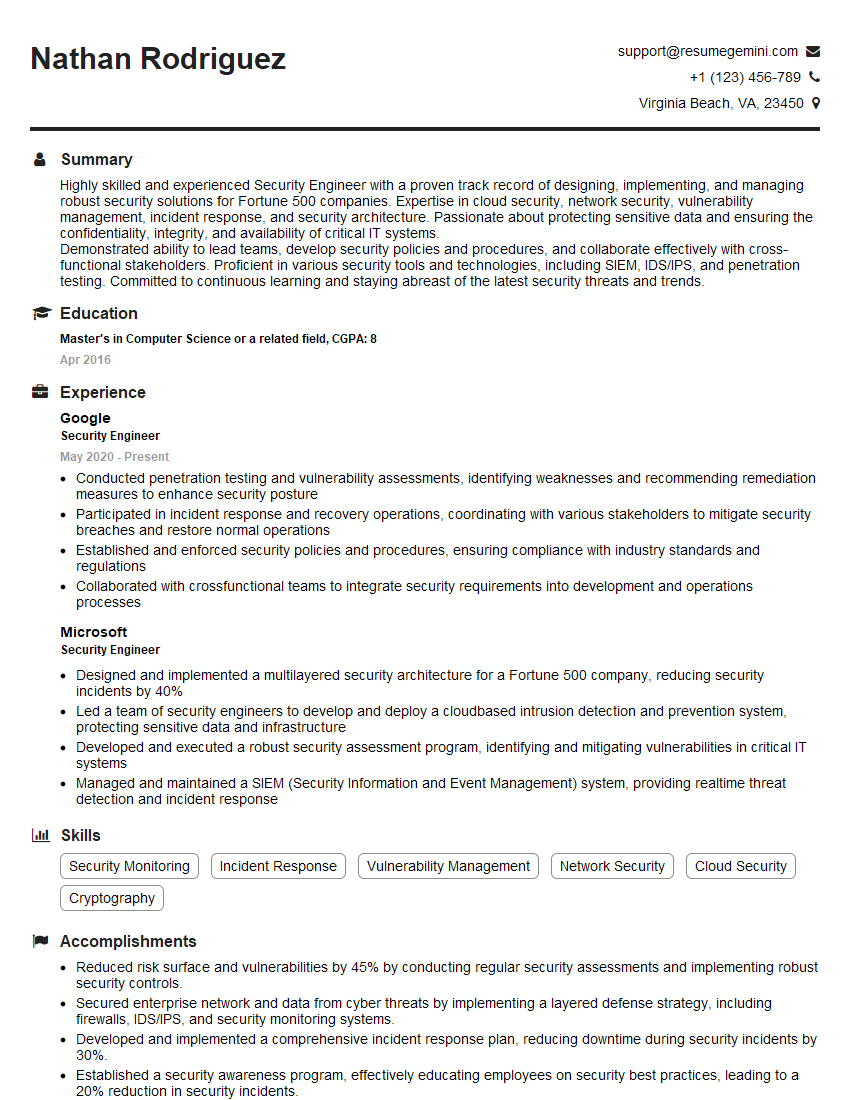
Security Engineer Resume Sample
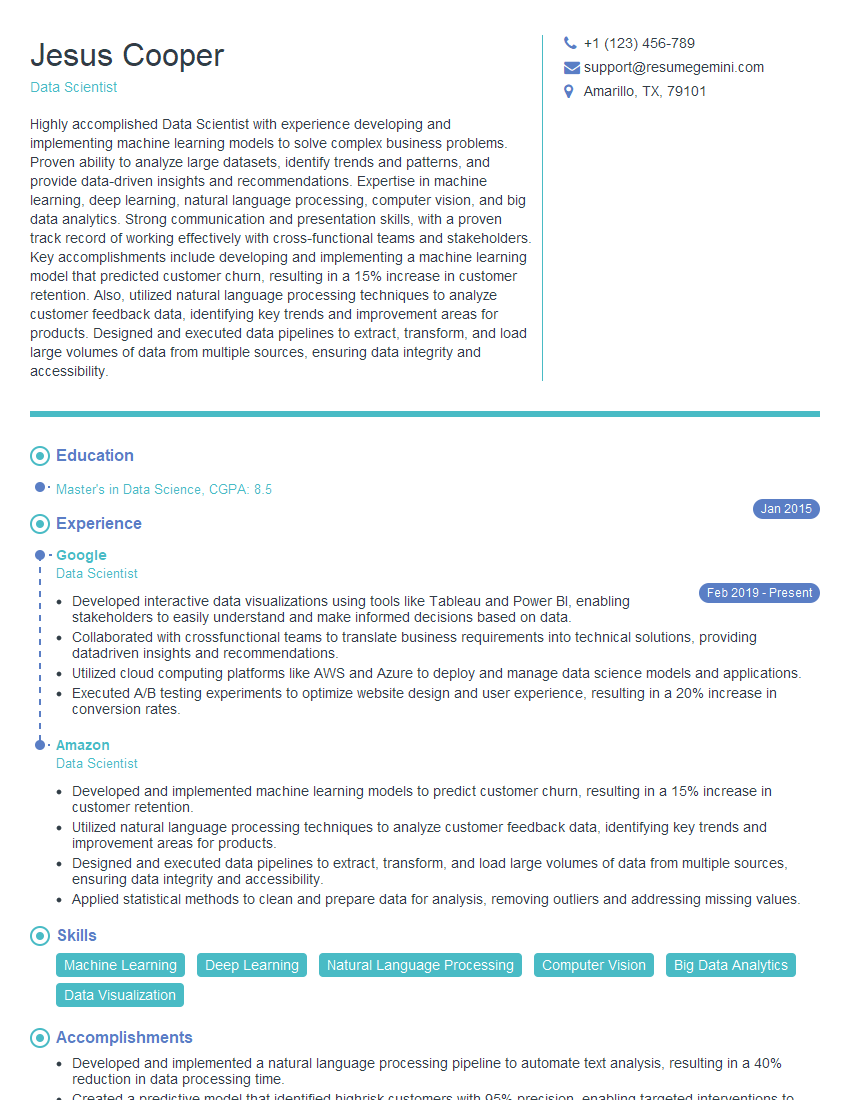
Data Scientist Resume Sample
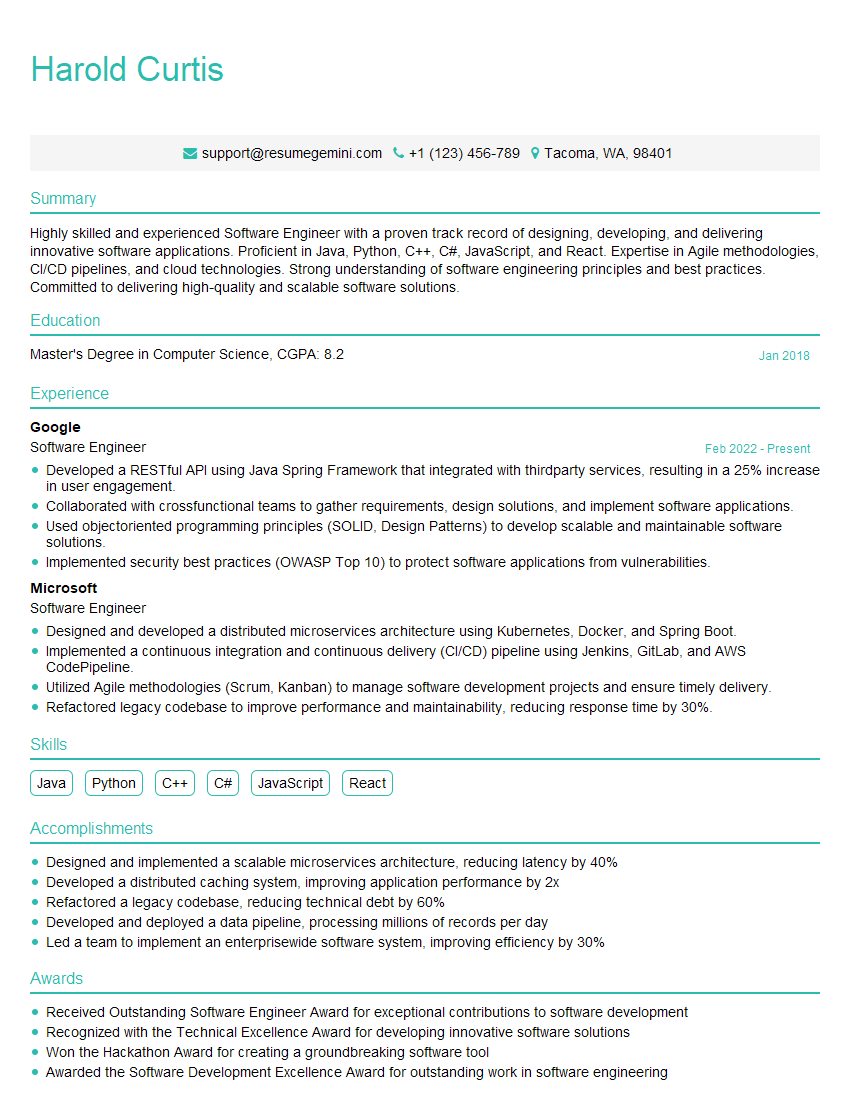
Software Engineer Resume Sample
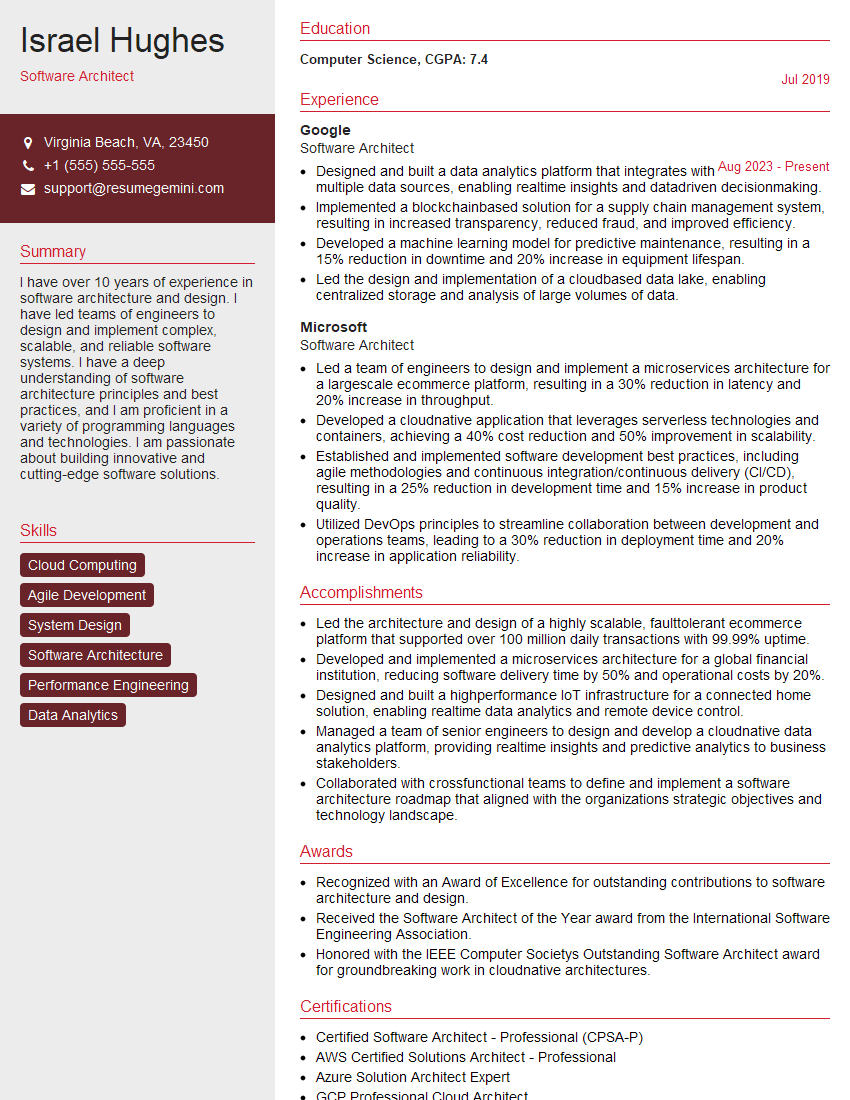
Software Architect Resume Sample
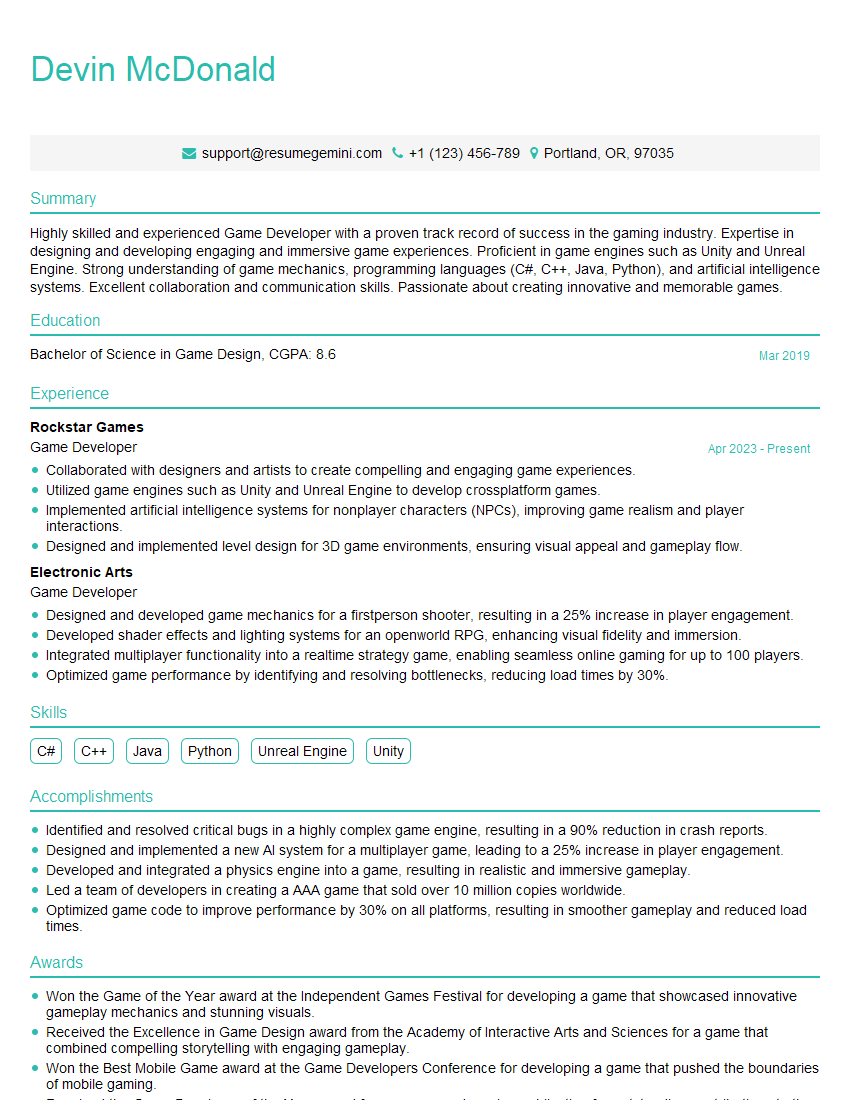
Game Developer Resume Sample
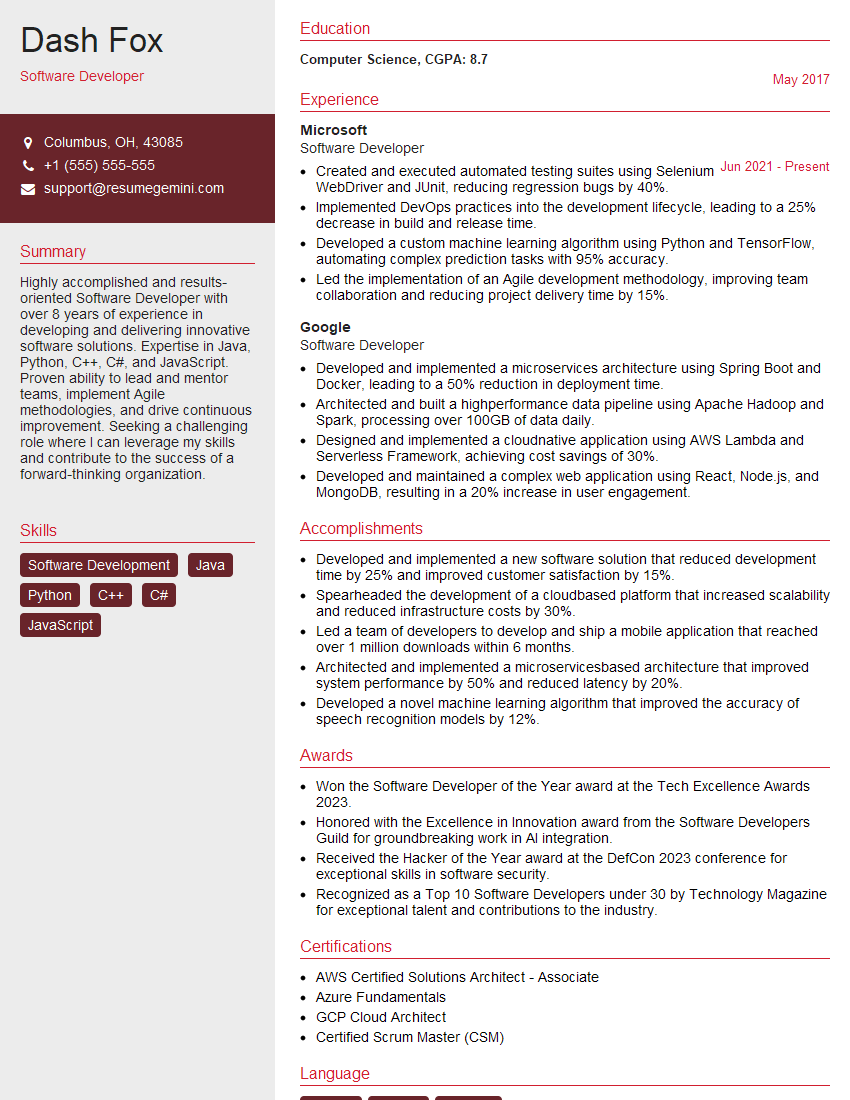
Software Developer Resume Sample

Senior Software Engineer Resume Sample
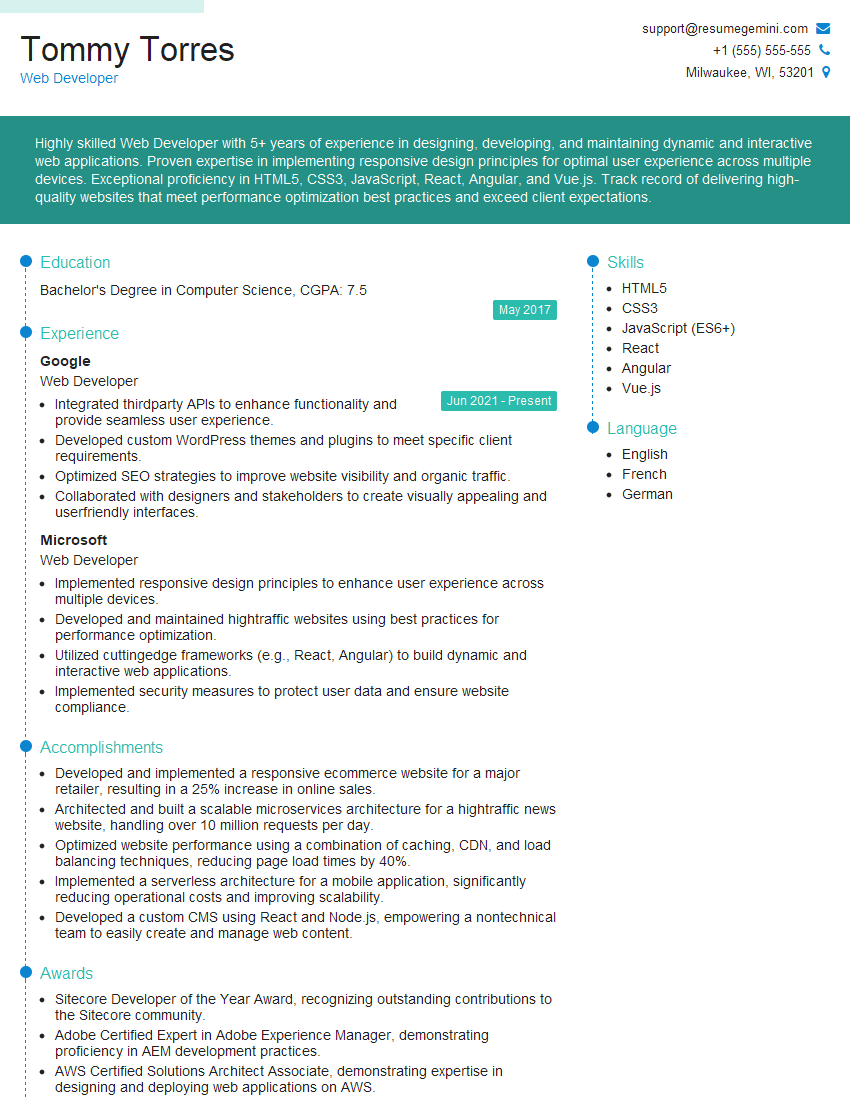
Web Developer Resume Sample
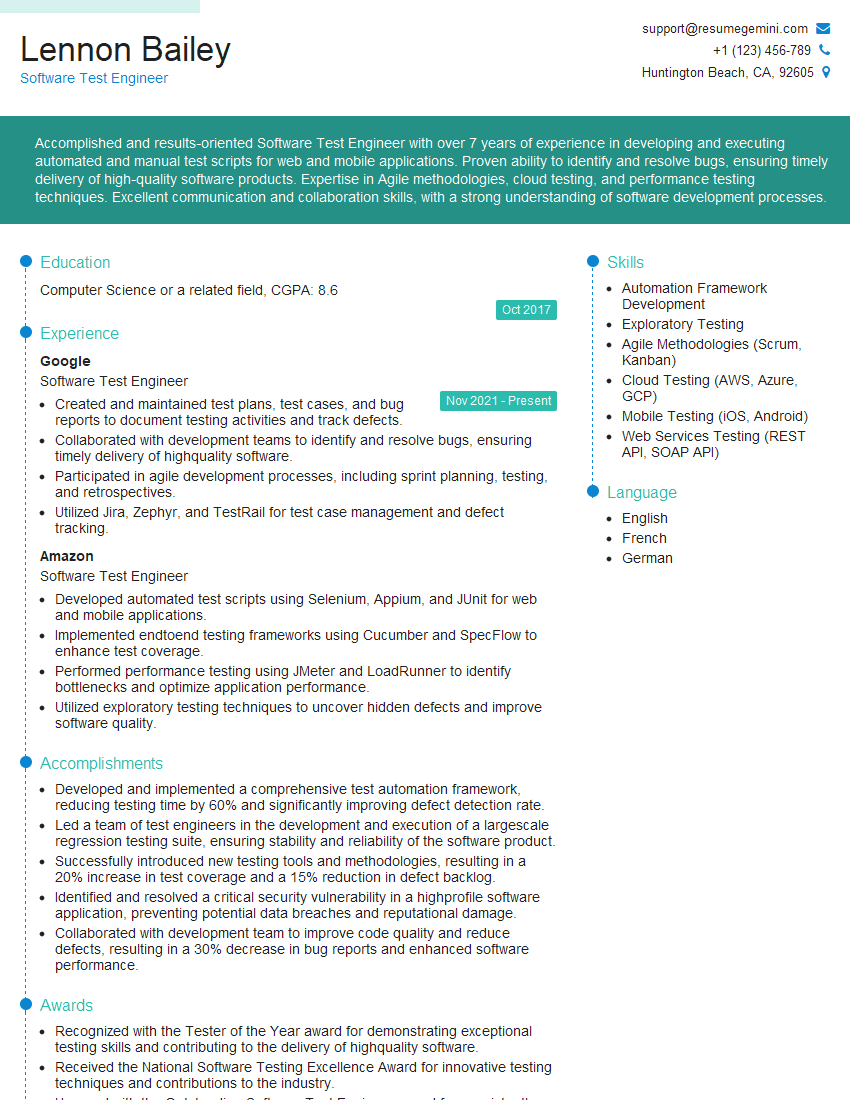
Software Test Engineer Resume Sample
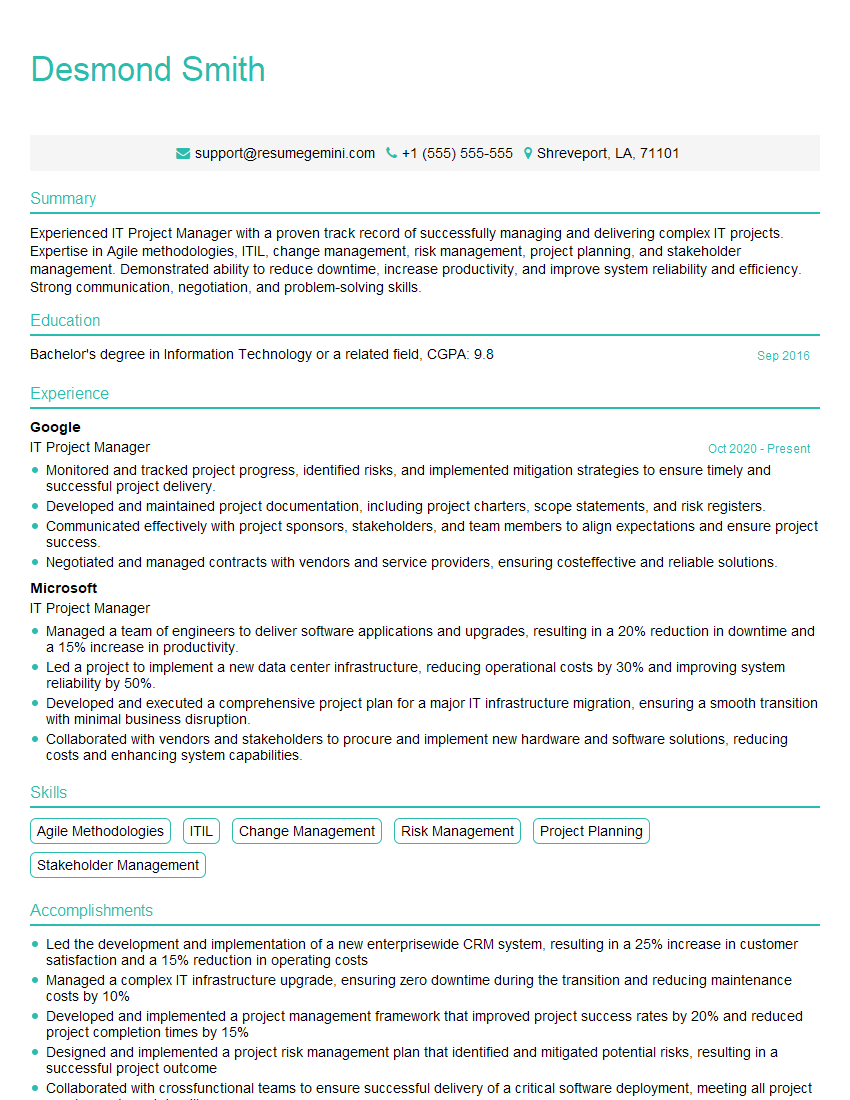
IT Project Manager Resume Sample
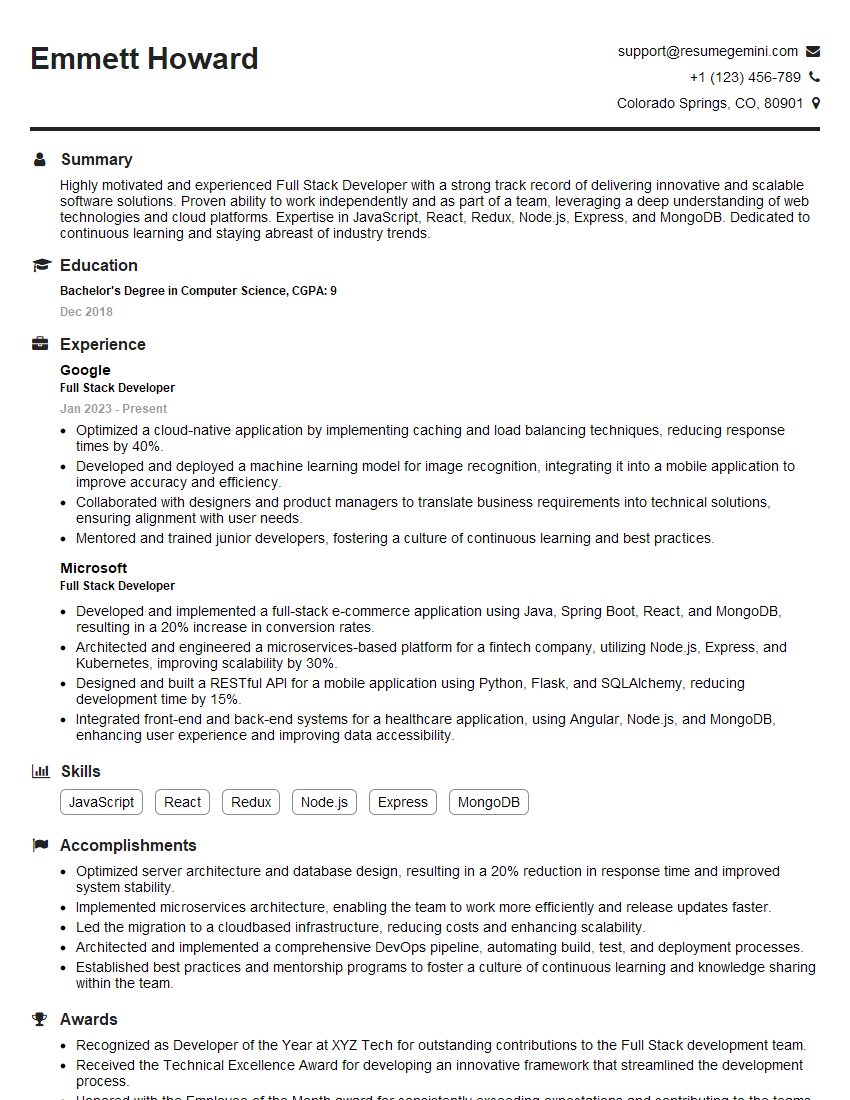
Full Stack Developer Resume Sample
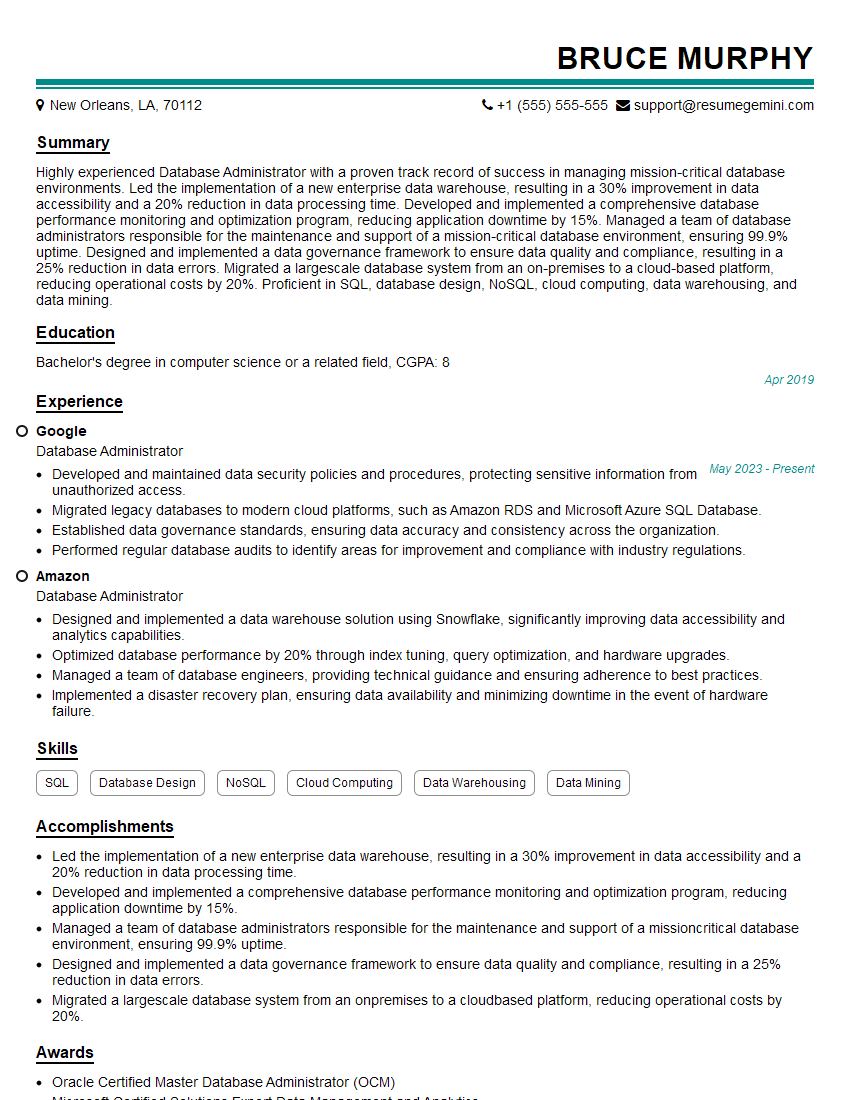
Database Administrator Resume Sample
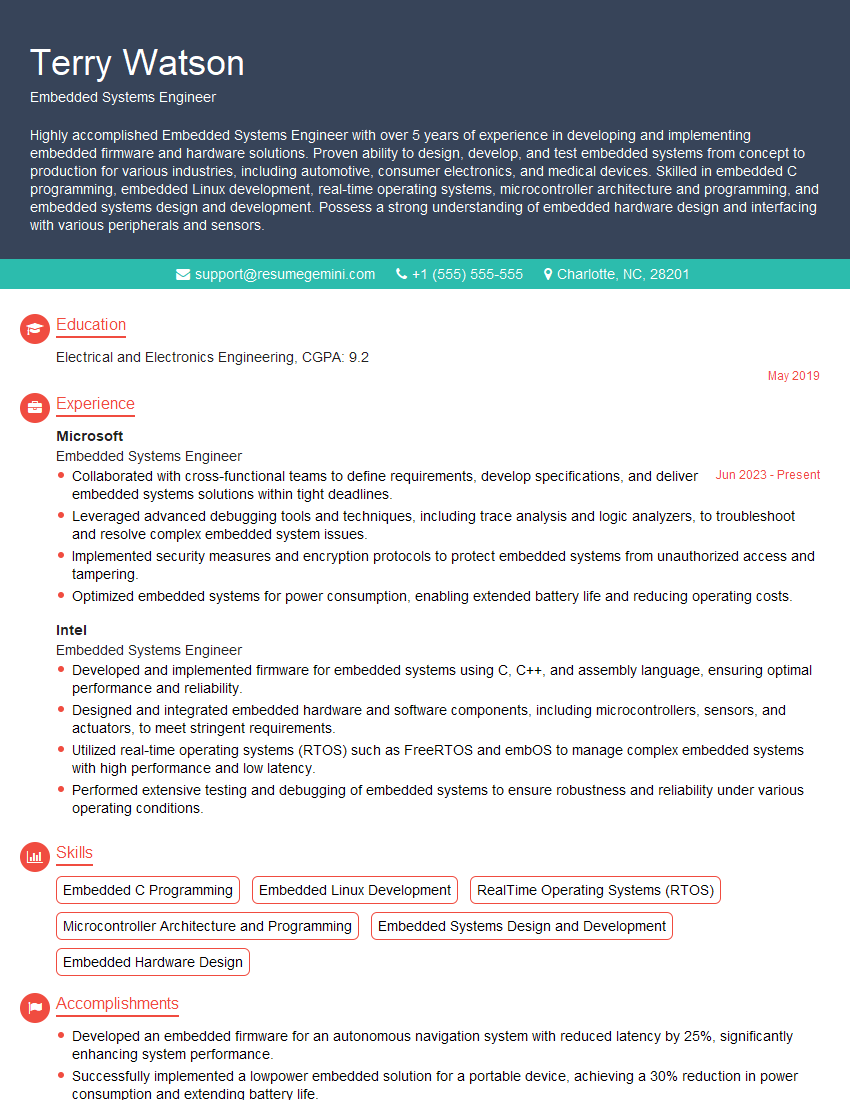
Embedded Systems Engineer Resume Sample
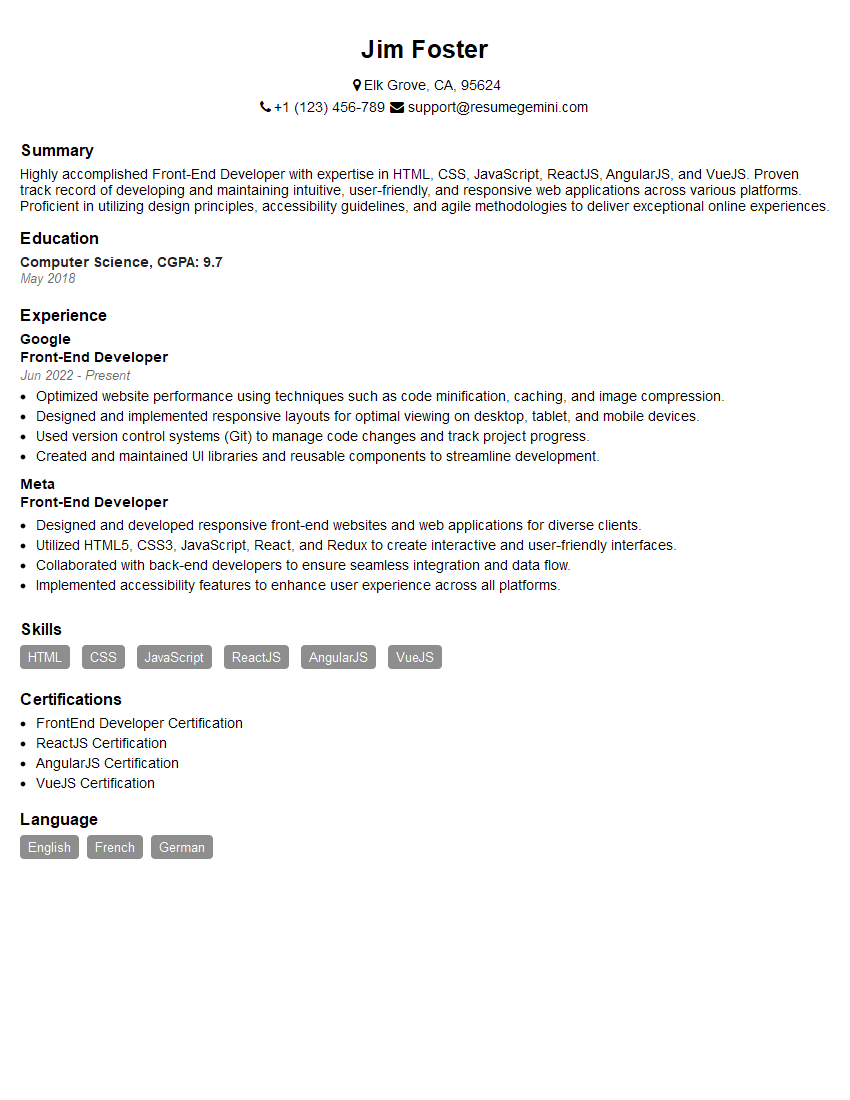
Front-End Developer Resume Sample
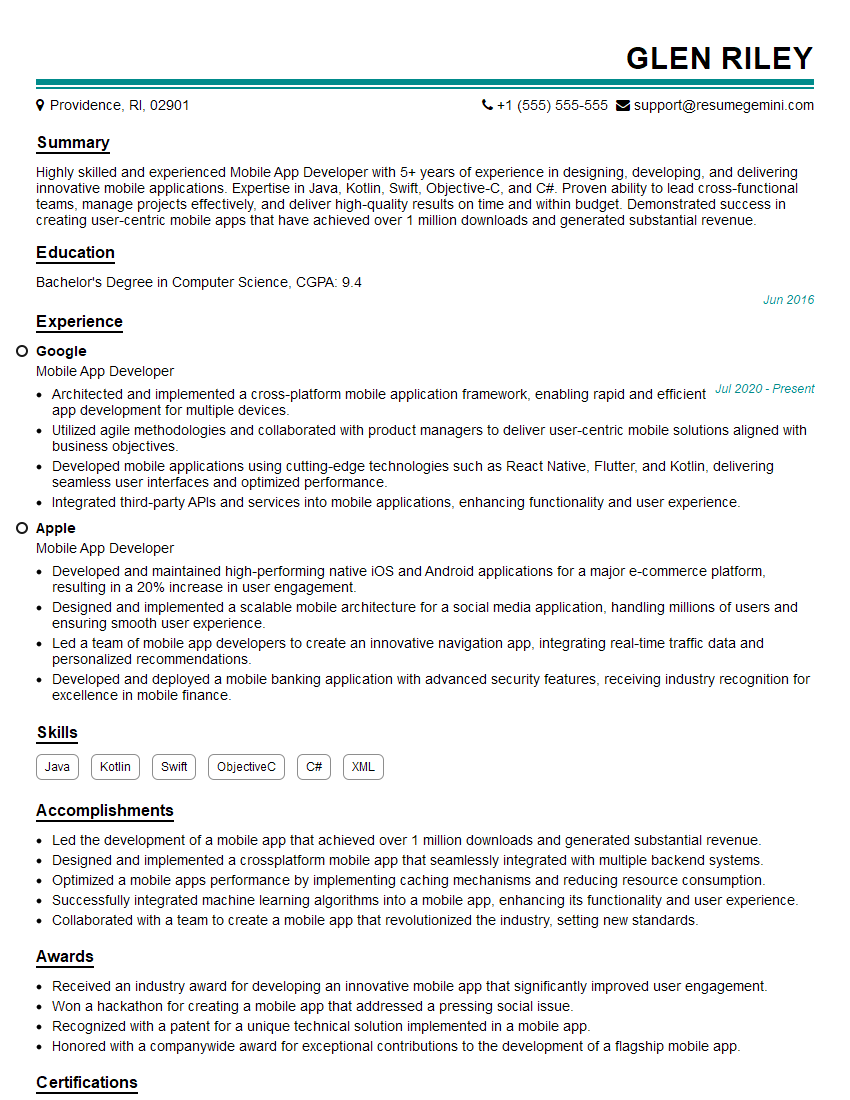
Mobile App Developer Resume Sample
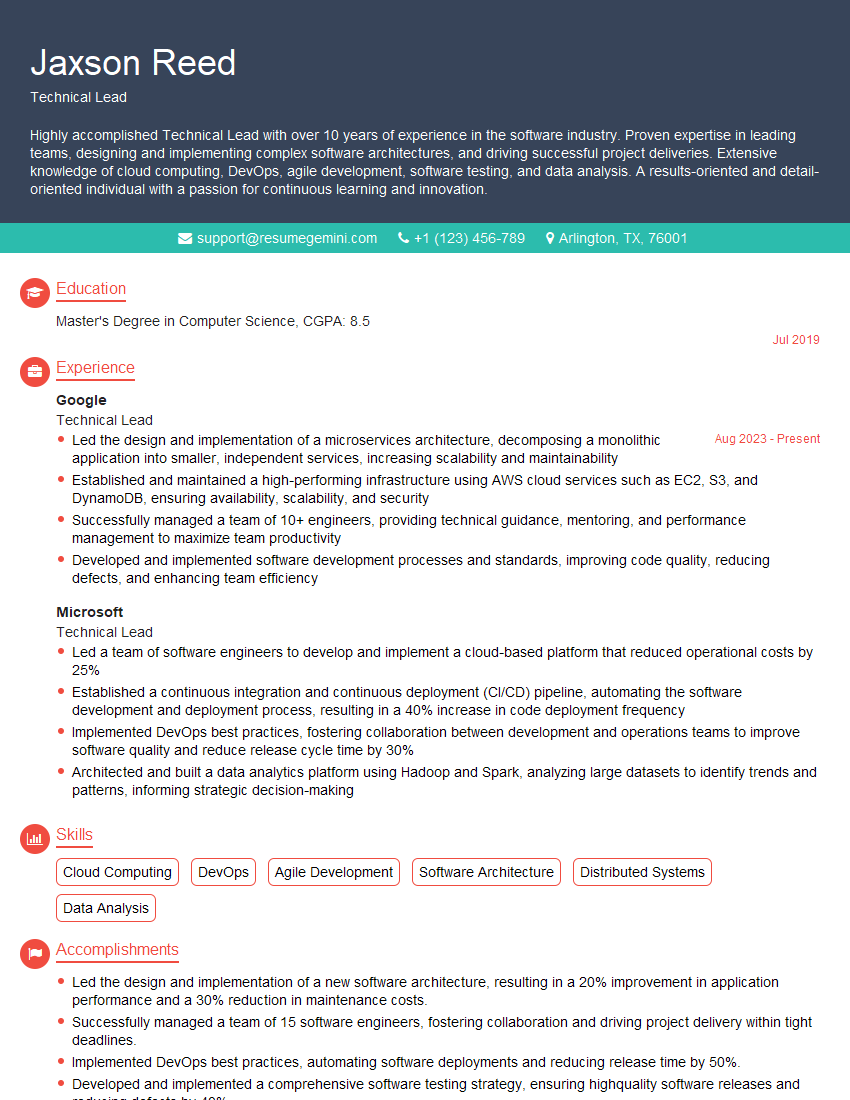
Technical Lead Resume Sample
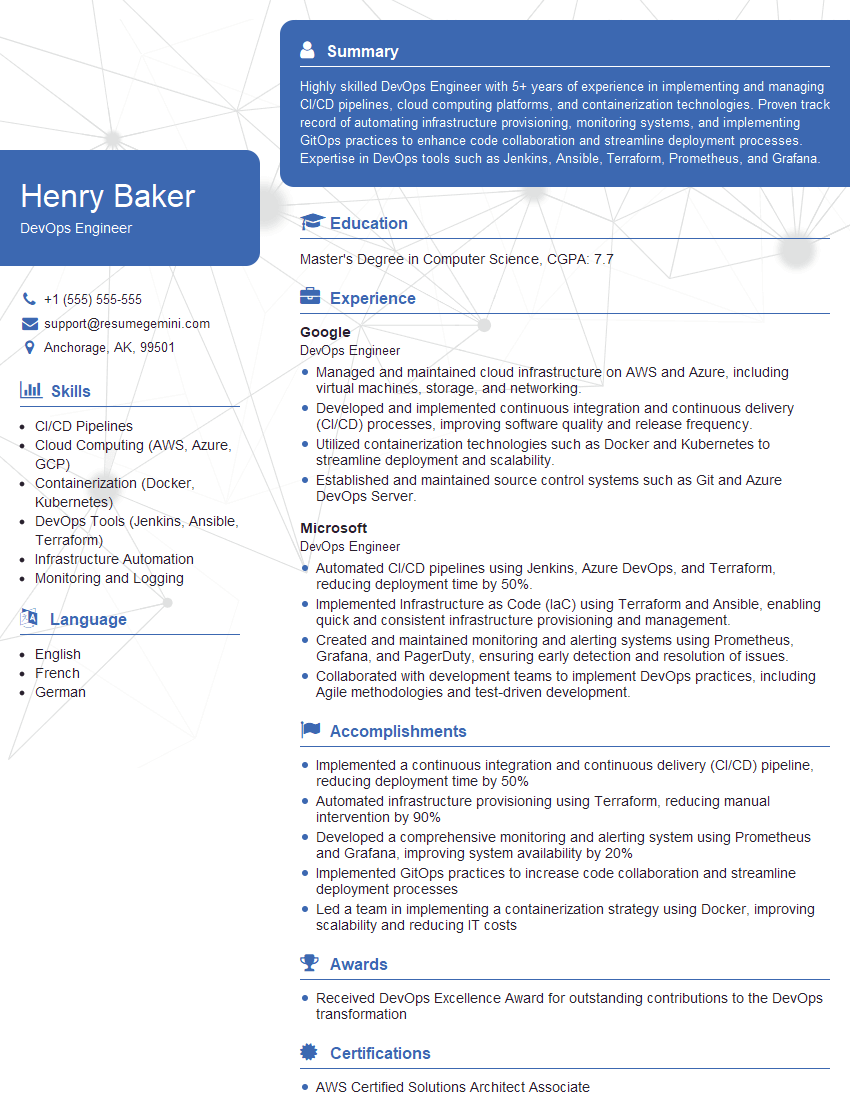
DevOps Engineer Resume Sample
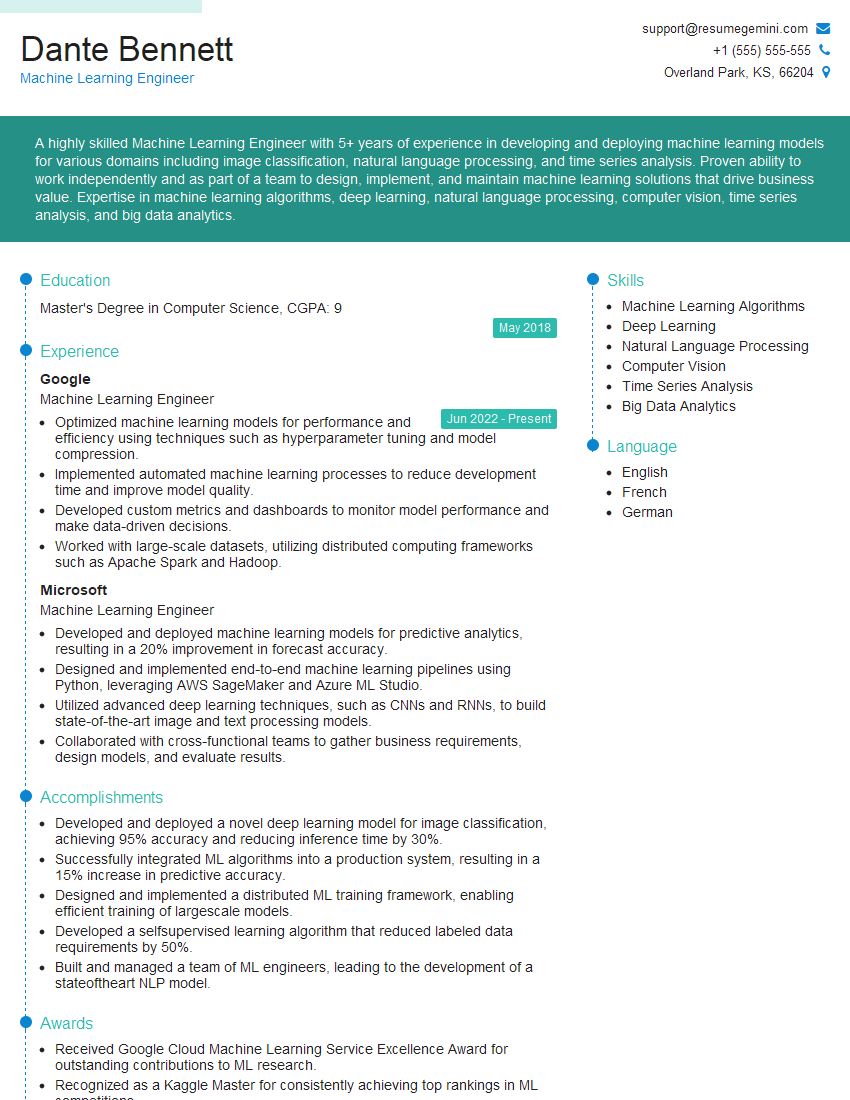
Machine Learning Engineer Resume Sample
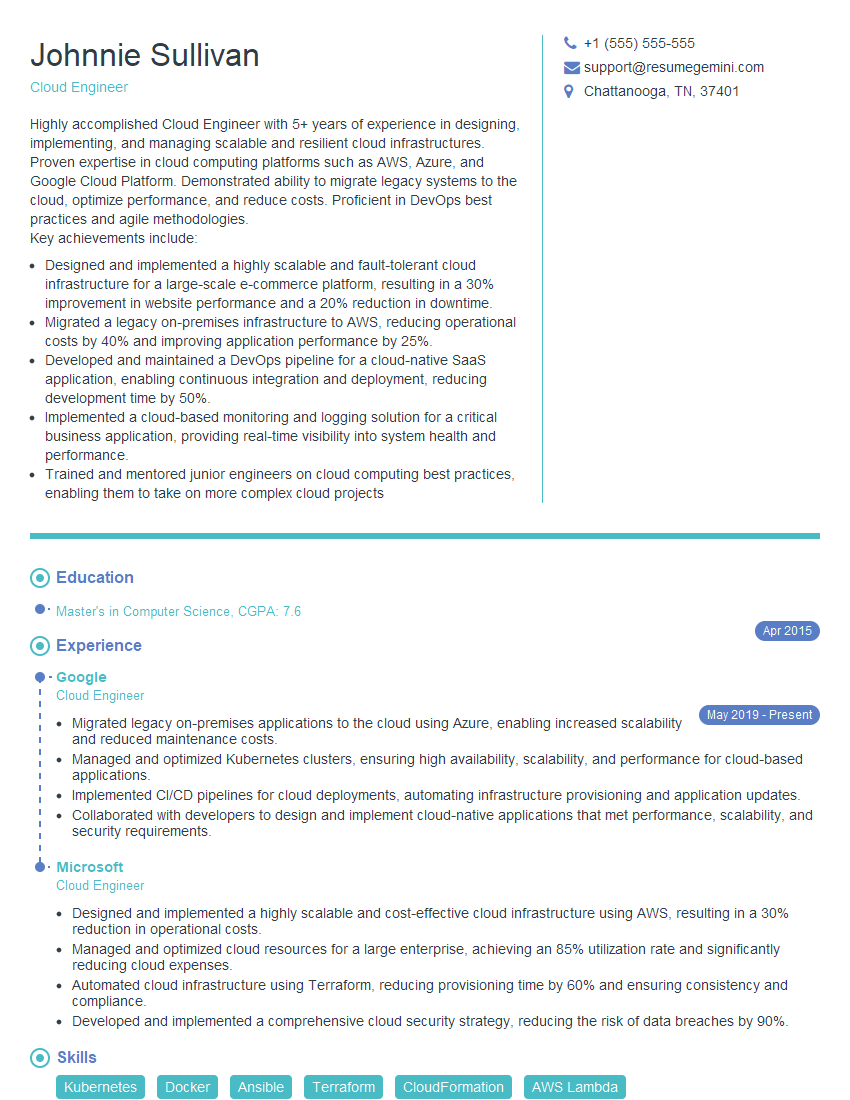
Cloud Engineer Resume Sample
- Security Engineer
- Data Scientist
- Software Engineer
- Software Architect
- Game Developer
- Software Developer
- Senior Software Engineer
- Web Developer
- Software Test Engineer
- IT Project Manager
- Full Stack Developer
- Database Administrator
- Embedded Systems Engineer
- Front-End Developer
- Mobile App Developer
- Technical Lead
- DevOps Engineer
- Machine Learning Engineer
- Cloud Engineer
Explore more articles
Users Rating of Our Blogs
Share Your Experience
We value your feedback! Please rate our content and share your thoughts (optional).
What Readers Say About Our Blog
Attention music lovers!
Wow, All the best Sax Summer music !!!
Spotify: https://open.spotify.com/artist/6ShcdIT7rPVVaFEpgZQbUk
Apple Music: https://music.apple.com/fr/artist/jimmy-sax-black/1530501936
YouTube: https://music.youtube.com/browse/VLOLAK5uy_noClmC7abM6YpZsnySxRqt3LoalPf88No
Other Platforms and Free Downloads : https://fanlink.tv/jimmysaxblack
on google : https://www.google.com/search?q=22+AND+22+AND+22
on ChatGPT : https://chat.openai.com?q=who20jlJimmy20Black20Sax20Producer
Get back into the groove with Jimmy sax Black
Best regards,
Jimmy sax Black
www.jimmysaxblack.com
Hi I am a troller at The aquatic interview center and I suddenly went so fast in Roblox and it was gone when I reset.
Hi,
Business owners spend hours every week worrying about their website—or avoiding it because it feels overwhelming.
We’d like to take that off your plate:
$69/month. Everything handled.
Our team will:
Design a custom website—or completely overhaul your current one
Take care of hosting as an option
Handle edits and improvements—up to 60 minutes of work included every month
No setup fees, no annual commitments. Just a site that makes a strong first impression.
Find out if it’s right for you:
https://websolutionsgenius.com/awardwinningwebsites
Hello,
we currently offer a complimentary backlink and URL indexing test for search engine optimization professionals.
You can get complimentary indexing credits to test how link discovery works in practice.
No credit card is required and there is no recurring fee.
You can find details here:
https://wikipedia-backlinks.com/indexing/
Regards
NICE RESPONSE TO Q & A
hi
The aim of this message is regarding an unclaimed deposit of a deceased nationale that bears the same name as you. You are not relate to him as there are millions of people answering the names across around the world. But i will use my position to influence the release of the deposit to you for our mutual benefit.
Respond for full details and how to claim the deposit. This is 100% risk free. Send hello to my email id: [email protected]
Luka Chachibaialuka
Hey interviewgemini.com, just wanted to follow up on my last email.
We just launched Call the Monster, an parenting app that lets you summon friendly ‘monsters’ kids actually listen to.
We’re also running a giveaway for everyone who downloads the app. Since it’s brand new, there aren’t many users yet, which means you’ve got a much better chance of winning some great prizes.
You can check it out here: https://bit.ly/callamonsterapp
Or follow us on Instagram: https://www.instagram.com/callamonsterapp
Thanks,
Ryan
CEO – Call the Monster App
Hey interviewgemini.com, I saw your website and love your approach.
I just want this to look like spam email, but want to share something important to you. We just launched Call the Monster, a parenting app that lets you summon friendly ‘monsters’ kids actually listen to.
Parents are loving it for calming chaos before bedtime. Thought you might want to try it: https://bit.ly/callamonsterapp or just follow our fun monster lore on Instagram: https://www.instagram.com/callamonsterapp
Thanks,
Ryan
CEO – Call A Monster APP
To the interviewgemini.com Owner.
Dear interviewgemini.com Webmaster!
Hi interviewgemini.com Webmaster!
Dear interviewgemini.com Webmaster!
excellent
Hello,
We found issues with your domain’s email setup that may be sending your messages to spam or blocking them completely. InboxShield Mini shows you how to fix it in minutes — no tech skills required.
Scan your domain now for details: https://inboxshield-mini.com/
— Adam @ InboxShield Mini
Reply STOP to unsubscribe
Hi, are you owner of interviewgemini.com? What if I told you I could help you find extra time in your schedule, reconnect with leads you didn’t even realize you missed, and bring in more “I want to work with you” conversations, without increasing your ad spend or hiring a full-time employee?
All with a flexible, budget-friendly service that could easily pay for itself. Sounds good?
Would it be nice to jump on a quick 10-minute call so I can show you exactly how we make this work?
Best,
Hapei
Marketing Director
Hey, I know you’re the owner of interviewgemini.com. I’ll be quick.
Fundraising for your business is tough and time-consuming. We make it easier by guaranteeing two private investor meetings each month, for six months. No demos, no pitch events – just direct introductions to active investors matched to your startup.
If youR17;re raising, this could help you build real momentum. Want me to send more info?
Hi, I represent an SEO company that specialises in getting you AI citations and higher rankings on Google. I’d like to offer you a 100% free SEO audit for your website. Would you be interested?
Hi, I represent an SEO company that specialises in getting you AI citations and higher rankings on Google. I’d like to offer you a 100% free SEO audit for your website. Would you be interested?