Interviews are opportunities to demonstrate your expertise, and this guide is here to help you shine. Explore the essential Tabletop interview questions that employers frequently ask, paired with strategies for crafting responses that set you apart from the competition.
Questions Asked in Tabletop Interview
Q 1. Explain the difference between a cooperative and competitive tabletop game.
The core difference between cooperative and competitive tabletop games lies in the players’ objectives. In cooperative games, players work together towards a common goal, succeeding or failing as a team. Think of Pandemic, where players must collaborate to cure deadly diseases before they wipe out humanity. Victory is shared, and defeat is shared. In contrast, competitive games pit players against each other, with only one (or sometimes a few) emerging victorious. Games like Settlers of Catan exemplify this; players compete for resources and ultimately points, striving to be the most successful on their own.
This fundamental difference influences every aspect of game design, from the mechanics to the player interaction. Cooperative games often feature shared resources and challenges that require teamwork, while competitive games often incorporate elements of direct conflict, negotiation, and strategic maneuvering to gain an advantage.
Q 2. Describe your experience with game mechanics.
My experience with game mechanics spans a wide range, from simple dice-rolling systems to intricate engine-building mechanisms. I’m proficient in designing and implementing various mechanics such as worker placement (like in Agricola), deck-building (like in Dominion), area control (like in Risk), and resource management (like in Power Grid). I understand how different mechanics interact and influence player choices, and I can adapt and combine them to create unique and engaging gameplay experiences. For example, I’ve successfully integrated a worker placement mechanism with a dice-rolling combat system in a fantasy-themed game, creating a dynamic blend of strategic planning and tactical decision-making. I am also skilled in balancing these mechanics to ensure a fair and challenging experience for all players, as discussed further in my response to question 4.
Q 3. What are your preferred tabletop game design tools and software?
My preferred tabletop game design tools and software depend heavily on the stage of development. For initial concept and prototyping, I frequently use pen and paper, whiteboards, and simple digital tools for sketching and flowcharting. As the design progresses, I leverage software like Tabletop Simulator for playtesting and visualization. It allows for rapid iteration and easy sharing with playtesters. For more complex aspects of game development, such as digital components, I may use Unity or similar game engines, though those tend to come in later stages. Furthermore, I utilize spreadsheet software like Excel or Google Sheets for tracking game data, balancing mechanics, and analyzing playtest results. This methodical approach enables efficient design and refinement.
Q 4. How do you balance gameplay mechanics to avoid overwhelming or frustrating players?
Balancing gameplay is an iterative process crucial for creating enjoyable experiences. Overly complex mechanics can overwhelm players, leading to frustration, while overly simple games can become repetitive and boring. I employ a multi-pronged approach:
- Playtesting with diverse groups: Testing with players of varying skill levels and backgrounds reveals areas of imbalance and identifies potential frustrations.
- Data analysis: I meticulously track playtest data, such as win rates, average game length, and player feedback, to identify problematic mechanics.
- Iterative adjustments: Based on data and feedback, I make incremental adjustments to game mechanics, fine-tuning parameters and rules to achieve optimal balance. For instance, I might adjust resource distribution, modify point values, or re-work card probabilities.
- Accessibility considerations: I strive to design games that are approachable for new players while also offering strategic depth for experienced players, often through variable difficulty settings or optional rules.
The key is to constantly test, evaluate, and refine, ensuring that the challenge remains stimulating but never insurmountable. Think of it like baking a cake: you need to find the right balance of ingredients and baking time to achieve perfection.
Q 5. How would you design a game system for a specific theme (e.g., fantasy, sci-fi)?
Designing a game system for a specific theme, such as fantasy or sci-fi, involves immersing oneself in that world and translating its core elements into engaging mechanics. For a fantasy game, I might incorporate character classes with unique abilities (like mages casting spells and warriors wielding swords), a quest-driven narrative, and resource management representing exploration of a vast kingdom. This could involve dice-rolling combat, RPG-like character progression, and exploration of a map with various locations and challenges.
A sci-fi game, conversely, might focus on technology, resource scarcity, and strategic exploration of space. Mechanics could involve technology upgrades, ship customization, resource management for fuel and weaponry, and tactical space combat using custom dice or cards. The core theme dictates the narrative and the mechanics that should support it. Ultimately, the theme informs the rules, but the rules should also enhance the feeling of immersion within the theme.
Q 6. Discuss your experience playtesting and iterative game development.
Playtesting and iteration are fundamental to my design process. I believe in a continuous feedback loop. I start with small-scale playtests with trusted colleagues to identify glaring flaws early on. As the game develops, I conduct larger playtests with more diverse groups, meticulously documenting feedback and observing player behavior. The data gathered influences iterative design changes, leading to refined mechanics, balanced gameplay, and improved clarity of rules. This process is not linear; often, solving one problem creates others that need addressing, leading to a continuous cycle of improvement. For example, in one game, early playtests revealed an imbalance in resource acquisition, prompting changes to resource distribution and crafting mechanics, which then necessitated further playtesting to adjust other aspects of the game that depended on the resource changes.
Q 7. What is your experience working within budgetary and time constraints?
Experience working within budgetary and time constraints is vital in game development. I’ve worked on projects with limited resources, necessitating creative solutions and prioritization. This involves:
- Careful planning and scoping: Defining a minimum viable product (MVP) to focus development efforts on essential features.
- Resource allocation: Efficiently managing available funds and personnel to maximize productivity.
- Agile development methodologies: Employing iterative development sprints to adapt to unforeseen challenges and shifting priorities.
- Prioritizing features: Focusing development on core mechanics and delaying less crucial elements until later.
By adhering to strict timelines and budgets, I can successfully deliver high-quality products while managing expectations and resources. This requires effective communication and proactive problem-solving to ensure that the project stays on track despite limitations.
Q 8. Explain your process for creating engaging narrative elements in a game.
Creating engaging narrative elements in a tabletop game is crucial for player immersion and enjoyment. My process begins with a strong core concept – a compelling premise, intriguing characters, or a captivating world. I then build a narrative framework, deciding how the story unfolds based on player choices. This framework can be as simple as a series of interconnected events or as complex as a branching narrative tree.
To maintain engagement, I weave the narrative into the game mechanics. This might involve using cards to reveal story elements, incorporating dice rolls to determine narrative outcomes, or designing challenges that directly advance the plot. For example, in a fantasy RPG, discovering a hidden clue during a dungeon crawl could unlock a new chapter in the overarching story. Alternatively, player choices might affect the ending of the game, leading to multiple narrative conclusions.
Finally, I prioritize creating memorable characters with distinct personalities, motivations, and compelling arcs. These characters shouldn’t just be static elements; they should actively interact with the players, respond to their decisions, and contribute to the overall narrative tapestry. Think of it like writing a collaborative short story where the players are co-authors.
Q 9. How do you address player feedback during the development process?
Player feedback is the lifeblood of game development. I actively solicit feedback throughout the design process, utilizing various methods including playtesting sessions, online surveys, and community forums. I strive to create a safe and constructive feedback environment where players feel comfortable voicing both positive and negative comments.
During playtesting, I observe players’ interactions with the game, noting their successes, struggles, and overall reactions. This provides invaluable insight into the game’s strengths and weaknesses. I then analyze this data, paying close attention to recurring themes or issues. Is a particular mechanic confusing? Are players finding the game too easy or too hard? Are they engaging with the narrative as intended?
Based on this analysis, I iterate on the design, making adjustments and improvements. I document these changes carefully, tracking the impact of each modification. The key is to be responsive and iterative, constantly refining the game based on real-world player experiences. A successful game is a product of continuous feedback and refinement.
Q 10. What are some common pitfalls to avoid when designing tabletop games?
Several common pitfalls can hinder the success of a tabletop game. One major pitfall is poor game balance, where certain strategies or characters are overwhelmingly overpowered, leading to frustrating gameplay experiences for some players. This often stems from insufficient playtesting or a flawed design process.
Another common issue is overly complex rules. While complexity can add depth, it can also overwhelm players, leading to slow gameplay and reduced enjoyment. Clear, concise, and well-organized rulebooks are paramount. A good rulebook acts as a friendly guide, not a daunting tome.
Lack of engaging gameplay is another frequent problem. Games must offer satisfying player choices, meaningful interactions, and a clear sense of progression. If players find the gameplay repetitive or uninteresting, they’ll quickly lose engagement. Finally, ignoring accessibility considerations can alienate potential players. Designing a game that’s inclusive of diverse player groups, including those with disabilities, enhances its reach and appeal.
Q 11. Describe your understanding of game balance and its importance.
Game balance refers to the fairness and competitiveness of a game. A well-balanced game provides all players with a roughly equal chance of success, preventing any single strategy or player from dominating consistently. It’s about creating a level playing field, fostering exciting competition rather than predictable outcomes.
The importance of game balance cannot be overstated. A poorly balanced game quickly becomes frustrating, as players feel their choices are meaningless if certain strategies always win. This leads to player dissatisfaction and ultimately, the game’s failure. Balance encourages replayability; players want to try different strategies and experience a dynamic and competitive game. Balancing a game requires extensive playtesting, careful analysis of player data, and a willingness to iterate on the design until a satisfactory equilibrium is achieved.
For example, in a card game, ensuring that different card combinations have roughly equal win rates is crucial. In a board game, it might involve balancing resources, actions, or player powers to prevent a single dominant strategy. This process often involves tweaking numbers, adjusting rules, and refining the game mechanics.
Q 12. How do you incorporate accessibility considerations into your game designs?
Incorporating accessibility into game designs is critical for inclusivity and reaching a wider audience. This means considering players with various needs and abilities, such as visual impairments, auditory impairments, motor impairments, and cognitive differences.
For visually impaired players, this might involve providing large-print rulebooks, tactile components, or audio descriptions. For players with auditory impairments, clear visual cues and alternative ways of conveying information become essential. For players with motor impairments, adaptable game components (e.g., larger dice, easier-to-grip pieces) can make a significant difference. Games with simple rules and straightforward mechanics are often more accessible to those with cognitive differences.
Beyond specific disabilities, consider accessibility in the broader sense. Clear and concise instructions, straightforward mechanics, and intuitive gameplay contribute to overall accessibility. Playtesting with diverse groups is crucial for identifying potential barriers and iteratively improving the game’s accessibility.
Q 13. What is your experience with different game genres (e.g., RPG, strategy, card games)?
My experience spans various tabletop game genres. I’ve designed and developed games within the RPG genre, creating rich narrative experiences with character progression and collaborative storytelling. I’ve also worked on strategy games, focusing on strategic depth, tactical decision-making, and carefully balanced competitive gameplay. My experience also includes card games, where mechanics are refined, player interaction is key and creating fast-paced and engaging experiences is paramount.
Each genre presents unique challenges and opportunities. RPGs require a focus on narrative and player agency, strategy games demand careful balance and strategic depth, and card games necessitate elegant simplicity and engaging player interaction. This diverse experience has given me a broad perspective on game design principles and how to tailor my approach to different genres. It’s allowed me to appreciate the nuances of each and apply cross-genre techniques to create well-rounded and unique gaming experiences.
Q 14. Explain your experience with game rulebooks and clarity of instructions.
Clear and concise rulebooks are essential for a positive player experience. A well-written rulebook acts as a friendly guide, helping players quickly understand the game and start playing. My approach focuses on using simple language, avoiding jargon, and structuring the rules logically. I use visual aids such as diagrams, illustrations, and examples to complement the written instructions.
I also incorporate multiple ways of presenting the rules. A quick-start guide for new players can focus on essential rules, while more comprehensive explanations cater to advanced players who wish to explore the game’s nuances. Playtesting the rulebook is crucial; I observe players attempting to use the rulebook during playtesting, identifying areas of confusion and making adjustments accordingly. Feedback from playtesters is used to improve clarity and ensure the rulebook effectively communicates the game’s mechanics.
In addition to the main rulebook, I consider supplemental resources such as FAQs, online tutorials, or video walkthroughs to further enhance player understanding and address any lingering questions. A clear and accessible rulebook is vital, ensuring that players can easily understand and enjoy the game without being bogged down by confusing instructions.
Q 15. How do you manage your time effectively when working on multiple design projects?
Effective time management is crucial in tabletop game design, especially when juggling multiple projects. My approach is based on a combination of strategic planning and flexible execution. I utilize project management tools like Trello or Asana to break down large projects into smaller, manageable tasks with deadlines. This allows me to visualize progress, prioritize tasks based on urgency and importance, and track my time effectively. For instance, if I’m working on a strategy game and a children’s card game concurrently, I might dedicate mornings to the strategy game’s complex rules design and afternoons to the more rapid prototyping and artwork for the children’s game. Regular time blocking ensures I dedicate focused time to each project, preventing burnout and maximizing productivity. I also schedule buffer time to account for unexpected delays or creative roadblocks.
Beyond tools, I find regular review and adjustment crucial. Weekly check-ins with myself or my team allow us to assess progress against the timeline, identify potential bottlenecks, and make necessary adjustments to the schedule. This iterative approach ensures flexibility and prevents overcommitment, leading to higher quality work and reduced stress.
Career Expert Tips:
- Ace those interviews! Prepare effectively by reviewing the Top 50 Most Common Interview Questions on ResumeGemini.
- Navigate your job search with confidence! Explore a wide range of Career Tips on ResumeGemini. Learn about common challenges and recommendations to overcome them.
- Craft the perfect resume! Master the Art of Resume Writing with ResumeGemini’s guide. Showcase your unique qualifications and achievements effectively.
- Don’t miss out on holiday savings! Build your dream resume with ResumeGemini’s ATS optimized templates.
Q 16. Describe your experience with various game components (dice, cards, miniatures, etc.)
My experience with various game components is extensive. I’ve worked extensively with dice, ranging from standard six-sided dice to custom-designed polyhedral dice with unique numbering systems. Understanding the weight, feel, and aesthetic impact of different dice materials is crucial for the overall game experience. For example, using weighted dice in a game of chance can subtly shift player perceptions and introduce interesting strategic layers. With cards, I’m proficient in selecting the right stock, finish, and size for optimal gameplay and durability. I’ve also worked with various printing techniques to achieve unique card effects. My experience with miniatures extends to selecting suitable materials (metal, plastic, resin), overseeing painting and sculpting processes, and understanding how miniature scale affects gameplay and immersion. Other components like tokens, custom boards, and rulebooks are also within my experience. In fact, I once designed a game using intricately carved wooden components to enhance the game’s overall theme and feel. This demonstrates my ability to utilize components creatively, beyond mere functionality, to enhance the overall player experience.
Q 17. How do you use prototyping to test and refine game mechanics?
Prototyping is an indispensable part of my game design process. I use iterative prototyping, beginning with very rough, functional prototypes to test core mechanics. These might involve simple paper components and improvised rules. For example, if I’m designing a worker placement game, my initial prototype might consist of paper squares representing workers and a hand-drawn board. This lets me quickly identify if the core gameplay loop is fun and engaging. As the design develops, I move to more refined prototypes incorporating more polished components, like printed cards or 3D-printed miniatures. This progressive refinement allows me to test the game with a wider range of players and gather increasingly specific feedback. This feedback informs design changes, leading to a more balanced and engaging final product. Playtesting sessions are carefully documented, with notes on player comments, observed strategies, and identified issues. This data is then utilized to refine rules, mechanics, or component design, ultimately improving the overall player experience.
Q 18. How familiar are you with market analysis and competitor research in the tabletop industry?
Market analysis and competitor research are integral to my approach. Before starting a new project, I conduct thorough research into current market trends, identifying popular game mechanics, themes, and target audiences. Tools like Kickstarter, BoardGameGeek, and industry reports help me understand which game types are successful and which niches are underserved. Competitor analysis involves studying games similar to my concept, evaluating their strengths and weaknesses, and identifying opportunities for differentiation. For instance, analyzing a successful worker placement game would help me determine what makes it popular—its art style, its complexity, the depth of its strategy—and how I could create something different yet equally appealing. This helps me to create a game that is not only fun and engaging but also has a reasonable chance of commercial success within its target market. By understanding the competitive landscape, I can develop a unique selling proposition that sets my game apart.
Q 19. Discuss your experience with game marketing and promotion strategies.
My game marketing and promotion experience is multifaceted. I’m familiar with various digital marketing channels, including social media (Twitter, Facebook, Instagram), online forums (BoardGameGeek), and content marketing (blogs, articles, videos). I believe in creating a strong online presence to build a community around the game. This might involve running contests, creating engaging content related to the game’s lore or design process, and interacting directly with potential players. I also understand the importance of working with distributors and retailers, building relationships and securing shelf space. For example, I successfully secured distribution deals for a previous project through a combination of impressive prototype demos and strategic networking at industry conventions. Moreover, I’ve employed pre-order campaigns and crowdfunding strategies (Kickstarter, Gamefound) to generate initial sales momentum and gauge player interest before full-scale production. A multi-pronged approach that blends digital marketing and traditional distribution channels is crucial for effective game promotion.
Q 20. What is your understanding of game licensing and intellectual property?
Game licensing and intellectual property are critical areas of understanding. I’m aware of the importance of securing the necessary rights before using copyrighted material, such as characters, settings, or existing intellectual property in my game designs. Understanding copyright law, trademark law, and licensing agreements is paramount to avoid legal issues. For example, I wouldn’t use characters from a popular franchise without securing a license to do so. Moreover, protecting my own intellectual property is equally vital. This involves properly registering trademarks and copyrights for my game titles, artwork, and mechanics. I understand the process of negotiating licensing agreements and ensuring that both parties’ rights are protected. This includes defining usage rights, payment terms, and territorial restrictions. In short, navigating the legal landscape of intellectual property is a critical aspect of the design and distribution process, and its importance cannot be overstated.
Q 21. How would you handle conflict within a team during game development?
Conflict resolution is an essential skill in team-based game development. My approach is to foster an environment of open communication and mutual respect. When conflicts arise, I encourage team members to express their concerns openly and respectfully, focusing on the issue at hand rather than attacking personalities. I facilitate constructive dialogue by encouraging active listening and finding common ground. If the conflict involves creative differences, I often suggest exploring multiple solutions, allowing each team member to contribute their ideas. If the issue involves disagreements over workflow or timelines, I work to clarify roles, responsibilities, and expectations, perhaps using a project management tool to enhance clarity. In more serious situations, I might mediate a discussion, helping the team reach a consensus. Ultimately, the goal is to resolve conflict in a way that preserves team morale, productivity, and the quality of the final product. A well-managed team is a productive team, and addressing conflict head-on is critical for a positive and efficient working environment.
Q 22. Describe your approach to problem-solving during game development.
My approach to problem-solving in game development is iterative and collaborative. I firmly believe in a structured approach, starting with clearly defined goals and breaking down complex challenges into smaller, manageable tasks. This allows for focused effort and easier tracking of progress. For example, if we’re struggling with balancing the game’s economy, I wouldn’t tackle it all at once. Instead, I’d analyze specific resource acquisition and expenditure points, testing adjustments one by one and iteratively refining the balance through playtesting and data analysis. This might involve creating spreadsheets to track resource flow and player progression, allowing us to pinpoint imbalances quickly.
My process often involves:
- Identifying the core problem: Clearly defining the issue—is it gameplay, mechanics, or something else?
- Brainstorming solutions: Exploring multiple potential solutions with the team, encouraging diverse perspectives.
- Prototyping and testing: Creating quick prototypes to test solutions and gather feedback.
- Iterative refinement: Based on test results, refining the chosen solution until it meets the desired outcome.
- Documentation and communication: Keeping detailed records of changes and communicating effectively with the team to ensure everyone is on the same page.
For instance, during the development of my last game, we faced issues with player engagement in the late game. Through meticulous data analysis and playtesting, we identified a lack of compelling challenges and adjusted the pacing and difficulty accordingly. This involved creating more engaging narrative events and introducing new strategic elements, significantly improving player retention.
Q 23. How do you ensure the quality and consistency of a tabletop game’s components?
Maintaining the quality and consistency of tabletop game components is crucial for a positive player experience. My approach starts long before manufacturing. It involves meticulous planning and rigorous quality control checks at every stage of production. This begins with selecting high-quality materials and working closely with our manufacturing partners to establish clear specifications and tolerances.
Specifically, this involves:
- Detailed specifications: Creating comprehensive documents outlining component specifications, including dimensions, materials, colors, and printing quality. For example, this would include detailed color profiles to ensure consistent color reproduction across all components.
- Prototyping and sampling: Producing multiple prototypes and samples to assess the quality of materials and manufacturing techniques before mass production.
- Quality control checks: Implementing rigorous quality checks at each stage of production, including initial material inspection, in-process inspections, and final product inspection.
- Statistical Process Control (SPC): Utilizing statistical methods to track variations in manufacturing and identify potential issues early on. This ensures consistent quality across large production runs.
- Random sampling: Inspecting a random sample of finished products to ensure overall quality and identify any inconsistencies.
Imagine the frustration if a player’s game is ruined by a poorly printed card. To avoid that, we carefully consider the entire supply chain, right down to the type of ink used in printing to prevent smudging or fading.
Q 24. What software and hardware experience are relevant to your work (e.g. CAD, Unity, etc.)?
My work heavily involves both software and hardware. Software proficiency is essential for design, prototyping, and project management. I’m proficient in several programs, each playing a crucial role in different aspects of game development.
- Adobe Creative Suite (Photoshop, Illustrator, InDesign): These are indispensable for creating game art, graphic design for rulebooks and packaging, and creating high-quality marketing materials.
- CAD Software (Fusion 360, Tinkercad): Crucial for designing physical game components, especially for 3D-printed prototypes or complex miniatures. This allows for accurate scaling and detailed modeling before mass production.
- Spreadsheet Software (Excel, Google Sheets): Essential for organizing game data, managing budgets, tracking project timelines, and analyzing playtesting data.
- Project Management Software (Asana, Trello): These facilitate effective team collaboration, task assignment, progress tracking, and deadline management.
Hardware-wise, I’m familiar with various 3D printers for rapid prototyping, high-resolution scanners for capturing textures and 3D models, and high-quality printers for generating rulebooks and packaging.
Q 25. What’s your process for creating a compelling game concept?
Creating a compelling game concept is a blend of inspiration, research, and iterative refinement. I usually start with a core mechanic or theme that excites me. This could be anything from a unique gameplay system to a fascinating historical period or an intriguing fantasy setting.
My process typically involves:
- Idea Generation: Brainstorming ideas, drawing inspiration from various sources, and exploring existing games for inspiration (never copying, always innovating).
- Concept Refinement: Defining the core gameplay loop, mechanics, and setting. Developing a clear elevator pitch to summarize the game’s essence.
- Market Research: Analyzing the existing game market to identify potential gaps and opportunities for my game to stand out.
- Playtesting and Iteration: Creating early prototypes and playtesting with target audiences to gather feedback and refine the game’s mechanics and design.
- Documentation: Creating a detailed game design document outlining all aspects of the game, including mechanics, story, art style, and target audience.
For example, my last successful game began with the idea of using a unique card-drafting mechanic combined with a narrative-driven campaign. Through multiple iterations and playtesting, it evolved into a compelling experience that blended strategic depth with a captivating story.
Q 26. Describe your experience with different game art styles and their impact on gameplay.
Game art style significantly impacts gameplay. The aesthetic directly contributes to the overall mood, theme, and player experience. Different styles evoke different emotions and cater to different audiences.
- Cartoonish/Stylized: This style is generally more accessible and can appeal to a wider audience. It often creates a lighter, more approachable atmosphere, suitable for family-friendly games or those with simpler mechanics.
- Realistic/Photorealistic: A more immersive experience, often suitable for strategy games, wargames, or games that require a higher level of realism to enhance the narrative and gameplay immersion. This style can, however, be more time-consuming and expensive to produce.
- Abstract/Minimalist: Abstract styles can be highly engaging, forcing players to focus on the mechanics rather than visual details. This style is often found in abstract strategy games or those with a focus on core mechanics.
- Pixel Art: Nostalgic and charming, suitable for games targeting retro gamers or those aiming for a specific aesthetic. Can be cost-effective but requires skilled artists.
The choice of art style should be carefully considered, aligning with the overall game design and target audience. A realistic art style might be a mismatch for a lighthearted party game, while a cartoonish style might feel inappropriate for a gritty wargame. The style must enhance, not detract from, the core gameplay experience.
Q 27. How do you ensure your game is engaging for players of different skill levels?
Creating engaging experiences for players of different skill levels requires careful consideration of game mechanics and difficulty scaling. We achieve this through several strategies.
- Variable Difficulty Levels: Offering different difficulty levels allows players to adjust the challenge to their skill level. This could involve adjusting AI difficulty, resource availability, or the number of opponents.
- Progressive Learning Curve: The game should gradually introduce new mechanics and complexities, avoiding overwhelming beginners while still providing a challenge for experienced players. Tutorial elements and clear instructions are essential.
- Multiple Paths to Victory: Offering various strategies and paths to success caters to different play styles and skill levels. Experienced players can explore complex strategies, while beginners can find success through simpler, more direct approaches.
- Modular Gameplay: Allowing players to customize their experience by choosing specific game modules or scenarios enables players to adjust difficulty and focus on their preferred aspects of the game.
- Strategic Depth vs. Accessibility: Balancing the depth of the game’s mechanics with intuitive and easy-to-understand rules. This allows experienced players to explore more intricate strategies without sacrificing accessibility for novices.
Consider a board game with a simple core mechanic but with advanced rules and options to unlock as players become more experienced. This approach ensures that both casual and hardcore players can find enjoyment and challenge.
Q 28. Explain your process for managing and tracking project progress and deadlines.
Managing project progress and deadlines effectively requires a structured approach. I rely on a combination of project management software and clear communication within the team.
My process typically includes:
- Project Breakdown: Breaking down the project into smaller, manageable tasks with clearly defined milestones and deadlines.
- Task Assignment: Assigning tasks to team members based on their skills and availability. This is best managed using project management software such as Asana or Trello, which allows for clear task assignments, progress tracking, and communication.
- Progress Tracking: Regularly monitoring the progress of each task, identifying potential roadblocks, and adjusting the schedule as needed. This includes regular team meetings and progress reports.
- Risk Management: Identifying and mitigating potential risks that might delay the project. This involves proactive planning and contingency planning for unforeseen events.
- Communication: Maintaining open and transparent communication among team members to ensure everyone is aware of the project’s progress and any issues that need to be addressed.
- Regular Reviews: Conducting regular project reviews to assess progress, identify areas for improvement, and make necessary adjustments to the schedule or plan.
Using Gantt charts within project management software allows for a visual representation of project timelines, task dependencies, and resource allocation, enabling efficient management of project deadlines and preventing delays.
Key Topics to Learn for Tabletop Interview
- Game Design Principles: Understand core mechanics, player agency, theme integration, and balancing gameplay elements. Consider how different design choices impact player experience.
- Prototyping and Iteration: Learn practical methods for rapid prototyping, playtesting, and iterative design. Discuss your experience with different prototyping tools and methodologies.
- Game Balance and Systems Design: Explore the intricacies of creating fair and engaging game systems. Be prepared to discuss strategies for balancing player power, resource management, and overall game difficulty.
- User Experience (UX) and User Interface (UI): Discuss how to create intuitive and user-friendly interfaces for tabletop games. Consider accessibility, clarity, and overall player experience.
- Market Research and Target Audience: Understand the importance of identifying your target audience and tailoring game design to their preferences and expectations. Prepare to discuss market analysis and competitor research.
- Production and Manufacturing Considerations: Discuss your knowledge of the production pipeline for tabletop games, from design to manufacturing and distribution. This includes component selection, packaging, and logistics.
- Software and Tools: Familiarize yourself with common software and tools used in tabletop game design, development, and production. Be ready to discuss your proficiency with relevant programs.
Next Steps
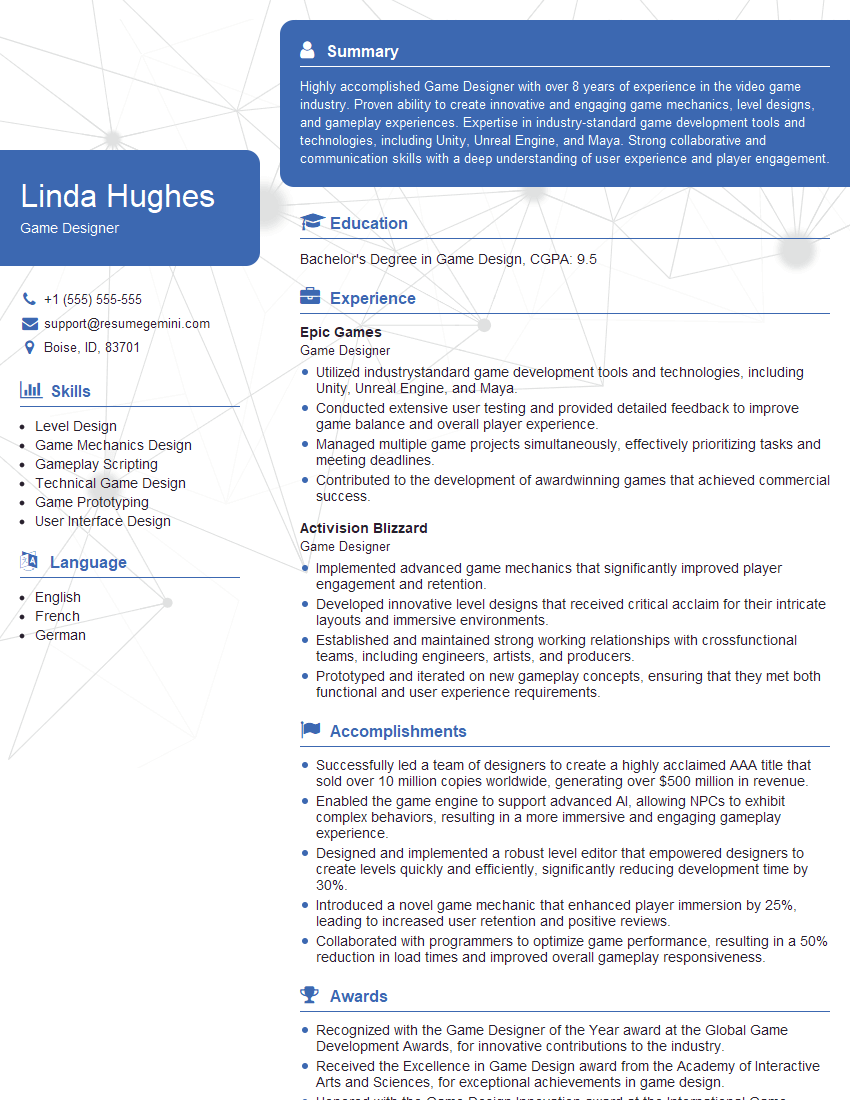
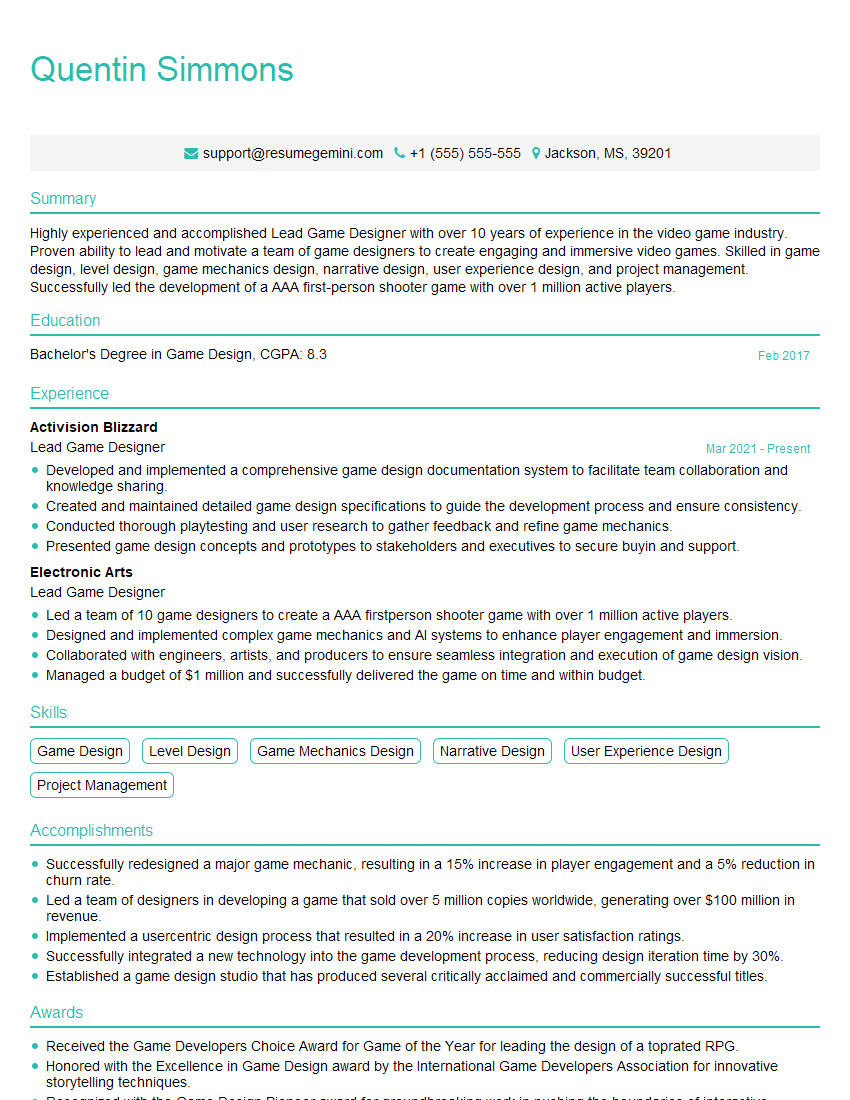
Mastering Tabletop game design and development opens doors to a creative and rewarding career. To maximize your job prospects, it’s crucial to present your skills effectively. An ATS-friendly resume is key to getting your application noticed by recruiters. We highly recommend using ResumeGemini to build a professional and impactful resume tailored to the Tabletop industry. Examples of resumes optimized for Tabletop roles are available below to help guide your creation.
Explore more articles
Users Rating of Our Blogs
Share Your Experience
We value your feedback! Please rate our content and share your thoughts (optional).
What Readers Say About Our Blog
Very informative content, great job.
good