The thought of an interview can be nerve-wracking, but the right preparation can make all the difference. Explore this comprehensive guide to Evasive Maneuvering interview questions and gain the confidence you need to showcase your abilities and secure the role.
Questions Asked in Evasive Maneuvering Interview
Q 1. Explain the difference between evasive driving and defensive driving.
Evasive driving and defensive driving are closely related but distinct concepts. Defensive driving focuses on anticipating potential hazards and taking proactive steps to avoid them. It’s about preventing accidents before they happen. Think of it as calmly and carefully navigating a busy highway, maintaining a safe following distance, and checking your mirrors frequently. Evasive driving, on the other hand, is reactive. It’s about employing maneuvers to avoid immediate collisions or threats after a hazard has already presented itself. This could involve swerving to avoid an obstacle or suddenly braking to prevent a rear-end collision.
In essence, defensive driving is preventative, while evasive driving is corrective. A skilled driver employs both.
Q 2. Describe the three-second rule and its application in evasive maneuvers.
The three-second rule is a fundamental safety guideline for maintaining a safe following distance. It dictates that you should maintain a minimum of three seconds of space between your vehicle and the vehicle in front of you. This gap allows for sufficient reaction time in various situations, including sudden braking or evasive maneuvers.
Application in evasive maneuvers: The three-second rule provides a crucial buffer. If the car ahead brakes suddenly, you have three seconds to react, assess the situation, and potentially initiate an evasive maneuver—giving you valuable time to avoid a collision. In a pursuit situation, maintaining this distance allows for more options and reduces the risk of losing control while maneuvering.
To apply it, pick a fixed point (like a signpost or tree) as the car in front passes it. Then count “one thousand one, one thousand two, one thousand three.” If you reach the same point before you finish counting, you are following too closely and need to increase your distance.
Q 3. What are the primary considerations when selecting an escape route?
Selecting an escape route during an evasive maneuver requires swift, decisive action based on several key considerations:
- Safety of others: Prioritize avoiding collisions with other vehicles or pedestrians. An escape route that might be faster but risks harming others is unacceptable.
- Terrain and road conditions: Assess the immediate surroundings. Is the escape route clear of obstacles like trees, walls, or other vehicles? What is the surface like? A smooth, wide road offers more maneuverability than a narrow, uneven one.
- Maintain control: Choose a route that allows you to maintain control of your vehicle. Avoid sharp turns or sudden braking if possible, especially at high speeds. A gradual, controlled maneuver is far safer than a drastic one.
- Accessibility: Is the route accessible given your current speed and vehicle capabilities? A route that appears safe but requires an impossible maneuver is useless.
- Escape from threat: The route should ideally lead you away from the immediate threat and towards a safe location, such as a well-lit area with other vehicles or a police station.
Q 4. How do you assess the immediate threat level during a pursuit?
Assessing the immediate threat level in a pursuit requires a calm, methodical approach focusing on observable factors:
- Pursuer’s behavior: Is the pursuer driving aggressively? Are they attempting to box you in or make contact? Their actions reveal their intent and the level of risk.
- Pursuer’s capabilities: What type of vehicle is it? How skilled is the driver? A high-performance vehicle driven by an experienced driver poses a greater threat than a slower vehicle driven recklessly.
- Surroundings: Are there obstacles nearby that could increase the risk of a collision, such as heavy traffic or poor visibility? These factors complicate evasive maneuvers.
- Your escape routes: Consider your escape options. Are there readily available, safe alternatives? A limited number of escape routes increases the urgency and risk.
Combining these observations allows you to categorize the threat as low, medium, or high, guiding your choice of response and evasive maneuvers.
Q 5. What techniques do you employ to avoid collisions while executing evasive maneuvers?
Avoiding collisions during evasive maneuvers requires a combination of techniques:
- Smooth steering inputs: Avoid jerky movements that could cause loss of control. Steer smoothly and progressively into the escape route.
- Controlled braking: If braking is necessary, apply it smoothly and progressively to avoid locking the wheels. Anti-lock brakes (ABS) can help but should not be over-relied upon.
- Maintaining vehicle control: Keep your eyes focused on the intended path and avoid fixating on the immediate danger. Maintain situational awareness throughout the maneuver.
- Strategic use of space: Utilize available space effectively, avoiding close proximity to other vehicles or obstacles as much as possible.
- Safe speed reduction: Reduce speed before initiating the maneuver. This gives you more control and allows for a smoother execution.
Proper vehicle maintenance, including tire pressure and brake system checks, is also crucial for effective evasive maneuvers.
Q 6. Explain the importance of situational awareness in evasive driving.
Situational awareness is paramount in evasive driving. It’s about understanding your surroundings, anticipating potential hazards, and adapting your driving accordingly. Without this awareness, even the most skilled evasive maneuvers can fail.
Importance: Situational awareness allows you to identify potential hazards early, giving you time to plan and execute an effective evasive maneuver. It involves continually scanning the environment—checking mirrors, blind spots, and looking ahead for potential obstacles or threats. It also includes understanding the behavior of other drivers and predicting their actions.
Example: A driver with poor situational awareness might focus solely on the car directly ahead, failing to notice a vehicle approaching quickly from the side or a pedestrian stepping into the road. A driver with high situational awareness would anticipate these possibilities and adjust their driving accordingly.
Q 7. Describe your experience with different types of evasive maneuvers (e.g., j-turn, s-turn).
My experience encompasses a range of evasive maneuvers, including the J-turn and S-turn. These are advanced techniques requiring significant practice and skill under controlled conditions and are not recommended for untrained drivers.
J-turn: A J-turn involves a rapid 180-degree turn, typically used in emergency situations to reverse direction quickly. It requires precise steering and throttle control to avoid loss of control and should only be attempted in open spaces with ample room for error.
S-turn: An S-turn involves a series of sequential turns, often used to navigate a tight space or change direction rapidly. It requires coordination and precision to maintain control throughout the sequence of turns and usually necessitates a controlled reduction of speed.
It’s crucial to understand that executing these maneuvers safely requires extensive training in a controlled environment under the guidance of experienced professionals. Improper execution can lead to accidents.
Q 8. How do you manage speed and control in high-pressure situations?
Managing speed and control during high-pressure situations requires a blend of anticipation, precision, and calm decision-making. It’s not about reckless speed, but rather maintaining the optimal speed for the circumstances.
Think of it like navigating a complex dance; you need to be aware of your surroundings – other vehicles, pedestrians, road conditions – and adjust your speed accordingly. In an emergency, maintaining control is paramount. This includes smooth braking, controlled acceleration, and precise steering inputs to avoid obstacles. Over-correcting can lead to loss of control. For example, if I’m faced with an unexpected obstacle, my priority is to assess the situation swiftly and then smoothly steer around it, adjusting my speed to make the maneuver safe and controlled. Excessive braking or sudden movements could cause a skid or collision.
Regular training and practice in controlled environments are crucial. Simulations and advanced driving courses help hone these skills, building muscle memory for smooth, controlled responses under stress. This prepares the driver for quick reaction times without compromising safety or control.
Q 9. How do you communicate effectively with passengers during an emergency maneuver?
Effective communication during an emergency maneuver is crucial for passenger safety and overall situational awareness. It needs to be clear, concise, and reassuring. Avoid jargon; use simple, direct language. For instance, instead of saying, “We’re executing a high-speed evasive maneuver,” I’d say, “We’re making a quick turn to avoid an obstacle; please hold on tight.”
Before the maneuver, establishing a rapport helps. Explaining the potential for unexpected events and emphasizing safety measures builds trust. During the maneuver, maintaining calm verbal cues provides reassurance and reduces passenger anxiety. After the event, providing a brief explanation and checking on their well-being demonstrates professionalism and care. Clear and consistent communication, even in stressful situations, is essential.
Q 10. What are the legal implications of performing evasive maneuvers?
The legal implications of performing evasive maneuvers are complex and vary greatly depending on jurisdiction and the specifics of the situation. Generally, the legality hinges on whether the maneuver was necessary to avoid a collision or other imminent danger, and whether it was executed safely and responsibly.
Performing an evasive maneuver that results in damage to property or injury to others may lead to legal repercussions, such as traffic violations or civil lawsuits. However, if the maneuver was deemed necessary to prevent a more serious accident, the legal outcome might be different. It is imperative to act reasonably and defensively and to thoroughly document the situation after the event. This might involve taking photographs of the scene, obtaining witness statements, and reporting the incident to the appropriate authorities.
Ultimately, demonstrating that the maneuver was a reasonable and necessary action taken to avoid greater harm is key to avoiding negative legal consequences. Seeking legal advice after such an incident is always recommended.
Q 11. Explain the concept of ‘cover’ and ‘concealment’ in relation to evasive driving.
In evasive driving, ‘cover’ and ‘concealment’ are distinct yet complementary concepts that significantly enhance safety and security. ‘Cover’ refers to something that offers physical protection from incoming fire or projectiles. For example, a brick wall provides cover because it can stop bullets. ‘Concealment,’ on the other hand, only hides you from view, offering no protection from incoming fire; this could be something like dense bushes.
In an evasive driving scenario, cover might be a sturdy building or a reinforced vehicle, while concealment might be a densely wooded area or a blind corner. The strategic use of both can be crucial in escaping a dangerous situation. For instance, you might use concealment to get away, then find cover to ensure you are out of danger.
Q 12. Describe your experience using counter-surveillance techniques.
My experience with counter-surveillance techniques involves a multi-faceted approach, combining observation, route planning, and vehicle maintenance. It’s about anticipating potential surveillance and taking steps to minimize its effectiveness.
This includes varying routes, using less frequented roads, maintaining a low profile (avoiding unnecessary attention), and frequently checking for surveillance vehicles or individuals. Regular vehicle checks, ensuring no tracking devices are attached, also play a vital role. I’ve also utilized techniques such as using blind corners, maintaining situational awareness, and varying speed patterns to create an unpredictable trajectory.
Training and experience are key to mastering counter-surveillance; it’s not just about learning techniques, but developing an instinct for recognizing potential threats and reacting appropriately. The more experience you have, the better you become at anticipating and reacting to potential threats.
Q 13. How do you identify and react to potential ambush scenarios?
Identifying and reacting to potential ambush scenarios relies on heightened situational awareness and risk assessment. Common indicators could include unusual activity in a normally quiet area, sudden changes in traffic patterns, or individuals behaving suspiciously along the route.
My response would be based on a dynamic risk assessment. If a threat is identified, options include altering the route immediately, increasing speed if it’s safe, seeking a more defensible position (perhaps a well-lit, public area), or, if necessary, taking evasive maneuvers to escape. Communication is also crucial – contacting authorities or alerting others to potential danger.
Training is fundamental to developing the ability to quickly assess and respond to these kinds of events, including decision-making under extreme stress.
Q 14. How do you adapt your driving techniques to different vehicle types?
Adapting driving techniques to different vehicle types is essential for effective evasive maneuvers. Each vehicle has unique handling characteristics: weight distribution, center of gravity, braking capabilities, steering responsiveness, etc.
A large SUV will handle differently than a small sports car; a van’s center of gravity will affect its response to turns. This means understanding the specific capabilities and limitations of each vehicle is crucial for performing safe and efficient maneuvers. For example, a high-center-of-gravity vehicle will require a slower speed and wider turning radius to avoid rollovers during emergency maneuvers compared to a lower-center-of-gravity vehicle. Regular practice with different vehicle types allows for the development of muscle memory and adaptable reflexes, leading to better decision-making and execution.
Q 15. How do you assess the risk of a particular route?
Assessing route risk involves a systematic evaluation of potential hazards. It’s like planning a hike – you wouldn’t just head out without checking the trail conditions, right? For evasive maneuvering, we consider several factors:
- Traffic Density: High traffic means increased chances of collisions. We’d prioritize less congested routes.
- Road Conditions: Smooth roads are ideal, but we need to anticipate rain, ice, or construction. A wet or icy road dramatically reduces control.
- Visibility: Poor visibility (night, fog, etc.) greatly increases the risk. We might choose routes with better lighting or clearer sightlines.
- Potential Pursuit Interception Points: We anticipate where pursuers might try to cut us off or block our path. This often involves analyzing potential escape routes and dead ends.
- Terrain: Hilly or mountainous terrain reduces speed and maneuverability. Flat, open areas are generally preferred.
We use a weighted scoring system to combine these factors, leading to a risk level (low, medium, high) for each potential route. This informs our route selection.
Career Expert Tips:
- Ace those interviews! Prepare effectively by reviewing the Top 50 Most Common Interview Questions on ResumeGemini.
- Navigate your job search with confidence! Explore a wide range of Career Tips on ResumeGemini. Learn about common challenges and recommendations to overcome them.
- Craft the perfect resume! Master the Art of Resume Writing with ResumeGemini’s guide. Showcase your unique qualifications and achievements effectively.
- Don’t miss out on holiday savings! Build your dream resume with ResumeGemini’s ATS optimized templates.
Q 16. Explain your process for route planning and risk mitigation.
Route planning and risk mitigation are interconnected processes. It’s like building a safety net before a high-wire act.
- Intelligence Gathering: We gather information about the pursuit environment – traffic patterns, road closures, construction zones, and potential pursuer tactics.
- Route Identification: We identify multiple potential routes, considering factors mentioned in the previous answer (traffic, road conditions, visibility). We aim for routes that offer multiple escape options.
- Risk Assessment: Each route is assigned a risk score based on our weighted scoring system. We consider the time it takes to traverse a route, the potential for detection, and the likelihood of encountering obstacles.
- Contingency Planning: We develop backup plans for each route. What if a road is blocked? What’s the next best option? This ensures we have flexibility during the pursuit.
- Communication: Clear and concise communication with the team is crucial. This allows us to adjust plans based on real-time changes in the situation.
This process is iterative. As the situation evolves, we continuously reassess risks and adapt our route accordingly. It’s a dynamic process, not a static plan.
Q 17. How do you handle unexpected obstacles during a pursuit?
Handling unexpected obstacles requires quick thinking and decisive action. Imagine driving and suddenly encountering a landslide. Your reaction needs to be immediate and appropriate.
- Assessment: Quickly assess the nature and severity of the obstacle. Is it a minor impediment or a major blockage?
- Maneuver: Based on the assessment, select an appropriate evasive maneuver. This might involve swerving (carefully!), braking, or even using a counter-steering technique to maintain control during an emergency.
- Communication: Communicate the obstacle and your chosen maneuver to the team immediately.
- Adaptation: Adjust the route based on the new conditions. The original plan might be obsolete, so you need to choose a new path quickly.
Training and experience are critical. We practice handling various unexpected obstacles during training exercises to ensure quick and efficient responses in real-world scenarios.
Q 18. How do you maintain vehicle control on different road surfaces?
Maintaining vehicle control on different surfaces demands both skill and awareness. It’s like adjusting your driving style for different terrains—a smooth highway versus a muddy track.
- Reduced Speed: The most important factor is adjusting speed to match the surface conditions. Reduced speed provides more control and reaction time.
- Smooth Inputs: Avoid sudden braking, acceleration, or steering inputs. These can easily cause loss of control, especially on slick surfaces.
- Controlled Braking: Use progressive braking techniques, applying steady pressure to avoid wheel lockup.
- Steering Adjustments: Adapt steering inputs to surface conditions. More cautious and measured movements are often necessary on slippery roads.
- Awareness: Constantly scan the road ahead, anticipating changes in the surface. This anticipatory awareness is critical to avoid problems before they arise.
Regular training on various surfaces is essential. We practice maneuvers on wet, icy, and gravel roads to hone our skills and build muscle memory.
Q 19. Describe your experience with emergency vehicle operations.
My experience with emergency vehicle operations is extensive. I’ve participated in countless hours of training, covering everything from high-speed driving techniques to emergency response procedures. It’s not just about driving fast; it’s about driving safely and efficiently under pressure.
- Advanced Driving Techniques: I’m proficient in techniques like counter-steering, emergency braking, and collision avoidance maneuvers.
- Emergency Vehicle Procedures: I understand the specific protocols and procedures for emergency responses, including lights and sirens use, communication, and scene management.
- Risk Management: I have a deep understanding of the risks associated with emergency driving and how to mitigate those risks effectively.
- Teamwork: Effective teamwork is essential. I’ve worked closely with teams to execute complex maneuvers safely and efficiently.
Through years of practical experience, I’ve developed a highly refined set of skills and instincts, allowing me to handle stressful and unpredictable situations with competence and composure.
Q 20. What are the common causes of accidents during pursuit driving?
Accidents during pursuit driving are often caused by a combination of factors. It’s never just one thing, but rather a convergence of circumstances.
- Excessive Speed: Speed is a major contributing factor. The faster you go, the less time you have to react to unexpected situations.
- Poor Visibility: Reduced visibility (night, fog, rain) limits reaction time and increases the risk of collisions.
- Road Conditions: Slippery roads, potholes, or construction zones reduce traction and increase the chances of losing control.
- Driver Error: This encompasses a broad range of mistakes, such as aggressive maneuvers, poor judgment, and failure to anticipate hazards.
- Mechanical Failure: Vehicle malfunctions can lead to accidents, highlighting the importance of proper vehicle maintenance.
To mitigate these risks, we prioritize safe driving practices, regular vehicle maintenance, and comprehensive training to minimize the probability of accidents.
Q 21. How do you prioritize safety during high-speed driving?
Prioritizing safety during high-speed driving is paramount. It’s not about how fast you can go, but how safely you can manage the speed. It’s like balancing on a tightrope – precision is key.
- Defensive Driving: Maintain a safe following distance, anticipate the actions of other drivers, and scan the road ahead for potential hazards.
- Controlled Maneuvers: Avoid abrupt movements. Smooth inputs are crucial for maintaining control, especially at high speeds.
- Situational Awareness: Continuously assess the situation, adjusting driving technique as needed. Be aware of surroundings, traffic, road conditions, etc.
- Communication: Clear and concise communication with the team is crucial for coordinating actions and avoiding conflicts.
- Risk Assessment: Continuously evaluate the risks associated with speed and adjust accordingly. Is the risk worth the speed?
By consistently adhering to safe driving practices, we strive to minimize risks and ensure the safety of ourselves and others. Speed is only one factor; controlled and responsible execution is more important.
Q 22. Describe your experience conducting driver training.
My driver training experience spans over 15 years, encompassing various roles from instructing novice drivers to advanced defensive driving techniques for professional drivers and law enforcement personnel. I’ve developed and delivered curricula covering a wide range of topics, from basic vehicle control to high-speed pursuit tactics and evasive maneuvers. My approach emphasizes practical application, scenario-based training, and risk assessment, ensuring trainees develop not only the skills but also the judgment to use them effectively and safely.
I’ve worked with diverse groups, including commercial drivers needing to refresh their skills, security personnel requiring specialized training, and law enforcement officers seeking to refine their pursuit techniques. My feedback mechanisms – involving both written and practical assessments – allows for tailored instruction to address individual strengths and weaknesses. A notable success was developing a specialized program for drivers transporting hazardous materials, drastically reducing near-miss incidents within the organization.
Q 23. What are the key elements of effective driver training?
Effective driver training hinges on a multi-faceted approach. It’s not just about mastering vehicle controls; it’s about developing a holistic understanding of safe driving practices and risk mitigation.
- Fundamentals: This includes mastering vehicle handling in various conditions (wet, icy, etc.), understanding braking distances, and practicing safe following distances. Proper use of mirrors and blind spot checks is paramount.
- Defensive Driving Techniques: This focuses on anticipating potential hazards, maintaining a safe speed, and leaving ample space around the vehicle. It emphasizes proactive risk management rather than reactive maneuvers.
- Evasive Maneuvers: These are taught as a last resort, focusing on safe and controlled execution. Proper techniques, such as controlled braking and steering inputs, are crucial to minimize risks.
- Risk Assessment and Decision-Making: This element is critical. Drivers need to learn to assess situations, weigh risks, and make sound decisions under pressure. Role-playing and scenario-based training are vital here.
- Emergency Procedures: This covers procedures for tire blowouts, engine failures, and other emergencies, emphasizing controlled responses and passenger safety.
Throughout the training process, consistent feedback, clear communication, and practical application are key to fostering confident and skilled drivers.
Q 24. Explain the limitations of evasive maneuvers.
Evasive maneuvers, while vital for avoiding collisions, have limitations that must be carefully considered. They are not a foolproof solution and should always be a last resort after all other options (e.g., braking, slowing down, changing lanes) have been exhausted.
- Speed and Vehicle Dynamics: High speeds severely restrict the effectiveness of evasive maneuvers. The higher the speed, the less control the driver has, increasing the risk of a loss of control or a more severe accident.
- Road and Environmental Conditions: Wet or icy roads, poor visibility, and limited space drastically reduce the effectiveness and safety of evasive maneuvers.
- Vehicle Limitations: The vehicle’s capabilities (handling, braking, tires) play a crucial role. An older vehicle or one with worn tires will respond differently to evasive maneuvers than a newer vehicle in good condition.
- Driver Skill and Reaction Time: Even with training, the driver’s skill and reaction time influence the success of an evasive maneuver. Panic or improper technique can exacerbate the situation.
- Unexpected Hazards: Unforeseen obstacles (pedestrians, other vehicles) can compromise even the best-executed maneuver.
Think of it like this: evasive maneuvers are a powerful tool, but like any tool, they must be used correctly and with a full understanding of their limitations to be effective and safe.
Q 25. How do you de-escalate potentially volatile situations involving vehicles?
De-escalating volatile situations involving vehicles requires a calm and measured approach. The primary goal is to ensure the safety of all involved, including yourself, passengers, and other drivers. My strategy emphasizes clear communication, controlled movements, and avoidance of any action that might be perceived as aggressive.
- Maintain a Safe Distance: Avoid confronting the other driver directly. Creating space reduces tension and allows for clearer thinking.
- Clear and Calm Communication: If communication is possible, use a calm and respectful tone. Avoid accusatory language. State your intentions clearly.
- Avoid Eye Contact: Prolonged eye contact can escalate tensions. Keep your gaze focused on the road and traffic.
- Document the Incident: If possible, record the license plate number, time, location, and any other relevant details. If the situation involves threats or violence, report it to the appropriate authorities.
- Seek Assistance if Needed: If the situation feels unsafe or escalates, call for assistance (law enforcement or security). Your safety is paramount.
It’s crucial to remember that your priority is always safety. Sometimes, the best de-escalation strategy is simply to avoid interaction and move away from the potentially volatile situation.
Q 26. How do you ensure the safety of passengers during an emergency?
Passenger safety is paramount during any emergency. My training emphasizes proactive measures to mitigate risks and ensure passenger well-being.
- Pre-Trip Briefing: Before any trip, especially in high-risk scenarios, brief passengers on safety procedures. This includes seatbelt use, emergency exits, and communication protocols.
- Secure Cargo and Loose Items: Ensure that all cargo and loose items are properly secured to prevent them from becoming projectiles in an emergency.
- Controlled Maneuvers: During an emergency, execute evasive maneuvers smoothly and predictably to minimize passenger discomfort and injury. Communicate to passengers what is happening and why.
- Post-Incident Procedures: After any incident, assess the situation for injuries and provide first aid if necessary. Contact emergency services as needed.
- Passenger Communication: Maintain open communication with passengers throughout the event, providing reassurance and updates as appropriate.
By prioritizing passenger safety through proactive planning and controlled responses, the risk of injury during an emergency can be greatly minimized.
Q 27. How would you handle a tire blowout during a high-speed pursuit?
A tire blowout during a high-speed pursuit presents a critical situation requiring immediate and controlled action. The key is to maintain control while safely bringing the vehicle to a stop.
- Grip the Steering Wheel Firmly: A sudden blowout can cause a significant pull on the steering wheel. Maintain a firm grip to prevent loss of control.
- Ease Off the Accelerator: Gradually reduce speed, avoiding sudden braking or jerky movements. Sudden braking can exacerbate the situation.
- Steer Straight: Try to maintain a straight course, avoiding sudden steering inputs which could lead to skidding or loss of control.
- Activate Hazard Lights: Immediately activate your hazard lights to alert other drivers of the emergency.
- Gradually Apply Brakes: Once you’ve slowed down significantly, gently apply the brakes to bring the vehicle to a complete stop away from traffic.
- Assess the Situation: Once safely stopped, assess the damage and the condition of passengers. Call for assistance if necessary.
Remember, a controlled response is paramount. Avoid panic and maintain focus on bringing the vehicle to a safe stop. This requires consistent training and practical application of techniques to effectively manage unexpected events such as a tire blowout at high speed.
Key Topics to Learn for Evasive Maneuvering Interview
- Fundamental Principles: Understanding the core concepts of evasion, including threat assessment, risk mitigation, and decision-making under pressure.
- Tactical Applications: Exploring practical scenarios and techniques for evasive maneuvers in various contexts (e.g., vehicle operation, urban environments, digital security).
- Route Planning & Navigation: Mastering the skills of route optimization, real-time adaptation to changing conditions, and utilizing navigation tools effectively.
- Countermeasures & Deception: Learning how to employ countermeasures to disrupt tracking and surveillance, and understanding principles of deception and misdirection.
- Technological Aspects: Familiarity with technologies relevant to evasive maneuvering, such as GPS jamming, signal obfuscation, and anti-surveillance techniques (depending on the specific job requirements).
- Legal and Ethical Considerations: Understanding the legal and ethical boundaries within which evasive maneuvers can be performed.
- Problem-Solving & Decision-Making: Developing the ability to quickly analyze situations, identify potential threats, and make effective, time-sensitive decisions.
- Stress Management & Situational Awareness: Maintaining composure and focus under pressure, and cultivating high situational awareness to anticipate threats.
Next Steps
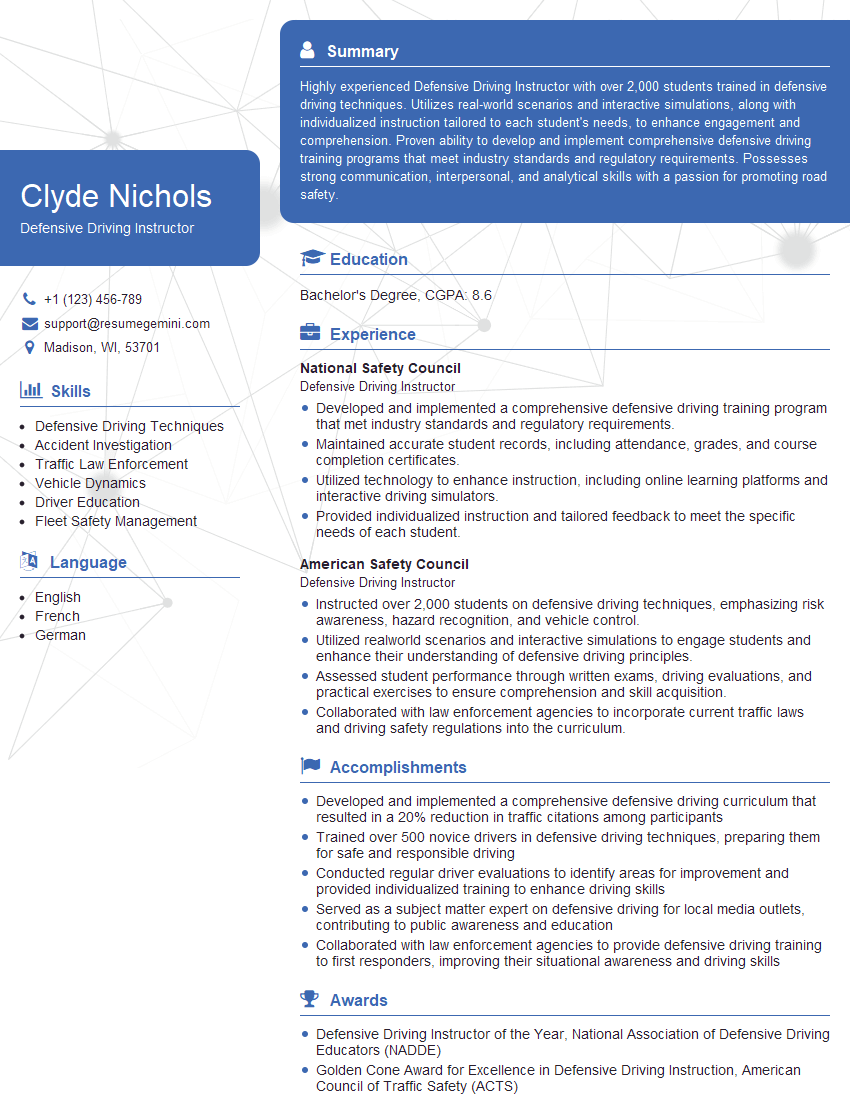
Mastering evasive maneuvering techniques significantly enhances your career prospects in fields demanding high levels of adaptability and strategic thinking. A strong understanding of these principles will set you apart from other candidates. To maximize your job search success, it’s crucial to present your skills effectively. Create an ATS-friendly resume that highlights your relevant experience and qualifications. ResumeGemini is a trusted resource that can help you build a professional and impactful resume tailored to the specific demands of your target roles. Examples of resumes tailored to Evasive Maneuvering are available to further guide your preparation.
Explore more articles
Users Rating of Our Blogs
Share Your Experience
We value your feedback! Please rate our content and share your thoughts (optional).
What Readers Say About Our Blog
Very informative content, great job.
good