Are you ready to stand out in your next interview? Understanding and preparing for Durability Evaluation interview questions is a game-changer. In this blog, we’ve compiled key questions and expert advice to help you showcase your skills with confidence and precision. Let’s get started on your journey to acing the interview.
Questions Asked in Durability Evaluation Interview
Q 1. Explain the difference between fatigue and static failure.
The key difference between fatigue and static failure lies in the type of loading and resulting damage mechanism. Static failure occurs when a material is subjected to a constant load that exceeds its ultimate strength. Think of it like snapping a twig by applying a single, strong force. The failure is immediate and catastrophic.
Fatigue failure, on the other hand, happens under cyclic loading, meaning the load repeatedly varies over time, even if the maximum load is significantly less than the material’s ultimate tensile strength. Imagine repeatedly bending a paper clip back and forth – eventually, it will break, even though a single bend wouldn’t break it. This gradual weakening and eventual fracture is due to the accumulation of microscopic damage over many load cycles. The failure is often unexpected and can occur at surprisingly low stress levels compared to static failure.
In short: Static failure is sudden, caused by exceeding the material’s strength; fatigue failure is gradual, caused by repeated loading even below the material’s strength.
Q 2. Describe various durability testing methods you are familiar with.
My experience encompasses a wide range of durability testing methods, tailored to the specific material and application. These include:
- Endurance Testing: Applying a constant or cyclic load until failure. This is fundamental for determining fatigue life.
- Strain-Life Testing: Focusing on the strain experienced by the material during cycling, useful for analyzing materials with significant plastic deformation.
- Random Vibration Testing: Simulating real-world vibration environments to assess a product’s resilience to dynamic forces, often seen in automotive or aerospace testing.
- Accelerated Life Testing (ALT): Exposing the product to higher-than-normal stress levels to accelerate the aging process and predict the lifetime under typical conditions. This saves significant time and resources.
- Thermal Cycling Testing: Repeatedly subjecting a product to temperature variations, crucial for applications involving significant temperature fluctuations.
- Combined Stress Testing: A more realistic approach, incorporating multiple stress factors such as vibration, temperature, and load simultaneously to mimic real-world operating conditions.
The choice of method depends heavily on the application. For example, a smartphone case might undergo drop testing and thermal cycling, while an aircraft wing would require extensive fatigue and vibration testing.
Q 3. How do you determine the appropriate testing standards for a given product?
Selecting the appropriate testing standards is critical for ensuring the reliability and safety of a product. This process involves several steps:
- Identify the relevant industry and regulatory requirements: Many industries have specific standards (e.g., ISO, ASTM, SAE) that dictate testing procedures. For medical devices, compliance with FDA regulations is paramount.
- Analyze the product’s intended use and application: A product used in harsh environments (e.g., offshore oil rig) will need more rigorous testing than a consumer product.
- Consider material properties and design specifications: The material’s inherent strength and the product’s geometry significantly influence the choice of test methods.
- Review existing literature and best practices: Researching similar products and consulting with experienced engineers can provide valuable guidance.
- Consult with certification bodies: For products requiring certification, working with a recognized certification body ensures adherence to relevant standards.
Failing to choose appropriate standards can lead to inaccurate predictions of product life, potentially resulting in premature failure and safety risks.
Q 4. What are the key factors to consider when designing a durability test plan?
Designing a robust durability test plan requires careful consideration of several key factors:
- Test Objectives: Clearly define the goals. Are you aiming for a specific fatigue life, assessing performance under specific conditions, or identifying potential failure modes?
- Test Environment: Accurately represent the real-world operating conditions. This includes temperature ranges, humidity, vibration levels, and applied loads.
- Test Specimens: Ensure that the test specimens are representative of the actual product in terms of materials, geometry, and manufacturing processes.
- Test Methods: Choose appropriate testing methods based on the product’s intended use, material properties, and relevant standards.
- Data Acquisition and Analysis: Implement a plan for collecting, storing, and analyzing data to draw meaningful conclusions. This might involve strain gauges, accelerometers, and advanced data acquisition systems.
- Statistical Analysis: Use statistical methods to analyze the test data and determine the confidence level of the results. This helps account for variability in manufacturing and testing.
A well-designed test plan reduces uncertainties, ensures meaningful results, and ultimately leads to more reliable and durable products.
Q 5. Explain the concept of stress-life (S-N) curves and their application.
Stress-life (S-N) curves are graphical representations of the relationship between the applied stress amplitude (S) and the number of cycles to failure (N) for a given material under cyclic loading. They’re fundamental in fatigue analysis.
The curve typically shows a downward trend: higher stress amplitudes lead to fewer cycles to failure. The curves are usually plotted on a log-log scale to better visualize the data, often exhibiting a distinct region of constant life, followed by a region where fatigue strength decreases with increasing number of cycles. The information derived from S-N curves is crucial in determining the fatigue life of components and designing for durability.
Application: S-N curves are used extensively in:
- Predicting fatigue life: Given a stress level, the curve provides an estimate of how many cycles a component can withstand before failure.
- Material selection: Comparing S-N curves of different materials helps in choosing the most appropriate material for a specific application.
- Design optimization: By understanding the S-N curve, engineers can optimize component geometry to improve fatigue resistance.
For example, in designing a bridge, engineers use S-N curves to estimate the fatigue life of the structural components under cyclical loading from traffic, ensuring the bridge can withstand years of operation.
Q 6. How do you interpret and analyze fatigue test data?
Interpreting and analyzing fatigue test data involves several steps:
- Data Validation: Checking for errors and outliers in the collected data. This ensures data accuracy and reliability.
- S-N Curve Generation: Plotting the stress amplitude versus the number of cycles to failure on a log-log scale. This visual representation helps identify trends and patterns.
- Statistical Analysis: Performing statistical analysis (e.g., regression analysis) to fit the data to an appropriate mathematical model (e.g., power law). This allows for extrapolation beyond the tested data range with appropriate caution.
- Failure Analysis: Examining the failed specimens to identify the initiation and propagation of cracks. Microscopic analysis can be crucial.
- Life Prediction: Using the derived S-N curve and statistical models to predict the fatigue life under various loading conditions.
- Uncertainty Quantification: Understanding the inherent uncertainty in the fatigue life prediction due to material variability, testing limitations, and model assumptions.
Sophisticated software is frequently used for this analysis, incorporating various statistical techniques and models. The output will typically include not only a fatigue life estimate but also a confidence interval representing the uncertainty inherent in the prediction.
Q 7. Describe your experience with finite element analysis (FEA) for durability prediction.
I have extensive experience using finite element analysis (FEA) for durability prediction. FEA allows for the simulation of complex stress and strain distributions within a component under various loading conditions. This provides valuable insights that complement experimental testing.
In my work, I’ve used FEA to:
- Predict stress hotspots: Identify locations within a component that experience the highest stresses, helping prioritize areas for fatigue testing or design modification.
- Simulate fatigue life: Using FEA in conjunction with fatigue analysis software, I can simulate the component’s fatigue life under specific loading scenarios.
- Optimize designs: By virtually modifying component geometry or material properties, FEA helps optimize designs for improved fatigue resistance and durability without the need for numerous physical prototypes.
- Validate experimental data: FEA results can be compared with experimental data to validate the accuracy of both the simulation and testing procedures.
For example, in a recent project involving a complex automotive component, FEA helped identify a previously unrecognized stress concentration, leading to a design modification that significantly improved fatigue life and reduced the risk of premature failure. FEA is an invaluable tool, but it’s crucial to remember that it’s a simulation and requires careful validation with experimental testing.
Q 8. What are some common failure modes observed in durability testing?
Common failure modes in durability testing depend heavily on the product and the type of stress applied. However, some prevalent modes include:
- Fatigue Failure: This is perhaps the most common, occurring due to repeated cyclic loading. Imagine bending a paper clip back and forth – eventually it will break. This is fatigue. We see this manifested as crack initiation and propagation in materials.
- Creep Failure: This involves the slow deformation of a material under sustained stress, often at elevated temperatures. Think of a sagging wire over time under its own weight.
- Fracture: A sudden separation of a material due to excessive stress, exceeding its ultimate tensile strength. Dropping a ceramic mug on a hard floor is a prime example.
- Corrosion: The degradation of a material due to chemical reactions with its environment. Rust on a car is a classic illustration.
- Wear: Material loss due to frictional contact. The wear of car tires is a constant process.
- Corrosion Fatigue: A combination of corrosion and fatigue, leading to accelerated failure.
Understanding these modes allows us to tailor our testing to anticipate and mitigate potential problems.
Q 9. How do you handle outliers or unexpected results during durability testing?
Outliers and unexpected results in durability testing require careful investigation. We follow a structured approach:
- Data Verification: First, we verify the data’s accuracy. Were there any errors in the testing setup, data acquisition, or recording?
- Root Cause Analysis: If the data is valid, we investigate the root cause. Did an unforeseen event occur (e.g., a sudden power surge)? Was there a manufacturing defect in the tested sample?
- Statistical Analysis: We employ statistical methods like outlier detection tests (e.g., Grubbs’ test) to determine if outliers are statistically significant. If so, we need to understand why.
- Repeatability and Reproducibility: We may repeat the test to confirm the outlier’s reproducibility. If consistent, it suggests a real issue and we need to revise our design or testing methodology.
- Documentation: Thorough documentation of the outlier, its investigation, and the conclusions drawn is crucial for transparency and learning.
For example, if a single sample fails prematurely during a fatigue test, we might investigate its microstructure for flaws or examine the loading history for unusual events.
Q 10. Explain your experience with different types of fatigue testing (e.g., constant amplitude, random vibration).
My experience encompasses various fatigue testing methodologies.
- Constant Amplitude Fatigue Testing: This involves applying a constant stress or strain amplitude to the specimen until failure. It’s relatively simple to conduct and analyze, providing data on fatigue life at a specific stress level. It’s useful for establishing baseline fatigue properties.
- Random Vibration Testing: This mimics real-world conditions where the loading is not constant but rather varies randomly. It’s more complex to set up and analyze, often requiring sophisticated equipment and software to generate and analyze the random vibration profile. This is crucial for products that experience complex vibrational environments, such as those in automotive or aerospace industries.
- Variable Amplitude Fatigue Testing: This simulates real-world loading scenarios with varying stress or strain amplitudes. This accurately reflects the complex loading experienced in many applications, leading to more realistic predictions of durability.
I’ve used these techniques in various projects, from testing the fatigue life of automotive components to assessing the durability of aerospace structures under simulated flight conditions.
Q 11. How do you assess the impact of environmental factors (temperature, humidity) on durability?
Environmental factors significantly impact durability. Temperature and humidity can influence material properties, accelerating degradation and failure.
We assess their impact using environmental chambers that simulate various temperature and humidity levels. For example, we might test a component at high temperatures to see if it experiences creep or accelerated fatigue. High humidity can promote corrosion, so we’d test materials in humid environments to understand its effect on their durability.
In our analysis, we examine the failure mechanisms under different environmental conditions. We use statistical methods to quantify the effects of temperature and humidity on the failure rate and other durability metrics. This enables us to develop more robust designs that can withstand various environmental stressors.
Q 12. Describe your experience with accelerated life testing.
Accelerated life testing (ALT) is a crucial technique for evaluating product durability faster than real-time. It involves subjecting products to more extreme conditions than those typically encountered in their intended use to accelerate failure. The principle relies on the concept that failure mechanisms are accelerated at higher stresses and temperatures. This allows us to gain a more accurate estimation of long-term performance in a short timeframe.
I have extensive experience designing and executing ALT studies, employing various methods such as:
- Step-stress testing: The stress level is increased stepwise during the test.
- Constant-stress testing: The component is stressed at a constant level until failure.
- Accelerated degradation testing: We measure a degradation parameter (e.g., crack growth rate) and extrapolate to predict failure.
Analyzing the data requires sophisticated statistical models (e.g., Weibull, lognormal) to extrapolate failure rates from accelerated conditions to real-world conditions. Proper planning is crucial to ensure the test accurately reflects the real-world failure mechanisms.
Q 13. What are some common software tools you use for durability analysis?
Several software tools are essential for durability analysis. My experience includes using:
- Finite Element Analysis (FEA) software: Such as ANSYS, Abaqus, and Nastran. These are used for simulating the stress and strain distributions in components under various loading conditions, helping predict potential failure points.
- Statistical software: Like Minitab, JMP, and R. These are used for analyzing durability data, performing reliability analysis, fitting statistical distributions, and performing life data analysis.
- Data acquisition and analysis software: Such as LabVIEW, DIAdem, and specialized test control software. These are used for acquiring and analyzing data from fatigue testing machines.
- Specialized Durability Analysis Software: There are some commercial packages specifically designed for fatigue and durability analysis, performing analyses such as rainflow counting, spectral analysis and damage accumulation calculations.
Choosing the right tools depends on the complexity of the analysis and the type of testing performed.
Q 14. How do you determine the appropriate sample size for durability testing?
Determining the appropriate sample size for durability testing is crucial for obtaining statistically valid results. It’s a balance between cost and accuracy. We consider several factors:
- Desired Confidence Level: How confident do we want to be in our results? A higher confidence level requires a larger sample size.
- Acceptable Margin of Error: How much variability are we willing to accept in our estimates? A smaller margin of error requires a larger sample size.
- Expected Variability in the Data: High variability in the data requires a larger sample size to get a clear picture.
- Test Cost: The cost of conducting the tests limits the practical sample size. A cost-benefit analysis is necessary.
- Statistical Power: The probability of detecting a true difference in durability between groups (if there is one). A higher power needs a larger sample size.
We often use statistical power analysis techniques to determine the minimum sample size required to achieve the desired confidence level and margin of error. For example, if we anticipate high variability in our test data, a larger sample size would be needed to maintain the desired accuracy.
Q 15. Explain the concept of reliability and its relationship to durability.
Reliability and durability are closely related but distinct concepts in product design and engineering. Reliability refers to the probability that a product will perform its intended function without failure for a specified period under stated conditions. Think of it as the consistency of performance. Durability, on the other hand, focuses on a product’s ability to withstand wear and tear, stress, and other environmental factors over its lifespan. It’s the robustness of the product. A highly reliable product might not be durable (e.g., a delicate sensor that always works perfectly until it breaks from a minor bump), and a durable product might not always be reliable (e.g., a robust but poorly designed engine that frequently malfunctions). Ideally, a successful product possesses both high reliability and high durability.
For example, a car engine must be reliable – starting and running consistently – and durable – withstanding years of use and harsh conditions. A reliable battery will maintain its charge effectively for its rated lifespan, while a durable battery can withstand extreme temperatures and still function, even if its reliability might start to decrease over time.
Career Expert Tips:
- Ace those interviews! Prepare effectively by reviewing the Top 50 Most Common Interview Questions on ResumeGemini.
- Navigate your job search with confidence! Explore a wide range of Career Tips on ResumeGemini. Learn about common challenges and recommendations to overcome them.
- Craft the perfect resume! Master the Art of Resume Writing with ResumeGemini’s guide. Showcase your unique qualifications and achievements effectively.
- Don’t miss out on holiday savings! Build your dream resume with ResumeGemini’s ATS optimized templates.
Q 16. How do you communicate complex technical information related to durability to non-technical audiences?
Communicating complex durability data to non-technical audiences requires simplification and visualization. I avoid jargon and instead use analogies and relatable examples. For instance, instead of saying “the fatigue life of the component exceeded the design requirements,” I might explain, “Our tests showed the part could withstand more wear and tear than we initially expected.”
I rely heavily on visual aids like charts and graphs. A simple bar chart comparing the durability of different materials or a graph showing the failure rate over time is far more effective than a table of numerical data. Infographics and short videos also work well to illustrate key points concisely. Finally, I focus on the implications of durability – how it translates to longer product life, reduced maintenance costs, and increased customer satisfaction.
Q 17. Describe a time you had to troubleshoot a failed durability test and identify the root cause.
During testing of a new type of composite material for a wind turbine blade, we experienced unexpected failures during fatigue testing. The blades were fracturing prematurely. Our initial troubleshooting involved meticulously examining the fractured surfaces using microscopy and analyzing the stress patterns using finite element analysis (FEA).
We discovered microscopic voids within the composite material, which were acting as stress concentrators, leading to premature failure. The root cause was traced back to inconsistencies in the manufacturing process of the composite layers, resulting in improper curing and the formation of these voids. We addressed this by implementing stricter quality control measures during manufacturing, improving the mixing process for the composite materials, and optimizing the curing parameters. Subsequent testing with the improved manufacturing process demonstrated significantly improved durability and eliminated premature failures.
Q 18. How do you use data analysis to improve the durability of a product?
Data analysis plays a crucial role in improving product durability. We collect data from various sources, including accelerated life testing, field failure reports, and simulations. This data is then analyzed using statistical methods to identify trends, patterns, and potential failure mechanisms.
For example, we might use regression analysis to understand the relationship between operating conditions (e.g., temperature, load) and product lifetime. Survival analysis helps determine the probability of failure over time, and design of experiments (DOE) helps optimize designs for improved durability. This data-driven approach allows us to identify weak points in the design and material selection, leading to targeted improvements and ultimately, a more durable product. We also use predictive modeling based on gathered data to estimate the likely lifetime of future product iterations.
Q 19. Explain your experience with durability standards and regulations.
I have extensive experience with various durability standards and regulations, including ISO, ASTM, and industry-specific standards like those for automotive components or aerospace applications. My work involves ensuring that our products meet or exceed these requirements. This includes understanding the specific test methods, acceptance criteria, and reporting procedures outlined in these standards.
For example, in automotive applications, we adhere to standards like ISO 16750 for environmental testing, ensuring our products can withstand various climatic conditions. Familiarity with these standards is critical for ensuring product compliance, minimizing risk, and gaining market access.
Q 20. Describe your experience with different types of materials and their durability characteristics.
My experience encompasses a wide range of materials, including metals (steel, aluminum, titanium), polymers (plastics, composites), and ceramics. Each material exhibits unique durability characteristics. For instance, steel possesses high strength and stiffness but is susceptible to corrosion, while certain polymers offer excellent flexibility and impact resistance but might exhibit creep under sustained load. Ceramics are typically hard and wear-resistant but brittle.
Understanding these material properties is crucial in selecting the appropriate materials for a specific application. For instance, in designing a medical implant, biocompatibility and corrosion resistance would be paramount, leading to choices like titanium alloys. For a consumer product requiring impact resistance, a polymer might be the preferred material.
Q 21. How do you balance the cost of durability testing with the risk of product failure?
Balancing the cost of durability testing with the risk of product failure is a crucial aspect of product development. Extensive testing is expensive, but inadequate testing can lead to costly field failures and damage to brand reputation. We use a risk-based approach, prioritizing testing based on the potential consequences of failure and the likelihood of occurrence.
This involves conducting a thorough Failure Mode and Effects Analysis (FMEA) to identify potential failure modes and their associated risks. This informs the development of a test plan that focuses on high-risk areas. We also leverage simulation and modeling techniques to reduce the need for extensive physical testing, optimizing resource allocation and minimizing costs while ensuring adequate assessment of product durability.
Q 22. Explain the importance of design for durability (DfD).
Design for Durability (DfD) is a crucial engineering philosophy that prioritizes a product’s lifespan and reliability from the initial design stage. It’s not just about making something strong; it’s about proactively mitigating potential failure modes and ensuring the product meets its intended service life under expected operating conditions. Think of it like building a house – you wouldn’t just use any materials; you’d choose ones known for their strength and resistance to weathering. Similarly, DfD involves careful material selection, robust component design, and thorough analysis to anticipate and prevent potential weaknesses.
The importance of DfD is multifaceted: it reduces warranty costs, enhances customer satisfaction, minimizes product recalls, and contributes to the overall brand reputation. A durable product translates directly to reduced manufacturing and repair costs, ultimately boosting profitability.
For instance, in designing a washing machine, DfD would involve considering the stresses on the drum during spinning, selecting corrosion-resistant materials for the interior, and designing a robust motor mount to prevent vibration-induced failures. Ignoring these aspects would lead to premature failures and dissatisfied customers.
Q 23. Describe your experience with different statistical analysis methods used in durability evaluation.
My experience encompasses a wide range of statistical methods for durability evaluation, primarily focusing on methods suitable for analyzing lifetime data. This includes:
- Weibull analysis: A powerful technique to model the time-to-failure distribution, allowing us to estimate characteristic life and the shape parameter, which indicates the failure pattern (e.g., wear-out, infant mortality). I’ve used this extensively to predict the reliability of various components under stress.
- Log-normal and Exponential distributions: These are alternative distributions for modeling lifetime data, each suited to different failure mechanisms. The choice depends on the specific application and the nature of the failure data observed.
- Regression analysis: Used to explore the relationships between variables like load, temperature, and material properties with the time-to-failure. This helps pinpoint critical factors that influence durability.
- Survival analysis: A broader statistical framework encompassing Weibull, Log-normal, and other methods. It allows for analyzing censored data (where failure isn’t observed for all samples), a common scenario in durability testing.
- Monte Carlo simulations: These simulations allow for modeling the uncertainty and variability inherent in materials and manufacturing processes. This helps in predicting a more realistic range of possible failure times, considering various input parameters.
I’m proficient in using statistical software packages like R and Minitab to perform these analyses and visualize the results. A key aspect of my work is not only performing the statistical analysis but also interpreting the results and communicating them effectively to engineers and stakeholders.
Q 24. How do you incorporate durability considerations into the product development lifecycle?
Durability considerations are integrated throughout the entire product development lifecycle (PDLC), starting from concept development and continuing through design, testing, and manufacturing. I employ a structured approach that involves:
- Concept Phase: Identifying potential failure modes and defining durability targets based on customer requirements and market expectations.
- Design Phase: Utilizing finite element analysis (FEA) and other simulation tools to assess stress, strain, and fatigue in critical components. Material selection is a crucial aspect, considering factors like strength, stiffness, corrosion resistance, and environmental impact.
- Testing Phase: Conducting various durability tests (e.g., vibration, thermal cycling, accelerated life testing) to validate the design and identify weaknesses. This phase involves careful test planning, data acquisition, and statistical analysis.
- Manufacturing Phase: Ensuring consistent manufacturing quality to prevent defects that compromise durability. This phase often requires close collaboration with manufacturing engineers.
- Post-Market Surveillance: Monitoring product performance in the field through warranty claims and customer feedback. This information is valuable for continuous improvement and future design iterations.
This iterative process allows for continuous refinement of the design and manufacturing processes to ensure the ultimate product meets or exceeds the intended durability targets.
Q 25. What are some common challenges you face in durability evaluation, and how do you overcome them?
Common challenges in durability evaluation include:
- Accelerated testing limitations: Accelerated life tests aim to shorten the testing time, but it’s crucial to ensure the accelerated conditions accurately reflect real-world usage. Over-acceleration can lead to misleading results.
- Complex failure mechanisms: Many products fail due to multiple interacting factors, making it difficult to isolate the root causes. This often requires advanced diagnostic techniques and careful failure analysis.
- Data variability and uncertainty: Manufacturing variability and environmental factors introduce uncertainties in the test data, requiring robust statistical methods to handle this variability.
- Cost and time constraints: Durability testing can be expensive and time-consuming. Balancing the need for thorough testing with project timelines and budgets is a constant challenge.
To overcome these challenges, I leverage a combination of approaches:
- Careful test planning: Rigorous planning, including defining clear test objectives, selecting appropriate test methods, and establishing realistic test conditions.
- Advanced analysis techniques: Employing sophisticated statistical methods and simulation tools to account for data variability and complex failure mechanisms.
- Design of Experiments (DOE): Optimizing the testing process by strategically selecting test parameters to maximize information gain while minimizing the number of tests.
- Collaboration and communication: Working closely with design, manufacturing, and other engineering teams to effectively manage resources and resolve challenges.
Q 26. Explain your understanding of different failure criteria (e.g., maximum stress, maximum strain, energy).
Failure criteria define the conditions under which a component or system is considered to have failed. Different criteria are appropriate depending on the material, loading conditions, and failure mode. Here are some common ones:
- Maximum stress: Failure occurs when the maximum stress in a component exceeds its material strength. This is often used for brittle materials where failure is sudden.
- Maximum strain: Failure occurs when the maximum strain in a component exceeds a critical value. This is often used for ductile materials that undergo significant deformation before failure.
- Energy-based criteria: These criteria consider the energy absorbed by a component during loading. Fracture occurs when a critical energy level is reached. This approach is particularly useful in impact situations.
- Fatigue failure criteria: These criteria consider the cumulative damage due to repeated cyclic loading. Fatigue life is typically predicted using S-N curves (stress-number of cycles to failure). For example, the Palmgren-Miner rule is a common method to estimate cumulative damage.
- Creep failure criteria: These criteria address failure under sustained stress at elevated temperatures, where material deformation occurs over time.
The choice of failure criterion depends heavily on the specific application and the nature of the expected failure. For example, a design for a pressure vessel might use maximum stress criteria, while a design for a car chassis would likely use fatigue criteria.
Q 27. Describe your experience with vibration testing and analysis.
Vibration testing and analysis is a crucial aspect of durability evaluation. It involves subjecting a product to controlled vibration profiles to simulate real-world operating conditions or transportation environments. My experience involves designing and conducting vibration tests using various techniques, including:
- Sine vibration: Applying a single frequency vibration to assess the resonant frequencies and structural response of the product.
- Random vibration: Applying a more realistic, broadband vibration signal that mimics various environmental conditions, including transportation shocks.
- Shock testing: Simulating sudden impacts to evaluate the ability of the product to withstand drop or impact events.
The data obtained from these tests is analyzed using techniques such as Fast Fourier Transform (FFT) to identify resonant frequencies, and time-domain analysis to assess the severity of vibration and shock. This informs improvements in design to minimize vibration-induced failures and enhance durability.
For example, I’ve been involved in vibration testing of electronics equipment for deployment in harsh environments, using a shaker table to induce vibrations and accelerometers to measure the response. The goal was to identify and mitigate potential resonances that could lead to component failure.
Q 28. How do you ensure the accuracy and reliability of your durability testing results?
Ensuring the accuracy and reliability of durability testing results is paramount. My approach focuses on several key aspects:
- Rigorous test planning: Defining clear objectives, selecting appropriate test methods and standards (e.g., ISO, ASTM), using calibrated equipment, and documenting procedures meticulously.
- Proper test setup and control: Minimizing environmental factors that could influence results (temperature, humidity), ensuring the test setup accurately replicates real-world conditions, and employing appropriate data acquisition techniques.
- Statistical analysis and uncertainty quantification: Employing robust statistical methods to analyze test data, accounting for variability, and quantifying the uncertainty in the results.
- Calibration and verification: Regularly calibrating testing equipment and verifying the accuracy of measurement systems to ensure reliable results.
- Independent verification and validation (IV&V): Whenever feasible, performing independent checks on test procedures and results to ensure accuracy and eliminate potential biases.
- Data integrity and traceability: Maintaining a comprehensive record of all test data, including raw data, processed data, and associated metadata, to ensure the traceability of results.
By adhering to these principles, I ensure that the durability testing results are credible, reliable, and can be used with confidence to inform design decisions and support product development efforts.
Key Topics to Learn for Durability Evaluation Interview
- Material Science Fundamentals: Understanding material properties (strength, fatigue, creep, fracture toughness) and their influence on durability.
- Testing Methods and Standards: Familiarity with various testing procedures (e.g., tensile testing, fatigue testing, impact testing) and relevant industry standards (e.g., ASTM, ISO).
- Data Analysis and Interpretation: Proficiency in analyzing experimental data, identifying trends, and drawing meaningful conclusions about component lifespan and reliability.
- Life Prediction Models: Knowledge of different life prediction models (e.g., S-N curves, cumulative damage models) and their application in assessing component durability.
- Failure Analysis: Ability to investigate and analyze component failures, identify root causes, and propose preventative measures.
- Simulation and Modeling: Experience with finite element analysis (FEA) or other simulation techniques to predict component durability and optimize designs.
- Practical Applications: Understanding how durability evaluation principles are applied in various industries (e.g., automotive, aerospace, civil engineering).
- Problem-Solving and Critical Thinking: Ability to approach complex durability challenges systematically, utilizing analytical and problem-solving skills.
Next Steps
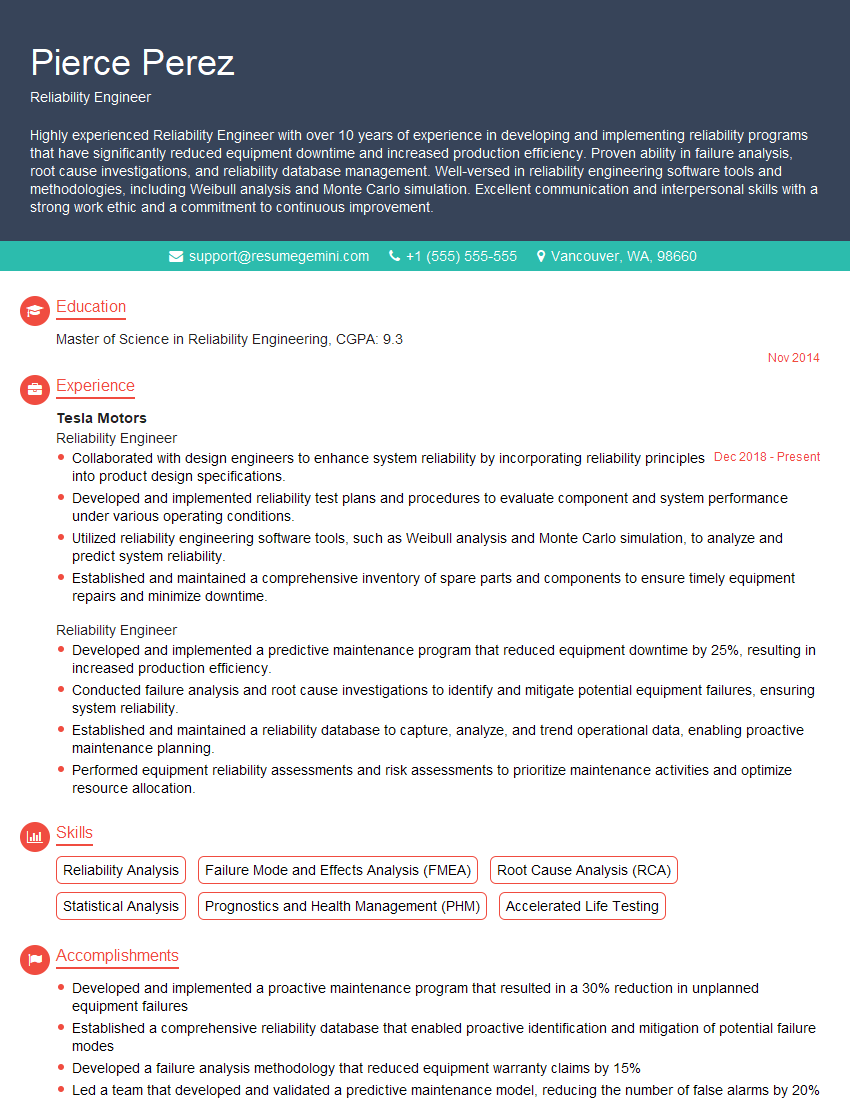
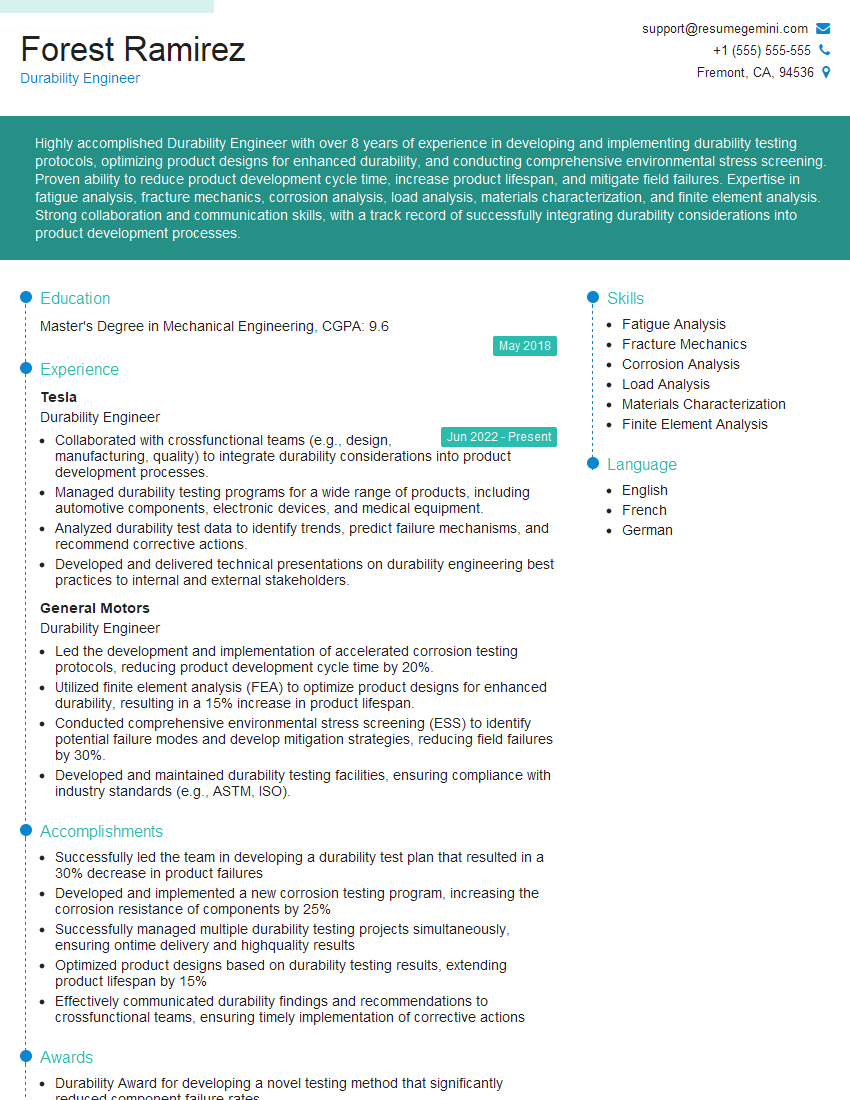
Mastering Durability Evaluation opens doors to exciting career opportunities in diverse and innovative fields. A strong understanding of these concepts is crucial for career advancement and securing high-impact roles. To significantly improve your job prospects, focus on creating an ATS-friendly resume that highlights your skills and experience effectively. We strongly recommend using ResumeGemini to craft a professional and compelling resume that showcases your expertise in Durability Evaluation. Examples of resumes tailored to this specific field are available to help guide you. Invest in your future – create a resume that makes a lasting impression.
Explore more articles
Users Rating of Our Blogs
Share Your Experience
We value your feedback! Please rate our content and share your thoughts (optional).
What Readers Say About Our Blog
Very informative content, great job.
good