Preparation is the key to success in any interview. In this post, we’ll explore crucial Weapon Fire Control Methods interview questions and equip you with strategies to craft impactful answers. Whether you’re a beginner or a pro, these tips will elevate your preparation.
Questions Asked in Weapon Fire Control Methods Interview
Q 1. Explain the principles of projectile motion and their impact on fire control.
Projectile motion is the curved path followed by an object launched into the air, influenced by gravity and air resistance. Understanding this is crucial for fire control because it dictates where a projectile will land given its initial velocity and launch angle. We must account for the parabolic trajectory to accurately hit a target.
For example, imagine throwing a baseball. The harder you throw (higher initial velocity), the farther it goes. The angle at which you throw it (launch angle) also affects the distance and the height of the arc. In fire control, we use sophisticated calculations, often incorporating ballistic equations, to predict this trajectory accurately. These equations factor in gravity’s constant downward pull, air density affecting drag, and the projectile’s ballistic coefficient (a measure of its aerodynamic efficiency). Ignoring these principles would result in significant misses.
Q 2. Describe the different types of fire control systems and their applications.
Fire control systems range from simple, manual aiming devices to highly complex, automated systems. They can be broadly categorized as follows:
- Direct Fire Systems: These systems rely on direct line-of-sight to the target. Think of aiming a rifle – you see the target and adjust your aim accordingly. Simple, but limited by range and visibility.
- Indirect Fire Systems: Used for longer-range weapons like artillery, mortars, or rockets. These systems require calculating the trajectory based on the target’s location relative to the weapon’s position, accounting for factors like terrain and atmospheric conditions. They often involve sophisticated computers and sensors.
- Automatic Fire Control Systems: These systems automate many aspects of the aiming and firing process, reducing human error. They typically use sensors like radar or laser rangefinders to track targets and automatically adjust the weapon’s aim and firing parameters. Modern fighter jets employ such systems.
The application depends on the weapon system’s characteristics and the nature of the engagement. A sniper might use a simple direct fire system, while a naval warship utilizes a complex, automated system incorporating radar and multiple sensors to track and engage multiple targets simultaneously.
Q 3. How do you account for environmental factors (wind, temperature, etc.) in fire control calculations?
Environmental factors significantly impact projectile trajectory. We use meteorological data and computational models to compensate for these influences. Wind, for instance, causes drift. A headwind will shorten the range, while a tailwind increases it. Temperature affects air density, impacting projectile drag. Higher temperatures typically reduce air density, resulting in a slightly longer range. Humidity also affects air density, though less significantly than temperature. Altitude affects air density and the force of gravity.
These factors are usually incorporated into fire control calculations using sophisticated ballistic models. Often these models are implemented within computer programs that take input from various sensors (e.g., weather stations, anemometers) to refine the aiming solution. A simple example is adjusting the aim point slightly to the left or right depending on the wind’s direction and speed. Accurate measurements are paramount for precision.
Q 4. What are the key components of a modern fire control system?
A modern fire control system comprises several key components, often integrated together:
- Sensors: These acquire information about the target (e.g., radar, laser rangefinders, electro-optical systems). Radar provides range, bearing, and sometimes velocity information.
- Computer: This processes sensor data, applies ballistic calculations to predict the projectile’s trajectory, and adjusts the weapon’s aim accordingly. This often incorporates advanced algorithms to account for complex environmental factors and target movement.
- Actuators: These physically adjust the weapon’s aim (e.g., motors driving the elevation and azimuth of a gun or the aiming of a missile).
- Display: Shows the operator information about the target, weapon status, and fire control solutions. This might be a simple sight or a sophisticated heads-up display in modern aircraft.
- Communication Systems: In networked systems, these facilitate data exchange between various components and other platforms.
The level of sophistication varies greatly depending on the system’s application and technological advancement. For instance, a modern tank’s fire control system will be far more complex than that of a simple handheld weapon.
Q 5. Explain the concept of lead angle and how it is calculated.
Lead angle is the angle by which a weapon must be aimed ahead of a moving target to compensate for the target’s movement during the projectile’s flight time. It’s crucial for accurately hitting moving targets, especially at longer ranges. Imagine throwing a ball to a dog running away. You don’t throw directly where the dog is; you throw ahead of it, anticipating its position when the ball arrives.
Calculating lead angle involves considering:
- Target speed and direction: This determines the rate at which the target is moving away.
- Projectile speed: The faster the projectile, the smaller the lead angle required.
- Range to target: The farther the target, the larger the lead angle needed.
The exact calculation is complex and often handled by the fire control system’s computer, involving trigonometric calculations to determine the necessary aiming offset. Simpler approximations can be used in some circumstances. Mistakes in lead angle calculations would lead to significant misses.
Q 6. Describe different types of aiming systems and their advantages and disadvantages.
Aiming systems vary greatly in complexity and technology:
- Iron sights: Simple, mechanical sights used on firearms. Advantages: rugged, reliable; Disadvantages: limited accuracy, especially at long ranges.
- Optical sights: Telescopic sights that magnify the target, improving accuracy. Advantages: improved accuracy and range; Disadvantages: can be more fragile.
- Laser rangefinders: Measure the distance to the target, improving accuracy. Advantages: Precise range measurement; Disadvantages: vulnerable to weather conditions and countermeasures.
- Computer-aided aiming systems: Found in advanced weapon systems; combine sensor data and ballistic calculations to provide precise aiming solutions. Advantages: highest accuracy, compensating for numerous environmental factors; Disadvantages: complex, expensive, can be susceptible to system failure.
The choice of aiming system depends on the weapon’s purpose and the precision needed. A simple iron sight might suffice for close-range defense, while an advanced computer-aided system is essential for long-range precision strikes.
Q 7. How does radar contribute to fire control accuracy?
Radar plays a critical role in fire control accuracy, primarily by providing accurate and timely information about the target. It offers range, bearing, and often target velocity (radial velocity).
In naval fire control, radar tracks the target’s position, continuously feeding updated coordinates to the fire control computer. This allows for compensation for target movement, ensuring the projectile impacts the target despite its maneuvers. It also assists in identifying targets amidst clutter and in low-visibility conditions. Modern radars can even provide information about target size and type, helping to select the appropriate weapon and ammunition.
For air-to-air combat, radar is essential. It allows fighter pilots to acquire and track enemy aircraft, providing the information necessary for the fire control system to compute the lead angle and fire guided missiles accurately. Without radar, engaging targets beyond visual range would be exceptionally difficult.
Q 8. What role does data fusion play in modern fire control systems?
Data fusion in modern fire control systems is crucial for achieving accurate and timely targeting. It’s the process of combining information from multiple sources – sensors, intelligence reports, and even predictive models – to create a more complete and reliable picture of the battlefield. Think of it like piecing together a puzzle: each sensor provides a piece of the picture, and data fusion assembles those pieces into a coherent, actionable intelligence.
For example, a fire control system might integrate radar data (range, bearing, speed), electro-optical imagery (target identification and classification), and GPS data (location) to pinpoint a moving target’s position with high accuracy. This integrated view is far superior to relying on any single sensor, which might be subject to noise, interference, or limited fields of view. Advanced algorithms are used to resolve inconsistencies and uncertainties between data sources, creating a robust and reliable target track.
Q 9. Explain the process of target acquisition and tracking.
Target acquisition and tracking is a two-stage process. Target acquisition involves initially detecting and identifying a potential target. This might involve searching a wide area using radar or electro-optical sensors. Once a potential threat is detected, its basic characteristics (like range, bearing, and speed) are determined. Imagine a searchlight sweeping across the night sky – that’s akin to target acquisition.
Target tracking, which follows target acquisition, involves continuously monitoring the target’s position and motion. Sophisticated algorithms predict the target’s future position, compensating for its movement and any sensor inaccuracies. This allows the fire control system to maintain a lock and provide accurate aiming solutions even with a moving target. Think of it as keeping that searchlight focused on the target as it moves across the night sky.
Accurate tracking requires robust algorithms that handle noisy sensor data and unexpected target maneuvers. Kalman filtering is a commonly used algorithm for this purpose, effectively predicting the target’s trajectory even in the presence of uncertainties.
Q 10. Describe different types of targeting algorithms and their strengths and weaknesses.
Numerous targeting algorithms exist, each with its own strengths and weaknesses. Some common examples include:
- Proportional Navigation (PN): This algorithm calculates the guidance command based on the line-of-sight rate between the missile and the target. It’s simple and effective but susceptible to target maneuvers.
- Augmented Proportional Navigation (APN): Improves on PN by incorporating acceleration information, leading to better performance against maneuvering targets. However, it increases computational complexity.
- Kalman Filtering: As mentioned earlier, this algorithm is widely used for target tracking and prediction. It’s robust to noise but computationally intensive, especially when tracking multiple targets.
- Nearest Neighbor Algorithm: A simple method for data association in tracking multiple targets, but it can suffer from errors when targets get close to each other.
The choice of algorithm depends heavily on factors such as the target’s maneuverability, the sensor capabilities, and the computational resources available. For example, a simple PN might suffice for a slow-moving target, whereas APN or a Kalman filter would be necessary for fast, agile targets.
Q 11. How do you ensure the reliability and maintainability of a fire control system?
Ensuring reliability and maintainability is paramount in fire control systems. This requires a multi-faceted approach:
- Redundancy: Critical components are often duplicated or triplicated to ensure continued operation even if one component fails. This could involve having backup processors, sensors, or communication links.
- Modular Design: The system is designed with interchangeable modules, making repairs and upgrades simpler. This minimizes downtime and facilitates easier maintenance.
- Built-in Test Equipment (BITE): Self-diagnostic capabilities allow the system to detect and report faults, facilitating quick troubleshooting and repair. Think of it as the system’s own internal doctor.
- Rigorous Testing: Extensive testing, including environmental testing and simulations, ensures the system’s reliability under various operating conditions.
- Regular Maintenance: Scheduled maintenance, including inspections, cleaning, and calibration, is crucial for extending the system’s lifespan and maintaining performance.
A well-designed fire control system prioritizes ease of maintenance, minimizing downtime and maximizing operational readiness.
Q 12. Explain the concept of system integration in the context of fire control.
System integration in fire control involves seamlessly merging different subsystems—sensors, processors, actuators, and communication networks—into a unified, cohesive system. It’s like orchestrating a symphony: each instrument (subsystem) plays its part, but the conductor (integration process) ensures they work together harmoniously to produce a beautiful whole (the fire control system). A poorly integrated system will likely suffer from performance issues, communication delays, and unreliable operation.
Effective system integration requires careful planning, standardized interfaces, and rigorous testing. Interface Control Documents (ICDs) define the communication protocols and data formats between different subsystems, preventing incompatibility problems. Simulation and hardware-in-the-loop testing are crucial for verifying that the integrated system functions correctly before deployment.
Q 13. Describe your experience with different types of sensors used in fire control systems.
My experience encompasses a wide range of sensors used in fire control, including:
- Radar: Provides range, bearing, and velocity information about targets. Different types exist, such as pulse-Doppler radar, which is particularly effective in cluttered environments.
- Electro-Optical (EO) sensors: Include infrared (IR) cameras and thermal imagers, offering visual identification of targets. These are essential for distinguishing friend from foe and for identifying specific target types.
- Laser Rangefinders: Provide precise range measurements, crucial for accurate targeting. They’re often integrated with EO sensors for a combined targeting system.
- GPS receivers: Provide location information for the platform carrying the fire control system, essential for calculating target position relative to the shooter.
The selection of sensors depends on the specific application, operational environment, and the required accuracy and range. Often, a combination of sensors is used to provide a more complete and reliable picture.
Q 14. How do you address the challenges of signal processing in fire control applications?
Signal processing in fire control presents significant challenges. Sensor data is often corrupted by noise, interference, and clutter, requiring sophisticated signal processing techniques to extract meaningful information.
Challenges include:
- Noise reduction: Filtering techniques, such as Kalman filtering and wavelet transforms, are used to remove unwanted noise from sensor signals.
- Clutter rejection: Algorithms are employed to distinguish real targets from background clutter, such as ground reflections or weather effects.
- Data association: Matching sensor data to the correct targets, particularly in dense environments with multiple targets, is a complex task requiring advanced data association algorithms.
- Real-time processing: Fire control systems often operate under strict real-time constraints, demanding efficient algorithms that can process large amounts of data quickly.
Addressing these challenges often involves using a combination of techniques tailored to the specific sensor type and operating environment. For instance, adaptive filtering can adjust to changing noise conditions, while advanced pattern recognition techniques can improve target detection and classification.
Q 15. What are the limitations of different fire control systems?
Fire control systems, while aiming for precision, face inherent limitations across various aspects. These limitations stem from both the system’s design and the unpredictable nature of the battlefield.
- Sensor Limitations: Radars, laser rangefinders, and other sensors have limited range, accuracy, and resolution. Environmental factors like fog, rain, or electronic countermeasures can significantly degrade sensor performance, leading to inaccurate target data. For example, a radar might struggle to differentiate between a genuine target and clutter in a dense urban environment.
- Environmental Factors: Wind, temperature, and the Earth’s rotation (Coriolis effect) all influence projectile trajectory. Precisely compensating for these effects, especially at long ranges, remains a challenge, introducing inherent errors in the fire control solution. Consider a long-range artillery shell; even slight variations in wind speed can significantly alter its trajectory.
- Weapon System Characteristics: Each weapon platform has its own unique characteristics, such as muzzle velocity variations, barrel wear, and projectile dispersion. These inconsistencies contribute to inaccuracies in hitting the target despite accurate aiming. For instance, the same ammunition fired from two different barrels of the same gun might have slightly different trajectories.
- Computational Limitations: Real-time calculations involved in fire control solutions, particularly those incorporating advanced algorithms for predicting target movement, are computationally intensive. Processing speed and memory constraints can lead to delays and approximations, affecting the accuracy of the firing solution. This is especially relevant in fast-paced situations requiring quick targeting decisions.
- Target Movement: Predicting the future position of a moving target is crucial but challenging. Sophisticated algorithms are used, but uncertainties in target trajectory, particularly with highly maneuverable targets, introduce errors in aiming. Anticipating the movement of a fast jet fighter, for example, necessitates highly accurate and rapid calculations.
Career Expert Tips:
- Ace those interviews! Prepare effectively by reviewing the Top 50 Most Common Interview Questions on ResumeGemini.
- Navigate your job search with confidence! Explore a wide range of Career Tips on ResumeGemini. Learn about common challenges and recommendations to overcome them.
- Craft the perfect resume! Master the Art of Resume Writing with ResumeGemini’s guide. Showcase your unique qualifications and achievements effectively.
- Don’t miss out on holiday savings! Build your dream resume with ResumeGemini’s ATS optimized templates.
Q 16. How do you handle malfunctions or failures in a fire control system?
Handling malfunctions or failures in a fire control system requires a multi-layered approach, emphasizing both immediate response and longer-term preventative measures.
- Built-in Redundancy: Modern systems incorporate redundant components and backup systems to ensure continued operation even with component failures. For instance, a dual-computer system with automatic switching ensures a seamless transition if one computer fails.
- Diagnostics and Fault Isolation: Sophisticated diagnostic tools are used to identify the source of malfunctions. This helps pinpoint the specific failing component or software bug. Real-time monitoring and alerts warn operators of impending problems.
- Fallback Procedures: In the event of a complete system failure, predetermined fallback procedures, often employing simpler aiming techniques, are essential to maintain operational capability. For example, transitioning to manual aiming with backup sights provides a less accurate but still functional alternative.
- Maintenance and Preventive Measures: Regular maintenance and preventative checks, including calibration and software updates, are crucial for minimizing failures and extending the lifespan of the system. This includes thorough testing and validation to prevent future problems.
- Operator Training: Well-trained operators are vital in handling unforeseen circumstances. Training incorporates troubleshooting scenarios, emphasizing quick reaction times and effective problem-solving techniques. This ensures operators can diagnose failures and implement appropriate responses quickly and efficiently.
Q 17. Describe your experience with fire control system testing and validation.
My experience in fire control system testing and validation encompasses various phases, from component-level testing to full-system integration and operational evaluations.
- Component-Level Testing: I’ve conducted rigorous testing of individual sensors, actuators, and processors, verifying their performance against specified requirements. This involved environmental testing to assess robustness under extreme conditions.
- Integration Testing: I’ve participated in integrating various components into a complete system, validating communication protocols and data flow. This is crucial to ensuring seamless interaction between the different parts of the system.
- System-Level Testing: I’ve overseen full-system testing in simulated and live-fire environments. This involved evaluating overall system performance, accuracy, and reliability.
- Validation against Requirements: Throughout testing, meticulous documentation and analysis were maintained to ensure that the system met specified performance parameters and adhered to regulatory standards. We used various metrics to objectively assess system accuracy and response times.
- Operational Evaluation: I’ve been involved in field testing to assess the system’s performance in realistic scenarios, providing crucial feedback for design improvements. This real-world validation highlighted potential areas needing further development or refinement.
One specific example involved testing a new predictive targeting algorithm. We employed high-fidelity simulations coupled with live-fire tests to validate its effectiveness against varying target maneuvers and environmental conditions. The results led to significant performance improvements, enhancing system accuracy under challenging circumstances.
Q 18. What are the safety considerations in the design and operation of fire control systems?
Safety is paramount in the design and operation of fire control systems. Several critical considerations must be addressed to minimize risks:
- Fail-Safe Mechanisms: Systems must be designed with fail-safe mechanisms to prevent accidental firing or unintended actions in case of system malfunctions. This includes implementing multiple layers of safety interlocks and emergency shutdown procedures. Think of a safety mechanism that prevents firing if the target is too close to friendly forces.
- Human-Machine Interface (HMI): The HMI must be intuitive and easy to use, reducing operator error. Clear displays, unambiguous controls, and appropriate feedback mechanisms help avoid mistakes. Well-designed interfaces minimize the chance of accidental activation.
- Software Safety: Rigorous software development practices are essential, incorporating techniques like coding standards, formal verification, and thorough testing to avoid software bugs that could lead to accidents. Proper software validation is key to preventing unintended commands.
- Physical Safety Measures: Protective measures should be in place to shield personnel from hazards, such as blast overpressure or projectile fragments. This can involve protective barriers, appropriate training on safe operating procedures, and emergency response plans.
- Environmental Considerations: System design should consider environmental impact, including potential risks related to ammunition handling, disposal, and electromagnetic interference. Safety protocols should consider both immediate and long-term effects.
Q 19. How do you stay current with advancements in fire control technology?
Staying current with advancements in fire control technology requires a multifaceted approach.
- Professional Development: Attending conferences, workshops, and seminars related to fire control systems, weapons technology, and sensor systems helps stay abreast of new developments and emerging trends. Networking with peers is invaluable.
- Literature Reviews: Regularly reading technical journals, research papers, and industry publications provides insights into the latest technologies, algorithms, and research findings. Keeping up with scholarly publications and technical reports is crucial.
- Industry Collaboration: Participating in industry groups, collaborations with leading companies and research institutions, and engaging in discussions and presentations fosters knowledge sharing and exposes me to cutting-edge innovations.
- Online Resources: Utilizing online platforms and resources for technical information and training, including webinars and online courses, enhances understanding of advancements and emerging technologies.
- Hands-on Experience: Working on projects incorporating new technologies, testing and evaluating novel fire control systems, and participating in real-world implementations keeps me connected to practical applications and technological advancements.
Q 20. Explain the impact of different ammunition types on fire control calculations.
Different ammunition types significantly impact fire control calculations due to variations in their ballistic properties.
- Ballistic Coefficients: Different projectiles have varying ballistic coefficients, affecting their trajectory response to environmental factors like wind and gravity. A higher ballistic coefficient means less trajectory deviation. The fire control system must adjust its calculations accordingly.
- Muzzle Velocity: The initial velocity of the projectile dramatically influences its range and trajectory. Variations in muzzle velocity between different ammunition types necessitate adjustments in fire control calculations to ensure accuracy.
- Aerodynamic Characteristics: The shape and design of the projectile influence its drag and stability, altering its flight path. This means fire control computations must account for differences in aerodynamic properties.
- Weight and Size: Mass and dimensions of the projectile affect its trajectory, particularly for longer ranges. Different ammunition types will have unique weight and size parameters that affect calculations.
- Explosive Fill: For explosive rounds, the type and amount of explosive filling may alter the projectile’s center of gravity and stability, thus needing adjustment of flight trajectory calculations. The effect of the charge on the overall projectile behavior must be taken into account.
For example, a high-explosive shell will behave differently compared to a tracer round due to differences in weight and aerodynamic drag. The fire control system must account for these differences to accurately predict projectile trajectory.
Q 21. Describe your experience with modeling and simulation of fire control systems.
My experience with modeling and simulation of fire control systems spans various levels of fidelity, from simplified models to highly detailed simulations.
- High-Fidelity Simulations: I’ve utilized high-fidelity simulations to test and evaluate complex scenarios, involving detailed representations of weapon systems, sensors, and target behavior. These simulations incorporated realistic environmental conditions and target maneuvers.
- Six-Degrees-of-Freedom (6DOF) Simulations: I’ve extensively used 6DOF simulations to model projectile flight dynamics, accounting for all forces acting on the projectile. This allows for highly accurate predictions of trajectory under various conditions.
- Software-in-the-Loop (SIL) Simulations: SIL simulations involve integrating fire control software with simulated hardware, enabling early detection of software bugs and performance issues. This helps in refining the software and improving system robustness.
- Hardware-in-the-Loop (HIL) Simulations: HIL simulations involve connecting the fire control system to a real-world hardware representation, such as a simplified gun mount. This allows testing under more realistic conditions and provides valuable feedback on system performance.
- Monte Carlo Simulations: I’ve used Monte Carlo simulations to assess the impact of uncertainties in input parameters (like sensor noise and environmental conditions) on overall system accuracy and reliability. This provides a statistical understanding of potential system errors.
In a recent project, we used high-fidelity 6DOF simulations coupled with Monte Carlo analysis to optimize the performance of a new fire control algorithm. This approach improved the system’s accuracy by reducing the sensitivity to environmental uncertainties and sensor errors.
Q 22. How do you handle data uncertainty and noise in fire control applications?
Data uncertainty and noise are inherent challenges in fire control applications. Sensors, whether radar, lidar, or infrared, are subject to inaccuracies due to environmental factors (weather, terrain), sensor limitations, and electronic noise. We address this using several techniques:
- Filtering: Kalman filters and other advanced filtering algorithms are employed to smooth out noisy sensor data, estimating the true values by considering past measurements and predicted dynamics. Imagine it like averaging out the jitters in a shaky video recording to reveal a clearer picture.
- Data Fusion: Combining data from multiple sensors (e.g., radar and optical) improves accuracy by mitigating individual sensor errors. Each sensor’s data provides a unique perspective, and combining them intelligently reduces uncertainty. Think of it as triangulation – the more points of reference you have, the more precise your location estimate.
- Robust Statistics: Methods like least median of squares regression are used to reduce the impact of outliers (extreme data points caused by glitches or errors). These statistical methods are designed to be less sensitive to anomalous data than traditional techniques. This ensures that a single faulty measurement doesn’t derail the entire calculation.
- Uncertainty Quantification: Instead of trying to eliminate uncertainty entirely, we incorporate it into our calculations. This means that the fire control system not only predicts the target’s location but also provides a measure of how confident it is in that prediction. This allows for adaptive strategies, such as adjusting the weapon’s aim based on the level of uncertainty.
In practice, the choice of method depends on the specific application and the characteristics of the sensors involved. A sophisticated fire control system will use a combination of these techniques to maximize accuracy while maintaining real-time performance.
Q 23. What is your experience with real-time computing in fire control systems?
Real-time computing is absolutely critical for fire control systems. The system needs to process sensor data, calculate firing solutions, and command the weapon, all within extremely tight time constraints. My experience includes working with:
- Embedded Systems: I’ve worked extensively with embedded processors and real-time operating systems (RTOS) like VxWorks and FreeRTOS to ensure deterministic and predictable system behavior. This is crucial to guarantee that the system always meets its deadlines.
- Parallel Processing: Modern fire control systems often leverage parallel processing techniques to distribute the computational load across multiple processors or cores. This allows for faster processing of large amounts of data, enabling quicker targeting and reaction times.
- Hardware Acceleration: Using specialized hardware like FPGAs (Field-Programmable Gate Arrays) to accelerate computationally intensive tasks, such as signal processing and trigonometric calculations, is a common practice. This significantly improves performance compared to solely relying on software.
- Data Structures and Algorithms: Efficient data structures and algorithms are essential for real-time performance. Proper use of techniques like optimized search and sorting methods can make the difference between hitting or missing a target.
For instance, during one project, we optimized the Kalman filter implementation by utilizing vectorized operations and parallel processing, resulting in a 30% reduction in processing time.
Q 24. How do you balance accuracy and speed in fire control system design?
Balancing accuracy and speed is a constant trade-off in fire control system design. Higher accuracy typically demands more complex calculations and data processing, which can reduce speed. This delicate balance is achieved through:
- Algorithmic Optimization: We employ advanced algorithms to achieve optimal solutions within tight time constraints. This may involve approximations or simplifying assumptions where appropriate without significantly compromising accuracy.
- Hardware Selection: Choosing appropriately powerful processors and specialized hardware (e.g., FPGAs) enables higher accuracy and speed simultaneously. More powerful hardware means we can perform more complex calculations without sacrificing speed.
- Model Simplification: We often use simplified models of projectile ballistics and target motion. These models provide a reasonable level of accuracy without incurring the high computational costs of extremely detailed models. This is similar to using a simpler equation for projectile motion in introductory physics versus the complex, real-world equations that account for every subtle factor.
- Adaptive Strategies: The system can dynamically adjust its level of accuracy depending on the situation. In a rapidly evolving scenario, speed might be prioritized over extremely high accuracy.
It’s often the case that a slightly less accurate but significantly faster system is preferable to a highly accurate but sluggish one. The optimal balance will depend on the specific weapon system and its intended use.
Q 25. Describe your experience with different types of weapon platforms and their fire control requirements.
My experience spans various weapon platforms, each with unique fire control requirements:
- Naval Gun Systems: These systems often involve large-caliber guns with long ranges, requiring precise prediction of projectile trajectory and target motion considering factors like wind, Coriolis effect, and sea state.
- Air-to-Air Missiles: These systems operate at high speeds and require highly responsive fire control, capable of tracking maneuvering targets with exceptional accuracy. High-G maneuvers and rapidly changing range demands sophisticated algorithms.
- Tank Gunnery Systems: These systems need to function effectively in complex terrain, accounting for factors like ground slope, projectile drop, and target movement. Real-time integration of terrain data and targeting information is crucial.
- Man-Portable Air Defense Systems (MANPADS): These systems often prioritize ease of use and speed of engagement, frequently employing simplified fire control algorithms that are less computationally expensive but still sufficiently accurate.
Each platform demands different levels of complexity, real-time performance, and accuracy. Understanding these nuances is vital in designing effective and robust fire control systems.
Q 26. What are the ethical considerations related to weapon fire control systems?
The ethical considerations surrounding weapon fire control systems are profound. They involve:
- Autonomous Weapons Systems (AWS): The development of fully autonomous weapons raises significant ethical questions about accountability, potential for unintended harm, and the risk of escalation. Who is responsible if an autonomous weapon makes an incorrect decision resulting in civilian casualties?
- Bias and Discrimination: Fire control algorithms trained on biased datasets might exhibit discriminatory behavior, disproportionately affecting certain populations. Careful consideration must be given to data selection and algorithm design to mitigate this risk.
- Human Control and Oversight: Maintaining appropriate levels of human oversight and control is paramount. Fully autonomous systems should be avoided unless their benefits demonstrably outweigh the ethical risks.
- Transparency and Explainability: The decision-making processes of fire control systems should be transparent and explainable to ensure accountability and prevent misuse.
These ethical challenges require careful consideration throughout the entire design and deployment lifecycle of weapon fire control systems. Robust ethical frameworks, rigorous testing, and ongoing monitoring are essential to mitigate risks.
Q 27. Explain the concept of predictive fire control and its advantages.
Predictive fire control anticipates the future position of a target, rather than simply aiming at its current location. This is particularly crucial for maneuvering targets or projectiles with significant time-of-flight. It works by:
- Target Tracking: The system continuously tracks the target’s position and velocity. Advanced algorithms like Kalman filters estimate the target’s future trajectory.
- Prediction Algorithms: Sophisticated algorithms use the estimated target trajectory to predict its future position at the time the projectile will arrive. These calculations account for target acceleration and maneuvers.
- Projectile Dynamics: The fire control system accurately calculates the projectile’s flight path, including the effects of gravity, wind, and other environmental factors.
The advantages of predictive fire control include:
- Increased Hit Probability: By aiming at the target’s predicted future position, the hit probability is significantly improved, especially against maneuvering targets. Think of leading a moving target like throwing a ball to someone running.
- Reduced Reaction Time: The system can initiate firing sooner, since it doesn’t need to wait for the target to reach a specific point.
- Improved Engagement Range: The ability to accurately predict the target’s future position allows for effective engagement at longer ranges.
Predictive fire control is essential for modern weapon systems, dramatically increasing their effectiveness against agile and evasive targets.
Q 28. Describe your understanding of the impact of autonomous systems on fire control.
Autonomous systems are fundamentally changing fire control. Increased reliance on autonomous systems presents both opportunities and challenges:
- Increased Speed and Efficiency: Autonomous systems can process information and make targeting decisions far faster than humans, resulting in quicker reaction times and improved combat effectiveness.
- Reduced Human Risk: Autonomous systems can take on high-risk tasks, reducing the potential for human casualties.
- Improved Situational Awareness: Autonomous systems can integrate data from multiple sources to provide a comprehensive situational awareness picture far exceeding human capability.
- Ethical Concerns and Reliability: The ethical concerns outlined earlier remain paramount. Furthermore, the reliability and robustness of autonomous systems must be rigorously verified to avoid unintended consequences.
- Cybersecurity Risks: Autonomous systems are vulnerable to cyberattacks, potentially disrupting their operation or even commandeering them for malicious purposes. This necessitates robust cybersecurity measures.
The increasing integration of autonomous capabilities requires careful consideration of these tradeoffs. A human-in-the-loop approach, retaining human control and oversight, is essential to balance the benefits of autonomous systems with the inherent risks and ethical considerations.
Key Topics to Learn for Weapon Fire Control Methods Interview
- Fundamentals of Fire Control Systems: Understanding the basic components and their interactions within a fire control system, including sensors, computers, actuators, and weapons.
- Targeting and Tracking Algorithms: Explore various algorithms used for target acquisition, tracking, and prediction, and their limitations under different conditions.
- Ballistics and Weapon Dynamics: Grasp the principles of projectile motion, factors affecting accuracy (e.g., wind, gravity, spin), and weapon system characteristics impacting trajectory.
- Error Compensation and Correction: Examine methods for compensating for errors introduced by various factors, including sensor noise, environmental conditions, and weapon imperfections.
- System Integration and Testing: Understand the process of integrating various components of the fire control system and methods for validating its performance through simulations and testing.
- Human-Machine Interface (HMI): Analyze the design and functionality of the HMI for effective operator interaction and control of the fire control system.
- Advanced Fire Control Concepts: Explore advanced concepts such as autonomous targeting, predictive firing solutions, and countermeasures against enemy fire control systems. This demonstrates a deeper understanding and proactive approach.
- Practical Application: Be prepared to discuss real-world scenarios and problem-solving approaches related to the operation, maintenance, and troubleshooting of fire control systems. Consider discussing case studies or simulations you’ve encountered.
Next Steps
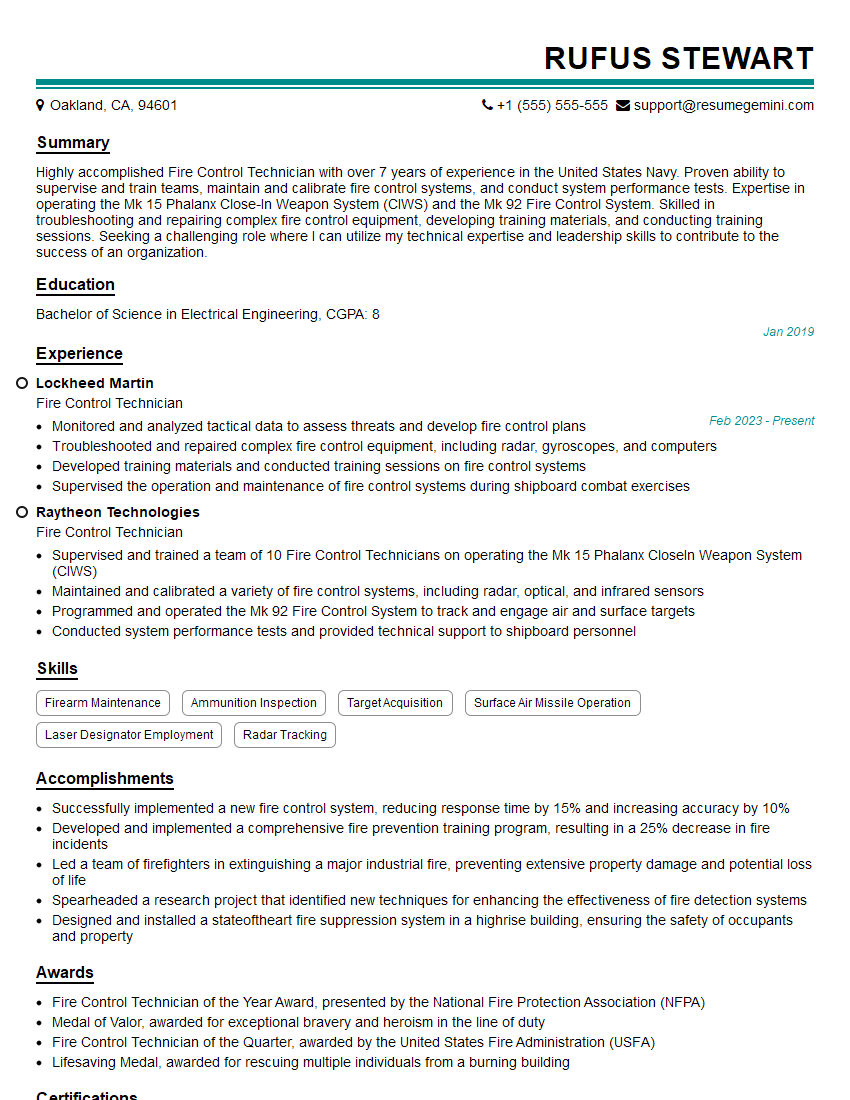
Mastering Weapon Fire Control Methods opens doors to exciting and impactful careers in defense technology, offering opportunities for continuous learning and innovation. A strong understanding of these methods is crucial for success in this field, making you a highly competitive candidate. To maximize your job prospects, it’s essential to present your skills and experience effectively. Creating an ATS-friendly resume is key to ensuring your application gets noticed by recruiters. We highly recommend leveraging ResumeGemini, a trusted resource, to build a professional and impactful resume tailored to highlight your expertise. ResumeGemini provides examples of resumes specifically designed for professionals in Weapon Fire Control Methods to help guide you in crafting your own compelling application materials.

Explore more articles
Users Rating of Our Blogs
Share Your Experience
We value your feedback! Please rate our content and share your thoughts (optional).
What Readers Say About Our Blog
Very informative content, great job.
good