Cracking a skill-specific interview, like one for Expertise in Open Source Intelligence, requires understanding the nuances of the role. In this blog, we present the questions you’re most likely to encounter, along with insights into how to answer them effectively. Let’s ensure you’re ready to make a strong impression.
Questions Asked in Expertise in Open Source Intelligence Interview
Q 1. Explain the difference between OSINT and HUMINT.
OSINT (Open-Source Intelligence) and HUMINT (Human Intelligence) are both crucial intelligence gathering methods, but they differ significantly in their sources and techniques. OSINT relies exclusively on publicly available information, whereas HUMINT involves direct interaction with human sources.
Think of it like this: OSINT is like piecing together a puzzle using only the pieces you find openly on the table, while HUMINT is like interviewing the puzzle’s creator to learn about the image.
- OSINT Sources: Public websites, social media, news articles, government documents, academic publications, and open-source databases.
- HUMINT Sources: Confidential informants, spies, interviews with witnesses or suspects.
In essence, OSINT is passive intelligence gathering, while HUMINT is active and often requires building relationships and managing sources. OSINT is often used for initial investigations or background checks, while HUMINT is typically employed when deeper insights or confidential information are required.
Q 2. What are the ethical considerations of using OSINT?
Ethical OSINT practices are paramount. The key is respecting privacy and adhering to the law. This includes:
- Respecting privacy: Avoid collecting or using personal information without consent, unless legally permitted (e.g., for investigative journalism or law enforcement).
- Avoiding illegal activities: OSINT should never be used to facilitate illegal activities, such as hacking, doxing, or harassment.
- Attribution and transparency: If using OSINT for public reporting or analysis, provide proper attribution to the sources used and be transparent about your methodology.
- Terms of Service compliance: Always adhere to the terms of service of the platforms you are accessing. Scraping data without permission is unethical and potentially illegal.
- Data minimization: Only collect the information necessary for the investigation and dispose of it securely once it’s no longer needed.
Ethical considerations are not just about legality but also about maintaining the integrity of the profession and public trust. Always be aware of the potential impact of your actions.
Q 3. Describe your experience with various OSINT tools and techniques.
My OSINT toolkit is quite extensive, and my approach is always tailored to the specific intelligence need. I’m proficient in using a wide range of tools and techniques including:
- Search Engines (Google, Bing, DuckDuckGo): Advanced search operators (
site:,intitle:,filetype:) are essential for targeted searches. - Social Media Intelligence (SMINT): I’m experienced with analyzing data from platforms like Twitter, Facebook, LinkedIn, Instagram, and Reddit. This involves identifying key individuals, tracking conversations, and analyzing sentiment.
- Data aggregation and analysis: I use tools to aggregate and analyze data from multiple sources, including Maltego, Gephi, and various open-source intelligence platforms.
- Archive Search Engines (The Wayback Machine): These enable accessing previous versions of web pages to understand how information has changed over time.
- Specific OSINT platforms: I’m familiar with various open-source intelligence platforms, each tailored to different tasks.
- Data mining and visualization: Data is often messy. I’m skilled in cleaning and structuring it for better analysis and visualization using tools like R or Python libraries.
My experience spans diverse areas, from verifying the credibility of online accounts to investigating cyber threats and performing due diligence on companies and individuals.
Q 4. How do you verify the accuracy of information found through OSINT?
Verifying OSINT accuracy is crucial. It’s like verifying information you’ve read in a magazine—you wouldn’t take it as fact without further corroboration. My verification process typically involves:
- Triangulation: Seeking confirmation from at least three independent sources. If the same information is repeated across different, reliable sources, the likelihood of accuracy increases.
- Source evaluation: Assessing the credibility of the source itself—Is it a reputable news outlet? A government agency? An individual with a known bias?
- Reverse image search: Using tools like Google Images to find the original source of an image and verify its context.
- Fact-checking websites: Utilizing dedicated fact-checking organizations to verify the truthfulness of specific claims.
- Cross-referencing with other datasets: Comparing information found with data from other databases or repositories to look for inconsistencies or additional details.
Remember, not all information found online is accurate. Critical thinking and a methodical verification process are essential.
Q 5. How do you prioritize information gathered from multiple OSINT sources?
Prioritizing OSINT information involves considering several factors, much like a detective prioritizes leads. My framework considers:
- Relevance: How directly does the information relate to the investigation’s objectives?
- Reliability: How trustworthy is the source of the information? High-reliability sources get precedence.
- Timeliness: How recent is the information? Recent data is usually more relevant.
- Completeness: Does the information provide a complete picture, or are there significant gaps?
- Actionability: Can the information be used to take further action or confirm other leads?
I typically use a matrix or a simple scoring system to weigh these factors and rank the information accordingly. The most relevant, reliable, timely, complete, and actionable information gets prioritized.
Q 6. Explain your experience with social media intelligence gathering.
Social media intelligence (SMINT) is a critical part of my OSINT work. It involves extracting valuable information from social media platforms. My experience includes:
- Profile analysis: Examining user profiles to understand their background, interests, and connections.
- Network mapping: Visualizing relationships between individuals and groups to identify influential figures or hidden connections.
- Sentiment analysis: Determining the overall sentiment expressed towards a particular topic or entity.
- Content analysis: Examining posts, comments, and other content to identify patterns, trends, or insights.
- Monitoring social media trends: Tracking trending topics and hashtags to identify emerging issues or potential threats.
I employ a range of tools and techniques to efficiently collect and analyze social media data, ensuring compliance with platform policies and respecting user privacy.
Q 7. Describe a time you used OSINT to solve a problem.
I once used OSINT to help a journalist verify information about a controversial company. They had received allegations of unethical practices but lacked concrete evidence. I began by searching for the company’s online presence, examining press releases, and reviewing financial reports. I then used advanced search operators to uncover archived news articles and blog posts, revealing past instances of questionable behaviour. Next, I analyzed social media activity surrounding the company, identifying employee comments and customer complaints. I cross-referenced this information with publicly available legal documents. Finally, I compiled my findings into a comprehensive report, providing the journalist with verifiable evidence supporting the allegations.
This case highlighted the importance of a systematic approach to OSINT, combining data from different sources to build a cohesive narrative and achieve investigative goals.
Q 8. How do you handle conflicting information from different OSINT sources?
Conflicting information is a common hurdle in OSINT. Think of it like piecing together a puzzle with some broken or mismatched pieces. My approach involves a multi-stage verification process. First, I critically evaluate the source itself: Is it a reputable news outlet, a personal blog, a forum known for misinformation? The source’s reputation significantly impacts the weight I give its information. Second, I cross-reference the data. If multiple trustworthy sources corroborate a piece of information, its credibility increases dramatically. If only one source mentions something, I treat it with much greater skepticism and seek additional confirmation. Third, I analyze the information’s context. Is it consistent with other known facts? Does it make logical sense within the broader narrative? If there are inconsistencies, I try to find explanations, perhaps identifying biases or limitations in the original reporting. Finally, I document everything. I meticulously record my sources and my reasoning, creating a transparent audit trail of my analysis. This allows me to retrace my steps, understand my conclusions, and readily address any questions about my findings.
For example, if one source claims a specific individual was at a certain location, I’d cross-reference that with social media posts, news articles, and potentially even publicly available geolocation data. Discrepancies require further investigation to determine the most likely scenario.
Q 9. What are some common challenges in using OSINT, and how do you overcome them?
OSINT presents several challenges. One major hurdle is the sheer volume of data. The internet is vast, and sifting through irrelevant information to find the nuggets of useful intelligence is time-consuming and requires strategic search techniques. Another challenge is the inherent bias and misinformation found online. Sources can be unreliable, deliberately deceptive, or simply inaccurate. Verifying information is crucial and often complex. Additionally, the dynamic nature of the internet means that data can change or disappear quickly. Information that is available today might be gone tomorrow. Finally, legal and ethical considerations must always be paramount. Respecting privacy, avoiding illegal activities, and adhering to terms of service are essential.
To overcome these challenges, I rely on a structured approach. I define clear objectives at the outset to focus my search. I use specialized tools and techniques to streamline data collection and analysis. I prioritize reliable sources and employ rigorous verification methods. I also practice effective time management, understanding that OSINT investigations can be lengthy and require focused effort. Regularly reviewing and updating my search strategies helps to address the constantly evolving nature of online data.
Q 10. Describe your experience with data analysis and visualization from OSINT data.
My experience with OSINT data analysis and visualization is extensive. I regularly use various tools to process and present my findings effectively. I’m proficient in using programming languages like Python with libraries such as Pandas and NetworkX to analyze large datasets, identify patterns, and extract meaningful insights. This allows me to handle data from diverse sources efficiently and quantitatively. For visualization, I utilize tools such as Tableau and Gephi to create charts, graphs, and networks that illustrate relationships and trends within the collected data. For example, I might use a network graph to show connections between individuals in a suspected criminal organization, revealing key players and their interactions.
In one project, I used Python to analyze thousands of social media posts related to a specific event. By identifying key terms and analyzing sentiment, I created a visual representation of public opinion over time. This visualization was critical in providing a comprehensive overview of the public’s perception and its evolution. My reports often include detailed visualizations to make complex data easily understandable for a non-technical audience.
Q 11. How familiar are you with different data formats used in OSINT (e.g., JSON, XML, CSV)?
I am very familiar with various data formats commonly used in OSINT, including JSON, XML, and CSV. Each format has its strengths and weaknesses, and selecting the right format depends on the context. JSON (JavaScript Object Notation) is lightweight and easy to parse, making it suitable for structured data like social media API responses. XML (Extensible Markup Language) is also commonly used, offering hierarchical data representation and flexibility. CSV (Comma Separated Values) is simpler, ideal for tabular data and easy to import into spreadsheets or databases. My experience includes using command-line tools and scripting languages like Python to process and convert data between these formats as needed.
For example, if I’m scraping data from a website that returns JSON, I use Python libraries like requests and json to extract the relevant information. If I have data in CSV format, I can efficiently analyze it using Pandas. This flexibility allows me to adapt to a wide range of data sources and formats effectively.
Q 12. How do you protect your online anonymity while conducting OSINT investigations?
Protecting online anonymity during OSINT investigations is crucial. It’s a layered approach, and it begins before I even start my investigation. I use a Virtual Private Network (VPN) to mask my IP address, preventing my location and internet activity from being directly traced back to me. I avoid logging into accounts or using services associated with my real identity. Instead, I use dedicated, anonymous accounts for research purposes. I pay close attention to the metadata associated with my online activities, such as location information embedded in images or timestamps in emails. I carefully review my privacy settings across various online platforms. I am also mindful of the information I share online, ensuring not to inadvertently reveal personal details that could compromise my anonymity.
Think of it like wearing a disguise when conducting field research – you wouldn’t go into a sensitive environment wearing your usual clothes and carrying your identification. Online, this means using the tools and techniques to protect your digital identity.
Q 13. Explain your understanding of different types of OSINT data sources (e.g., forums, social media, blogs).
OSINT data sources are incredibly diverse. Social media platforms like Twitter, Facebook, and LinkedIn provide vast amounts of publicly available information about individuals, organizations, and events. Forums and online communities often contain discussions and information not found elsewhere. Blogs and news articles can offer valuable context and insights. Government websites, official records, and company websites provide structured, official data. Open-source databases and repositories offer everything from geographical information to satellite imagery. Even seemingly innocuous sources like website WHOIS records or historical archives can reveal critical pieces of information.
My approach involves leveraging all these different data sources in a complementary manner. For instance, I might start with a social media search to find initial leads, then delve into forums to find more detailed discussions or specialized knowledge. I then consult official sources to verify information before constructing a coherent narrative.
Q 14. How do you assess the credibility of an online source?
Assessing the credibility of an online source is fundamental. It’s not enough to simply read something; I need to critically evaluate its validity. I consider several factors. First, the source’s reputation matters: Is it a well-known and respected news organization, a government agency, or an anonymous blog with a history of misinformation? Second, I check for author expertise and potential biases. Is the author qualified to comment on the topic, or do they have a clear vested interest that might influence their perspective? Third, I look for evidence of fact-checking and source verification. Does the source provide evidence to support its claims, or is it relying on unsubstantiated assertions? Fourth, I cross-reference the information with other sources. Does the information align with what I already know or what other trustworthy sources are reporting? Finally, I consider the date of publication, as information can become outdated or irrelevant over time.
Think of it like evaluating a witness in a courtroom: you wouldn’t blindly accept their testimony without considering their reliability, potential biases, and whether their story is consistent with other evidence. The same rigorous scrutiny applies to online sources.
Q 15. Describe your experience with using search engines effectively for OSINT.
Effective OSINT search engine usage goes beyond simply typing keywords. It’s about strategically crafting queries, understanding search engine algorithms, and leveraging advanced search operators. I utilize a multi-stage approach. First, I identify core keywords related to my investigation. Then, I refine these keywords using Boolean operators (AND, OR, NOT) to narrow or broaden my search. For example, searching for "John Doe" AND "London" AND "finance" will yield results containing all three terms, providing much more precise results than a simple keyword search. Next, I explore advanced search operators specific to each engine, such as Google’s site: operator to limit searches to a particular website or filetype:pdf to find specific document types. Finally, I meticulously review the results, prioritizing credibility and relevance, and often cross-referencing information found across multiple search engines to validate findings. I also use the ‘related searches’ suggestions provided by search engines to discover new avenues of inquiry that I might have otherwise missed.
For instance, during an investigation involving a suspected fraudulent online business, I started with basic keywords like the company name and its alleged location. By progressively refining the search using Boolean operators and site operators, I managed to locate archived versions of their website showcasing altered content over time, alongside forum posts and news articles confirming my suspicions.
Career Expert Tips:
- Ace those interviews! Prepare effectively by reviewing the Top 50 Most Common Interview Questions on ResumeGemini.
- Navigate your job search with confidence! Explore a wide range of Career Tips on ResumeGemini. Learn about common challenges and recommendations to overcome them.
- Craft the perfect resume! Master the Art of Resume Writing with ResumeGemini’s guide. Showcase your unique qualifications and achievements effectively.
- Don’t miss out on holiday savings! Build your dream resume with ResumeGemini’s ATS optimized templates.
Q 16. How do you maintain situational awareness during an OSINT investigation?
Maintaining situational awareness in OSINT is crucial for effective and efficient investigations. It involves constantly monitoring the evolving information landscape and adapting my strategies accordingly. This includes setting up alerts for keywords related to the investigation using tools like Google Alerts. Regularly reviewing news articles, social media posts, and relevant online forums is also important. Additionally, I actively track the sources I utilize, meticulously documenting their credibility and potential biases. A crucial element is recognizing the dynamic nature of online information; what’s available today might be gone tomorrow, so timely data collection and preservation are paramount. This involves utilizing techniques like web archiving to save crucial web pages or social media posts. Ultimately, maintaining situational awareness is a continuous process, not a one-time event.
During an investigation into a cyberattack, I set up Google Alerts for keywords related to the victim company and the suspected attacker group. This allowed me to receive immediate notifications of new online information, enabling me to swiftly update my analysis and incorporate fresh data.
Q 17. What are some advanced OSINT techniques you’re familiar with?
Beyond basic search engine techniques, I employ several advanced OSINT methods. These include using specialized search engines like Shodan (for internet-connected devices) and Maltego (for network analysis and data visualization). I utilize network analysis tools to map relationships between individuals, organizations, and events, and I’m proficient in image analysis techniques, using reverse image search to identify the origin and context of images. Furthermore, I utilize passive DNS monitoring tools to track domain registration and changes, which can uncover hidden infrastructure or malicious activities. I’m also adept at using data mining techniques and regular expressions to extract meaningful information from large datasets such as logs and databases.
For example, using Shodan, I once identified an organization’s unsecured server, revealing sensitive internal information due to misconfiguration. This discovery helped a security team mitigate risks promptly.
Q 18. How do you document your OSINT findings?
Meticulous documentation is the cornerstone of any credible OSINT investigation. I maintain detailed records using a structured approach. This usually involves a combination of methods such as maintaining a comprehensive spreadsheet detailing sources, findings, timestamps, and analysis. I often create visual representations like timelines or relationship diagrams to summarize complex data. Screenshots and web archives are used to preserve transient online information. All my findings are carefully cross-referenced and linked back to their original sources to ensure transparency and reproducibility. The format of documentation adapts to the specific investigation, but the focus remains on clarity, completeness, and accessibility.
In one case, I used a dedicated case management software to document the discovery of a suspect’s online persona, linking various accounts across multiple social media platforms and forums. This meticulously documented trail of evidence was pivotal in the subsequent investigation.
Q 19. How do you handle large datasets during OSINT investigations?
Handling large datasets requires a strategic approach. I often utilize data analysis tools and techniques to manage and analyze large amounts of information. This might involve using programming languages like Python with libraries like Pandas and NumPy to clean, filter, and analyze datasets. Regular expressions are frequently used to extract specific information from unstructured text. I focus on filtering and cleaning data to eliminate noise and focus on the most relevant information. Data visualization tools are helpful to identify patterns and trends within the data. The choice of tools depends on the specific dataset and the investigation’s goals.
For example, during an investigation involving a large database of financial transactions, I used Python to identify unusual patterns and outliers that indicated potential fraudulent activities.
Q 20. Describe your experience with mapping and geospatial analysis in OSINT.
Mapping and geospatial analysis are powerful tools in OSINT. I use tools like Google Earth, QGIS, and other GIS software to visualize locations, track movements, and identify patterns based on geographical data. I can integrate data from various sources, such as social media posts with location tags, news reports, and satellite imagery, to create a comprehensive geographical context for my investigations. This allows for the identification of potential connections, timelines of events, and the reconstruction of scenarios based on location information. The visualization of data geographically often reveals patterns or relationships not immediately apparent in tabular data.
In a missing person case, I used Google Earth and social media geolocation data to map the individual’s movements in the days leading up to their disappearance, helping law enforcement narrow their search area.
Q 21. Explain your understanding of legal and regulatory compliance in OSINT.
Legal and regulatory compliance are paramount in OSINT. I adhere strictly to all relevant laws and regulations, including data privacy laws like GDPR and CCPA. I never access or collect information that I’m not authorized to access. I understand the difference between open-source and publicly available information versus private or protected data. Before starting an investigation, I always clarify the scope of permissible activities and any restrictions based on the legal framework and client instructions. Maintaining a detailed audit trail of my actions is crucial to demonstrate compliance. Any questionable information discovered is carefully evaluated, and if access or use seems questionable, I will consult with legal counsel.
For instance, I always verify if obtained information falls within the scope of ‘publicly available’ information before utilization and I meticulously document all sources to ensure transparency and accountability.
Q 22. How familiar are you with specific OSINT tools such as Maltego, SpiderFoot, or Shodan?
My familiarity with OSINT tools like Maltego, SpiderFoot, and Shodan is extensive. I’ve used each extensively in various investigations. Maltego, for instance, excels at visualizing relationships between entities – people, companies, websites – by leveraging its transformation capabilities to pull data from diverse sources. I’ve used it to map out complex networks of individuals involved in a potential fraud case, revealing previously hidden connections. SpiderFoot is another favorite; its automated nature makes it ideal for large-scale reconnaissance. Its ability to perform targeted searches across multiple data sources quickly provides a comprehensive overview of a target. I’ve employed it to build detailed profiles of competitors for competitive intelligence. Finally, Shodan – the search engine for internet-connected devices – is invaluable for identifying vulnerabilities in organizations’ infrastructure. I’ve used it to locate exposed databases or servers, offering crucial insights into potential security weaknesses. My proficiency extends beyond simply using these tools; I understand their underlying methodologies and limitations, which is crucial for interpreting results accurately.
Q 23. How do you contribute to a team environment during an OSINT investigation?
In a team setting, I believe strong communication and collaboration are paramount. I actively participate in brainstorming sessions, contributing my OSINT expertise to define the scope of the investigation and identify potential data sources. I excel at clearly communicating my findings, both verbally and through well-documented reports. I’m adept at breaking down complex information into digestible parts for colleagues with varying technical skills. For example, during a recent investigation involving a cybercrime ring, I was responsible for gathering OSINT data. I collaborated with our digital forensics team to correlate my findings with their technical analysis, significantly speeding up the investigation. Furthermore, I’m always willing to mentor junior team members and share my knowledge to foster growth within the team.
Q 24. Describe your experience with using OSINT for competitive intelligence gathering.
I have extensive experience leveraging OSINT for competitive intelligence. This typically involves identifying and analyzing publicly available information about competitors, such as their marketing strategies, financial performance, and technological capabilities. For example, I used OSINT to research a competitor’s new product launch. By analyzing their social media presence, press releases, and patents, I was able to assess their market positioning, target audience, and potential market share. This information was then used to inform our own product development strategy. I also regularly use OSINT to monitor competitors’ activities, identify potential threats, and uncover emerging opportunities. My approach is always ethical and compliant with relevant regulations, focusing solely on publicly accessible information.
Q 25. How do you stay up-to-date with the latest trends and developments in OSINT?
Staying current in the dynamic field of OSINT requires a multi-faceted approach. I regularly follow industry blogs and publications, attend conferences and webinars, and actively participate in online communities and forums. This constant engagement allows me to learn about new tools, techniques, and legal considerations. I also regularly experiment with new tools and techniques, constantly refining my skills. Furthermore, I closely monitor changes in legislation and regulations related to data privacy and OSINT, ensuring all my activities remain ethical and compliant. This continuous learning keeps my skills sharp and helps me anticipate emerging trends, allowing me to stay ahead of the curve.
Q 26. Describe your experience with using OSINT for threat intelligence.
My OSINT experience in threat intelligence is extensive. I’ve used it to identify and assess potential threats to organizations. This involves analyzing publicly available information to uncover malicious actors, their tactics, techniques, and procedures (TTPs), and potential attack vectors. For example, I’ve used OSINT to identify potential phishing campaigns by analyzing suspicious websites and email addresses, uncovering links between seemingly unrelated events to understand the larger picture of an attack. This allows for proactive mitigation strategies and enhances overall security posture. The process starts with identifying indicators of compromise (IOCs) from various open sources, then correlating them to identify patterns and develop a comprehensive threat profile. This information is then shared with the security team to inform threat hunting and incident response activities.
Q 27. How do you effectively communicate your OSINT findings to both technical and non-technical audiences?
Effective communication of OSINT findings is crucial. I tailor my communication style to the audience. For technical audiences, I present detailed reports with specific data points, technical analysis, and relevant code snippets. For non-technical audiences, I use clear, concise language, avoiding technical jargon and focusing on the key takeaways and implications of my findings. Visual aids like charts, graphs, and maps are invaluable tools for presenting complex information in a digestible format. Regardless of the audience, I always prioritize clarity, accuracy, and conciseness to ensure the information is understood and actionable. For instance, while explaining a complex phishing campaign, I might use a simple flow chart for a non-technical audience, while offering a detailed technical breakdown to the security team with specific IOCs and attack vectors.
Key Topics to Learn for Expertise in Open Source Intelligence Interview
- Data Collection & Sourcing: Understanding various OSINT sources (social media, forums, government databases, etc.), techniques for efficient data gathering, and ethical considerations.
- Data Analysis & Interpretation: Developing skills in analyzing diverse data types, identifying patterns and connections, and drawing accurate conclusions. Practical application includes verifying information, identifying individuals, or investigating events.
- Information Verification & Validation: Mastering techniques to assess the credibility and reliability of information found online, including source evaluation, triangulation, and fact-checking methodologies.
- Search Engine Optimization (SEO) & Advanced Search Techniques: Knowing how to utilize advanced search operators and techniques to efficiently locate specific information within large datasets.
- Data Visualization & Reporting: Presenting findings in a clear, concise, and visually appealing manner using charts, graphs, and other visualization tools.
- Legal & Ethical Considerations: Understanding the legal and ethical implications of OSINT investigations and adhering to best practices for responsible data collection and use.
- Specific Tools & Technologies: Familiarity with commonly used OSINT tools and technologies (mentioning general categories rather than specific tools to encourage independent research).
- Problem-Solving & Critical Thinking: Demonstrating the ability to approach complex problems systematically, analyze information objectively, and develop creative solutions.
Next Steps
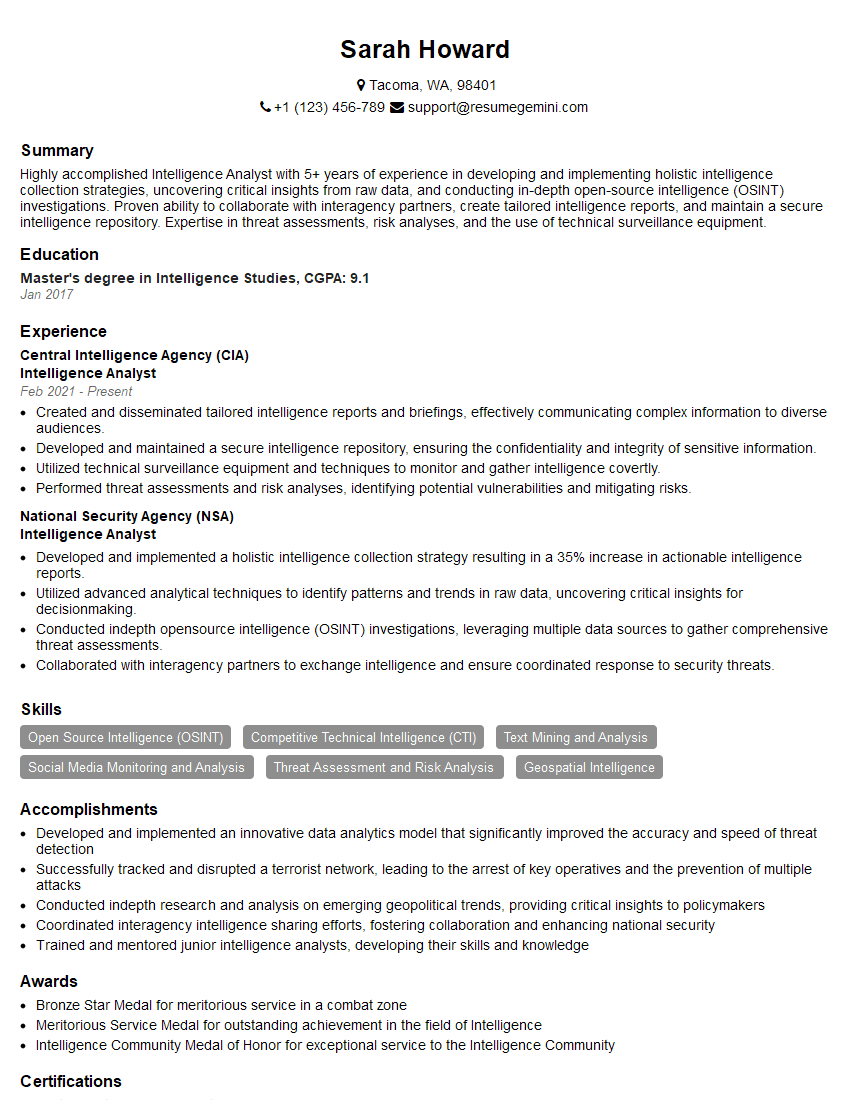
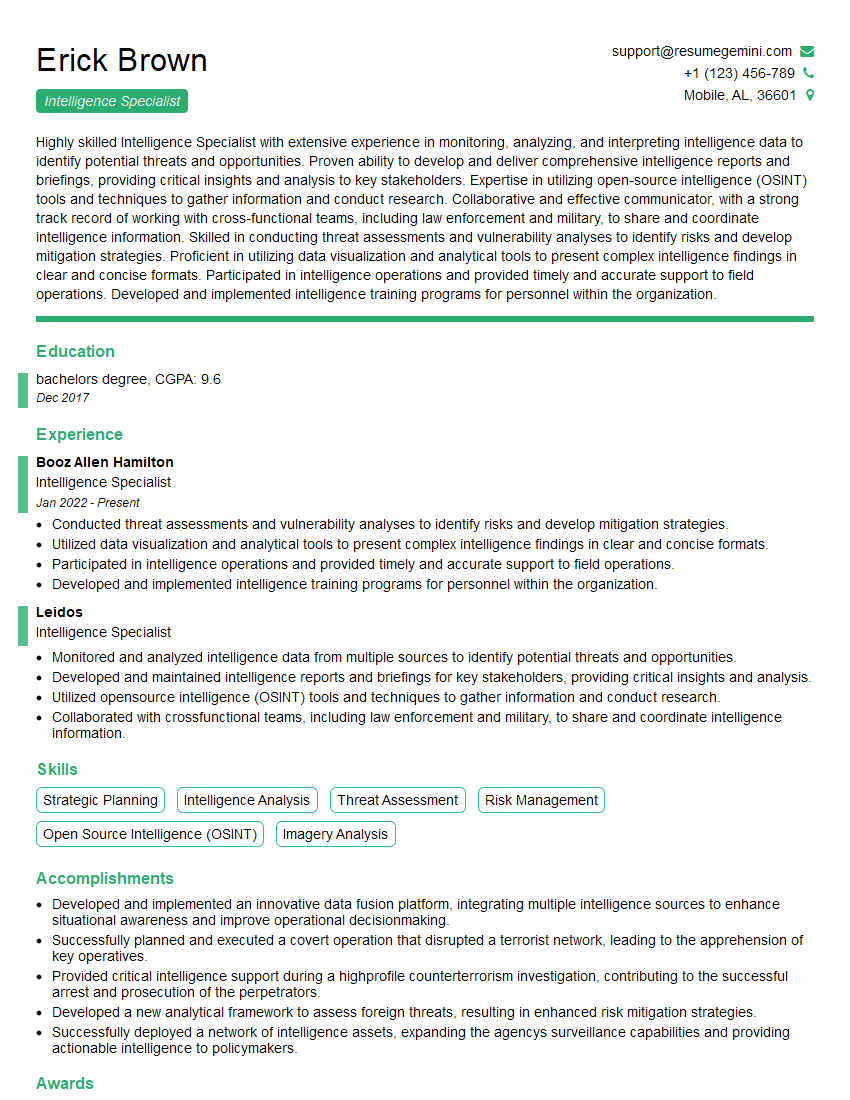
Mastering Open Source Intelligence is crucial for a successful career in many high-demand fields, offering opportunities for growth and advancement. To maximize your job prospects, it’s vital to present your skills effectively. An ATS-friendly resume is key to getting your application noticed by recruiters. ResumeGemini is a trusted resource that can help you build a professional and impactful resume tailored to showcase your OSINT expertise. Examples of resumes specifically designed for OSINT professionals are available within ResumeGemini to guide you. Invest the time to craft a compelling resume – it’s your first impression and a significant step towards landing your dream job.
Explore more articles
Users Rating of Our Blogs
Share Your Experience
We value your feedback! Please rate our content and share your thoughts (optional).
What Readers Say About Our Blog
Attention music lovers!
Wow, All the best Sax Summer music !!!
Spotify: https://open.spotify.com/artist/6ShcdIT7rPVVaFEpgZQbUk
Apple Music: https://music.apple.com/fr/artist/jimmy-sax-black/1530501936
YouTube: https://music.youtube.com/browse/VLOLAK5uy_noClmC7abM6YpZsnySxRqt3LoalPf88No
Other Platforms and Free Downloads : https://fanlink.tv/jimmysaxblack
on google : https://www.google.com/search?q=22+AND+22+AND+22
on ChatGPT : https://chat.openai.com?q=who20jlJimmy20Black20Sax20Producer
Get back into the groove with Jimmy sax Black
Best regards,
Jimmy sax Black
www.jimmysaxblack.com
Hi I am a troller at The aquatic interview center and I suddenly went so fast in Roblox and it was gone when I reset.
Hi,
Business owners spend hours every week worrying about their website—or avoiding it because it feels overwhelming.
We’d like to take that off your plate:
$69/month. Everything handled.
Our team will:
Design a custom website—or completely overhaul your current one
Take care of hosting as an option
Handle edits and improvements—up to 60 minutes of work included every month
No setup fees, no annual commitments. Just a site that makes a strong first impression.
Find out if it’s right for you:
https://websolutionsgenius.com/awardwinningwebsites
Hello,
we currently offer a complimentary backlink and URL indexing test for search engine optimization professionals.
You can get complimentary indexing credits to test how link discovery works in practice.
No credit card is required and there is no recurring fee.
You can find details here:
https://wikipedia-backlinks.com/indexing/
Regards
NICE RESPONSE TO Q & A
hi
The aim of this message is regarding an unclaimed deposit of a deceased nationale that bears the same name as you. You are not relate to him as there are millions of people answering the names across around the world. But i will use my position to influence the release of the deposit to you for our mutual benefit.
Respond for full details and how to claim the deposit. This is 100% risk free. Send hello to my email id: lukachachibaialuka@gmail.com
Luka Chachibaialuka
Hey interviewgemini.com, just wanted to follow up on my last email.
We just launched Call the Monster, an parenting app that lets you summon friendly ‘monsters’ kids actually listen to.
We’re also running a giveaway for everyone who downloads the app. Since it’s brand new, there aren’t many users yet, which means you’ve got a much better chance of winning some great prizes.
You can check it out here: https://bit.ly/callamonsterapp
Or follow us on Instagram: https://www.instagram.com/callamonsterapp
Thanks,
Ryan
CEO – Call the Monster App
Hey interviewgemini.com, I saw your website and love your approach.
I just want this to look like spam email, but want to share something important to you. We just launched Call the Monster, a parenting app that lets you summon friendly ‘monsters’ kids actually listen to.
Parents are loving it for calming chaos before bedtime. Thought you might want to try it: https://bit.ly/callamonsterapp or just follow our fun monster lore on Instagram: https://www.instagram.com/callamonsterapp
Thanks,
Ryan
CEO – Call A Monster APP
To the interviewgemini.com Owner.
Dear interviewgemini.com Webmaster!
Hi interviewgemini.com Webmaster!
Dear interviewgemini.com Webmaster!
excellent
Hello,
We found issues with your domain’s email setup that may be sending your messages to spam or blocking them completely. InboxShield Mini shows you how to fix it in minutes — no tech skills required.
Scan your domain now for details: https://inboxshield-mini.com/
— Adam @ InboxShield Mini
support@inboxshield-mini.com
Reply STOP to unsubscribe
Hi, are you owner of interviewgemini.com? What if I told you I could help you find extra time in your schedule, reconnect with leads you didn’t even realize you missed, and bring in more “I want to work with you” conversations, without increasing your ad spend or hiring a full-time employee?
All with a flexible, budget-friendly service that could easily pay for itself. Sounds good?
Would it be nice to jump on a quick 10-minute call so I can show you exactly how we make this work?
Best,
Hapei
Marketing Director
Hey, I know you’re the owner of interviewgemini.com. I’ll be quick.
Fundraising for your business is tough and time-consuming. We make it easier by guaranteeing two private investor meetings each month, for six months. No demos, no pitch events – just direct introductions to active investors matched to your startup.
If youR17;re raising, this could help you build real momentum. Want me to send more info?
Hi, I represent an SEO company that specialises in getting you AI citations and higher rankings on Google. I’d like to offer you a 100% free SEO audit for your website. Would you be interested?
Hi, I represent an SEO company that specialises in getting you AI citations and higher rankings on Google. I’d like to offer you a 100% free SEO audit for your website. Would you be interested?