Every successful interview starts with knowing what to expect. In this blog, we’ll take you through the top Protocol Coordination interview questions, breaking them down with expert tips to help you deliver impactful answers. Step into your next interview fully prepared and ready to succeed.
Questions Asked in Protocol Coordination Interview
Q 1. Describe your experience managing complex event logistics and protocols.
Managing complex event logistics and protocols requires meticulous planning, flawless execution, and the ability to anticipate and resolve unforeseen challenges. Think of it like orchestrating a complex symphony – each instrument (participant, detail) must play its part precisely at the right time for a harmonious outcome. My experience involves coordinating events ranging from international summits to high-profile corporate gatherings. This includes everything from venue selection and security arrangements to managing guest lists, travel arrangements, and catering needs. For instance, during a recent international trade conference, I was responsible for coordinating the schedules of over 500 delegates from diverse backgrounds, ensuring smooth transitions between sessions, and handling unexpected logistical issues such as a sudden power outage. This required proactive communication, contingency planning, and quick, decisive problem-solving.
- Detailed Scheduling: Creating and managing detailed schedules with built-in buffer times to account for delays.
- Risk Assessment and Mitigation: Identifying potential risks (e.g., security threats, technical malfunctions) and developing mitigation strategies.
- Resource Allocation: Optimizing the use of resources, including staff, budget, and equipment.
- Communication Management: Maintaining clear and consistent communication with all stakeholders.
Q 2. Explain your understanding of diplomatic protocol and its practical applications.
Diplomatic protocol is a system of rules and customs governing the conduct of official interactions between nations and their representatives. It is crucial for maintaining harmonious international relations and facilitating effective communication. Understanding diplomatic protocol involves knowing the order of precedence among dignitaries, the proper use of titles and addresses, gift-giving etiquette, and the nuances of formal communication styles. In practical applications, this ensures smooth interactions at international conferences, state visits, and bilateral meetings. For example, knowing the correct seating arrangements at a formal dinner, or the appropriate protocol for presenting credentials to a foreign ambassador, prevents misunderstandings and strengthens diplomatic ties. Neglecting these protocols can cause significant embarrassment or even damage international relations.
- Order of Precedence: Understanding the ranking system among diplomats and officials based on their position and seniority.
- Forms of Address: Using appropriate titles and forms of address to show respect and maintain formality.
- Gift-Giving Etiquette: Knowing the cultural considerations for exchanging gifts, and avoiding potential faux pas.
- Communication Styles: Understanding the nuances of diplomatic communication, such as formal written correspondence and carefully chosen language.
Q 3. How do you prioritize competing demands and deadlines in a fast-paced protocol environment?
Prioritizing in a fast-paced protocol environment demands a structured approach. I use a system that combines urgency, importance, and dependency analysis. I employ a matrix to categorize tasks based on urgency (immediate, short-term, long-term) and importance (critical, significant, minor). Dependencies between tasks are also clearly mapped. This allows me to focus on critical, time-sensitive tasks first, while ensuring that dependent tasks are addressed in the correct order. For example, if a VIP’s arrival is delayed, I must rapidly adjust the entire schedule while ensuring all other associated tasks (security, catering, media) are still properly managed. Using project management software assists greatly in tracking progress, deadlines, and resource allocation. Regular communication with stakeholders provides transparent updates and ensures everyone is working in sync towards the common goal.
- Urgency/Importance Matrix: Categorizing tasks based on urgency and importance.
- Dependency Mapping: Identifying the relationships between different tasks to optimize workflow.
- Project Management Software: Using tools to track progress, manage deadlines, and facilitate communication.
- Regular Communication: Keeping stakeholders informed of progress, changes, and potential challenges.
Q 4. Detail your experience in coordinating high-level meetings and events.
I have extensive experience in coordinating high-level meetings and events, including international conferences, summits, and bilateral meetings between heads of state or high-ranking officials. My role encompasses every aspect, from pre-event planning and logistics to on-site management and post-event evaluation. This includes managing the logistics for securing venues, arranging travel and accommodation for participants, developing detailed agendas, and managing communication with various stakeholders. For a recent high-level summit, I managed the intricate details of security protocols, diplomatic clearances, and media coverage, ensuring all aspects aligned flawlessly. Success lies not only in flawless execution but also in proactively anticipating and addressing potential disruptions, such as translating documents, managing interpreters, and dealing with unexpected changes in the program.
- Agenda Development: Creating detailed agendas that meet the objectives of the event.
- Venue Management: Securing and preparing appropriate venues that meet the needs of participants.
- Security Protocols: Implementing stringent security measures to protect participants and maintain confidentiality.
- Communication Management: Ensuring effective communication between all parties involved.
Q 5. How familiar are you with international protocol and etiquette standards?
My familiarity with international protocol and etiquette standards is comprehensive. I have a deep understanding of cultural nuances that influence how protocols are interpreted and applied across different regions and countries. I’m fluent in navigating diverse cultural contexts and adapting my approach accordingly. This includes understanding specific customs related to greetings, gift-giving, dining etiquette, and business practices in various cultures. For example, I’ve successfully adapted event plans to account for the different communication styles and expectations of participants from Eastern and Western cultures, understanding that direct communication isn’t always welcomed in all contexts. Continuous learning through professional development and immersion in diverse cultural settings is critical in this field. Understanding these nuances ensures respectful interactions and fosters positive relationships between individuals and nations.
Q 6. Describe your experience in managing VIP visits and ensuring their smooth execution.
Managing VIP visits requires meticulous planning and execution, focusing on security, comfort, and efficiency. This starts with developing a detailed itinerary that balances the VIP’s schedule with logistical realities. I work closely with security personnel to establish comprehensive security protocols, including threat assessments, route planning, and access control. For example, during a recent visit by a foreign dignitary, I coordinated with multiple government agencies to ensure smooth passage through customs and airport security, while managing their transport and accommodations. The success of a VIP visit depends heavily on anticipating and mitigating potential issues and providing a positive and productive experience for the VIP and their entourage.
- Security Management: Working with security personnel to develop and implement comprehensive security protocols.
- Itinerary Development: Creating a detailed itinerary that considers all logistical and security aspects.
- Communication Coordination: Establishing clear communication channels with all involved parties.
- Contingency Planning: Developing plans to address potential challenges or disruptions.
Q 7. Explain your process for developing and implementing protocol procedures.
Developing and implementing protocol procedures involves a systematic approach that prioritizes clarity, consistency, and adaptability. The process begins with a thorough needs assessment, identifying all stakeholders and their specific requirements. Based on this, we establish clear guidelines and procedures for various situations, incorporating relevant legal and regulatory requirements. These procedures are documented clearly, ensuring all parties understand their roles and responsibilities. Regular review and updates are critical to ensure procedures remain relevant and effective. Feedback from past events helps identify areas for improvement and ensures that procedures are adaptable to changing circumstances. For example, we may have a standard operating procedure for managing media inquiries during an event, and this is tested, reviewed, and updated after each event based on what worked well and what could be improved. This iterative process is key to continuously improving efficiency and effectiveness.
- Needs Assessment: Identifying the specific requirements and objectives of the protocol procedure.
- Procedure Development: Creating clear, concise, and easy-to-understand guidelines.
- Documentation: Creating written documentation that outlines procedures and responsibilities.
- Review and Update: Regularly reviewing and updating procedures to maintain effectiveness and relevance.
Q 8. How do you handle unexpected issues or protocol breaches during events?
Handling unexpected issues during events requires a proactive and adaptable approach. My strategy centers around a robust contingency plan, meticulous pre-event checks, and a calm, decisive response under pressure.
For example, during a high-profile summit, a sudden power outage occurred. Our pre-planned backup generator kicked in immediately, minimizing disruption. We also had a secondary communication system in place, ensuring seamless information flow. The key is anticipating potential problems – everything from technical glitches to unforeseen logistical challenges – and developing detailed protocols to mitigate them. This includes clearly defined roles and responsibilities for the team to handle various scenarios, enabling swift and coordinated responses.
In cases of protocol breaches, I follow a structured procedure: Assess the severity, contain the situation to prevent further escalation, document the incident meticulously, and then implement corrective actions to prevent recurrence. Transparency and open communication with relevant stakeholders are vital during such situations. We would review our protocols to identify gaps and update them accordingly, learning from the experience to strengthen future event planning.
Q 9. Describe your experience with travel arrangements and protocol for international dignitaries.
My experience with international dignitaries includes coordinating travel arrangements for several high-profile visits. This involved liaising with foreign embassies, arranging secure transportation, managing visas and customs protocols, and coordinating accommodation at secure and appropriate locations. It’s crucial to be aware of the specific cultural nuances and security protocols of each visiting dignitary and their country.
For instance, I once coordinated a visit for a delegation that had specific dietary requirements and religious observances to consider. This required careful planning and coordination with local caterers and venues to ensure their needs were fully met. Detailed itineraries were provided in advance, and on-the-ground support was consistently provided throughout their stay. Maintaining impeccable communication and anticipating their every need was paramount to ensure their visit was successful and respectful of their cultural background.
Q 10. How do you ensure effective communication and coordination among multiple stakeholders?
Effective communication and coordination among multiple stakeholders are paramount in protocol management. I utilize a multi-pronged approach involving regular meetings, clear communication channels, and a centralized information system. This ensures everyone is informed, aligned on objectives, and aware of their roles and responsibilities.
For example, during a large-scale conference, I utilized project management software to create shared calendars, task lists, and communication platforms. This enabled real-time updates and efficient information sharing across all teams (security, logistics, communications, etc.). Regular briefings and progress reports ensured everyone was on the same page. I also foster a culture of open communication, encouraging proactive problem-solving and feedback, facilitating collaboration and team spirit.
Q 11. How do you maintain confidentiality and discretion in handling sensitive information?
Confidentiality and discretion are fundamental to my work. I adhere to strict data protection policies and protocols. This includes using secure communication channels, controlling access to sensitive information through role-based permissions, and ensuring physical security of documents. Information is only shared on a need-to-know basis with appropriately authorized individuals. I also regularly review and update security protocols to stay ahead of potential threats.
For example, all sensitive documents are stored in encrypted formats and access is strictly controlled through password-protected systems. Any communication concerning confidential information is done through secure channels, not email. All staff are thoroughly briefed on security policies and the importance of protecting confidential information. We also conduct regular security training sessions to enhance awareness.
Q 12. How do you adapt your protocol approach to diverse cultural contexts?
Adapting to diverse cultural contexts involves thorough research and preparation. Before engaging with any international delegation or event, I research the specific cultural norms, customs, and etiquette of the involved countries. This includes understanding appropriate greetings, communication styles, gift-giving customs, and dietary restrictions.
For instance, when coordinating an event with representatives from East Asia, I ensured we understood the importance of hierarchy and appropriate addressing protocols. We made sure the seating arrangements, gift presentations, and communication style reflected this understanding. Sensitivity and respect for cultural differences are crucial for successful protocol management, ensuring every individual feels respected and valued.
Q 13. Explain your proficiency in using protocol management software or tools.
I am proficient in utilizing several protocol management software and tools, including project management platforms like Asana and Monday.com, communication platforms like Slack, and specialized event management software. These tools allow for efficient scheduling, task management, communication, and data storage. I also have experience with secure document management systems and CRM tools for contact management.
Example: Utilizing Asana to create a project timeline for an international summit, assigning tasks to team members, and tracking progress in real-time. These platforms are crucial for maintaining order and facilitating effective coordination, particularly during large-scale events with numerous stakeholders.
Q 14. Describe your experience in preparing briefing materials for executives or dignitaries.
Preparing briefing materials for executives and dignitaries requires accuracy, clarity, and conciseness. I tailor the information to the audience and the specific context, ensuring it is relevant and easily digestible. The materials are usually structured to provide a concise overview of the key issues, relevant background information, potential challenges, and proposed solutions. Visual aids such as charts, graphs, and maps are often incorporated to enhance understanding.
For example, when preparing a briefing for a CEO prior to an important international negotiation, I focused on providing key data points related to the political and economic context of the negotiations, while summarizing the team’s strategy and risk assessment. The briefing included clear visual representations of the key parameters to aid decision-making.
Q 15. How do you ensure compliance with relevant regulations and security protocols?
Ensuring compliance with regulations and security protocols is paramount in protocol coordination. It’s not just about ticking boxes; it’s about proactively mitigating risks and upholding the integrity of the event or process. My approach is multi-faceted.
- Thorough Due Diligence: Before any event or project commences, I conduct a comprehensive review of all applicable regulations, industry best practices, and client-specific security requirements. This includes reviewing relevant legislation, data privacy regulations (like GDPR or CCPA), and any internal policies. For instance, for a high-profile international summit, I would meticulously review relevant diplomatic protocols, security clearances needed for attendees, and local laws regarding public gatherings.
- Risk Assessment and Mitigation: I perform a detailed risk assessment, identifying potential threats and vulnerabilities. This could include anything from data breaches to physical security risks. For each identified risk, I develop and implement mitigation strategies, such as cybersecurity measures, background checks for personnel, and emergency response plans.
- Regular Audits and Monitoring: Ongoing monitoring and regular audits are crucial. I employ tools and processes to continuously monitor compliance throughout the project lifecycle. This ensures that security measures remain effective and that compliance requirements are consistently met. Post-event, I conduct a thorough review to identify any areas for improvement.
- Training and Education: I invest in training all stakeholders involved—from event staff to participants—on relevant security protocols and compliance requirements. This ensures everyone understands their responsibilities and is equipped to handle potential issues.
Career Expert Tips:
- Ace those interviews! Prepare effectively by reviewing the Top 50 Most Common Interview Questions on ResumeGemini.
- Navigate your job search with confidence! Explore a wide range of Career Tips on ResumeGemini. Learn about common challenges and recommendations to overcome them.
- Craft the perfect resume! Master the Art of Resume Writing with ResumeGemini’s guide. Showcase your unique qualifications and achievements effectively.
- Don’t miss out on holiday savings! Build your dream resume with ResumeGemini’s ATS optimized templates.
Q 16. How do you handle challenging personalities or situations involving protocol breaches?
Handling challenging personalities and protocol breaches requires diplomacy, strong communication skills, and a firm understanding of the rules. I approach these situations systematically.
- Active Listening and Empathy: I start by listening carefully to understand the individual’s perspective. This shows respect and helps de-escalate tension. Even if their behavior is unacceptable, understanding their motivations can help find a solution.
- Clear and Direct Communication: When a protocol breach occurs, I address the issue directly but diplomatically. I clearly explain the relevant protocols and the consequences of non-compliance. It’s about correction, not confrontation.
- Mediation and Conflict Resolution: In situations involving personality clashes, I act as a mediator, facilitating communication and finding mutually acceptable solutions. I focus on finding common ground and collaborative solutions.
- Consistent Enforcement: Consistency in enforcing protocols is key. Uneven application creates resentment and undermines the overall effectiveness of the protocol system. Any breach, regardless of the individual’s position, is addressed fairly and consistently.
- Documentation: Maintaining clear and accurate records of all incidents, communications, and resolutions is crucial for future reference and accountability. This also serves as evidence should further issues arise.
For example, if a VIP guest ignores security procedures, I’d privately address them, explaining the reasons for the protocols and offering alternative solutions to ensure their safety and the overall security of the event.
Q 17. What are your strategies for building and maintaining strong relationships with stakeholders?
Building and maintaining strong relationships with stakeholders is foundational to successful protocol coordination. It’s about trust, open communication, and mutual respect.
- Proactive Communication: I maintain regular, clear, and concise communication with all stakeholders. This includes providing updates on project progress, addressing concerns promptly, and seeking their input. For example, I use regular email updates, briefings, and scheduled meetings to ensure transparency and engagement.
- Relationship Building: I invest time in getting to know stakeholders on a personal level. Understanding their needs, priorities, and communication styles helps build trust and facilitates collaboration.
- Collaboration and Teamwork: I foster a collaborative environment, involving stakeholders in the decision-making process. This strengthens their sense of ownership and commitment.
- Conflict Management: I address disagreements proactively and fairly, seeking mutually beneficial solutions. A strong relationship helps resolve conflicts more smoothly.
- Feedback and Appreciation: I actively seek feedback from stakeholders and express appreciation for their contributions. This demonstrates respect and encourages continued engagement.
In practice, this means building rapport with government officials, security personnel, event organizers, and VIP guests, understanding their unique perspectives and adapting my communication style accordingly.
Q 18. Explain your experience in managing budgets and resources for protocol events.
Managing budgets and resources for protocol events requires meticulous planning, careful tracking, and efficient resource allocation. My experience involves:
- Budget Development: I collaborate with stakeholders to create a detailed budget, forecasting all anticipated expenses. This includes personnel costs, venue rentals, security measures, catering, transportation, and communication systems. I always build in contingency funds to account for unforeseen circumstances.
- Resource Allocation: I allocate resources efficiently, ensuring that funds are used appropriately and effectively. This involves prioritizing expenditures based on their importance to the event’s success and adherence to protocols.
- Cost Control: I monitor expenditures closely, ensuring that the budget is adhered to. This includes negotiating favorable contracts with vendors, optimizing resource utilization, and tracking expenses regularly.
- Financial Reporting: I provide regular financial reports to stakeholders, keeping them informed of the budget’s status and any potential variances.
- Procurement and Vendor Management: I manage the procurement process, selecting and contracting reliable vendors that meet our requirements. I establish clear communication and expectations with vendors to ensure quality of service and timely delivery.
For example, in planning a large-scale conference, I’d use project management software to track expenses, ensure timely payment of invoices, and monitor the budget against the actual spend, allowing for course correction if needed.
Q 19. Describe your experience in post-event analysis and reporting on protocol effectiveness.
Post-event analysis and reporting is critical for continuous improvement in protocol coordination. It allows us to learn from successes and failures, ensuring that future events are even more efficient and effective. My process involves:
- Data Collection: I gather data from various sources, including event logs, security reports, feedback surveys, and communication records.
- Performance Evaluation: I analyze the collected data to evaluate the effectiveness of the protocol implemented. This includes assessing compliance rates, identifying areas for improvement, and measuring the overall success of the event against pre-defined objectives.
- Identifying Best Practices: I identify best practices that contributed to the success of the event and document them for future use.
- Reporting: I prepare a comprehensive report summarizing the event’s performance, highlighting key findings, and recommending improvements for future events.
- Continuous Improvement: I implement changes based on the analysis and recommendations from the report. This iterative process ensures continuous improvement in protocol coordination practices.
For instance, after a large-scale international conference, I would analyze security breach reports, feedback from participants, and logistical data to identify areas where protocols were particularly successful and areas where improvements are needed for the next event.
Q 20. How do you measure the success of your protocol coordination efforts?
Measuring the success of protocol coordination efforts depends on defining clear, measurable objectives beforehand. There isn’t one single metric, but rather a combination of factors:
- Compliance Rate: The percentage of protocols followed successfully. This provides a clear indication of effectiveness.
- Incident Rate: The number of security incidents or protocol breaches. A low rate indicates effective mitigation strategies.
- Stakeholder Satisfaction: Feedback surveys provide insights into the experience of stakeholders, revealing areas where protocols might have impacted positively or negatively.
- Efficiency: Did the protocols streamline the event or process, reducing time or resources needed? This is often measured in time saved, reduced costs, or improved resource utilization.
- Risk Mitigation: Did the protocols successfully prevent or minimize potential risks? This is qualitative but critical.
Combining these measures provides a holistic view of success. For example, a high compliance rate alongside high stakeholder satisfaction demonstrates effective protocol design and implementation. A low incident rate with positive feedback shows risk mitigation was successful.
Q 21. How do you stay updated on changes in protocol guidelines and best practices?
Staying updated on changes in protocol guidelines and best practices is an ongoing process that requires proactive engagement. My strategies include:
- Professional Organizations: I actively participate in relevant professional organizations, attending conferences, workshops, and webinars to stay abreast of industry trends and updates. This allows for networking and knowledge sharing.
- Industry Publications and Journals: I regularly review reputable industry publications and journals, keeping updated on new regulations, security standards, and best practices.
- Online Resources and Databases: I utilize online resources and databases to access the latest information on relevant guidelines and protocols.
- Networking: Maintaining a strong network of contacts within the industry allows for the sharing of knowledge and best practices.
- Continuing Education: I pursue professional development opportunities, including courses and certifications, to enhance my knowledge and skills.
By combining these methods, I ensure that my knowledge and skills remain current and that I am equipped to handle the ever-evolving landscape of protocol guidelines and best practices.
Q 22. Explain your experience in training others on protocol procedures and etiquette.
Training others on protocol procedures and etiquette requires a structured approach combining theoretical knowledge with practical application. I typically begin by establishing a clear understanding of the overall goals and context of the protocol. Then, I break down complex procedures into manageable steps, using visual aids like flowcharts and checklists where appropriate. Interactive exercises, role-playing scenarios, and real-world case studies are crucial for reinforcing learning and developing practical skills. For instance, when training staff for a high-profile international summit, I developed a training module that included simulated scenarios involving VIP arrivals, media interactions, and potential logistical hiccups. This allowed participants to practice their responses and build confidence in handling unforeseen circumstances.
Regular quizzes and feedback sessions ensure continuous improvement and address any knowledge gaps. Post-training, I provide ongoing mentorship and support, making myself available for questions and offering guidance on resolving protocol-related challenges in the workplace. This ensures that the knowledge gained during the training remains relevant and effective over time.
Q 23. How do you leverage technology to enhance efficiency in protocol coordination?
Technology plays a vital role in streamlining protocol coordination. I utilize project management software like Asana or Monday.com to centralize information, track tasks, and manage deadlines related to various protocol events. This ensures seamless collaboration among team members and stakeholders. Dedicated communication platforms such as Slack or Microsoft Teams facilitate instant updates and efficient communication, minimizing potential delays or misunderstandings. For instance, during the preparation for a large-scale international conference, we utilized a shared online calendar to schedule meetings, coordinate logistics, and track RSVPs for various events.
Furthermore, digital databases are invaluable for storing and readily accessing crucial protocol information, such as seating charts, guest lists, and biographical details. Using automated email marketing tools can expedite communications to a large number of participants and stakeholders, and also allows for personalized messaging and reminders. These tools greatly enhance efficiency and reduce the risk of errors.
Q 24. Describe a time you had to resolve a conflict related to protocol.
During a state visit, a disagreement arose regarding the seating arrangement at a formal dinner. One delegation felt their position did not reflect their seniority, and this threatened to escalate into a diplomatic incident. My approach involved active listening to both sides, ensuring I fully understood their perspectives and concerns without taking sides. I then consulted the established protocol guidelines to determine the correct seating arrangement based on precedence and diplomatic protocols.
Once I had the necessary information, I presented a solution that acknowledged the concerns of both delegations, explaining the basis of the arrangement using established precedence. This wasn’t just about following the rules; it was about communicating the logic behind them, fostering transparency and mutual understanding. I also emphasized the importance of maintaining a positive and collaborative atmosphere throughout the event, and the resolution was successfully implemented without further incident. This experience reinforced the importance of clear communication, diplomacy, and a thorough understanding of the applicable protocol.
Q 25. What is your experience with crisis management related to protocol issues?
My experience in crisis management related to protocol issues involves anticipating potential problems and developing contingency plans. For instance, during a major international conference, we developed a crisis communication plan to handle situations such as security breaches, medical emergencies, or unexpected cancellations. This involved establishing clear lines of communication, identifying key personnel responsible for responding to different scenarios, and preparing pre-written communication templates to expedite the dissemination of information during a crisis.
During a specific instance, a VIP guest experienced a sudden medical emergency. Our pre-established protocol, which included designated medical personnel and communication channels, allowed for a swift and coordinated response. This prevented the situation from escalating and ensured the guest received prompt medical attention while minimizing disruption to the event. The preemptive planning and clear communication channels proved invaluable in maintaining control and minimizing negative impacts.
Q 26. How do you ensure accessibility and inclusivity in protocol procedures?
Ensuring accessibility and inclusivity is paramount in developing and implementing protocols. This involves considering the needs of all participants, regardless of physical abilities, cultural backgrounds, or other factors. For example, when designing event spaces, I ensure that they are wheelchair accessible and comply with ADA standards. Providing materials in multiple languages or formats, including Braille and large print, caters to diverse linguistic and visual needs. We actively seek feedback from participants to identify potential barriers and make improvements.
Beyond physical accessibility, cultural sensitivity is crucial. Protocols must be designed and implemented in a way that respects different cultural norms and traditions. This includes things like dietary considerations, appropriate greetings, and gender-neutral language usage in all communications. For example, during an international event, we ensured that the menu options catered to various dietary restrictions and cultural preferences, demonstrating respect and inclusivity.
Q 27. Describe your experience in developing and implementing protocol for virtual events.
Developing and implementing protocol for virtual events requires a unique approach, addressing the specific challenges of the digital environment. First, I establish clear guidelines for online etiquette, ensuring participants understand expectations regarding communication, attire, and participation during virtual meetings and sessions. This often includes training on the use of virtual event platforms and technologies.
Secondly, I ensure that the virtual event platform is accessible to all participants, offering options for closed captioning, screen reader compatibility, and other accessibility features. Technical support during the event is crucial to resolve any technical glitches swiftly and efficiently. Pre-event testing and simulated runs are essential to ensure a smooth flow and minimize technical issues during the live event. For example, I worked on a virtual summit that used a platform allowing for breakout sessions and interactive Q&A, ensuring engagement despite the virtual format. Clear guidelines on virtual participation, including the use of chat functions and virtual backgrounds, fostered a productive and respectful environment.
Q 28. How do you balance adherence to protocol with flexibility and adaptability?
Balancing adherence to protocol with flexibility and adaptability is crucial in protocol coordination. While strict adherence to established procedures ensures consistency and professionalism, unforeseen circumstances often require deviation from pre-planned arrangements. The key is to understand the underlying principles and goals of the protocol.
For example, if a VIP guest is unexpectedly delayed, I would adapt the schedule to accommodate the delay without compromising the overall integrity of the event. This might involve adjusting timings, rearranging presentations or activities, or informing relevant stakeholders immediately. The ability to make informed decisions swiftly and effectively, while prioritizing the safety and comfort of all participants, is essential. Documentation of any deviations from the established protocol with a clear rationale is crucial for transparency and future reference.
Key Topics to Learn for Protocol Coordination Interview
- International Protocol and Etiquette: Understanding cultural nuances, diplomatic sensitivities, and appropriate communication styles across diverse settings.
- Event Planning and Management: Practical application of protocol guidelines in organizing and executing high-profile events, including logistics, scheduling, and stakeholder management.
- Communication and Stakeholder Management: Effectively communicating complex information to diverse audiences, managing expectations, and resolving conflicts diplomatically.
- Crisis Management and Contingency Planning: Developing proactive strategies to mitigate potential protocol breaches and handling unforeseen circumstances with professionalism and efficiency.
- Technology and Protocol: Utilizing technology (e.g., scheduling software, communication platforms) to streamline processes and enhance communication within protocol frameworks.
- Record Keeping and Documentation: Maintaining accurate and detailed records of events, communications, and decisions related to protocol procedures.
- Legal and Regulatory Compliance: Adherence to relevant laws, regulations, and organizational policies related to protocol and ethical conduct.
- Security Protocols and Risk Assessment: Understanding and implementing security measures to ensure the safety and well-being of attendees and stakeholders.
- Budgeting and Resource Allocation: Effectively managing resources within budgetary constraints and optimizing expenditures.
Next Steps
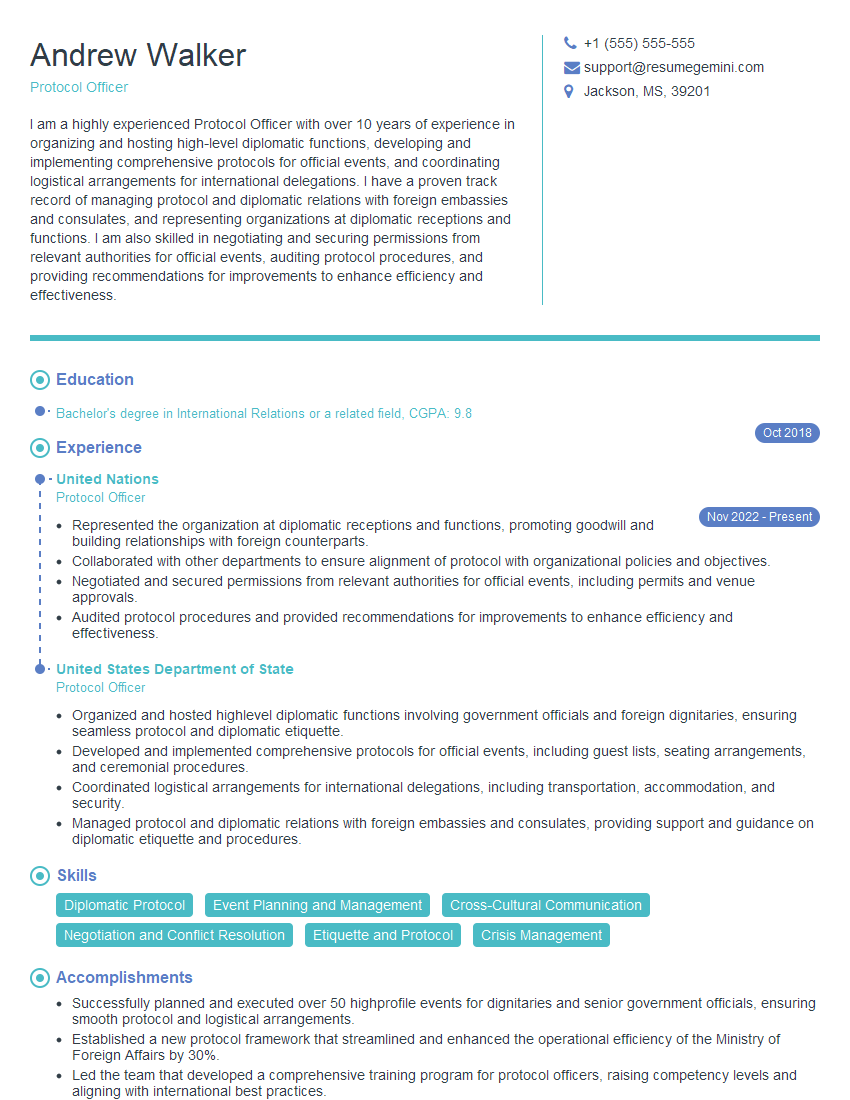
Mastering Protocol Coordination opens doors to exciting career opportunities in diverse sectors, offering high levels of responsibility and professional satisfaction. A strong resume is your key to unlocking these prospects. An ATS-friendly resume ensures your qualifications are effectively conveyed to hiring managers. We encourage you to leverage ResumeGemini, a trusted resource for crafting professional resumes that make a lasting impression. Examples of resumes tailored to Protocol Coordination are available to help you build your best application.
Explore more articles
Users Rating of Our Blogs
Share Your Experience
We value your feedback! Please rate our content and share your thoughts (optional).
What Readers Say About Our Blog
Attention music lovers!
Wow, All the best Sax Summer music !!!
Spotify: https://open.spotify.com/artist/6ShcdIT7rPVVaFEpgZQbUk
Apple Music: https://music.apple.com/fr/artist/jimmy-sax-black/1530501936
YouTube: https://music.youtube.com/browse/VLOLAK5uy_noClmC7abM6YpZsnySxRqt3LoalPf88No
Other Platforms and Free Downloads : https://fanlink.tv/jimmysaxblack
on google : https://www.google.com/search?q=22+AND+22+AND+22
on ChatGPT : https://chat.openai.com?q=who20jlJimmy20Black20Sax20Producer
Get back into the groove with Jimmy sax Black
Best regards,
Jimmy sax Black
www.jimmysaxblack.com
Hi I am a troller at The aquatic interview center and I suddenly went so fast in Roblox and it was gone when I reset.
Hi,
Business owners spend hours every week worrying about their website—or avoiding it because it feels overwhelming.
We’d like to take that off your plate:
$69/month. Everything handled.
Our team will:
Design a custom website—or completely overhaul your current one
Take care of hosting as an option
Handle edits and improvements—up to 60 minutes of work included every month
No setup fees, no annual commitments. Just a site that makes a strong first impression.
Find out if it’s right for you:
https://websolutionsgenius.com/awardwinningwebsites
Hello,
we currently offer a complimentary backlink and URL indexing test for search engine optimization professionals.
You can get complimentary indexing credits to test how link discovery works in practice.
No credit card is required and there is no recurring fee.
You can find details here:
https://wikipedia-backlinks.com/indexing/
Regards
NICE RESPONSE TO Q & A
hi
The aim of this message is regarding an unclaimed deposit of a deceased nationale that bears the same name as you. You are not relate to him as there are millions of people answering the names across around the world. But i will use my position to influence the release of the deposit to you for our mutual benefit.
Respond for full details and how to claim the deposit. This is 100% risk free. Send hello to my email id: lukachachibaialuka@gmail.com
Luka Chachibaialuka
Hey interviewgemini.com, just wanted to follow up on my last email.
We just launched Call the Monster, an parenting app that lets you summon friendly ‘monsters’ kids actually listen to.
We’re also running a giveaway for everyone who downloads the app. Since it’s brand new, there aren’t many users yet, which means you’ve got a much better chance of winning some great prizes.
You can check it out here: https://bit.ly/callamonsterapp
Or follow us on Instagram: https://www.instagram.com/callamonsterapp
Thanks,
Ryan
CEO – Call the Monster App
Hey interviewgemini.com, I saw your website and love your approach.
I just want this to look like spam email, but want to share something important to you. We just launched Call the Monster, a parenting app that lets you summon friendly ‘monsters’ kids actually listen to.
Parents are loving it for calming chaos before bedtime. Thought you might want to try it: https://bit.ly/callamonsterapp or just follow our fun monster lore on Instagram: https://www.instagram.com/callamonsterapp
Thanks,
Ryan
CEO – Call A Monster APP
To the interviewgemini.com Owner.
Dear interviewgemini.com Webmaster!
Hi interviewgemini.com Webmaster!
Dear interviewgemini.com Webmaster!
excellent
Hello,
We found issues with your domain’s email setup that may be sending your messages to spam or blocking them completely. InboxShield Mini shows you how to fix it in minutes — no tech skills required.
Scan your domain now for details: https://inboxshield-mini.com/
— Adam @ InboxShield Mini
support@inboxshield-mini.com
Reply STOP to unsubscribe
Hi, are you owner of interviewgemini.com? What if I told you I could help you find extra time in your schedule, reconnect with leads you didn’t even realize you missed, and bring in more “I want to work with you” conversations, without increasing your ad spend or hiring a full-time employee?
All with a flexible, budget-friendly service that could easily pay for itself. Sounds good?
Would it be nice to jump on a quick 10-minute call so I can show you exactly how we make this work?
Best,
Hapei
Marketing Director
Hey, I know you’re the owner of interviewgemini.com. I’ll be quick.
Fundraising for your business is tough and time-consuming. We make it easier by guaranteeing two private investor meetings each month, for six months. No demos, no pitch events – just direct introductions to active investors matched to your startup.
If youR17;re raising, this could help you build real momentum. Want me to send more info?
Hi, I represent an SEO company that specialises in getting you AI citations and higher rankings on Google. I’d like to offer you a 100% free SEO audit for your website. Would you be interested?
Hi, I represent an SEO company that specialises in getting you AI citations and higher rankings on Google. I’d like to offer you a 100% free SEO audit for your website. Would you be interested?